Entries for March 2015
Mike Poulton adapted Hilary Mantel’s Wolf Hall and Bring Up the Bodies for the stage. The play premiered last year in the UK and just began its run on Broadway here in NYC. There’s a book version of the adaptation that contains some notes that Mantel wrote for the actors playing the various characters. The New York Review of Books has an excerpt of Mantel’s notes; here’s Anne Boleyn:
You do not have six fingers. The extra digit is added long after your death by Jesuit propaganda. But in your lifetime you are the focus of every lurid story that the imagination of Europe can dream up. From the moment you enter public consciousness, you carry the projections of everyone who is afraid of sex or ashamed of it. You will never be loved by the English people, who want a proper, royal Queen like Katherine, and who don’t like change of any sort. Does that matter? Not really. What Henry’s inner circle thinks of you matters far more. But do you realize this? Reputation management is not your strong point. Charm only thinly disguises your will to win.
The BBC aired a six-part TV version of Wolf Hall & Bring Up the Bodies that finished up a month ago, and PBS will start showing it this weekend. I’ve watched all but the last part and it’s really well done.
Today’s drop in crude-oil prices, which began in the summer of 2014, may be as disruptive as the quadrupling of oil prices that created the oil shock of 1974.
For most of us, lower oil prices simply translate as better prices at the gas pump. But the value of oil has big consequences around the world. From Moisés Naím in The Atlantic: The Hidden Effects of Cheap Oil.
Ok, April Fools’ is still idiotic, but this is pretty cool: you can play Pac-Man in any neighborhood on Google Maps.

NYC’s West Village is a fun place to play. See also Pac-Manhattan, a real-life game of Pac-Man played on the streets of Manhattan in 2004 by a group of ITP students, including Foursquare CEO Dennis Crowley.
In 1983, the BBC aired a six-part series called Fun to Imagine with a simple premise: put physicist Richard Feynman in front of a camera and have him explain everyday things. In this clip from one of the episodes, Feynman explains in very simple terms what fire is:
So good. Watch the whole thing…it seems like you get the gist about 2 minutes in, but that’s only half the story. See also Feynman explaining rubber bands, how trains go around curves, and how magnets work.
The New Yorker has an excerpt of the fourth volume of Karl Ove Knausgaard’s My Struggle.
Throughout our childhood we three had sat chatting, that was what I was used to, but this was the first time we had done it without Dad living in the house, and the difference was immense. Knowing that he couldn’t walk in at any moment, forcing us to think about what we were saying and doing, changed everything.
We had chatted about everything under the sun then too, but never so much as a word about Dad, it was a kind of implicit rule.
I had never thought about that before.
But we couldn’t talk about him now, that would have been inconceivable.
Why?

Although I am slowly coming around1 to Massimo Vignelli’s assertion that designers should only use a handful of typefaces, I enjoyed seeing Typographica’s list of their favorite typefaces of 2014.
Typeface design and distribution is in a state of rapid change. Last year we noted its diffusion around the globe, and that trend persists. The majority of font production is no longer concentrated in a few regional epicenters.
That goes for corporate epicenters as well. The independence of type designers themselves is increasingly evident. Small foundries have existed since the dawn of digital fonts, but now they are the norm. Only a handful of the selections in this year’s list were published by companies with more than ten employees.
I discovered that one of the selections, a beautiful custom typeface made for the reopening/rebranding of the Cooper Hewitt Design Museum (sample shown above), has been made available by the museum for free download (including a web fonts version).
In a series of three articles, Dianna Kenny examines the life expectancy of pop musicians, the myth of the 27 Club1, and how genre affects popular musicians’ life expectancy. It is from the third article that this chart is taken:
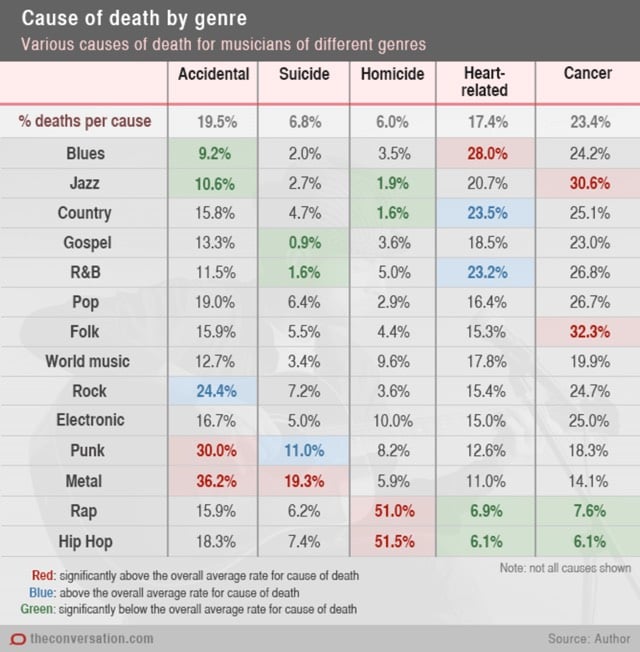
For male musicians across all genres, accidental death (including all vehicular incidents and accidental overdose) accounted for almost 20% of all deaths. But accidental death for rock musicians was higher than this (24.4%) and for metal musicians higher still (36.2%).
Suicide accounted for almost 7% of all deaths in the total sample. However, for punk musicians, suicide accounted for 11% of deaths; for metal musicians, a staggering 19.3%. At just 0.9%, gospel musicians had the lowest suicide rate of all the genres studied.
Murder accounted for 6.0% of deaths across the sample, but was the cause of 51% of deaths in rap musicians and 51.5% of deaths for hip hop musicians, to date. This could be due to these genres’ strong associations with drug-related crime and gang culture.
Heart-related fatalities accounted for 17.4% of all deaths across all genres, while 28% of blues musicians died of heart-related causes. Similarly, the average percentage of deaths accounted for by cancer was 23.4%. Older genres such as folk (32.3%) and jazz (30.6%) had higher rates of fatal cancers than other genres.
In the case of the newer genres, it’s worth pointing out that members of these genres have not yet lived long enough to fall into the highest-risk ages for heart- and liver-related illnesses. Consequently, they had the lowest rates of death in these categories.
(via mr)

From Vanity Fair’s William Langewiesche, who has written extensively on the aviation industry and is a pilot himself, a detailed account of what happens during a space flight on Richard Branson’s Virgin Galactic.
Accelerating through Mach 0.95, the aircraft wobbles as shock waves develop on its wings and tails. This is known as a burble, and it marks the entry into supersonic flight. The shock waves change the airflow over the conventional control surfaces — the elevons — and render them almost useless, forcing the pilot in supersonic flight to fly entirely by trimming the stabilizers on the tail. Flying by trim is difficult to do well, but with pilots like these the passengers probably don’t need to worry. At Mach 1, the pilot rolls the pitch trim aft to a pre-determined position, and the spaceship responds by bending the flight path upward at a rate that pushes the passengers straight down into their seats with a force of 2.5 Gs. The passengers are now experiencing a total of 5.5 Gs, divided between two distinct vectors, and are rotated onto their backs as the spaceship accelerates ever more steeply upward. As they approach the vertical, nearing Mach 2, the pilot rolls the trim forward to capture the position, and 2.5 Gs are stripped away. Pointing straight up, the ship rockets into air growing so thin that the aerodynamic speeds decrease rapidly even as the ship keeps accelerating through Mach 3. At around that time, after about one minute of burn, and when an onboard instrument shows that the vehicle has sufficient energy to follow a ballistic path into space, the pilots shut down the rocket motor. The effect for the passengers, who are lying on their backs, facing straight up, is to go immediately from a condition of three Gs to the zero-G state called weightlessness.
From Charlie Brooker’s Weekly Wipe, here’s how every single news report on the economy plays out:
Dennis and Pamela People are affected by numbers, and since they have a child, you’ll empathize with what they say while I nod in their direction.
“Well, it’s been hard because of the numbers.”
“Yeah, it has been hard, mainly because of the numbers.”
Brooker, you may remember, is the creator of Black Mirror.
John Oliver says April Fools’ Day is terrible and we shouldn’t take part in it.
Pranks are terrible. Anyone who claims to be excited for April Fools’ Day is probably a sociopath. Because what they are really saying is, “I cannot wait to hurt the people close to me”.
If you play this video (click the sound on) and look at the man on the left side, it sounds like he’s saying “bar”. But if you look at the man on the right, it look like he’s saying “far”!
And if you close your eyes, it’s “bar” again. (via @arainert)
Update: This is called the McGurk effect.
The McGurk effect is a perceptual phenomenon that demonstrates an interaction between hearing and vision in speech perception. The illusion occurs when the auditory component of one sound is paired with the visual component of another sound, leading to the perception of a third sound. The visual information a person gets from seeing a person speak changes the way they hear the sound. People who are used to watching dubbed movies may be among people who are not susceptible to the McGurk effect because they have, to some extent, learned to ignore the information they are getting from the mouths of the “speakers”.
Update: The Vine clip I previously posted just yanked the bar/far comparison from a AsapSCIENCE video, so I’ve replaced the imposter with the real thing. (via @michaelck & jess)
James Krupa teaches a mandatory biology class at the University of Kentucky and some students have a difficult time because Krupa refuses to shy away from evolution.
Rarely do I have a Kentucky student who learned about human evolution in high school biology. Those who did usually attended high schools in large urban centers like Louisville or Lexington. Given how easily it can provoke parents, the teaching of human evolution is a rarity in high school, so much so in Kentucky that it startled me when I first arrived.
The story of our evolutionary history captivates many of my students, while infuriating some. During one lecture, a student stood up in the back row and shouted the length of the auditorium that Darwin denounced evolution on his deathbed — a myth intentionally spread by creationists. The student then made it known that everything I was teaching was a lie and stomped out of the auditorium, slamming the door behind him. A few years later during the same lecture, another student also shouted out from the back row that I was lying. She said that no transitional fossil forms had ever been found — despite my having shared images of many transitional forms during the semester. Many of her fellow students were shocked by her combativeness, particularly when she stormed out, also slamming the door behind her. Most semesters, a significant number of students abruptly leave as soon as they realize the topic is human evolution.
I personally don’t understand the compatibility of evolutionary biology and Christianity Krupa emphasizes in his class, but I guess it helps to meet people halfway?
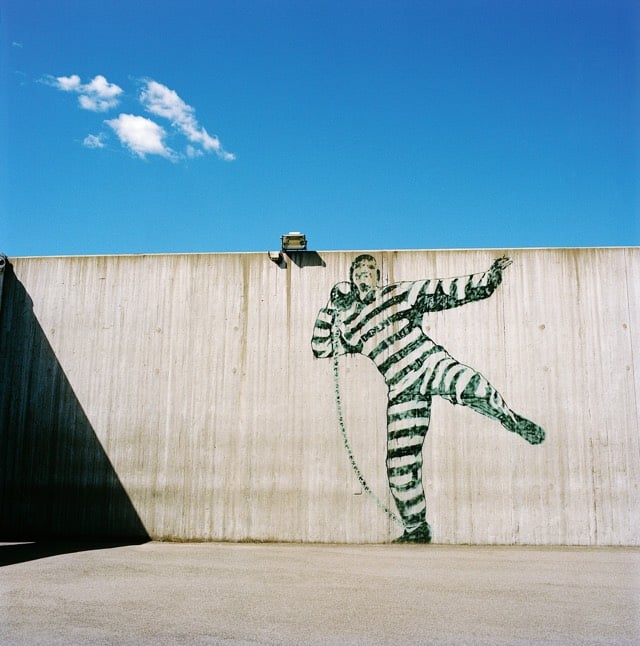
Better out than in. That’s the unofficial motto of the Norwegian Correctional Service. And they seem to mean it. In Norway, there is no death penalty and there are no life sentences. NYT Magazine’s Jessica Benko visited Norway’s Halden Prison and experienced what she described as its radical humaneness:
Its modern, cheerful and well-appointed facilities, the relative freedom of movement it offers, its quiet and peaceful atmosphere — these qualities are so out of sync with the forms of imprisonment found in the United States that you could be forgiven for doubting whether Halden is a prison at all. It is, of course, but it is also something more: the physical expression of an entire national philosophy about the relative merits of punishment and forgiveness.
Even the food was good.
The best meal I had in Norway — spicy lasagna, garlic bread and a salad with sun-dried tomatoes — was made by an inmate who had spent almost half of his 40 years in prison.
Halt and Catch Fire season two is starting on May 31! And there’s a five-minute clip to whet your appetite! And it passes the Bechdel test with flying colors!
The exclamation points mean that I am excited for the new season without explicitly saying so!! (via @kathrynyu)

The New Yorker’s Louis Menand reviews a new book by W. Joseph Campbell, 1995: The Year the Future Began.
Clinton’s affair with Monica Lewinsky is one of the five things that happened in 1995 that Campbell believes opened the door to the future. The others are the O. J. Simpson trial, the Oklahoma City bombing, the Dayton negotiations that settled the Bosnian war, and the rise and fall of the Internet browser Netscape Navigator.
The list certainly reflects the inchoate spirit of the age. But that is not Campbell’s point. His point is that our contemporary (American) world started with a White House sex scandal; the murder trial of a former football star; a set of agreements hammered out among foreign heads of state on an Air Force base in Ohio; a loner who thought that blowing up a federal office building was justified on political principles; and a computer program that ultimately lost the “browser wars” to Microsoft. You have to admire a historian who proposes to extract reverse-prediction gold from that material.
I graduated from college in 1995 so I’m probably biased, but that year does seem like a cultural turning point in many ways. Interested to read Campbell’s book.
The Ballad of Geeshie and Elvie is a good old fashioned musical detective story told by John Jeremiah Sullivan.
In the world of early-20th-century African-American music and people obsessed by it, who can appear from one angle like a clique of pale and misanthropic scholar-gatherers and from another like a sizable chunk of the human population, there exist no ghosts more vexing than a couple of women identified on three ultrarare records made in 1930 and ‘31 as Elvie Thomas and Geeshie Wiley. There are musicians as obscure as Wiley and Thomas, and musicians as great, but in none does the Venn diagram of greatness and lostness reveal such vast and bewildering co-extent. In the spring of 1930, in a damp and dimly lit studio, in a small Wisconsin village on the western shore of Lake Michigan, the duo recorded a batch of songs that for more than half a century have been numbered among the masterpieces of prewar American music, in particular two, Elvie’s “Motherless Child Blues” and Geeshie’s “Last Kind Words Blues,” twin Alps of their tiny oeuvre, inspiring essays and novels and films and cover versions, a classical arrangement.
Yet despite more than 50 years of researchers’ efforts to learn who the two women were or where they came from, we have remained ignorant of even their legal names. The sketchy memories of one or two ancient Mississippians, gathered many decades ago, seemed to point to the southern half of that state, yet none led to anything solid. A few people thought they heard hints of Louisiana or Texas in the guitar playing or in the pronunciation of a lyric. We know that the word “Geechee,” with a c, can refer to a person born into the heavily African-inflected Gullah culture centered on the coastal islands off Georgia and the Carolinas. But nothing turned up there either. Or anywhere. No grave site, no photograph. Forget that — no anecdotes. This is what set Geeshie and Elvie apart even from the rest of an innermost group of phantom geniuses of the ’20s and ’30s. Their myth was they didn’t have anything you could so much as hang a myth on. The objects themselves — the fewer than 10 surviving copies, total, of their three known Paramount releases, a handful of heavy, black, scratch-riven shellac platters, all in private hands — these were the whole of the file on Geeshie and Elvie, and even these had come within a second thought of vanishing, within, say, a woman’s decision in cleaning her parents’ attic to go against some idle advice that she throw out a box of old records and instead to find out what the junk shop gives. When she decides otherwise, when the shop isn’t on the way home, there goes the music, there go the souls, ash flakes up the flue, to flutter about with the Edison cylinder of Buddy Bolden’s band and the phonautograph of Lincoln’s voice.
This piece originally appeared in the NY Times Magazine, but it works much better online, interspersed with videos and musical snippets cleverly embedded in the text. One of my favorite things I’ve read all month.
In order to keep the Harry Potter gravy train going, Scholastic and Bloomsbury are releasing a fully illustrated version of each of the seven Harry Potter books over the next seven years. Here’s the cover for Harry Potter and the Sorcerer’s Stone:
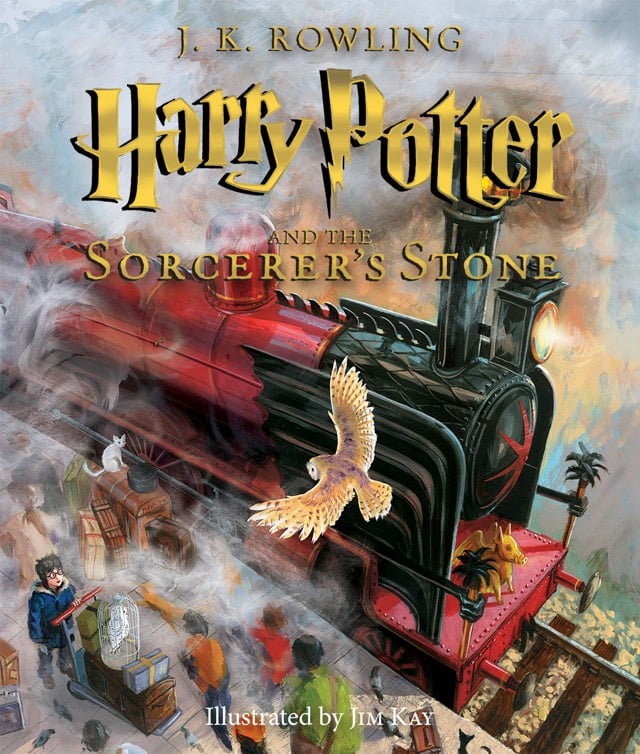
The book will contain 100+ full-color illustrations done by Jim Kay. (via buzzfeed)
This article on the science of free diving is fascinating. Boyle’s Law predicted that the human body couldn’t survive depths past 100 feet — after which, the lungs would rupture — but millions of years of evolution has equipped the human body with all sorts of tricks to survive at depths of over 900 feet.
Lundgren, among others, demonstrated how these phenomena might counteract Boyle’s law. He recruited volunteer firemen from a fire brigade in the Swedish city of Malmo, submerged them up to the neck in water, and used a heart catheter to measure the increase in blood circulation in the chest. Lundgren discovered the body was able to counteract the increased outside water pressure by reinforcing vessels in the walls of the lungs with more blood, in much the same way we increase tire pressure by adding more volume of oxygen to the inside of a tire.
Boyle’s Law had not been overturned. Scientists simply hadn’t taken into account the effect this counterforce could exert to allow survival underwater. “A lot of blood, much more than was usually thought, can be transferred from the blood circulation out in the tissues into the blood vessels of the lung,” Lundgren said, placing that amount at about half a gallon. The extra, densely packed blood can act as a bulwark, exerting a counterforce against the increased pressure pushing inward by the water.
Ask Polly, by Heather Havrilesky,1 is surely one of the best advice columns out there. In yesterday’s installment, Havrilesky adopted the voice of Deadwood’s Al Swearengen to answer a letter about a boyfriend’s troublesome relationship with a married woman.
It sounds like you’re feeling less than your full fucking self, and for good reason! The hour requires some unvarnished words and since you made mention of your passion for Deadwood, David Milch’s brilliant portrait of the Wild West (largely unsung and partially unfinished thanks to some big-city cocksuckers at HBO, who’d sooner brand their own foreheads with a flat iron than allow a man of the pen to complete the masterpiece for which his name will henceforth be praised), I’d like to sally forth in a style befitting the scoundrels, whores, dirt-worshippers, and hoopleheads of that melancholy town. Be forewarned, though, the language herein might lead some to imagine that yours truly has been pillaging Doc’s stash of chloroform, more typically reserved for offering animals a merciful exit from this mortal plane. Suffice it to say that skeptical cocksuckers and those with delicate sensibilities might be well-advised to seek respite elsewhere. You can help your delicate sensibilities by turning the fuck away.
From New York Magazine, a big feature on NYC after midnight. Several people shared their stories, including Bebe Buell:
In 1974, I was on Hudson and Horatio — it was still pretty shady over there at the time - and I could not get a cab. This big giant Cadillac pulls up, and a guy and a girl were in it. It was obviously a pimp and his girl. And the guy goes, “My name is Magic. Do you need a ride?” Who in their right mind would get in that car? But I did. His name was Magic, her name was Angel, and it was like a scene out of a Scorsese movie. I just remember the tranny girls yelling, “You go, girl!” They thought I had gotten a trick or something. I don’t know what made me think it was going to be okay. Angel let me know, “Don’t worry, honey, we’re not serial killers.” And for some godforsaken reason, I believed them.
And Alec Baldwin, who has always been interested in Saturday Night Live:
I was told that there was a place called Louis’s Toy Bar on the Upper East Side. And it was this narrow sliver of a shop that obviously had sold antique clothes or something. And this guy Louis who owned it would put out plates of, like, Velveeta cheese and crackers and very modest kinds of canapes. I was told, back then, that all the cast of the original Saturday Night Live went there after the show; this was their haunt, this was their after-party-after-party Copacabana. And I went there countless times, eating Velveeta cheese, waiting for them, and they never came. They never showed up.
And Lydia Lunch:
I made money by standing on the corner of Sixth Avenue and 8th Street, shaking down women with children, saying I worked for the Cancer Foundation, until I got \$10. I could live on that. The rent at my apartment on 12th Street between A and B was \$75 a month.
And Dr. Jason D’Amore, formerly a resident at Bellvue:
One night, we got this guy in who was riding his Harley down the FDR at high speed, and he got run over by a semi, and he comes in and is very close to death. […] So this guy, he was covered head-to-toe in iron crosses and swastikas and white-power tattoos. I’m looking around, and I’m D’Amore, and the ortho guy was Schwarzbaum, and we had to call neurosurgery, and that was Goldberg, and we intubated him and we got him stabilized and into the operating room, and he’s totally sedated, and I leaned down and said, “Dude, I just wanted you to know a bunch of Jews just saved your ass.”
And Colin Quinn:
It’s easier to be nostalgic now. It’s easier to look at it now and say, “Oh, I miss Taxi Driver.” Suddenly, we’re all like French film students who romanticize New York, even though when you lived it, it was bad. There were so many heroin dealers. If you were on, like, Avenue B and C, and somebody goes, “You want heroin?” and you said no, they’d get mad at you, like you were going browsing in a store and not buying anything. “You’re wasting our time! Trying to make money here.”
And Alexis Swerdloff:
The hand-delivered invite was a velvet-wrapped VHS tape. Five minutes and 42 seconds long, the video had Oprah, Ellen DeGeneres, Ananda Lewis, Todd Oldham, Veronica Webb, Ben Stiller, Pauly Shore, Derek Jeter, and dozens of other ’90s luminaries hyping Puff Daddy’s 29th-birthday party on November 4, 1998. Chris Rock said to leave your posse at home, Magic Johnson instructed guests to arrive at 10 p.m. on the dot, and Will Smith directed people to a 212 number in order to RSVP for the secret location. “It’s gonna be all that,” cooed Tyra Banks.
And there’s so much more…go read the whole thing. The photos are great too. Look for the one with Edith Piaf singing at a club; it’s just her in 1950 on a tiny stage with no microphone singing to people while they eat dinner. Man, if I had a time machine…
From the Slow Mo Guys, a video shot at 170,000 frames/sec of a CD shattering after being spun at 23,000 RPM. Worth watching until (or skipping to) the end to see exactly how the disc fractures.
(via digg)
Michael Williams of A Continuous Lean made a video for Mr. Porter about how to care for your new pair of jeans.
I remember reading his original post on the topic and boggling at the concept of wearing a new pair of raw selvage jeans for an entire year before washing them. (I still have never done such a thing. I’m just not that fancy.)
On Friday, astronauts Scott Kelly and Mikhail Kornienko will be launched into space, where they will spend an entire year on the International Space Station. Time is doing a documentary series on Kelly’s stay in space.
On March 27, the veteran of three previous space flights will take off for the International Space Station (ISS) and, along with cosmonaut Misha Kornienko, remain aloft for a full year. Meantime, Scott’s twin brother Mark, a veteran of four space flights, will remain on the ground. The two men with their matching backgrounds, similar health and identical genomes, will serve as the perfect controlled experiment to learn more about how the human body handles weightlessness-and what can be done to minimize the damage during long-term trips to Mars and elsewhere.
The trailer is available here. Kelly and Kornienko will be the fifth and sixth people to spend at least a year in space…cosmonaut Valeri Polyakov spent 437 straight days in space in 1994-5.
From Amanda McCall, a selection of Ben & Jerry’s flavors featuring women.




McCall made these because Ben & Jerry’s hasn’t done such a good job highlighting women with their products:
Over the past three decades, Ben & Jerry’s has created over twenty flavors honoring various famous people, and only two of those people have been female: Tiny Fey’s character on 30 Rock (“Liz Lemon’s Greek Frozen Yogurt”, released in 2013 ) and Olympic snowboarder Hannah Teter (“Hannah Teter’s Maple Blondie”, released briefly in 2009).
There are currently no female flavors of Ben & Jerry’s ice cream (even Tina Fey would agree that, while “Greek frozen yogurt” is certainly a healthy ice cream alternative, it is not the same as ice cream), despite the fact that women consume significantly more ice cream than men do.
The best thing about the Butter Pecancé Knowles flavor is that butter pecan ice cream is actually the singer’s favorite flavor.
“I love my butter pecan ice cream,” she says, “but I also love to work out. We all have our issues. Mine is arms and legs, keeping them tight and toned. It takes work, believe me.”
Ben & Jerry’s! Let’s make this happen! (via @amateurgourmet)
Oh my, I had forgotten about the Name of the Year site and how amazing it is. Each year, they collect the most unusual names in the world and pit them against each other in a March Madness-style bracket. Here are some of the names in the running for the 2015 Name of the Year:
Swindly Lint
Dr. Electron Kebebew
Flavious Coffee
Lancelot Supersad Jr.
Jazznique St. Junious
(A reminder…these are actual names of actual people. Somehow.)
Littice Bacon-Blood
Dr. Wallop Promthong
Infinite Grover
Genghis Muskox
Malvina Complainville
Beethoven Bong
Amanda Miranda Panda
Some Hall of Name inductees include Tokyo Sexwale, Nimrod Weiselfish, Doby Chrotchtangle, Tanqueray Beavers, and Vanilla Dong.
To simulate unusual cloud formations in movies (like Close Encounters, Raiders of the Lost Ark, and Independence Day), special effects artists injected paint into tanks containing water with two different densities.
A cloud tank consists of a bottom layer of salt water and a top layer of fresh water and when various forms of liquid are injected into tank, clouds are produced. This was the common technique that Hollywood used for decades to capture supernatural weather.
The developer of the cloud tank effect, Scott Squires, wrote a post detailing how it was accomplished.
Next white liquid tempra paint is injected in the fresh water portion (top), usually just a few inches from the dividing line of the fresh and salt water. Think of a large syringe with an aquarium tube going into the water. When the tempra paint is injected it billows outward like cumulus clouds and will tend to sink a bit. But the salt water prevents it from going lower so the ‘cloud’ tends to flatten it’s base on the salt water line and and billow outward, similar to real clouds based on air pressure levels. Avoid going below into the saltwater since the clouds will just drop to the bottom of tank.
I loved every opinionated moment of this interview with Fran Lebowitz about fashion. Where do I even start? Some choice bits:
Yoga pants are ruining women.
Shirts don’t go bad, they’re not peaches.
I feel very strongly that almost the entire city has copied my glasses.
Dry…clean. These words don’t go together. Wet clean — that is how you clean. I can’t even imagine the things they do at the drycleaner. I don’t want to know.
I have to say that one of the biggest changes in my lifetime, is the phenomenon of men wearing shorts. Men never wore shorts when I was young. There are few things I would rather see less, to tell you the truth. I’d just as soon see someone coming toward me with a hand grenade. This is one of the worst changes, by far. It’s disgusting. To have to sit next to grown men on the subway in the summer, and they’re wearing shorts? It’s repulsive. They look ridiculous, like children, and I can’t take them seriously.
Now people need special costumes to ride bicycles. I mean, a helmet, what, are you an astronaut??
Of course, more people should wear overcoats than those damned down jackets. Please. Are you skiing, or are you walking across the street? If you’re not an arctic explorer, dress like a human being.
I, myself, am deeply superficial.
Feeling good about an outfit is the point at which that outfit finally becomes good.
So good.
The Art of the Scene looks at how Raiders of the Lost Ark came to be and how the opening scene is the perfect introduction to the main character and the “look and feel” of the rest of the film.
I love that Lucas got the idea for the boulder from a Scrooge McDuck comic book. (via devour)
A group of astronomy enthusiasts rented a plane and flew through the shadow cast by the recent eclipse of the Sun. One passenger took the following video. Look at that shadow creeping across the cloud cover! So cool.
P.S. Still super excited for the 2017 eclipse! (via slate)
Oh, this sounds fantastic: PBS is set to air a six-hour documentary series, Cancer: The Emperor of All Maladies, starting at the end of March. How have I not heard about this before today?
This “biography” of cancer covers its first documented appearances thousands of years ago through the epic battles in the 20th century to cure, control and conquer it, to a radical new understanding of its essence. The series also features the current status of cancer knowledge and treatment — the dawn of an era in which cancer may become a chronic or curable illness rather than its historic death sentence in some forms.
The series is based on Siddhartha Mukherjee’s The Emperor of All Maladies: A Biography of Cancer, which is one of the most interesting books I’ve read in the past few years. Ken Burns is executive producing and Barak Goodman is directing.
Thanks to Sarah Klein at Redglass Pictures for letting me know about this. Redglass created a pair of videos for the series featuring Terrence Howard and Ken Jeong talking about their experiences with cancer.
Update: All three parts of the series are available on the PBS site for the next two weeks or so.
Two years ago, Angelina Jolie wrote in the NY Times1 about her choice to have a preventive double mastectomy. Today, she is back with an update on her choice to have another elective preventive surgery, the removal of her ovaries and fallopian tubes.
Two weeks ago I got a call from my doctor with blood-test results. “Your CA-125 is normal,” he said. I breathed a sigh of relief. That test measures the amount of the protein CA-125 in the blood, and is used to monitor ovarian cancer. I have it every year because of my family history.
But that wasn’t all. He went on. “There are a number of inflammatory markers that are elevated, and taken together they could be a sign of early cancer.” I took a pause. “CA-125 has a 50 to 75 percent chance of missing ovarian cancer at early stages,” he said. He wanted me to see the surgeon immediately to check my ovaries.
I went through what I imagine thousands of other women have felt. I told myself to stay calm, to be strong, and that I had no reason to think I wouldn’t live to see my children grow up and to meet my grandchildren.
I called my husband in France, who was on a plane within hours. The beautiful thing about such moments in life is that there is so much clarity. You know what you live for and what matters. It is polarizing, and it is peaceful.

From product designer Greg Koenig, a fantastic display of Kremlinology on how he thinks Apple makes the Apple Watch, based on the available evidence (production videos, patents, product specs).
In the above shot, blanks are placed in an immersion ultrasonic tester. What Apple is looking for is the presence of voids or density variances within the structure of the blank that, under stress, could lead to part failure or surface defects as material is removed in further machining processes. This level of inspection is, to put it mildly, fastidious beyond where most other companies would go (save Rolex). Immersion ultrasonic inspection is typically reserved for highly stressed medical implants and rotating components inside of aircraft engines; not only does this step take time, it also is typically performed by custom built machines of tremendous expense.
If you don’t have the time or energy to read through the whole thing, at least skip to the final two paragraphs about manufacturing as ritual.
Also, Koenig’s Twitter stream is full of interesting nuggets about Apple. Here are a few that caught my attention:
For years, one of the knocks on Pixar was the lack of main characters who are women in their movies. 2012’s Brave and this summer’s Inside Out have addressed this criticism to an extent1. But Alex of every flavored bean noticed that, in contrast to the diversity of male faces, female characters in Disney/Pixar’s recent movies all have the same face.
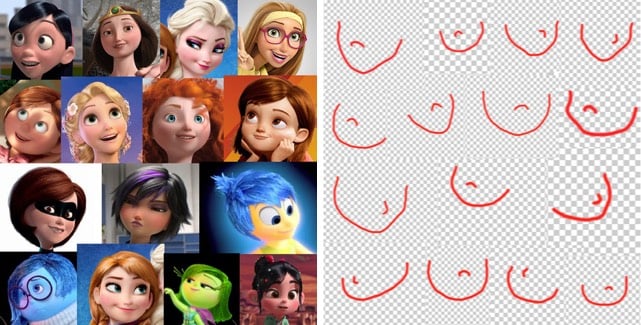
Boys in animated movies have faces that are square, round, skinny, fat, alien-looking, handsome, and ugly. The only face that girls get to have is some round snub-nosed baby face. That’s not right.
Great observation.
Update: This piece has generated some interesting comments on Good, including this one from Dan Povenmire, co-creator of Phineas and Ferb.
This is idiotic and obviously written by someone who (A) can’t draw and (B) has an axe to grind. The female characters they show have very varied faces. Yes the face shapes are all softer feminine shapes, but they purposely didn’t include female characters from those same movies with less feminine faces, like Edna Mode in The Incredibles, or the Witch or the Cook in Brave, or any of the older female characters, like the fairy godmother, or… whatever. All the princes and male romantic leads in these movies have the same face shape as well but NO, she takes old men and villains and comedy relief characters to “prove” how sexist animation is. This is just stupid.
If you want literally dozens of examples of other characters omitted from the list see the other comments below.
(via @ckoerner)
Older posts






Socials & More