kottke.org posts about prison
Documentary filmmaker Lynn Novick, who co-directed The Vietnam War and The US and the Holocaust with Ken Burns, has directed an 8-hour PBS series called Crime and Punishment in America.
A sweeping look at the American criminal justice system, from the origins of prisons and policing to our continued fascination with crime, the film traces the contours of our imperfect system and how it influences nearly all parts of our society: the media, economics and politics. Through the voices and testimony of those who have committed crimes, experienced incarceration, enforced the law, or lost loved ones to violence, the series explores the cost of America’s choices and the enduring tension between crime and punishment, vengeance and mercy, justice and redemption.
And from the trailer:
We think about our history in terms of progress, but we have become consumed with practices of punishment.
When I think about crime and punishment in America, I think that it says we are a very unforgiving country.
This looks great. It starts airing on PBS tonight, Nov 16.
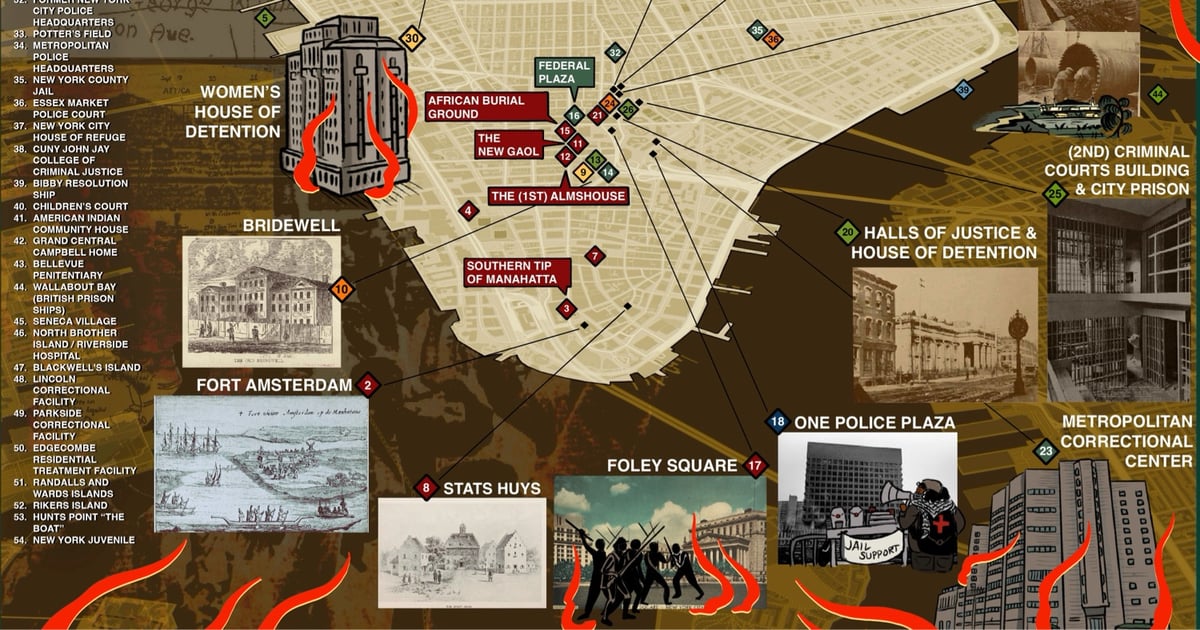
The website for the Abolitionist Guide to NYC is just getting started, but the site does house an Abolitionist Map of NYC.
The Abolitionist Map of NYC offers a geographic survey of incarceration and anti-carceral resistance in Manahatta from the Dutch colonization of Lenapehoking to the present day. The map highlights some of the first jails and prisons to exist in the area, the movement of facilities from one place to the next, and sites of rebellion against the expansion of the prison industrial complex.
It is meant to serve as a tool for abolitionist resistance grounded in a long view of the struggle, tactics, and goals.
The map is available as a PDF and as an interactive version. (via @prisonculture.bsky.social)
The Quilters (trailer) is a short documentary about a group of men in a Missouri prison who spend 40 hours a week making birthday quilts for foster kids and kids with disabilities.
The Quilters follows the daily lives of several quilters inside the sewing room at South Central Correctional Center, a Level 5 maximum-security prison in a small town two hours south of St. Louis, MO. From design to completion, the men reveal their struggles, triumphs, and sense of pride in creating something beautiful in this windowless, sacred space deep within the prison walls.
The Quilters is now available to watch on Netflix.
This short video takes us on a trip through the criminal justice system and highlights a “hidden form of punishment” directed toward incarcerated people: fees. At every turn, people who are sentenced to incarceration are subject to tens of thousands of dollars in fees: bail fees, public defender fees, filing fees, court costs, mandatory contributions to funds like the state police fund, room & board, phone calls, money transfer fees, medical co-pays, and fees for post-incarceration monitoring. This is on top of any penalties that are paid by offenders.
We’re not talking about fines, those monetary punishments that judges impose on offenders. And this isn’t about restitution, which is an additional sanction intended to reimburse victims. Fees are far more insidious, functioning like predatory taxes that raise revenue for the government. They can vary from state to state, municipality to municipality, institution to institution.
And they can have severe economic consequences, particularly for people who are already broke when they enter the system — that is, most people who run afoul of the law. The resulting debts can destroy people’s credit, prevent them from voting and interfere with their ability to find employment and housing.
And guess what? People in debt turn to crime to pay their bills. This is all just another way that America’s criminal justice system is punitive and not rehabilitative.
Vice News visited the Mountain View Correctional Facility in Maine, where incarcerated people eat food that they’ve grown and cooked themselves, augmented by other locally grown and raised food (beef, chicken, etc).
Mark McBride is the culinary director at Mountain View Correctional Facility, a 350-person prison where inmates don’t eat processed chicken fingers and sloppy joes.
“When I started 6 years ago, the majority of the food was processed foods, and I wanted to try to see if we couldn’t replicate more homestyle cooking - scratch cooking - using raw local ingredients. But the truth is, by taking these raw products from farmers and putting the work into breaking this down, we’re actually able to save money. In 2018, our two kitchens saved $142,000 off of their budget.
It’s heartening to see an American prison that takes seriously the well-being and rehabilitation of the people in its care. (via neatorama)
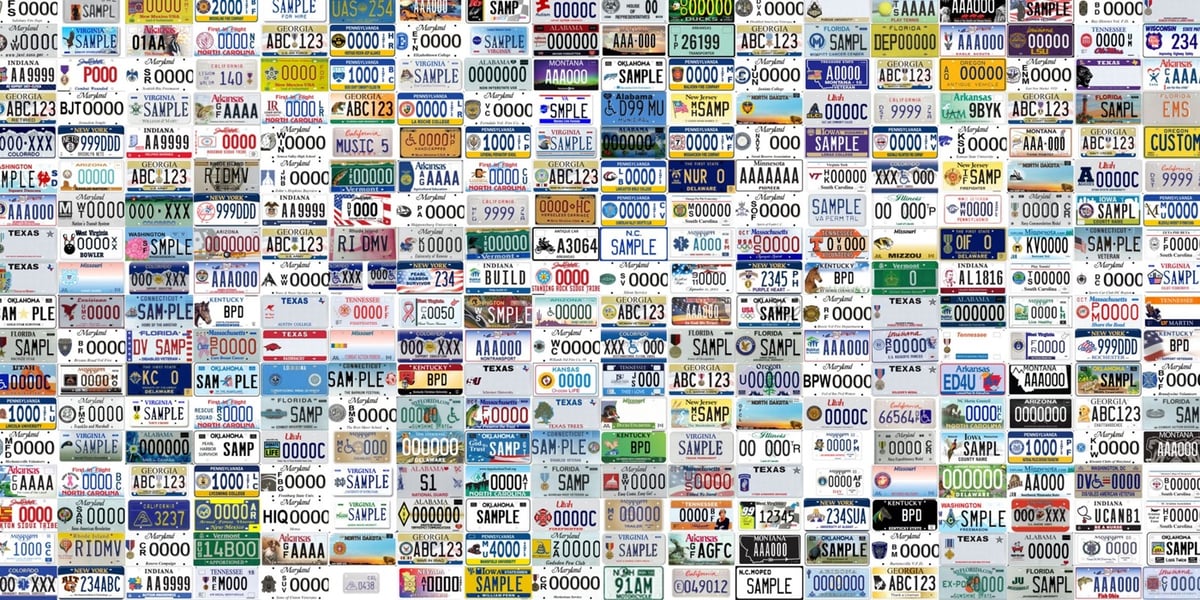
Have you noticed there are a lot of different license plates you can choose for your car these days? So did Jon Keegan; he scraped the DMV websites of all 50 states and DC and came up with over 8,200 different plate combinations you might see out on the road.
By my count, there are currently 8,291 different vehicle license plates offered by the 50 states and the District of Columbia. States now offer a vast menu of personalized plate options for a dizzying array of organizations, professions, sports teams, causes and other groups.
My count was conducted over June and July 2023, so this should be considered a snapshot, as I’m sure some plates have changed already.
Fun fact: finishers of the Iditarod Trail Sled Dog Race are eligible to get a special “Iditarod Finisher” plate for their car.
Less fun fact, per Keegan:
Yes, license plates are still made by cheap prison labor in most states. 80% of all license plates issued in the U.S. today were made by state prisoners, with only 12 states opting out of the practice. According to a 2022 ACLU report on prison labor in the U.S., many states offer no pay at all to prisoners, while the average hourly wage across the country was between 13 and 52 cents per hour.
Here in Vermont, the use of prison labor for manufacturing things like license plates resulted in the image of a pig hidden in a cow’s spots appearing on an official crest emblazoned on state police cars back in 2012.
Based on data from a 2021 survey, FlowingData made these cool infographics of all of the different types of households in the United States. Here are the ten most common:
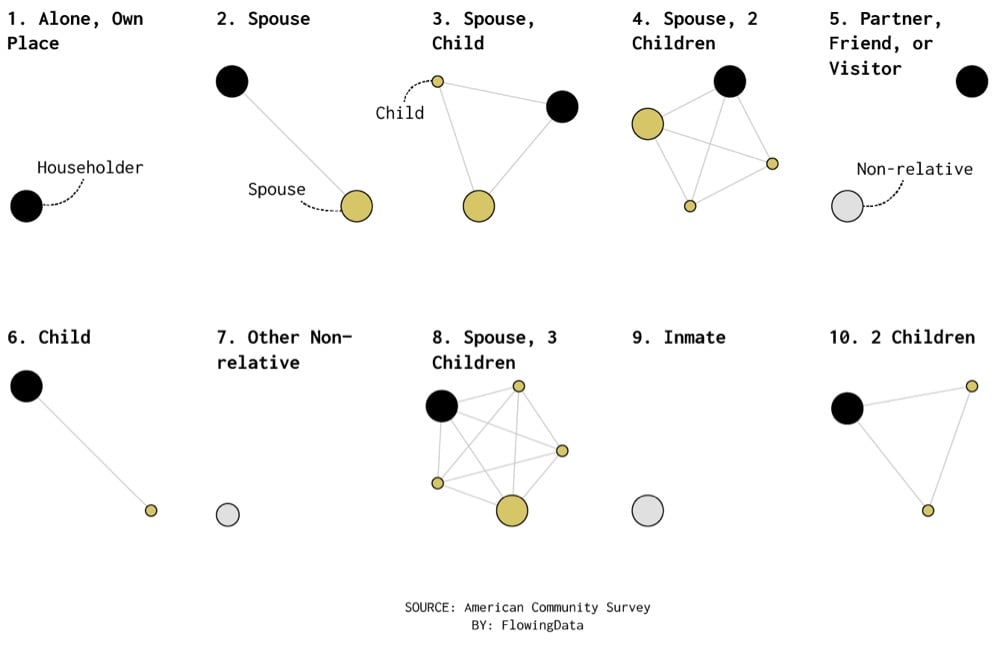
Single homeowners are the most common but look at #9: inmate. Shameful.
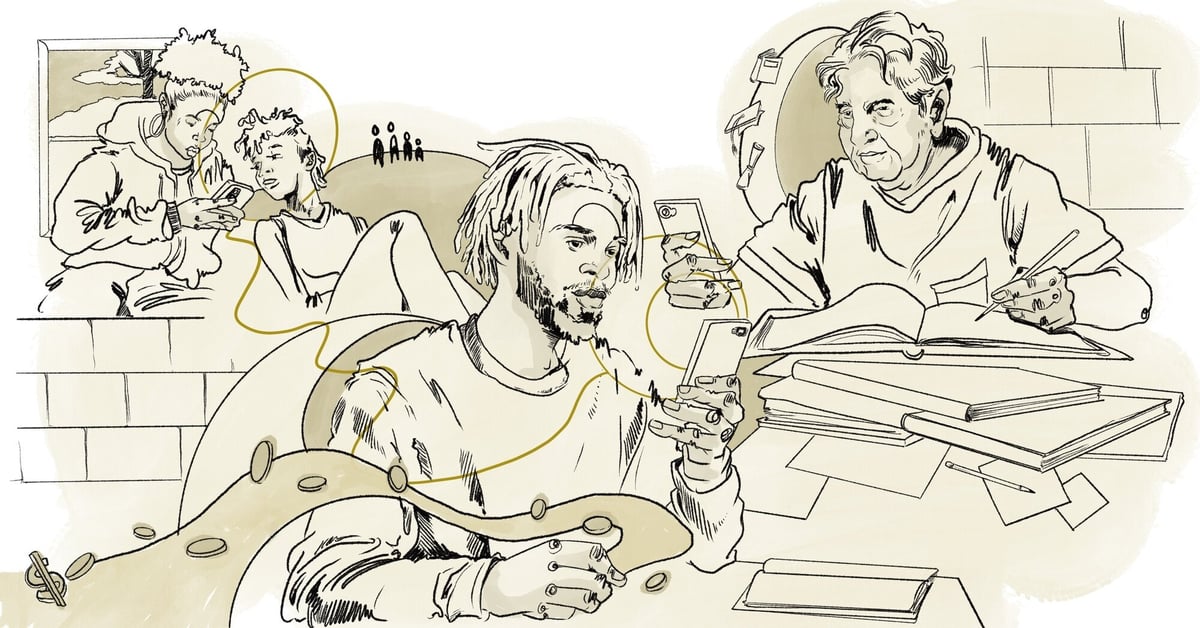
In most jails and prisons, cellular phones are considered contraband and can be confiscated if they’re found in a prisoner’s possession. If they’re lucky, that’s the limit of the punishment. But just because something isn’t allowed doesn’t mean it doesn’t exist, and phones inside lockup are popular for most of the same reasons they’re popular on the outside: they’re fun, useful tools for work or communication.
Keri Blakinger writes about the wide range of uses inmates have found for mobile phones:
Most of what I knew about illicit electronics came from press releases and news stories that offered example after example of all the bad things people could do with contraband phones, things like trafficking drugs, making threats and running scams. While it’s true those things can happen, over the past three years I’ve also seen a lot of people use their phones for good. Some use them to self-publish books or take online college classes. Others become prison reform advocates, teach computer skills, trade bitcoin or write legal briefs. I’ve seen a whole plethora of savvy and creative uses that fly in the face of stereotypes about people behind bars. “Our cell phones have saved lives,” a man in prison in South Carolina told me.
Along with communication, activism, and journalism, cell phones are popular not least because they can be used for profit (helped, not hindered, by the peculiarities of the prison economy):
Even though contraband phones can cost anywhere from around $300 to $6,000, sometimes the devices pay for themselves, because a lot of prisoners use them to earn money. One Texas prisoner I interviewed had been selling his artwork online, while others say they have used their phones to learn how to trade stocks or do online gig work. More commonly, I know guys who use their phones to get work as freelance writers. You might read their stories and not even know the author penned them from prison. Unfettered internet access makes research quicker, and one man explained that a pricey contraband phone can still end up being cheaper and more reliable than communicating in approved ways.
“Typewriter ribbons here are extortionately priced,” one federal prisoner explained. “Talk-to-text makes writing articles so much cheaper, even including the cost of the phone and the rate plan”… Some people earn money by renting out their phones or charging people to use them as hotspots to secretly connect their prison-issued tablets to the internet. “You can buy hotspot time for $1 a day,” a prisoner in one Southern state told me. “A dollar is two ramen noodle soups, and that’s how it’s paid for.”
But the most popular use for a phone in jail or prison is simply to keep in touch with friends and family outside.
When the California prisoner I spoke to got his first phone about a decade ago, the first thing he did, he said, was call his wife and ask to speak to his son. Ordinary uses like that, he said, are why most people in prison want phones.
“I mean, there are some people where you might have legitimate concerns about them having phones, and they might want to order a hit,” he said. “But in the prison I’m at, the only thing we want to order is a pizza.”

Merete Mueller’s short film Blue Room is about as meditative and peaceful a look at life in prison as you’ll ever see. It’s also quietly disturbing. In the US, our prison system is designed to punish incarcerated people by separating them from the outside world. Perhaps most significantly for their mental health, they are kept separate from nature: trees, rivers, lakes, oceans, the night sky; things that can keep people happy, healthy, and well-balanced. After learning about a program that shows nature videos in prisons, Mueller went to film and observe:
Years ago, I read about an exploratory program that showed nature imagery to people in prison to improve their mental health. During allotted downtime and in high-stress situations, individuals could request to visit the “blue room” to watch nature videos. Prison administrators hoped that these sessions would offer alternatives for people who were struggling emotionally, many of whom often ended up in solitary confinement.
We believe in the power of relaxing and meditative videos around here and I’m glad people in these prisons are able to find some peace in the blue room, but videos are not the real world. If Blue Planet II is necessary for incarcerated people to maintain their sanity and tenuous connection to nature and the outside world, as a society we really need to rethink what this system is doing to people. A friend said it reminded her of the incredibly dystopian use of VR goggles on cows in order to produce more milk. In his 2009 New Yorker article, Atul Gawande said that long-term solitary confinement is torture — but maybe all imprisonment is torture in our deeply punitive system? (thx, caroline)


Since 1800, when the first newspaper was published in a NYC prison, over 500 newspapers have been published in prisons around the country. JSTOR is hosting a growing archive of such publications: American Prison Newspapers 1800-2020: Voices from the Inside.
With the United States incarcerating more individuals than any other nation — over 2 million as of 2019 — these publications represent a vast dimension of media history. These publications depict and report on all manner of life within the walls of prisons, from the quotidian to the upsetting. Incarcerated journalists walk a tightrope between oversight by administration — even censorship-and seeking to report accurately on their experiences inside. Some publications were produced with the sanction of institutional authorities; others were produced underground.
(thx, caroline)
This video interview with two former inmates (Five Mualimm-Ak and Terrence Slater) about their experiences in solitary confinement is, well, I was going to says “sobering” but it’s not sobering. It’s fucking infuriating and upsetting. Just to pick one moment, here’s Mualimm-Ak’s answer to “How do you maintain a sense of who you are?”:
You don’t. You live off of your memories because you have nothing else to accumulate to move forward. And then you end up having this short-term memory disorder which is a part of you the consequences of being in solitary where you can’t keep one train of thought for too long. And then you’re dropped off in 42nd Street-Times Square, the biggest tourist spot in the world, with 20 million commuters. It’s a sensory overload.
As Atul Gawande wrote in the New Yorker in 2003, solitary confinement is legalized torture by the state. Here’s more from a Psychology Today article on how long-term solitary can change your perception of the world:
Being confined in a 6x9-foot cell for almost 30 years, with very limited contact with other humans or physical exercise, surely has consequences on one’s overall health, including the brain. King knew that solitary confinement was changing the way his brain worked. When he finally left his cell, he realized he had trouble recognizing faces and had to retrain his eyes to learn what a face was like. His sense of direction was also messed up, and he was unable to follow a simple route in the city by himself. It is as if his brain had erased all those capabilities that were no longer necessary for survival in a cell no bigger than the back of a pick-up truck.
A couple of things from the video that merit your attention. The first is Hell Is a Very Small Place, a book of stories by people who are now or have been in solitary confinement. And second, Mualimm-Ak started an organization called Incarcerated Nation Network “an abolition alliance network dedicated to transforming the prison industrial complex & ending torture” — join me in sending a donation to them? (via open culture)
In 1971, Richard Nixon kicked off America’s “war on drugs”, focusing not on the societal problems that lead to drug abuse but on categorizing drug users as criminals.
In Nixon’s eyes, drug use was rampant in 1971 not because of grand social pressures that society had a duty to correct, but because drug users were law-breaking hedonists who deserved only discipline and punishment.
Over the next several decades, the US government (and particularly Ronald Reagan) took Nixon’s lead and imprisoned millions of people for drug offenses, including a disproportionate number of Black men. Michelle Alexander wrote about this in her 2010 book The New Jim Crow. From the about page:
Alexander shows that, by targeting black men through the War on Drugs and decimating communities of color, the U.S. criminal justice system functions as a contemporary system of racial control, even as it formally adheres to the principle of colorblindness.
In 1994, former Nixon aide and Watergate co-conspirator John Ehrlichman proudly told writer Dan Baum that racial control and discrimination was in fact the purpose of the war on drugs.
At the time, I was writing a book about the politics of drug prohibition. I started to ask Ehrlichman a series of earnest, wonky questions that he impatiently waved away. “You want to know what this was really all about?” he asked with the bluntness of a man who, after public disgrace and a stretch in federal prison, had little left to protect. “The Nixon campaign in 1968, and the Nixon White House after that, had two enemies: the antiwar left and black people. You understand what I’m saying? We knew we couldn’t make it illegal to be either against the war or black, but by getting the public to associate the hippies with marijuana and blacks with heroin, and then criminalizing both heavily, we could disrupt those communities. We could arrest their leaders, raid their homes, break up their meetings, and vilify them night after night on the evening news. Did we know we were lying about the drugs? Of course we did.”
An astonishing thing to admit but hardly a rare tactic for the cynical Republican Party. See also how they decided to champion abortion as an issue to attract the support of white evangelical Christians and shifted from indifference to scientific denialism on climate change in order to oppose the Obama administration and advance the interests of wealthy donors.
Thanks to Ibram X. Kendi’s How to Be an Antiracist for reminding me of Ehrlichman’s admission.
Photo Requests from Solitary is a project that takes photo requests from prisoners being held in solitary confinement and invites volunteer photographers to make the images for them. For prisoners being tortured with long-term solitary stays, photos can be a lifeline to the outside world.
They spend at least 22 hours a day in a cell that measures on average of 6 x 9 feet, either in supermax prisons or in segregation units in other prisons and jails. Meals usually come through slots in the solid steel doors of their cells, as do any communications with prison staff. Exercise is usually alone, in a cage or concrete pen, for no more than one hour a day. People in solitary may be denied contact visits, telephone calls, television, reading materials, and art supplies.
The goal of PFRS is to fulfill each request to exact specifications for the person who requested it, with images that — through some combination of form, content, composition, design, and/or sheer commitment — are compelling enough that someone would want to return to them for repeated viewing. (People in solitary are sharply limited in the numbers of photographs they can have, so every image is important.)
An inmate named Sergio requested:
I would like a picture of the Mexican flag at sunrise, at the Zocalo, in the capitol of Mexico City; while the sun is rising and it hits the Mexican flag un-furled, with the Zocalo in the foreground.
And photographer Nica Ross delivered this image:

Another inmate, Dan requested:
I would like a photograph of a female in black leather pants with the same material stitches but a different color like hot pink all which that can define her figures with a setting of orange and blue in the sky posted up next to a benz (powder blue) in a park black female with hazel eyes.
A photographer named Jason Altaan submitted this:

David requested:
My photo request is simple, yet, very poignant for me. I’d very much appreciate any photos of fallen autumn leaves. I have no particular preference of area or location; just any scene focusing on the beauty of autumn leaves, (which, as you know, we do not have access to in the concrete box that is deemed as “yard” here.)
Several photographers responded, including Gerard Gaskin:

If you look at the site, there are currently many more unfilled requests than requests with submissions. Current requests include “first lady Michelle Obama planting vegetables in the White House garden”, “police being arrested by regular citizens”, “sunrise over the Sahara”, “beautiful women laughing and playing volley ball on the beach in ‘free Raul’ t-shirts”, and “wise old man with an angry expression”. Submitting a photo is easy…you can upload right from the website.
Doreen St. Félix wrote more about the project for the New Yorker.
The Shawshank Redemption came out in 1994. Although crime rates had already started falling across the country, the media (with shows like COPS) and government (Joe Biden & Bill Clinton’s push for a crime bill now considered disastrous) were still pursuing and glorifying a punitive criminal justice system. But as this excellent video by Pop Culture Detective explains, Shawshank offered 90s audiences a different view of prison and the criminal justice system.
On a narrative level The Shawshank Redemption is a movie about the power of hope in the face of extraordinary hardship. But underpinning Andy Dufresne’s story we also find a blistering critique of the prison system and criminal justice policy in the United States.
In the film, the audience gets to see the system as harsh & corrupt and the prisoners as, well, people — human beings worthy of rehabilitation. In the 25 years since Shawshank debuted (and bombed) at the box office, public opinion in America has shifted away from the punitive view of the 90s to the more humanistic perspective embodied by the film.
See also Running from COPS, Sexual Assault of Men Played for Laughs, and Ava DuVernay’s 13th. (via waxy)

People are fascinated by prison tattoos. (I include myself in “people.”) This post at Mental Floss tries to spell out their meanings. The Economist’s Wade Zhou has crunched their numbers. And for The Marshall Project, Joseph Darius Jaafari digs into their technologies and economies: how they are made and how they circulate.
In Reddit threads and YouTube videos, former inmates describe the painstaking task of making tattoo machines and colored ink. Prisoners take apart beard trimmers or CD players to get at the tiny motor, which they can adapt to make the tattoo needle go up and down quickly enough. (Tattoo artists who use beard trimmers can quickly put the shaver back on and trick guards searching for contraband.)
The needle itself is often made from a metal guitar string split in two by holding it over an open flame until it snaps in half, creating a fine point. The springs inside gel pens can also flatten into needles.
One former prisoner who now runs a tattoo shop said he used to make black ink by trapping soot in a milk carton placed over a burning pile of plastic razors or Bible pages. He would mix the leftover ash and soot with a bit of alcohol (for hygienic purposes). To get color, some inmates use liquid India ink that family members buy from arts and crafts stores.
Why Bible pages, I wonder? Is it an availability thing or a ritual thing? Or both?
Older posts





Socials & More