kottke.org posts about Sun
Portuguese photographer Rui Santos captured this shot of the recent solar eclipse.
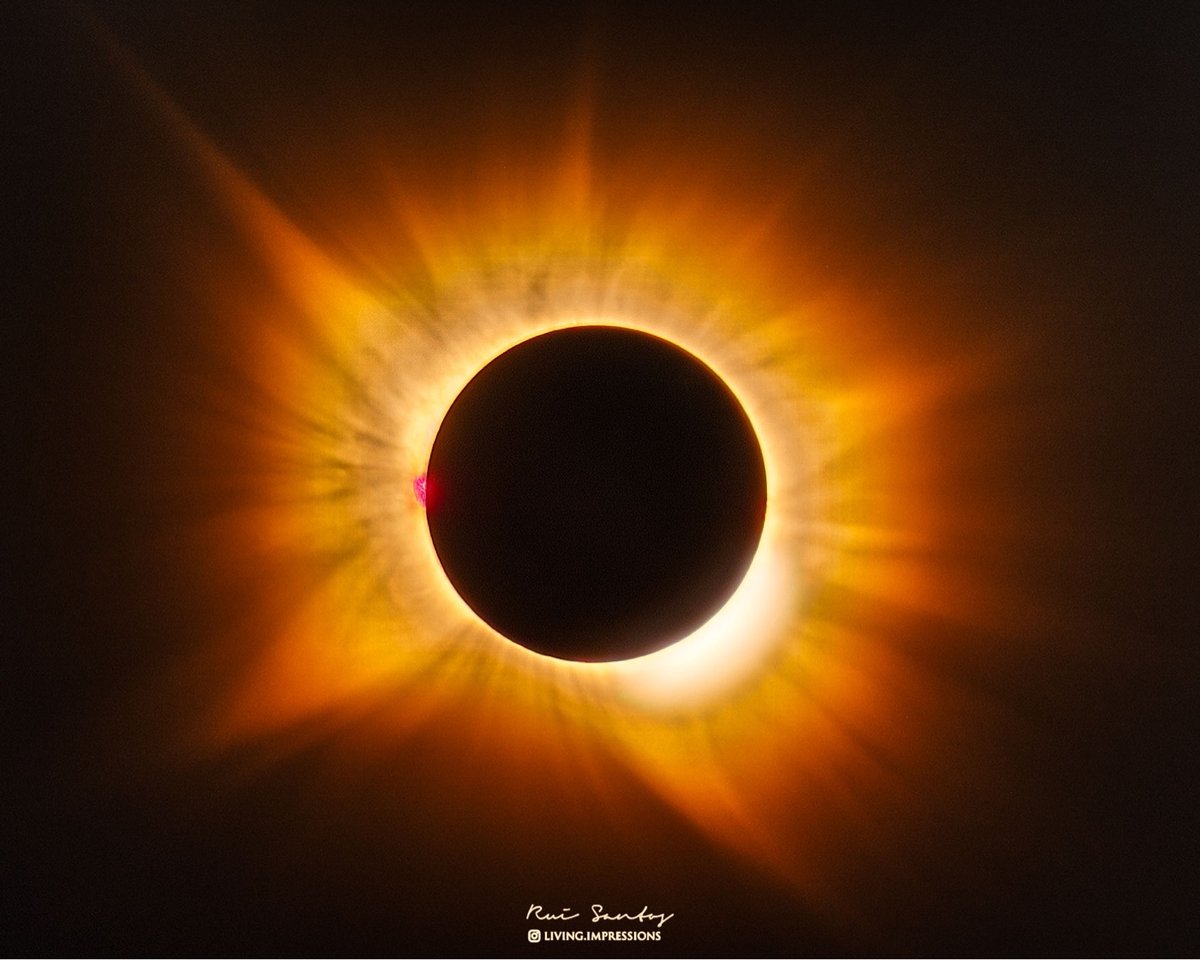
Stunning. Here’s what makes this shot look a little different from other eclipse photos; from APOD:
Usually the solar corona appears white, and to some observers the corona of last week’s total solar eclipse did appear this pearly color. But this time, totality observers in Spain saw a corona that appeared unusually golden. For one reason, from Spain, the totality occurred when the setting Sun was near the horizon. That low, sunlight travels through a large amount of air which scatters out blue light. An unusual amount of smoke in the air from nearby forest fires acted as a second filter, further scattering the remaining blue tones and deepening the already gold-dominated light.
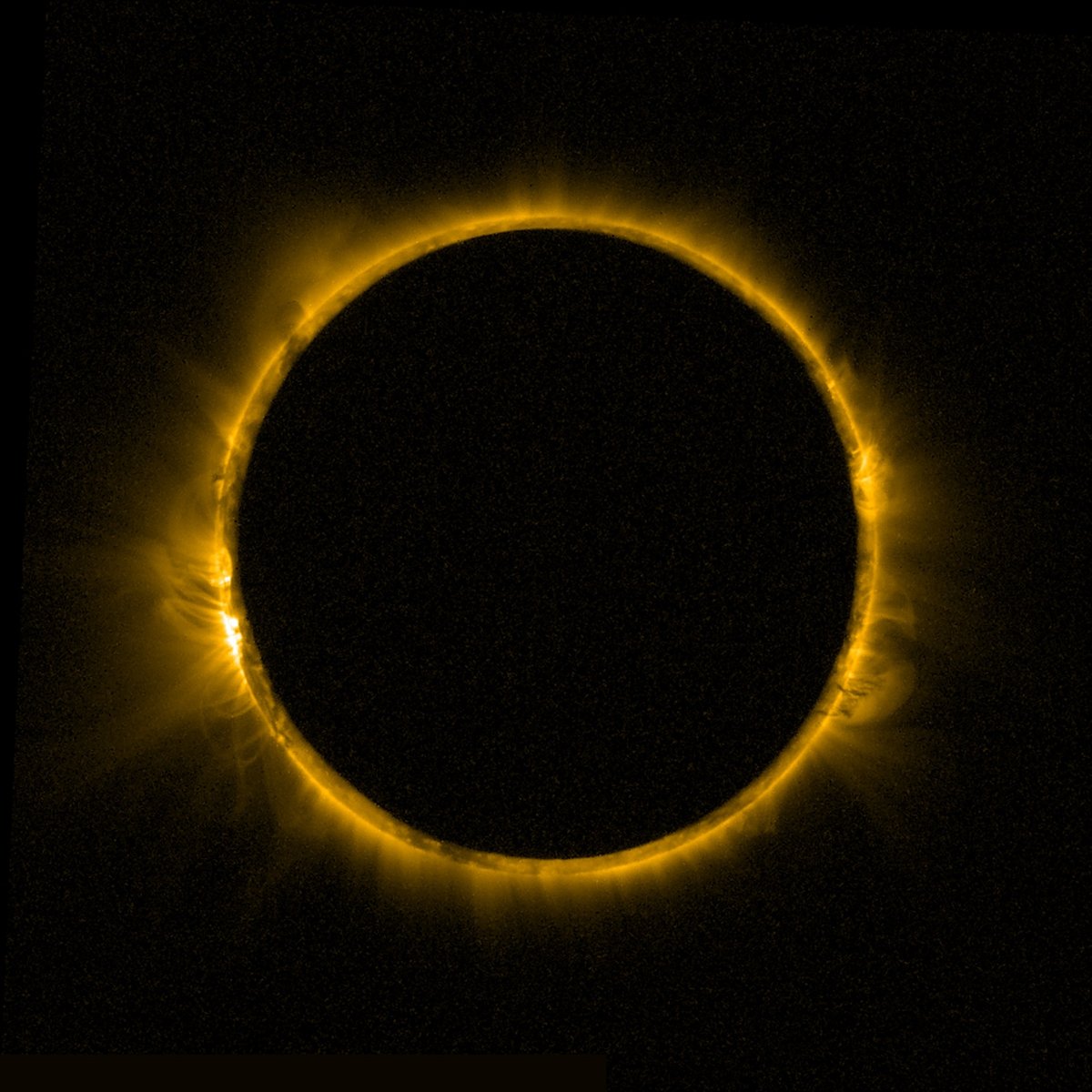
During the recent annular solar eclipse on February 17, the ESA’s PROBA-2 satellite captured this great shot of the Moon passing in front of the Sun. Cue up the Johnny Cash.


Skydiver & musician Gabriel Brown and astrophotographer Andrew McCarthy teamed up to capture these incredible photos of Brown transiting the Sun while skydiving. You can see a video of the jump and some behind the scenes calculations on Instagram.
We had to find the right location, time, aircraft, and distance for the clearest shot; while factoring in the aircraft’s power-off glideslope for the optimal sun angle and safe exit altitude. Then we had to align the shot using the opposition effect from the aircraft (shout out to the pilot @jimhamberlin) and coordinate the exact moment of the jump on 3-way coms!
As if that wasn’t hard enough, we had a myriad of malfunctions that almost led to the shot not being captured… But as you can see, against all odds, we got it on the sixth try!
That sounds….complicated. But the results speak for themselves. More coverage of this on Petapixel and Colossal.
As Petapixel notes, the photos are composite shots:
After he captured the shot of Brown, he then made the image “super high-res” by shooting the Sun on another telescope and “assembled a mosaic of the entire Sun”, which he later matched with the features in Brown’s photo.
(thx, alex)
Ok, I said no more eclipse posts (maybe) and then posted like two or three more, but really this is the last one — maybe! In 1973, a group of scientists witnessed the longest ever total solar eclipse by flying in the shadow (umbra) of the moon in a Concorde prototype for 74 minutes over the Sahara desert. From the abstract of a paper in Nature about the flight:
On June 30, 1973, Concorde 001 intercepted the path of a solar eclipse over North Africa, Flying at Mach 2.05 the aircraft provided seven observers from France, Britain and the United States with 74 min of totality bounded by extended second (7 min) and third (12 min) contacts. The former permitted searches for time variations of much longer period than previously possible and the latter provided an opportunity for chromospheric observations of improved height resolution. The altitude, which varied between 16,200 and 17,700 m, freed the observations from the usual weather problems and greatly reduced atmospheric absorption and sky noise in regions of the infrared.
Mach 2.05 = 1573 mph = 2531 km/h. 17,700 m = 58,000 ft. They added portholes to the roof of the plane for better viewing and data gathering. This page on Xavier Jubier’s site contains lots of amazing details about the flight, including a map of the flight’s path compared to the umbra, photos of the retrofitted plane, and a graph of the umbra’s velocity across the surface of the Earth (which shows that for at least part of the eclipse, the Concorde was actually outrunning the moon’s shadow).
By flying inside the umbral shadow cone of the Moon at the same speed, the Concorde was going to stay in the darkness for nearly 74 minutes, the time for astronomers and physicists on board to do all the experiences they could imagine to complete during this incredible period of black Sun. They were able to achieve in one hour and fifteen minutes what would have taken decades by observing fifteen total solar eclipses from places that would have not necessarily gotten clear skies.
And finally, here’s a 30-minute French documentary from 1973 about the eclipse flight.
So. Cool!
Hey, gang. Today is the solar eclipse, it’s supposed to be mostly sunny here in Colchester, VT, we’ve got 3 minutes and 16 seconds of totality to enjoy, and I built a solar filter for my telescope (and binoculars!), so kottke.org is going to take the day off. Edith and I will see you back here tomorrow.
In the meantime, are you doing anything for the eclipse? Anyone got any crazy camera/telescope setups? Do you think Instagram is going to crash this afternoon? Will I completely lose my mind if a cloud drifts in front of the sun today at 3:26pm ET? Is it a coincidence or a miracle that we happen to be alive during the relatively brief period of time when the moon almost exactly covers the sun, resulting in total solar eclipses? Could you imagine if the eclipse somehow doesn’t happen today??!
In 1900, celebrated magician (and astronomy enthusiast) Nevil Maskelyne travelled to North Carolina to film a solar eclipse on May 28, 1900. The Royal Astronomical Society and the British Film Institute reckon this is “the first surviving astronomical film in the world”.
In 1898 he travelled to India to photograph an eclipse. He succeeded but the film can was stolen on his return journey home.
It was not an easy feat to film. Maskelyne had to make a special telescopic adapter for his camera to capture the event. This is the only film by Maskelyne that we know to have survived.
The original film fragment held in The Royal Astronomical Society’s archive has been painstakingly scanned and restored in 4K by conservation experts at the BFI National Archive, who have reassembled and retimed the film frame by frame. The film is part of BFI Player’s recently released Victorian Film collection, viewers are now able to experience this first film of a solar eclipse since the event was originally captured over a century ago.
(via boing boing)
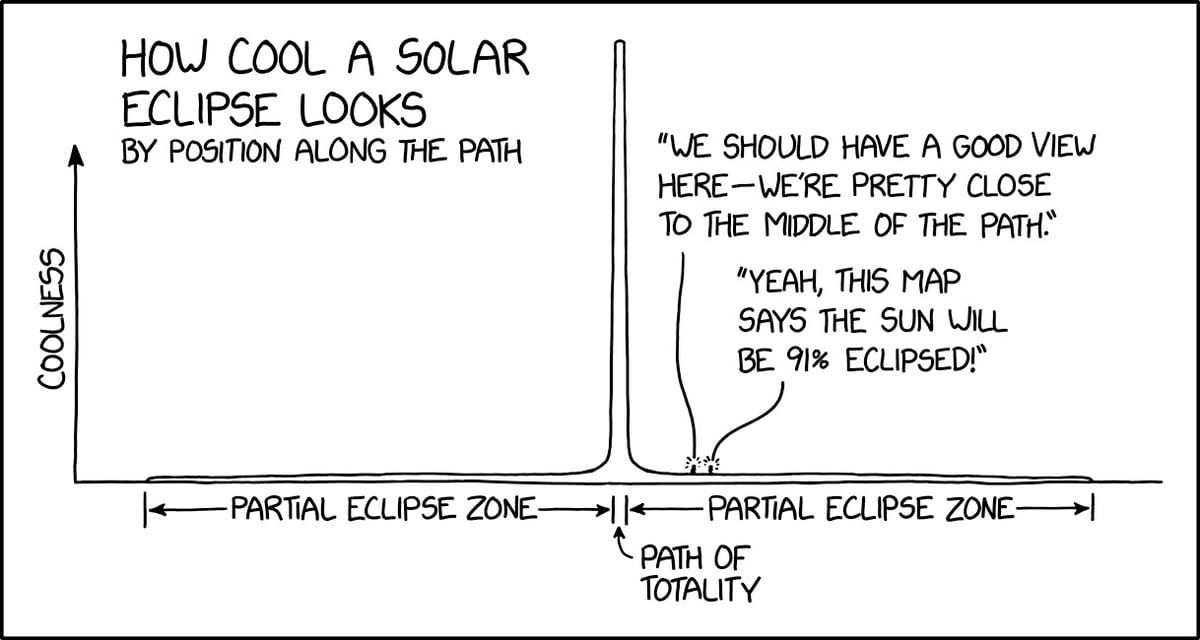
As usual, XKCD is spot on with this graph of solar eclipse coolness as a function of distance from the path of totality. The image’s alt text reads:
A partial eclipse is like a cool sunset. A total eclipse is like someone broke the sky.
See also the 2017 version. After witnessing the 2017 total solar eclipse, I wrote:
We saw the Baily’s beads and the diamond ring effect. And then…sorry, words are insufficient here. When the Moon finally slipped completely in front of the Sun and the sky went dark, I don’t even know how to describe it. The world stopped and time with it. During totality, Mouser took the photo at the top of the page. I’d seen photos like that before but had assumed that the beautifully wispy corona had been enhanced with filters in Photoshop. But no…that is actually what it looks like in the sky when viewing it with the naked eye (albeit smaller). Hands down, it was the most incredible natural event I’ve ever seen.
Vi Hart:
I’m not sure exactly what I expected, but this wasn’t it. I’d seen photos of coronas around suns, but this wasn’t that. And I’d expected that those photos, like many astronomical pictures, are long exposure, other wavelengths, and otherwise capturing things the naked eye can’t see. I thought there might be a glow of light in a circle, or nothing, or, I don’t know. What I did not expect was an unholy horror sucking the life and light and warmth out of the universe with long reaching arms, that what I’d seen in pictures was not an exaggeration but a failure to capture the extent of this thing that human eyes, and not cameras, are uniquely suited to absorb the horror of.
Annie Dillard:
I had seen a partial eclipse in 1970. A partial eclipse is very interesting. It bears almost no relation to a total eclipse. Seeing a partial eclipse bears the same relation to seeing a total eclipse as kissing a man does to marrying him, or as flying in an airplane does to falling out of an airplane. Although the one experience precedes the other, it in no way prepares you for it.
I am so looking forward to Monday and crossing my fingers for clear skies — the path of totality goes right over my house.
Using a custom hydrogen alpha solar telescope, Jason Kurth took a collection of high-resolution photographs of the recent annular solar eclipse and arranged them into an 8K video of the event. The level of detail here is incredible — you can see solar flares and features on the surface of the Sun pulsing and shifting as the Moon moves across it. You can see a bit of Kurth’s setup on Instagram.
Blackstar is a relaxing and meditative 45-minute video of the Sun made by Seán Doran using footage from the Solar Dynamics Observatory. Instead of the familiar yellow, Doran has chosen to outfit our star in vivid blue and black, which lends the video a sort of alien familiarity. This looks absolutely stunning in 4K.
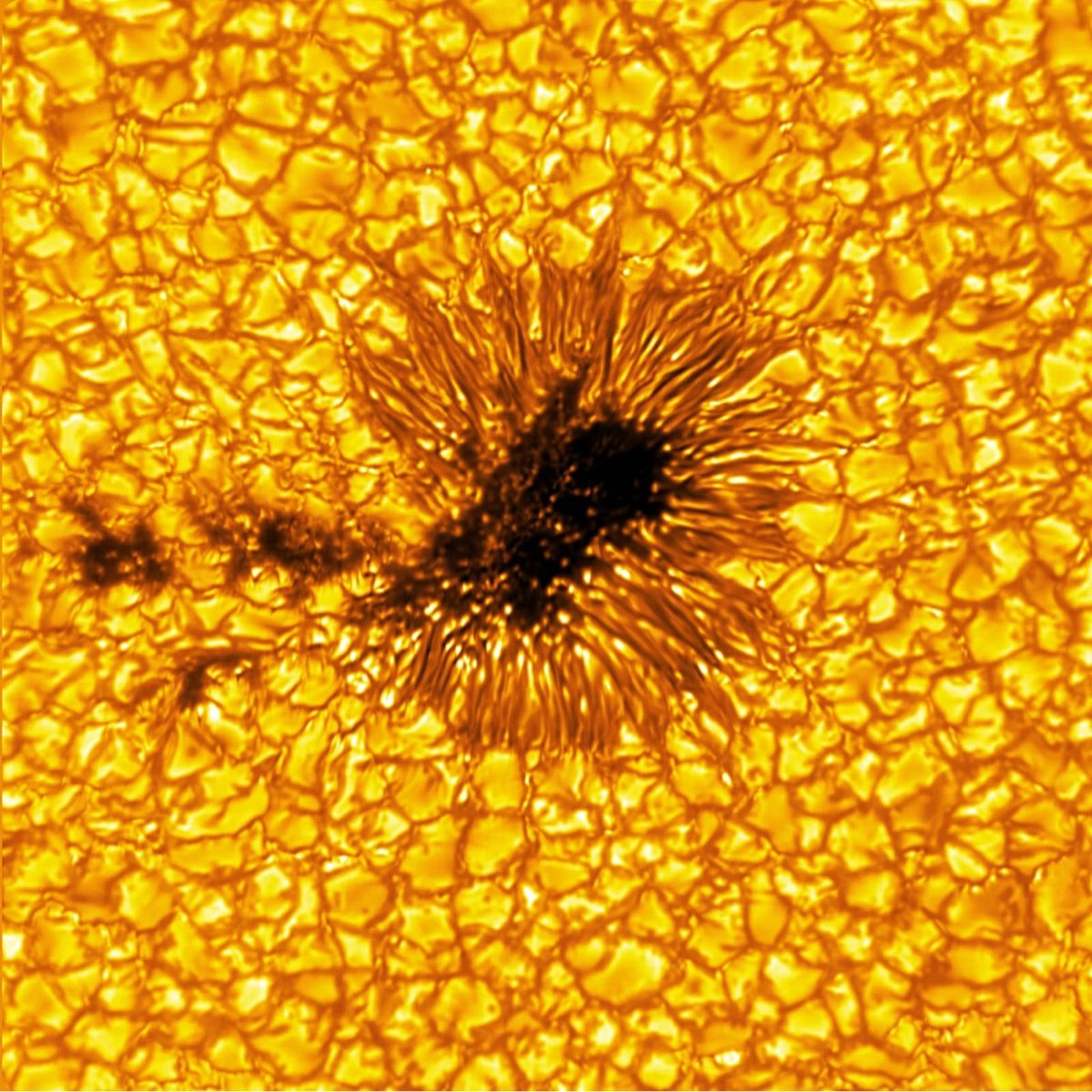
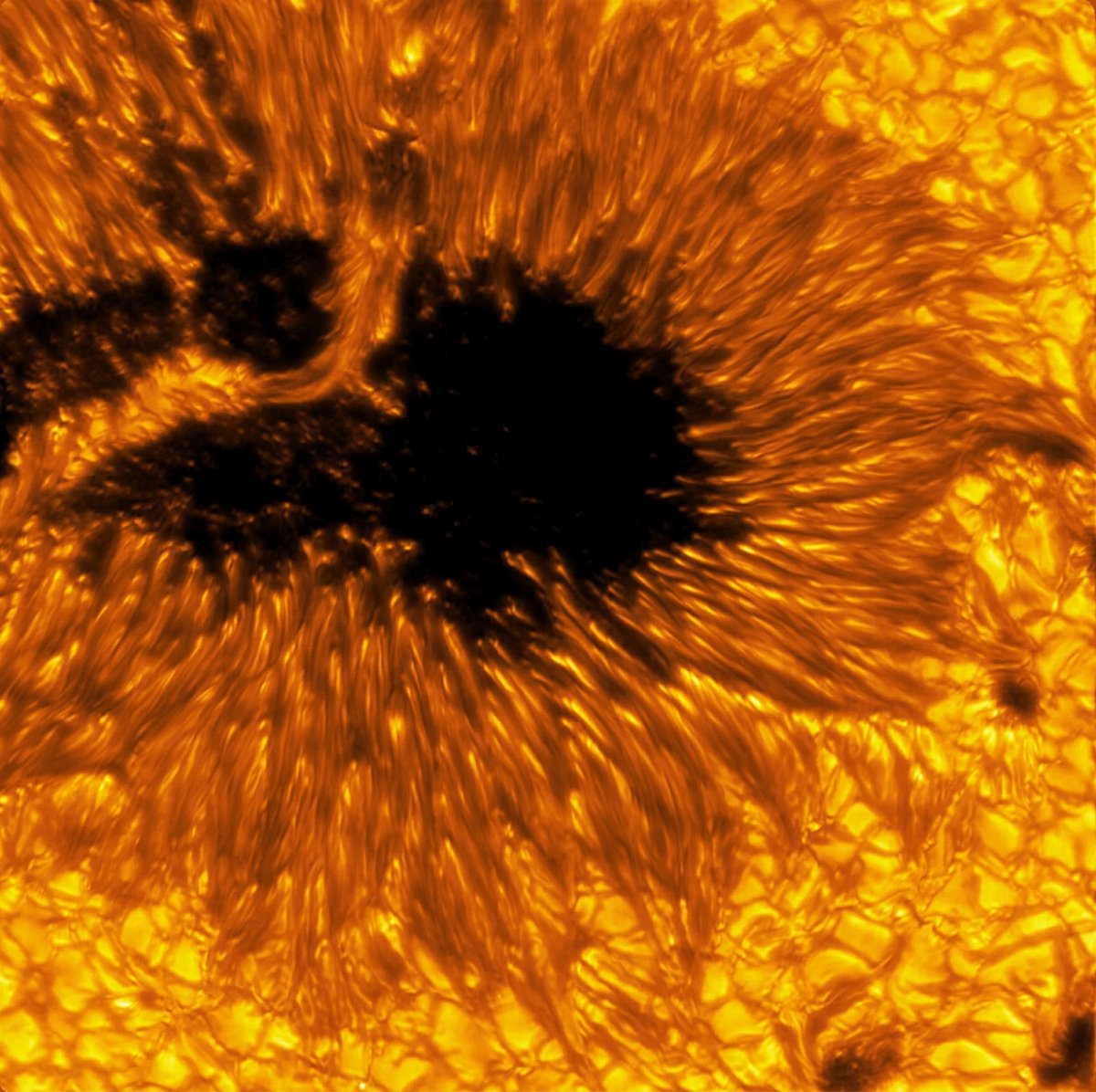
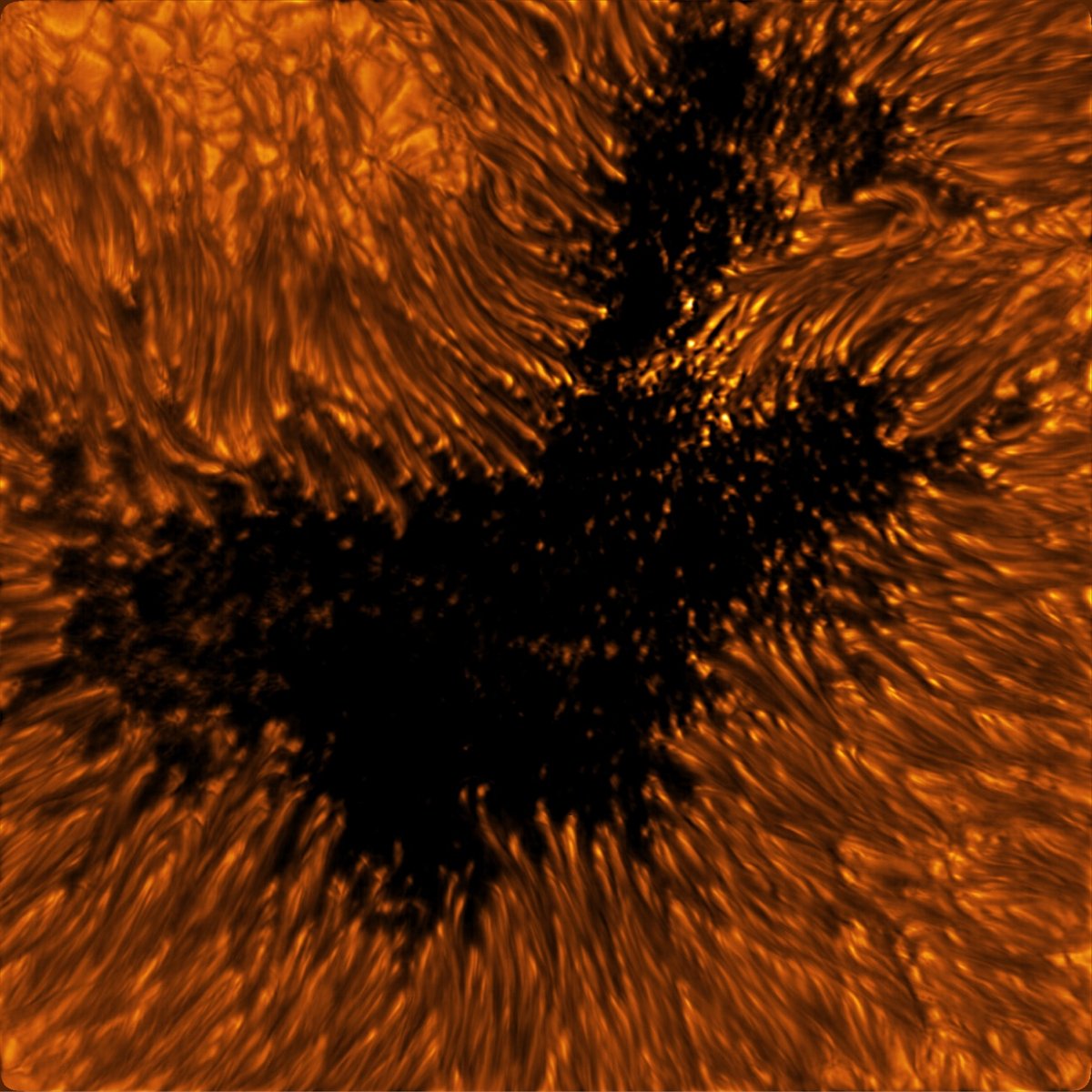
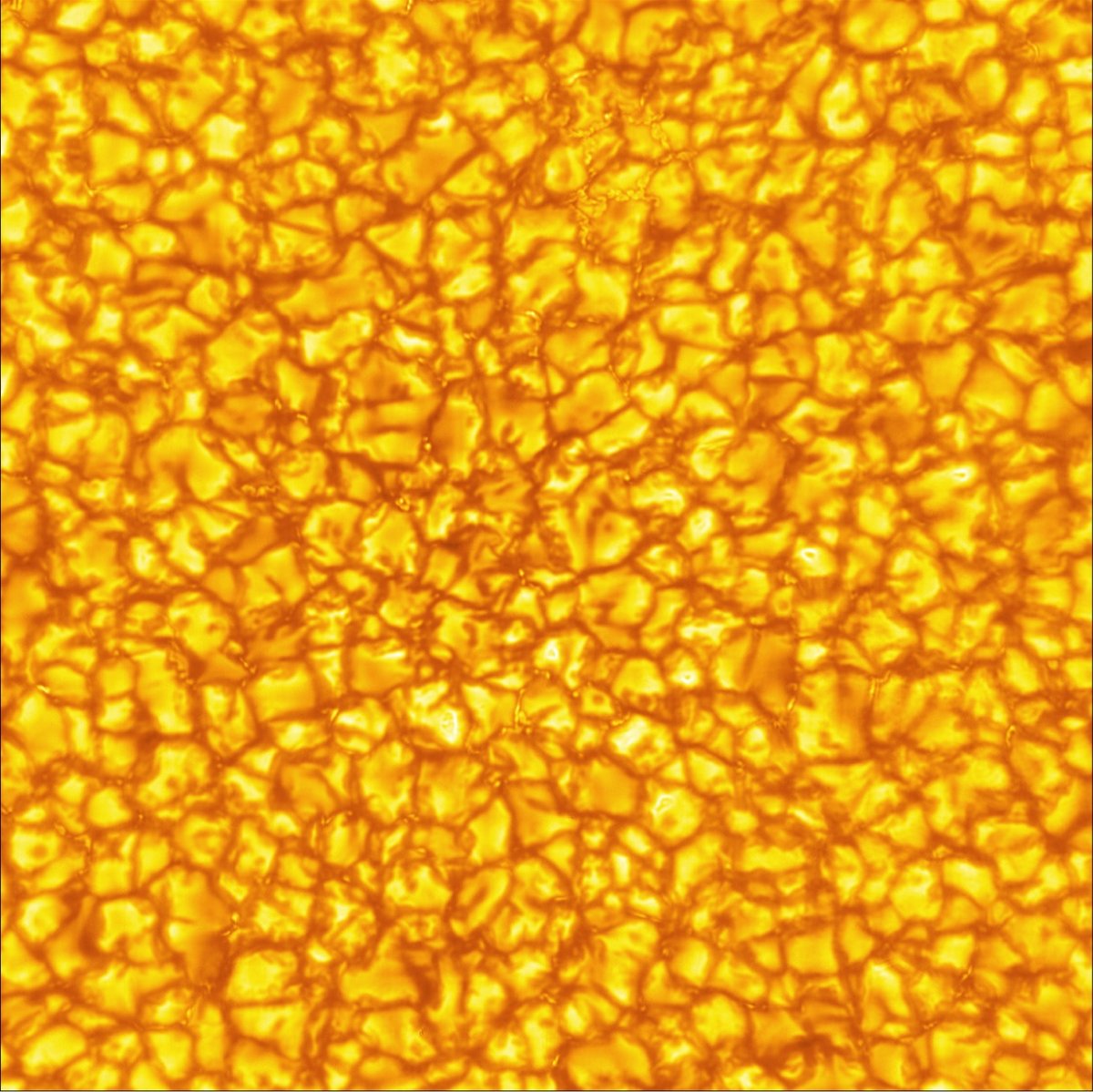
The Inouye Solar Telescope is the largest and most powerful solar telescope in the world. The telescope is still in a “learning and transitioning period” and not up to full operational speed, but scientists at the National Solar Observatory recently released a batch of images that hint at what it’s capable of. Several of the photos feature sunspots, cooler regions of the Sun with strong magnetic fields.
The sunspots pictured are dark and cool regions on the Sun’s “surface”, known as the photosphere, where strong magnetic fields persist. Sunspots vary in size, but many are often the size of Earth, if not larger. Complex sunspots or groups of sunspots can be the source of explosive events like flares and coronal mass ejections that generate solar storms. These energetic and eruptive phenomena influence the outermost atmospheric layer of the Sun, the heliosphere, with the potential to impact Earth and our critical infrastructure.
In the quiet regions of the Sun, the images show convection cells in the photosphere displaying a bright pattern of hot, upward-flowing plasma (granules) surrounded by darker lanes of cooler, down-flowing solar plasma. In the atmospheric layer above the photosphere, called the chromosphere, we see dark, elongated fibrils originating from locations of small-scale magnetic field accumulations.
(via petapixel)
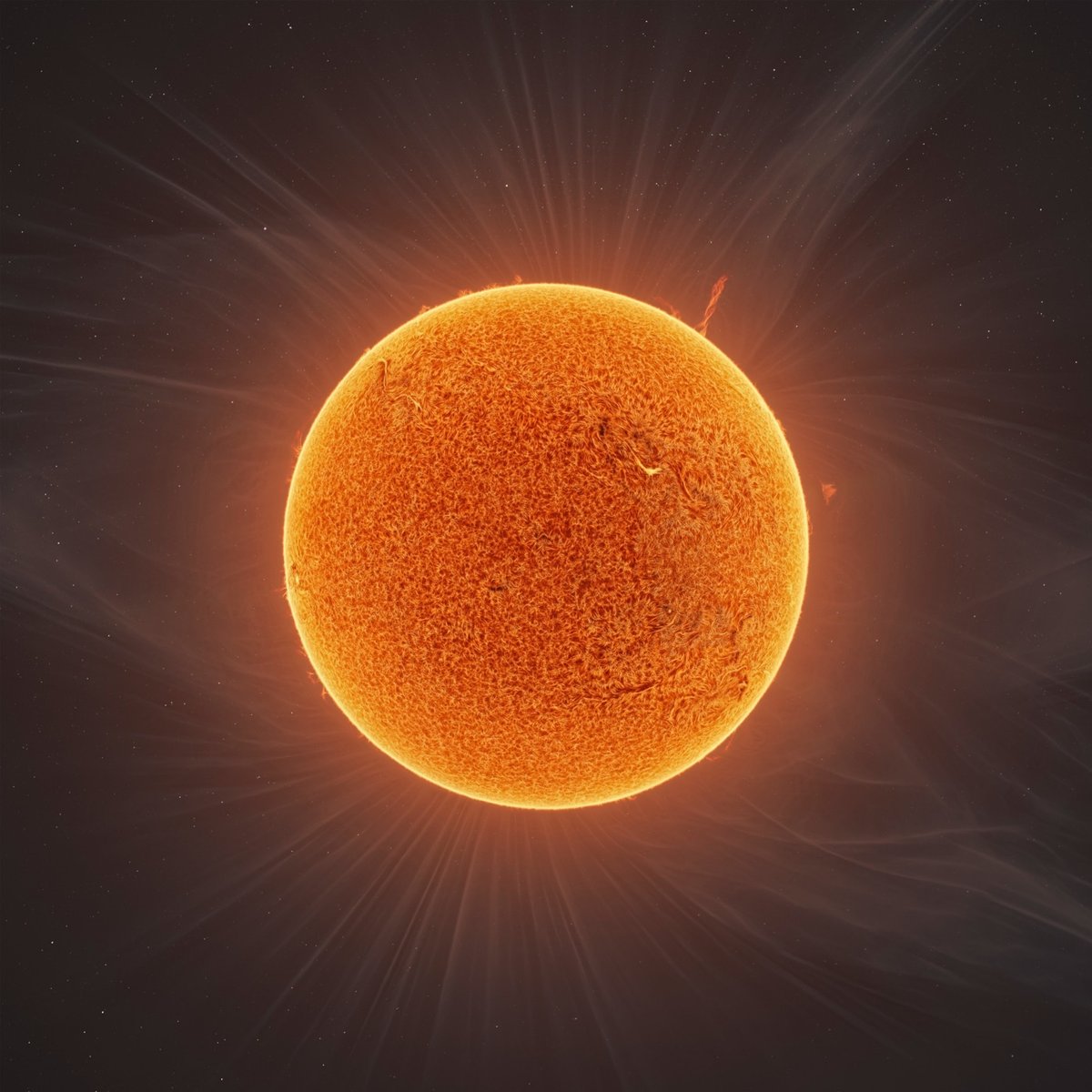
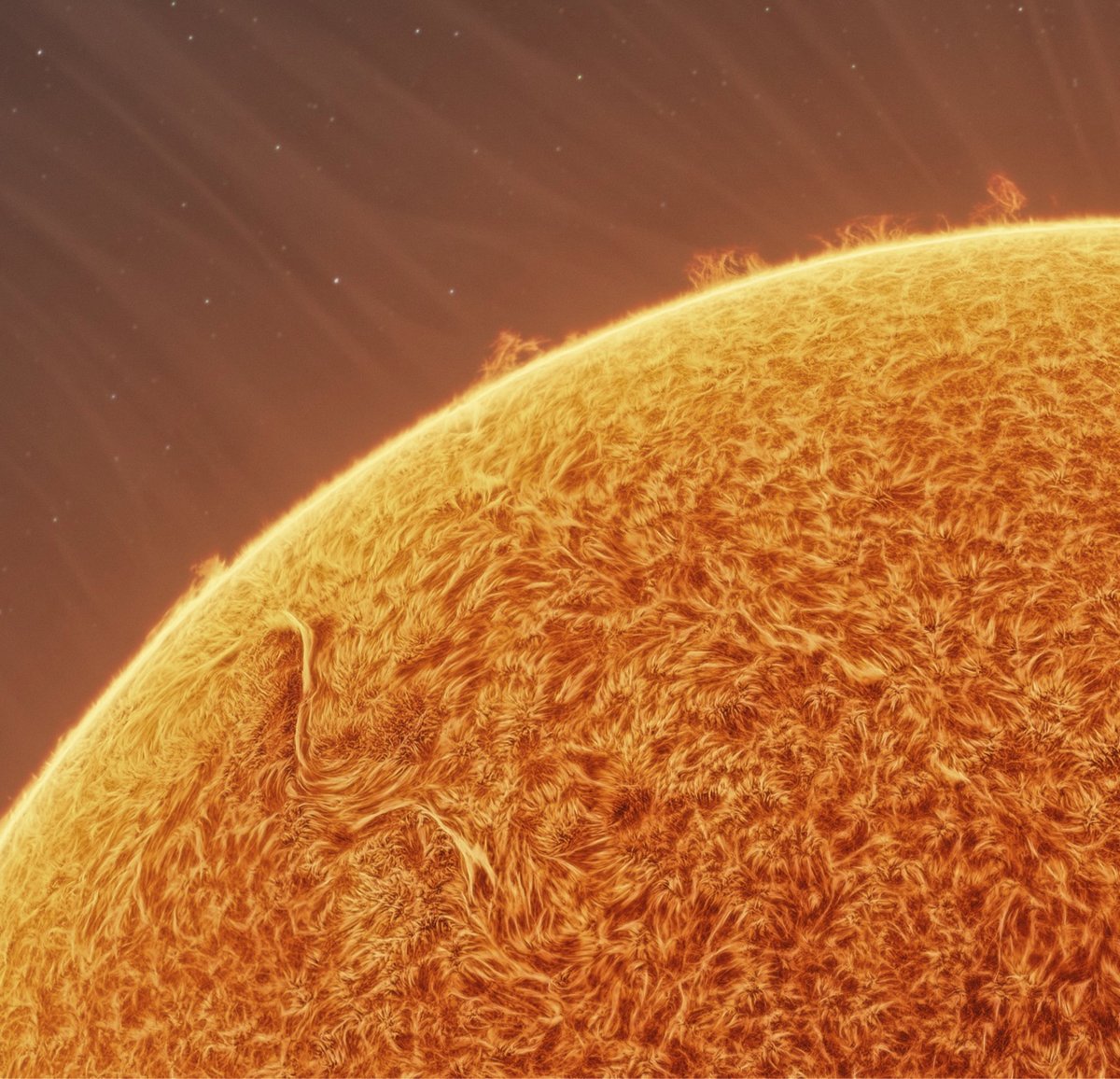
Good morning, sunshines! Well, amateur astrophotographer Andrew McCarthy has done it again. Collaborating with Jason Guenzel, he has produced this absolutely gobsmacking image of the Sun.
The aptly named “Fusion of Helios” is a fusion from the minds of two astrophotographers, Andrew McCarthy and Jason Guenzel. Using a custom-modified hydrogen alpha solar telescope, the combined data from over 90,000 individual images was jointly processed to reveal the layers of intricate details within the solar chromosphere. A geometrically altered image of the 2017 eclipse as an artistic element in this composition to display an otherwise invisible structure. Great care was taken to align the two atmospheric layers in a scientifically plausible way using NASA’s SOHO data as a reference.
I’ve included the full image and my favorite crop (the solar tornado the height of 14 Earths was a close second) above, but do yourself a big favor and check out the largest image available (which is still way smaller than the 140 megapixel final image they produced). If you’re curious about the process, here’s how McCarthy gets his Sun photos:
So how do I resolve atmospheric details, like spicules, prominences, and filaments? The trick is tuning the telescope to an emission line where these objects aren’t drown out by the bright photosphere. Specifically, I’m shooting in the Hydrogen-alpha band of the visible spectrum (656.28nm). Hydrogen Alpha (HA) filters are common in astrophotography, but just adding one to your already filtered telescope will just reduce the sun’s light to a dim pink disk, and using it without the aperture filter we use to observe the details on the photosphere will blind you by not filtering enough light. If you just stack filters, you still can’t see details. So what’s the solution?
A series of precisely-manufactured filters that can be tuned to the appropriate emission line, built right into the telescope’s image train does the trick! While scopes built for this purpose do exist (look up “coronado solarmax” or “lunt solar telescope” I employ a heat-tuned hydrogen alpha filter (daystar quark) with an energy rejection filter (ERF) on a simple 5” doublet refractor. That gives me a details up close look at our sun’s atmosphere SAFELY. I’ve made a few custom modifications that have helped me produce a more seamless final image, but am not *quite* yet ready to share them, but just the ERF+Quark on a refractor will get you great views.
Photography has always been a combination of technology, artistry, and wrangling whatever light you can get to best express the feeling that you’re going for — astrophotography certainly dials that wrangling up to 11.
Prints of this image (and some digital downloads) are available in various sizes from McCarthy and Guenzel.
Sure, the James Webb Space Telescope and ok, the Hubble, but the Solar Dynamics Observatory has to be right up there for producing some of the most jaw-dropping space photography around. This 4K video from NASA’s Goddard Space Flight Center condenses 133 days of the SRO’s observations of the Sun into a soothing hour-long time lapse.
See also The Highest Resolution Photo of the Sun Ever Taken, A Decade of Sun, Epic Time Lapse Videos of Mercury’s Transit of the Sun, and Thermonuclear Art.
This 360° time lapse video, filmed by meteorologist Witek Kaszkin in 2015, follows the never-setting Sun in a 24-hour trip around the sky above the Arctic Circle as the icy Arctic landscape is bathed in constant summer sunlight.
See also — and I may be burying the lede here — Kaszkin’s video of a total solar eclipse filmed from the same location. Wow. (via the kid should see this)

The European Space Agency’s Solar Orbiter recently took 25 images of the Sun from a distance of 46 million miles that, when stitched all together, form the highest resolution photo of the Sun (and its corona) ever created.
The high-resolution telescope of EUI takes pictures of such high spatial resolution that, at that close distance, a mosaic of 25 individual images is needed to cover the entire Sun. Taken one after the other, the full image was captured over a period of more than four hours because each tile takes about 10 minutes, including the time for the spacecraft to point from one segment to the next.
In total, the final image contains more than 83 million pixels in a 9148 x 9112 pixel grid. For comparison, this image has a resolution that is ten times better than what a 4K TV screen can display.
You can zoom in on the image here to see how remarkably detailed it is.
For the first time in human history, a spacecraft has flown through the Sun’s corona to collect data and capture samples (and, crucially, exited safely).
During the flyby, Parker Solar Probe passed into and out of the corona several times. This is proved what some had predicted — that the Alfvén critical surface isn’t shaped like a smooth ball. Rather, it has spikes and valleys that wrinkle the surface. Discovering where these protrusions line up with solar activity coming from the surface can help scientists learn how events on the Sun affect the atmosphere and solar wind.
Six panels of images taken from inside a coronal streamer. They appear grayish with white streaks showing particles in the solar wind.
At one point, as Parker Solar Probe dipped to just beneath 15 solar radii (around 6.5 million miles) from the Sun’s surface, it transited a feature in the corona called a pseudostreamer. Pseudostreamers are massive structures that rise above the Sun’s surface and can be seen from Earth during solar eclipses.
Passing through the pseudostreamer was like flying into the eye of a storm. Inside the pseudostreamer, the conditions quieted, particles slowed, and number of switchbacks dropped — a dramatic change from the busy barrage of particles the spacecraft usually encounters in the solar wind.
For the first time, the spacecraft found itself in a region where the magnetic fields were strong enough to dominate the movement of particles there. These conditions were the definitive proof the spacecraft had passed the Alfvén critical surface and entered the solar atmosphere where magnetic fields shape the movement of everything in the region.
The first passage through the corona, which lasted only a few hours, is one of many planned for the mission. Parker will continue to spiral closer to the Sun, eventually reaching as close as 8.86 solar radii (3.83 million miles) from the surface. Upcoming flybys, the next of which is happening in January 2022, will likely bring Parker Solar Probe through the corona again.
The video above provides a great overview of the origins, objectives, and motivations for the mission.
Older posts




Socials & More