The original Star Wars movie was a mashup. George Lucas and his collaborators pulled from everywhere: westerns, samurai movies, Flash Gordon, and a 1955 war film called The Dam Busters. This video shows just how closely the attack on the Death Star mirrors a scene from The Dam Busters of a group of bombers attacking a dam. The dialogue is identical in places. From the Dam Busters Wikipedia page:
Director George Lucas hired Gilbert Taylor, responsible for special effects photography on The Dam Busters, to be the director of photography for the film Star Wars. The attack on the Death Star in the climax of Star Wars is a deliberate and acknowledged homage to the climactic sequence of The Dam Busters. In the former film, rebel pilots have to fly through a trench while evading enemy fire and fire a proton torpedo at a precise distance from the target to destroy the entire base with a single explosion; if one run fails, another run must be made by a different pilot. In addition to the similarity of the scenes, some of the dialogue is nearly identical. Star Wars also ends with an Elgarian march, like The Dam Busters.
You can also watch Star Wars footage with Dam Busters audio and Dam Busters footage with Star Wars audio to see just how closely the two scenes match.
Given modern IP concerns and stakes, it’s difficult to envision this type of homage working today. Star Wars came out just 22 years after The Dam Busters, which is a beloved & acclaimed movie in Britain…it’s not obscure. Imagine a movie released in 2026 by a young Academy Award-nominated director that lifts a scene wholesale from a 2004 film like The Notebook, The Incredibles, Eternal Sunshine of the Spotless Mind, or Million Dollar Baby — it just wouldn’t happen without a lot of lawyerly conversation. I mean, maybe Lucas had those convos with The Dam Busters filmmakers… 🤷♂️
The first version of Star Wars that George Lucas showed publicly (to Steven Spielberg and Brian De Palma) was, as Spielberg later related, a mess. This video from RocketJump shows how Lucas and the film’s team of editors, particularly George’s then-wife Marcia Lucas, recut the film into the classic it is today. The beginning of the film was extensively reworked — some scenes were cut and others moved around to give the story more clarity. In other spots, small cutaway scenes were added to improve the flow, to explain plot details without expositional dialogue, and to smooth over rough transitions. And the drama of the end of the film was totally constructed in the editing phase by using off-screen dialogue and spliced-in scenes from earlier in the film.
There are greater examples of editing in other films, but Star Wars is such a known entity that this is a particularly persuasive take on just how important editing is in filmmaking. (via fairly interesting)
Vanity Fair’s David Kamp recently tried to get Kathleen Kennedy and Rian Johnson to tell him the meaning behind The Last Jedi, the title of the upcoming Star Wars movie. LOL. Hopeless move, right? Why would he even ask such a question? Oh, because George Lucas told him who the The Phantom Menace referred to before that movie came out.
Vanity Fair: So, do we know what the words The Last Jedi allude to?
Kathleen Kennedy: Why in the world do you think I would tell you that?
VF: I’ll tell you why. Back in 1998, I interviewed George Lucas for V.F. ahead of The Phantom Menace, and I asked, “Who or what is the phantom menace?” And he nonchalantly said, “Oh, it’s Darth Sidious.”
KK: Did he really?
VF: Just like that.
KK: I’m not going to do that.
VF: So, does the word “Jedi” work in the singular or the plural?
KK: That’s actually what’s interesting about the title, and very intentionally ambiguous.
VF: As you’re being right now.
KK: Yes.
Here’s the relevant passage from a piece written by Kamp and published in 1999:
Given that The Phantom Menace is a Vader- and Emperor-free movie, the role of evil string-puller falls to someone we’ve never heard of. “The phantom menace is a character named Darth Sidious,” Lucas says, “who is the last of the Sith” (“An ancient people… conquered by powerful dark-side Jedi magic”-page 268, Star Wars Encyclopedia, by Stephen J. Sansweet). Actually, Lucas goes on to explain, the “menace” honorific should be broadened to include Sidious’s apprentice, Darth Maul, a terrifyingly fierce-looking character played by the martial-arts expert Ray Park. Maul gets to fight a lightsaber battle with Obi-Wan, but Sidious remains a shadowy figure. “Nobody knows Darth Sidious exists,” says Lucas. “Well, he’s seen to the audience, but not to the players.”
Lucas appears to be firmly in the spoilers are fine camp.
A few years ago, Dan Harmon broke the structure of stories down into eight basic parts:
- A character is in a zone of comfort,
- But they want something.
- They enter an unfamiliar situation,
- Adapt to it,
- Get what they wanted,
- Pay a heavy price for it,
- Then return to their familiar situation,
- Having changed.
Calling himself a “corny screenwriting guru”, this is Harmon’s attempt to simplify Joseph Campbell’s concept of the monomyth, or hero’s journey.
A hero ventures forth from the world of common day into a region of supernatural wonder: fabulous forces are there encountered and a decisive victory is won: the hero comes back from this mysterious adventure with the power to bestow boons on his fellow man.
In the video above, Will Schoder explains Harmon’s theory using a number of different stories (movies, books, TV shows, etc.) as examples, most notably the original Star Wars, which George Lucas created using Campbell’s ideas.
1. There are SPOILERS in this post. If you have not seen the movie, do not continue reading. I’ve only read one other review of the movie, so much of this may be stated elsewhere (and better) by others.
2. Overall, I enjoyed the movie. But thinking back to The Phantom Menace, I also enjoyed that quite a bit in the same spine-tingling way. But this movie is way better than the prequels were.
3. The cast was excellent and the casting progressive. I love that the two new protagonists are a black man and a woman. “Why are you grabbing my hand?”
4. Carrie Fisher’s voice has changed a lot. It suited her character.
5. By far the best part of the movie at the showing I went to didn’t appear on screen. I went to a matinee at 11am and the audience was mostly adults…probably 98% over the age of 30. When Rey uses the Force to persuade the Stormtrooper to release her, a little kid’s voice from the front row echoed out loudly across the entire theater: “Jedi mind trick”. The place exploded in laughter. A perfect comedic moment.
6. How many times are they going to keep making the same movie though? The plots of A New Hope, Return of the Jedi, and The Force Awakens are more or less the same: a small band of resistance fighters going up against an evil superpower headed by two practitioners in the Dark Side discover a weakness in the enemy’s planet-sized superweapon and destroy it with some X-wing fighters in the nick of time. Also: stolen plans in a droid, a young orphan discovering the ways of the Force, a trench run by a gifted young pilot to blow up the superweapon, a bailing-out of the X-wing fighters by the crew of the Millennium Falcon, sons/students striking down their fathers/masters, and so on. Is this part of the reason that Empire Strikes Back is considered the best of the series, because it’s different?
7. When Lucas made the first trilogy (and when he and Spielberg made Raiders of the Lost Ark), he constructed it from a bunch of different sources from when he was a kid and in film school. With The Force Awakens, JJ Abrams did the same thing, but instead of pulling from Flash Gordon and Kurosawa like Lucas did, he pulled from what he grew up with as a kid and in film school…Star Wars and Spielberg. In a way, The Force Awakens is a reboot of the original 1977 Star Wars, similar plot and all. And even if it isn’t a true reboot, it sure does rhyme.
8. Aside: when is the Empire/First Order going to learn not to put all of their eggs in one basket? Their superweapon strategy has failed three times now. They always seem to know where the rebels are hiding, they possess overwhelming force…why don’t they just defeat them through conventional means?
9. More synchronicity. When I watched the original Star Wars as an adult, one of the things I noticed is what a relatively minor character Vader is in the Empire when compared to his importance to the story and his increased power & responsibility in Empire and Jedi. He’s not in command, he’s not really part of the military at all, and the military leaders aren’t all that impressed with The Force. It’s almost almost like he’s the Emperor’s personal assistant. Kylo Ren’s role in The Force Awakens is similar…he’s not in charge (General Hux is), he’s not really part of the military (although he commands troops), and according to Snoke, Ren hasn’t even completed his training. (What was Vader’s excuse, then? He presumably completed his training long before the events of A New Hope…what was taking him so long to gain power?)
10. The scene at the very end bugged me. Having discovered the whereabouts of Luke Skywalker, the last of the Jedi, the Resistance sends Ren, Chewy, and R2 to see what’s up? I get the symbolism and all, but wouldn’t Leia be interested in seeing her brother again? Or more persuasive in getting him to come out of retirement?
11. We’re going to hear more about Rey’s parentage, right? She’s Luke’s daughter or something? (I’m guessing not. Waaay too obvious, even for Star Wars.)
12. Speaking of parentage, why is Snoke so big? So we’re not wondering if Rey is Snoke’s granddaughter or something? Or is it that Snoke’s hologram is big and he’s normal sized? (Wookiepedia says Snoke is 7 feet tall but doesn’t cite a source.)
13. If you liked this movie, you have to give the proper credit to George Lucas for allowing it to exist. He could have sat on this series until after his death and beyond. But he didn’t. He sold the whole shebang to Disney and trusted Kathleen Kennedy to make more movies.
14. Ok, Kennedy. Now I want to see Quentin Tarantino’s Star Wars. Wes Anderson’s Star Wars. Miranda July’s Star Wars. Seriously, do this. (I do not want to see Kevin Smith’s Star Wars. That one you can keep.)
15. All theaters should have assigned seating. I got the exact two seats I wanted (two months ahead of time) and showed up to the theater about 10 minutes before showtime, sat down, and the lights went down soon after. So much less stress than getting there 45 minutes (or 2 hours) beforehand and playing Are These Seats Taken? with strangers.
Update: 16. Does Han’s death scene reference the cantina scene w/ Greedo in Episode IV? He and Ren are both holding the lightsaber. Ren tells Han he needs to do something but doesn’t know if he can go through with it. Ren asks Han to help. The lightsaber activates and Han dies. Does Han activate the lightsaber, thereby causing his death? In other words, does Han shoot first? (Bonus update: I just saw the movie again and I don’t think Han activates the lightsaber. He looks too surprised and Ren definitely thrusts the saber into him.)
Update: 17. In his belated review, Chris Blattman notes the remarkable agreement on the lack of spoilers on social media:
Humanity’s tacit agreement to abide by a no-spoilers-on-social-media rule was one of the greatest acts of social cooperation I have witnessed. And we used it up to keep you from learning Han Solo is killed.
George Lucas says he had nothing to do with The Force Awakens and furthermore that the movie was not done the way he would have done it.
“The issue was ultimately, they looked at the stories and they said, ‘We want to make something for the fans,’” Lucas said. “People don’t actually realize it’s actually a soap opera and it’s all about family problems — it’s not about spaceships. So they decided they didn’t want to use those stories, they decided they were going to do their own thing so I decided, ‘fine…. I’ll go my way and I let them go their way.’”
Soooooooooooooooo, if Star Wars is a family story, why did you make it about spaceships and special effects?
In his recent book, How Star Wars Conquered the Universe, Chris Taylor tells the story of how avant garde cinema fan George Lucas built one of the biggest movie franchises ever.
How did a few notes scribbled on a legal pad in 1973 by George Lucas, a man who hated writing, turn into a four billion dollar franchise that has quite literally transformed the way we think about entertainment, merchandizing, politics, and even religion? A cultural touchstone and cinematic classic, Star Wars has a cosmic appeal that no other movie franchise has been able to replicate. From Jedi-themed weddings and international storm-trooper legions, to impassioned debates over the digitization of the three Star Wars prequels, to the shockwaves that continue to reverberate from Disney’s purchase of the beloved franchise in 2012, the series hasn’t stopped inspiring and inciting viewers for almost forty years. Yet surprisingly little is known about its history, its impact — or where it’s headed next.
(via mr)
Yesterday I posted a video looking at the influence of Akira Kurosawa on Star Wars. Well, Michael Heilemann has posted an amazing feature-length exploration of Star Wars and the films that influenced it.
It’s not Heilemann talking about anything…it’s a sort of meta-Star Wars comprised of dozens of elements from other films that influenced Lucas in making it. For instance, here’s the opening crawl from Forbidden Planet (1956):
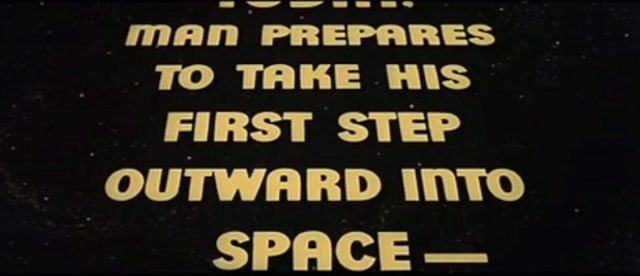
Heilemann also includes a crawl from a 1936 Flash Gordan serial. For more, check out Kitbashed, particularly the extensive ebook on Star Wars sources.
Wow. In 1978, George Lucus gathered together Steven Spielberg and screenwriter Lawrence Kasdan to go over ideas for a film Lucas had wanted to make about a swashbuckling archeologist, i.e. Raiders of the Lost Ark. Their sessions were recorded and there’s a transcript available online.
Lucas - Now, several aspects that we’ve discussed before: The image of him which is the strongest image is the “Treasure Of Sierra Madre” outfit, which is the khaki pants, he’s got the leather jacket, that sort of felt hat, and the pistol and holster with a World War One sort of flap over it. He’s going into the jungle carrying his gun. The other thing we’ve added to him, which may be fun, is a bull whip. That’s really his trade mark. That’s really what he’s good at. He has a pistol, and he’s probably very good at that, but at the same time he happens to be very good with a bull whip. It’s really more of a hobby than anything else. Maybe he came from Montana, someplace, and he… There are freaks who love bull whips. They just do it all the time. It’s a device that hasn’t been used in a long time.
Spielberg - You can knock somebody’s belt off and the guys pants fall down.
Lucas - You can swing over things, you can…there are so many things you can do with it. I thought he carried it rolled up. It’s like a Samurai sword. He carries it back there and you don’t even notice it. That way it’s not in the way or anything. It’s just there whenever he wants it.
Spielberg - At some point in the movie he must use it to get a girl back who’s walking out of the room. Wrap her up and she twirls as he pulls her back. She spins into his arms. You have to use it for more things than just saving himself.
Lucas - We’ll have to work that part out. In a way it’s important that it be a dangerous weapon. It looks sort of like a snake that’s coiled up behind him, and any time it strikes it’s a real threat.
Kasdan - Except there has to be that moment when he’s alone with a can of beer and he just whips it to him.
Patrick Radden Keefe at the New Yorker read through the whole thing and has some highlights and general thoughts.
Over the intervening decades of enormous wealth and success, both Lucas and Spielberg have carefully tended their public images, so there is a voyeuristic thrill to seeing them converse in so unguarded a manner. As the screenwriters Craig Mazin and John August pointed out recently on the Scriptnotes podcast, one delight of reading the transcript is watching Spielberg throw out bad ideas, and then noting how Lucas gently shuts him down. Spielberg, who had sought to direct a Bond movie-and, astonishingly, been rejected-thought that their hero should be an avid gambler. Lucas replied that perhaps they shouldn’t overload him with attributes. (Lucas himself had briefly entertained, then mercifully set aside, the notion that his archaeologist might also be a practitioner of kung fu.) There’s a good reason we seldom get to spy on these conversations: really good spitballing, like improv comedy, requires a high degree of social disinhibition. So the writers’ room, like a therapist’s office, must remain inviolable.
(via @jcn)



Socials & More