kottke.org posts about physics
This is so cool: in the early 1900s, a mechanical engineer named Louis Brennan invented a self-balancing train that ran on a single track. This video demonstrates how the train worked using a clever system of gyroscopes.
This is the Brennan Monorail, a train from the early 1900s that seemed to defy the laws of physics. Not only did it keep itself perfectly balanced on a single rail, but it mysteriously leaned into corners without any driver input.
It’s kind of incredible how well Brennan’s system worked. It’s ingenious. (via messy nessy)
Physicist Sean Carroll leads off this video with this line:
I like to say that Einstein is, if anything, underrated as a physicist, which is hard to imagine given how highly he is rated.
And then leads us through a history of modern physics and quantum mechanics that, Einstein and Newton aside, is much more collaborative than you often hear about.
This idea that there are many people contributing and many different parts of the pieces need to put together is actually much more characteristic of how physics is usually done than the single person inventing everything all by themselves.
Bees use polarized sunlight scattered by the atmosphere in order to navigate; they always know where the sun is, even if it’s cloudy or behind a mountain. Then they waggle dance to inform their hive-mates about food source locations.
So if a bee wants to fly straight towards the sun, it waggles straight up the hive. If the food is 30° away from that polarization line, it waggles 30° away from vertical. If the food is directly away from the sun, it waggles downward.
And the distance they should fly is encoded on how long the waggle lasts. It depends on the species of bee, but a waggle of about 1 second means about a kilometer away. So a 45° waggle for about 0.6 seconds means fly at 45° angles from the sun polarization line for about 600 meters.
The bee repeats this waggle dance over and over. And the more excited the dance, the better the food source. And if other bees verify it and perform the same dance, the signal gets amplified until the whole hive knows where to go.
As shown in this video, it’s possible to construct an optical compass using polarized filters in order to wayfind like the bees. Pretty cool! (via damn interesting)
The latest video from Kurzgesagt imagines a scenario in which an advanced civilization called the Noxans can potentially survive the heat death of the universe.
With five hours of the full energy emitted by the Sun, we could power present day humanity for about 10 billion years.
So the Noxans harvest the last stars and build a gigantic complex of batteries around their home star. In principle, this energy could keep them alive for a few hundred trillion years, a long time but not even close to forever.
So now the hard part of the plan begins. The Noxans need to change the nature of life itself.
Steve Mould is always informative and entertaining, so I started watching his video on building the world’s tallest siphon, nodding along to what I thought was the reasonable conclusion. And then the video kicked into another gear — because with science, the simple solution is not always the whole story when extreme conditions are in play. (via the kid should see this)
In the most recent episode of Howtown, Joss Fong explains how above-ground nuclear testing in the 50s and 60s left a signature in all life on Earth that can be used as a forensic tool for catching art forgers, shady ivory dealers, and even fraudulent wine sellers/cellars.
In the 1950s and early 1960s, the United States and the Soviet Union (with contributions from the UK and France) conducted a series of above-ground nuclear tests that led to an increase in the radioactive carbon-14 concentration in the atmosphere. This global surge, known as the “bomb pulse” or the “bomb spike”, is one of the most distinctive chemical signatures of the Cold War. The radiocarbon spread worldwide, embedding into plants, animals, and humans.
Scientists later discovered that this bomb-pulse radiocarbon spike could be used as a precise dating tool. Bomb-pulse dating allows researchers to determine whether biological material formed before or after nuclear testing. This method has been applied to forensic science, medical research, and environmental monitoring. It has been used to identify forgeries in artwork, measure human cell turnover, and estimate the lifespan of Greenland sharks.
One of the most important applications has been in tracking the illegal ivory trade. Elephant tusks absorb atmospheric carbon while the animal is alive. By analyzing the carbon-14 content of ivory artifacts or raw ivory, investigators can determine whether the material comes from a legally antique source or from a recently killed elephant.
This intersection of nuclear history, atmospheric science, and conservation biology demonstrates how Cold War nuclear fallout became a forensic tool for fighting elephant poaching and wildlife trafficking. More broadly, it demonstrates the creativity and resourcefulness of scientific researchers, who find ingenious uses for datasets of unlikely origin.
A question from a viewer of XKCD’s What If? series: “What would happen if the Moon were replaced with an equivalently-massed black hole? And what would a lunar (“holar”?) eclipse look like?” The answer to the first part of the question is: not that much. But the explanation of why that is is fascinating.
It’s worth reading the comments on the post as well…XKCD brings out the nerds and their interesting observations:
Imagine if a species grew up on a planet that had a black hole moon the mass of the moon. They’d have tides, they’d have an unobstructed view of the night sky, and they’d have no clue about this behemoth out there and would be unable to explain these bizarre perturbations in Earth’s orbit when they finally worked out Earth’s orbit.
EDIT: To everyone mentioning lensing effects: no. The eye can discern about 1 arc minute which at the distance of the moon is 280km. The lensing effect is detectable generally about double the event horizon. If the event horizon is about the size of a grain of sand, doubling it is not going to come close to being detectable with the naked eye from Earth. It is probably safe to assume that the same would be true of captured dust — that the particle size is too small to be detectable to the naked eye.
Another commenter points out that the video never explicitly answers the second question:
It never answered the part of the question about the eclipse. A grain of sand passing in front of the sun wouldn’t be visible, but if it’s a black hole, would lensing effects do anything weird?
The consensus in the comments seems to be that the effect would be minor and nearly imperceptible:
Lensing is dependent on two things: Mass of the object around which light passes, and how close by light passes. Since the black hole is one lunar mass, a very small mass on gravitational level, the lensing would be minor. Light could get a lot closer to the black hole, though. You might see a very slight “shimmer” at the edge of the sun when the black hole passes by the edge, but not much more than that. If the black hole happened to perfectly pass in front of a star that you’re observing with a telescope, you might very very briefly see a small ring instead of a point of light, but that’s about it.
Science!
In this video, musician Armin Küpper performs a saxophone duet with the echo of his past self by playing near the end of a large pipe. That’s pretty cool. And it’s also a learning opportunity! Hey wait, come back…you haven’t finished your bowl of physics yet:
What you hear after each note is an echo, a sound wave reflecting off the far end of the pipe and traveling back to him.
Sound travels at around 343 meters per second (1,235 km/h or 767 mph) through air. In this video, the echo takes about 1.5 seconds to return. That means the reflected sound traveled about 514.5 meters (1,688 feet) round-trip, so the end of the pipe is at around 257 meters (843 ft) away.
It seems more like a second to me (so ~563 feet), but whatever…still cool.
TIL I learned about gravastars (aka a gravitational vacuum star), theoretical objects related to black holes. Both are massive & dense, but instead of a singularity surrounded by an event horizon, gravastars are made up of dark energy surrounded by a extremely thin shell of exotic matter.
The shell of the gravastar is utterly dark and the coldest thing in the universe, only a billionth of a degree above absolute zero. If we look at it in deep infrared, even the cosmic microwave background glows bright in comparison. It is made from an entirely new, unique and extreme matter that is at the very limit of what is physically possible in nature and doesn’t have a name yet. Actually, the shell is so incredibly thin that atoms seem truly gigantic next to it.
In this video, Sara Saadouni explains the three passive cooling techniques used by fellow architect Diébédo Francis Kéré in designing a school building in Burkina Faso, where temperatures can be quite warm all year. The roof is especially clever.
He introduced a curved double roof that created an air gap between the first and second roof. As the heat naturally rises and escapes into the gap, the prevailing winds quickly carry it away, accelerating this process and cooling the building more efficiently.
But that’s not all. The first roof is made up of perforated ceiling slabs, allowing the heat to escape more efficiently and therefore to be quickly transported by the wind.
The other genius idea was to also curve the roof, which allowed for the Venturi effect — a phenomenon where air speeds up as it moves through the narrower sections created by the curve and therefore boosting natural ventilation.
(via the kid should see this)
So we all know the color purple has always been associated with royalty because the dye used to make it was extremely limited because you could only get it from the Phoenician city of Tyre where a tiny snail lived. Dye makers had to “crack open the snail’s shell, extract a purple-producing mucus and expose it to sunlight for a precise amount of time,” and it took 250K snails to make an ounce of dye. But did we know purple isn’t like all the other colors?
Most of you here probably know that our perception of color comes down to physics. Light is a type of radiation that our eyes can perceive, and it spans a certain range of the electromagnetic spectrum. Individual colors are like building blocks in white light: they are subdivisions of the visible spectrum. For us to perceive an object as being of a certain color, it needs to absorb some of the subdivisions in the light that falls on it (or all of them, for black). The parts it reflects (doesn’t absorb) are what gives it its color. But not so for purple, because it is a non-spectral color.
Hahahah. Yessssss. Pound sand, Harold!
A pair of physicists from MIT and Jefferson Lab and an animator have created a new visualization of the atomic nucleaus.
For the first time, the sizes, shapes and structures of nuclei in the quantum realm are visualized using animations and explained in the video.
The video also establishes what appears to be a new unit of measure with an adorable name, the babysecond:
To better define the velocities of particles at such small distance scales, we establish the baby second as 10^-23 seconds. A photon moving at the speed of light crosses three femtometers (a bit more than the radius of oxygen-16) in one baby second.
In a collaboration with Red Bull & Prada (uh, ok) and with the help of the Polish State Railways, Dawid Godziek rode a mountain bike on a ramps course on top of a moving train, performing tricks & flips between cars. The train and rider moved at the same speed in opposite directions, which made it seem as though, from the perspective of someone on the ground next to the train, that the rider is nearly horizontally stationary.
The result is trippy & counterintuitive and also a demonstration of Newton’s laws of motion & frames of reference. But since Godziek was not riding in a vacuum, there were some real world details to contend with:
We observed something interesting — the lack of air resistance. In theory, this could have made it easier, but the opposite was true. The air resistance creates a tunnel that somehow keeps me in a straight line and doesn’t allow me to shift right or left. Luckily on the recordings we had, the headwind gave me artificial air resistance, which helped me to get a feel for the flight on classic hops. On the tests, the wind was blowing weaker or in a different direction, making shooting tricks difficult. Not bad, right? We’re always complaining about air resistance, and when it wasn’t there, we found that it was impossible to fly without it.
See also Mythbusters shooting a soccer ball out of the back of a moving truck.
The folks at Kurzgesagt have done a few time travel videos now, but this one is notable for its concise, intuitive explanation and visualization of our constant speed through spacetime (special relativity).
Everything in our universe moves at the speed of light through four dimensional spacetime. Your speed through spacetime is the sum of your separate speeds through time and space. It is impossible for you to stay still. Even if you are not moving through space dimensions, you are moving through the time dimension, blasting face first into the future.
You can slow down in the time dimension, by moving faster through the space dimensions but in total, you will always move at the speed of light through spacetime.
And you can “trade” moving through space for moving through time: “Move faster through space, go slower in time. Move slower through space, go faster in time.” Or as a commenter put it:
Your speed is constant. So the faster you move through the space dimensions, the slower you move through the time dimension, and vice versa.
Not sure this textual explanation makes as much sense as the visualization in the video, so maybe just watch that? Oh, and check out the sources for the video.
Kurzgesagt attempts to answer the question (from the perspective of physics): Do we have free will? Here’s the deterministic perspective (from the show notes):
Now imagine that if right after the Big Bang, a supersmart supercomputer looked at every single particle in the universe and noted all their properties. Just by applying the deterministic laws of physics, it should be able to predict what all the particles in existence would be doing until the end of time.
But if you are made of particles and it’s technically possible to calculate what particles will do forever, then you never decided anything. Your past, present and future were already predetermined and decided at the Big Bang. This would mean there is a kind of fate and you are not free to decide anything.
You may feel like you make decisions, but you are on autopilot. The motions of the particles that make up your brain cells that made you watch this video were decided 14 billion years ago. You are just in the room when it happens. You are only witnessing how the universe inside you unfolds in real time.
And the other side of the argument (in favor of free will):
We know that we can reduce everything that exists to its basic particles and the laws that guide them. While this makes physics feel like the only scientific discipline that actually matters, there is a problem: You can’t explain everything in our universe only from particles.
One key fact about reality that we can’t explain by looking just at electrons and quantum stuff is emergence. Emergence is when many small things together create new fundamental traits that didn’t exist before.
Emergence occurs at all levels of reality, and reality seems to be organized in layers: atoms, molecules, cells, tissues, organs, you, society. Put many things in one layer together and they’ll create the next layer up. Every time they do, entirely new properties emerge.
Having thought about this for all of 20 minutes (or, practically all of my life), the emergence argument against determinism makes a lot of sense to me. Then again, James Gleick’s Chaos and Steven Johnson’s Emergence both made a huge impression on me when I read it more than 20 years ago.
Kurzgesagt is back with another video about black holes; it has the innocuous-seeming title of The Easiest Way To Build a Black Hole. But the main topic of the video is the speculation that universes (like ours!) might exist within black holes.
Black holes might create infinite universes while destroying time and space. Everything in existence could be black holes, all the way down. We might live inside a black hole that is inside a black hole, that is inside a black hole. But let’s start at the beginning and build a black hole out of air.
This one is a bit of a brain-bender. From the show notes:
The first part of the script is based on the empirical fact that, somewhat intriguingly, the observable universe seems to have the exact size and mass that would be required to make a black hole as big as the observable universe itself.
The second, completely independent proposal we explore is the idea that our Universe could be born from the singularity of a black hole, and that in turn the universe that contains that black hole could be born from a black hole itself. If so, universes in later generations of this process could be better fitted to produce an abundance of black holes, in a sort of “natural selection” towards efficient black hole production.
NASA used one of their supercomputers to model what it would look like if you flew into a supermassive black hole. (You can watch the simulation in a 360° view on YouTube. I bet it looks great on a VR rig like Apple Vision Pro.)
The movies begin with the camera located nearly 400 million miles (640 million kilometers) away, with the black hole quickly filling the view. Along the way, the black hole’s disk, photon rings, and the night sky become increasingly distorted — and even form multiple images as their light traverses the increasingly warped space-time.
In real time, the camera takes about 3 hours to fall to the event horizon, executing almost two complete 30-minute orbits along the way. But to anyone observing from afar, it would never quite get there. As space-time becomes ever more distorted closer to the horizon, the image of the camera would slow and then seem to freeze just shy of it. This is why astronomers originally referred to black holes as “frozen stars.”
At the event horizon, even space-time itself flows inward at the speed of light, the cosmic speed limit. Once inside it, both the camera and the space-time in which it’s moving rush toward the black hole’s center — a one-dimensional point called a singularity, where the laws of physics as we know them cease to operate.
“Once the camera crosses the horizon, its destruction by spaghettification is just 12.8 seconds away,” Schnittman said. From there, it’s only 79,500 miles (128,000 kilometers) to the singularity. This final leg of the voyage is over in the blink of an eye.
Black holes: so cool. (via the kid should see this)
Using a scale model of the solar system the size of New York City and some dazzling visual effects, Epic Spaceman explains that black holes are generally smaller than you might think (because they’re so dense) — even the supermassive black hole at the center of our galaxy. But when you consider some of the biggest black holes we’ve discovered…wow.
Is the universe finite or infinite? If finite, what shape is it and how does that shape influence its overall size and properties? If it’s infinite, what meaning of “expanding” can be applied to it? I don’t know if this video provides any satisfying answers, but even being able to ponder these questions is thrilling.
Infinity gets much weirder though. As you travel with your spaceship in a straight line, you find new galaxies, stars and planets, new wonders, new weird stuff, probably new aliens and new lifeforms stranger than you could ever imagine. But after a long time, you might find the most special thing in the universe: Yourself. An exact copy of you watching this video right now.
How can that be? Well, everything in existence is made of a finite amount of different particles. And a finite number of different particles can only be combined in a finite number of ways. That number may be so large that it feels like infinity to our brains — but it is not really. If you have finite options to build things, but infinite space that is full of things in all directions forever, then it makes sense that by pure chance, there will likely be repetition.
Kurzgesagt’s latest video on the paradox of time is a bit more of a brain-bender than their usual videos. From the accompanying sources document:
This video summarizes in a narrative format two well-known theories about time: the so-called “block universe” and the “growing block”.
The block universe is an old theory of time which appears to be an unavoidable consequence of Einstein’s theory of special relativity. In philosophical contexts, basically the same idea is known as “eternalism”. Simplified, this theory posits that, although not apparent to our human perception, both the past and the future exist in the same way as the present does, and are therefore as real as the present is: The past still exists and the future exists already. As a consequence, time doesn’t “flow” (even if it looks so to us) and things in the universe don’t “happen” - the universe just “is”, hence the name “block universe”.
But then: “Quantum stuff is ruining everything again.” And so we have the growing block theory:
The Evolving/Growing Block: A relatively new alternative to the classical block universe theory, which asserts that the past may still exist but the present doesn’t yet, and all that in a way that is still compatible with Einstein’s relativity.
And there are still other theories about how time works:
Some scientists think that the idea of “now” only makes sense near you, but not in the universe as a whole. Others think that time itself doesn’t even exist — that the whole concept is an illusion of our human mind. And others think that time does exist, but that it’s not a fundamental feature of the universe. Rather, time may be something that emerges from a deeper level of reality, just like heat emerges from the motion of individual molecules or life emerges from the interactions of lifeless proteins.
Like I said, a brain-bender.
In a video for the Royal Society, physicist Brian Cox explains the science of snowflakes, from how they form to where their shape and symmetry comes from. Plus this bombshell: “Snowflakes aren’t actually white.” (via aeon)
In their latest video, Kurzgesagt takes a break from their more serious topics to consider a scenario from the realm of science fiction: interstellar combat. Using technology that is theoretically available to us here on Earth, could a more advanced civilization some 42 light years away destroy our planet without any warning? They outline three potential weapons: the Star Laser, the Relativistic Missile, and the Ultra-Relativistic Electron Beam.
Here’s what I don’t understand though: how would the targeting work? In order for an alien civilization to hit the Earth with a laser from 42 light years away, it has to not only predict, within a margin of error of the Earth’s diameter, precisely where the Earth is going to be, but also have a system capable of aiming across 42 light years of distance with that precision. Is this even possible? How precisely do we know where the Earth is going to be in 42 years? And if you’re aiming at something 42 light years away, if you move the sights a nanometer, how much angular distance does that shift the the destination by? And how much does the gravity of matter along the way shift the trajectory and is it possible to accurately compensate for that? Maybe this should be their next video…
If you look closely at a rainbow made from sunlight (e.g. through a prism or an actual rainbow), you’ll notice that some of the colors are missing. It turns out that these absent colors (called Fraunhofer lines) have something to do with the types of elements that are present in the Sun (and the Earth’s atmosphere). Dr. Joe Hanson explains in the video above.
Over 200 years ago, scientists were looking at sunlight through a prism when they noticed that part of the rainbow was missing. There were dark lines where there should have been colors. Since then, scientists have unlocked the secrets encoded in these lines, using it to uncover mind-boggling facts about the fundamental nature of our universe and about worlds light-years away.
Science is fascinating…Fraunhofer lines can tell us something about objects and processes all along the Powers of Ten scale, from the inner workings of the atom to the composition of the Earth’s atmosphere to how quickly the universe is expanding or contracting.
If you’d like to check out the missing parts of the rainbow for yourself, you can make this DIY spectroscope using a CD or DVD and a few other items. (via the kid should see this)
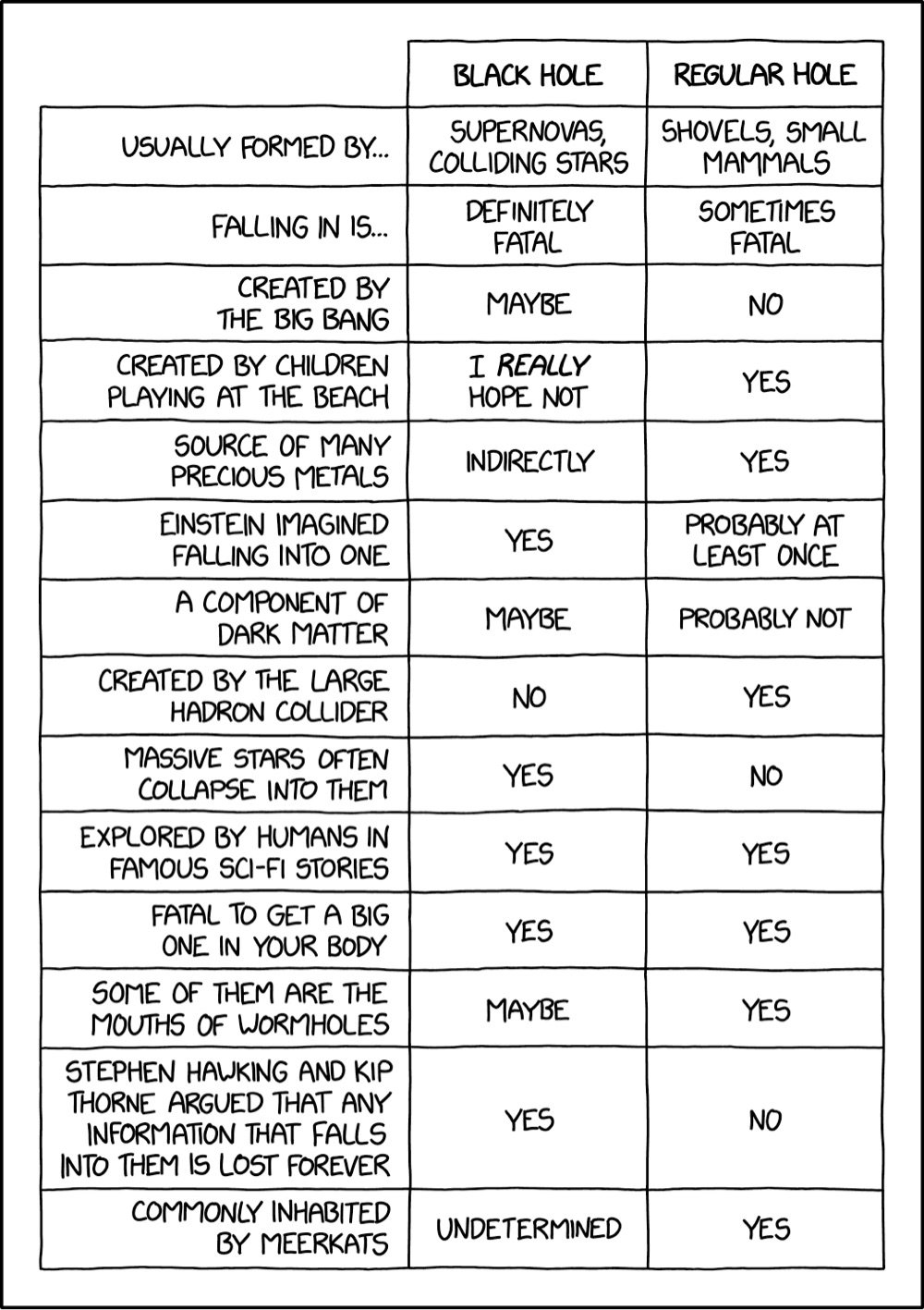
From XKCD, a comparison chart that shows how black holes and regular holes measure up to one another. Some of these are pretty clever: “some of them are the mouths of wormholes”.
Erik Wernquist made his short film One Revolution Per Minute to explore his “fascination with artificial gravity in space”. The film shows what it would be like to travel on a large, circular space station, 900 meters (0.56 miles) in diameter that rotates a 1 rpm. Even at that slow speed, which generates 0.5 g at the outermost shell, I was surprised to see how quickly the scenery (aka the Earth, Moon, etc.) was rotating and how disorienting it would be as a passenger.
Realistically - and admittedly somewhat reluctantly — I assume that while building a structure like this is very much possible, it would be quite impractical for human passengers.
Putting aside the perhaps most obvious problem with those wide windows being a security hazard, I believe that the perpetually spinning views would be extremely nauseating for most humans, even for short visits. Even worse, I suspect — when it comes to the comfort of the experience — would be the constantly moving light and shadows from the sun.
I calculated that the outer ring of the space station is moving at 105.4 mph with respect to the center. That’s motoring right along — no wonder everything outside is spinning so quickly.
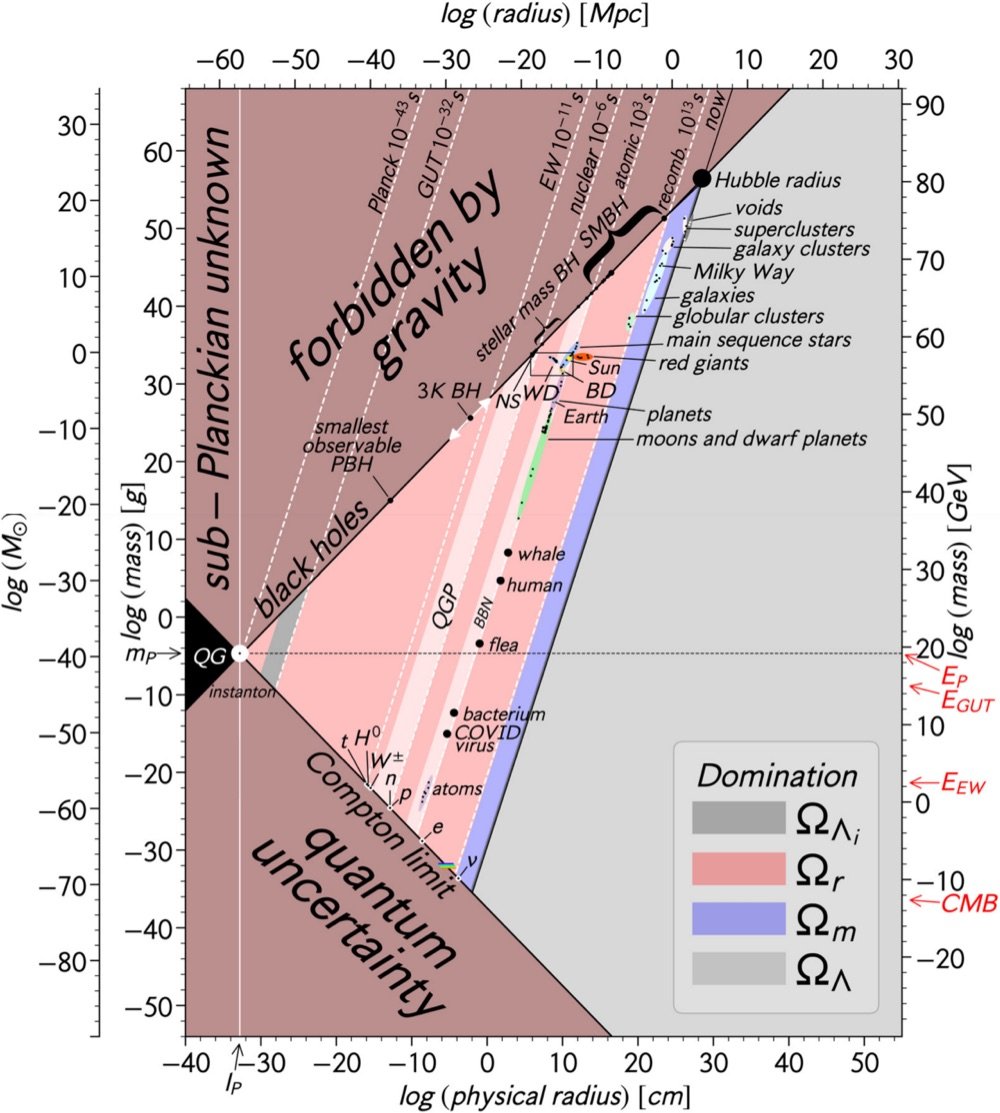
You just have to admire a chart that casually purports to show every single thing in the Universe in one simple 2D plot. The chart in question is from a piece in the most recent issue of the American Journal of Physics with the understated title of “All objects and some questions”.
In Fig. 2, we plot all the composite objects in the Universe: protons, atoms, life forms, asteroids, moons, planets, stars, galaxies, galaxy clusters, giant voids, and the Universe itself. Humans are represented by a mass of 70 kg and a radius of 50 cm (we assume sphericity), while whales are represented by a mass of 10^5 kg and a radius of 7 m.
The “sub-Planckian unknown” and “forbidden by gravity” sections of the chart makes the “quantum uncertainty” section seem downright normal — the paper collectively calls these “unphysical regions”. Lovely turns of phrase all.
But what does it all mean? My physics is too rusty to say, but I thought one of the authors’ conjectures was particularly intriguing: “Our plot of all objects also seems to suggest that the Universe is a black hole.” Huh, cool.
Here’s a fun thought experiment: can you destroy a black hole? Nuclear weapons probably won’t work but what about antimatter? Or anti black holes? In this video, Kurzgesagt explores the possibilities and impossibilities. This part baked my noodle (in a good way):
Contrary to widespread belief, the singularity of a black hole is not really “at its center”. It’s in the future of whatever crosses the horizon. Black holes warp the universe so drastically that, at the event horizon, space and time switch their roles. Once you cross it, falling towards the center means going towards the future. That’s why you cannot escape: Stopping your fall and turning back would be just as impossible as stopping time and traveling to the past. So the singularity is actually in your future, not “in front of you”. And just like you can’t see your own future, you won’t see the singularity until you hit it.
🤯
I really enjoyed this piece by Tom Vanderbilt on how time is kept, coordinated, calculated, and forecast. It’s full of interested tidbits throughout, like:
Care to gawk at one of the world’s last surviving original radium standards, a glass ampoule filled with 20.28 milligrams of radium chloride prepared by Marie Curie in 1913? NIST has it in the basement, encased in a steel bathtub, buried under lead bricks.
And:
For GPS to work, it needs ultra-exact timing: accuracy within fifteen meters requires precision on the order of fifty nanoseconds. The 5G networks powering our mobile phones demand ever more precise levels of cell-tower synchronization or calls get dropped.
And:
And as Mumford could have predicted, nowhere has time become so fetishized as in the financial sector, with the emergence over the past decade of algorithmic high-frequency trading. Donald MacKenzie, the author of Trading at the Speed of Light, estimated in 2019 that a trading program could receive market data and trigger an order in eighty-four nanoseconds, or eighty-four billionths of a second.
And:
All this makes F1 staggeringly accurate: it will gain or shed only one second every 100,000,000 years. Since the days when time was defined astronomically, the accuracy of the second is estimated to have increased by a magnitude of eight.
And:
“A clock accurate to a second over the age of the cosmos,” Patrick Gill, a physicist at the U.K.’s National Physical Laboratory, is quoted as saying in New Scientist, “would allow tests of whether physical laws and constants have varied over the universe’s history.”
And:
“If you were to lift this clock up a centimeter of elevation,” Hume told me, “you would be able to discern a difference in the ticking rate.” The reason is Einstein’s theory of relativity: Time differs depending on where you are experiencing it.
And I could go on and on. If any or all of those tidbits is interesting to you, you should go ahead and read the whole thing.
Craig Mod has my favorite take to date on Oppenheimer: that it should have been more like Richard Rhodes’ The Making of the Atomic Bomb:
My ideal version of this film would have begun in the 1900s or ’10s, with flashes of Relativity and then the steps of Quantum Mechanics with Planck, Bohr, and Heisenberg. Quantum tunneling with Gamow and Gurney. The nuclear shell model with Maria Goeppert Mayer and J. Hans D. Jensen. Chadwick’s discovery of the neutron. Anderson’s positron unveiling. Hold the camera longer on Lawrence and his cyclotron. What’s going on there? (I mean, ya got Josh Hartnett’s pretty head, plaster it up!) Shoot in high-grade mega-IMAX-bokeh the oddly simple experimental setups, the beakers, the blips, the radiation tick-tick-ticks, the iterations, the step-by-step expansion of understanding the fabric of everything around us. Give us an hour of this, this arguably greatest moment of human insight. You can still call the film Oppenheimer. Let the man loom, weave him between it all as he makes his way through Europe, sets up at Berkeley, is selected to lead Los Alamos. Ramp up the Nazi threat. Show the diaspora of brilliance more clearly. Believe the audience is willing to sit through more than just “Is it a wave … or is it particle?” Oh! There is so much excitement, so much incredible science to be mined, and Nolan mined so little.
Mod and I both share a love for that masterpiece of a book and I would watch the hell out of an 10-part HBO series (in the vein of Chernobyl) based on it, American Prometheus, and John Hersey’s Hiroshima.
This short animation from NASA shows the sizes of some of the supermassive black holes that feature at the center of galaxies. Some are relatively small:
First up is 1601+3113, a dwarf galaxy hosting a black hole packed with the mass of 100,000 Suns. The matter is so compressed that even the black hole’s shadow is smaller than our Sun.
While others are much larger than the solar system…and this isn’t even the biggest one:
At the animation’s larger scale lies M87’s black hole, now with a updated mass of 5.4 billion Suns. Its shadow is so big that even a beam of light — traveling at 670 million mph (1 billion kph) — would take about two and a half days to cross it.
Older posts





Socials & More