Culasso is blind, but his hearing is so acute (he has absolute pitch) he can identify over 3,000 components of birdsong and differentiate among more than 700 species in his native South America (he’s Uruguayan). Ten years ago, he won a $45,000 prize in a National Geographic competition by accurately identifying 15 random bird calls.
When you look at this gigantic mass of ice, it’s hard to get a personal relationship to it. So we wanted to document this landscape to give us an idea of what it sounds like inside a glacier. There is also the sadness because you know that all these sounds are disappearing right now. Of course, melting is something natural for glaciers, but the problem is that nothing new is coming back.
Entertaining YouTuber Benn Jordan built a setup to record and analyze bird sounds, songs, and calls. He used it to record a starling who has mastered mimicking all sorts of manmade and artificial sounds in its environment, including things like the default iPhone camera shutter sound. Jordan drew an image of a bird, played it as a sound, the starling played the sound back, and Jordan was able to see his bird drawing in the decoded sound.1 That is, he uploaded a picture of a bird to a bird and then downloaded the bird picture from the bird. 🤯
That’s the hook of the video, but the whole thing is well-worth watching (perhaps save for the last 10 minutes, which is a nerdy deep-dive into equipment) — the explanation of bird acoustics is both interesting & entertaining.
Thanks to KDO reader Liana for sending me this video three days ago, a full 48 hours before it got linked to from everywhere yesterday. *sigh* Some days I wish there were four or five of me to handle all of the cool things I run across and that people send me.
So for a few weeks I thought I was going crazy because I would hear my Samsung dryer “Load Complete” song play but I didn’t have the dryer going and it sounded far away but not like it was in the house. On Saturday, I was out working in the yard and heard it again and there was a bird perfectly emulating the “Load Complete” song note for note! I started the dryer and from the tree the bird was in, you can clearly hear the dryer which is I guess how it learned it. Nature is so cool!
Imagine teaching a whole species of birds one song that draws a bird on a spectrogram. Suppose it survives with the species for millennia. One hell of a trip for future civilisations to find.
yeah I host my files on an AAS (Avian Accessible Storage). It’s a cloud storage solution
A Rainbow Lorikeet chose me for a partner 4 years ago. Excellent mimic. He calls my two cats to the back door, ” Here Kitty Kitty, Here Puddy Puddy” in MY voice. The cats come, expecting and looking for me. The bird then proceeds to laugh at them, with MY laugh. I’m also attempting to teach him to whistle the last stanza of the Italian national anthem.
In this video, musician Armin Küpper performs a saxophone duet with the echo of his past self by playing near the end of a large pipe. That’s pretty cool. And it’s also a learning opportunity! Hey wait, come back…you haven’t finished your bowl of physics yet:
What you hear after each note is an echo, a sound wave reflecting off the far end of the pipe and traveling back to him.
Sound travels at around 343 meters per second (1,235 km/h or 767 mph) through air. In this video, the echo takes about 1.5 seconds to return. That means the reflected sound traveled about 514.5 meters (1,688 feet) round-trip, so the end of the pipe is at around 257 meters (843 ft) away.
It seems more like a second to me (so ~563 feet), but whatever…still cool.
In theory, this should be a golden age for movie sound. There’s better digital recording and mixing equipment than ever, theaters are incentivized to offer a premiere experience, and home theater equipment is more expensive, elaborate, and ubiquitous.
Some of the sound problems just have to do with plain incorrigibility of the people involved: directors (Christopher Nolan is singled out) and actors who pride themselves on arty unintelligibility. There’s also some incompetence: movie houses who’ve let go of skilled projectionists and play the movie back too low (often if someone complained it was too loud), or filmmakers who rush through a shoot or a mix counting on the fact that they’ll be able to pick up the sound later. And sure, we’re probably overromanticizing our youth, when everything was pure and clear (but really made by the same kind of hacks still in charge of the movie business).
The more interesting problems, however, really are structural. For instance, remixing a movie for streaming (when you can afford to do a proper second mix), often bumps up against not just digital compression, but the fact that competing streaming services have no single standard for sound quality and mixes:
Compression is inescapable when streaming is involved, but it turns out not all streaming platforms are created equal. Craig Mann tells me something he says “is not well-known” outside the sound community: different streamers have different specifications when it comes to their audio mixes. “Netflix has excellent specs in terms of dialogue norm and overall levels,” he reveals. “They need a particular level in order to pass quality control, and the level is essentially based on the dialogue level throughout the length of the program.”
But since there’s no industry standard in how to measure audio for streaming, other platforms base their levels on other parts of the sound mix. Case in point: Mann recently worked on Joe Carnahan’s “Boss Level,” which was originally meant to be a theatrical release. “For a variety of reasons, it ended up at Hulu, and when we got a look at that spec, they require it to be based on the overall [volume] of the film, not on the dialogue level of the film. Consequently, that’s a big action movie with shooting and cars and big music, and the result of that is that you have a much more squashed up, un-impactful mix … there are only a couple different ways of measuring these things these days, and I can only imagine that it’s somebody just not understanding the reason why it should be this and not that.”
As for downmixing the streaming service for stereo, well, as Pearson writes:
For audio mixers, the theatrical mix comes first, followed by a streaming mix. Then, a stereo mix will often be created, funneling the full scope of the sound mix through just two simple speakers in a process Donald Sylvester likens to “taking a beautiful steak and dragging it through the dirt.”
As for solving the problem of unintelligibility and bad sound experiences, it mostly boils down to having more respect for and a better understanding of sound, from preproduction to the algorithms that serve up a mix to your TV set or headset. No easy fixes, just time and craftmanship. (In other words, don’t hold your breath.)
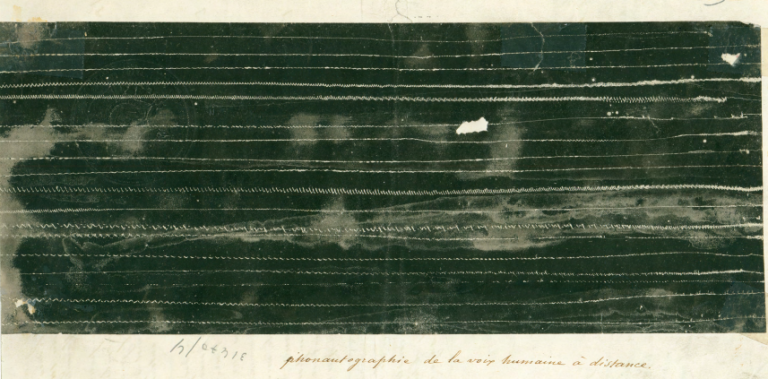
Centuries of Sound is a podcast that creates mixtapes by year. So far, that’s pretty standard. The main difference is that CoS’s mixtapes begin in 1853.
That’s as early as we’ve been able to recover recorded audio, mostly from technology that did not work particularly well at the time. The technology of the 1850s recorded sound, but couldn’t reliably reproduce it.
The real start date for us is nearly a quarter of a century [before Thomas Edison], in the studio of French printer and bookseller Édouard-Léon Scott de Martinville. The year was 1853 or 1854, and he was working on engravings for a physiology textbook, in particular a diagram of the internal workings of the human ear. What if, he thought, we could photograph sounds in the way we do images? (photography was a quarter-century old at this point) He began to sketch a device, a way of mimicking the inner workings of the human ear in order to make lines on a piece of paper.
I cover a plate of glass with an exceedingly thin stratum of lampblack. Above I fix an acoustic trumpet with a membrane the diameter of a five franc coin at its small end—the physiological tympanum (eardrum). At its center I affix a stylus—a boar’s bristle a centimeter or more in length, fine but suitably rigid. I carefully adjust the trumpet so the stylus barely grazes the lampblack. Then, as the glass plate slides horizontally in a well formed groove at a speed of one meter per second, one speaks in the vicinity of the trumpet’s opening, causing the membranes to vibrate and the stylus to trace figures.
Firstsounds.org did the most work in deciphering these early paper recordings, and that story is well told by the radio show Studio 360.
It even has a perfect name, what these people do: archeophony.
Here, then, is Centuries of Sound’s mix of all the recorded audio up to 1860 that they’ve been able to recreate from those early, not-at-the-time-reproducible pre-Edison audio signal recordings.
I wish I had known about this when I was still writing my dissertation (which was, in part, on paper and multimedia in the 1900s). It would have made many things much easier.
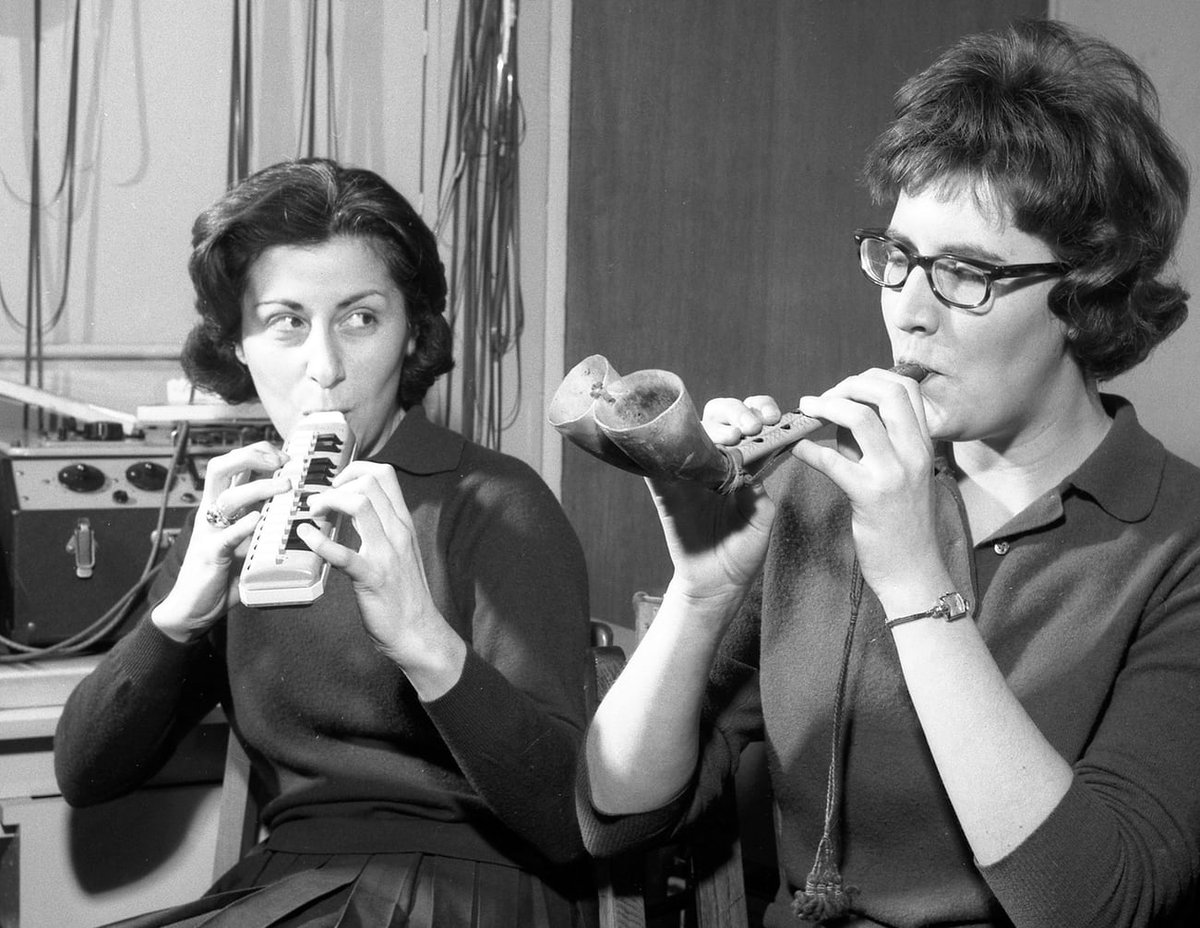
I am a sucker for high-tech analog art: magnetic tape, early wireless, punch cards, film and vinyl, the telephone, telegraph, and typewriter, and electricity before the transformation of digital technology. Consequently, and unsurprisingly, I love the BBC Radiophonic Workshop, and was delighted to read an article on its history from The Guardian.
Radiophonics owes everything to the invention of the tape recorder. Once you could capture sound, using a workable material, you could play with it: slow it down until it thundered, feed it back on itself until it shrieked and echoed, or simply slice bits out. However extreme these experiments became, there was always something eerily familiar to the ear, because they were made from real objects or events.
The term “radiophonic” came about because these mutated everyday sounds were put to the service of radio. “It is a new sound,” said the BBC, “suggestive of emotion, sensation, mood, rather than the literal moaning of the wind or the opening of a door.” Such things are now so easily achieved with digital technology that it’s hard to grasp how laborious - and groundbreaking - this all was.
The piece, riffing on a new book by does a nice job of eschewing undue nostalgia while digging into some of the Workshop’s most famous work — Doctor Who, The Hitchhiker’s Guide to the Galaxy — while also pointing out that most of the work was on simple education programs (which nevertheless introduced whole generations to new sonic possibilities). It restores the place of the many women who came through the workshop, including the inventive Delia Derbyshire, who played a huge role even as they often couldn’t get jobs at record studios or elsewhere in the recording industry.
My only complaint: it’s too darn short. I gotta read a book or something.
I recently rewatched a bunch of Hayao Miyazaki’s films, although “watched” is a bit of a misnomer. I was playing them in the background while I was working, or reading, or trying to sleep, so really I was re-listening to them, and not especially closely.
This almost feels like a sin for movies as beautiful as these, but it did help me notice something. Nausicaa: Valley of the Wind looks different from Princess Mononoke or The Wind Rises, sure; however, it sounds way different. The music, the foley effects, the subtler cues, the sheer sound density are completely different from one end of the career to another.
Jiro enters his airplane, adjusts his aviator gloves and starts the artisanal machine. By now we have noticed the sound effects of the valves and exhaust pipes made of human mouth sounds and with vocalisations. The first engine starts and it’s clear that human voice is used to portray this activity. But once the propeller activates a low rumble sound effects is introduced, and a sound effect of a servo ascending is applied to the airplane rising, triggered by Jiro’s pulling the lever, and it’s in harmony with the music score. One occurrence with the sound that emphasises the oneiric dimension of this scene is the ‘dreamy’ quality of the reverb applied on the last blow of the machine lifting before it goes crossing the skies [00:02:03].
Here’s a clip a little later in the sequence — I’d never recognized that the dream engine sounds were being made by human mouths, but once you hear it, it’s perfect.
Or consider the earthquake, detail by detail:
It is now that we are in the presence of the horror lived in this earthquake and sound plays such a big role with all its brutality. Different to the traditional approach of western film, the main elements heard are a composition of :
horrified human screams on a higher-pitch range,
medium-low pitch throat growls and groans like coming from a big beast,
that moves upwards in pitch as the image from the houses undulates from a farther plane to a closer one.
an earthy impact stinger
These elements are introduced a couple of frames before we see the houses being ripped apart.
In the next scene the audience is shown, through close-ups, how the ground is animated in brutal waves breaking and disrupting the order of all man-made constructions. We no longer hear the horrifying screams and the sound designer paints the scene with sound of the ground disrupting, by utilising rumbles and earth debris. The sounds here are in the same universe as those indicated on Jiro’s first dream - choir-like sounds mimicking up and down movements, in which the upwards vocalisations are like rising stingers.
It really helped me appreciate these movies again, as sonic masterpieces.
For all the hubbub of constant sound it is amazing how clearly the crack of a bat, the whoosh of a pitch (at least from the powerhouse Sabathia), and the leathery thud of the ball smothered in the catcher’s mitt cut through the textures. And if the hum of chattering provides the unbroken timeline and undulant ripple of this baseball symphony, the voices that break through from all around are like striking, if fleeting, solo instruments.
The most assertive soloists are the vendors. My favorite was a wiry man with nasal snarl of a voice who practically sang the words “Cracker Jack” as a three-note riff: two eighth notes on “Cracker,” followed by a quarter note on “Jack,” always on a falling minor third. (Using solf`ege syllables, think “sol, sol, mi.”) After a while I heard his voice drifting over from another section, and he had transposed his riff down exactly one step.
The streets of Hong Kong can be a hectic place, but one of the first things you notice is that the pedestrian street crossing signals have a very clear audio signal (one would assume, for the blind and/or very nearsighted). Some American signals has audio as well, but very few, they’re not very loud, and they generally kind of lacking. Anyway, I made an audio recording of the signals (30 sec, 240 KB mp3). The sound is kind of blown out (it’s my first experiment with the iTalk) and the signal doesn’t sound that loud IRL, but you get the gist.
Note: If you are a member and tried to log in, it didn't work, and now you're stuck in a neverending login loop of death, try disabling any ad blockers or extensions. Or try logging out and then back in. Still having trouble? Email me!




Socials & More