Entries for October 2012
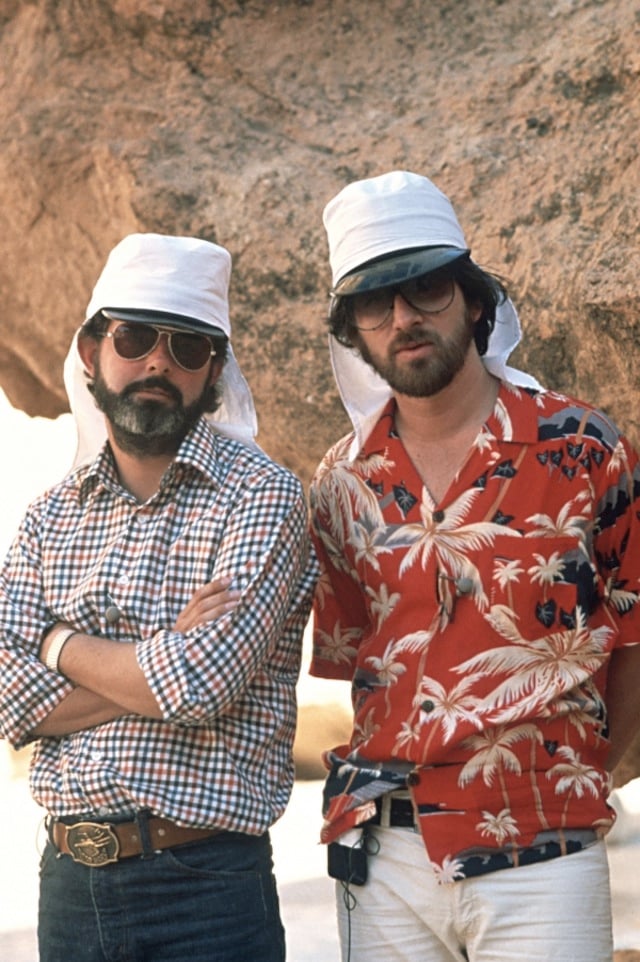
Here’s a big collection of behind the scenes photos of the filming of Raiders of the Lost Ark. Including George Lucas and Steven Spielberg looking rad.
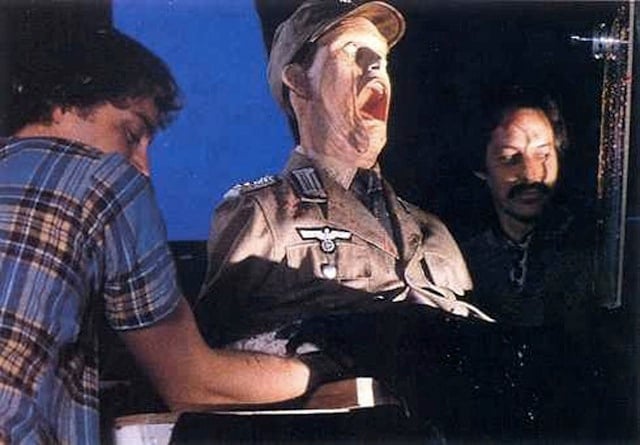
And this scene, which scarred me for several years.
I’ve been offline for two days and Aaron already posted this (and had the information relayed to me via land line into my power-less house) but this is just too, like, wow to pass up. Disney is buying Lucasfilm for $4 billion.
Under the deal, Disney will acquire ownership of Lucasfilm, a leader in entertainment, innovation and technology, including its massively popular and “evergreen” Star Wars franchise and its operating businesses in live action film production, consumer products, animation, visual effects, and audio post production. Disney will also acquire the substantial portfolio of cutting-edge entertainment technologies that have kept audiences enthralled for many years. Lucasfilm, headquartered in San Francisco, operates under the names Lucasfilm Ltd., LucasArts, Industrial Light & Magic, and Skywalker Sound, and the present intent is for Lucasfilm employees to remain in their current locations.
And they’re gonna release a 7th Star Wars film:
Ms. Kennedy will serve as executive producer on new Star Wars feature films, with George Lucas serving as creative consultant. Star Wars Episode 7 is targeted for release in 2015, with more feature films expected to continue the Star Wars saga and grow the franchise well into the future.
Crazy. A non-Lucas non-prequel Star Wars film will hopefully be pretty great, but the purchase price is puzzling. Only $4 billion?
Jason is still without power, but he and family are doing fine.
JFK and Newark are open, but jammed.
ConEd is saying Manhattanites without power will get it back within 3 days. Interactive map of the outages. Long Island could be longer. ConEd map here.
Some subway service should return Thursday, likely north of Midtown. Transit updates here.
With people returning to work, traffic is bad. As power returns, more people going back to work, could make the traffic worse.
NYTimes has a good summary of the storm damage along the East Coast.
AP photo of what’s left of Breezy Point after the fire Monday night.
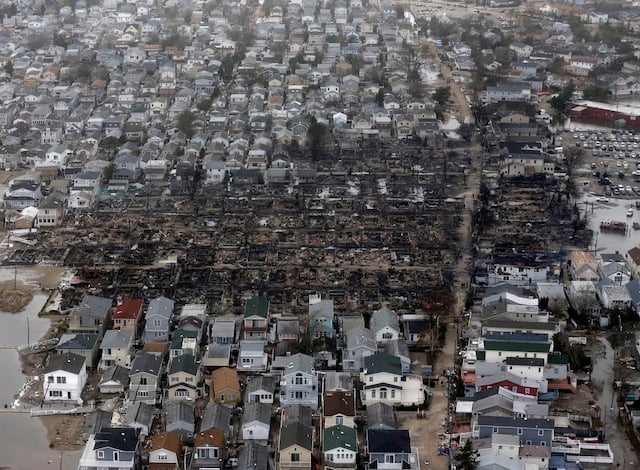
Collection of Sandy photos from the Boston Globe.
Video of storm from birth to landfall.
(Jason and family are fine, but without power, unsure of when it will come back. Aaron will be updating this throughout the day.)
Hurricane Sandy went through New York City yesterday causing massive flooding and power loss all over the city. While expectations for the storm had ranged across the spectrum, most observers seemed to be caught off guard at the amount of destruction. Here is the Kottke.org Hurricane Sandy link from yesterday and the one from the day before.
Updated Wed 12:15am ET:
22 deaths reported in New York City, 40 total in eight states combined. Several dozen more in Haiti and the Caribbean. This in the NYTimes, talks about two of NYC’s fatalities.
Sunday’s NYC Marathon will go on.
If you’re still without power, it could be 4-5 days before it comes back. And it’s not looking great for the subway, either.
Really old skeleton unearthed by fallen tree in New Haven.
David reminded us about how oysters might be able to help with future flooding (and did in the past).
I asked my friend Kevin for a few words on how a new New Yorker rode out the storm.
During the worst of the storm, around 9 p.m., I was huddled in my bed watching Homeland on my laptop, scanning Thought Catalog’s surprisingly good Hurricane Sandy Liveblog, and checking Twitter, which was probably in the finest form I’ve seen it in a long time: a terrific balance of helpful updates, links, GIFs, and personal communication. Even misinformation, which spreads like wildfire via retweet, was quickly debunked, like CNN’s report that the NYSE was under three feet of water. My one disappointment was Twitter’s fake satirical accounts, which were mostly uninspired, with the bold exceptions of @ElBloombito and @RomneyStormTips (which was mysteriously shut down).
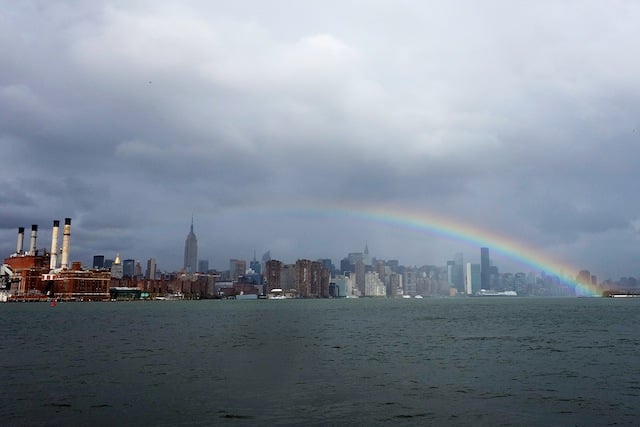
Finally, a rainbow by Noah Kalina.
Updated Tues 5:15pm ET:
This might be a dark cloud for many New Yorkers still digging out. Disney has purchased Lucasfilm and plans to release a new Star Wars feature film every 2-3 years. Star Wars 7 comes out in 2015. This information is being delivered to Jason by land line telephone, like in the old days.
A list of open New York City restaurants.
Sea level will be at Sandy levels normally by 2200.
Phenomenal illustration of the effect of last night’s power outage on the NYC skyline.
I’ve not been able to find much information about the impact the storm damage in NJ, NYC, CT, and DE will have on the election. Not on the politics of it, which have been interesting, but will people actually be able to vote? I just heard a radio report on All Things Considered that officials in NJ and CT, at least, are assessing the issue now and considering all options such as loosening absentee ballot rules, paper ballots, generators in voting locations, etc. While states have the responsibility of managing the elections, the date of the election is mandated by the Constitution as “the first Tuesday after the first Monday in November.” It’s unclear whether states have the power to move this date, but preventing citizens from having to vote after most of the votes in the country have been cast is the priority at this point.
A fantastic infographic of storm info/damage from NYTimes.
Updated Tues 2:00pm ET:
Up here in Boston, things seem to be OK. My neighborhood experienced high winds and whipping rain, but fairly low damage. My street, which floods once or twice a year in heavy rain, was fine. There are reports of branches and trees downing power lines around Cambridge, Somerville, Boston, etc, but most friends that lost power got it back after a relatively short period.
New York death toll updated to 15, 10 in the city.
Buses should be up and running by 5PM, on a Sunday schedule, and will be free today and tomorrow.
All of Jersey City and Newark are without power.
New York City specific ‘how to help’ link.
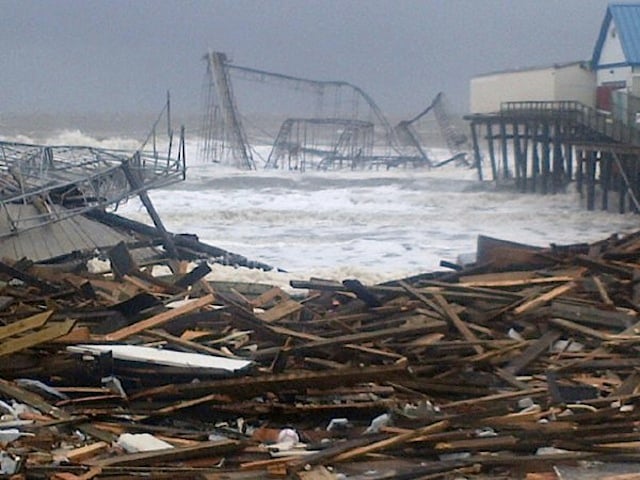
NBC’s Brian Thompson got a pic of the roller coaster at Seaside Heights in New Jersey in the ocean. (via theatlanticwire)
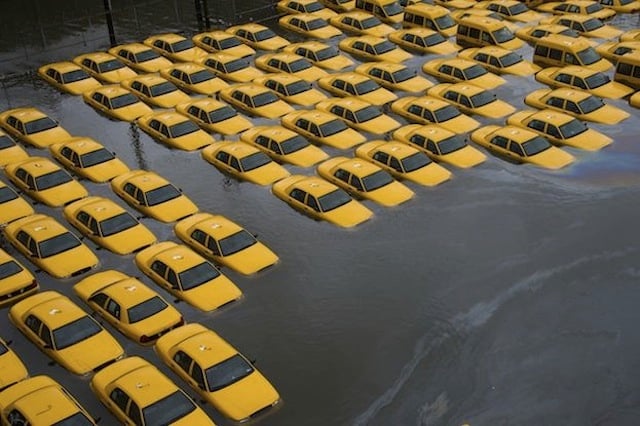
AP photo of cabs underwater in Hoboken. (via theatlanticwire)
Tappan Zee Bridge, East River Bridges, RFK Bridge, Lincoln Tunnel open.
JFK should open tomorrow. Laguardia has runways underwater and may take a little longer.
Matt Stopera is walking around providing pretty remarkable photos of other damage in his Twitter stream. Like this one, this one, and this one.
I can’t believe these ‘boats on shore pictures’. 1. 2.
Watch this transformer explode in Queens.
As of now, there are 9 reported storm-related fatalities in New York. Across the East Coast, the number is reported to be 14 total.
Mayor Bloomberg spoke earlier this morning to update the city. “This was a devastating storm. Maybe the worst that we have ever experienced.” (This video seems wonky, you might have to scroll forward to get it started.)
All of the MTA tunnels under the rivers flooded, and, “There is currently no timetable” for when the subway will be up and running again.
As of last night, seven subway tunnels under the East River flooded. Metro-North Railroad lost power from 59th Street to Croton-Harmon on the Hudson Line and to New Haven on the New Haven Line. The Long Island Rail Road evacuated its West Side Yards and suffered flooding in one East River tunnel. The Hugh L. Carey Tunnel is flooded from end to end and the Queens Midtown Tunnel also took on water and was closed. Six bus garages were disabled by high water. We are assessing the extent of the damage and beginning the process of recovery. Our employees have shown remarkable dedication over the past few days, and I thank them on behalf of every New Yorker. In 108 years, our employees have never faced a challenge like the one that confronts us now. All of us at the MTA are committed to restoring the system as quickly as we can to help bring New York back to normal.
MTA’s photo stream shows damage in the stations.
The back up generator at NYU Hospital failed last night forcing hospital staff, firefighters, and EMTs to carry patients down flights of stairs as they were evacuated to other hospitals.
There was an enormous 6 alarm fire in the Breezy Point area of Queens, destroying at least 50 homes. 200 firefighters fought chest-high water to battle the fire and rescue residents. An image of the destruction.
Along with hundreds of thousands of New Yorkers, Gizmodo, Gawker, Daily Kos, and Buzzfeed were among many websites which went down after their data-centers in lower Manhattan lost power.
Letterman and Fallon did their shows without audiences last night.
Crazy video of a ConEd plant exploding on E14 and FDR.
Video of flooding at East 8th and Avenue C, especially spooky because the power suddenly goes out at the :40 second mark. (via Gawker)
Almost 6,000 flights were canceled today.
It’s about 1:30 pm here in NYC and we’re starting to see the effects of Hurricane Sandy. Rivers are overflowing their banks, wind is whipping, and residents are either hunkered down or scurrying around picking up last minute supplies. I’ll be updating this post when I can, here and there, during the course of the day.
Updated Mon 7:42pm ET:
Kids are way worse than the hurricane today. FEMA, NYPD, FDNY, need emergency parental evac now!
What to Expect at Landfall in Next Two Hours (WSJ):
The storm’s quicker-than-expected forward motion means it will make landfall about two hours sooner than previously anticipated. Landfall is now expected around 6 p.m. this evening, near or just south of Atlantic City, N.J. This doesn’t change the forecast much for coastal New Jersey, but it could greatly complicate coastal flooding projections for New York Harbor.
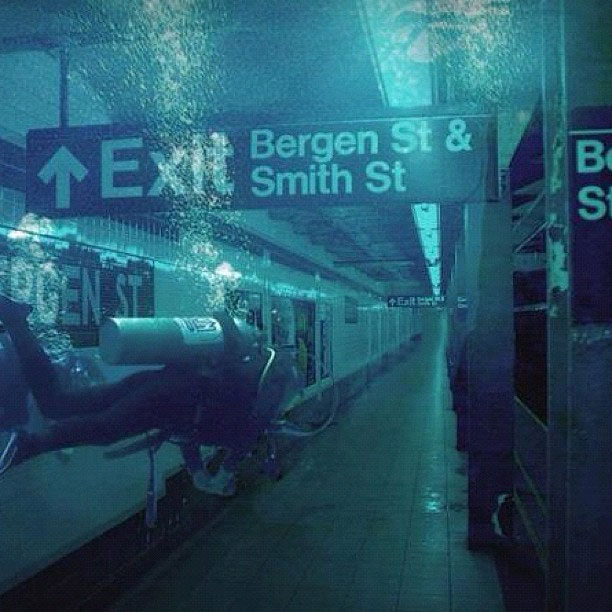
Whoa, it looks like the situation in the Brooklyn subway is getting dire:
Twitter has compiled a list of hurricane resources on Twitter.
Here’s a close-up photo of that crane that’s dangling from that building on 57th Street. CBS has a live view of the crane.
Not from The Onion, but this report on how Williamsburg residents are coping with the storm sure reads like it:
“I just got these kick-ass new stereo speakers and I am going to listen to those until the power runs out,” Jim Butler, another Edge resident, said, tugging on the doors of the CVS that is part of the complex-it had just closed a few minutes before 5 p.m. “Then I’m going to read and look at my art books. I’ll live by candlelight, get in touch with my 19th century self.”
From just now on the TV: Con Ed has taken down the Bowling Green and Fulton electrical networks in lower Manhattan. Likely area hit is “east of Broadway btwn Wall St & tip of Manhattan & from Frankfort to Wall btwn William St & East river.”
Water level at the Battery has hit 11.25 ft, breaking a record set in 1821.
Updated Mon 4:08pm ET:
Tweet from Jen Bekman:
[Con Ed] rep on NY1 sayspower shutdown “very likely” south of 34th st. 7-9pm for high tide.
Some common sense tips: how to make your cell phone charge last if the power goes out.
Walked by Joseph Leonard on Waverly Place here in the West Village earlier and it was jam packed.
Want to look at a bunch of good photos of the hurricane? Alan Taylor at In Focus has you covered.
Great story of how Dan Rather hacked up the first radar image of a hurricane shown on TV for Hurricane Carla in 1961.
He took a camera crew to the U.S. Weather Bureau (now the National Weather Service) office in downtown Galveston, which featured a cutting-edge WSR-57 radar console. He convinced the bureau staff to let him broadcast, live, from the office. He asked a Weather Bureau meteorologist to draw him a rough outline of the Gulf of Mexico on a transparent sheet of plastic; during the broadcast, he held that drawing over the computer’s black-and-white radar display to give his audience a sense both of Carla’s size and of the location of the storm’s eye. As CBS plugged into the broadcast, that audience suddenly became a national one.
Tappan Zee Bridge closed as of 4pm. And all bridges/tunnels in and out of Manhattan are closing at 7pm…or so I’ve heard on TV/Twitter. Is that right? Has anyone seen the Batman?
Things aren’t looking good on Nantucket. And probably not even close to max storm surge.
Updated Mon 3:47pm ET:
There are reports of a crane collapse at One World Trade but Jake Dobkin doesn’t see any evidence of that. (Update: Jake was right…no crane issue at 1WTC.)
Updated Mon 3:11pm ET:
More footage of the 1938 hurricane that hit the northeastern US.
Updated Mon 3:07pm ET:
Is TV news and Twitter whipping everyone into a hurricane-like froth with its incessant coverage of Sandy? Well, E.B. White has similar complaints about radio and Hurricane Edna back in 1954.
The radio either lets Nature alone or gives her the full treatment, as it did at the approach of the hurricane called Edna. The idea, of course, is that the radio shall perform a public service by warning people of a storm that might prove fatal; and this the radio certainly does. But another effect of the radio is to work people up to an incredible state of alarm many hours in advance of the blow, while they are still fanned by the mildest zephyrs.
That awesome photo you saw of Hurricane Sandy? It might not be Hurricane Sandy.
Vintage newsreel footage of hurricanes in 1938, 1955, and 1969.
Piers Morgan spotted a crane that has buckled on a building near CNN HQ in NYC (157 West 57th):

Massive bang and this giant skyscraper crane outside my office just buckled… Scary.
Updated Mon 2:19pm ET:
Lots of people have noted this feed of hurricane-related photos on Instagram.
NYC mayor Michael Bloomberg urges residents to “Have a sandwich out of the fridge. Sit back, and watch the television.” I am so there, Mr. Mayor.
The lower level of FDR Drive on the east side of Manhattan is underwater:
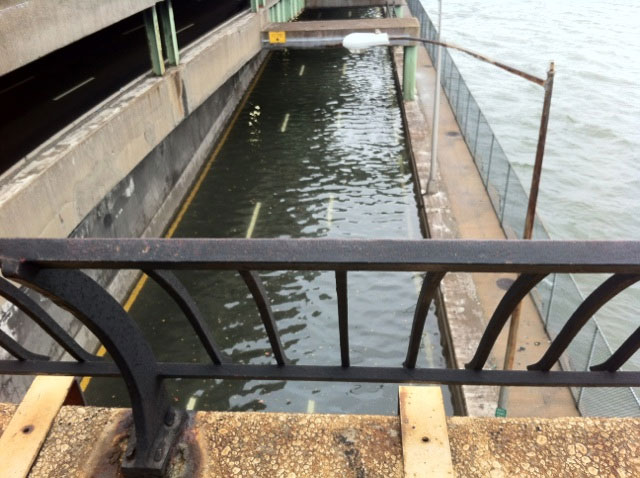
The storm surge in New York Harbor is getting serious.
Con Ed just called us saying that they might have to shut off our power. No timeline mentioned.
Climate change has not been an issue at all in the 2012 Presidential election. Elizabeth Kolbert says that’s “grotesque”.
BTW, Mitt Romney wants to shut down FEMA and have the states fend for themselves. United(?) States of America?
Earlier:
This WSJ comparison of 2011’s Hurricane Irene and Sandy really captures just how massive this storm is and why people seem more concerned about it than they were with Irene.
Via Jeff Masters, Sandy is already producing record storm surges:
The National Weather Service in Atlantic City, NJ said that isolated record storm surge flooding already occurred along portions of the New Jersey coast with this morning’s 7:30 am EDT high tide cycle. As the tide goes out late this morning and this afternoon, water levels will fall, since the difference in water levels between low tide and high tide is about 5’. However, this evening, as the core of Sandy moves ashore, the storm will carry with it a gigantic bulge of water that will raise waters levels to the highest storm tides ever seen in over a century of record keeping, along much of the coastline of New Jersey and New York. The peak danger will be between 7 pm - 10 pm, when storm surge rides in on top of the high tide. The full moon is today, which means astronomical high tide will be about 5% higher than the average high tide for the month, adding another 2 - 3” to water levels.
The Holland Tunnel and the Brooklyn Battery Tunnel will be closing at 2pm today.
The swans are leaving Sheepshead Bay in Brooklyn:

Here’s a satellite view of Sandy developing near the equator and building in strength as it churns through the Caribbean and up the Atlantic coast:
Here’s my post from yesterday with all sorts of hurricane resources, including Jeff Master’s WunderBlog, the Wind Map, and check out your flood zone in NYC.
I don’t know how much I’m going to be updating this, but here’s a few things about the hurricane that’s bearing down on the East Coast right now. Mostly NYC centric.
Updated Sun 11:52pm ET:
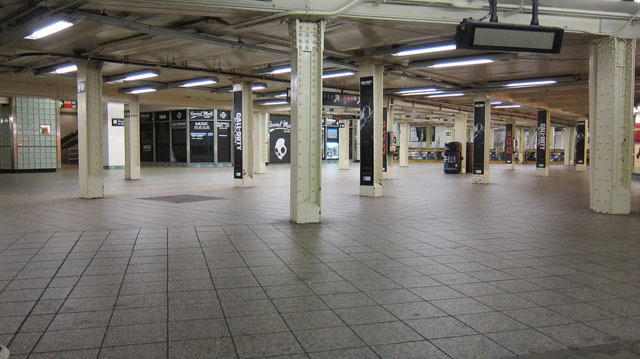
The main hall of the closed Grand Central Terminal, deserted. Even stranger, the busiest subway station in NYC (Times Square), closed and deserted.
The Wind Map will likely be interesting over the next 36-48 hours. (via @panicstreak)
From Jeff Masters’ WunderBlog, a more technical view of the storm:
The National Weather Service in Upton, New York mentioned today that the predicted maximum water level of 11.7 feet at The Battery in New York City, which is expected to occur at 8:13pm ET on Monday, would break the record of 10.5 feet which was set on September 15, 1960 in Hurricane Donna.
The storm’s barometric pressure is going to be historically low:
Sandy should have sustained winds at hurricane force, 75 - 80 mph, at landfall. Sandy’s central pressure is expected to drop from its current 953 mb to 945 - 950 mb at landfall Monday night. A pressure this low is extremely rare; according to wunderground weather historian Christopher C. Burt, the lowest pressure ever measured anywhere in the U.S. north of Cape Hatteras, NC, is 946 mb (27.94”) measured at the Bellport Coast Guard Station on Long Island, NY on September 21, 1938 during the great “Long Island Express” hurricane.
Masters says that part of the NYC subway system may flood:
The full moon is on Monday, which means astronomical high tide will be about 5% higher than the average high tide for the month. This will add another 2 - 3” to water levels. Fortunately, Sandy is now predicted to make a fairly rapid approach to the coast, meaning that the peak storm surge will not affect the coast for multiple high tide cycles. Sandy’s storm surge will be capable of overtopping the flood walls in Manhattan, which are only five feet above mean sea level. On August 28, 2011, Tropical Storm Irene brought a storm surge of 4.13’ and a storm tide of 9.5’ above MLLW to Battery Park on the south side of Manhattan. The waters poured over the flood walls into Lower Manhattan, but came 8 - 12” shy of being able to flood the New York City subway system. According to the latest storm surge forecast for NYC from NHC, Sandy’s storm surge is expected to be at least a foot higher than Irene’s. If the peak surge arrives near Monday evening’s high tide at 9 pm EDT, a portion of New York City’s subway system could flood, resulting in billions of dollars in damage. I give a 50% chance that Sandy’s storm surge will end up flooding a portion of the New York City subway system.
But Linsey Lohan urges you not to panic:
WHY is everyone in SUCH a panic about hurricane (i’m calling it Sally)..? Stop projecting negativity! Think positive and pray for peace.
US financial markets were supposed to be open tomorrow but officials now have closed the markets on Monday.
Updated Sun 8:54pm ET:
The Day After Tomorrow, a movie directed by Roland Emmerich in which a super storm hits Manhattan, is available for streaming ($2.99) or to buy ($9.99) on Amazon Instant Video and on iTunes for sale ($12.99).
John Seabrook notes on Twitter:
Full moon at 7.50pm tomorrow, ten minutes before the high point of storm surge. Seems kind of biblical…
Or Mayan. 2012, y’all.
Justin reminds me of a classic New Yorker piece by Joe Morgenstern about a NYC skyscraper that was unprepared for hurricane-force winds.
On a warm June day in 1978, William J. LeMessurier, one of the nation’s leading structural engineers, received a phone call at his headquarters, in Cambridge, Massachusetts, from an engineering student in New Jersey. The young man, whose name has been lost in the swirl of subsequent events, said that his professor had assigned him to write a paper on the Citicorp tower, the slash-topped silver skyscraper that had become, on its completion in Manhattan the year before, the seventh-tallest building in the world.
LeMessurier found the subject hard to resist, even though the call caught him in the middle of a meeting. As a structural consultant to the architect Hugh Stubbins, Jr., he had designed the twenty-five-thousand-ton steel skeleton beneath the tower’s sleek aluminum skin. And, in a field where architects usually get all the credit, the engineer, then fifty-two, had won his own share of praise for the tower’s technical elegance and singular grace; indeed, earlier that year he had been elected to the National Academy of Engineering, the highest honor his profession bestows. Excusing himself from the meeting, LeMessurier asked his caller how he could help.
The student wondered about the columns—there are four—that held the building up. According to his professor, LeMessurier had put them in the wrong place.
“I was very nice to this young man,” LeMessurier recalls. “But I said, ‘Listen, I want you to tell your teacher that he doesn’t know what the hell he’s talking about, because he doesn’t know the problem that had to be solved.’ I promised to call back after my meeting and explain the whole thing.”
Updated Sun 8:22pm ET:
From the excellent coverage at WSJ:
Those living above the 10th floor in skyscrapers may want to find shelter in lower floors. Winds increase with height in a hurricane and could be significantly stronger than on ground level. Be cautious about sleeping near a window on Monday night. Do not walk outside on Monday evening, as there could be significant amounts of airborne debris flying around. Rain totals 4-8 inches.
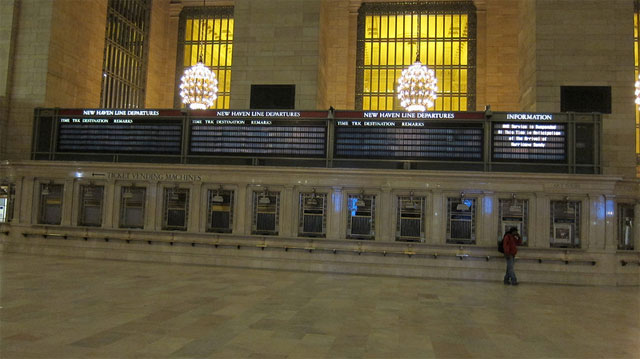
Not a sight you see that often: Grand Central is closed.
From Quartz, a list of webcams to watch as Sandy approaches.
Updated Sun 8:11pm ET:
BREAKING NEWS! [siren] Powerful Storm Brings Down NY Times Paywall: “The Times is providing free unlimited access to storm coverage on nytimes.com and its mobile apps.”
From When There’s a Flood: if you’re preparing your house for a flood, shut off the water, propane, and electricity.
Just checked Uber in the West Village…about 10 cars less than three minutes away. Usually a lot less inventory than that.
Was rumored that MoMA would be open tomorrow with skeleton crew but word just now from their Twitter account: closed tomorrow.
From the NY Times:
If the surge runs as high as forecast, Con Ed will shut off two electrical networks in Lower Manhattan, known as the Fulton and Beekman networks, the official said.
I looked all over the place for a map that showed which parts of the city are served by the Fulton and Beekman but couldn’t find anything. I’m assuming the Fulton station is near the World Trade Center and the Beekman is on Beekman St by Pace University. So way Lower Manhattan?
Earlier:
Subway, bus and railroad services in New York and New Jersey are being shut down starting at 7pm tonight. Probably won’t be back open until sometime on Wednesday.
NYC schools are closed on Monday. And probably Tuesday. And if public transit is closed on Wed, schools with probably be closed that day too.
Taping your windows to protect them from hurricanes is “a waste of effort, time, and tape”.
Residents in Zone A in NYC have been ordered to evacuate. Check out where your zone is here.
New York City’s Hurricane brochure is available here.
The tracking map on Weather Underground gives you the opportunity to “share this storm”. Weather.com lets you see “friends at risk.” Uhh….
For storm updates in Spanish, be sure to follow Miguel Bloombito:
Did tu packo el vamos bag? No forgeto el casho, los medicatioño y tamponitos.
The WSJ has a great post comparing Sandy with Irene from last year. Sandy is much more potentially damaging in almost all respects.
On Saturday, Sandy became the largest storm in recorded Atlantic basin history, with a diameter of gale force winds of over 1000 miles. Tropical storm warnings were in place Saturday simultaneously for North Carolina and Bermuda, a sign of the storm’s massive geographic sweep. Those winds will follow Sandy northward, potentially encompassing more than 50 million people at once from Virginia to New England.
Peter Kafka paraphrasing Bloomberg: “don’t be stupid and it will be fine”.
Satellite view of Sandy from 2:42 am last night. Massive. This thing is Day After Tomorrow big.
Zones, evacuation centers, webcams, and more on this Google Maps maps.
Chad Dickerson notes that the decentralization of NYC’s stores is a plus:
the institution of the neighborhood corner store in NYC comes through for storm prep. decentralization ftw!
The NYTimes Magazine has a story about the Greek island of Ikaria where old people just keep getting older instead of dying. There are many theories as to why this is, but my favorite in the article boils down to diet (just kidding, I like the idea about naps and sex).
Following the report by Pes and Poulain, Dr. Christina Chrysohoou, a cardiologist at the University of Athens School of Medicine, teamed up with half a dozen scientists to organize the Ikaria Study, which includes a survey of the diet of 673 Ikarians. She found that her subjects consumed about six times as many beans a day as Americans, ate fish twice a week and meat five times a month, drank on average two to three cups of coffee a day and took in about a quarter as much refined sugar — the elderly did not like soda. She also discovered they were consuming high levels of olive oil along with two to four glasses of wine a day.
Chrysohoou also suspected that Ikarians’ sleep and sex habits might have something to do with their long life. She cited a 2008 paper by the University of Athens Medical School and the Harvard School of Public Health that studied more than 23,000 Greek adults. The researchers followed subjects for an average of six years, measuring their diets, physical activity and how much they napped. They found that occasional napping was associated with a 12 percent reduction in the risk of coronary heart disease, but that regular napping — at least three days weekly — was associated with a 37 percent reduction. She also pointed out a preliminary study of Ikarian men between 65 and 100 that included the fact that 80 percent of them claimed to have sex regularly, and a quarter of that self-reported group said they were doing so with “good duration” and “achievement.”
Writing for the Los Angeles Review of Books, Adam Wilson has a thoughtful take on Louis C.K., his TV show, and his comedy style in general.
The format of the American sitcom held steady for almost 40 years. The most noteworthy innovation was a negation; in the early nineties, HBO comedies like the short-lived Dream On ditched the pervasive canned laugh track, paving the way for the so-called cringe comedy of shows like Curb Your Enthusiasm. On Curb, the absence of a laugh track makes it difficult for viewers to know when to laugh. We cringe because we’re holding in laughter, waiting for a cue that it’s okay to release. But there is always a breaking point, an explosion into an absurdity so deep — Larry rushing into the water to “save” a baptismal candidate from drowning, for example — that the tension is relieved, and the laughter is released.
Louie both reacts to the failure of Lucky Louie and advances on Curb’s cringe comedy by creating something tenser, more tonally ambiguous. Louie’s singularity lies in its ability to further confound viewers by setting up jokes, and then providing pathos instead of punch lines. Not only does Louie’s audience not know when to laugh, they don’t even know if what they’re watching is supposed to be funny. For the Laptop Loner, this ambiguity is made all the more palpable by the absence of viewing partners; we use other people’s reactions to gauge the correctness of our own. But it also makes the ambiguity less assaulting. Alone, we can be comfortable in our discomfort.
I cannot believe these are some of the passwords people actually use:
1. password
2, 123456
3. 12345678
4. abc123
5. qwerty
6. monkey
7. letmein
8. dragon
9. 111111
10. baseball
11. iloveyou
12. trustno1
I feel more secure than ever with my “password2” password.
Chantel Tattoli was assigned to report on Frank Sinatra, Jr’s concert at the Seminole Casino Coconut Creek in Florida. And, as one does, she arranged for her father to go with her.
Two weeks ago, I told my father I’d been assigned to report Frank Sinatra, Jr.’s concert, told him I had a second press pass for a photographer. My father heard me loud and clear. He went out and bought a telescopic Nikon. It is now July 12, 2012, a Thursday. An hour ago, I showed him how to hold the camera like a pro, by cradling the lens in his left hand. We were in the parking garage waiting for an elevator. The long window looked out on the complex where a water tower sprouted behind the honey-colored stucco. Behind it was a backdrop of perfect pool blue sky. “Try to shoot that,” I said, pointing. He tried. But the auto-setting didn’t like the light conditions. The shot wouldn’t take. “Well,” my father mumbled; his eyes danced over the machine. “How do you do it manually?” It was at that point that dread began to gnaw on his daughter.
This is a wonderful little story…and there’s even a faint echo of Frank Sinatra Has a Cold about it.
In 1985, Vanessa Veselka was a teenaged hitchhiker who was picked up by a man who would come to be known as the Truck Stop Killer. Nearly three decades later, she returns to the scene of that experience and writes about it for GQ: “I said I wouldn’t go to the cops if nothing happened to me, but it was his choice — until he looked at me and I went still. There was going to be no more talking. I knew in my body that it was over.”
With Typing Karaoke, instead of singing the songs, you type along to the lyrics and get points for lack of errors and how well you keep up. Too fun!
Rod McLaren collects links on Rodcorp and on Pinboard about how people work. He recently recapped some of the work techniques from those links. Here are a few of my favorites:
Ray Bradbury wrote an early version on Fahrenheit 451 in nine days on a rented typewriter in the UCLA library basement.

Gay Talese would pin pages of his writing to a wall and examine them from the other side of the room with binoculars.
Jonathan Safran Foer has a collection of blank sheets of paper.
Truman Capote wrote lying down, as did Marcel Proust, Mark Twain and Woody Allen.
Note: Illustration by Chris Piascik…prints & more are available.
I only downloaded Letterpress about 10 minutes ago but I am already hopelessly hooked. The game is a combination of Boggle and Go and was made by Loren Brichter, who made Tweetie back in the day. This is the sort of app that makes me weep because it’s so simple and polished yet endless. Brichter is some sort of iOS wizard and we should have him burned at the stake for his wonderfully addictive magic.
Children often close or cover their eyes to hide, and researchers at the University of Cambridge wanted to find out why. Click through for more interesting snippets.
Now things get a little complicated. In both studies so far, when the children thought they were invisible by virtue of their eyes being covered, they nonetheless agreed that their head and their body were visible. They seemed to be making a distinction between their “self” that was hidden, and their body, which was still visible. Taken together with the fact that it was the concealment of the eyes that seemed to be the crucial factor for feeling hidden, the researchers wondered if their invisibility beliefs were based around the idea that there must be eye contact between two people — a meeting of gazes — for them to see each other (or at least, to see their “selves”).
(via @noahwg)
I loved this profile of novelist Hilary Mantel written by Larissa MacFarquhar. Not just for the subject matter but the lyrically novelistic way in which it’s written.
During this time, she discovered that her house was haunted. It wasn’t only she who felt it-she overheard adults talking about the ghosts as well. She realized that they were as frightened as she was, and were helpless to protect her. She already understood that the world was denser and more crowded than her senses could perceive: there were ghosts, but even those dead who were not ghosts still existed; she was used to hearing talk in which family members alive and dead were discussed without distinction. The dead seemed to her only barely dead.
Until she was twelve or so, she was deeply religious. “When you’re inculcated with religion at such an early age, or when you’re receptive to it, as I was, you become preoccupied with the unseen reality,” she says. “This other world, the next world, to me in my childhood seemed just as real as the world I was living in. It wasn’t that I had a mental picture of it — it was that I never questioned its existence. I used to conduct a lot of imaginary conversations with God. I don’t think Jesus was any less real to me than my aunts and uncles; the fact that I happened not to be able to see him was pretty irrelevant to me.”
She felt, as a child, in a permanent state of sin. There was something terribly wrong about her, for which she was to blame, but which she had only limited ability to change. Catholic guilt continued to grip her even after she stopped believing in God. Her family’s misery was encompassing and bewildering, and was it not likely that she was responsible for making her parents so unhappy? Might they not, without her, have a chance at a better life? But these suspicions were not so powerful as the effect of a thing that happened to her one day that she cannot explain.
That “thing that happened” was seeing… well, I don’t want to spoil it. Mantel wrote Wolf Hall, a recent favorite of mine, and a few days after this profile ran in the New Yorker, she won the Man Booker Prize for her new novel, Bring Up the Bodies.
Aired as The Quest For Tannu Tuva in the UK and The Last Journey Of A Genius in the US, this hour-long program is the last extended interview that physicist Richard Feynman gave; he died a few days after the recording.
Richard Feynman was not only an iconoclastic and influential theoretical physicist and Nobel laureate but also an explorer at heart. Feynman through video recordings and comments from his friend and drumming partner Ralph Leighton tell the extraordinary story of their enchantment with Tuva, a strange and distant land in the centre of Asia.
While few Westerners knew about Tuva, Feynman discovered its existence from the unique postage stamps issued there in the early 20th century. He was intrigued by the unusual name of its capital, Kyzyl, and resolved to travel to the remote, mountainous land. However, the Soviets, who controlled access, were mistrustful, unconvinced that he was interested only in the scenery. They obstructed his plans throughout 13 years.
I could watch this guy talk all day long. Feynman is a national treasure; we should give Andrew Jackson the boot and put Feynman on the $20.
Joshua David Stein takes Guy Fieri deep in a biting review of the ridiculous fat-food huckster’s new restaurant in Times Square.
It would be disingenuous to claim that Times Square represents anything but a regurgitation of the American dream, monetized, metastasized, made blindingly bright by light-emitting diodes and shoved back down the gullets of those souls unlucky enough to have mistakenly stumbled into the red zone, or worse, like moths to the incinerating flame, have actively sought it out. To deride Mr. Fieri for opening his restaurant there as if he’d taken a dump in the Louvre is silly. He pooped on a pile of bright shiny poop, Jeff Koonsian poop, Guy Debordian poop. But public defecation is still a crime in New York City (Health Code Section 153.09), and his offenses rest not in their location but in their very nature.
Mr. Fieri not only serves truly horrible-tasting food, an awkward origami of clashing aleatory flavors, but he serves this punishing food emulsified with a bombastic recasting of deep-fried American myth. Mr. Fieri’s most egregious transgression isn’t what he puts into his fellow citizens’ stomachs, it’s how the cynical slop interfaces with what he puts into their minds.
This video by Nina Paley about the repeated takeover of the land formerly known as Palestine is a little funny at first but then you stop laughing. By the end, it seems very much like Dr. Strangelove and you just feel uncomfortable about having chuckled at the beginning.
Paley also wrote, directed, and animated the critically acclaimed Sita Sings the Blues, which is available to watch for free online. (via @haditurk)
NOC is a white whale that, for a period of four years, could make human speech-like sounds. Take a listen:
“The whale’s vocalizations often sounded as if two people were conversing in the distance,” says Dr. Sam Ridgway, President of the National Marine Mammal Foundation. “These ‘conversations’ were heard several times before the whale was eventually identified as the source. In fact, we discovered it when a diver mistook the whale for a human voice giving him underwater directions.”
As soon as the whale was identified as the source, NMMF scientists recorded his speech-like episodes both in air and underwater, studying the physiology behind his ability to mimic. It’s believed that the animals close association with humans played a role in how often he employed his ‘human’ voice, as well as in its quality.
Perhaps instead of the machines taking over as with Skynet in the Terminator movies, we should be worried about Seanet: talking whales, dolphins, and octopuses working together to fight humanity. (via @DavidGrann)
This is one of the nuttiest sports things I have ever seen. Ethan Sherwood Strauss was rewatching a second round game from the 1993 NBA playoffs. Shawn Kemp’s Seattle SuperSonics vs. Hakeem Olajuwon’s Houston Rockets. Game seven. Overtime. Hakeem has the ball in the closing moments of the game. And suddenly, Strauss spies a sixth player on the court for Houston. The refs missed the extra player and so did most everyone else for the last 19 years. Take a look for yourself…the play in question starts at 16:50:
Number 22 just wanders off the bench and into the game!
Uroscopy is the now obsolete practice of using the smell, taste, and color of urine to diagnose illness. There were even charts to help doctors and other healers identify different types of urine.
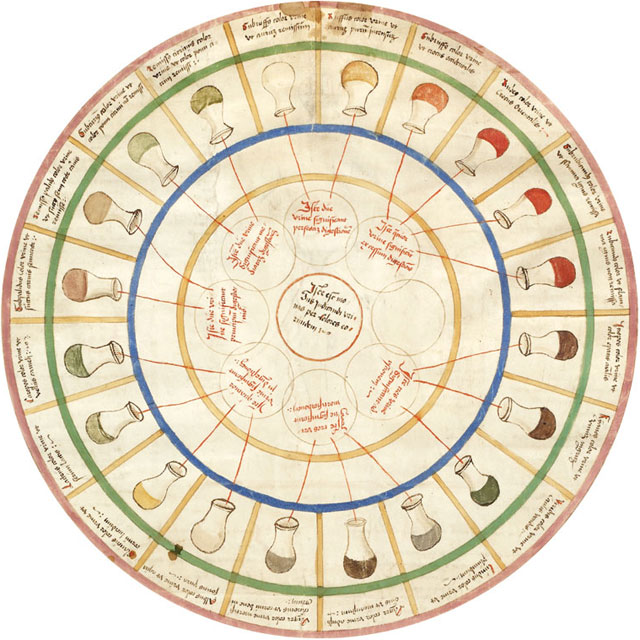
Many diseases affect metabolism and many changes in metabolism can be detected in the urine. For example, diabetics will excrete sugar in their urine — sometimes enough sugar that it can be fermented into whisky. There are many other diseases that change the smell of a person’s urine, including the very descriptively named Maple Syrup Urine Disease or Sweaty Feet Syndrome, now much more likely to be diagnosed by electronic sensor arrays than actually tasting the urine.
(via edible geography)
Our small corner of the internet freaked out yesterday when Linn Nygaard noticed that all her books had been wiped from her Kindle and her Amazon account had been closed. Nygaard’s account and books have since been restored but the incident has caused many to remember that, oh yeah, the Kindle is more of a Blockbuster Video-like rental store than a reading device. To that end, Zachary West has posted instructions for converting all of your DRM’d Kindle books into a non-DRM format that you can read on any number of devices.
One of my favorite “memes” of all time is Drunk Jeff Goldblum. The first video, a slowed-down ad for Apple from 1999, is still the best. “In ter net?! I’d say In ter net.”
But this new one about PayPal is pretty great too.
“Buying a chair… while sitting in a chair…” (via ★interesting)
Billion, by artist Vincent Kohler, shows the different pieces of wood derived from a log. It reminds me of the iconic butchery map showing the different cuts of meat. The sculpture, interestingly, is made out of polystyrene.

(via dens)
Writing for Slate, Dan Kois looks back on the landmark album for kids, Free to Be… You and Me, which was released 40 years ago. Part one details how the album came to be.
[Marlo] Thomas’ fruitless Martindale’s shopping trip led her to the idea that her next project ought to be a collection of stories for children that avoided sexual stereotypes and promoted gender equality. She could solicit the stories and record herself reading them. It would be just like the records she and her sister had listened to in their rooms as little girls, but liberated, smarter, modern. She just had to find the stories.
Part two covers how the album was created:
The sketches were recorded at the grand MediaSound studio on West 57th Street over the course of a few days. Billy De Wolfe, Thomas’s co-star on That Girl, lent his distinctive voice to several roles on the record, including the dandyish principal who plays the flute for Dudley Pippin. (Dudley Pippin himself was voiced by “Bobby Morse,” better known now as cranky senior partner Bertram Cooper on Mad Men.) Some of the sessions were quite impromptu: Dick Cavett remembers getting a call from Thomas in the morning-“I had a show to tape that day, and I thought, well, God, I can’t really do it, but I like her, and she does good stuff, and also I was very familiar with her face because on my daytime show the promo for That Girl ran at least 10 times during each show”-and walking the few blocks from his office to MediaSound to record that afternoon.
Mel Brooks’ session was more eventful. Thomas had written to him that the album “would benefit the Ms. Foundation,” and when he came in the morning of his recording, he told her that he thought the material Reiner and Stone had written was funny but that he didn’t know what it had to do with multiple sclerosis. Once set straight about the MS in question, Brooks joined Thomas in the recording booth, where they would both play babies for the album’s first sketch, “Boy Meets Girl.”
“When I directed,” Alda recalls, “I would be meticulous and relentless. I would do a lot of takes. But Mel is not a guy who’s used to doing a lot of takes. He’s not used to taking direction from anybody-you know, he gives direction.” Alda didn’t love the first few takes of “Boy Meets Girl”; in the end it took, Alda remembers, 10 or 15 tries, with Brooks improvising madly all along the way. Rodgers was there that day to record “Ladies First,” and she still remembers standing in the control room laughing harder with each take. “Mel was generous,” Alda allows, “and he let me egg him on.”
And part three addresses the impact the album has had:
Criticism came from the other direction, too. Thomas held on to a review from the feminist newspaper Off Our Backs, which chided Free To Be for its focus on the nuclear family and hetero relationships. “The message is so upbeat and catchy and some of the messages so appealing,” Fran Pollner wrote, “that the adult feminist listener may miss the first time around the basic idea of this one-hour album: that little boys and little girls should get together at a young age to ensure a solid and satisfying future marriage and family life.”
“I think it was very hard in the 1970s to ever make any comment that was viewed as radical enough,” laughs Laura Lovett, co-editor with Rotskoff of When We Were Free To Be. “People were holding one another to really hard and clear goals.”
But of course part of the point of Free To Be was making radical feminist beliefs palatable to a broad audience that might otherwise reject them. “It was second-wave feminism that went mainstream,” Rotskoff says. “It was packed with telegenic celebrities. It was performed by famous people. And the messages were both revolutionary and accessible enough for a mainstream audience.”
We listen to a lot of Free to Be on long car trips. No idea whether any of it is getting through, but it’s nice to have something to reference when we’re talking about, for example, the maddening no-boys-allowed princess parties thrown by Ollie’s school classmates. [hair tearing-out noise]
Last week Aaron linked to Kanye Wes. Turns out there is also Arrested Westeros (Arrested Development quotes + Game of Thrones scenes):
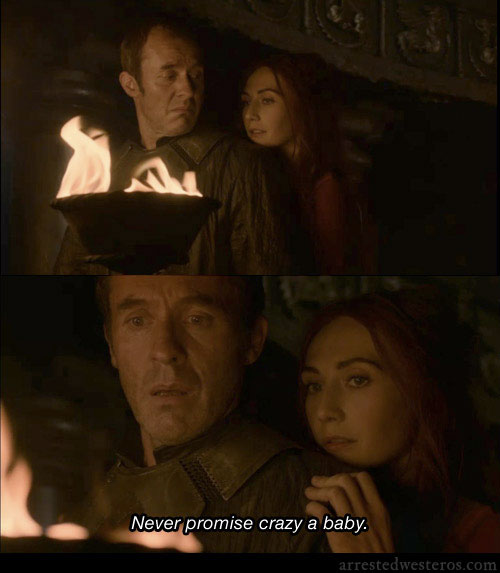
Man, I wish Kanye Westeros were better. (via @JoshMorrison)
Rex Sorgatz is writing about a piece of video everyday at View Source, which is also an email newsletter. Or is it a newsletter with a website?
If you’re like me, you suspect that YouTube is packed with interesting stuff, but we lack a system for finding it. A few interesting clips might come to you via so-called social media, but that just reinforces the feeling that there’s probably more out there beyond your friends.
My hope is that VIEWSOURCE will help solve this problem. It’s a simple daily email newsletter with just one video clip. It might be a long-forgotten music documentary, a new webshow with a celebrity, some crazy hip-hop video, or a new supercut. There is no “demographic” in mind, but hopefully it eschews the “viral video” genre.
A letter from the chairman of the Committee on Promotion and Tenure at Marshall College outlines the many reasons why they have denied Henry “Indiana” Jones Jr. tenure at the school.
Though the committee may have overstepped the boundaries of its evaluation, I find it pertinent to note that Dr. Jones has been romantically linked to countless women of questionable character, an attribute very unbecoming of a Marshall College professor. One of these women was identified as a notorious nightclub singer whose heart he attempted to extract with his hands, and whom he then tried, and failed, to lower into a lake of magma. Another was a Nazi scholar he was seen courting just last year who, I’m told, plummeted into a fathomless abyss at Dr. Jones’s hand. And, of course, no one can forget the slow decline and eventual death of Professor Abner Ravenwood after Dr. Jones’s affair with Abner’s underage daughter was made public, forcing her to emigrate to Nepal to escape the debacle.
(via df)
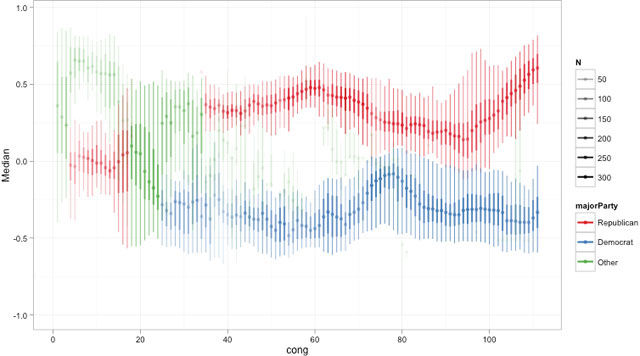
It was not my intent to be so politically oriented this morning but here we are. This is a chart that tracks the ideologies of the Democratic and Republican members of Congress from 1789 to 2010. As you can see, the shift away from the center by the Republicans since 1975 is unprecedented, perhaps matched only by the shift toward the center by the Democrats beginning in 1921 and ending in 1945.
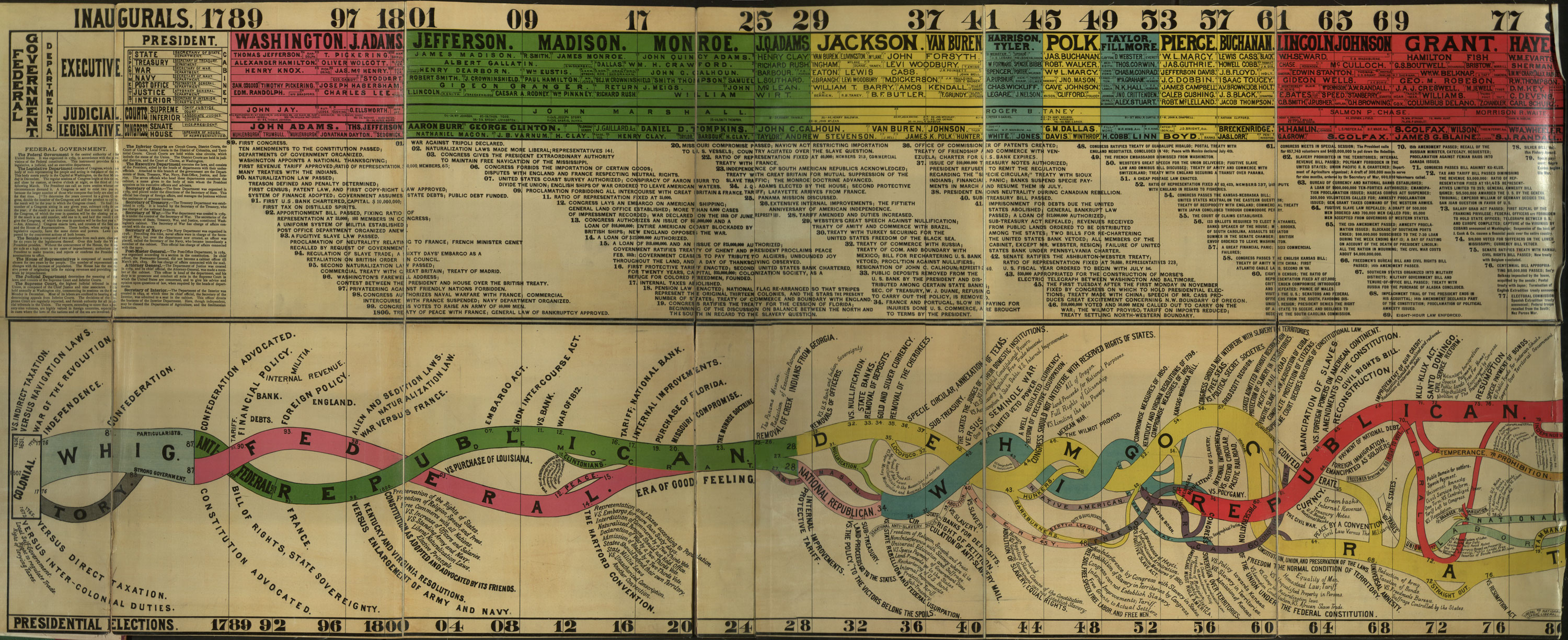
This reminds me of a timeline created circa 1880 for a book called Conspectus of the History of Political Parties and the Federal Government:
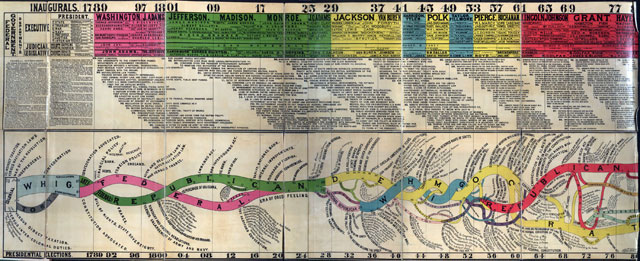
Bigger version here. (via @joecarryon)
Following up on her piece in the New Yorker on how hedge fund billionaires have become disillusioned with President Obama, Chrystia Freeland says that the 1% are repeating a mistake made many times throughout history of moving from an inclusive economic system to an extractive one.
Extractive states are controlled by ruling elites whose objective is to extract as much wealth as they can from the rest of society. Inclusive states give everyone access to economic opportunity; often, greater inclusiveness creates more prosperity, which creates an incentive for ever greater inclusiveness.
Freeland is riffing on an argument forwarded by Daron Acemoglu and James Robinson in Why Nations Fail. Their chief example cited by Freeland is that of Venice:
In the early 14th century, Venice was one of the richest cities in Europe. At the heart of its economy was the colleganza, a basic form of joint-stock company created to finance a single trade expedition. The brilliance of the colleganza was that it opened the economy to new entrants, allowing risk-taking entrepreneurs to share in the financial upside with the established businessmen who financed their merchant voyages.
Venice’s elites were the chief beneficiaries. Like all open economies, theirs was turbulent. Today, we think of social mobility as a good thing. But if you are on top, mobility also means competition. In 1315, when the Venetian city-state was at the height of its economic powers, the upper class acted to lock in its privileges, putting a formal stop to social mobility with the publication of the Libro d’Oro, or Book of Gold, an official register of the nobility. If you weren’t on it, you couldn’t join the ruling oligarchy.
The political shift, which had begun nearly two decades earlier, was so striking a change that the Venetians gave it a name: La Serrata, or the closure. It wasn’t long before the political Serrata became an economic one, too. Under the control of the oligarchs, Venice gradually cut off commercial opportunities for new entrants. Eventually, the colleganza was banned. The reigning elites were acting in their immediate self-interest, but in the longer term, La Serrata was the beginning of the end for them, and for Venetian prosperity more generally. By 1500, Venice’s population was smaller than it had been in 1330. In the 17th and 18th centuries, as the rest of Europe grew, the city continued to shrink.
BTW, Acemoglu and Robinson have been going back and forth with Jared Diamond about the latter’s geographical hypothesis for national differences in prosperity forwarded in Guns, Germs, and Steel. I read 36% of Why Nations Fail earlier in the year…I should pick it back up again.
Not a surprise really, but the New Yorker’s endorsement of Obama for President is a clear headed assessment of his first term and an effect critique against the “increasingly reactionary and rigid” Republican Party which Romney, to his discredit, has aligned himself with.
Perhaps inevitably, the President has disappointed some of his most ardent supporters. Part of their disappointment is a reflection of the fantastical expectations that attached to him. Some, quite reasonably, are disappointed in his policy failures (on Guantánamo, climate change, and gun control); others question the morality of the persistent use of predator drones. And, of course, 2012 offers nothing like the ecstasy of taking part in a historical advance: the reëlection of the first African-American President does not inspire the same level of communal pride. But the reëlection of a President who has been progressive, competent, rational, decent, and, at times, visionary is a serious matter. The President has achieved a run of ambitious legislative, social, and foreign-policy successes that relieved a large measure of the human suffering and national shame inflicted by the Bush Administration. Obama has renewed the honor of the office he holds.
This paragraph is terrifying:
In pursuit of swing voters, Romney and Ryan have sought to tamp down, and keep vague, the extremism of their economic and social commitments. But their signals to the Republican base and to the Tea Party are easily read: whatever was accomplished under Obama will be reversed or stifled. Bill Clinton has rightly pointed out that most Presidents set about fulfilling their campaign promises. Romney, despite his pose of chiselled equanimity, has pledged to ravage the safety net, oppose progress on marriage equality, ignore all warnings of ecological disaster, dismantle health-care reform, and appoint right-wing judges to the courts. Four of the nine Supreme Court Justices are in their seventies; a Romney Administration may well have a chance to replace two of the more liberal incumbents, and Romney’s adviser in judicial affairs is the embittered far-right judge and legal scholar Robert Bork. The rightward drift of a court led by Justices Roberts, Scalia, Thomas, and Alito — a drift marked by appalling decisions like Citizens United — would only intensify during a Romney Presidency. The consolidation of a hard-right majority would be a mortal threat to the ability of women to make their own decisions about contraception and pregnancy, the ability of institutions to alleviate the baneful legacies of past oppression and present prejudice, and the ability of American democracy to insulate itself from the corrupt domination of unlimited, anonymous money. Romney has pronounced himself “severely conservative.” There is every reason to believe him.
The endorsements of major newspapers can be tracked here.
Technology journalist Glenn Fleishman appeared on Jeopardy on Thursday and wrote up a piece for Boing Boing on his experience.
The secret of Jeopardy, what defuses the reality-show aspect, is that we all universally wanted each other to win even though we knew that only one person took home the big money and would return to fight again.
Here’s Glenn’s Final Jeopardy from that night:
I wouldn’t have gotten that question in a millions years. Maybe in high school…
The Rolling Stones cover the Beatles in 1965 orig. from Oct 19, 2012
Early color photography orig. from Sep 04, 2009
* Q: Wha? A: These previously published entries have been updated with new information in the last 24 hours. You can find past updates here.
In production for the past twenty-four years, it looks as though the documentary about Arrested Development might be nearing its release. Here’s the final trailer:
Update: You can watch the documentary on Amazon. (via @mcnees)
Newsweek announced yesterday that the print magazine will cease publication and the entire thing will move to an all-digital format.
Newsweek Global, as the all-digital publication will be named, will be a single, worldwide edition targeted for a highly mobile, opinion-leading audience who want to learn about world events in a sophisticated context. Newsweek Global will be supported by paid subscription and will be available through e-readers for both tablet and the Web, with select content available on The Daily Beast.
In talking about the shift on his Daily Beast blog, Andrew Sullivan notes something interesting about reading online vs. reading in print (emphasis mine):
Which is why, when asked my opinion at Newsweek about print and digital, I urged taking the plunge as quickly as possible. Look: I chose digital over print 12 years ago, when I shifted my writing gradually online, with this blog and now blogazine. Of course a weekly newsmagazine on paper seems nuts to me. But it takes guts to actually make the change. An individual can, overnight. An institution is far more cumbersome. Which is why, I believe, institutional brands will still be at a disadvantage online compared with personal ones. There’s a reason why Drudge Report and the Huffington Post are named after human beings. It’s because when we read online, we migrate to read people, not institutions. Social media has only accelerated this development, as everyone with a Facebook page now has a mini-blog, and articles or posts or memes are sent by email or through social networks or Twitter.
People do tend to read people and not institutions online but a shift away from that has already started happening. A shift back to institutions, actually. Pre-1990s, people read the Times or Newsweek or Time or whatever. In 2008, people read Andrew Sullivan’s Daily Dish or Paul Krugman’s column in the Times or Gwyneth Paltrow’s GOOP. Today, people read feeds of their friends/followees activities, interests, thoughts, and links on sites like Twitter, Facebook, Pinterest, and Tumblr, i.e. the new media institutions.
Now, you may follow Daily Dish or Krugman on Twitter but that’s not quite the same as reading the sites; you’re not getting the whole post/article on Twitter, Krugman items are intermingled & fighting for attention with tweets from @horse_ebooks & Lady Gaga, and if you unfollowed Krugman altogether, you’ll find when he writes something especially good, someone else in your Twitter stream will point you to it pretty quickly. That is, Twitter or Facebook will provide you with the essential Krugman without you having to pay any attention to Krugman at all.
What that means is what blogs and the web are doing to newspapers and magazines, so might Facebook & Twitter do to blogs. Blogs might not even get the chance to be called old media before they’re handed their hats. It’ll be interesting to see how smartphone/tablet apps affect this dynamic…will apps push users/readers back toward old media institutions, individuals, or the friend-packaging institutions like Twitter?
German photographer Hugo Jaeger traveled around Poland after the Nazi invasion and documented daily life there. Life has a selection of Jaeger’s color photos from that time.

Why would Hugo Jaeger, a photographer dedicated to lionizing Adolf Hitler and the “triumphs” of the Third Reich, choose to immortalize conquered Jews in Warsaw and Kutno (a small town in central Poland) in such an uncharacteristic, intimate manner? Most German photographers working in the same era as Jaeger usually focused on the Wehrmacht; on Nazi leaders; and on the military victories the Reich was so routinely enjoying in the earliest days of the Second World War. Those pictures frequently document brutal acts of humiliation, even as they glorify German troops.
The photographs that Jaeger made in the German ghettos in occupied Poland, on the other hand, convey almost nothing of the triumphalism seen in so many of his other photographs. Here, in fact, there is virtually no German military presence at all. We see the devastation in the landscape of the German invasion of Poland, but very little of the “master race” itself.
It is, of course, impossible to fully recreate exactly what Jaeger had in mind, but from the reactions of the people portrayed in these images in Warsaw and Kutno, there appears to be surprising little hostility between the photographer and his subjects. Most of the people in these pictures, Poles and Jews, are smiling at the camera. They trust Jaeger, and are as curious about this man with a camera as he is about them. In this curiosity, there is no sense of hatred. The men, women and children on the other side of the lens and Jaeger look upon one another without the aggression and tension characteristic of the relationship between perpetrator and victim.
It’s still amazing the extent to which early color photography can transport us back to the past in a way that black & white photography or even video cannot.
Kanye Wes Anderson is a Tumblr posting screencaps of Wes Anderson moves mashed with Kanye West lyrics resulting in a good time for all. Plus, Kanye and Wes totally hang out.
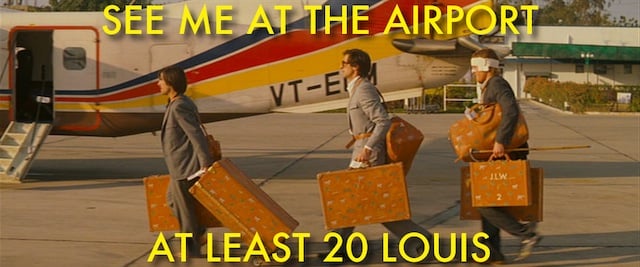
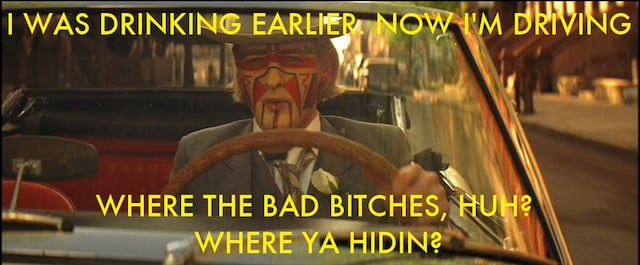
(via @ryansholin)
Here are the Rolling Stones touring Ireland in 1965, messing around in what looks like a hotel room, playing a couple of Beatles tunes, I’ve Just Seen a Face and Eight Days a Week.
Jagger at least seems to be taking the piss more than honestly enjoying the music of his fellow British invasion personnel. (via dangerous minds)
Update: From Andy Baio, a reminder that The Stones’ first top 20 single was a cover of The Beatles’ I Wanna Be Your Man.
Mary HK Choi takes an hour-long journey in the last remaining sensory deprivation tank in New York.
Okay. This is when you realize you had a picture in your mind about an isolation tank, so you’re going to be simultaneously bummed out and fully relieved that the tank isn’t one of them lock-down joints from “Fringe.” This one basically looks like a huge bathtub, enclosed behind an upright sliding shower door that’s black and features a handsome wooden handle. There is no lid. The darkness is your lid, just as it’s always been. (JK JK, I don’t even know what that means!) This is good, because you don’t have to worry about suffocating on your own carbon dioxide because you don’t experience that thing where your breath breathes back at you because you’re panting and watching the intruder from inside your closet that is so very small. :(
The water-“water”-is set at exactly body temp, so don’t expect that tingly sensation of sliding into a hot tub. And remember that it’s saline solution, so don’t get it on your face. It’s not that tricky, since you’ll slide in so that you’re on your back. So your eyes, nose and mouth are completely exposed and floating, as well as your toes, the tops of your thighs and a half-bagel of your belly (or full bagel depending on the day).
Girl with a Pearl Earring and Point-and-Shoot Camera orig. from Oct 18, 2012
* Q: Wha? A: These previously published entries have been updated with new information in the last 24 hours. You can find past updates here.
Danxia refers to a “type of petrographic geomorphology” found in China. What that means is you get these mountains that look as though they were decorated with crayons by a five-year-old channelling Dalí.
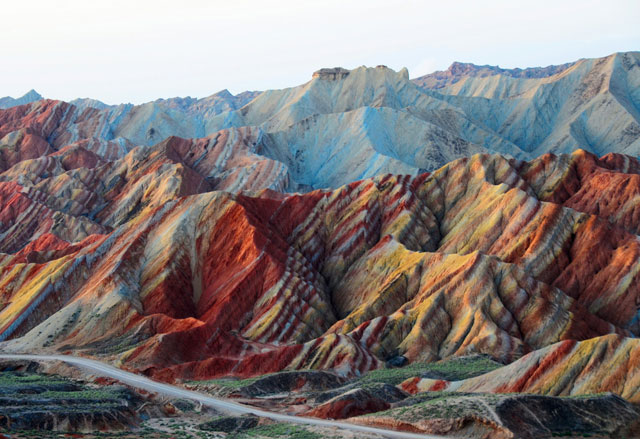
That shot was taken by Melinda ^..^ on Flickr…you can find dozens of her Danxia photos here. A kottke.org reader suggests that Tiny Wings creator Andreas Illiger was influenced by the Danxia landforms in developing the iconic scenery for the game.

Not a bad theory. (thx, christopher)
The Roots drummer, ?uestlove, will be schooling kids left and right this spring as he teaches a class on classic albums at NYU. It’s too bad this isn’t a high school class so my Young MC ‘Principal’s Office’ reference would fit better.
The course will include lectures on albums such as Sly & The Family Stone’s There’s a Riot Goin’ On, Aretha Franklin’s Lady Soul, Led Zeppelin’s IV, Prince’s Dirty Mind, Michael Jackson’s Off the Wall, and the Beastie Boys’ Paul’s Boutique.
They’ll also cover what constitutes a “classic” or “seminal” album, looking at the music, lyrics, production, and business behind great albums.
Billboard reports that the course was inspired by an NPR blog post over the summer where an intern reviewed Public Enemy’s It Takes A Nation of Millions To Hold Us Back, an album he’d never heard before. ?uestlove responded to the dismissive review in the comments, prompting NYU’s Jason King to invite ?uestlove and Weinger to teach the course.
I’ve never seen so much household organizational porn collected in one place before. Tumblr should get a Nobel Peace Prize for propagating such useful information so far and wide. A couple of examples:

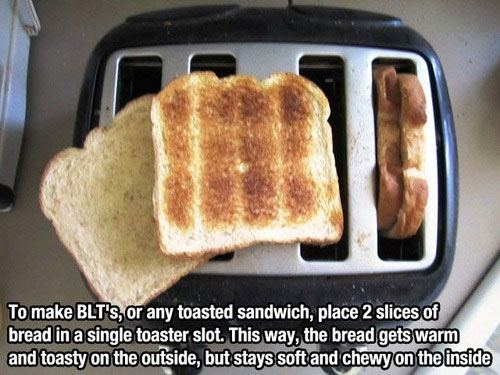
(via hacker news)
This forgotten Vermeer has been floating around for a few months but I just saw it. Love it:

Anyone know who did this? I spent a few minutes trying to find out but got dead-ended in a Tumblr/Imgur attribution black hole. (via ★ryanvlower)
Update: The creator of the image is supposedly Mitchell Grafton, although I couldn’t find any airtight attribution. (thx, all)
Chris Lee and his friends have embarked on a project to build a 1:1 scale model of the Millennium Falcon, complete with a correctly scaled interior.
I own a secluded 88 acre tract of wooded land where we’ll be building. We have selected a site on the property that is low enough so that the top of the Falcon can be seen easily from several vantage points. A flat area roughly 400’ x 400’ is being cleared. And yes, I am aware that it will eventually show up on Google Earth and Google Maps. I’m counting on that.
There isn’t much to say about this one except I majored in German so it was easy for me to translate “Owa, mein Arsch” to “Ow, my ass.”
(via laughing squid)
Over the past few years, we’ve seen an endless parade of stories debunking the value of many of the products that line the shelves of our local pharmacies. Well, here’s a different kind of story. A massive study that included more than 15,000 men and lasted more than 13 years found that taking a daily multivitamin (in this case Centrum Silver) reduced the risk of cancer. It looks like there’s something to taking one multivitamin as opposed to swallowing high doses of individual vitamins.
Brian Simmons is one of the two best horseshoe pitchers in the world. Without giving too much away about the story, he’s overcome a lot to reach that status.
Brian Simmons does not like the clay at this year’s World Horseshoe Tournament in Knoxville, Tenn. It’s powdery, slippery. Even the non-horseshoe pitchers can tell this, because the bleachers in the convention center, where the tournament is being held, are coated in a light gray dust and the concrete floor has gotten more slick with each passing day. The clay dust gets on Simmons’s shoes and then the shoes slip out of his hand. It’s supposed to be Kentucky Blue Clay but that is hard to believe. More like Kentucky Synthetic, one man says. It makes it damn hard to pitch a horseshoe with the accuracy normally attributed to a man like Simmons.
This is what Simmons is thinking about as he stares down a 14-inch tall stake. He is thinking about the slippery clay, and how he might adjust his release point, and as these thoughts slip into his brain, he has lost without even pitching the shoe.
Also, I have been throwing horseshoes wrong all these years.
What if Andreas Gursky, Garry Winogrand, and Henri Cartier-Bresson put cheesy watermarks all over their photographs?

(via @jenbee)
Older posts





Socials & More