kottke.org posts about video
The official trailer for the now-confirmed final season of Succession (until they do one more, like 12 years from now). Premieres on HBO Max March 26. As I said when the teaser trailer dropped in January, Succession is my current pick for The Best Show on TV Right Now and I’m excited (and sad) for this final season!
In a 1959 talk entitled There’s Plenty of Room at the Bottom, physicist Richard Feynman casually invented nanotechnology, inviting the audience and then the world to imagine exploring and making use of the “inner space” of the micro and nano realms. In this video from Kurzgesagt, thye imagine how things would seem if you could somehow shrink yourself down to the size of a grain of sand or a molecule or even smaller, sort of a more educational (but still fun) Ant-Man and the Wasp: Quantumania.
You are the size of a grain of sand just 2 mm high, standing on a blade of grass that seems as tall as an eight storey building to you. A square meter of lawn is now a dense metropolitan area, with 100,000 blades, or two Manhattans worth of grass towers. From your new tiny perspective, the park that you could quickly stroll through before, is now the size of France. Crossing it would take at least a week. Human-sized humans loom over you, 4 times taller than the Empire state building, their steps falling from horizon to horizon.
A bee the size of a helicopter lands near you, making the ground shake, as its hairy carapace vibrates with each wingbeat. You try to escape but are barely able to move because the air is so… gooey. Before you clicked the button air resistance was barely noticeable — but as you’re now a thousand times smaller, it is as if the air has become a thousand times denser. It feels like you are moving through honey.
Flying insects like bees use this to their advantage. Their wings are not made for gliding but like paddles that row through the air. Scaled up to human size, the bee would outrun a Concorde Jet — except it couldn’t even take off because it would be too heavy for its wings.
See also Meet the Nano Sapiens, Scaling Laws and the Speed of Animals, The Biology of B-Movie Monsters, and Powers of Ten.
From Vox, an inflation explainer video that sums up the three primary explanations for the current rise in prices worldwide — Too much money, supply shocks, massive markups (aka corporate price gouging) — and what governments can do about it.
Right now, inflation is inescapable. At the grocery store, the gas station, and in almost every country in the world, people are playing more — way more — than they did just a couple of years ago for everything.
In this video, we explore three explanations for why prices are rising, as well as different policy options for bringing them down.
Bill Neil is a movie trailer editor at Buddha Jones and in this video he guides us through a short history of movie trailers — from Dr. Strangelove in the 60s to Neil’s own Nope trailer — and gently picks them apart to show us how they work. I enjoyed hearing all of the vocabulary for the techniques that they use: rug pull, bumper, diegetic, rise, and signature sound (aka leitmotif).
The promise of 3D movies is that they are supposed to draw the viewer further into the world of the film — the all-important immersive experience. In this video, Evan Puschak argues persuasively that the 3D effect actually has the opposite effect, for four main reasons:
1. The different focus and convergence points.
2. The darkness of 3D movies
3. 3D glasses shrink the screen
4. 3D forces you to look at only what’s in focus
I’ve long disliked 3D movies so Puschak’s explanation makes me feel vindicated about my stance. I’ve only ever seen two of them that were any good: the original Avatar and Tron: Legacy. Tron in particular was one of my peak movie-going experiences: I saw it, nearly alone, in a 3D IMAX theater from the best seat in the house. When the lightcycle match started, the 3D effect brought the playing field right into the theater a few inches from my nose and I just gaped in wonder like a little kid for the rest of what is essentially a 125-minute Daft Punk music video (nothing wrong with that!). If all 3D movies were like that, sign me up! But otherwise, I’m gonna stick to 2D.
Genetics determines most of how tall children will grow as adults, but environmental factors affect it too. As the wealth of many countries around the world has increased over the past 100 years, living conditions and access to nutrition have improved and people have gotten taller.
A century ago, humans were quite short. For example, the average South Korean woman was about 4-foot-7, or 142 centimeters, while the average American woman was about 5-foot-2, or 159 centimeters. Humans were fairly short by today’s standards, and that was true throughout nearly all of human history.
But in the past century, human heights have skyrocketed. Globally, humans grew about 3 inches on average, but in South Korea, women grew an astounding 8 inches and men grew 6 inches.
South Korea is almost unique in how quickly their population has gotten taller because they went from a relatively low-income country in the 1950s to well on their way to being a rich, industrialized country by the 90s. And the difference is particularly stark when you compare the heights of South Koreans with those of North Koreans, where the living standard is much lower and access to nutrition is restricted.
I really like the show-your-work vibe of this video, along with this recent one on the greatest unexpected performances in the NBA. These videos are not only relating something interesting to the audience, they’re showing us how the data analysis works: where the data is from, how it’s analyzed, and what it all means, which builds data and statistical literacy in a society that desperately needs it.
The Oscar voters haven’t always gotten their top picks right, but there’s no denying that this visual showcase of Best Cinematography winners from 1967-2021 contains some fantastic work. Just to call out a few of the films recognized: Bonnie and Clyde; Barry Lyndon; The Killing Fields; Schindler’s List; Titanic; Crouching Tiger, Hidden Dragon; Master and Commander; There Will Be Blood; Inception; Blade Runner 2049; and Dune.
There’s an interesting shift in the winners (presaged by Close Encounters of the Third Kind in 1977); they move away from historical realism and towards fantasy, sci-fi, and the future: Crouching Tiger (2000) and Lord of the Rings (2001) and then, more definitively, Avatar (2009) and Inception (2010). But the shift is not by any means total: The Revenant (2015), Roma (2018), 1917 (2019), and Mank (2020) are all firmly in the realist realm.
Shetland Islanders, descendents of Jamaican immigrants living in London, and African Americans all tend to say “axe” or “aks” instead of “ask” when speaking. Linguist Geoff Lindsey traces the history of differing pronunciations of ask/aks from all the way back to the beginnings of written English up to the present day.
See also Ask or aks? How linguistic prejudice perpetuates inequality and linguist John McWhorter on The ‘ax’ versus ‘ask’ question.
First, it’s important to understand that, as English goes, “ax” is a perfectly normal thing to have happened to a word like “ask.” Take the word “fish.” It started as “fisk,” with the same -sk ending that “ask” has. Over time, in some places people started saying “fisk” as “fiks,” while in others they started saying “fisk” as “fish.” After a while, “fish” won out over “fiks,” and here we are today. The same thing happened with “mash.” It started as “mask.” Later some people were saying “maks” and others were saying “mash.” “Mash” won.
With “ask,” some people started saying “aks,” and some started saying “ash.” But this time, it wasn’t “ash” that won out. Instead, for a while “aks” was doing pretty well. Even Chaucer used it in “The Canterbury Tales,” in lines such as this one: “Yow loveres axe I now this questioun.”
There is an element of chance in how words change over time, and we will never know why “aks” and “ash” lost out to “ask.” All we know is that the people whose English was designated the standard happened to be among those who said “ask” instead of “aks” - and the rest is history.
(via @peterme
ASMR videos don’t really do anything for me, but I could watch videos of gears and mechanisms doing their thing all day long. I watched this video of 20 mechanical Lego widgets being combined into one useless machine, absolutely rapt. Bevel gears, rack and pinion, camshaft, worm gear, universal joint, Schmidt coupling — this thing has it all.
See also Gears and Other Mechanical Things and a Treasure Trove of Over 1700 Mechanical Animations. (via the kids should see this & meanwhile)
A rule of thumb for me in evaluating what movies to watch with my limited free time these days: I will often go for something visually impressive or inventive over other options. So this short reel featuring the nominees for Best Visual Effects Oscar talking about scenes from their movies — All Quiet on the Western Front, Avatar: The Way of Water, The Batman, Black Panther: Wakanda Forever, Top Gun: Maverick — is right up my alley. (via @tvaziri)
Ok this video from The Pudding is cool for two different reasons. First, you learn about which NBA player had the most unexpectedly great performance since 1985 (e.g. when a guy who is usually good for 6-8 pts inexplicably drops 50). But, you also get a fun little tutorial in how statistical analysis works and the importance of paying attention to the right data in order to get an answer that’s actually meaningful and relevant. How to interpret data in this way is an under-appreciated aspect in the bombardment of data and statistics we see in the media these days and teaching more people about it doesn’t have to be boring or stuffy.
The Pudding also sets an example here by working in the open: the data they used for their analysis is available on Github.
You’ve probably never heard of Raymond Scott’s Powerhouse, even though it’s one of the most well-known songs of the 20th century. Powerhouse is the slapstick “the chase is on!” and relentless “assembly line” music that you’ve heard in many Looney Tunes shorts and other cartoons, including The Simpsons and Spongebob. Here it is in the 1946 ‘toon, Baby Bottleneck:
From Cartoon Brew’s appreciation of Powerhouse on the 86th anniversary of its recording:
I’m sure Raymond Scott never would’ve guessed that he was sealing his legacy when he sold his publishing rights to Warner Bros. Music in 1943. This little transaction gave genius composer Carl Stalling free reign to plug Raymond Scott’s melodies into his scores for the Looney Tunes and Merrie Melodies cartoons. The propulsive energy of Scott’s quirky instrumental jazz compositions made perfect fodder for the likes of Bugs Bunny and Daffy Duck, and Stalling found immediate use for his new library; Stalling’s first quotation of “Powerhouse” appears in the Frank Tashlin classic Porky Pig’s Feat (1943).
The peculiar strains of Raymond Scott’s music and the screwball slapstick of the Warner Bros. cartoons were a match made in heaven…
That CB post has a bunch of embedded videos of different uses of the song, along with this gem of Scott and his “Quintette” playing Powerhouse on TV in 1955:
(via @tcarmody)
In 1986, a team led by Bob Ballard went down in a submersible to explore the wreck of the Titanic, marking the first time since its sinking in 1912 that the ship was seen by human eyes. When some of the photos and video footage they shot were released to the public, it caused a sensation. But much of the video footage has never been seen by the public — the video above is 1h 21m of “rare, uncut, and unnarrated footage” from that initial dive. (via open culture)
Now showing on American Experience on PBS: Ruthless: Monopoly’s Secret History.
For generations, Monopoly has been America’s favorite board game, a love letter to unbridled capitalism and — for better or worse — the impulses that make our free-market society tick. But behind the myth of the game’s creation is an untold tale of theft, obsession and corporate double-dealing. Contrary to the folksy legend spread by Parker Brothers, Monopoly’s secret history is a surprising saga that features a radical feminist, a community of Quakers in Atlantic City, America’s greatest game company, and an unemployed Depression-era engineer. And the real story behind the creation of the game might never have come to light if it weren’t for the determination of an economics professor and impassioned anti-monopolist.
You can watch the first ten minutes of the show on YouTube or see the whole thing on the PBS website.
See also The Antimonopolist Origins of Monopoly Differ from Hasbro’s Official Story. (via @Kitbuckley)
This is pretty amazing: a guy making a 0.6mm screw for a watch using a very precise watchmaker’s lathe. It’s so small! I love that the hardest part is trying to find the impossibly tiny thing after it detaches from the high-RPM lathe. (thx, mick)
Well, I was not expecting the next video game to be turned into an edgy drama (an 80s Cold War techno-thriller, no less) to be Tetris, but here we are.
Taron Egerton stars in a new Apple Original Film inspired by the true story of how one man risked his life to outsmart the KGB and turn Tetris into a worldwide sensation.
If you’d have told me that this trailer was a Saturday Night Live sketch from 6 years ago, I would have believed you — and as it is, the release date of March 31 gives me pause.1 But I’ll give it a shot.
A group of astronomers say they have evidence that links supermassive black holes at galactic centers with dark energy, the mysterious force that accounts for roughly 68% of the energy in the universe. Here’s the news release and the paper. From the Guardian:
Instead of dark energy being smeared out across spacetime, as many physicists have assumed, the scientists suggest that it is created and remains inside black holes, which form in the crushing forces of collapsing stars.
“We propose that black holes are the source for dark energy,” said Duncan Farrah, an astronomer at the University of Hawaii. “This dark energy is produced when normal matter is compressed during the death and collapse of large stars.”
The claim was met with raised eyebrows from some independent experts, with one noting that while the idea deserved scrutiny, it was far too early to link black holes and dark energy. “There’s a number of counter-arguments and facts that need to be understood if this claim is going to live more than a few months,” said Vitor Cardoso, a professor of physics at the Niels Bohr Institute in Copenhagen.
And here’s a short video explainer:
It’s a radical claim to be sure — it’ll be interesting to see how it shakes out in the weeks and months to come as other scientists interpret the results.
In the midst of the zaniness of Everything Everywhere All at Once is one of the funniest things I have seen in a movie theater in years: Raccacoonie. (If you know, you know.) Inverse talked to a bunch of people involved with the film about how Raccacoonie came about and what the folks at Pixar thought about the riff on Ratatouille. First off, here’s the initial mention of Raccacoonie in the movie:
The initial idea came from stories that producer Jonathan Wang would tell about his father messing up the names of American movies:
I think it’s pretty common when you have parents who are speaking English as a second language: They butcher movie titles. [My dad] would call James Bond “double seven” instead of “double-O seven.” He would just mess up movie titles all the time. My favorite one he would say was “Outside Good People Shooting” — that one is Good Will Hunting.
Costume designer Shirley Kurata added:
Being an Asian American and having parents where English isn’t their native language, I was used to hearing my parents mispronounce things. I had this memory when I was really young and I saw this word and I didn’t know what it said. I asked my mom. She was like, “Pin-oh-shee-oh.” I think both of us just laughed because we realized she totally mispronounced Pinocchio.
What did the folks at Pixar think? Of course, they loved it — because it’s great.
I never even thought about whether or not we would get a call from Disney or if Pixar was going to be mad. We did a tour of the Pixar campus and got to hang out with [animator/director] Domee Shi, and she’s so great. We were like, “Have you guys talked about, uh… us ripping off Ratatouille?” Everyone loves it there, and it seemed like no one was really upset. That was the only thing we thought of: Are we going to get flagged for this? But lawyers cleared it; everyone cleared it.
It’s worth reading the whole thing — I hadn’t realized they got Randy Newman to do a song for it.
DNA and RNA get all of the headlines, but it’s not difficult to argue that much of the glorious complexity and possibility of life is due to proteins. In the latest episode of Kurzgesagt, they explain the role of cellular proteins in creating life.
You are cells. Your muscles, organs, skin and hair. They are in your blood and in your bones.
Cells are biological robots. They don’t want anything, they don’t feel anything. They are never sad or happy. They just are, right here, right now. They are as conscious as a stone or a chair or a neutron star. Cells just follow their programming that has been evolving and changing for billions of years, molded by natural selection.
They are impossible machines and yet, here they are, driven entirely by the fundamental forces of the universe. The smallest unit of life, right at the border where physics becomes biology.
Sometimes, to get a truer understanding of how amazing something is, you need to hold your breath and dive in really deep. So, what are cells and how do they work?
As always, you can see a list of their sources and further reading for the video.
Riffing on a recent piece by Izzie Ramirez, Vo’x Kim Mas educates us on why the quality of consumer goods has dropped over the past several years.
Maybe you’ve noticed: In the past 10 years everything we buy from clothes to technology has gotten just a little bit worse. Sweaters are more likely to tear. Phones are more likely to break. Smart toasters and TVs burn out and die after only a few years. It might seem like consumer products just aren’t built to last anymore. What’s going on?
Unfortunately (and fortunately!), part of the problem is us. For decades, we’ve been conditioned to buy, buy, buy, and today it’s normal for many consumers to shop for new clothes at least once a month. In order to keep up, many companies have to prioritize making things in the fastest and least expensive way possible. To do that, they cut corners with materials and labor. In turn, quality suffers, which leaves consumers with a lot of crappy things.
So, here’s how they make vinyl records at Third Man Records in Detroit. As you might expect, the process is a bit less automated than what you’d imagine for digital music media — those records are human-handled dozens of times before they are finally placed into their jackets.
Vinyl is in the real world. It’s not something that exists only on your computer or your phone, it’s three-dimensional. Your nervous system is designed to take in the sound. It heals you. It’s a nutrient. It’s like vitamins. You feel it. It’s like getting a massage or eating a beautiful sandwich.
See also this slow-motion video of a vinyl record playing, recorded with an electron microscope. You can see how the soundwaves are encoded in the grooves. (via open culture)
I have never seen this before so maybe you haven’t either: a full-length video recording of Prince and the Revolution playing at First Avenue in 1983. This show marked the first time Prince played Purple Rain in public; it’s this recording of the song (lightly edited and reworked) that you hear on the album of the same name released the next year. From a piece in The Current about the show:
Before the 1984 blockbuster Purple Rain catapulted Prince on to the national stage, there was an Aug. 3, 1983 benefit concert for the Minnesota Dance Theatre at the recently re-branded First Avenue. It was there that the budding pop star debuted much of the Purple Rain album tracks, and recorded the versions of “Purple Rain,” “I Would Die 4 U” and “Baby I’m A Star” heard in the film and soundtrack.
“Those versions were almost exactly what he did live,” said longtime Prince producer David Rivkin, also known as David Z.
Since technology at the time couldn’t record wireless bass well, Rivkin said, Prince later added bass overdubs. He did some content edits, cutting the song down from about 14 to nine minutes.
“It was incredible; I mean little did I know it was gonna be that big of a recording,” Rivkin said. “Prince was really not a well-known figure back then. This is the kind of recording that launched him into super stardom.”
From Anil Dash’s piece on how Purple Rain came to be:
While Prince and the Revolution had been carefully rehearsing Purple Rain all summer, adjusting each detail of how the song was structured and played, Prince’s nearly-unequalled ability to spontaneously take a live performance to the next level was certainly on display that August night.
Exemplifying this ability is the repeated lilting motif that Prince begins playing on his guitar at 4:40 in the song. For all the countless times they’d practiced the song, even earlier on the same day as the First Avenue performance, Prince had never played this riff during Purple Rain before. In the original live show, it’s clear that Prince realizes he’s found something magical, returning again and again to this brief riff, not just on guitar but even singing it himself during the final fade of the song.
Just as striking is how this little riff shows the care and self-criticism that went into making the song Purple Rain. Like any brilliant 25-year-old guy who’s thought of something clever, Prince’s tendency when he thought of this little gem was to overdo it. In the unedited version of the song, Prince keeps playing the riff for almost another minute, pacing around the stage trying to will the audience into responding to it.
Update: From Louder, an oral history of Purple Rain and the night it was recorded.
After Melvoin’s opening acoustic chords, Bobby Z’s drums — mostly acoustic, and triggering Linn drums later added to in the mix — accompanied Prince’s singing for the first two minutes. “It’s just a back-beat and him from his guts,” Bobby says. “It’s just so raw for him. I remember those two minutes. Because the room is silent except for the pattern you’re playing. He was in the moment, and you’re in it with him, and it was a special place to be. It was a whole different planet.”
(via @peterbutler
Yesterday, Fox aired a very short, very good Rihanna concert, preceded and succeeded by a football game — you can watch it in its entirety on YouTube (possibly US-only). I caught this live and loved every second of it. The set design, choreography, costumes, the baby bump, and, of course, the music & singing: all pitch-perfect.
Update: I took out the embedded video because for some dumb reason the NFL doesn’t allow embeds on that video.
The Greek government and activists have long been calling for the return of the Parthenon Marbles from the British Museum to Greece. But how did the marbles get to Britain in the first place?
In the early 19th century, a British lord named Elgin removed a significant portion of the remaining marble decoration and statuary from The Parthenon in Athens and brought it back to Britain. To cover his debts, he sold the marbles to the British government and they eventually made their way into the British Museum. In the video above, Evan Puschak provides more detail about how it all went down.
For its part, the British Museum isn’t budging, although their official stance on the matter seems defensive, almost like they know they’re on thin ice, morally speaking. It’s long past time the marbles were repatriated and they should just get it over with already.
Update: This is interesting from David Allen Green: the return of the Parthenon Marbles isn’t up to the British Museum.
The fourth point is that the current legislation does make it difficult-to-impossible for the museum to dispose (to use the legal word) of the marbles as it wishes, either by returning them to Greece or otherwise.
An elaborate legal basis could, perhaps be provided, but — on balance — one suspects an English court would rule such a disposal as unlawful.
This means this is not a matter solely for the trustees of the museum (as I explain here).
For the marbles to be returned properly to Greece would require a change in primary legislation, which in turn means it has to have government support (or at least no government opposition).
(via someone I can’t remember but thank you!)
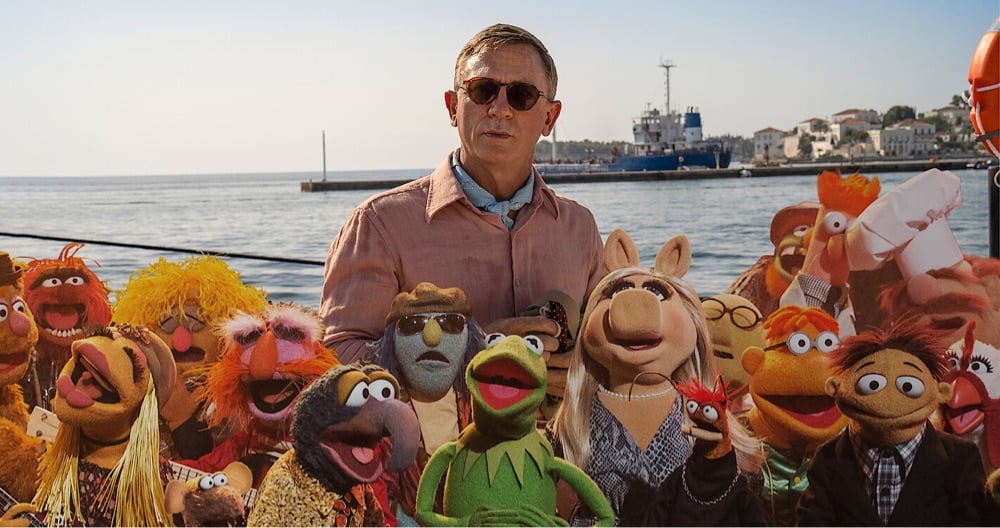
From comments made by Knives Out and Glass Onion director Rian Johnson, it doesn’t seem likely that a Benoit Blanc mystery movie with the Muppets or a Muppet movie with Benoit Blanc will ever happen. So, we’ll have to settle for this mashup of Blanc and The Great Muppet Caper made by Nerdist:
I dunno Johnson, that works pretty well…
Leave it to The Kid Should See This for finding this gem of a video, featuring the hatching and early life of a tiny zebra finch.
This is the smallest bird I’ve ever hatched. After a little Finch had lost her partner, I was asked if she could stay in my big Aviary. When I returned home after picking her up, on the way back she had laid an egg in the little transport box! Birds only do this when they have an egg that needs to be laid. I knew there was only a small chance she would accept and hatch this egg in an actual nest herself, but I wanted to try before I set plan B in motion…
The mother bird didn’t accept the egg, it was moved to an incubator, and after a couple of weeks the tiniest bird you’ve ever seen hatches. The birth and first feeding were absolutely riveting — I was on the edge of my chair! What weird little alien creatures baby birds are. (via the kid should see this)
Last night, in the third quarter of an eventual loss to the Oklahoma City Thunder (a team name that didn’t even exist when James made his NBA debut), LA Lakers forward LeBron James broke the once-untouchable all-time NBA scoring record, formerly 38,387 points and held by the great Kareem Abdul-Jabbar. Afterward, James had this to say about the moment:
Everything just stopped. It gave me an opportunity to embrace it and look around and seeing my family, the fans, my friends. It was pretty cool. I probably can count on my hands how many times I have cried in 20 years, either in happiness or in defeat. So that moment was one of them when I kind of teared up a little bit. It was ‘I can’t believe what’s going on’ tears.
The Athletic liveblogged the occasion as it happened and detailed how James was able to break the record.
James’ path to the all-time scoring record will look much different than his predecessor, and it’s quite obvious why: 3-pointers.
The impact of long-range shooting within the NBA has grown since the league embraced 3-pointers during the 1979-80 season. How has that affected James’ path to the top of the NBA’s scoring list? During Abdul-Jabbar’s final season in 1988-89, NBA teams averaged 6.6 3-point attempts per game. This season, James is averaging 6.7 3-point attempts on his own.
But let’s pause for a tribute to man James passed for the record: Kareem Abdul-Jabbar Is Greater Than Any Basketball Record.
Guided by the footsteps of Jackie Robinson and Bill Russell, Abdul-Jabbar pushed forward, stretching the limits of Black athlete identity. He was, among other qualities, brash and bookish, confident and shy, awkward, aggressive, graceful - and sometimes an immense pain to deal with. He could come off as simultaneously square and the smoothest, coolest cat in the room.
In other words, he was a complete human being, not just the go-along-to-get-along, one-dimensional Black athlete much of America would have preferred him to be.
James has run with the branding concept that he is “More Than an Athlete.” Fifty-plus years ago, Abdul-Jabbar, basketball’s brightest young star, was already living that ideal.
From The Ringer, How LeBron James Broke the All-Time Scoring Record:
Just how long has James been playing in the NBA at a high level? Long enough to face nine father-son duos in games.
LeBron James opened his NBA career on Oct. 29, 2003, scoring 25 points in 42 minutes in a loss to the Sacramento Kings. On the Kings’ bench sat Jabari Smith, a 6-foot-11 center in his third year who wouldn’t remove his warmups that night.
Nineteen years, two months and 18 days later, James would be reminded of that matchup by another Smith, Jabari Smith Jr., a rookie with the Houston Rockets who is Jabari Smith’s son.
“Hey, you played against my dad in your first NBA game ever,” the rookie told LeBron.
“Why you do that to me,” a chuckling James said, to which Smith responded, “You feel old, don’t you?”
From The NY Times, How LeBron James Outscored Kareem Abdul-Jabbar and All the N.B.A. Greats:
James had a head start on catching Abdul-Jabbar because he was drafted out of high school, which wasn’t allowed in Abdul-Jabbar’s day. Then known as Lew Alcindor, Abdul-Jabbar first spent four years at U.C.L.A., where he was one of the most dominant college basketball players in the country.
James, at 38, is one of the oldest players in the league and in his 20th season. When Abdul-Jabbar was 38, he was in just his 17th professional season. By the time he hit his 20th year, he was no longer as dominant as he had been. James, with the good timing of being able to start this journey at 18 years old, is still proving every day just how much he has left, scoring 40 points on several nights this season and almost reaching 50 in a January game against Houston. He could be the first player to score 40,000 points.
On a personal note, I’ve never been that excited about LeBron James. I don’t hate him, but I didn’t really root for him or enjoy watching him play. Part of my aversion was no doubt due to many people trying, far too early, to place James on the GOAT throne, ahead of the player I grew up watching and rooting for, Michael Jordan. If I were in charge of drafting players for an all-time team, I’d still select Jordan first — his unique combination of drive, athleticism, and skill is still, IMO, the best in the game, ever. But with his versatility and longevity, LeBron James has more than earned the status of the NBA’s greatest player of all time.
James Cameron is not one for half-measures. When making Titanic, he used every image and description of the ship he could lay his hands on to build accurate sets & models and financed 12 dives to the ship’s actual wreckage on the bottom of the ocean floor to gather footage to use in the film. For the mega-blockbuster’s 25th anniversary, Cameron has returned his attention to Titanic, to scientifically test the fan theory that there was enough room on the door for Jack at the end of Titanic (see the video above).
In order to reexamine Jack’s final moments, Cameron enlisted help from a team of scientists and two stunt people to test four different scenarios to examine whether two people could have shared the door.
“Jack and Rose are able to get on the raft, but now they’re both submerged in dangerous levels of freezing water,” Cameron explains as the stunt people prove it.
Meanwhile in another example, Cameron details, “Out of the water, violent shaking was helping him and projecting it out, he could’ve made it pretty long, like hours.”
If you can stand the forced-cheer morning show banter, there’s a bit more footage of Cameron and the testing from Good Morning America:
Cameron’s ultimate conclusion: “Jack might’ve lived, but there’s a lot of variables.”
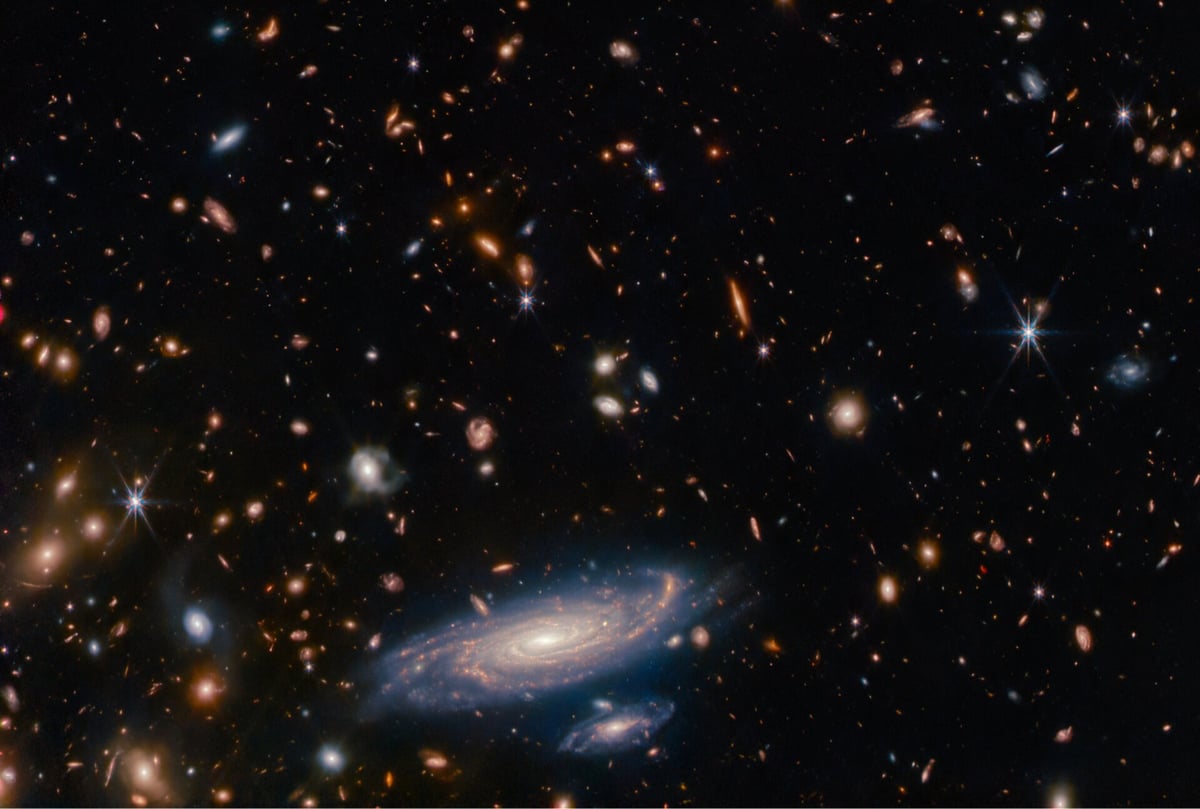
The European Space Agency has released a gobsmacking deep field image of thousands of galaxies taken by the James Webb Space Telescope.
A crowded field of galaxies throngs this Picture of the Month from the NASA/ESA/CSA James Webb Space Telescope, along with bright stars crowned with Webb’s signature six-pointed diffraction spikes. The large spiral galaxy at the base of this image is accompanied by a profusion of smaller, more distant galaxies which range from fully-fledged spirals to mere bright smudges. Named LEDA 2046648, it is situated a little over a billion light-years from Earth, in the constellation Hercules.
I know we’ve seen deep field images from the Hubble, but I don’t know how you can tire of looking at actual images created by human technology that shows thousands of galaxies, billions of years, trillions of stars, quadrillions of planets, untold numbers of potential intelligences & civilizations, and who really knows what else. It boggles the mind, every time.
You can download/view a massive high-res copy of this image right here.
Update: Here’s a video that zooms in from a wide view of the Milky Way all the way into galaxy LEDA 2046648 pictured above.
Wow. (via @cparnot)
If you’ve ever wondered what HBO and the producers of The Last of Us might do with some slightly different source material, Pedro Pascal and the cast of Saturday Night Live took a crack at a gritty adaptation of Mario Kart. I mean, I would 100% watch this.
Newer posts
Older posts





Socials & More