kottke.org posts about Mars
According to NASA, the Perseverance rover has driven just over 28 miles on the surface of Mars, making it the vehicle that has driven the farthest distance outside of Earth.
On Oct. 11, the rover’s odometer reached 28.10 miles (45.22 kilometers), eclipsing the record of 28.06 miles (45.16 kilometers) set by NASA’s Opportunity rover, which explored Mars from 2004 to 2018. Perseverance reached the mark on the 2,006th Martian day, or sol, of its mission, covering in five and a half years a distance that took Opportunity almost 15.
For a vehicle whose top speed is 0.1 mph and which stops all the time to do science, 28 miles is quite a distance. The route video is fun to watch…it resembles a dog’s path, sniffing out its favorite spots and doubling back along familiar routes.
BTW, the Guinness World Record for the number of miles driven by one vehicle on Earth is 3,039,122 miles. (And the guy kept driving it after the record was recorded…he reached 3,260,257 miles before he died.)
This is a video slideshow of some of the best images from the Mars missions — Spirit, Opportunity, Curiosity, and Perseverance — presented in 4K resolution at 60fps. These look amazing on the biggest hi-res screen you can find. (via open culture)
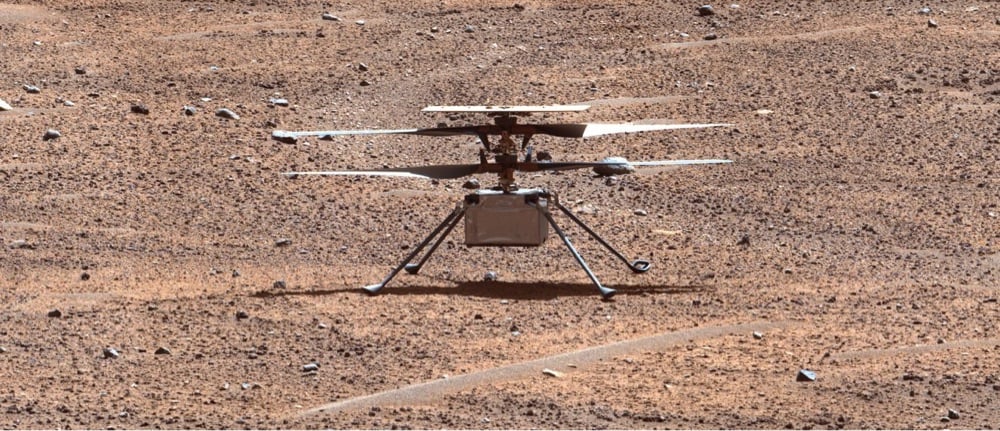
NASA has announced that the mission of the Ingenuity helicopter has come to an end on the surface of Mars.
While the helicopter remains upright and in communication with ground controllers, imagery of its Jan. 18 flight sent to Earth this week indicates one or more of its rotor blades sustained damage during landing and it is no longer capable of flight.
Originally designed as a technology demonstration to perform up to five experimental test flights over 30 days, the first aircraft on another world operated from the Martian surface for almost three years, performed 72 flights, and flew more than 14 times farther than planned while logging more than two hours of total flight time.
Nice job, little flying rover! Rest well.
This short, relaxing, mesmerizing video of an Martian impact crater called Aram Chaos was taken by the HiRISE camera on the Mars Reconnaissance Orbiter. The images were run through an enhanced color red-green-blue filter, which tends to highlight the structure and geology rather than the true color. For example, the blue in the video often represents basalt, an igneous rock of volcanic origin.

Using data from the ESA’s Mars Express probe, the German Aerospace Center has released an enhanced color image of Mars that shows off the planet’s geology and mineral content better than the usual dusty red photos do. Here’s part of what you’re seeing:
It is well known that most of Mars is reddish in colour, due to the high amount of oxidised iron in the dust on its surface, earning it the nickname the ‘Red Planet’. But it is also immediately noticeable that a considerable region of Mars is rather dark, appearing bluish in colour in image 1. These regions represent greyish-blackish-bluish sands, which are volcanic in origin and form large, dark sand layers on Mars. They were primarily piled up by the wind to form imposing sand dunes or enormous dune fields on the floor of impact craters. These unweathered sands consist of dark, basaltic minerals, of which volcanic lava on Earth is also composed. Basalt is the most widespread volcanic rock on Earth — and in the Solar System. Earth’s ocean floor is made of basalt, as are the extinct volcanoes of the Eifel, Mount Etna in Sicily and volcanoes of the Hawaiian archipelago.
In my mind, the best bit is how much clearer you can see the various geographical features of the planet. (via bad astronomy)
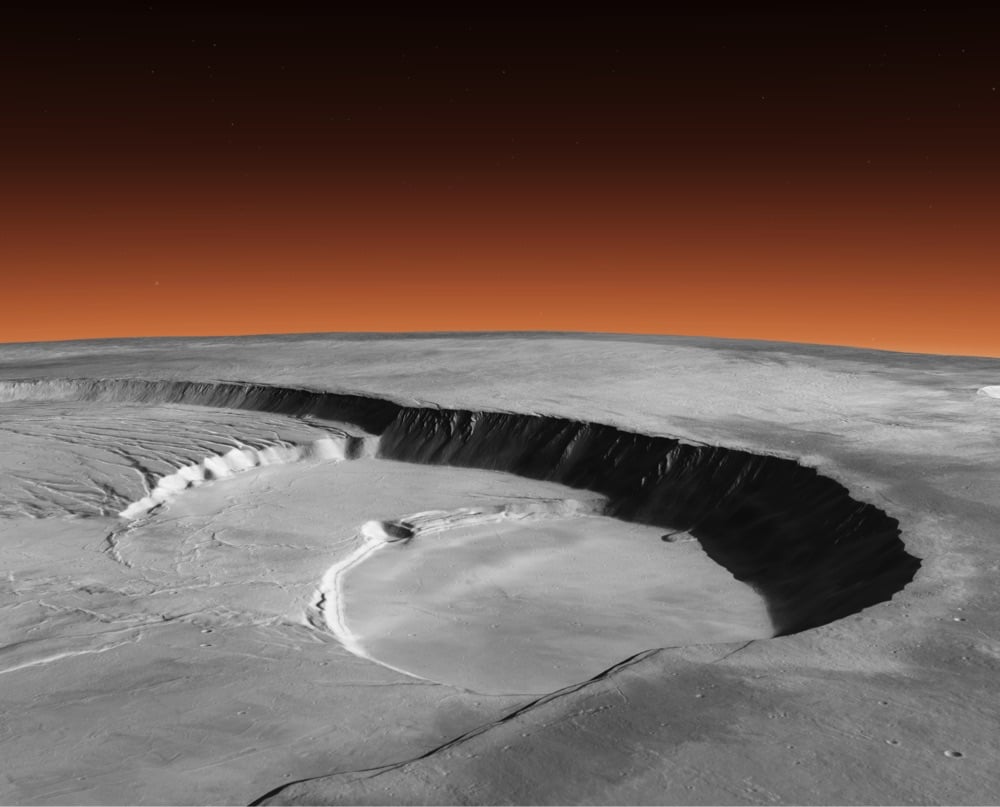
Using imagery from the Mars Reconnaissance Orbiter, the Bruce Murray Laboratory for Planetary Visualization at Caltech has created a 5.7 terapixel mosaic image that covers 99.5% of the surface of Mars. The whole image is available to navigate with a 3D viewer in your browser.
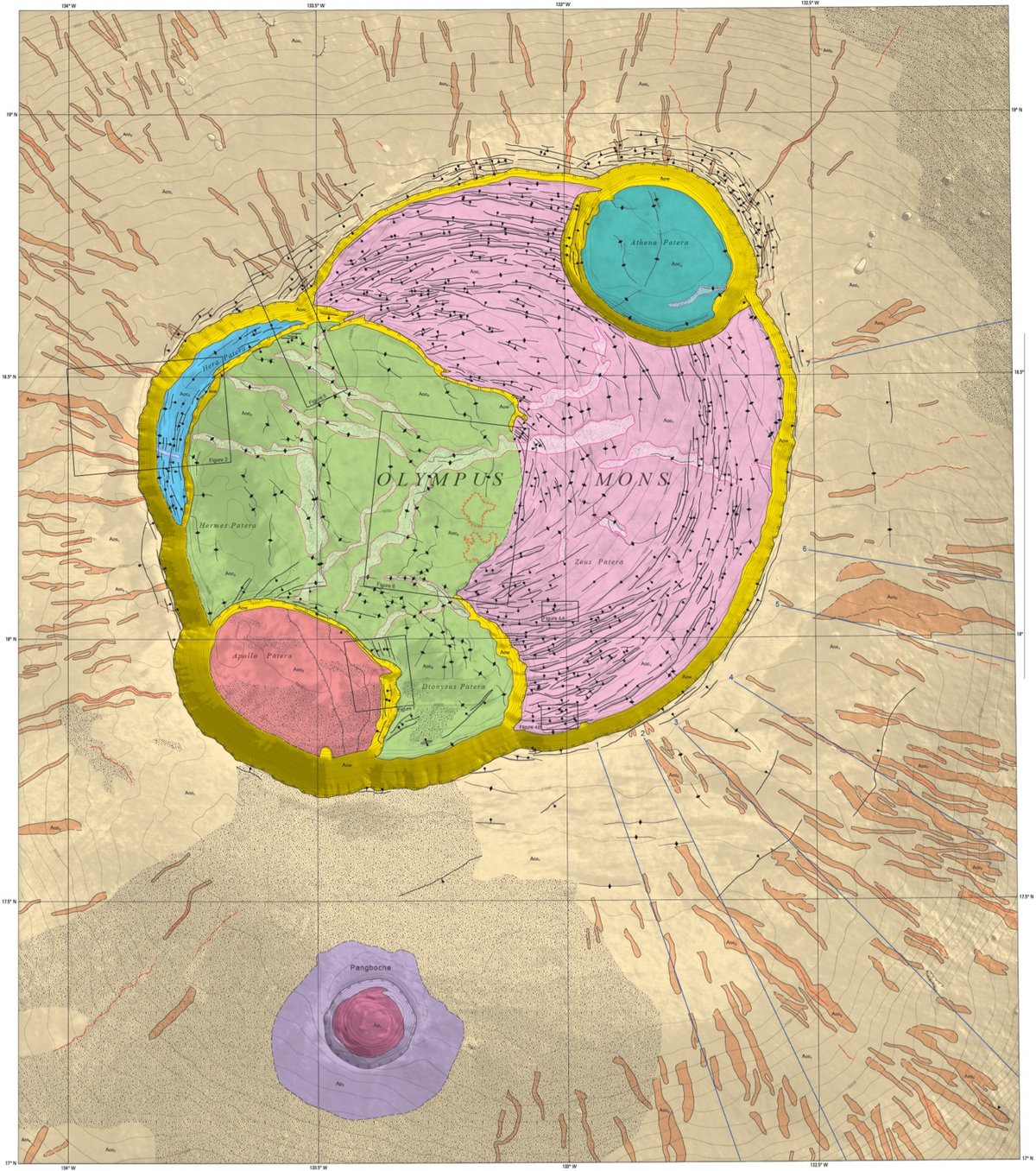
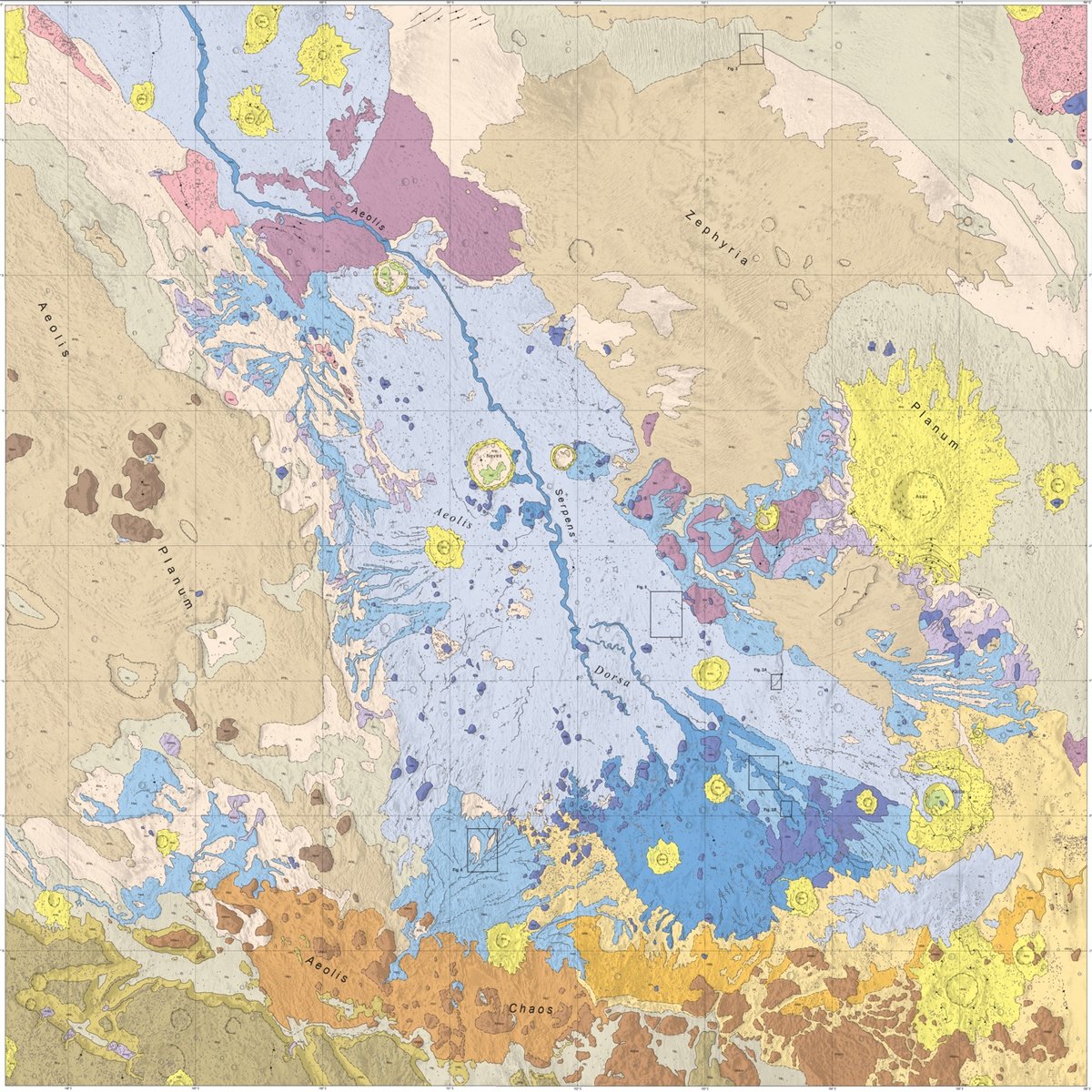
The USGS Astrogeology Science Center recently released a series of detailed geological maps of Mars that detail features from the red planet’s past like volcanos and flowing water. If you’re thinking, “hey that looks a lot like a river in that second image”, you’re not far off.
One particularly interesting feature that hints at Mars’ watery past is the sinuous ridge, which is a winding, narrow ridge that looks like an inverted river channel. These ridges are interpreted to be aqueous (formed by water), making them possible clues about the history of water on Mars.
The scale of the maps is useful for identifying geologic changes over time:
The new map of Aeolis Dorsa adds to the hypothesis that Mars was once wet and had abundant active river systems in the past before aqueous activity decreased over time. This change caused the primary depositional methods in the region to shift from rivers (fluvial) to sediment fans with intermittent deposition (alluvial) and eventually to a dry and wind-driven (aeolian) system. This local pattern mimics our current understanding of the global environmental history of Mars.
Lovely aesthetics as well. (via @geoffmanaugh)
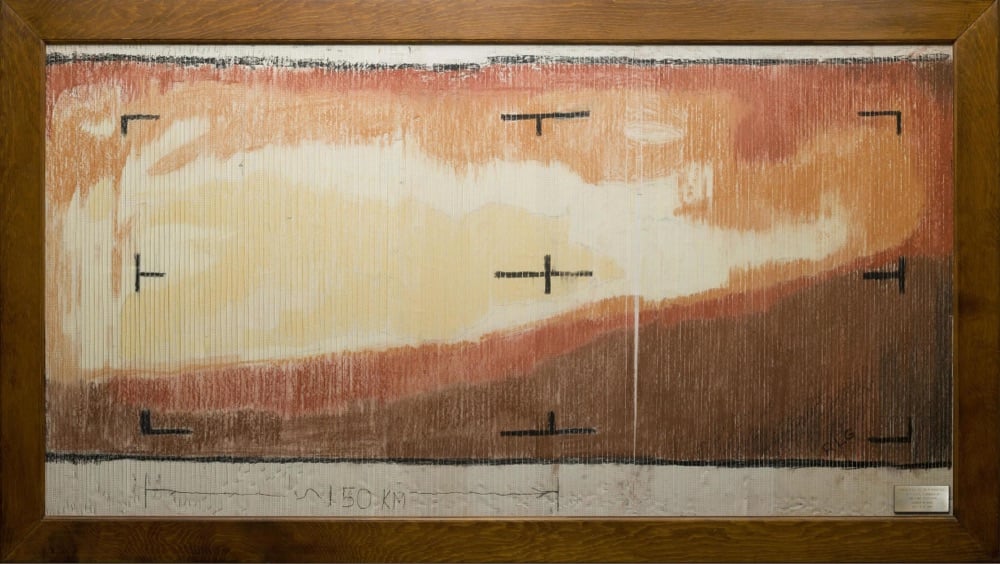
On July 15, 1965, NASA’s Mariner 4 probe flew within 6,118 miles of the surface of Mars, capturing images as it passed over the planet. The image data was transmitted back to scientists on Earth, but they didn’t have a good way to quickly render a photograph from it. They determined that the fastest way to see what Mariner 4 had seen was to print out the imaging data as a series of numbers, paste them into a grid, buy a set of pastels from a nearby art store, and do a paint-by-numbers job with the pastels on the data grid. The result (pictured above) was the first closeup representation of the surface of an extraterrestrial planet — in color, no less!
After the flyby of the planet it would take several hours for computers to process a real image. So while they were waiting, the engineers thought of different ways of taking the 1’s and 0’s from the actual data and create an image. After a few variations, it seemed most efficient to print out the digits and color over them based upon how bright each pixel was. So Mr. Grumm went to a local art store and asked for a set of chalk with different shades of gray. The art store replied that they “did not sell chalk” (as that was apparently too low for them, only convenience stores sold “chalk”), but they did have colored pastels. Richard did not want to spend a lot of time arguing with them, so he bought the pastels (actual pastels seen below), had the 1’s and 0’s printed out on ticker tape about 3in wide, and his team colored them by their brightness level (color key seen below).
Here’s a closer view of the pastels and numbers:
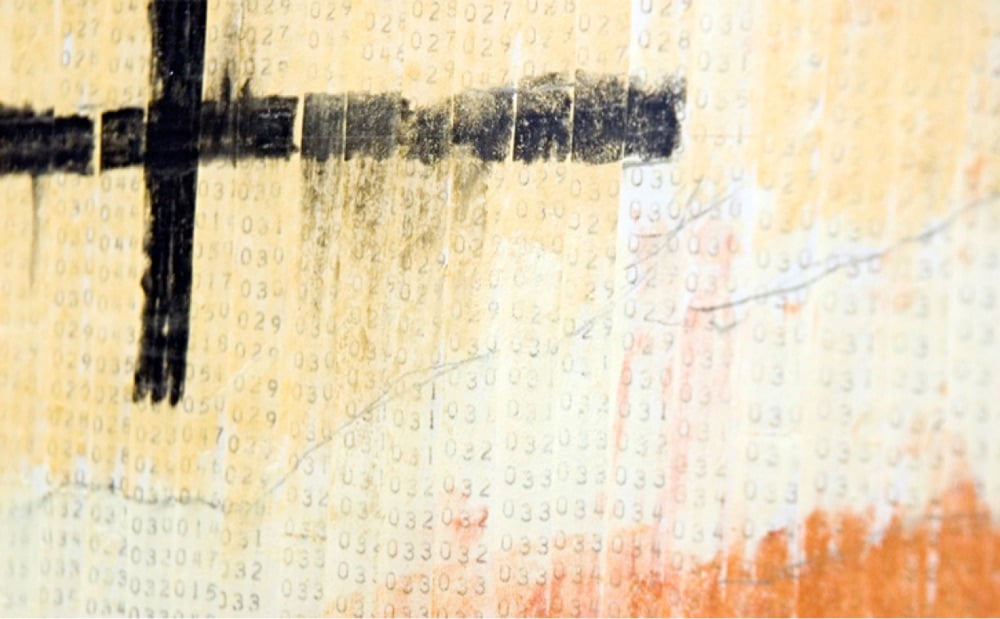
The choice of color palette was serendipitous:
Though he used a brown/red color scheme, the thought that Mars was red did not enter his mind. He really was looking for the colors that best represented a grey scale, since that was what they were going to get anyway. It is uncanny how close his color scheme is to the actual colors of Mars. It’s as if they came right out of current images of the planet.
Compare with the photography we’re getting from Curiosity these days; we’ve come a long way in the last 60 years. (via @jenniferrrrrroberts and robin sloan)
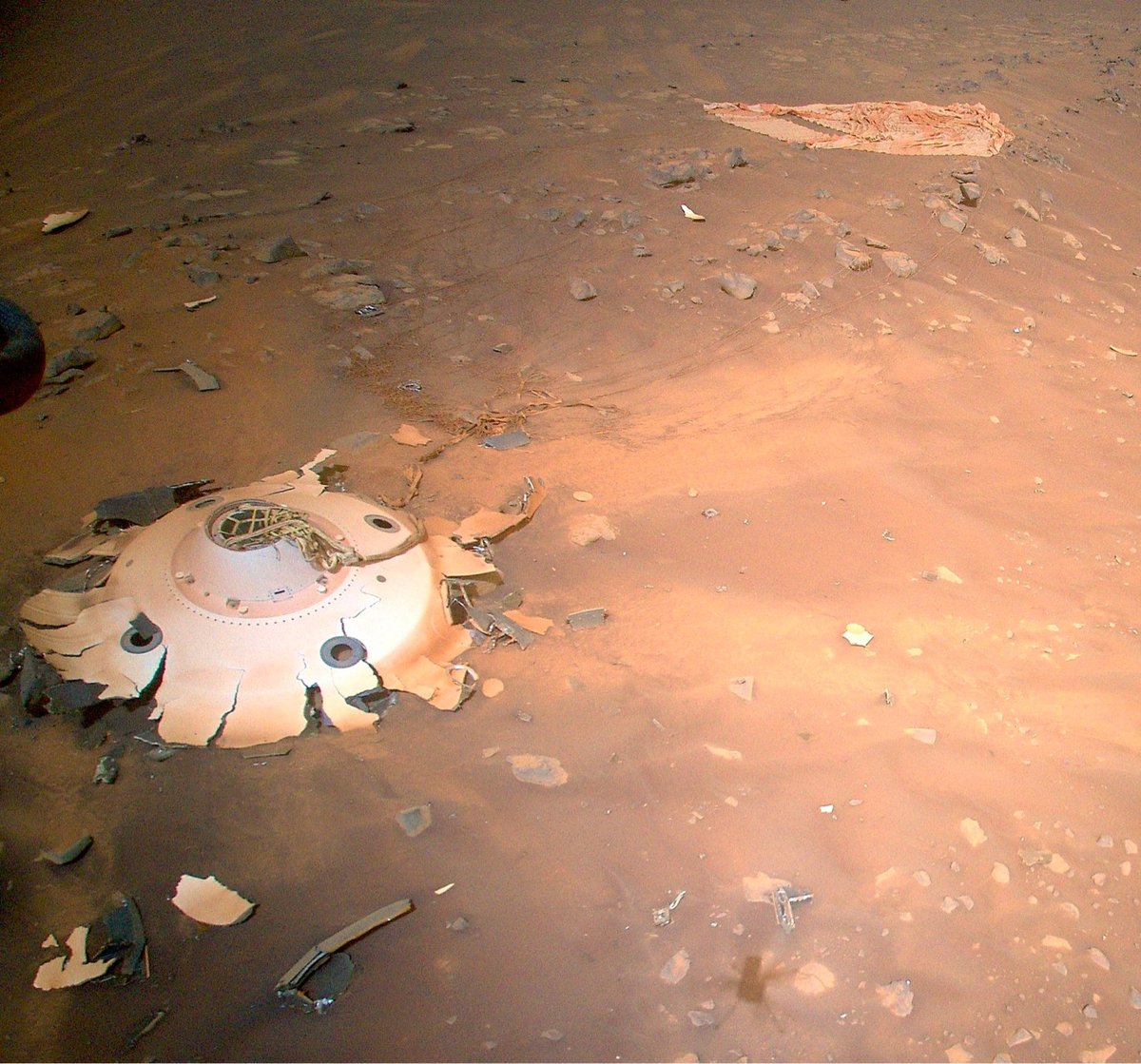
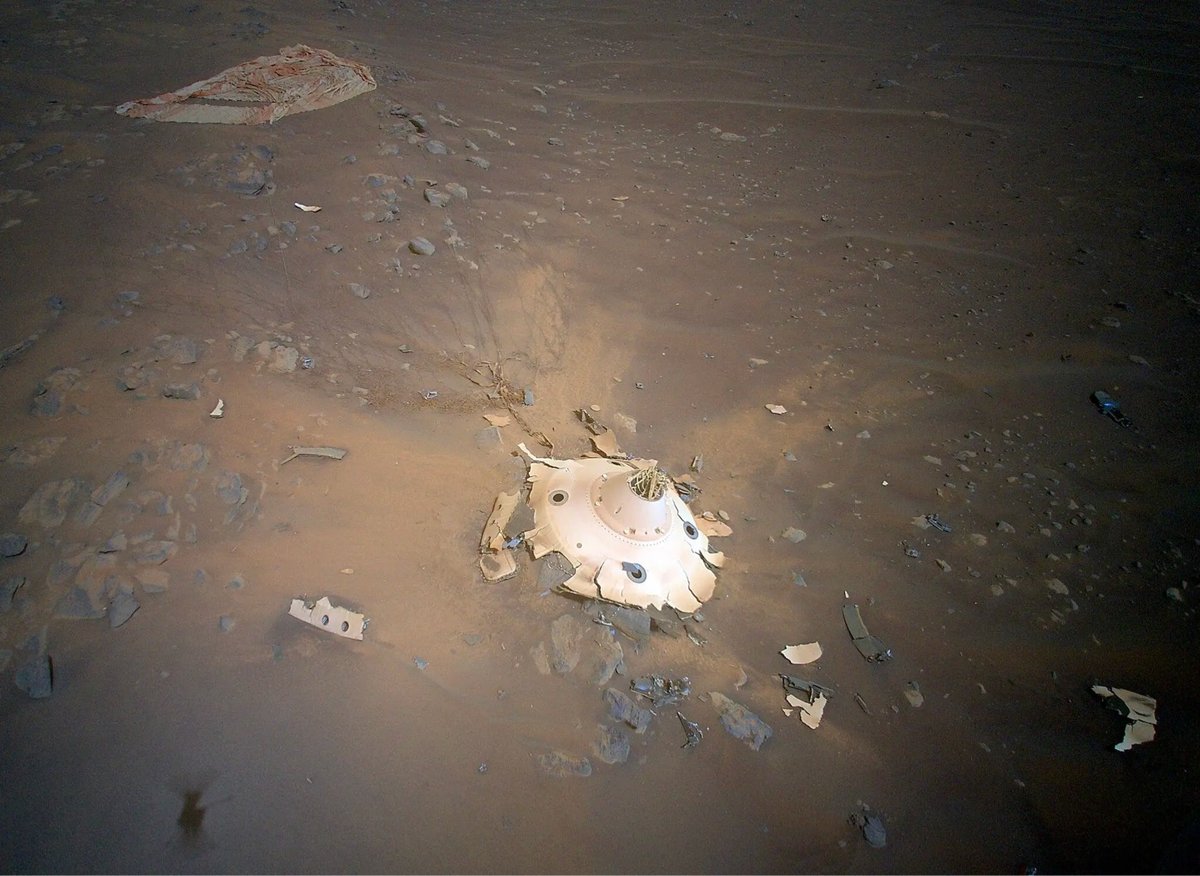
On the 26th flight of Ingenuity, NASA’s helicopter on Mars, it spotted and photographed the wreckage of the Perseverance rover’s landing gear, protective shell, and parachute. From a NY Times article on the photos:
“There’s definitely a sci-fi element to it,” Ian Clark, an engineer who worked on Perseverance’s parachute system, said of photographs released on Wednesday. “It exudes otherworldly, doesn’t it?”
Part of the reason NASA had Ingenuity go take a look is to see how all of that equipment held up during the landing process. Data from the photos will inform future missions.
“Perseverance had the best-documented Mars landing in history, with cameras showing everything from parachute inflation to touchdown,” said JPL’s Ian Clark, former Perseverance systems engineer and now Mars Sample Return ascent phase lead. “But Ingenuity’s images offer a different vantage point. If they either reinforce that our systems worked as we think they worked or provide even one dataset of engineering information we can use for Mars Sample Return planning, it will be amazing. And if not, the pictures are still phenomenal and inspiring.”
In the images of the upright backshell and the debris field that resulted from it impacting the surface at about 78 mph (126 kph), the backshell’s protective coating appears to have remained intact during Mars atmospheric entry. Many of the 80 high-strength suspension lines connecting the backshell to the parachute are visible and also appear intact. Spread out and covered in dust, only about a third of the orange-and-white parachute — at 70.5 feet (21.5 meters) wide, it was the biggest ever deployed on Mars — can be seen, but the canopy shows no signs of damage from the supersonic airflow during inflation. Several weeks of analysis will be needed for a more final verdict.
It is really remarkable, the images we’re seeing from Mars, taken by a robotic helicopter.
Wow, NASA just released a video shot by the Mars Perseverance rover of a solar eclipse by the moon Phobos. The video description calls it “the most zoomed-in, highest frame-rate observation of a Phobos solar eclipse ever taken from the Martian surface”. According to this article from JPL, the video of the eclipse is played in realtime; it only lasted about 40 seconds.
Captured with Perseverance’s next-generation Mastcam-Z camera on April 2, the 397th Martian day, or sol, of the mission, the eclipse lasted a little over 40 seconds — much shorter than a typical solar eclipse involving Earth’s Moon. (Phobos is about 157 times smaller than Earth’s Moon. Mars’ other moon, Deimos, is even smaller.)
Just a hunk of space rock passing in front of a massive burning ball of gas recorded by a robot from the surface of an extraterrestrial planet, no big deal.
Seán Doran strikes again. In this short flyover rendered in 8K resolution by Doran, we’re treated to a detailed look at a crater on Mars. The imagery is from the HiRISE camera onboard the Mars Reconnaissance Orbiter. Beautiful — worth taking a second or third pass to catch all the details.
For the last nine months, NASA’s Perseverance rover has been rolling around on Mars taking photos and doing science. It’s also been recording audio of its environment with a pair of microphones and in this video, a pair of NASA scientists share some of those recordings and what we might learn about Mars from them.
This is one of my absolute favorite sounds. This is the sound of a helicopter flying on Mars. We used this sound to actually understand the propagation of sound in general through the Martian atmosphere, and it turns out that we were totally wrong with our models. The Martian atmosphere can propagate sound a lot further than we thought it could.
And surprisingly for me, that’s my friend Nina in the video! (We eclipse-chased together in 2017.) I knew she was working on the rovers but didn’t know she was going to pop up in this video I found on Twitter this morning. Fun!

Deployed from NASA’s Perseverance rover, the Ingenuity helicopter took off and hovered for about 30 seconds in its first flight early this morning.
The solar-powered helicopter first became airborne at 3:34 a.m. EDT (12:34 a.m. PDT) — 12:33 Local Mean Solar Time (Mars time) — a time the Ingenuity team determined would have optimal energy and flight conditions. Altimeter data indicate Ingenuity climbed to its prescribed maximum altitude of 10 feet (3 meters) and maintained a stable hover for 30 seconds. It then descended, touching back down on the surface of Mars after logging a total of 39.1 seconds of flight. Additional details on the test are expected in upcoming downlinks.
Ingenuity’s initial flight demonstration was autonomous — piloted by onboard guidance, navigation, and control systems running algorithms developed by the team at JPL. Because data must be sent to and returned from the Red Planet over hundreds of millions of miles using orbiting satellites and NASA’s Deep Space Network, Ingenuity cannot be flown with a joystick, and its flight was not observable from Earth in real time.
NASA livestreamed the team in Mission Control as the test results were transmitted back to Earth. The photo above is of Ingenuity’s shadow taken while in flight by its onboard camera.
Update: Here’s video footage of the first flight:
And there’s always room for a little Great Span on this site. Alex Knapp:
The world’s oldest living person was alive when the Wright Brothers flew at Kitty Hawk and when the first helicopter flew on Mars.
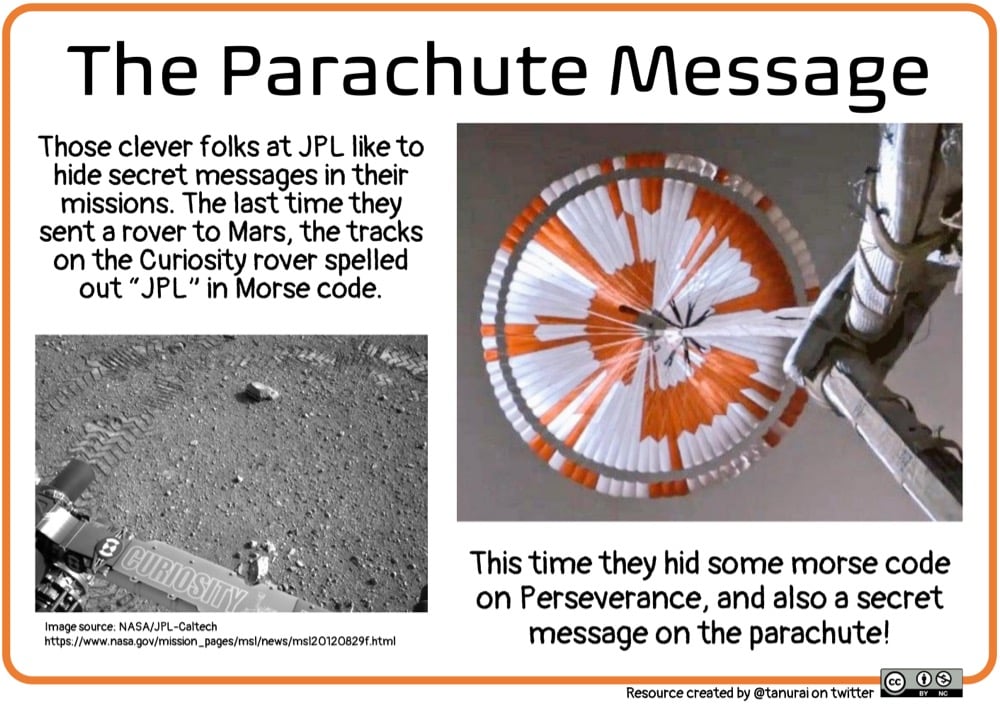

NASA engineers encoded a secret message in the parachute the Perseverance rover used to slow its descent to the surface of Mars. Tanya Fish provided a handy guide to decoding it on Twitter and as a PDF available on GitHub.
Just a few days after the Perseverance rover successfully touched down on Mars, NASA has released onboard video from the descent and landing from multiple perspectives. I watched this with my kids last night and all three of us had our mouths hanging open.
The real footage in this video was captured by several cameras that are part of the rover’s entry, descent, and landing suite. The views include a camera looking down from the spacecraft’s descent stage (a kind of rocket-powered jet pack that helps fly the rover to its landing site), a camera on the rover looking up at the descent stage, a camera on the top of the aeroshell (a capsule protecting the rover) looking up at that parachute, and a camera on the bottom of the rover looking down at the Martian surface.
After watching it again just now, I am struck by two things:
- Sometime in my lifetime, live broadcasts from Mars will likely become commonplace. There will be dozens or hundreds of Mars webcams you can pull up on whatever the 2052 internet equivalent is. It will be amazing how boring it all is. (Or perhaps it’ll be boring how amazing it all is.)
- That humans landed on the Moon in 1969 was an incredible feat, but a close second is that the first steps were broadcast live from the Moon’s surface to everywhere on the Earth. Unbelievable.
Can’t wait to see more from Perseverance once the science program gets cranking.
Older posts


Socials & More