kottke.org posts about video
This might be my new favorite skate video? It follows a pair of young skaters around the city as they chat about their friendship, share tips about living life, and try skating everything that is even remotely skateable.
Best friends, Ari and Luca are two of the most promising NYC talents right now. They are consistently street skating, crushing events, and are keeping skateboarding exciting for a generation we seemingly missed.
If these two stick with it, we have no problem betting that they’ll be the next big names out of the city, and we were lucky enough to catch them right before they arrive.
(via craid mod)
David Epstein, author of the recent Inside the Box (a book about the value of constraints), did a fascinating video on “anticipatory skill” and “chunking” and how players like Lionel Messi and Cristiano Ronaldo (who can accurately head the ball even in the dark) use them to slow down a fast, complex game.
And this is the skill that Messi, Ronaldo, and Pujols all share. They’re chunking positions of people and angles of legs and spins of balls in order to understand immediately what’s going on and what might happen next. The more patterns you absorb in any domain, the less effort it takes to read what’s happening and to predict what’s coming next.
So when Messi walks, he’s not resting. He’s chunking the entire field. Every position, every shift, every gap in the backline is feeding a pattern library that he’s been building since he was 5 years old. By the time he decides to move, the map is already drawn. And when Ronaldo heads a ball into the net in total darkness, it’s because he’s seen that angle of another player’s leg and that ball’s trajectory a hundred times over and knows the pattern it follows.
I love this kind of thing and even though I am not a world-class boxer or football player, I can see it in action as I’ve gotten better over the years downhill mountain biking (where I’m able to go faster on the bike while still being able to react to terrain in what feels like the same amount of time), playing Fortnite (which I’m still not great at, but the game seems to move at a much slower pace, allowing me to keep up), or doing the crossword puzzle (you get an instinctive feel for answers just by how questions are posed). I’m sure this shows up in my work too — I read so damn much online that sometimes it takes me only 2-3 seconds to figure out if something is worth my while — but it’s easier to observe in sports or gaming.
BTW, Epstein just started his YouTube channel a few months ago, but it’s already filled with great stuff like Why The Fastest Way To Improve Is To Subtract, Why The Smartest People I Know Set Constraints, Not Goals, and Why The Best Kids Are Rarely The Best Adults. I’ve got some catching up to do.
Martin Timko (aka matogolf) cut this video of the best musical moments from Hans Zimmer & Friends: Diamond in the Desert. He plays a number of pieces from various soundtracks, including Dunkirk, Gladiator, Interstellar, Dune, and The Dark Knight. Great to hear live performances of these iconic pieces.
To celebrate the 250th anniversary of our great nation, The Onion has produced a Ken Burns-esque film called Birth of a Nation (“the only movie ever named this”).
250 years ago, a group of illiterate men would gather in these hallowed halls to scribble down what historians can now only assume were words. Words that would one day be assigned meaning. Words and pictures. Pictures mostly. That would serve as the founding principles for a grand new experiment that would forever change the course of human history. An experiment that would produce a monstrosity so powerful it would soon be known to the whole world by just one name. America.
A graphic of a floppy disk hamburger was created on an early Amiga computer, photographed, and then deleted (more specifically, it couldn’t be saved). Stuart Brown set out to recreate this image as accurately as possible, including colors, dimensions, etc. This is deliciously nerdy. Here’s the resulting image (with some horizontal padding I added):

(via unsung)
For the latest episode of Howtown, Adam Cole and Joss Fong look at wildfires and how investigators go about determining and proving how they start. The backdrop of video is the investigation into the Palisades Fire and the related arson trial that just concluded.
What started the Palisades Fire, and why did the LA arson trial fall apart? This Howtown episode investigates the deadly Pacific Palisades wildfire, the smaller New Year’s Eve Lachman Fire, and the federal arson case against Jonathan Rinderknecht. Prosecutors argued that the Lachman Fire became a hidden holdover fire, smoldering in roots and dense vegetation before reigniting during Santa Ana winds and becoming the catastrophic Palisades Fire. We examine how ATF fire investigators determine fire origin and cause using wildfire forensics, burn patterns, fire behavior, wind direction, topography, fuel, surveillance camera footage, ALERTCalifornia cameras, cell phone location data, ignition source testing, and lab experiments.
The episode also looks at competing theories in the Palisades Fire investigation, including fireworks, cigarette ignition, open flame, accidental fire, intentional arson, smoldering roots, and reignition. At trial, prosecutors pointed to Rinderknecht’s location, behavior, searches, messages, 911 calls, and alleged motive, while the defense argued there was no direct evidence, no smoking gun, no recovered ignition source, and serious uncertainty in the wildfire investigation. The LA arson trial ended with a deadlocked jury, a mistrial, and a 10–2 split, raising questions about reasonable doubt, negative corpus, forensic science, ATF methods, LAFD response, the Skull Rock trailhead, the Lachman Fire origin, and why proving wildfire arson is so difficult after the evidence has burned away.
Idris Elba, knight of the realm and forever Avon Barksdale’s right-hand man in my heart, has been a DJ since he was 14 years old. He recently DJed a house party for Black House Radio and it looks like everyone had a lot of fun.
You can also find this mix on Soundcloud, along with many more of Elba’s mixes.
Senior living communities generally don’t go viral or gain media attention for positive reasons, so it’s nice to see this story about the University Village Retirement Community in Tulsa, Oklahoma and their champion Wii bowling team.
On this recent Thursday in June, their hopes are pinned on Phyllis Wimer, known as Phyllis Killer or Phyllis the GOAT for the many strikes she bowls; Charlene “the Grasshopper” Giles, whose hop gives her some extra oomph as she releases the ball; “Marvelous” Marcia Ness, who describes herself as a “tough old broad,” ready to bowl after recovering from a broken wrist and back; and “Rollin’” Ron Demaree, who grips the lower-left handlebar on his motorized wheelchair to propel himself upward and forward for more power in his roll.
Phyllis the GOAT is 95 years old and rolls 300s in practice sessions like it’s nothing. Here’s a local news segment on the team from a few months ago:
I was very into Wii Sports 20 years ago (!!!) and still occasionally play Switch Sports with the kids (golf, bowling, and tennis mostly). They’re great party/gathering games and evidently also great for staying active and sharp in your 90s.
Good god, The Complete Kubrick from Criterion.
Collected here for the first time are Kubrick’s thirteen features and three shorts, all restored in 4K, with their original soundtracks alongside the 5.1 mixes, restored and remastered; over twenty-five hours of interviews, documentaries, and behind-the-scenes materials; and deluxe packaging illustrated with rare photographs, artwork, and documents annotated by Kubrick himself, all housed in a singular box inspired by the director’s legendary archive.
Altogether it’s 30 discs, $480 if you pre-order, and it’ll be out in mid-October.
P.S. While it’s not a fancypants box set, the KDO tag page for Stanley Kubrick functions pretty well as “DVD extras” — and it’s free. (via df)

Fulfilling the purpose for which it was built almost 2000 years ago, football fans packed the Roman Theatre of Amman to watch the Jordan v Algeria World Cup match. I don’t know whether Roman rulers, builders, and architects envisioned their works would remain standing & useful millennia after their construction, but longevity is certainly not a priority these days.
Here’s a video of Jordan fans watching their opener vs Austria in the theater:
Update: I’ve learned something today: a theater and an amphitheater are two different things. I’ve corrected my post. (thx, francesca)
This is one of those videos that you start watching and then can’t really stop until you’ve finished. Cow Trip tells the story of an effort to save a baby cow by driving it (and another baby cow rescue) in a not-huge SUV 600 miles from Vermont to a sanctuary in Maryland.
A calf in Vermont hits the lottery when a farmer decides to save him. But someone has to drive the baby cow 600 miles to his new home. A freshly retired doctor and his filmmaker daughter volunteer for the job, but nothing goes as planned. What emerges is an unlikely story of a community of people who will do anything to give one calf a real home.
I think maybe this needs to be a children’s book?
As the World Cup gets underway here in the Americas, here’s a look back at a football battle for the ages: Germany vs. Greece in The Philosophers’ Football Match. Germany’s lineup included Nietzsche , Kant, Hegel, Wittgenstein, and Marx while the likes of Plato, Socrates, Sophocles, and Archimedes took the field for Greece.
Hegel is arguing that reality is merely an a priori adjunct of non-naturalistic ethics, Kant — via the categorical imperative — is holding that ontologically, it exists only in the imagination, and Marx is claiming it was offside.
(thx, meg)
Twice in the Earth’s history, massive ranges of supermountains have formed on ancient continents.
Studies like these point to something we do know for sure: from the highest peaks to the smallest cells, geology and biology are deeply intertwined. And while it’s often said that we are stardust — built from elements forged in the hearts of dying stars — in a sense, we also might be supermountain dust.
They were perhaps as tall or taller than Everest but their distinguishing feature was their massive breadth — we’re talking ranges 5000 miles long, three to four times the length of the Himalayas — just a unbelievable volume of earth. And their formation may have “fueled two of the biggest evolutionary boom times in our planet’s history”.
That’s a lot of rock to erode — and, according to the researchers, that’s why these enormous mountains are so important.
As both mountains eroded away, they would have dumped tremendous amounts of nutrients like iron and phosphorus into the sea through the water cycle, the researchers said. These nutrients could have significantly sped up biological cycles in the ocean, driving evolution to greater complexity. In addition to this nutrient spillover, the eroding mountains may have also released oxygen into the atmosphere, making Earth even more hospitable to complex life.
I also learned about the Boring Billion from this video, a billion-year period of relative “tectonic stability, climatic stasis and slow biological evolution” nestled in-between the two supermountain eras.
On his YouTube channel, Thomas Whichello reads interesting literature aloud, often in the original languages, dialects, or accents, with the goal of making “classic works intelligible and enjoyable to everybody”. One of his most popular videos is his recitation of book 1 of the Iliad in Ancient Greek.
In the translation for this video, I have attempted to follow the emphasis, division of thought, and order of ideas of the original, as well as its turn of phrase, as closely as the English idiom will bear. By means of the line-breaks, which bear a resemblance to free verse, I hope that the parallel text may serve (as it were) as a speaking version of a Loeb Classical Library book. For these line-breaks have been made to correspond roughly with the phraseology of the Greek, as reflected by my impulses of breath and intonation when speaking, so that even a perceptive person who knows no Greek, may be able to infer at times which parts of the original correspond to the respective parts of the translation.
The video is an hour and 45 minutes long so I confess to not having listened to all of it, but even dipping your toe in a little bit is worthwhile, just for the experience. Whichello’s full text translation is available on his website if you’d like to use it to follow along. (via open culture)
Before making his revolutionary documentary film The Thin Blue Line, filmmaker Errol Morris worked as a private detective. His detective skills came in handy not only in making the film but in actually solving the crime at the heart of the story and freeing an innocent man from a prison life sentence.
The Thin Blue Line (1988) not only exposed a miscarriage of justice and freed an innocent man from prison, but created a new genre of movies and forever changed the way Americans view their own justice system.
In this modified scene from Breaking Bad, Walter White’s hat grows in proportion to his ego. YT commenter: “He was just brimming with confidence.” Could be time for a BB rewatch. (via @ernie.tedium.co)
Rockwood, Texas is home to a unique business, Starfront Observatories. Owner/operator Bray Falls hosts hundreds of other people’s telescopes in perfect conditions — ultra-dark skies (Class 1 on the Bortle scale), clear weather, and fast internet — so astrophotographers from around the world can run their scopes and make observations completely from their computers.
Out in the middle of nowhere Texas, a young astrophotographer is running one of the largest telescope ranches on Earth. Stargazers from around the world ship their gear to Bray Falls, who tends 550 telescopes (and counting) on 40 acres outside Brady, the geographic heart of Texas. Customers control the scopes from a laptop anywhere on the planet for as little as 99 dollars a month. We dropped by Starfront Observatories on a perfect dark sky night to see how the operation actually works.
I first learned about telescope ranching late last year from astrophotographer Ian Lauer; he’s got a good video about Starfront Observatories as well:
The imagery produced by the telescopes on this ranch is impressive. Here’s one of Falls’ own images, a nebula he discovered called The Crown of Thorns Nebula.
I’ll start this off by saying this nebula should not be here! Supernova remnants are the remains of stars which detonated long ago. Nearly all supernova remnants in the sky exist within 10° of the Milky Way band, where the greatest density of stars can be seen.
This remnant lives 42° off the beaten path in VIRGO! It is a remnant that stands alone surrounded by nothing. It is the only supernova remnant in the constellation Virgo.
It is so far from where it should be, that my scientist friend Dr. Robert Fesen has doubts that it could be what we think it is, and so a professional observatory has collected data on the object and is now studying it.
Released a few days ago, this is the official video for Max Cooper’s Becoming, directed by Brandon Eversole. It’s mesmerizing, trippy, and a little bit glitchy. The video is also notable for being so wide that it breaks YouTube’s desktop layout — anything less than stretching my browser window to the edges of my screen and I can’t read the left-most text under the video.
Thomas Bangalter, one half of the legendary duo Daft Punk, played a 75-minute DJ set for The Lot Radio the other day. He played tracks by Boards of Canada, Burial, Sonic Youth, and even Daft Punk (full setlist). The set is also available on Soundcloud.
Bangalter also put recent rumors of a Daft Punk reunion to rest:
Was it scary to be that big? “It was almost performance art where you create these characters and blur the line between fiction and reality.” So it felt like fame was happening to the robots more than you? “I think so, yes.” If not wearing the helmets they would do interviews with their backs to the camera or, on one occasion, with bags over their heads. You can see why he and Homem-Christo, whom he calls “Guy-Man”, decided to wind up the band. “The history of music is made of fruitful partnerships and they usually last way shorter than the 28-year run that we had. It was great but staying in character and not spoiling it became very difficult.”
The teaser trailer for the sequel to David Fincher’s The Social Network is here — they’re calling the movie “a companion piece” to the first film. It’s based on The Facebook Files:
Primarily, the reports revealed that, based on internally commissioned studies, the company was fully aware of negative impacts on teenage users of Instagram, and the contribution of Facebook activity to violence in developing countries. Other takeaways of the leak include the impact of the company’s platforms on spreading false information, and Facebook’s policy of promoting inflammatory posts. Furthermore, Facebook was fully aware that harmful content was being pushed through Facebook algorithms reaching young users. The types of content included posts promoting anorexia nervosa and self-harm photos.
Jeremy Strong nails Zuckerberg’s voice & mannerisms. The hint of Reznor/Ross at the end is great, though it looks like Alexandre Desplat is doing the music this time around. Aaron Sorkin, who wrote the screenplay for the first film, writes and directs. Out in theaters October 9th.
The folks at Fred Rogers Productions have launched a YouTube channel dedicated to Mister Rogers’ Neighborhood. They plan to post compilations, clips, and full episodes, some of which haven’t been seen on PBS in years & years. One of the first complete episodes they’ve posted is the one about how crayons are made!
Other full episodes include A Visit with Officer Clemmons, The Very First Episode (from 1968), and Koko the Gorilla Meets Mister Rogers.
And there’s also this 30-minute compilation of fan-favorite factory visits.
Again, here’s the channel if you want to subscribe or explore more.
In March 1976, Talking Heads played a show at The Kitchen in NYC; you can watch the entire show recorded from two angles in this video. The band had formed the year before and was more than a year away from recording and releasing their debut album.
It’s a great insight as to what these early Talking Heads shows were like, and with it also being in color, being good quality, and having two angles for most of the show, this is a must-watch.
The band played for about 90 minutes (2 sets plus an encore), working through tracks like Psycho Killer, Thank You For Sending Me An Angel, and Love → Building On Fire. (via open culture)
Watch and listen to bardcore trio Courseval play a cover version of Daft Punk’s Veridis Quo, a track from Discovery. This is lovely. And a banger.
Courseval have covered other popular music in medieval style, including Rihanna’s Umbrella, Take On Me by A-Ha, Bad Romance by Lady Gaga, and Gloria Gaynor’s I Will Survive.
The original Star Wars movie was a mashup. George Lucas and his collaborators pulled from everywhere: westerns, samurai movies, Flash Gordon, and a 1955 war film called The Dam Busters. This video shows just how closely the attack on the Death Star mirrors a scene from The Dam Busters of a group of bombers attacking a dam. The dialogue is identical in places. From the Dam Busters Wikipedia page:
Director George Lucas hired Gilbert Taylor, responsible for special effects photography on The Dam Busters, to be the director of photography for the film Star Wars. The attack on the Death Star in the climax of Star Wars is a deliberate and acknowledged homage to the climactic sequence of The Dam Busters. In the former film, rebel pilots have to fly through a trench while evading enemy fire and fire a proton torpedo at a precise distance from the target to destroy the entire base with a single explosion; if one run fails, another run must be made by a different pilot. In addition to the similarity of the scenes, some of the dialogue is nearly identical. Star Wars also ends with an Elgarian march, like The Dam Busters.
You can also watch Star Wars footage with Dam Busters audio and Dam Busters footage with Star Wars audio to see just how closely the two scenes match.
Given modern IP concerns and stakes, it’s difficult to envision this type of homage working today. Star Wars came out just 22 years after The Dam Busters, which is a beloved & acclaimed movie in Britain…it’s not obscure. Imagine a movie released in 2026 by a young Academy Award-nominated director that lifts a scene wholesale from a 2004 film like The Notebook, The Incredibles, Eternal Sunshine of the Spotless Mind, or Million Dollar Baby — it just wouldn’t happen without a lot of lawyerly conversation. I mean, maybe Lucas had those convos with The Dam Busters filmmakers… 🤷♂️
Andor loves a good monologue. Among the best of them is Nemik’s Manifesto:
Remember this, Freedom is a pure idea. It occurs spontaneously and without instruction. Random acts of insurrection are occurring constantly throughout the galaxy.
And Kino Loy’s speech to his fellow prisoners on Narkina 5:
There is one way out. Right now, the building is ours. You need to run, climb, kill! You need to help each other. You see someone who’s confused, someone who is lost, you get them moving and you keep them moving until we put this place behind us.
In this just-released episode of Nerdwriter, Evan Puschak breaks down Luthen Rael’s “extraordinary” monologue about what he’s sacrificed for the cause.
Here’s the original scene and a transcript of the speech:
Calm. Kindness. Kinship. Love. I’ve given up all chance at inner peace. I’ve made my mind a sunless space. I share my dreams with ghosts. I wake up every day to an equation I wrote 15 years ago from which there’s only one conclusion, I’m damned for what I do. My anger, my ego, my unwillingness to yield, my eagerness to fight, they’ve set me on a path from which there is no escape. I yearned to be a savior against injustice without contemplating the cost and by the time I looked down there was no longer any ground beneath my feet. What is my — what is my sacrifice? I’m condemned to use the tools of my enemy to defeat them. I burn my decency for someone else’s future. I burn my life to make a sunrise that I know I’ll never see. And the ego that started this fight will never have a mirror or an audience or the light of gratitude. So what do I sacrifice? EVERYTHING!
The great thing about Luthen’s monologue, which Puschak doesn’t really get into, is that it makes the viewer rethink the entire basis of the show — and of Star Wars in general. Instead of Good Guys and Bad Guys, you’re asked to consider shades of gray. These blurred lines are hinted at before, mostly through individual character arcs (Han, Anakin, Lando, Rey, Kylo), but Luthen plainly lays out the moral complexity involved: revolutions and rebellions are led by and made up of flawed people who do harmful things for the right reasons…or at least, that’s what they tell themselves, what they need to tell themselves.
Luthen, Mon Mothma, Cassian — there’s no solution to their personal trolley problem, except that they somehow have to keep living after condemning others to suffering and death. Viewed through that lens, the rest of Star Wars reads quite differently.
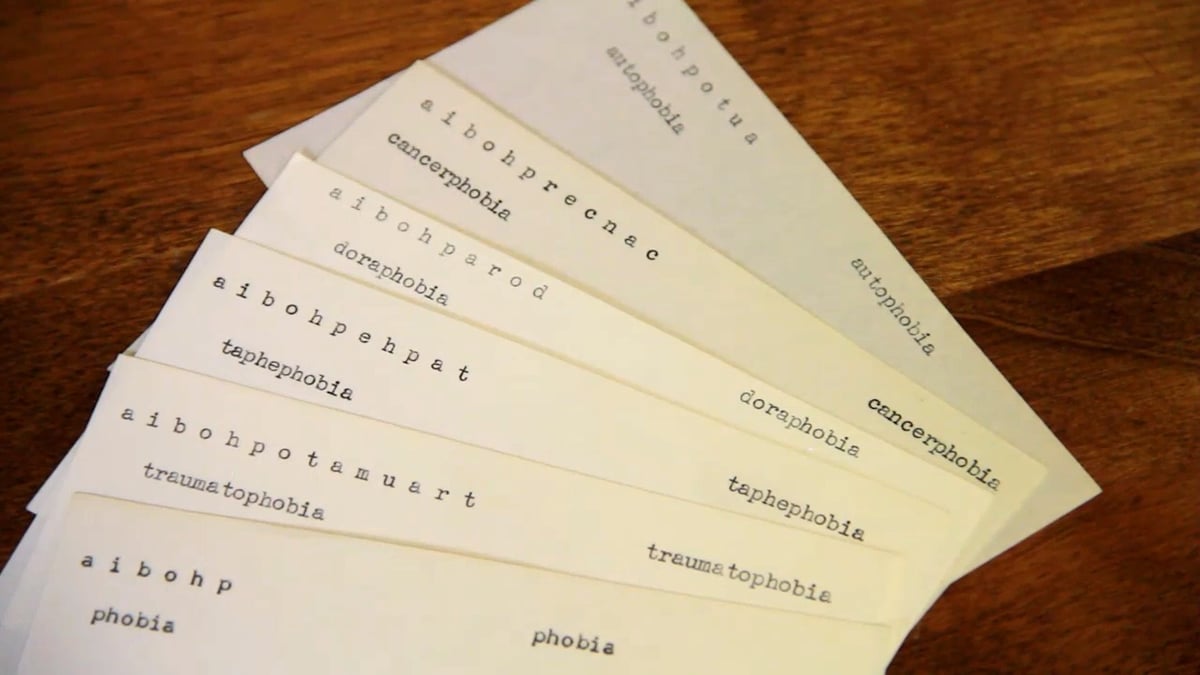
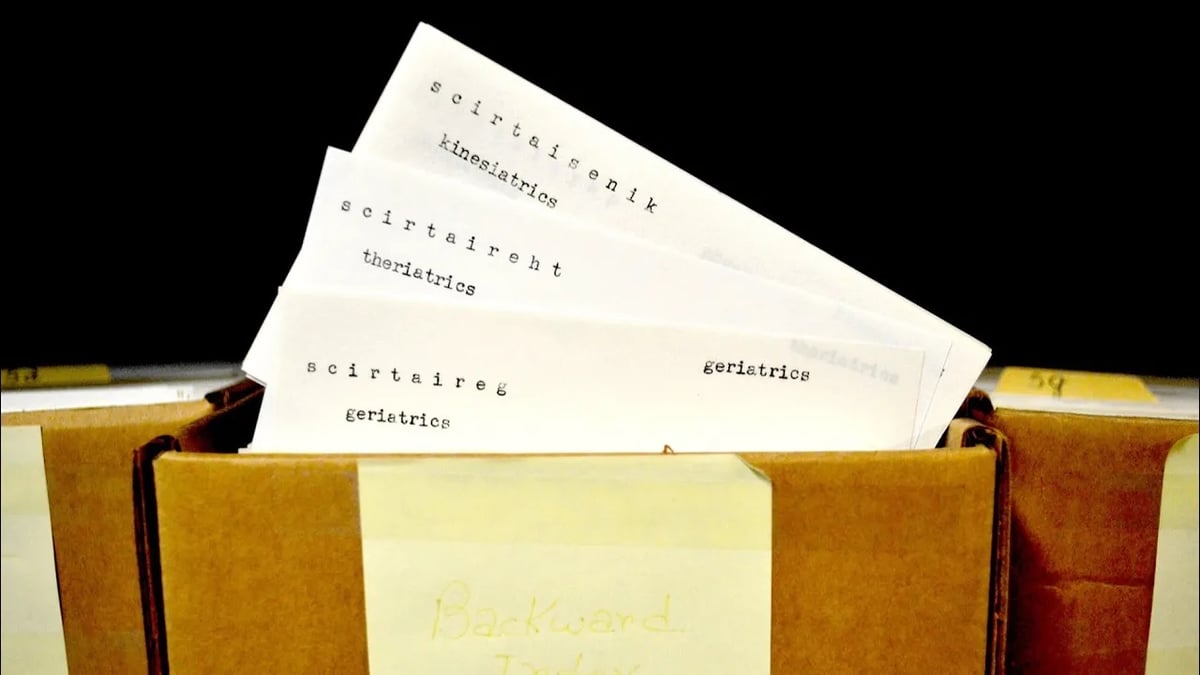
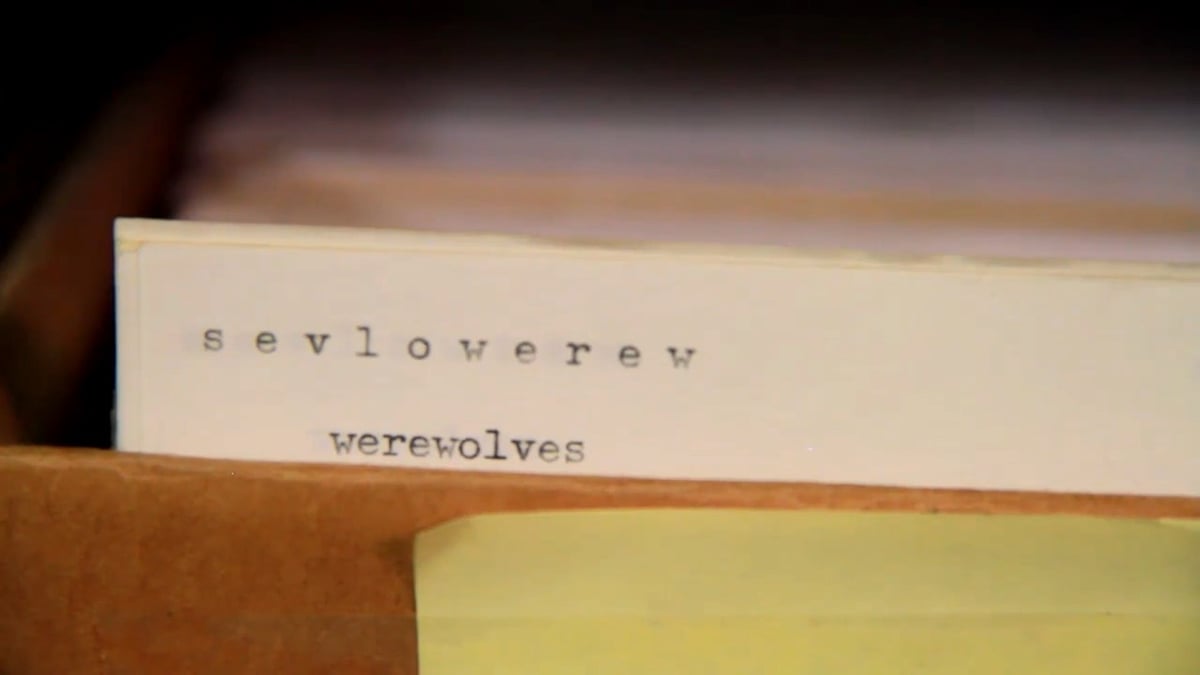
How do dictionary makers keep track of similarly suffixed words, like those ending in -ism, -graphy, -ness, or -ology? With a computer, it’s simple, but how did they do it before the computing age? Starting in the 1950s, lexicographers at Merriam-Webster typed all of the words in the dictionary out backwards and organized them alphabetically into a collection called the Backward Index.
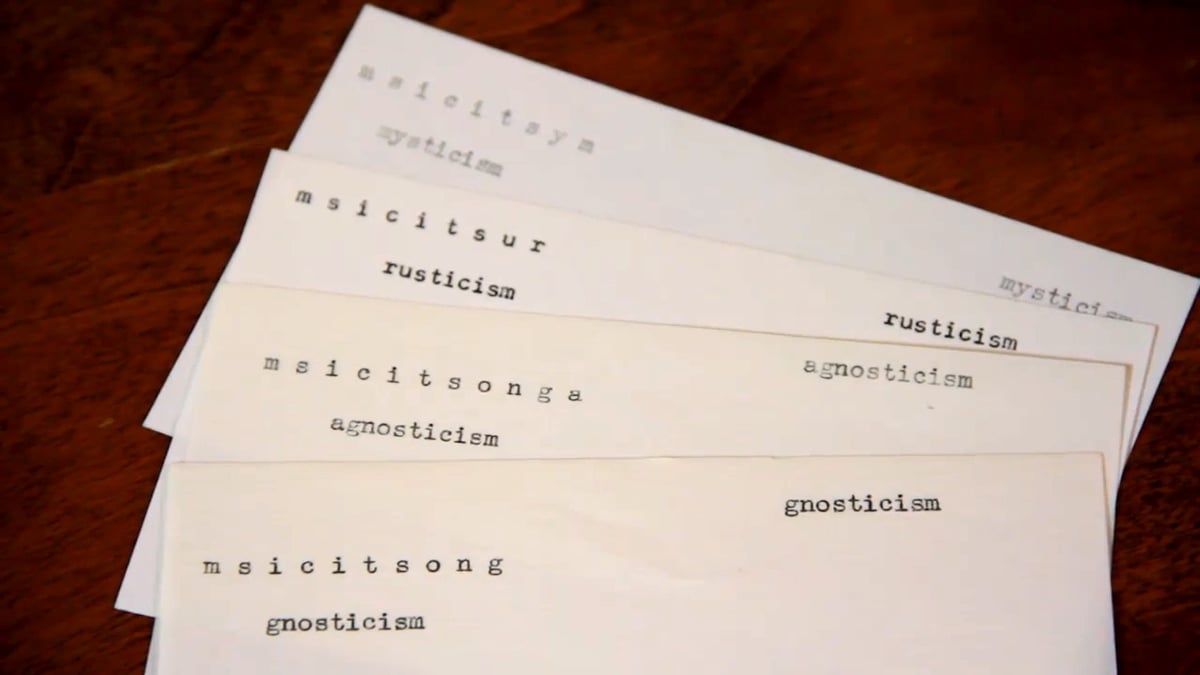
The Backward Index evidently turned out to be a useful tool in the pre-electronic age. For example, it could help identify a set of related terms that should be defined in similar ways, including open compounds (Highland pony, Shetland pony, Welsh pony), closed compounds (blocklike, clocklike, rocklike, socklike, chalklike), and morphologically related terms (phytopathological, ethological, lithological, ornithological). Thus, looking up all the diseases that end in –itis or all the doctrines and theories that end in –ism was now possible. Since rhymes depend on word endings, initial research for a rhyming dictionary also made use of the Index, where sequences such as seepy, steepy, weepy, sweepy and dorty, forty, shorty, snorty, porty, sporty, rorty, torty show up regularly.
The index of reversed words eventually grew to 315,000 entries, each one typed up by one of M-W’s many typists.
We do know a few facts. One is that they were typed up. They were typed up by the typist and I interviewed several retired Merriam-Webster employees, at least a couple of them in their 90s. And they all recall this work. They all recall the file and they say, well, that’s what the typists did when there was no manuscript for them to type. When in the process of making the Unabridged Dictionary, for example, there was an enormous amount of copy at the beginning of the project. But then as the typesetting went on, what happened was through revision and later stages of editing, there was less and less and less of the actual manuscript to type. And that left some of the typing pool available to do other projects. And their assignment was to, when they had the time, to type the headwords in the dictionary backwards.
Here are some more examples of entries from the Backward Index:


(thx, margaret)
Let’s the keep the David Attenborough love going: this is a six-hour video featuring 100 of the most iconic moments from the famed naturalist’s work. I got this via Enrique, who rightly asserts that “There’s no such thing as too much David Attenborough.”
See also Three Hours of Unbelievable Moments From Nature, Narrated by David Attenborough.
A Tube station in West London used to have a flooding problem. Instead of opting for an expensive reworking of the landscape via reservoir & levee, local officials reintroduced a family of beavers into the area.
The beavers are part of an unlikely effort to bring back a vanished species and help Britain adapt to a very modern problem: climate change.
Britain is famous for drizzle, but climate change is making rainfall heavier and more erratic. Places that didn’t used to flood are now waterlogged. So scientists have enlisted some of the animal kingdom’s best flood engineers — beavers — to help.
In West London, conservationists got a government license to resettle a family of five beavers in a 20-acre urban park near the Greenford Tube station. It used to be a golf course, with a creek running through it. Within weeks, the beavers dammed up the creek, creating a pond that holds water and stops it from spilling into the city. They also diverted the creek’s flow into smaller tributaries, creating a wetland that better absorbs heavy rainfall — mitigating the risk of flooding downstream.
“They effectively turned this site into a giant sponge that can take heavy rainfall and slowly release water back into the landscape, creating a lot more resilience for flooding,” explains Sean McCormack, a local veterinarian who started the Ealing Beaver Project, named for the London borough of Ealing, where it’s located.
The beaver-engineered landscape has attracted other animals, increasing the area’s biodiversity:
“By felling trees, they’ve also opened up the canopy, and we’ve seen an abundance of biodiversity,” McCormack says.
Freshwater shrimp have appeared in the creek, he says, plus eight new species of birds, two types of bats and rare brown hairstreak butterflies, which lay their eggs on blackthorn branches nibbled by beavers.
The moment I clicked through to the Caught In Joy YouTube channel, I knew I was going to love it. The description:
Over 80 albums designed to focus, flow and reset. Instrumental electronic music for you brain to wander.
And from the website:
Caught In Joy (Karol Pokojowczyk) is a multi-instrumentalist based in Florida, passionately dedicated to live composing, hardware synthesizers, and tape recording - a completely independent music project. I strive to create four albums and visual performances every month, entirely by myself.
I started my professional life as a software engineer and later became a serial entrepreneur, with a few successes along the way. After more than 30 years of working, I saved enough to fund my dream: building a home studio where I could finally focus fully on music.
In the past three years, he’s released 80+ albums and other performances, which are available for purchase on BandCamp. I’ve only had time to listen to bits and pieces of a few albums & videos, but I know a bunch of them are going into my Underscore collection very soon.1 (via johnny decimal)
I have a pizza oven and baked very underwhelming bread twice during the pandemic, but I’ve found it difficult to fall into a proper rabbit hole when it comes to dough-making. Focaccia might do it for me.
My daughter and I had been wanting to experiment with focaccia (and schiacciata) and so I suggested we make this Bon Appetit recipe that Alana recommended in this recent KDO recipe thread — it’s tough to resist “I am mildly famous for this focaccia. It’s bread for lazy people who love hot bread.” It’s me. I am lazy. I love hot bread.
We made it yesterday and it came out well: very delicious right out of the oven. And it was really the first time I’ve made dough where I’ve been like, “oh, I finally get why people say pizza/bread dough is a living thing”. Today we made sandwiches (mortadella, prosciutto, burrata, arugula) and they were quite good — but the focaccia crumb was pretty dense. Which sent me on a little bit of a research expedition, during which I found this video on YouTube:
Wow! Check out all those bubbles…ours didn’t look anything like that. I actually squealed when she pressed down on the bread and it sprung right back — that focaccia might be able to replace my car’s suspension. This recipe results in a more hydrated dough than the BonApp recipe does. And you work it more and it has different flour (00 instead of all-purpose). And the process looks only a little bit less lazy…manageable for me, I think. Looking forward to trying this out next!
Newer posts
Older posts





Socials & More