kottke.org posts about video
Scottish trials rider and mountain biker Danny MacAskill, who I first featured on the site more than 17 years ago, recently took his Santa Cruz eMTB north of the Arctic Circle to Narvik, Norway. He rode three different mountains and the result is this incredibly beautiful video, backed by a Max Cooper soundtrack. As one of the commenters notes, MacAskill makes a relatively heavy eMTB seem extraordinarily playful.
As a mountain biker myself, some of that looks insanely fun but the narrow steep stuff looks insanely insane. Makes me want an eMTB, which I suppose is the whole point of the video.
Project Hail Mary is already on my list of movies that I can just throw on in the backround while I do a bit of work or puttering around. (Not sure whether that’s an endorsement or not…I like the movie!) Anyhoo, if you get tired of the movie, you can watch Rocky sleep for 2+ hours with the PHM soundtrack playing in the background.
From Deep Down History, an entertaining hour-long explainer video on the Bayeux Tapestry.
This video tells the Tapestry’s story in full, using Charles Stothard’s early colour reproduction, presented here as a seamless scroll for the first time. We follow Harold Godwinson’s fateful journey from Edward the Confessor’s court to Normandy, his later seizure of the Crown, and William the Conqueror’s invasion. Beyond its political messaging, the Tapestry is also bursting with medieval history, including jokes, fascinating technical details, and a warning for those who break their promises…
Completed within a decade or two of the events which it depicts, the tapestry is back in the news & public consciousness because it’s back in England for the first time since it was made and on display at the British Museum.
From NTS, this is a two-hour mix of jazz music featured in the books of Haruki Murakami.
‘Somewhere along the line Coltrane’s soprano sax runs out of steam. Now it’s McCoy Tyner’s piano solo I hear, the left hand carving out a repetitious rhythm and the right layering on thick, forbidding chords. Like some mythic scene, the music portrays somebody’s — a nameless, faceless somebody’s — dim past, all the details laid out as clearly as entrails being dragged out of the darkness. Or at least that’s how it sounds to me. The patient, repeating music ever so slowly breaks apart the real, rearranging the pieces. It has a hypnotic, menacing smell, just like the forest’ —Kafka On The Shore
The playlist features tracks by Ornette Coleman, Coltrane, Dizzy, the Bill Evans Trio, Monk, Mingus, and Miles Davis. Some of the video’s comments:
I had just prepared a light meal and hit play on this playlist when the telephone began to ring.
about to make my morning matcha, a spring breeze is flowing through the open windows, the air smells of optimism
Early morning, sun shining to balcony, having espresso and writing.
Studying the day before the exam with a bittersweet optimism while playing this and holding on to my hopes
Canned cold beer, windows open on a warm summer night, just after finishing a simple dinner of rice and salmon and sitting next to my cat
See also Classical Music from Murakami Novels. Both of these are going straight into my Underscore collection.
At the beginning of a clip from this podcast episode of Conan O’Brien Needs a Friend with Matt Groening, Conan talks about one of his favorite things they did on The Simpsons:
It’s a phenomenon that the Simpsons did so beautifully, which is — and we did this with Homer a lot — but Homer is not the smartest guy in the world, but if it’s funny for him to have a certain knowledge of something or turn a phrase, suddenly he has it.
And one of my favorites of that is he’s sitting around the table and Lisa’s despondent. Something didn’t go well for her and she doesn’t think she’s going to get to go to a good school now. And she’s sitting at the table and she said, “Oh no, now I’ll never get to go to an Ivy League school. I’ll have to go to Vasser.” Which is just this like — by the way, my wife went to Vasser, it’s a very good school. But it was just this thing where in Lisa’s little world, oh my god, I’ve been I’ve been ruined. I’ll have to go to Vasser. And Homer like slams a table and says, “There’ll be no Vasser bashing in this house.”
I loved this about the show too. And it was part of a general thing the writers did where sometimes characters would play against type. So Marge became reckless, Homer was smart/sensitive, Bart was organized, and Lisa was a giggly little girl. Those moments helped make the show and when, after the epic run in the early-to-mid 90s, the show became almost exclusively about how dumb & crass Homer was, it was much less rich and entertaining. (thx, mark)
The thing about me is if I see a making-of video for pencils, I’m gonna stop and watch it and then post it to my website, especially if said pencils are Blackwings, made in Japan.
Take a first-ever, in-depth look at the Blackwing pencil manufacturing process. This short film gives a glimpse into its manufacturing facilities in Japan and California. Beginning in Kofu, Japan, the film details the intricate graphite formulation and cutting process, then transitions to the woodworking facility in Tokyo where the pencils are pressed and lacquered.
Finally, it ends in Stockton, California at Blackwing’s headquarters where the pencils are imprinted, assembled with its signature ferrule, quality-checked, and hand-packed. Each and every Blackwing pencil is thoughtfully made to help you slow down and have the best tools for your creative journey.
I’m always so curious about what’s being blurred out in making-of videos like this!
See also See How Pencils Are Made in a Japanese Factory, How Pencils Are Made, A Visit to an American Factory That’s Been Producing Pencils Since 1889, and A History of Pencil Lead and How Pencils Are Made. (via NaOH)
On the fifth episode of her late 80s variety show Dolly, Dolly Parton was joined by Kermit the Frog for a lovely rendition of Sly and the Family Stone’s 1968 hit Everyday People.
You can also watch the clip on Instagram and Reddit. The full episode, which features special guest stars Delta Burke, Terence Trent D’Arby, and the Oak Ridge Boys (in addition to Jim Henson as Kermit), can be seen on YouTube (not very good quality unfortunately).
Holy moly, NPR’s Tiny Desk has been going for a long time. Weird Al Yankovic first stopped by the desk in 2010, so early that they didn’t even have it on YouTube until more recently. And the other day, they had him back for a second session!
Yankovic focused on originals the first time around, but for this show he brought parodies of Don McLean’s “American Pie” (“The Saga Begins,” from 1999’s Running with Scissors) and Backstreet Boys’ “I Want It That Way” (“eBay,” from 2003’s Poodle Hat), as well as the Weezer pastiche “Skipper Dan,” from 2011’s Alpocalypse. And, for fans of the breathtakingly factual 2022 biopic Weird: The Al Yankovic Story, he performs the film’s Emmy-losing closing-credits blues-rock jam “Now You Know.”
We only get so many gifts in this life, so let’s set an intention here and now to return “Weird Al” Yankovic to the Tiny Desk in the summer of 2042. But if he’s gonna come back and see us (or whoever’s buried us and moved on) at a sprightly 82, we’ll have to ask him to bring a string section, just to keep things fresh.
For TCM, Every Frame a Painting’s Taylor Ramos & Tony Zhou tell us how legendary Japanese filmmaker Yasujiro Ozu made the transition to color filmmaking. His first color film was Equinox Flower in 1958 and it took a couple of films for Ozu to work out how to best employ color.
When you watch later Ozu films, you’re struck by how similar two people can be. How often one place resembles another, how life itself is cyclical and Ozu used color as another way to build these patterns.
In the recent post about the supersonic trebuchet, I wrote that if I’d had access to engineering process videos like that when I was a kid, I would have grown up to be an engineer. Well, same thing for Every Frame a Painting: 12-year-old Jason had zero idea how filmmaking worked and videos like theirs would have fired me up to try my hand at it (no idea where I would have gotten a camera though…) Maybe it’s best that I grew up to do what I’m doing, where I can learn a little bit about all of these different fascinating things. 🤷♂️
Ok so when you woke up this morning, you probably didn’t expect to watch a 20-minute video about a trebuchet — but to be fair, I didn’t either. But Tom Stanton’s build of a fully mechanical trebuchet that propels a tiny plastic pellet faster than the speed of sound (complete with tiny sonic boom) is genuinely fascinating to watch.
He starts with a basic plan, but as he builds & tests, there are all sorts of problems (weight, strength) that he needs to overcome. The final product is impressive, but it’s the process that’s most interesting to me. What a gift these sorts of videos are…you could sometimes find process-heavy shows on PBS (like How to Create a Junk Food) when I was a kid, but if I’d had access to stuff like the supersonic trebuchet video (and all those Lego engineering videos), I’d have probably wanted to grow up to be an engineer.
Lovely short video about artist Jas Knight, who is a participant in the Met Museum’s Copyist Program:
The Copyist Program offers time and space for artists to develop their own interpretation of an artwork through intimate study in the Museum’s galleries. Copyists have created reinterpretations of original artworks in The Met collection since 1872.
Here’s Knight from the video, in which he is copying Diego Velázquez’s Juan de Pareja:
Almost every artist was a copyist up until the 20th century because as a painter you would go through certain exercises to learn how to paint. You haven’t begun to see a painting until you’ve copied it.
And I especially liked this bit:
Velázquez’s brain is on that canvas. So we’re encountering a person’s brain that doesn’t exist anymore when we’re looking at a painting by them. I’m literally interacting with Velázquez.
In a piece about Harold Fisk’s Mississippi meander maps, I wrote about art as a time machine:
It takes some imagination, but standing before a painting by Hilma af Klint, a sculpture by Bernini, or a cave painting in Chauvet, France draws you back in time in a powerful way: you know you’re standing precisely where those artists stood hundreds or even thousands of years ago, laying paint to surface or chisel to stone. Even experiencing art through prints or photographs leads the mind to consider all the cultural, political, technological, and economic things that were happening when the work was produced. Art is a doorway to past worlds.
You can see Knight’s copy of Velázquez’s Juan de Pareja and compare it with the original. (via the kid should see this)
Death Cab for Cutie rolled into the NPR offices for a Tiny Desk Concert, which featured two new songs from their current album and some oldies: Title and Registration and Soul Meets Body. Gibbard noted:
I’m starting to realize that some of our earlier records came out a similar distance away from, like, the Beatles records when I was a kid.
This is Death Cab’s second Tiny Desk…here’s the first one from 2015:
I took this as an opportunity to listen to my favorite Death Cab song, Transatlanticism. And when are we getting a Postal Sevice Tiny Desk? Come on, we’ve been good! We need this!
British climate scientist Kevin Anderson (from a 2024 video):
So there is lots that you will hear — lots of rhetoric, lots of good words, lots of optimism about the future. But given we’ve known about this subject and apparently been working on it for 30 years, the trend line tells us that we are heading towards three to four degrees centigrade of warming across this century: an absolute climate catastrophe, a catastrophe for all species including our own. And so that’s the direction of travel. Now, that direction of travel does not have to continue, but the current trend line tells us that all we are doing so far is giving rhetoric and optimism and greenwash, and not driving the levels of change that are necessary to stay within the 1.5-to-2-degree framing of the Paris Agreement.
And:
And I have to be honest and say that my judgment, my best guess as someone who’s worked on this for years, is that we are going to fail. We’re going to go to three or four degrees centigrade of warming, and we’re going to put up with — well, we won’t put up with — we’ll have to live through, or die from, all of the repercussions that that will have. That is a terrible prospect, and one that I think we have to try everything we can to avoid.
But the message of hope, if there’s any thread of hope in this, is that it is a choice to fail. We have so far repeatedly — I’m going to say “we”; what I mean is effectively our leaders, politically, academically, in the journalistic community, across the board, those people that are framing this debate — have chosen actively to fail for three decades. And when they have breakfast with their own children, I hope they are thinking about what they have deliberately, what we have deliberately, imposed upon their future.
So, I’m not exactly sure what this is, but what it appears to be is a fan-assembled album of the recording sessions for Tron: Legacy by Daft Punk & Joseph Trapanese. 67 tracks in this YouTube playlist and 61 tracks from the Internet Archive (not sure of the overlap here…) Some of it sounds just like the 31 tracks from the “Complete Edition” of the soundtrack, some of it is alternate studio takes, and some of it is probably just random bits and bobs from the movie that didn’t make it onto the soundtrack.
Anyway, if you love this album as much as I do, I’ll leave you to explore.
This is a completely fantastic look at how the Enigma Machine works. Jared Owen constructed a 3D model of the German cipher device and clearly walks the viewer through how the electricity flows through the machine to scramble and unscramble secret messages.
When electricity travels through one rotor it changes the letter once. But remember, we have three of these rotors and they each have different wirings on the inside. When electricity travels through all three of them it changes the letter three times.
Then at the end, we have the reflector. This also has 26 metal contacts. Inside is more wiring that connects the letters in pairs. So it goes in as one letter and then comes out as another letter.
To the right of here is the input wheel. It has 26 wires that go in and connects to the 26 metal contacts.
Let’s put this all together. Electricity flows through one of the 26 wires, let’s say the wire for the letter Y. Then it gets changed to a different letter at all three rotors. Then it hits the reflector, which again, changes the letter. And then it goes back through the rotors again which changes the letter three more times. And it comes back out on a wire that represents a completely different letter. And if you were counting, this means the letter was changed seven times.
Seriously, this is one of the best explanations I’ve ever seen of anything on YouTube — by the end of it, I was pretty sure I could now build an Enigma Machine if I needed to. (via benn jordan)
Do you remember the video I posted last summer of YouTuber Benn Jordan where he “uploaded a picture of a bird to a bird and then downloaded the bird picture from the bird”? So cool. Jordan is back with more data encoding tricks in his latest video, There Are Files Stored in This Video (or: How To Hide Shit In Media).
Here’s his intro, which sounds completely bonkers but he demonstrates everything he says he’s going to:
This video is a very deep dive on all of the different ways that you can covertly send and receive data. I’m going to show you how to secretly store encrypted files in music that sounds completely normal to the human ear. I even made a little web app where somebody could paste a link to a Spotify song and it unlocks a completely secret separate audio stream. I’m going to show you how you can send and receive encrypted messages via ultrasound with no cell service or Wi-Fi required by turning your phone into a modem. We’re going to be exploiting Meta’s copyright protection to store ebooks inside Instagram videos. And I’m going to show you how I stored, hosted, and shared malware inside of a harmless Facebook photo of my [dog].
This is a pretty dense video and, I’m going to be honest, some of it went right over my head. But it is also genuinely mind-blowing and makes me want to watch a Sneakers-esque hackers movie where the characters do things like:
So if you ever want to send someone a selfie over PA system in a place with no Wi-Fi or cell service, I guess we’ve made that possible today.
If you want to play around with any of the stuff in the video, Jordan coded a bunch of demos and tools and put them up on his website.
I also ran across this recently: a system that can transfer data at 190 KB/s between two phones by pointing the camera of one phone at a QR video.
Using high-definition open source videos and photos from NASA and his own music, John Boswell (aka Melodysheep) created this mesmerizing eight-minute video recap of the Artemis II mission that enchanted us all back in the spring. Like all of his videos I’ve featured on KDO, this one is really well done.
See also Animated Artemis II Photos Reveal Satellites Buzzing Around Earth and Stunning Artemis II Phone Wallpapers. (via colossal)
So, I don’t know what kind of nerd you are, but my brand of nerdiness dovetails neatly with this video about the origins of some of the most common symbols on your keyboard: #, @, &, §, *, ¶, †, and ‡, as well as ☞.
The “and” symbol or ampersand does not look like a word, but it is one. In fact, it is a full one. It is the Latin word for “and”: “et”. The Romans themselves used this. How do we know? Because we have this: the earliest known example of it, graffitied onto a wall in the doomed Roman city of Pompeii.
See also Where the $&%@# Did Grawlixes Come From?
This 17-minute interview about the Odyssey with Christopher Nolan conducted by philosophy doctoral student Zhong Shu is one of the better ones I’ve seen.
The first two questions are:
- Do you consider yourself a bard for a civilization at dusk?
- Have you Christianized The Odyssey?
And nary a comment or question about filming in IMAX.
Comedian Mo Welch has a new show on PBS called The Drawing Room, where she interviews people while she draws them (and her guests draw her). What a great idea for a show.
The first three episodes are live already: Brett Goldstein, Sarah Silverman, and violinist Vijay Gupta; here’s the premiere episode with Goldstein:
Each episode is only 10-12 minutes long. The lineup of guests for the rest of the season include Demi Adejuyigbe, Tig Notaro, Adam Conover, and Aparna Nancherla.
This is an extremely 2026 story (derogatory): because of the Trump regime’s assualt on scientific funding, a group of scientists who has been studying marmot populations in Colorado since 1962 turned to OnlyFans to fund their research this year.
From The NY Times:
In June, Daniel Blumstein, a biologist, sat in a field in Gothic, Colo., waiting to see a marmot. The rodent was elusive, leaving his thoughts to wander.
He lamented a lack of funding for his work amid federal cuts to scientific research. Then he alighted on the television show “Margo’s Got Money Troubles” and that’s when the epiphany came.
Perhaps the show’s plot, about a single mother who, unable to find conventional work, turns to the adult-content site OnlyFans to support herself, could be applied to marmots and research funding.
Back at his lab, Dr. Blumstein pitched the idea (with a wholesome spin) to his colleagues, who offered mixed feedback. But then one of his graduate students suggested naming the profile OnlyMarms.
Here’s the G-rated OnlyMarms account on OnlyFans; you can also donate to the project directly. More from Live Science:
OnlyFans is a subscription platform that allows users to pay creators to see exclusive photos and videos. The platform has become popular with adult-only content creators, but it hosts others too, including musicians, athletes and celebrities — and now marmots.
“We’re trying this out of frustration with an extremely challenging funding environment,” Blumstein said. “If we’re lucky, it can help raise money for supplies and some expenses. But unless we are very lucky, it won’t replace the federal funding that has driven discovery in the US since the 1950s.”
We’ve got GoFundMe for healthcare and now OnlyFans for science funding. The privatization of the United States is coming along nicely and the future looks bright!
Word nerd Rob Watts explains where the names of all the European countries come from.
Which country is the “land of the rabbits”? Why does Germany have so many different names? Where do the Dutch actually live? What links Croatians and neckties?
(via open culture)
From the filmmakers who made the excellent Once Upon a Time in Northern Ireland comes a four-part series on space exploration, Once Upon a Time in Space. A short trailer is above; here’s a synopsis:
Drawing on intimate, unseen archive and powerful first-hand testimony, this landmark 4-part series tells the human stories behind our quest to explore space, offering a unique perspective on our changing world and where we are headed.
The series first aired on the BBC and the first two episodes are now available on PBS. (thx, mitch)
In addition to leading the animation studio at the National Film Board of Canada, René Jodoin made several animated films that explored geometric forms and motion, including the one above, A Matter of Form from 1984.
Set to the rousing notes of Schubert’s Military March, this animation film is an ingenious example of how a single point can be the building-block for a multiplicity of shapes and configurations. Lines and forms grow out of the point, eventually covering the entire screen in splashes of colour. This is geometric wizardry at its colourful best. A film without words.
I’m not saying my affinity for such animations is because I watched so much Sesame Street as a kid, but I’m not not saying it either.
Here’s another of Jodoin’s films, Dance Squared:
You can watch more of Jodoin’s work in this YouTube playlist. (via the kid should see this)
Well, this is just absolutely lovely: photographer and artist Jan Erik Waider shot these videos of cracked-but-unbroken Baltic Sea ice undulating with the gentle motion of the sea. Mesmerizing…I could watch these for hours.
Using William Blake (aka “the patron saint of unclassifiable artists”) as an example, Evan Puschak’s latest video explores how society often rejects artists whose work doesn’t fit neatly into established categories and frameworks of criticism and commerce.
What you’re seeing here, these are not paintings. They’re prints of engravings from Blake’s illuminated books, which he designed, wrote, etched, colored, and printed himself using a technique that he invented. These extraordinary books are works of art that mix and synthesize categories. And as a result, the art world of the late 17 and early 1800s didn’t really know what to make of them. And Blake never sold more than a handful.
Mission Impossible. Oppenheimer. F1. The Odyssey. Top Gun: Maverick. Mad Max: Fury Road. Inception. Dune. Filmmakers and studios who make movies like these love to emphasize their heavy use of practical effects, i.e. real cars jumping real bridges or real people hanging off of real airplanes. “No CGI”, they say, despite the hundreds of names in the visual effects section of the films’ credits.
In his six-part series, Jonas Ussing, who co-owns a visual effects studio in Denmark, takes a look at these “No CGI” films and shows us just how much digital graphical effects goes into them. For instance, did you know that every single flying jet in Top Gun: Maverick, a movie we were assured was all practical effects, was built with CGI? Take a look:
His latest video is all about Christopher Nolan:
I’ve only watched bits and pieces of these videos so far (the Nolan one is 71 minutes long), but when ILM’s Todd Vaziri says something film-related is good, it’s good.
This video from Kurzgesagt is a great little primer on how the human brain stores memories.
Memory is one of the strangest abilities you possess. Your brain uses an incredibly complex biological system to preserve moments from your past that no longer exist, allowing you to revisit experiences from years ago. But memories are not always recordings of reality. In fact, every time a memory comes under the spotlight of your attention, it can melt and change a tiny bit.
What exactly is a memory, how is a moment in time stored inside your brain, and why does remembering something slowly rewrite the story of your life?
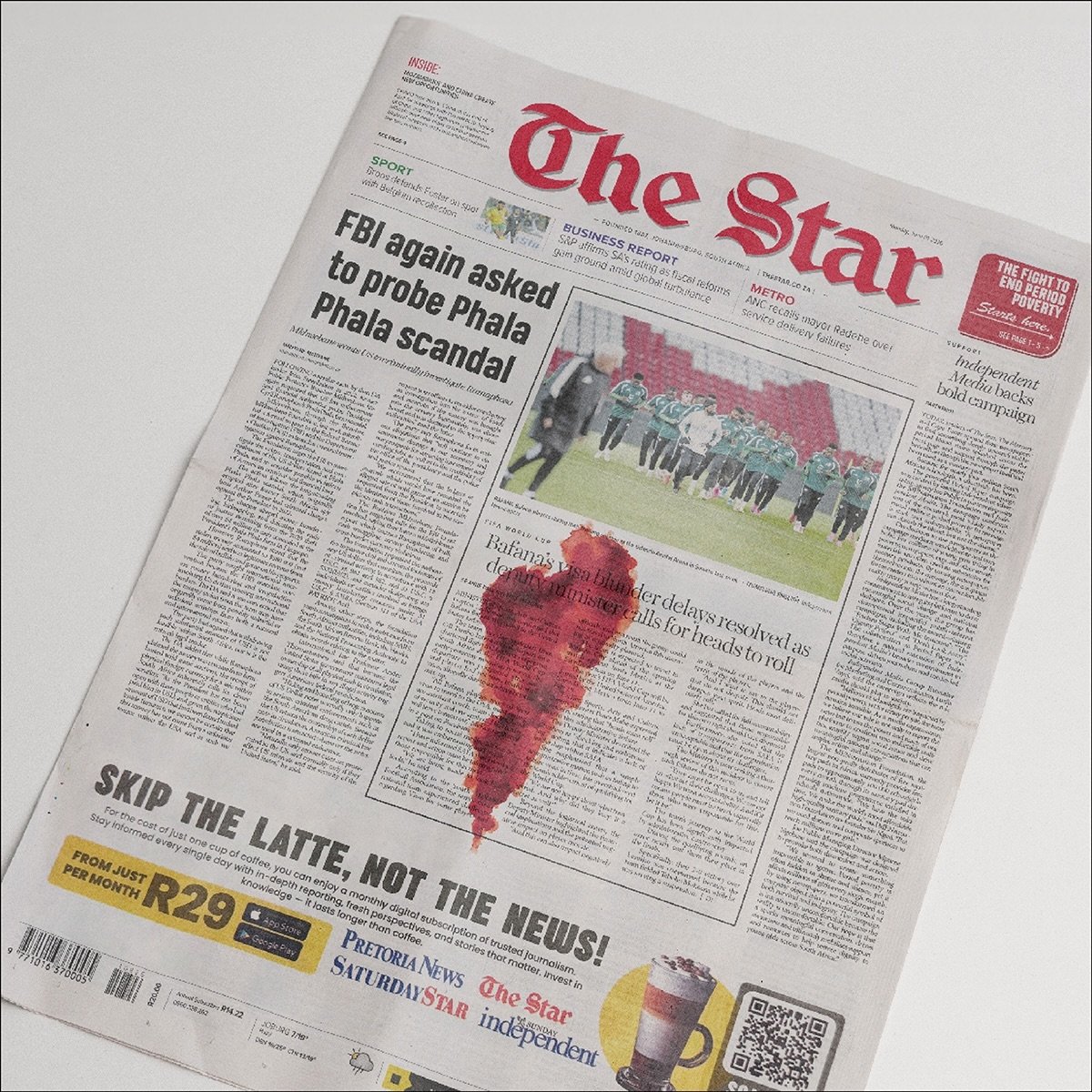
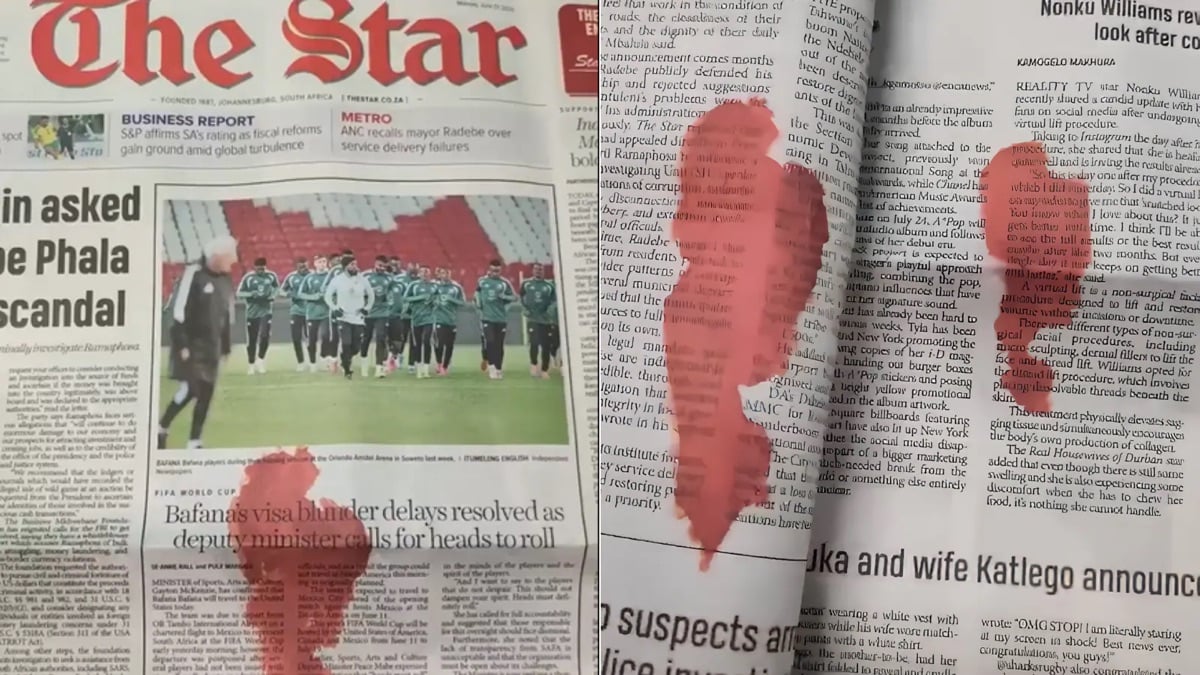
To draw attention to the millions of girls who cannot afford period products, the MENstruation Foundation ran a unique advertisement in three major South African newspapers.
Readers of The Star, The Mercury and Cape Times opened their newspapers this week to find something deeply uncomfortable: period blood stains on the front page, seeping through to the pages beneath — as if the newspaper itself had been used as a sanitary pad.
South African schoolgirls suffering from period poverty are forced to use newspapers, rags, and even cow dung in place of sanitary pads. Here’s a short video of what the ad looks like as you page through the paper, culminating in a full page highlighting the foundation’s free sanitary pad dispensers placed in schools.
Maybe one of the best advertisements I’ve ever seen? (thx, caroline)
I’d seen that there was a new Tom Cruise movie coming out this fall called Digger, but I was not prepared for the trailer, in which we see Cruise playing a dipshit oligarch in what appears to be a Dr. Strangelove-style satire/thriller.
The most powerful man in the world embarks on a frantic mission to prove he is humanity’s savior before the disaster he’s unleashed destroys everything.
The film is directed by Alejandro Iñárritu (Amores perros, Birdman, The Revenant) and also stars John Goodman as a geriatric president, Sandra Hüller, and Jesse Plemons. Digger has just moved near the top of my most-anticipated movies of 2026 list.
Newer posts
Older posts


Socials & More