kottke.org posts about video
The other day when I posted about iconic hip-hop samples from the past 50 years, I noticed a name that featured prominently in the early years: Sylvia Robinson. Robinson was the CEO and co-founder of the very first rap record label, Sugar Hill Records. She produced the first rap record, Rapper’s Delight, and the seminal The Message, widely regarded as one of the best and most influential rap and hip-hop tracks ever.
From an essay written on the occasion of her induction into the Rock and Roll Hall of Fame in 2022:
Sylvia Robinson played many roles in the music world — artist, producer, and, most notably, record executive. But as the founder and leader of the pioneering Sugar Hill label, she revealed herself to be something even rarer. She was a visionary.
In 1979, “Rapper’s Delight” by the Sugarhill Gang introduced hip-hop to the global mainstream, illustrating the genre’s commercial and creative potential. Robinson had overseen the record’s backing track, assembled the group members, and arranged their vocals — but fundamentally, it was her idea that rap was even viable as recorded music. Her place in history would be secured by that track alone, though it was far from her only impact on the direction of pop.
Here’s a short video that covers the high points of her career:
It’s sad that Robinson and her achievements haven’t been more widely known — this seems like another case (as in computing and other industries) where women played an early vital role and were then forgotten.
The makers of Alto’s Adventure and Alto’s Odyssey, two of my all-time favorite video games, are back with a game called Laya’s Horizon, which brings the familiar Alto vibe to a 3D open-world situation. In the game, you fly & glide around, navigating different terrain to achieve various goals and objectives. I’ve been playing it for the last few days and it’s a really fun, chill game. Basically, if you loved either Alto game, you’ll enjoy this.
Laya’s Horizon is available on iOS and Android and is free to play if you have a Netflix account. Did you know Netflix had a gaming service? (thx, patrick)
This started off a little slow for me but once it hit the early-to-mid 80s, I was hooked — and bobbing my head uncontrollably throughout. The visualizations really help you see how the various samples were modified, repeated, and layered to achieve the desired sounds — geniuses at work. Man, watching stuff like this makes me want to learn how to do this. (via waxy
Alexey Molchanov, one of the best freedivers of all time, recently set two new world records at a competition at Dean’s Blue Hole in the Bahamas:
- An FIM dive that took 4m 42s and went to a depth of 133 meters (442 feet). Molchanov pulled himself down and up using a guide rope without fins.
- A CWT dive that took 4m 13s and went to a depth of 133 meters (442 feet). CWT is when the diver uses a monofin and weight belt to dive and return to the surface.
His complete record-breaking dives are embedded above and are completely suspenseful to watch even though you know the outcome. They’re almost like watching someone meditate instead of compete in an extreme sport. Molchanov needs to expend some energy and oxygen getting down and back, but also can’t over-exert himself. A lot of it is just being relaxed and calm — this is truly a mind-over-matter discipline.
I’ve written about Molchanov before,1 riffing off of this profile of him in GQ.
When Alexey was younger, his mother, Natalia Molchanova, was the world’s best freediver, a distinction that she held for many years. She was a pioneer in the sport and the practitioner of a mind-and-body-control technique called “attention deconcentration.” She passed her secrets to her son, who perfected them and uses the regimen to reach a state of intense calm. By doing so, he can slow his heart rate, his metabolic rate, while simultaneously slowing the activity of his brain and his body. His focus deepens. He relaxes to the point of seeming asleep. He takes deep, drowsy breaths, like a summer breeze filling a sail.
I will never not be fascinated by freediving.
Tom Scott visits the small Swiss ski town of Zermatt, where petrol cars have never been allowed. In the 1980s, the town skipped right from horse-drawn carriages to locally-built electric vehicles, which are made pretty much by hand and are expensive — but they are also easy to maintain and repair and can last for 30-50 years. Because space is at a premium, the town tightly controls who can own a vehicle and most of allowed vehicles are delivery vans, public transportation, or other vehicles with a communal use.
Produced by Venus & Serena Williams and US soccer star Alex Morgan and directed by Rachel Ramsay & James Erskine, Copa 71 is a forthcoming documentary about a women’s soccer tournament that took place in Mexico City in 1971 that was the first, albeit unofficial, Women’s World Cup. A short teaser trailer is above. From a piece in Variety about the film:
In August 1971, more than 100,000 football fans packed Mexico City’s Azteca Stadium for a historic tournament. Teams from England, France, Denmark, Argentina and Italy flew in for 21 days of matches alongside Mexico’s national team, while eager sponsors lined up for a piece of the action. The players, who received a hero’s welcome wherever they went, might as well have been the Rolling Stones.
They were, in fact, a group of around 100 women — many of them teenagers — taking part in a pioneering unofficial Women’s World Cup. And just as quickly as they tasted fame, it was snatched away as the tournament was all but erased from football history.
Many of the competitors were just teenagers — from Wikipedia:
England’s team included 13-year-old Leah Caleb, 14-year-old Gill Sayell, and 15-year-old Chris Lockwood; their captain was 19-year-old Carol Wilson and they were accompanied by referee Pat Dunn as a chaperone and trainer. 15-year-old Susanne Augustesen scored a hat-trick for Denmark as they beat Mexico 3-0 in the final.
Copa 71 is premiering at the Toronto Film Festival in September and then hopefully will find its way into theaters and onto streaming. (thx, meg)
Catia Lattouf and an assistant run a medical clinic and rehab center for hummingbirds in her Mexico City apartment.
With dozens of the tiny birds buzzing overhead, along walls and the window of her bedroom, Lattouf explained that she began caring for them a year after surviving colon cancer in 2011. It started with one hummingbird that had an eye injured by another bird.
A veterinarian friend encouraged her to try to help it. She named it Gucci after the brand of the glasses case she kept it in. The bird became her inseparable companion, perching on her computer screen while she worked.
“It wrote me a new life,” she said of the nine months the bird lived with her.
I’m not entirely sure I’d like 60 hummingbirds constantly flitting around my house, but I’m not entirely sure I wouldn’t like that either.
A short TED-Ed video on the flow state of creativity and how you might enter it more easily.
Flow is more than just concentrating or paying attention; it’s a unique mental state of effortless engagement. And those who more frequently experience flow report higher levels of positive emotions, creativity, and feelings of accomplishment. But what exactly is flow? And how can we find it in our daily lives? Explore steps you can take to increase your chances of finding flow.
While I am not feeling particularly in the groove today, over the past several weeks I’ve been in the flow state a lot, working on a couple of projects for the site. It’s been a long time since I’ve had that feeling for more than a couple of hours every few months and booooooy does it feel good. There is almost nothing that fills me with as much joy as the “effortless engagement” of being in the flow state. I’m very glad it’s back in my life — I’d been afraid it was gone forever. (via open culture)
This short, relaxing, mesmerizing video of an Martian impact crater called Aram Chaos was taken by the HiRISE camera on the Mars Reconnaissance Orbiter. The images were run through an enhanced color red-green-blue filter, which tends to highlight the structure and geology rather than the true color. For example, the blue in the video often represents basalt, an igneous rock of volcanic origin.
Scrabble is one of those games where pro/expert gameplay differs so much from amateur/novice gameplay that it might as well be a totally different game. In this entertaining recap of the finals of the 2023 Scrabble World Championships, former US champ Will Anderson explains how finalists David Eldar and Harshan Lamabadusuriya think and strategize throughout the best-of-seven series.
Gameplay aside, the thing that stood out for me is how many of the words played I’d just never heard of before. Like, at least 60% of them. Like I said, it’s just a completely different game at the expert level, with a shit-ton of memorization required. I don’t play Scrabble for this reason — because if you don’t have a bunch of two-letter words and Q,Z, & X words memorized and you’re playing against someone who does, it’s not fun. But it is fun to see two heavyweights of the game go at it on equal terms. (via peterme)
It is astounding to me the number of YouTube channels that I have never heard of with subscriber bases larger than that of many countries. (This goes double and triple for Instagram and TikTok.) Alan Becker has over 23 million subscribers and makes videos pitting animated characters against various other entities. His latest video is Animation vs. Math and it is super nerdy and engaging. You might have to be a bit of a math nerd to enjoy this fully, but even if you only get the gist of what’s going on (like I did for at least half of the video), it’s still pretty entertaining. You can check the comments for an explanation of the math or this illustrated explainer.
In a June piece for The Guardian and the video above from just a few days ago, Robert Reich outlines five crises — including wokeness, the trans panic, and critical race theory — that Republicans have manufactured in order to deflect from their true agenda.
Virginia governor Glenn Youngkin’s “day one” executive order banned the teaching of critical race theory. DeSantis and Greg Abbott, the Texas governor, have also banned it from schools.
Here again, though, there’s no evidence of a public threat. CRT simply teaches America’s history of racism, which students need to understand to be informed citizens.
Banning it is a scare tactic to appeal to a largely white, culturally conservative voter base.
However, I would argue that Reich needed to go a bit further. While the crises are inventions, their consequences go beyond mere distraction and into the territory of active harm, particularly of queer and trans people, Black people, and people of color. That’s why I modified the title from his original.
In the 1994 Caribbean Cup qualifying group stage match between Barbados and Grenada, the 90 minutes of normal time ended with an intentional own goal by Barbados and then with Grenada trying to score either a goal or an own goal and Barbados defending both nets. Say what?! How did this happen?
Well, it was the confluence of a few things:
- The match would go into overtime in case of a tie.
- The “golden goal” rule was in effect for overtime…the first goal wins and the match is immediately over. Oh, and the goal is worth 2 goals, not just one.
- To qualify for the next round, Barbados not only needed to win the match, they needed to win it by two goals…a one-goal difference would not be enough.
I found out about the match by reading this SBNation article but Wikipedia does a better job in clearly explaining why that combination of factors resulted in chaos:
The match started off routinely and Barbados scored the first two goals, establishing the two-goal winning margin they required: in the 83rd minute, the game changed when Grenada scored a goal, which would take Grenada through to the finals unless Barbados could score again.
Barbados attempted to score for the next few minutes, but as time ran out they switched to a different strategy: tying the game so they could attempt to achieve the two-goal margin with the golden goal in extra-time. In the 87th minute, they stopped attacking, with Barbados defender Terry Sealey and goalkeeper Horace Stoute passing the ball between each other before Sealey intentionally scored an own goal to tie the game at 2-2.
With just three minutes of normal time left, the Grenadian players caught on to the Barbadians’ plan, and realised that they would advance in the tournament by scoring a goal in either net, since they would still qualify for the finals with a 1-goal loss. This saw normal time finish in a highly unusual manner, with Grenada trying to score a goal in (and Barbados trying to defend) both nets. For the next three minutes, Barbadian players successfully defended both sides.
As 90 minutes had expired with the score at 2-2, the game went on to extra time, where the winning “golden goal” would count double — thus, Barbados only had to score once to qualify for the 1994 Caribbean Cup. Trevor Thorne scored the winning goal for Barbados to advance to the next round with a score of 4-2.
From Adam Kovacs’ YouTube channel Adam Something comes this brisk 10-minute video essay on why European malls are doing better than their American progenitors. I thought his third point, about poor urban planning, was particularly interesting: malls tend to fail in America because they are not integrated into the fabric of towns and cities (because very little is integrated into the fabric of cities and towns in many places these days).
Malls, hell, all commerce has to be an organic part of towns and cities. People should be able to get to them by means other than a car, and conveniently. Such integrated commercial spaces are far more resilient. If your commercial spaces aren’t resilient — if you just plop a big box outside the town — don’t be surprised when it goes bust in a few years. And then it’s bulldozed for the next thing to be put up for it to go bust the same way and then get bulldozed and then the next thing and the next and the next so on and so forth.
Starting with Jaws, his first big blockbuster movie that defined the genre, Steven Spielberg has filled the audiences of his films with a sense of wonder, that alchemical mix of fear and astonishment of the unknown. No other director does it better and this video essay explores how he does it.
The music for Sinéad O’Connor’s 1990 smash hit Nothing Compares 2 U is already pretty stripped down to emphasize the vocals, but in this video, the vocals are almost fully isolated so you can really hear the clarity and emotion in that wonderful voice of hers.
The song was apparently recorded in one take:
“I actually think the intensity of Sinéad’s performance came from the breakup of her latest relationship,” opines Chris Birkett, who co-produced and engineered the track as well as the accompanying, Grammy Award-winning album, I Do Not Want What I Haven’t Got, which topped the Billboard 200 for six weeks and sold seven million copies worldwide. “She had been dating her manager, Fachtna O’Ceallaigh, who’s a really good guy and had been instrumental in getting her deal with Ensign Records. However, their relationship had gone pear-shaped and they were in the process of breaking up when we recorded ‘Nothing Compares 2 U’, so that’s probably why she did such a good vocal. She came into the studio, did it in one take, double-tracked it straight away and it was perfect because she was totally into the song. It mirrored her situation.”
(via openculture)
A NYC DJ named Dwells released this mashup of Radiohead’s Everything In Its Right Place and Kendrick Lamar’s N95 back in March and I love it:
You can also find it on Soundcloud and Bandcamp. I ran across it when Radiohead shared a snippet of it on TikTok.
FWIW, Dwells seems to be the same DJ Dwells that won the NYC regional of the prestigious DMC DJ competition when he was just 13 years old. (via @jessicabrillhart)
Cruise ships are a relatively new human invention that look quite different from other ships. Oh, and they are absolutely massive. How did they get that way?
The predecessor of today’s cruise ships was the ocean liner: big, beautiful ships that sailed across the Atlantic. But ocean liners had a totally different purpose from cruise ships: They were for transportation. Everything about them was designed to facilitate an ocean voyage from one continent to another.
But air travel changed that. Planes eliminated the main reason to take a ship somewhere, and ocean liner business plummeted. So the industry pivoted and began selling a ship as the destination itself. The cruise ship was born. But the ocean liners, built for a voyage, weren’t ideal for the purposes of a cruise, and over the next few decades, the cruise ship began its evolution. And it has culminated in the behemoths we see today.
Cruise ships always make me think of David Foster Wallace’s classic piece, Shipping Out (which you might know as A Supposedly Fun Thing I’ll Never Do Again).
[Note: If you’re reading/watching this, I assume you’ve watched season two or don’t care about spoilers; they abound.] The Bear is an intense show about a group of intense people doing an intense job. It can be tough to watch sometimes because people often communicate by screaming and yelling at each other. As Evan Puschak observes in this perceptive video essay, the second season delves into where some of those behaviors came from (surprise: childhood trauma) and offers a counterbalancing force: tenderness, listening, and paying attention.
I have said previously that “even on my busiest day, I will drop everything to watch a video of pencils being made”. Still true! This video from Process X of a Tokyo pencil factory really hits the spot. My favorite part of watching pencils get made is always the sharpening of the finished pencils by belt sander.
See also How Pencils Are Made, A Visit to an American Factory That’s Been Producing Pencils Since 1889, and A History of Pencil Lead and How Pencils Are Made. (via the kid should see this)
I’ve gotta say that I was a little skeptical when Phil Edwards started out this video saying that he wasn’t going to talk about Pac-Man’s gameplay as a vital component of why it was such a huge success when in came out in 1980. He allows that, of course, the gameplay was very compelling but other factors truly pushed the game beyond the competition and into its own category, including the decline of pinball (profit per square foot), its family friendliness, and some legal & financial maneuverings.
Oh, and here’s the playable keychain-sized Pac-Man that you can see in the video. Didn’t even know that was a thing!
The roots of hip-hop and rap are various and stretch back in time to the antebellum South and from there to Africa. But by some accounts, a song called Noah by gospel group The Jubalaires was the first instance of recorded music that sounded like rap. Listen for yourself…the relevant bit is right around the 35-second mark:
I’m not a music historian by any stretch, but that sounds 30 years ahead of its time. There are several bad remixes of Noah on YouTube…this one is maybe the best at pairing their singing with a rap beat.
Designed by Olson Kundig Architects, the Maxon House features a studio that’s attached to the main house but can be rolled away on railroad tracks to be closer to the trees. From Dezeen:
The two-storey structure was based on the design of the “traditional caboose”. A workspace sits on the first level while the second, accessible via a steel ladder, serves as a cupola for taking in views and functions as a “calmer zone for creative exploration and restoration”.
The control panel that operates the rails was taken from a Burlington Northern locomotive, while the door colour and the wood used were directly informed by colours and materials commonly found on American trains.
The railroad ties for the track were repurposed from the Great Northern Railroad line, though the studio noted the steel tracks “are a much larger gauge than is typically used”.
There’s even a Wes Anderson connection (because of course there is):
Inspired by Wes Anderson’s love of trains in cinema, Maxon Railway takes some visual cues in the form of on-board artifacts and props from The Darjeeling Limited.
You can read lots more about the house and the railway, including more than you’d probably want to know about the history of rail travel and commerce in the Pacific Northwest.

This is pretty cool: in collaboration with the British Museum, a team led by woodblock printmaker David Bull (who I first wrote about back in 20051) is carving woodblocks and creating prints from a series of previously unpublished drawings by legendary Japanese artist Katsushika Hokusai.
The Museum has in their possession a group of drawings by Hokusai that were apparently intended for use in the production of a series of books. For reasons unknown to us now that project was cancelled, but the drawings survived, and we have selected 12 of them for a new subscription series.
For more details of the collection of images, please refer to this page of the British Museum website. But here, we can simply note that the drawings fall into a number of categories, and our set will reflect that diversity. Hokusai’s series was intended to take his readers through aspects of Japanese historical culture, and we will meet Buddhist deities, warriors from ancient China, and historical landscapes, along with more prosaic scenes of the natural world.
The print shown above was the first one to be sent out in January. But look at this original drawing from the collection:
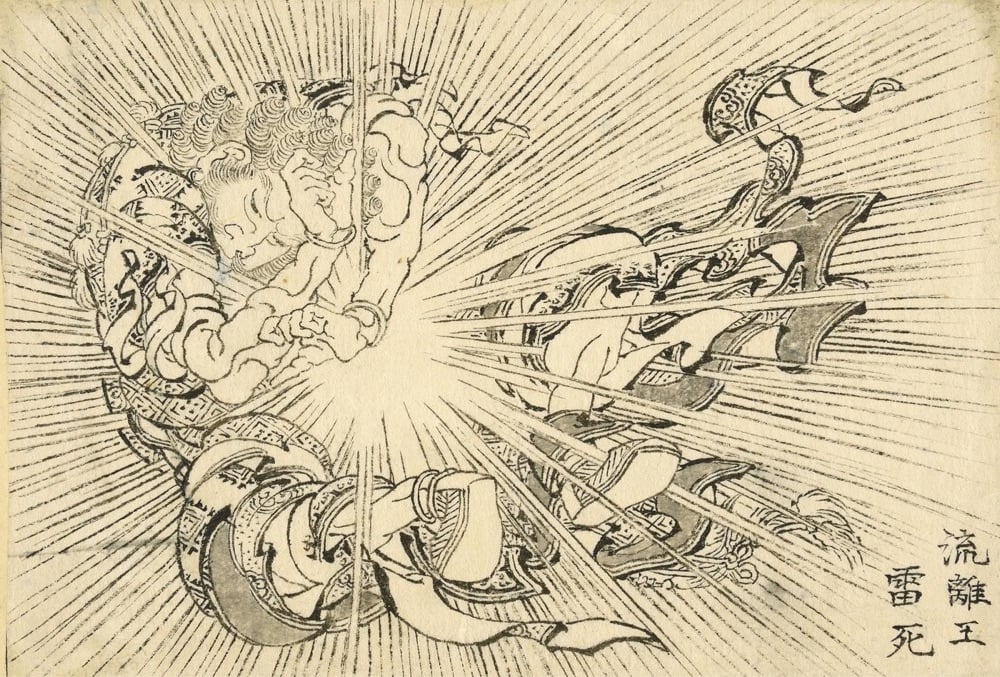
Wow. That is shockingly modern — like a 60s superhero comic or a still from 60s anime. I hope they reprint this one!
Here’s a video from the British Museum of Bull talking about the project:
If you make woodblock prints for a living, you know the name Hokusai, and if you’re a woodblock carver and you hear about original drawings from Hokusai that have never been carved into prints you would most likely do a little happy dance.
(via open culture)
In 1910, a group of inexperienced climbers claimed to have summited Denali, the highest peak in what is now the United States. Their story was greeted with skepticism.
So when I found out that the first people to reach the highest point in North America (Denali, the mountain formerly known as McKinley) were just a bunch of Average Joes with no climbing experience who went up on a bet, I was flabbergasted. How had I never heard this story? The more I looked into it, the more fantastic the story became. When these guys descended from the mountain, nobody believed they really even made it. And they wouldn’t be the first people to fraudulently claim to have reached the top, with no evidence to offer that they succeeded. This story has all the makings of a blockbuster action comedy. It’s almost unbelievable.
But later evidence suggests that they just might have made it to the top.
In 1842, a French artist and scholar named Joseph-Philibert Girault de Prangey set out on a tour of the eastern Mediterranean to document sights and architecture via the brand new medium of photography. He started off in what is now Italy and continued on to Greece, Egypt, Turkey, Syria, and the Levant (which includes modern-day Lebanon, Israel, and Palestine). The daguerreotypes he took are the oldest surviving photos of those locations (aside from Italy). It’s incredible to time travel back 180 years to see what these places looked like. (via aeon)
Vox talked to four television writers about how streaming and prestige TV have changed the financial picture for writers over the past 15 years, contributing to the writers strike that’s been going on since early May.
Companies like Netflix, Hulu, Apple TV+, and more have given consumers an unprecedented array of films and TV shows and opened the door to new voices that don’t have to adhere to mainstream network formats. On the other hand, streaming has also changed how television gets produced, the role writers play, and how they get paid. We interviewed four television writers and showrunners about how streaming has changed how they work, how their incomes have taken a hit, and why it has become harder than ever to build a career.
I just really love the hell out of these iterative Lego build videos from Brick Experiment Channel and Brick Technology. In this one, a car is repeatedly modified to roll perfectly on an increasingly inclined treadmill. I started watching and in 10 seconds I was 100% invested.
They’re not even really about Lego…that’s just the playful hook to get you through the door. They’re really about science and engineering — trial and error, repeated failure, iteration, small gains, switching tactics when confronted with dead ends, how innovation can result in significant advantages. Of course, none of this is unique to engineering; these are all factors in any creative endeavor — painting, sports, photography, writing, programming. But the real magic here is seeing it all happen in just a few minutes.
See also A Lego 5-Speed Manual Transmission, Designing a Lego Car to Cross Gaps, Engineering a Capable Climbing Lego Car, Making A Solar-Powered Billion-Year Lego Clock, and 20 Mechanical Principles Combined in a Useless Lego Machine.
Traditionally, the subjects depicted in Western art were either religious or rich — wealthy patrons paid for paintings of themselves or of their religions. As Evan Puschak explains in this brief video essay, that began to change in the 16th century as revolution, reformation, and the development of a merchant class shifted who was worthy of depiction and who could pay.
Hey folks. I’m trying to get into the habit of doing these media diet posts more frequently than every six months so they’re actually, you know, somewhat relevant. Here’s what I’ve been watching, reading, listening to, and experiencing over the last two months.
Spider-Man: Across the Spider-Verse. One of the most visually stunning movies I’ve ever seen. A worthy sequel to the first film. (A)
On Being with Krista Tippett: Isabel Wilkerson. I will take any opportunity to listen to Isabel Wilkerson talk about her work. (A)
Deep Space Archives. Been listening to this album by A.L.I.S.O.N on heavy rotation while working recently. (A-)
Parable of the Sower by Octavia Butler. Bleak and powerful, science fiction at its finest. (A)
Asteroid City. I liked Wes Anderson’s latest effort quite a bit. Not quite as much as The French Dispatch but more than many other folks. (A-)
Dunkirk. Rewatched for the 5th time. For my money, this is Nolan’s best movie. (A+)
Beef. I wanted to like this but I only lasted two episodes. Not for me, YMMV. (C)
Antidepressants. It took a bit to home in on the right one, but even my relatively low dose has helped me out of a particularly low point over the last few months. (A)
The Diplomat (season one). Burned through this one in just a few days — an entertaining political thriller that doesn’t take itself too seriously. (B+)
Ooni Volt 12. Ooni was kind enough to send me this electric pizza oven to test out, so take this with a grain of salt, but I’ve been having a lot of fun making no-fuss pizza. Need to work on my dough game tho. (A-)
Silo. This hooked me right away and didn’t let go, although it got a little bit ridiculous in places. I’m eager to see where things go in season two. (B+)
Interstellar. Watched this with the kids and we all enjoyed it. The musical score does a lot of heavy lifting in all of Nolan’s films but in this one especially. (A-)
The Age of Pleasure. My only complaint about this album from Janelle Monáe is that it’s too short. (A-)
Barr Hill Gin & Tonic. The best canned cocktail I’ve had. And it’s turned me into a G&T fan. (A)
VanMoof S3. *sigh* Figures that I finally pull the trigger on getting an e-bike and the company that produces it files for bankruptcy. No matter: this thing is fun as hell and has flattened all the hills out around here. (A)
Átta. You always know what you’re going to get with Sigur Rós: atmospheric, ambient, abundant crescendos, ethereal vocals. (B+)
Air. Ben Affleck has a bit of a mixed record as a director, but this Air Jordan origin story is really solid and entertaining. Viola Davis is great as Michael Jordan’s mother Deloris. (A-)
The Bear (season two). There are aspects of The Bear that I don’t like (the intensity seems forced sometimes, almost cheesy) but the highs are pretty high. Forks was a fantastic episode. More Sydney and Ayo Edebiri in season three please. (A-)
Indiana Jones and the Dial of Destiny. Solid Indy adventure and I love Phoebe Waller-Bridge as the sidekick/partner. I know some folks didn’t like the climax but seeing Jones get what he’s always wanted was satisfying. (B+)
Rebranding beloved brands. Max? X? No. So dumb. (F)
65. Oh dear. Adam Driver needs to choose his projects more wisely. Interesting premise but the rest was pretty lifeless. (C+)
Pizzeria Ida. The pizza is expensive (esp for Vermont), the ingredients top-notch, and the service rude (if you believe the reviews). We had a great time and this is probably the best pizza you can get in VT; it wouldn’t be out of place in NYC. (A)
Oppenheimer. Epic. Almost overwhelming at times. Don’t see this on anything but a big screen if you can help it. Perhaps not Nolan’s best but it still packs a wallop. (A-)
Barbie. I enjoyed this very much but found it uneven in spots. And no more Will Ferrell please. But it was great seeing people dressed up for the occasion — Barbenheimer felt like the first time since before the pandemic that you could feel the buzz in the audience, an excitement for what we were about to experience together. (B+)
Currently I’m reading American Prometheus (on which Oppenheimer is based) and Wool (on which Silo is based), so I’ll have those reviews for you next time hopefully. I don’t have a TV series going right now and nothing’s really catching my eye. Maybe I’ll dig into season three of (the underrated) The Great — I’ve heard it’s back to top form after a s02 dip.
Past installments of my media diet are available here.
Newer posts
Older posts





Socials & More