



What a five-year-old thinks about famous logos
Designer Adam Ladd asked his five-year-old daughter for her impressions of several well-known logos. This is great:
(via stellar)

This site is made possible by member support. 💞
Big thanks to Arcustech for hosting the site and offering amazing tech support.
When you buy through links on kottke.org, I may earn an affiliate commission. Thanks for supporting the site!
kottke.org. home of fine hypertext products since 1998.
Beloved by 86.47% of the web.
Designer Adam Ladd asked his five-year-old daughter for her impressions of several well-known logos. This is great:
(via stellar)
Over at Sew Weekly, Mena Trott predicts what some of the characters will be wearing in the coming season of Mad Men.
Oh, Betty. For years, she has been immaculately dressed and presented as the facade of the perfect 1950s/1960s wife. With her cinched waists and billowing skirts, she’s held onto late 1950s and early 1960s fashion the longest. In season four, she’s married to the anti-Don, the boring Henry Francis and is getting a little too familiar with the bottle. When you’re married to Henry Francis, you just don’t care any more. That should be embroidered on a pillow.
Over at The Wirecutter, Brian Lam writes about technology, journalism, happiness, and why “clicking the like button 1 billion times will never give you an orgasm or a hug or a high five”.
The first thing I did was to take back my time. I quit all the online content that was id-provoking and knee jerk. I stopped reading the stupid hyped up news stories that are press releases or rants about things that will get fixed in a week. I stopped reading the junk and about the junk that was new, but not good. I stopped reading blogs that write stories like “top 17 photos of awesome clouds by iphone” and “EXCLUSIVE ANGRY BIRDS COMING TO FACEBOOK ON VALENTINES DAY.” And corporate news that only affects the 1%. Most days, I feel like most internet writers and editors are engaging in the kind of vapid conversation you find at parties that is neither enlightening or entertaining, and where everyone is shouting and no one is saying anything. I don’t have time for this.
The Eames’ Powers of Ten and Eva Szasz’s Cosmic Zoom both came out in 1968 and were based on Kees Boeke’s 1957 essay called Cosmic View. This seems like an incredible coincidence. I couldn’t find anything online about which film came first or if there was any influence one way or the other, so I thought I’d ask if anyone knows anything about which came out first. Hit me at [email protected].
The Pronunciation Book channel on YouTube shows you how to say various words in American English in a straightforward fashion. Here’s how to say Zegna, the men’s clothing brand:
This is not to be confused with the Pronunciation Manual channel, which does the same thing in the same format but much funnier and more incorrect.
I could have embedded a dozen more…I have no idea why I think these are so funny but I just cannot stop laughing at them. Ok, one more:
And this one! Make it stop!!
Update: My kids and I still use these mispronunciations around the house all the time. I cannot help looking at even the fanciest bottle of Châteauneuf-du-Pape without thinking choody-noofy-doopy-poopy.
Well some of them are. The plain old American Oreo didn’t sell so well in China, so Kraft had to rethink everything about the cookie.
It turns out that if you didn’t grow up with Oreos and develop an emotional attachment to the cookie, it can be a weird-tasting little thing. And this started a whole process in the Chinese division of Kraft of rethinking what the essence of an Oreo really is.
Key terms in this article include “the essence of Oreoness” and “Twist, Lick, Dunk”.
At the end of last week’s post about John Tyler’s grandsons still being alive (and indeed, NY Mag did an interview with one of them), I provided a couple of other examples of living persons bridging distant historical periods and asked:
Someone needs to come up with a term for this sort of thing (history bridges? no.)
On Twitter, David Galbraith suggested “timebenders”. After more thought, I came up with “human wormholes” but that’s not quite right either. Tony Hiss, in a book about his father Alger (the accused Soviet spy), said that Alger had a term for stories kind of like these: the Great Span.
My father himself even had a name for a kind of ongoing closeness between people in which death is sometimes only an irrelevance. He called it “the Great Span,” a sort of bucket brigade or relay race across time, a way for adjacent generations to let ideas and goals move intact from one mind to another across a couple of hundred years or more.
Hiss cites a pair of stories involving Alger (who died in 1996) and Oliver Wendell Holmes, who Alger clerked for and also figured in one of my earlier examples. In one story, Holmes told Alger about his experience fighting in the Civil War. The other story reaches back even further:
In the Holmes story Alger treasured above all others, the Justice told him that when he had been very young, his grandmother, a woman he revered, had shared her memories of the day at the beginning of the American Revolution when she was five and had stood in her father’s front window on Beacon Hill in Boston and watched rank after rank of Redcoats marching through town.
Another instance of the Great Span are the three Civil War widows (Maudie Hopkins, Alberta Martin, and Gertrude Janeway) who lived into the 2000s, two of them collecting their husbands’ pensions until their deaths. (thx, mike & @ithinkihaveacat)
If you divide 1 by the number 998,001, you get a list of all the three digit numbers in order except 998. Like so:

Math! (via mlkshk)
BLDGBLOG is running a distributed film festival called Breaking Out and Breaking In that will explore the architecture of escapes and break-ins in movies.
Breaking Out and Breaking In is an exploration of the use and misuse of space in escapes and heists, where architecture is the obstacle between you and what you’re looking for.
Watch the films at home-or anywhere you may be-and then come back to discuss the films here on BLDGBLOG. It’s a “distributed” film fest; there is no central venue, just a curated list of films and a list of days on which to watch them. There’s no set time, no geographic exclusion, and no limit to the food breaks or repeated scenes you might require. And it all leads up to a public discussion at Studio-X NYC on Tuesday, April 24.
The overall idea is to discuss breaking out and breaking in as spatial scenarios that operate as mirror images of one another, each process with its own tools, techniques, and unique forms of unexpected architectural expertise.
It started on Friday, but there’s still plenty of time and opportunity to join in.
Five Minutes on The Verge: Jason Kottke:
Then it’s eight more-or-less solid hours of ass-in-chair because surprisingly, that’s the way stuff gets done.
The Setup: An interview with Jason Kottke:
My white desk doesn’t work so well with the optical mouse, so for some dumb reason I’m using a 242-page book called Proust Was a Neuroscientist by Jonah Lehrer as a mousepad.
An internet sleuth used the lyrics of Ice Cube’s It Was a Good Day to figure out when his exceptional day occurred.
CLUE 3: “The Lakers beat the Super Sonics”
Dates between Yo MTV Raps air date AUGUST 6 1988 and the release of the single FEBRUARY 23 1993 where the Lakers beat the Super Sonics…
Update: Someone fact-checked the original calculation and found it wanting. (thx, trevor)
The Bay of Fundy in Eastern Canada has some of the world’s greatest tides…at times, high tide is 50+ feet higher than low tide. Here’s a time lapse video of those tides in action.
Korean artist Kang Duck-Bong makes PVC pipe sculptures that look like they’re moving.

(via colossal)
In this transcript of a talk given to the attendees of the Joint Summits on Translational Science, Carl Zimmer highlights an important aspect of understanding the human body and how to treat its many maladies: the ecosystem of microbes.
The microbes in your body at this moment outnumber your cells by ten to one. And they come in a huge diversity of species — somewhere in the thousands, although no one has a precise count yet. By some estimates there are twenty million microbial genes in your body: about a thousand times more than the 20,000 protein-coding genes in the human genome. So the Human Genome Project was, at best, a nice start. If we really want to understand all the genes in the human body, we have a long way to go.
Now you could say “Who cares? They’re just wee animalcules.” Those wee animacules are worth caring about for many reasons. One of the most practical of those reasons is that they have a huge impact on our “own” health. Our collection of microbes-the microbiome-is like an extra organ of the human body. And while an organ like the heart has only one function, the microbiome has many.
When food comes into the gut, for example, microbes break some of them down using enzymes we lack. Sometimes the microbes and our own cells have an intimate volley, in which bacteria break down a molecule part way, our cells break it down some more, the bacteria break it down even more, and then finally we get something to eat.
Another thing that the microbiome does is manage the immune system. Certain species of resident bacteria, like Bacteroides fragilis, produce proteins that tamp down inflammation. When scientists rear mice that don’t have any germs at all, they have a very difficult time developing a normal immune system. The microbiome has to tutor the immune system in how to do its job properly. It also acts like an immune system of its own, fighting off invading microbes, and helping to heal wounds.
While the microbiome may be an important organ, it’s a peculiar one. It’s not one solid hunk of flesh. It’s an ecosystem, made up of thousands of interacting species.
Monty Python member Terry Jones is set to direct a sci-fi comedy that will feature other Python members “voicing key roles”. Gilliam, Cleese, and Palin have all signed on and they’re working on getting Eric Idle.
Members of Monty Python’s Flying Circus are reteaming for “Absolutely Anything,” a sci-fi farce combining CGI and live action, with Terry Jones to direct and Mike Medavoy to produce.
Plans are for filming to begin in the U.K. this spring, with the Pythons voicing key roles as a a group of aliens who endow an earthling with the power to do “absolutely anything” to see what a mess he’ll make of things — which is precisely what happens. There’s also a talking dog named Dennis who seems to understand more about the mayhem that ensues than anyone else does. Robin Williams will voice the character.
“It’s not a Monty Python picture, but it certainly has that sensibility,” Jones told Variety.
(via ★vuokko)
Typographica shares their favorite typefaces of 2011.
The idea is simple: I invite a group of writers, educators, type makers and type users to look back at 2011 and pick the release that excited them most.
(via ★essl)
Maybe I’m just way over-cautious but this guy does almost kill himself while bungee jumping off a bridge using a jury-rigged climbing rope and harness, right? This is just totally batshit crazy:
Skip ahead to about 1:30…everything before that is just filler. (via ★bryce)
Aaron Cohen calls this “the best story you’ll read about a burglary you’ll read this week” and I think he’s right.
When John Davidson’s apartment gets robbed, he learns that the easiest way to get his stuff back is to have one drug dealer lie to another drug dealer while he lies to the police.
Posters for Oscar nominated movies that maybe tell the truth of each movie a bit more than the conventional posters. For instance, Iron Lady becomes Total Bitch, Tree of Life becomes Wuh?, and The Girl with the Dragon Tattoo becomes All the Rape, No Subtitles.

(via ★vuokko)
That’s right, two exclamation points because this blows my mind. John Tyler was the 10th President of the United States. He was born in 1790 and took office in 1841. His son, Lyon Gardiner Tyler, was born in 1853, when Tyler was 63 years old. In turn, Lyon had six children with two different wives, two of whom were Lyon Gardiner Tyler, Jr. and Harrison Ruffin Tyler (born 1924 & 1928 respectively, when Lyon Sr. was in his 70s). They are reportedly both still living in their 80s.
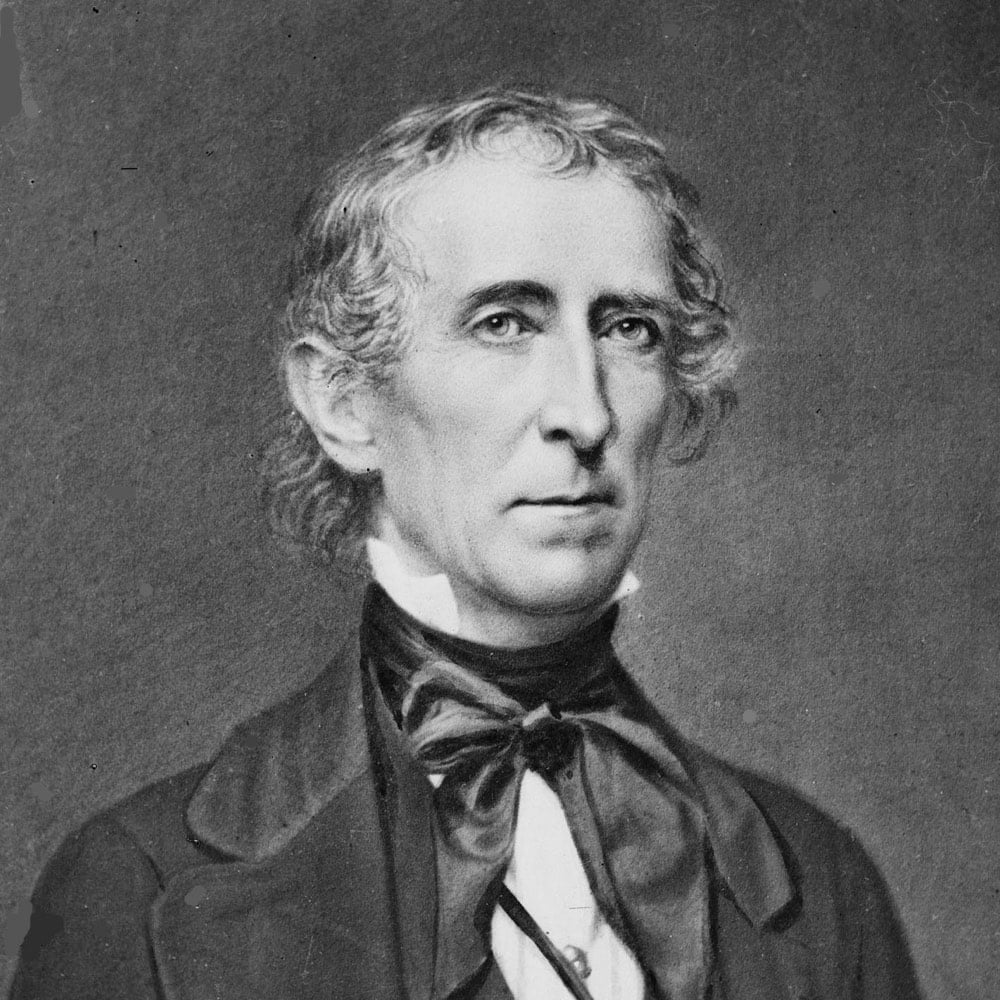
Someone needs to come up with a term for this sort of thing (history bridges? no.). There’s also this 1956 game show appearance of a Lincoln assassination eyewitness and Supreme Court Justice Oliver Wendell Holmes (1841-1935) shaking hands during his lifetime with both John Quincy Adams (b 1767) and John F Kennedy (d 1963), one man spanning 200 years of American history.
Update: As of early 2018, both of Tyler’s grandsons are still alive. I’ve been collecting these kinds of stories on The Great Span page, after a term that accused Soviet spy Alger Hiss came up with:
My father himself even had a name for a kind of ongoing closeness between people in which death is sometimes only an irrelevance. He called it “the Great Span,” a sort of bucket brigade or relay race across time, a way for adjacent generations to let ideas and goals move intact from one mind to another across a couple of hundred years or more.
Adrian Chen has an interview with a renegade IT guy named Martin who does social media, hacking, and other tech stuff for “High Net-worth Individuals” and criminals. One of things he does is set up drug rings with prepaid cell phones and a rotating collection of SIM cards a la the Barksdale/Bell drug crew in The Wire.
With Martin’s system, each crewmember gets a cell phone that operates using a prepaid SIM card; they also get a two-week plastic pill organizer filled with 14 SIM cards where the pills should be. Each SIM card, loaded with $50 worth of airtime, is attached to a different phone number and stores all contacts, text messages and call histories associated with that number, like a removable hard drive. This makes a new SIM card effectively a new phone. Every morning, each crewmember swaps out his phone’s card for the card in next day’s compartment in the pill organizers. After all 14 cards are used, they start over at the first one.
Of course, it would be hugely annoying for a crewmember to have to remember the others’ constantly changing numbers. But he doesn’t have to, thanks to the pill organizers. Martin preprograms each day’s SIM card with the phone numbers the other members have that day. As long they all swap out their cards every day, the contacts in the phones stay in sync. (They never call anyone but each other on the phones.) Crewmembers will remind each other to “take their medicine,” Martin said.
That’s clever. The “take their medicine” detail reads like it’s straight out of the movies.
Economist Jason Barr and his colleagues measured the bedrock depth in Manhattan and correlated it with building height. In doing so, they busted the long-held belief that there were no skyscrapers between Midtown and the Financial District because of insufficient bedrock.
What the economists found was that some of the tallest buildings of their day were built around City Hall, where the bedrock reaches its deepest point in the city, about 45 meters down, between there and Canal Street, at which point the bedrock begins to rise again toward the middle of the island. Indeed, Joseph Pullitzer built his record-setting New York World Building, a 349-foot colossus, at 99 Park Row, near the nadir, as did Frank Woolworth a decade later.
(via @bobulate)
From the 1890s until the 1960s, the location and orientation of stamps on postcards were used for the transmission of secret messages.
For all those who are in the situation of Hero and Leander, and similarly to them can only exchange secret signs about the feelings of their hearts, here we publish the secrets of the language of stamps. If the stamp stands upright in the upper right corner of the card or envelope, it means: I wish your friendship. Top right, across: Do you love me? Top right, upside down: Don’t write me any more. Top right, thwart: Write me immediately. Top right, upright [once more again???]: Your love makes me happy. Top left, across: My heart belongs to someone else. Top left, upright: I love you. Bottom left, across: Leave me alone in my grief. In line with the name: Accept my love. Same place, across: I wish to see you. Same place, upside down: I love someone else.

Clip after clip of formerly intact objects (boats, planes, buildings) being destroyed in a matter of seconds.
(via @unlikelywords)
Letters of Note ran a 1955 letter from advertising legend David Ogilvy that details his process for writing advertising copy.
I have never written an advertisement in the office. Too many interruptions. I do all my writing at home.
David Galbraith updated his post on where the web was invented (which includes an interview with Tim Berners-Lee) to include the juicy tidbit that the building in which TBL invented the web is in France, not Switzerland.
I’ll bet if you asked every French politician where the web was invented not a single one would know this. The Franco-Swiss border runs through the CERN campus and building 31 is literally just a few feet into France. However, there is no explicit border within CERN and the main entrance is in Switzerland, so the situation of which country it was invented in is actually quite a tricky one. The current commemorative plaque, which is outside a row of offices where people other than Tim Berners-Lee worked on the web, is in Switzerland. To add to the confusion, in case Tim thought of the web at home, his home was in France but he temporarily moved to rented accommodation in Switzerland, just around the time the web was developed. So although, strictly speaking, France is the birthplace of the web it would be fair to say that it happened in building 31 at CERN but not in any particular country! How delightfully appropriate for an invention which breaks down physical borders.
Before he died last year at the age of 44, Mike DeStefano shared the story of his wife’s final days many years earlier. She’s in hospice care, DeStefano shows up with his new Harley and takes her for a ride, morphine drip and all.
She’s holding the pole [of the IV drip]! Marc, it was a pole with four wheels on the bottom, and we’re riding around this hospice, and you could hear the goddamn wheels jangling and banging; it was insane.
And then I pass the front door, and all these nurses are standing out front, and they’re all crying. They’re watching us, and they’re crying. And I didn’t know why they were crying. I was like, Why are they crying? I didn’t get what they were seeing. I didn’t know. Because I was just in it; I was living it. I knew my wife who had suffered, she was a prostitute, she was a freakin’ heroin addict, she was beaten by pimps — this was her past — and then she ends up with AIDS, and she’s dying, and all she wants is a goddamn ride on my motorcycle.
So the next thing you know we’re on I-95, because women, it’s never enough for them. We’re on I-95, and she unhooks the pole, and she’s holding the morphine bag over her head with her gown that’s flying up in the air so you could see her entire naked, bony body with the morphine bag whipping in the wind, and we’re passing by these guys in their Lamborghinis, and I’m looking at them like, What the hell kind of life are you living? Look at me, I’m on top of the world here.
I love this story. The podcast from which it was taken is available here.
Gavin Purcell produces Late Night with Jimmy Fallon and the other night on Twitter, he shared some info about how the show comes together.
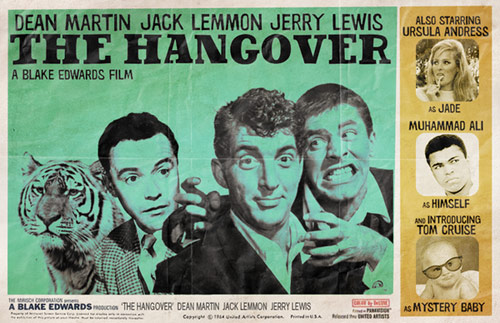
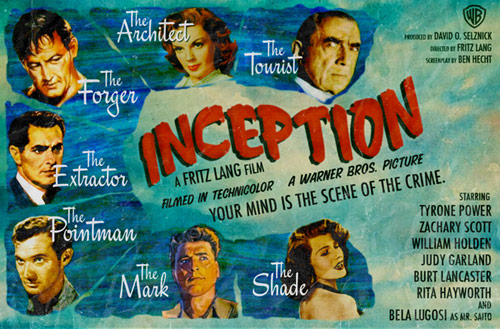
If recent movies like The Hangover, Drive, Inception, and Rushmore had been made in an earlier era, who would have starred in and directed these premakes? How about Dean Martin, Jack Lemmon, and Jerry Lewis in The Hangover?
Or Inception directed by Fritz Lang?
(thx, al)
Camera shutters used to be verrrry slow so to help young kids stay still during the long exposure, the photographer would have the mother be in the frame but typically covered by a blanket or cloth. Like so:

(via cup of jo)
For his new book, Tim Mantoani took hundreds of portraits of photographers posing with prints of their most well-known work. Here’s Neil Leifer holding his photo of Ali standing over Liston.

(via sly oyster)
According to this YouTube video, Japanese do multiplication by drawing lines like this:
(via ★vuokko)
Type designer Matthew Butterick sent a letter to director Brad Bird about the use of Verdana in captions and subtitles in the latest Mission Impossible movie.
Second, it’s not stylistically suitable. Verdana is a built-in font on nearly every Windows and Mac computer. It’s used on zillions of web pages. It’s ubiquitous. Therefore, the person who uses Verdana suggests to readers “I couldn’t be bothered to pick anything better.” It’s also well-known as the corporate font of IKEA — probably not the association you’re going for.
(via ★aaronsw)
From McSweeney’s, In Which I Fix My Girlfriend’s Grandparents’ WiFi and Am Hailed as a Conquering Hero.
But then one gray morning did Internet Explorer 6 no longer load The Google. Refresh was clicked, again and again, but still did Internet Explorer 6 not load The Google. Perhaps The Google was broken, the people thought, but then The Yahoo too did not load. Nor did Hotmail. Nor USAToday.com. The land was thrown into panic. Internet Explorer 6 was minimized then maximized. The Compaq Presario was unplugged then plugged back in. The old mouse was brought out and plugged in beside the new mouse. Still, The Google did not load.
(via @coudal)
The Internet Archive is hosting a copy of the American Specimen Book of Type Styles put out by the American Type Founders Company in 1912. It’s a 1300-page book listing hundreds of typefaces and their possible use cases.
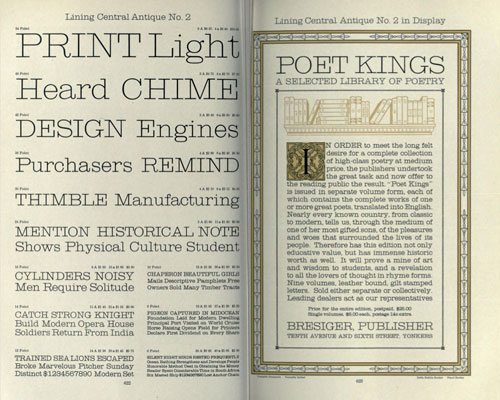
There’s also a 1910 copy of what is basically the German version of the ATF book. Look at these swirls! (via @h_fj)
From the February 2012 issue of Esquire, an interview with former President Bill Clinton about the current political and governmental landscape in America.
One of the real dilemmas we have in our country and around the world is that what works in politics is organization and conflict. That is, drawing the sharp distinctions. But in real life, what works is networks and cooperation. And we need victories in real life, so we’ve got to get back to networks and cooperation, not just conflict. But politics has always been about conflict, and in the coverage of politics, information dissemination tends to be organized around conflict as well. It is extremely personal now, and you see in these primaries that the more people agree with each other on the issues, the more desperate they are to make the clear distinctions necessary to win, so the deeper the knife goes in.
Adele’s Rolling in the Deep has been covered thousands of times on YouTube…here’s 70 of those performances cut together into one seamless song.
(via ★davidfg)
A collection of things that New Yorkers say. Like “where’s the train?”, “you have to go to Brooklyn, it’s the law”, and “tourists!”
Watch as John Scalzi’s 13-year-old daughter sees an LP record for the first time.
This is… This is… What? What?! This is huge! This is like ten CDs in one. How many songs does it have on it?
I believe the record in question is from Jonathan Coulton. (via ★mathowie)
Scott Carpenter was one of the original seven Mercury astronauts and the second American to orbit the Earth. Just before he went into space, his father wrote this wonderful letter.
And I venture to predict that after all the huzzas have been uttered and the public acclaim is but a memory, you will derive the greatest satisfaction from the serene knowledge that you have discovered new truths. You can say to yourself: this I saw, this I experienced, this I know to be the truth. This experience is a precious thing; it is known to all researchers, in whatever field of endeavour, who have ventured into the unknown and have discovered new truths.
From photographer Steven Siegel, a reminder of what a magical shithole NYC was in the 1980s. Oh hey, here’s a hole in the Manhattan Bridge walkway:

See also kids digging up graves in Greenwood Cemetary, the abandoned West Side Highway, and what looks like a bombed-out Bushwick. (via gothamist)
Well, from making blockbuster movies anyway. And that’s only one of the interesting tidbits in this long NY Times profile of Lucas
Lucas has decided to devote the rest of his life to what cineastes in the 1970s used to call personal films. They’ll be small in scope, esoteric in subject and screened mostly in art houses. They’ll be like the experimental movies Lucas made in the 1960s, around the time he was at U.S.C. film school, when he recorded clouds moving over the desert and made a movie based on an E. E. Cummings poem. During that period, Lucas assumed he would spend his career on the fringes. Then “Star Wars” happened — and though Lucas often mused about it, he never committed himself to the uncommercial world until now.
Sitting in a sun-drenched office, his voice boyish, Lucas talked about himself as if he were a character in one of his movies. He’s at the end of an epic saga; he’s embracing a new destiny (“Make the art films, George”); he’s battling former acolytes who have become his sworn enemies; and George Lucas is — no kidding — in love. Before he takes his digital camera with him into obscurity, though, Lucas has one last mission. He wants to prove that with “Red Tails,” he can still make the kind of movie everyone in the world will want to see.
I don’t know if the nudie playing cards are absolutely essential, but this trick is pretty neat.
(via @itscolossal)
This article, about how gender is manipulated in South Asia, is very difficult to read.
It’s a girl, a film being released this year, documents the practice of killing unwanted baby girls in South Asia. The trailer’s most chilling scene is one with an Indian woman who, unable to contain her laughter, confesses to having killed eight infant daughters.
The statistics are sickening. The UN reports approximately 200 million girls in the world today are ‘missing’. India and China are said to eliminate more female infants than the number of girls born in the US each year. Lianyungang in China has the worst infant gender ratio on record with 163 boys born for every 100 girls. Taiwan, South Korea and Pakistan are also countries in which unwanted female babies are aborted, killed or abandoned.
Here’s more information on the mentioned film. (via @cshirky)
Stanley Kubrick’s meticulousness about his movies extended right on down to how they were marketed. When A Clockwork Orange came out in the US, he spent weeks crunching theater ticket grosses to figure out which theaters the film should play in.
Clockwork would be shown in standard cinemas as a quality platform release, which meant there were many options per city. I knew that Don Rugoff’s Cinema 1, the most prestigious cinema in New York, had to be the New York theater, but how to be sure that the film would be booked into the best cinema in Indianapolis or Cleveland or Atlanta? To choose the right theater in each city, we needed to know which cinema sold the most tickets to the most interesting pictures. But while a studio would know what its own films grossed, detailed box-office figures of competitive films were closely held secrets. There was no comparative information, and that is exactly what Stanley wanted.
Influenced by Kubrick’s system, Variety released their first nation box office rankings chart a few months later. (via df)
Matt Haughey shares a bad experience he had backing a Kickstarter project and what the project creators could have done to avoid it.
This is the story of the worst project I’ve funded on Kickstarter. I am posting this not to single out the creators behind it, or bad mouth their business, but to go over my disappointment in the hopes that future Kickstarter project creators can learn from it. It’s all about communication with your funders, setting up and delivering on expectations for funders, and doing the right thing when things go wrong.
Shipping a product or app is hard. It requires experience, hard work, and a little luck. But providing effective and genuine customer service might be even harder because you just have sit there, take it, and react well under pressure over and over and over. The entrepreneur side of your brain is saying “this is a great product and I am proud of it and anyone who says otherwise is wrong and I will show them and succeed” and sometimes customer service is acknowledging publicly and repeatedly the exact opposite thing…that the product isn’t meeting needs, you are right, we will fix it, and thank you sir may I have another? That’s a lot of potential cognitive dissonance! The best teams and companies deflect that dissonance and turn customer service problems into opportunities to improve their products, their teams, and their relationships with their customers (current and potential). That’s when the magic happens.
Susan Cain argues that the lack of privacy and freedom from interruption in modern offices might not be the best way for those office employees to be creative…particularly for introverts.
The New Groupthink has overtaken our workplaces, our schools and our religious institutions. Anyone who has ever needed noise-canceling headphones in her own office or marked an online calendar with a fake meeting in order to escape yet another real one knows what I’m talking about. Virtually all American workers now spend time on teams and some 70 percent inhabit open plan offices, in which no one has “a room of one’s own.” During the last decades, the average amount of space allotted to each employee shrank 300 square feet, from 500 square feet in the 1970s to 200 square feet in 2010.
The new offices of Foursquare and Buzzfeed (where I work from) are a perfect example of the New Groupthink Cain refers to….rows and rows of people sitting next to each other in open spaces. Much of this is because of NYC’s insane rental market, but Fog Creek’s offices are a nice counterexample:
Every developer, tester, and program manager is in a private office; all except two have direct windows to the outside (the two that don’t get plenty of daylight through two glass walls).
Available at Etsy, prints of Star Wars characters wearing designer clothes by John Woo (not the director). A stormtrooper wearing Thom Browne, Boba Fett wearing Supreme Visvim, and my favorite, Jango Fett wearing Comme des Garçons.

Woo does similar illustrations outside the Star Wars universe…here’s the T-1000 from Terminator 2 wearing Thom Browne. (via flavorwire)
The Fournitures Generales Pour Le Piano is a shop in Paris that sells parts for piano repair. The owner runs the shop himself, sells fewer and fewer parts each year, and dreams of building a one-string instrument which sounds like a piano, lute, and harp all at the same time.
See also the decline in piano quality over the last 100 years. (thx, judy)
Quentin Tarantino released a list of his favorite films of last year. His number one choice? Midnight in Paris. Here’s his top five…click through for his other choices:
1. Midnight In Paris
2. Rise Of The Planet Of The Apes
3. Moneyball
4. The Skin I Live In
5. X-Men: First Class
(via moviefone)
Socials & More