kottke.org posts about video
Isolation does funny things to people. Just ask designer Lydia Cambron, who recognized a certain kinship between the themes of her lockdown in Brooklyn this spring and Stanley Kubrick’s 2001: A Space Odyssey. Over the course of two months, Cambron meticulously recreated 2001’s ending scene in her apartment, not only shot-by-shot but nearly look-by-look, and produced a tiny masterpiece of her own.
The adapted version delineates the passing of time through wardrobe rather than age, identifying each phase of the character’s journey with a product of self care or PPE. Tools of private entertainment or self betterment are also used as props, questioning our confidence in products and productivity as anchors during times of uncertainty. Multitasking while #wfh, conjuring guilt or longing with unused exercise equipment, your entire being reduced to a measure of time — these scenes all illustrate the absurd comedy of trying to maintain control during this unprecedented and unpredictable time.
(via daring fireball)
I love things that sound like other things and this video of a kid crashing into some trash bins on his bike sounds a lot like the drums in Phil Collins’ “In the Air Tonight”. (If I may play spoiler for just a second though, capturing the sound of those bins going over so clearly from that far away seems a little suspect. But let’s assume it’s real and have our fun.) See also This Stumbling Deer’s Hooves Sound Like Phil Collins’ Drum Fill on “In the Air Tonight”. (thx to everyone who sent this in)
Kirby Ferguson, creator of the Everything Is a Remix and This Is Not a Conspiracy Theory video series, has a new video out that attempts to explain the rise of QAnon, conspiracy theories, and magical thinking in America.
Ferguson zeros in on the divide between two different ways people make sense of a complex, chaotic, and uncertain world: evidence seeking and magical thinking. All of us employ both of these techniques to help ease our anxiety about the world, but those who tend towards magical thinking arrive at explanations that are based primarily on instinct, emotion, feelings, and gut reaction while evidence seekers mostly rely on scientific and empirical reasoning.
He also identifies six main aspects of magical thinking:
1. Obsession with symbols and codes (e.g. pizza as a “deep state” code for child trafficking)
2. Dot connecting (e.g. linking 5G with Covid-19)
3. Behind every event is a plan concocted by a person (e.g. Soros and the “deep state” conspiracy)
4. Purity (e.g. the Satanic panic and heavy metal music)
5. Apocalypse is nigh (e.g. the “deep state” again)
6. Preoccupation with good and evil (e.g. liberals are not only wrong but evil)
For me, the key quote about magical thinking is this one for late in the video: “These are not systems of knowledge, and they cannot build solutions. They can only criticize and second-guess.”
With the help of Harvard historian Khalil Gibran Muhammad, this video from BuzzFeed documents investigations into police brutality and racism from the past century and how reforms based on those investigations have not brought about meaningful change. These reports — exploring the causes of unrest in Chicago in 1919, Harlem in 1935 & 1943, LA in 1965, Ferguson in 2014 — demonstrate again and again the discriminent violence committed against Black people by the police, and yet that violence and racism continues until the next investigation is conducted with the same conclusion.

The English translation of Elena Ferrante’s latest novel, The Lying Life of Adults, is due out at the beginning of September and is available for preorder (Kindle). Here’s the synopsis:
Giovanna’s pretty face is changing, turning ugly, at least so her father thinks. Giovanna, he says, looks more like her Aunt Vittoria every day. But can it be true? Is she really changing? Is she turning into her Aunt Vittoria, a woman she hardly knows but whom her mother and father clearly despise? Surely there is a mirror somewhere in which she can see herself as she truly is.
Giovanna is searching for her reflection in two kindred cities that fear and detest one another: Naples of the heights, which assumes a mask of refinement, and Naples of the depths, a place of excess and vulgarity. She moves from one to the other in search of the truth, but neither city seems to offer answers or escape.
The Guardian and the Washington Post have reviews of the Italian version of the book. And Netflix has already announced that they’re producing a TV series based on the novel; here’s a short teaser:
The series is being made by the same folks responsible for HBO’s My Brilliant Friend series (based on Ferrante’s Neapolitan novels), which has been outstanding in its two seasons so far.
I’m Thinking of Ending Things. Charlie Kaufman (Being John Malkovich, Eternal Sunshine of the Spotless Mind, Adaptation), director. Łukasz Żal (Ida, Cold War), cinematographer. Jesse Plemons (Friday Night Lights), Jessie Buckley (Chernobyl), Toni Collette (too many amazing things), David Thewlis (Lupin from Harry Potter). Adapted from I’m Thinking of Ending Things by Iain Reid. Netflix. September 4. Trailer above. Excited! Bye.
Popped popcorn kernels are like snowflakes: no two are alike. If you watch popcorn popping at the ludicrously slow speed of 100,000 fps, you can see these individualized forms flowering into existence. Pro tip: turn off the upbeat music on the video and supply a mellower soundtrack of your own — slow motion video requires meditative music.
See also How to Make Popcorn Using a Blow Torch & Hair Dryer. (via moss & fog)
First conceived and implemented in 2011, Universal Everything’s walking figure has been remastered and rebuilt from the ground up with the latest digital effects. Transfiguration (2020) treats us to the spectacle of caramel, fire, rocks, smoke, and shrubbery striding around like a person.


I think the flowers are still my favorite.
Update: Their latest is called Run Forever:
(via colossal)


As part of his Literally Balling project, artist Victor Solomon fixed up a rundown basketball court, repairing the blacktop using the Japanese art of kintsugi. Traditionally, the kintsugi method involves repairing pottery with glue mixed with gold powder, which results in visible cracks, a reminder of the pottery’s past and what it’s been through. Says Solomon of the project:
With the heartbreaking beginning to 2020 and this weekend’s return of basketball — I’ve been thinking about the parallels between sport as a uniting platform to inspire healing and my ongoing experiments with the technique of Kintsugi that embellishes an objects repair with gold to celebrate it’s healing as formative part of the journey.
(via the kid should see this)


Last year, Craig Mod walked 620 miles from Tokyo to Kyoto along the Nakasendō historic highway and along the way he stopped at kissaten (or kissa), old-school Japanese cafes known for their pizza toast. Mod wrote about his quest late last year for Eater and has now turned a fuller account of the journey into a gorgeous book called Kissa By Kissa.
Those kissaten — or kissa — served up toast. I ate that toast. So. Much. Toast. Much of it pizza toast. If you buy this book, you’ll learn more than you ever dared to know about this variety of toast available all across Japan. It’s a classic post-war food staple. Kissa by kissa, and slice by thick slice of beautiful, white toast, I took a heckuva affecting and long walk. This book is my sharing with you, of that walk, the people I met along the way, and the food I ate.
Even more interesting is that to sell the book, Mod built a Kickstarter clone on top of Shopify called Craigstarter. And he’s released the code for it on Github.
Kickstarter is an excellent way to run a crowdfunding campaign. But if you already have a community built up, and have communication channels in place (via a newsletter, for example), and already run an online shop, then Kickstarter can be unnecessarily cumbersome. Kickstarter’s 10% fee is also quite hefty. By leaning on Shopify’s flexible Liquid templating system and reasonable CC processing fees, an independent publisher running a campaign can save some ~$7,000 for every $100,000 of sales by using Craigstarter instead of Kickstarter. That’s materially meaningful, especially in the world of books.
You can order Kissa By Kissa right here.
Update: Mod made a short video of the proprietor of Būgen, one of the kissaten featured in the book, making pizza toast:
At John Lewis’s funeral yesterday, Barack Obama delivered a eulogy for his friend and mentor, praising him for his achievements in the struggle for civil rights. He also took the opportunity to suggest what politicians might do to honor Lewis and to continue his struggle, beyond just words. From the text of his speech:
If politicians want to honor John, and I’m so grateful for the legacy of work of all the Congressional leaders who are here, but there’s a better way than a statement calling him a hero. You want to honor John? Let’s honor him by revitalizing the law that he was willing to die for. And by the way, naming it the John Lewis Voting Rights Act, that is a fine tribute. But John wouldn’t want us to stop there, trying to get back to where we already were. Once we pass the John Lewis Voting Rights Act, we should keep marching to make it even better.
By making sure every American is automatically registered to vote, including former inmates who’ve earned their second chance.
By adding polling places, and expanding early voting, and making Election Day a national holiday, so if you are someone who is working in a factory, or you are a single mom who has got to go to her job and doesn’t get time off, you can still cast your ballot.
By guaranteeing that every American citizen has equal representation in our government, including the American citizens who live in Washington, D.C. and in Puerto Rico. They are Americans.
By ending some of the partisan gerrymandering — so that all voters have the power to choose their politicians, not the other way around.
And if all this takes eliminating the filibuster — another Jim Crow relic — in order to secure the God-given rights of every American, then that’s what we should do.
The Auralnauts, who have rejiggered the dialogue and sounds from your favorite movies with hilarious results (most notably Star Wars), have reimagined Bane from The Dark Knight Rises as a coronavirus mask advocate for their latest video.
Do I look like I live in fear of anything?! I’m wearing this mask for you, the people of Gotham, who, I can’t help but notice, are not social distancing!
A compilation of TV news clips of people saying “mask debate” (which sounds very much like another unrelated word when spoken — try saying it out loud right now to see what I mean), stitched together by the folks at Last Week Tonight with John Oliver. It feels good to laugh at infuriating things sometimes.
BTW, the actual debate over masks will continue to wane — science and then culture will win most people over and it’ll just become a normal thing that most people do in public all the time, like wearing shoes or carrying a bag.
Filmmaker Errol Morris has uploaded the entire two-season run of his 2000-2001 TV series First Person to YouTube for free viewing: season 1 playlist, season 2 playlist. Each of the show’s 17 episodes is a one-on-one interview with someone who Morris finds fascinating, shot in the style that would find a wider audience and greater critical acclaim in The Fog of War two years later.
In the first season, Morris interviewed Temple Grandin about slaughterhouse design:
And Tony Mendez, former espionage expert for the CIA, whose work was the subject of the 2012 film Argo:
In season two, he profiled Josh Harris, one of the first internet celebrities:
Again, you can find every episode of First Person on YouTube: season 1, season 2.
Update: There’s an episode of First Person that has not been uploaded to YouTube: the one about Tanya Corrin (more on her here). That episode is also not listed on Morris’s site. I wonder what the story is here? (thx, @endquote)
I Am a Scientist is an effort to introduce children to scientists outside of the narrow stereotypes that our culture typically offers (old, male, white, nerdy). They’re doing this through “scientist-of-the-month toolkits” that tell stories about contemporary working scientists who embody an “incredible range of personalities, interests, backgrounds, and pursuits”. From a blog post about the program:
Science has been the driving force in the modernization of the world as we know it, yet science as an industry has failed to adequately diversify with the times. While the new digital age offers opportunities to expand interest in and appeal of STEM careers, many barriers still hinder equitable access for all students. Conversations of famous scientists often draw answers such as “Albert Einstein” and “Bill Nye the Science Guy”. While accurate references of scientific leaders, the lack of diversity in the public image of scientists can contribute to the lack of diversity in STEM fields.
Introducing the “I Am A Scientist” initiative, which provides opportunities for students, specifically those in Junior High School and High School, to interact with the science and stories of today’s scientists-breaking down barriers like race, gender, and personal interests.
The program’s collection of classroom toolkits provide real-life stories of modern scientists, classroom resources, posters, career resources, and more. The initiative aims to help students engage with scientists that may look, act, or think like them, and are making great strides in remarkable fields that are often left out of career planning discussions. With featured scientists that range from multidimensional graduate students to globally recognized innovators at the top of their field, “I Am A Scientist” tunes into the power that comes from discovering a wide range of role models.
Ten years on from the release of Christopher Nolan’s Inception, Andrew Saladino of The Royal Ocean Film Society smartly traces the key influences of the film, rejecting the simplistic notion that Inception is just a rip-off of Paprika or The Matrix. Instead, he delves into long-standing themes in science fiction and other genres that Nolan is able to synthesize into something new. (Remember, everything is a remix.)
Also, kudos to Saladino to getting through an entire video on the ideas that influenced Inception without making an inception joke or reference, e.g. “Dark City incepted Nolan into including malleable architecture”. Clearly I could not have resisted.
Estelle Caswell talks to Tony Hawk and architectural historian Iain Borden (author of
Skateboarding and the City) about some of skateboarding’s most iconic spots and how skate architecture has changed over the years, from sidewalks to empty swimming pools in the desert to home-built halfpipes to “if you can see it you can skate it” structures (curbs, handrails, hydrants) all over cities.
Plus, their reference list of historic skateboard videos should keep you occupied for several hours/days/lifetimes.
Matthew Highton is recreating the opening credit sequences of TV shows using only stock video footage. Here’s the intro to Friends and (my favorite) the Duck Tales intro:
He’s also done Buffy the Vampire Slayer, Happy Days, The Young Ones, and the OC. Check out the entire playlist on YouTube or his thread on Twitter.
The kids and I were talking about how slow motion video works the other day, so I was happy to see this new video from Phil Edwards detailing how the technique works and its history in cinema, from Eadweard Muybridge to Wes Anderson and from Seven Samurai to The Matrix.
I am an unabashed fan of slow motion; you can check out dozens of slow motion videos I have posted over the years, including this video of Alan Rickman dramatically drinking tea.

The European Space Agency’s Solar Orbiter is not even at its closest distance to the Sun and its telescope has already captured some images that reveal new information about our star, including features called “campfires” that are too small to have been captured by previous instruments. From the description of the video embedded above:
This animation shows a series of close-up views captured by the Extreme Ultraviolet Imager (EUI) at wavelengths of 17 nanometers, showing the upper atmosphere of the Sun, or corona, with a temperature of around 1 million degrees.
These images reveal a multitude of small flaring loops, erupting bright spots and dark, moving fibrils. A ubiquitous feature of the solar surface, uncovered for the first time by these images, have been called ‘campfires’. They are omnipresent miniature eruptions that could be contributing to the high temperatures of the solar corona and the origin of the solar wind.
The Solar Orbiter can also peek around the back side of the Sun for the first time:
“Right now, we are in the part of the 11-year solar cycle when the Sun is very quiet,” says Sami Solanki, the director of the Max Planck Institute for Solar System Research in Gottingen, Germany, and PHI Principal Investigator. “But because Solar Orbiter is at a different angle to the Sun than Earth, we could actually see one active region that wasn’t observable from Earth. That is a first. We have never been able to measure the magnetic field at the back of the Sun.”
As revealing as these first images are, at its closest approach later in the mission the Solar Orbiter’s resolving power will roughly double. Can’t wait to see what else it turns up.
Donald Trump’s idiotic brag about how well he did on a cognitive test (“Person. Woman. Man. Camera. TV.”) set to Daft Punk’s Harder, Better, Faster, Stronger.
You just have to laugh because if you actually stop to think about how much harm this man has done and will continue to do in his remaining time in office, the incandescent rage might make you pass out.
Earlier this week, Republican Representative Ted Yoho accosted Democratic Representative Alexandria Ocasio-Cortez on the steps of the Capitol Building and called her “disgusting”, “crazy”, “dangerous”, and, as a parting shot, a “fucking bitch”. After Yoho offered a non-apology on the House floor, Ocasio-Cortez responded to both the incident and his remarks in a short speech before the House.
The video is only 10 minutes long — I urge you to watch the whole thing if you haven’t seen it. It’s masterful. Here are some excerpts from the transcript.
This is not new, and that is the problem. Mr. Yoho was not alone. He was walking shoulder to shoulder with Representative Roger Williams, and that’s when we start to see that this issue is not about one incident. It is cultural. It is a culture of lack of impunity, of accepting of violence and violent language against women, and an entire structure of power that supports that. Because not only have I been spoken to disrespectfully, particularly by members of the Republican Party and elected officials in the Republican Party, not just here, but the President of the United States last year told me to go home to another country, with the implication that I don’t even belong in America. The governor of Florida, Governor DeSantis, before I even was sworn in, called me a “whatever that is”. Dehumanizing language is not new, and what we are seeing is that incidents like these are happening in a pattern. This is a pattern of an attitude towards women and dehumanization of others.
…
I do not need Representative Yoho to apologize to me. Clearly he does not want to. Clearly when given the opportunity he will not and I will not stay up late at night waiting for an apology from a man who has no remorse over calling women and using abusive language towards women, but what I do have issue with is using women, our wives and daughters, as shields and excuses for poor behavior. Mr. Yoho mentioned that he has a wife and two daughters. I am two years younger than Mr. Yoho’s youngest daughter. I am someone’s daughter too. My father, thankfully, is not alive to see how Mr. Yoho treated his daughter. My mother got to see Mr. Yoho’s disrespect on the floor of this House towards me on television and I am here because I have to show my parents that I am their daughter and that they did not raise me to accept abuse from men.
As a reminder, properly apologizing to someone requires:
1. An expression of regret - this, usually, is the actual “I’m sorry.”
2. An explanation (but, importantly, not a justification).
3. An acknowledgment of responsibility.
4. A declaration of repentance.
5. An offer of repair.
6. A request for forgiveness.
As Ocasio-Cortez correctly notes, Yoho’s attempt does not make the grade.
And so what I believe is that having a daughter does not make a man decent. Having a wife does not make a decent man. Treating people with dignity and respect makes a decent man, and when a decent man messes up as we all are bound to do, he tries his best and does apologize. Not to save face, not to win a vote, he apologizes genuinely to repair and acknowledge the harm done so that we can all move on.
Lastly, what I want to express to Mr. Yoho is gratitude. I want to thank him for showing the world that you can be a powerful man and accost women. You can have daughters and accost women without remorse. You can be married and accost women. You can take photos and project an image to the world of being a family man and accost women without remorse and with a sense of impunity. It happens every day in this country. It happened here on the steps of our nation’s Capitol. It happens when individuals who hold the highest office in this land admit, admit to hurting women and using this language against all of us.
Again, I urge you to watch the whole thing — it’s full of powerful truths expertly and passionately delivered. Among many thoughts I had while watching it, one in particular kept rising in my mind: Alexandria Ocasio-Cortez will one day be President of the United States and we will be very lucky to have her.
Update: Ocasio-Cortez didn’t write out her speech ahead of time; she jotted down a few notes just minutes before she started speaking.
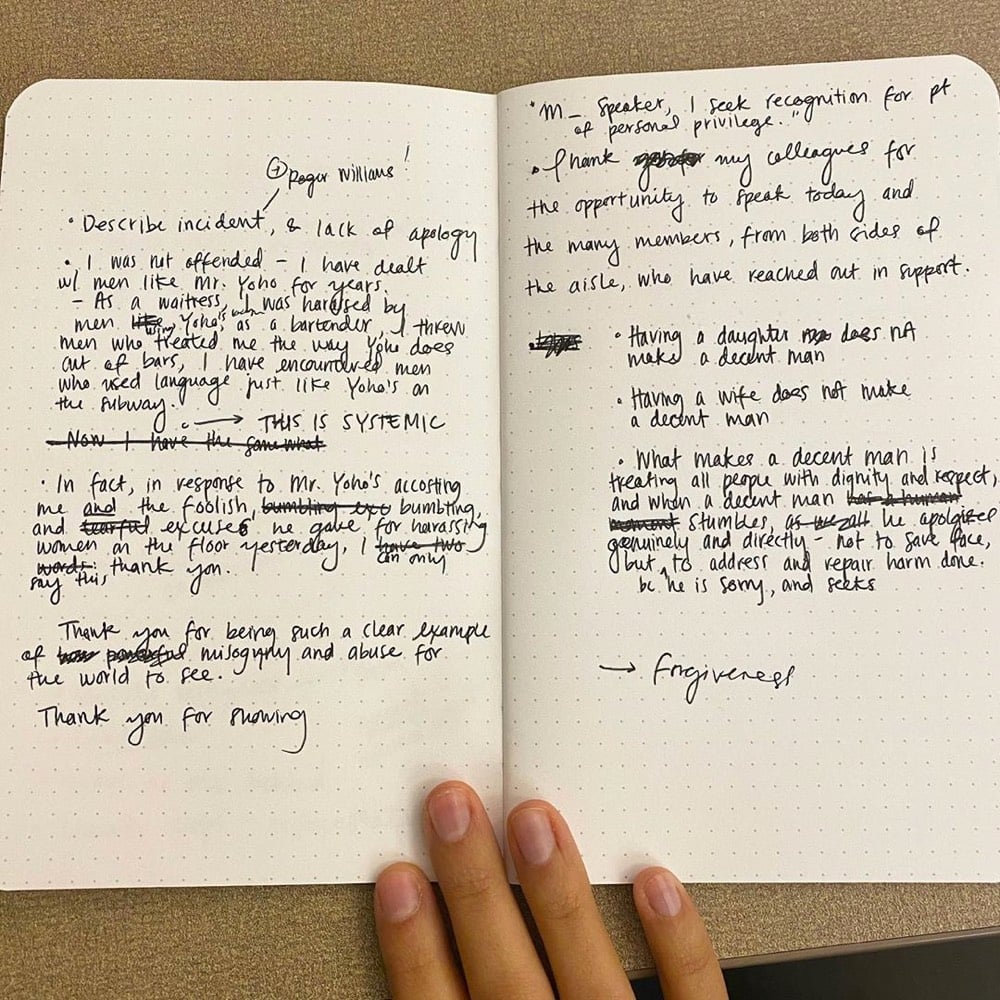
Many have asked me if my speech was pre-written. The answer is no. But in some ways, yes. Yes because this speech was a recounting of thoughts that so many women and femme people have carried since the time we were children. It flowed because every single one of us has lived this silent script: stay silent (why?), keep your head down (for whom?), suck it up (to whose benefit?). But my chosen words were largely extemporaneous. I got to the House floor about ten minutes before my speech and scribbled down some quick notes after reflecting on what had transpired over the last few days. Pictured here are all the notes I had, and from there I improvised my composition and spoke live.
Update: In a profile of Ocasio-Cortez in Vanity Fair, a new detail in this story:
This part hasn’t been reported: The next day Ocasio-Cortez approached Yoho and told him, “You do that to me again, I won’t be so nice next time.” She felt his actions had violated a boundary, stepping “into the zone of harassment, discrimination.” His mocking response, straight out of Veep: “Oh, boo-hoo.” Publicly, Yoho doubled down, issuing a non-apology on the House floor, citing his wife and daughters as character witnesses.
Isamu Yamamoto is 17 years old and has been one of the world’s best freestyle skateboarders for years — he won his first world championship in 2014 at the age of 11. He started skating because he saw a video of Rodney Mullen and now Mullen says of Yamamoto:
The way he links his tricks together and the speed of them — it’s beautiful to watch. I would dare say that not many could do that, in that way, if they tried.
The three videos above show off Yamamoto’s seemingly effortless virtuosity on a skateboard; from top to bottom: a session from 2019, a 2017 short film, and his routine for the World Freestyle Round-Up, held virtually due to the pandemic — he ended up finishing second. (via @cdevroe)
Oh god, I needed this video in my life this morning. Watch as Uncle Roger (a character created by comedian Nigel Ng) hilariously critiques a BBC Food video about how to cook fried rice. Spoiler alert: the cook drains the rice in a colander and then rinses it with water. Oh, and no MSG.
If you sad in life, use MSG. If you happy in life, use MSG. Put MSG in everything, it’ll turn it better. You just get a baby? Put MSG on baby, it’ll be better baby, smarter.
On Instagram, Uncle Roger shared how to cook rice properly.
Uncle Roger have many white friend tell me they use saucepan. Saucepan? Haiyaaa. World War II is over, use technology. Proper Asian use rice cooker.
(via @jennyyangtv <— this thread is an entertaining read as well)
Update: Uncle Roger meets up with the woman who cooked the egg fried rice in the BBC video:
In this video, Lin-Manuel Miranda shares how he came up with some of his most iconic songs from In the Heights, Hamilton, Moana, and even Star Wars (he wrote a cantina song for The Force Awakens). I can sit and listen to creators talking about how they came up with their best work pretty much forever. But honestly the reason I’m sharing this is this incredible detail about the “whoa whoa whoa” bit in “My Shot” (at ~7:35):
And then the “whoa” is based on the AOL startup dial sound, because I wanted it to feel like his words are connecting with the world and they’re reverberating out into the world. And I associate that with the first time I signed on to the internet and you hear [simulated modem noises]. It’s the AOL dialup octave.
Well, I’ll never listen to that song in the same way again. For spry minds, inspiration comes from everywhere. (via the spry minds at open culture)
To create this ultra HD footage of the surface of Mars, high-definition panoramas created from hundreds of still photos taken by the Mars rovers are panned over using the Ken Burns effect. The end product is pretty compelling — it’s not video, but it’s not not video either.
A question often asked is: ‘Why don’t we actually have live video from Mars?’
Although the cameras are high quality, the rate at which the rovers can send data back to earth is the biggest challenge. Curiosity can only send data directly back to earth at 32 kilo-bits per second.
Instead, when the rover can connect to the Mars Reconnaissance Orbiter, we get more favourable speeds of 2 Megabytes per second.
However, this link is only available for about 8 minutes each Sol, or Martian day.
As you would expect, sending HD video at these speeds would take a long long time. As nothing really moves on Mars, it makes more sense to take and send back images.
(thx, paul)
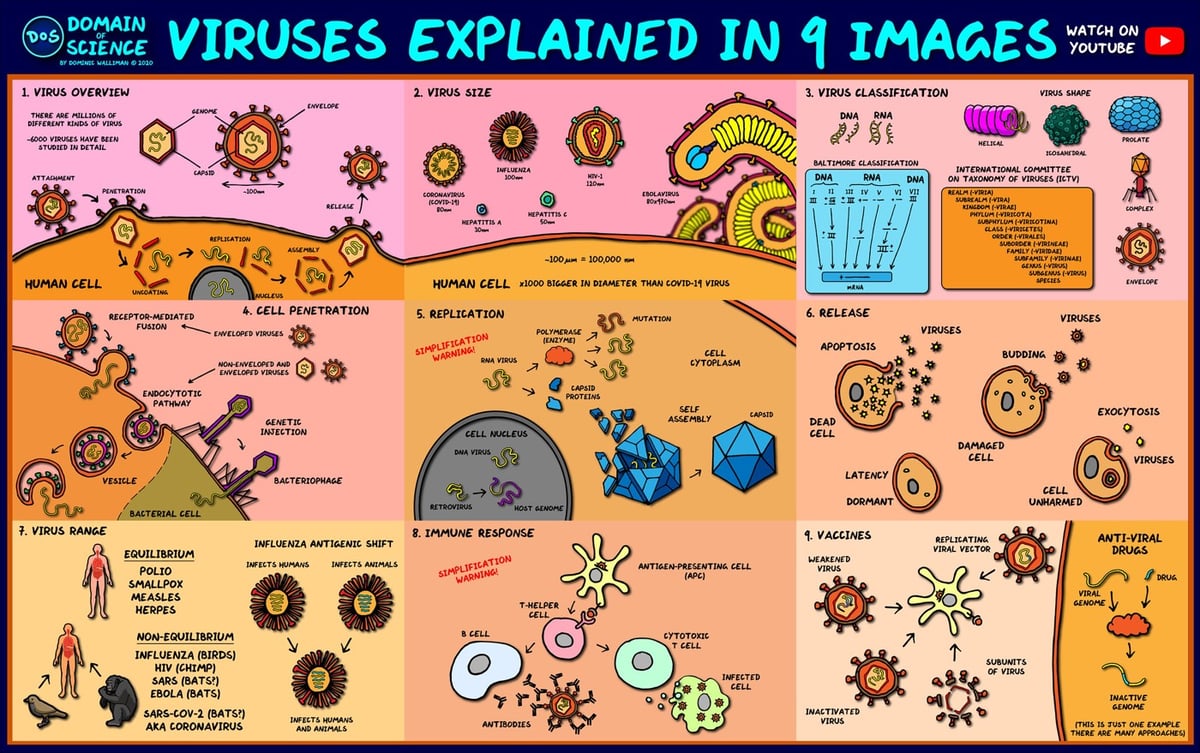
In this video and accompanying infographic, scientist Dominic Walliman of Domain of Science explains what viruses are, how they infect cells, how they replicate, and what can be done to mitigate their effects on the human body.
At the beginning of this pandemic like everyone I was hearing lots about viruses, but realised I didn’t know that much about what they are. So I did a load of research and have summarised what I learned in these nine images. This video explains the key aspects of viruses: how big they are, how they infect and enter and exit cells, how viruses are classified, how they replicate, and subjects involving viral infections like how they spread from person to person, how our immune system detects and destroys them and how vaccines and anti-viral drugs work.
After watching, it’s worth checking out Walliman’s sources in the video description for a deeper dive into viruses. (via open culture)
In this special video edition of the Code Switch podcast, host Gene Demby explores the dangers of running while Black and why the safety of Black runners has not been given the same sort of attention as the safety of white women. The most striking bit of the video for me was right in the beginning when Demby debunks the myth of “all you need to run is a pair of shoes”.
When we runners talk about running — or let’s be real — when we evangelize about it, we talk a lot about how democratic it is. But it’s not really that simple. You’re gonna want gear, which costs money. Then there’s the issue of actual physical space. You want sidewalks that aren’t jagged, trails that aren’t overgrown, air that’s clean enough to breathe. (So ideally you don’t live near landfills or power plants or factories.) So yeah… all you need are shoes. And space. And money. And time. Oh and you also need something from the people around you — the sense that you belong in that space. Women don’t always get that luxury. And neither do runners of color.
Even a seemingly simple thing like running and who can do it is affected by decades of policy decisions that disproportionately favor residents of predominantly white neighborhoods.
My two favorite performances in the Disney+ version of Hamilton are Renée Goldsberry’s Angelica Schuyler and Daveed Diggs’ twin roles as Marquis de Lafayette and Thomas Jefferson. But perhaps a close third is Jonathan Groff’s turn as King George III. Ever since we watched the show a few weeks ago, my kids and I have been walking around the house breaking into song and talking a lot about what was so mesmerizing about Groff’s performance.
So, I was excited to run across this video of musical theatre coach Marc Daniel Patrick breaking down his performance of “You’ll Be Back”. Yes, he covered the spitting but I found the discussion of how he held specific members of the audience with his gaze for extended periods much more relevant in understanding what made that performance work. I particularly loved how still Groff held his body and the rest of his head as his lower jaw pistoned up and down like a ventriloquist dummy’s singing the “da da da dat” parts. The audio is funny enough, but his possessed mandible makes me laugh every time I see it.
Patrick made a similar video analyzing Phillipa Soo’s performance of “Burn”.
With time to burn during ye olde pandemic, practitioners of a musical genre called bardcore have been taking pop songs and medieval-izing their lyrics and tunes. The three examples embedded above are Radiohead’s Creep, Jolene by Dolly Parton, and Paint It Black by the Rolling Stones. Here’s how Creep starts off:
When thou wert here before
I could not look thee in the eye
Thou art like an angel
Thy skin makes me cry
Thou float’st like a feather
In a beautiful world
I wish I was special
Thou’rt so very special
But I am a creep
I am a weirdo
What in hell am I doing here?
I do not belong here
Here’s a playlist full of bardcore favorites.
Wikipedia and most of the news articles about bardcore date the genre to April 2020, but I found a cover of System of a Down’s Toxicity from 2017 and a medieval cover of Metallica’s One from 2014 by Belarusian band Stary Olsa, which released a whole album of medieval covers of classic rock hits in 2016.
Newer posts
Older posts





Socials & More