Entries for September 2015
HLN (which used to be CNN Headline News) needed someone to talk about Edward Snowden, US government whistleblower. They meant to invite a gentleman named John Hendren, a journalist for Al Jazeera, onto the show but instead invited funnyman Jon Hendren, who goes by the username of @fart on Twitter. Hendren, Jon used the opportunity to defend both Edward Snowden, briefly, and then sexy-but-misunderstood barber Edward Scissorhands.
Well, you know, to say he couldn’t harm someone, well, absolutely he could. But I think to cast him out, to make him invalid in society, simply because he has scissors for hands, I mean, that’s strange. People didn’t get scared until he started sculpting shrubs into dinosaur shapes and whatnot.
The best part is that anchor Yasmin Vossoughian just keeps on plowing right through her script like they’re not talking suddenly about a man with scissors for hands, deftly demonstrating what a farce these TV news “conversations” are. (via nymag)
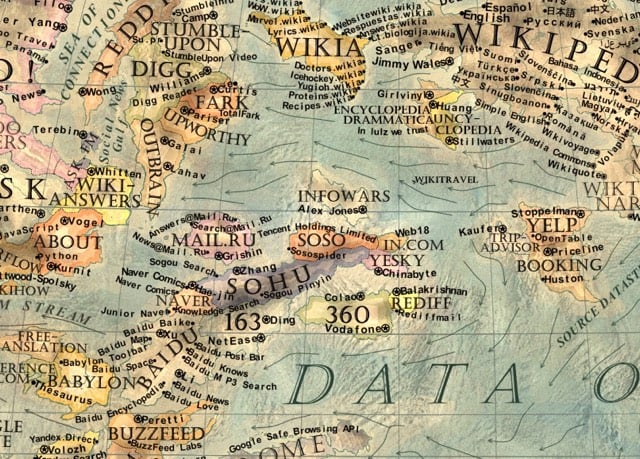
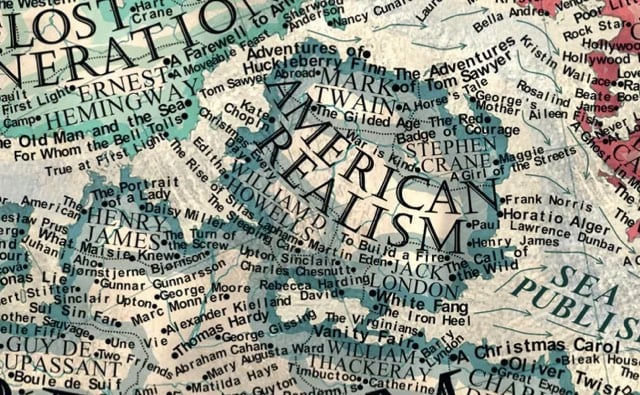
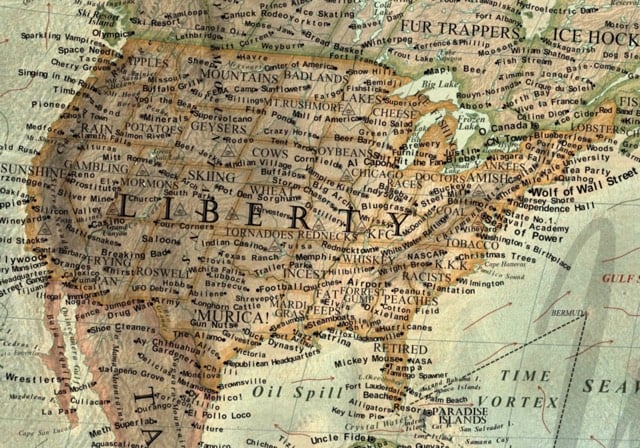
In his upcoming book, Vargic’s Miscellany of Curious Maps, Martin Vargic builds maps of imaginary worlds like the Map of the Internet, the Map of Literature, the Map of Stereotypes, The Music Map, The Map of YouTube, and The Corporate World Map. (via @tcarmody)
Kent Jones has directed a documentary on the 1962 meeting where a young François Truffaut interviewed a seasoned Alfred Hitchcock about his films (the output of which was a beloved book). As the narration from the trailer says, “[Truffaut] wanted to free Hitchcock from his reputation as a light entertainer”, to which Peter Bogdanovich adds, “it conclusively changed people’s opinions about Hitchcock”.
In 1962 Hitchcock and Truffaut locked themselves away in Hollywood for a week to excavate the secrets behind the mise-en-scène in cinema. Based on the original recordings of this meeting — used to produce the mythical book Hitchcock/Truffaut — this film illustrates the greatest cinema lesson of all time and plummets us into the world of the creator of Psycho, The Birds, and Vertigo. Hitchcock’s incredibly modern art is elucidated and explained by today’s leading filmmakers: Martin Scorsese, David Fincher, Arnaud Desplechin, Kiyoshi Kurosawa, Wes Anderson, James Gray, Olivier Assayas, Richard Linklater, Peter Bogdanovich and Paul Schrader.
Truffaut’s recontextualization of Hitchcock and his work reminds me of the point Matt Daniels recently made about younger generations deciding how work from older artists is remembered in his post about timeless music:
Biggie has three of the Top 10 hip-hop songs between 1986 and 1999. This is a strong signal that future generations will remember Biggie as the referent artist of 80s and 90s hip-hop. And there’s No Diggity at the top — perhaps it’s that glorious Dr. Dre verse.
Hip hop heads will lament the omission of Rakim, Public Enemy, or Jay-Z’s Reasonable Doubt. It’s a depressing reality that exists for every genre and generation: not every artist will be remembered. The incoming generation will control what’s relevant from the 90s and carried into the future, independent of quality and commercial success. For rock, that might be Blink-182. For electronica, that might be Sandstorm.
Take Star Wars as another example. I’ve had conversations recently with other parents whose young kids are really into the series. The way they experience Star Wars is different than my generation. We saw Episodes IV-VI in the theater, on VHS, and on DVD and then saw Episodes I-III in the theater accompanied by various degrees of disappointment and disregard. Elementary school-aged kids today might have watched the prequels first. They read the comics, play the video games, and watch the Clone Wars animated series. To many of them, the hero of the series is Anakin, not Luke.1 And Generation X, as much as we may hate that, there’s not a damn thing we can do about it.2 Unless… there is… another… (via subtraction)
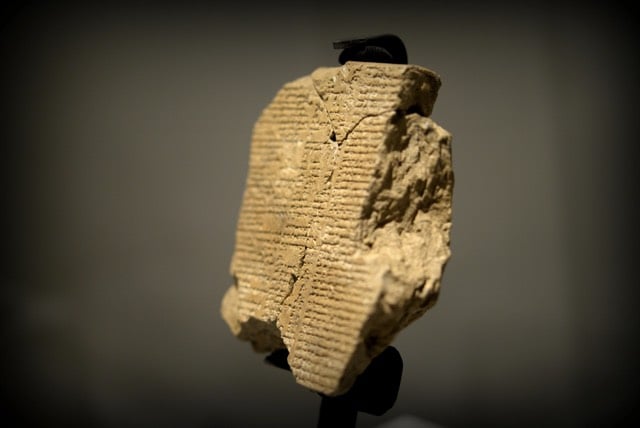
The Epic of Gilgamesh just got more epic. A recent find of a stone tablet dating back to the neo-Babylonian period (2000-1500 BCE) has added 20 new lines to the ancient Mesopotamian poem.
The tablet adds new verses to the story of how Gilgamesh and Enkidu slew the forest demigod Humbaba. Gilgamesh, King of Uruk, gets the idea to kill the giant Humbaba, guardian of the Cedar Forest, home of the gods, in Tablet II. He thinks accomplishing such a feat of strength will gain him eternal fame. His wise companion (and former wild man) Enkidu tries to talk him out of it — Humbaba was set to his task by the god Enlil — but stubborn Gilgamesh won’t budge, so Enkidu agrees to go with him on this quest. Together they overpower the giant. When the defeated Humbaba begs for mercy, offering to serve Gilgamesh forever and give him every sacred tree in the forest, Gilgamesh is moved to pity, but Enkidu’s blood is up now and he exhorts his friend to go through with the original plan to kill the giant and get that eternal renown he craves. Gilgamesh cuts Humbaba’s head off and then cuts down the sacred forest. The companions return to Uruk with the trophy head and lots of aromatic timber.
How the tablet was discovered is notable as well. Since 2011, the Sulaymaniyah Museum in the Kurdistan Region of Iraq was been paying smugglers to intercept artifacts leaving the country, no questions asked. The tablet was likely illegally excavated from the southern part of Iraq, and the museum paid the seller of this particular tablet $800 to keep it in the country.
Twitter plans to exceed 140-char limit. My advice: don’t make it a “new product”, bake it into Twitter proper.
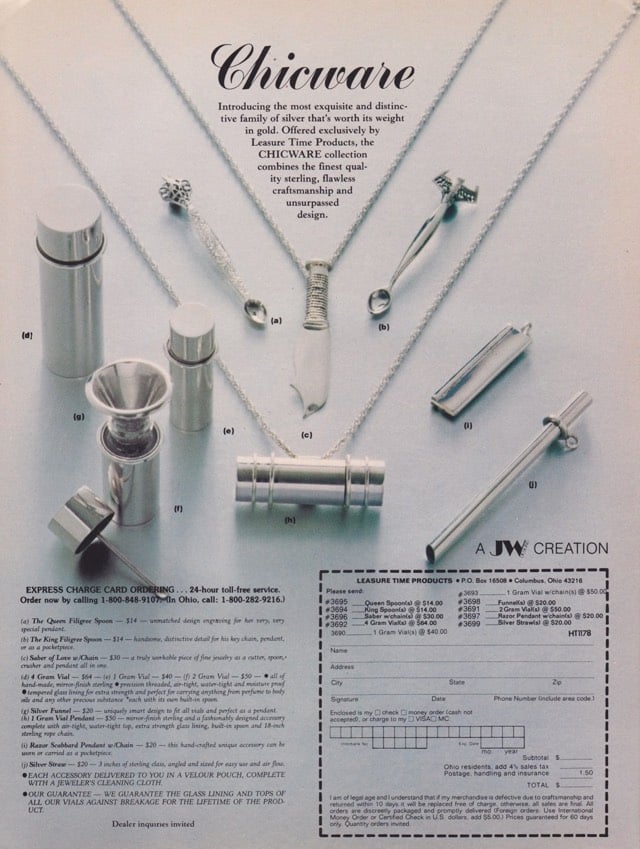
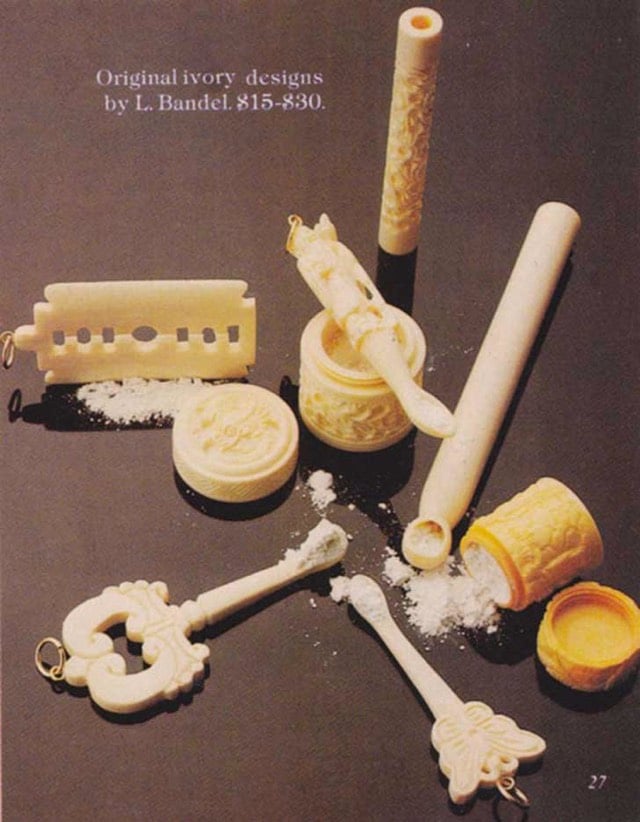
Before the Reagans cranked up the War on Drugs in the early 80s due to the massive influx of cocaine from Latin America, advertisements offering all kinds of coke paraphernalia could be found in magazines. The World’s Best Ever collected a bunch of ads offering spoons, mirrors, straws, knives, and the like for America’s coke sniffers.
I am an episode and a half into Narcos on Netflix. Pretty good (but not great) so far.1 (via adfreak)
Mario Carbone is a chef and restaurateur who, with his partners, runs a number of NYC restaurants like Dirty French, Parm, Carbone, and Santina. Carbone borrowed and modified his mother’s recipe for meatballs and put it on the menu at one of his restaurants. In this video, a clash of home cooking and fine dining, Mario and his mother Maria get together to cook and fight over the provenance of these meatballs.
I love the brief exchange at ~4:00 where Mario admits to using a French technique to make his mother’s Italian meatballs and Maria responds “Ah. See?” with a healthy helping of side-eye. (via @CharlesCMann, whose description of the video — “A ferocious Oedipal power struggle over meatballs” — I cannot improve upon)

Cartographer Daniel Huffman made a map that imagines the shoreline of Lake Michigan as a straight line. Click through to see the entire map and to read about houw Huffman did it. (thx, mark)
I wasn’t expecting much, but this list of status items from The Cut is pretty interesting reading. Status is often equated with money, but this list goes beyond that with picks like Japanese chalk for lecturing professors, the proper throat balm for theater people, watches for bankers1, weed for High Times editors, and the best canned tomatoes.
In the NYT, Sherry Turkle provides the backup data to confirm what you already know about the digital age: Stop Googling. Let’s Talk.
Studies of conversation both in the laboratory and in natural settings show that when two people are talking, the mere presence of a phone on a table between them or in the periphery of their vision changes both what they talk about and the degree of connection they feel … Even a silent phone disconnects us.
Hip-hop group Run the Jewels have released a remix album called Meow the Jewels of their second album that features various meows, purrs, yowls, and other cat noises. Congratulations Internet, we have achieved Peak Cat.
From the landmark science series Cosmos, Carl Sagan narrates the evolution of humans from the first cells billions of years ago.
That’s Yoann Hervo’s tribute to The Simpsons in the form of a glitchy opening scene. I watched this last week and wasn’t going to post it but found myself thinking about it over the weekend so heeeeeere you go.

NASA’s press conference doesn’t start for a few minutes yet, but the NY Times has the scoop: NASA has found “definitive signs” of liquid water on the surface of Mars. Like, right now on Mars, not millions of years ago.
In a paper published in the journal Nature Geoscience, Dr. McEwen and other scientists identified waterlogged molecules — salts of a type known as perchlorates - in readings from orbit.
“That’s a direct detection of water in the form of hydration of salts,” Dr. McEwen said. “There pretty much has to have been liquid water recently present to produce the hydrated salt.”
By “recently,” Dr. McEwen said he meant “days, something of that order.”
This is fantastic timing for the release of The Martian movie, which comes out this weekend.
Update: And here’s the official press release from NASA.
“Our quest on Mars has been to ‘follow the water,’ in our search for life in the universe, and now we have convincing science that validates what we’ve long suspected,” said John Grunsfeld, astronaut and associate administrator of NASA’s Science Mission Directorate in Washington. “This is a significant development, as it appears to confirm that water — albeit briny — is flowing today on the surface of Mars.”
These downhill flows, known as recurring slope lineae (RSL), often have been described as possibly related to liquid water. The new findings of hydrated salts on the slopes point to what that relationship may be to these dark features. The hydrated salts would lower the freezing point of a liquid brine, just as salt on roads here on Earth causes ice and snow to melt more rapidly. Scientists say it’s likely a shallow subsurface flow, with enough water wicking to the surface to explain the darkening.
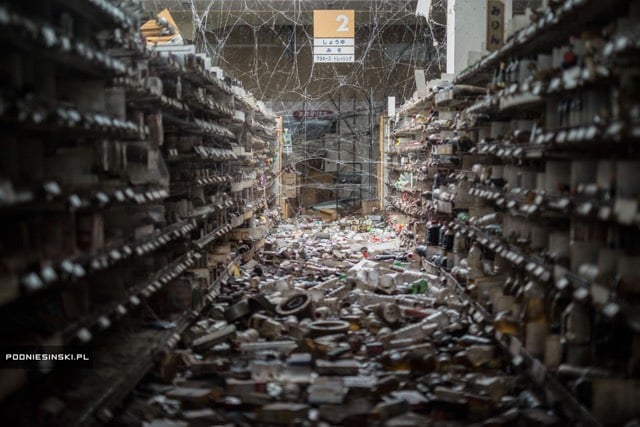
Photographer Arkadiusz Podniesiński recently took a trip to Japan to the area affected by the Fukushima Daiichi nuclear disaster. He toured towns closed due to high radiation levels, talked to former residents, and observed clean-up efforts in some of the less affected areas.
When entering the zone, the first thing that one notices is the huge scale of decontamination work. Twenty thousand workers are painstakingly cleaning every piece of soil. They are removing the top, most contaminated layer of soil and putting it into sacks, to be taken to one of several thousand dump sites. The sacks are everywhere. They are becoming a permanent part of the Fukushima landscape.
The contamination work does not stop at removal of contaminated soil. Towns and villages are being cleaned as well, methodically, street by street and house by house. The walls and roofs of all the buildings are sprayed and scrubbed. The scale of the undertaking and the speed of work have to be admired. One can see that the workers are keen for the cleaning of the houses to be completed and the residents to return as soon as possible.


(thx, james)
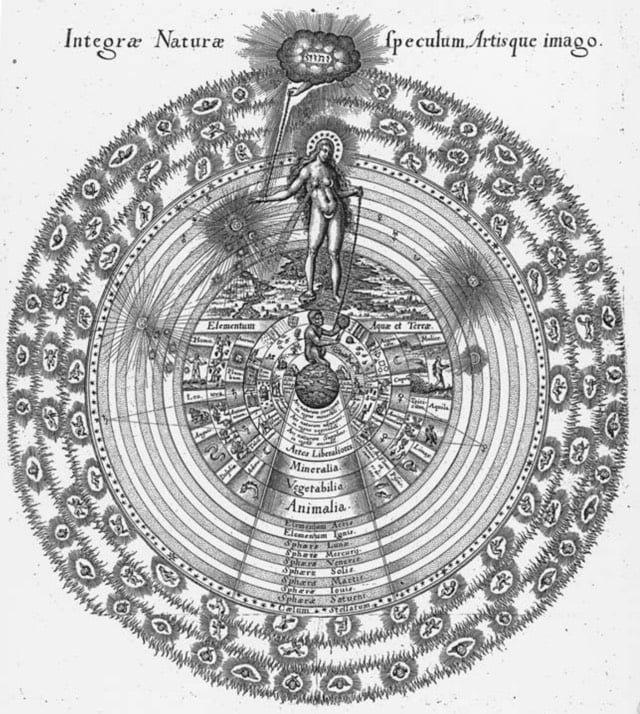
Published in 1987, copies of Volume 1 of The History of Cartography are expensive and difficult to find.1 The subsequent two volumes aren’t much less expensive. So the publisher of the series, The University of Chicago Press, has made PDFs of the books available online for scholars and map enthusiasts to use.

Lucky Peach is coming out with a cookbook called 101 Easy Asian Recipes. I’ve always been a little intimidated by Asian cooking.1 Other types of cuisine seem easy: French is butter & salt, Italian is olive oil & garlic, American is roast chicken & burgers. Plus, Asian cuisine is a huge umbrella of wonderful foods from all sorts of different cultures that it’s difficult to know where to start. I’ve been wanting to cook less Western at home, and I’m hoping this cookbook will give me some good ideas on how to proceed.
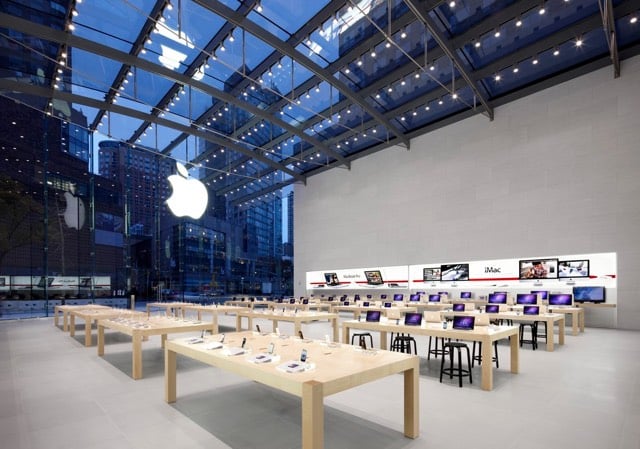
Sarah Laskow of Atlas Obscura took cultural historian Erica Robles-Anderson to the Soho Apple store. Robles-Anderson recently studied the use of technology in churches and Laskow wanted to know: are Apple stores the new temples?
“People have used technology for a long time to speak to the gods,” she says — to create collective experiences of the sublime.
These days, technology is more often talked about as a way to create personalized, individual experiences, but Robles-Anderson thinks that’s only part of the story. Communal ritual is always a part of technology: Early computers came into group spaces, like families and offices. (Mad Men understood this dynamic: the computer as an event weathered together.) Powerpoint presentations gather people to look at giant screens. Even using an iPhone to tune out the human beings around you requires being part of a larger group.
And Apple, more than any other technology company, has been able to access both these experiences, the individual and the collective. “They feel iconic, like an emblem of the personal,” says Robles-Anderson. “And yet it’s a cult. Right? It’s so obviously a cult.”
The architecture of the stores contributes to the sacred feeling of cult membership.
“The oversized doors are fantastic,” says Robles-Anderson. “There’s no reason for them.” They’re there only to communicate that this place is important. Also, they’re heavy, like church doors, to give purpose and portent to the entry into the space.
We walk inside. It’s light and bright, and immediately in front of us, a wide staircase of opaque glass sweeps up to the second floor.
This is an old, old trick. “It’s used in ziggurats, even,” Robles-Anderson says. “It creates a space that emphasizes your smallness when you walk in. You look at something far away, and that makes your body feel like you’re entering somewhere sacred or holy.”
Netflix and Charlie Brooker have agreed to make 12 more episodes of the fantastic Black Mirror.
Netflix has commissioned House of Tomorrow to produce the twelve new episodes as a Netflix original series. House of Tomorrow’s Charlie Brooker and Annabel Jones, who executive produced the first seven episodes of the series, will continue to serve as executive producers and showrunners for the new episodes. Brooker has commenced writing the new episodes, which are scheduled to begin production in late 2015 from the series’ production base in the UK.
“It’s all very exciting — a whole new bunch of Black Mirror episodes on the most fitting platform imaginable. Netflix connects us with a global audience so that we can create bigger, stranger, more international and diverse stories than before, whilst maintaining that ‘Black Mirror’ feel. I just hope none of these new story ideas come true,” said Brooker.
My three favorite TV shows from the past 5 years: Mad Men, Transparent, and Black Mirror. Second tier: Breaking Bad, Sherlock, Game of Thrones, Halt and Catch Fire, and Boardwalk Empire. (via @mccanner)
Julia Nunes is a musician who 1) first developed a following for her music on YouTube, and 2) is putting out her latest album, which drops tomorrow. This summer, Nunes took down a bunch of the videos that started her on this path and explained why.
I took down a bunch of videos bc I don’t want what I’m doing now to be lost amongst what I’ve done for the past 8 years. I don’t want the best thing I’ve ever done to be 10% of what you can find if you’re looking. I want anyone who is just finding me now to see who I really am. Later, they can dig deep into the internet and find my nose ring but until then I wanna greet the world as I am now.
Nunes had changed and she wanted her online persona to reflect the shift.
There will always be resistance to change and the first roadblock is usually yourself. I think I was putting myself in a box there for a little bit, too beholden to the image I started with.
One of my favorite posts, which I think about often, is this one about social media and self-reinvention. In it, I quote a post1 from Scott Schuman’s The Sartorialist about a woman named Kara who significantly remade her image after moving to NYC.
Actually the line that I think was the most telling but that she said like a throw-away qualifier was “I didn’t know anyone in New York when I moved here…”
I think that is such a huge factor. To move to a city where you are not afraid to try something new because all the people that labeled who THEY think you are (parents, childhood friends) are not their to say “that’s not you” or “you’ve changed”. Well, maybe that person didn’t change but finally became who they really are. I totally relate to this as a fellow Midwesterner even though my changes were not as quick or as dramatic.
I bet if you ask most people what keeps them from being who they really want to be (at least stylistically or maybe even more), the answer would not be money but the fear of peer pressure — fear of embarrassing themselves in front of a group of people that they might not actually even like anyway.
Taking down those videos is Nunes’ way of trying for a fresh online start. Makes me think about whether having more than 17 years of archives on kottke.org still hanging around is such a good idea.
It’s the Pope’s first time in America and we sent him straight to Congress. That doesn’t exactly seem like we’re putting our best foot forward. In his historic speech to a joint session of Congress, Pope Francis addressed climate change, capitalism, the death penalty and immigration. MoJo pulled out the ten most important lines from the speech.
“This Pope often operates through symbolism and gestures that convey his intentions in ways that words never could.” The New Yorker on Pope Francis and his little Fiat.
Photographer Yann Arthus-Bertrand is known for his aerial photography of the Earth’s landscapes, but in his film Human, he blends his trademark overview style with simply shot interviews with people from all over the world.
Humans made its debut earlier this month and is available in its entirety on YouTube in three 90-minute parts; start here with part one. (via in focus, which is featuring several photos from the film)

SmokyMountains.com has the best fall foliage map I’ve ever seen. It’s very simply designed and has a slider that lets you check the leaf peeping forecast across the entire US.
P.S. It’s decorative gourd season, motherfuckers.
Artist and programmer Jeff Thompson has compiled 15,000 hand-drawn maps of the Sun made by astronomers into a single video, creating a mesmerizing and delightfully makeshift stop-motion animation of the Sun’s activity over the last 43 years. Astronomers have been drawing these “solar synoptic maps” since 1956 in order to keep track of the Sun’s “weather”…sunspots, flares, and the like. (via slate)
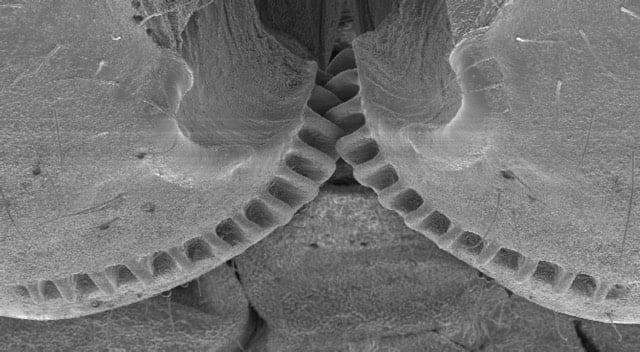
Scientists have discovered that an insect has evolved something like a gearbox to coordinate its leg movements while jumping. That’s right, nature invented mechanical gears before man got around to it.
The gears in the Issus hind-leg bear remarkable engineering resemblance to those found on every bicycle and inside every car gear-box.
Each gear tooth has a rounded corner at the point it connects to the gear strip; a feature identical to man-made gears such as bike gears — essentially a shock-absorbing mechanism to stop teeth from shearing off.
The gear teeth on the opposing hind-legs lock together like those in a car gear-box, ensuring almost complete synchronicity in leg movement — the legs always move within 30 ‘microseconds’ of each other, with one microsecond equal to a millionth of a second.
This is critical for the powerful jumps that are this insect’s primary mode of transport, as even minuscule discrepancies in synchronisation between the velocities of its legs at the point of propulsion would result in “yaw rotation” — causing the Issus to spin hopelessly out of control.
“This precise synchronisation would be impossible to achieve through a nervous system, as neural impulses would take far too long for the extraordinarily tight coordination required,” said lead author Professor Malcolm Burrows, from Cambridge’s Department of Zoology.
In an interview with Slashfilm, Mad Max: Fury Road director George Miller stated that “the best version of this movie is black and white” and that the purest version of the film would also be silent (which it very nearly is anyway). Miller wanted to include the B&W version on the Blu-ray, but the studio decided to delay the release of that until a Super Special Ultra Gimme All Your Money Blu-ray Edition can be arranged at some later date. Until then (or, more probably, until Warner’s lawyers get around to taking it down), we have this fan-made edit of the film in B&W without dialogue. (via @SebastianNebel)
Update: Well, that was fun while it lasted. Good thing I totally didn’t grab a copy to watch later using a Chrome extension. (And before you ask, no I won’t.)
Making a sandwich completely from scratch took this guy six months and cost $1500. He grew his own vegetables, made his own butter & cheese, made sea salt from salt water, and harvested wheat for bread flour. And that’s with a few shortcuts…he didn’t raise the cow & chicken from a calf & chick or the bees from a starter hive.
See also I, Pencil, how a can of Coca-Cola is made, and How to Cook Soup.
The opening credits sequence of The Wire done using clips from The Simpsons. The theme song and clips are from the third seasons of the respective shows.
Turns out, you can have too much of a good thing. Like water for instance…drink six liters of water and it can kill you. So can 85 chocolate bars. Or being almost 9 feet tall. Or listening to music at 185 db.
Kenji Lopez-Alt, whose work you and I have followed at Serious Eats for several years now, has come out with a cookbook called The Food Lab: Better Home Cooking Through Science.
Ever wondered how to pan-fry a steak with a charred crust and an interior that’s perfectly medium-rare from edge to edge when you cut into it? How to make homemade mac ‘n’ cheese that is as satisfyingly gooey and velvety-smooth as the blue box stuff, but far tastier? How to roast a succulent, moist turkey (forget about brining!) — and use a foolproof method that works every time?
Instant purchase for me. You take a peek inside the book at Kenji’s site.
Michael Lopp, Head of Engineering at Pinterest, recently gave a talk at the Cultivate conference in which he talks about different merit badges that a leader might earn if there were such a thing. Check the video for the whole list, but here are a few of them:
Influence without management authority
Delegate something you care about
Ship a thing
Ask for help from an enemy
Fail spectacularly
Part of the list made me think of parenting, which reminded me of Stella Bugbee’s recommendation of the book Siblings Without Rivalry on Cup of Jo.
I have a VERY, VERY unlikely book that I often reference as a boss: Siblings Without Rivalry. It’s not about money or business per se, but I’ve found since reading it that I put so many of its lessons into practice managing my team at work. I love the way it teaches you to listen, repeat the issues without taking sides, empathize and then teach the parties involved to solve their own disputes. It also helps at home. (Duh.)

An upcoming book from BLDGBLOG’s Geoff Manaugh, A Burglar’s Guide to the City examines architecture through Ocean’s Eleven-tinted glasses.
At the core of A Burglar’s Guide to the City is an unexpected and thrilling insight: how any building transforms when seen through the eyes of someone hoping to break into it. Studying architecture the way a burglar would, Geoff Manaugh takes readers through walls, down elevator shafts, into panic rooms, up to the buried vaults of banks, and out across the rooftops of an unsuspecting city.
Update: The book is now out, accompanied by a spiffy new website.
In the latest installment of Every Frame a Painting, Tony Zhou talks about the different techniques filmmakers use to make shoot locations like Vancouver (Zhou’s hometown) look like New York, India, Chicago, Shanghai, and San Francisco in the finished films.
Older posts


Socials & More