Entries for October 2013
Not to get all Malcolm Gladwell here, but it’s counterintuitive that hot water freezes faster than cold water. The phenomenon is called the Mpemba effect and until recently, no one could explain how it works. A group of researchers in Singapore think they’ve cracked the puzzle.
Now Xi and co say hydrogen bonds also explain the Mpemba effect. Their key idea is that hydrogen bonds bring water molecules into close contact and when this happens the natural repulsion between the molecules causes the covalent O-H bonds to stretch and store energy.
But as the liquid warms up, it forces the hydrogen bonds to stretch and the water molecules sit further apart. This allows the covalent molecules to shrink again and give up their energy. The important point is that this process in which the covalent bonds give up energy is equivalent to cooling.
In fact, the effect is additional to the conventional process of cooling. So warm water ought to cool faster than cold water, they say. And that’s exactly what is observed in the Mpemba effect.
(via ★djacobs)
Real Kitchen, a small Chicago eatery that mostly does take-out food, dressed up as Michelin 3-star Alinea for Halloween. Some genuine LOLs here, especially the table-side dessert to-go.
For his latest What If? column, Randall Munroe tackles the question “When, if ever, will Facebook contain more profiles of dead people than of living ones?”
Based on the site’s growth rate, and the age breakdown of their users over time, there are probably 10 to 20 million people who created Facebook profiles who have since died.
That’s an incredible number; most tech startups would kill (well, not really but maybe…) for that many alive users.
This month, Smithsonian magazine tells the story of America using 101 objects drawn from the 19 musuems and research centers of the Smithsonian Institution. Among the objects are the original Star Spangled Banner flag, the passenger pigeon, the polio vaccine, the pill, and Benjamin Franklin’s Experiments and Observations on Electricity.
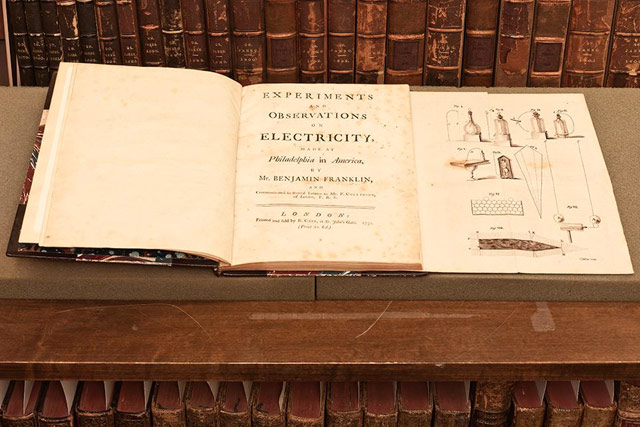
A companion book, The Smithsonian’s History of America in 101 Objects, is available.
Adrian Cárdenas, formerly a player for the Chicago Cubs, quit baseball to pursue an education in creative writing and philosophy.
I wish I had looked up more often, even at the cost some of my success. The American dream didn’t tell me that an experience only matters if I acknowledge it, that losing yourself in the game is a good way to lose what makes life meaningful. When you’re standing at the plate and you hit a sharp foul ball to the backstop, the spot on the bat that made contact gets hot; the American dream forgot to tell me to step back and enjoy the smell of burnt wood.
In Focus has a selection of winning photos from Nikon’s Small World Photomicrography Competition. The award for most terrifying goes to Dimitri Seeboruth for his shot of a worker ant:

I, for one, welcome our new insect overlords.
Greg Packer gets quoted in the news a lot, an area man among mere area boys. Andrew David Watson added fuel to his fire by producing a short film about Packer for the New Yorker.
Filed under even if it’s fake it’s real. (via ★interesting)
Jay Zeamer and a group of fellow misfits collectively called the Eager Beavers were an American photoreconnaissance team in the Pacific theater during WWII. They flew their beat-up B-17 bomber into enemy territory to collection reconnaissance photographs. Roger Cicala shares the engaging story of their most noteworthy photo.
The only crew that volunteered, of course, was Jay Zeamer and the Eager Beavers. One of the crew, bombardier Joseph Sarnovski, had absolutely no reason to volunteer. He’d already been in combat for 18 months and was scheduled to go home in 3 days. Being a photo mission, there was no need for a bombardier. But if his friends were going, he wanted to go, and one of the bombardier’s battle stations was to man the forward machine guns. They might need him, so he went.
They suspected the airstrip at Buka had been expanded and reinforced, but weren’t sure until they got close. As soon as the airfield came in sight, they saw numerous fighters taking off and heading their way. The logical thing to do would have been to turn right and head for home. They would be able to tell the intelligence officers about the increased number of planes at Buka even if they didn’t get photos.
But Zeamer and photographer William Kendrick knew that photos would be invaluable for subsequent planes attacking the base, and for Marines who were planning to invade the island later. Zeamer held the plane level (tilting the wings even one degree at that altitude could put the photograph half a mile off target) and Kendrick took his photos, which gave plenty of time for over 20 enemy fighters to get up to the altitude Old 666 was flying at.
(via petapixel)
In this 7-minute interview, Alfred Hitchcock explains his editing/cutting technique.
The full interview from which this is taken, which is “part interview, part master class in the craft of telling stories on film”, is available on YouTube: part 1 and part 2.
This summer, Lou Reed reviewed Kanye West’s Yeezus, praising the albums contradictions.
Very often, he’ll have this very monotonous section going and then, suddenly — “BAP! BAP! BAP! BAP!” — he disrupts the whole thing and we’re on to something new that’s absolutely incredible. That’s architecture, that’s structure — this guy is seriously smart. He keeps unbalancing you. He’ll pile on all this sound and then suddenly pull it away, all the way to complete silence, and then there’s a scream or a beautiful melody, right there in your face. That’s what I call a sucker punch.
He seems to have insinuated in a recent New York Times interview that My Beautiful Dark, Twisted Fantasy was to make up for stupid shit he’d done. And now, with this album, it’s “Now that you like me, I’m going to make you unlike me.” It’s a dare. It’s braggadoccio. Axl Rose has done that too, lots of people have. “I Am a God” — I mean, with a song title like that, he’s just begging people to attack him.
(via @dunstan)
Speaking of Wes Anderson, Matt Zoller Seitz has finished his video essay series on Anderson’s movies. You can find the entire collection of videos on Vimeo and transcripts and notes are on Seitz’s blog. Here are the final two to get you going:
And if that’s not enough for you, here’s the book that the videos are based on.
A blooper reel from the original Star Wars…looks like this hasn’t ever been seen before.

Right now, two men on skis pulling 440 lb sleds are inching their way across the Antartic continent, bound for the South Pole and then back again. Ben Saunders and Tarka L’Herpiniere are attempting to complete, solo and unsupported, the same journey that claimed the lives of Robert Falcon Scott and his party in 1912. They’re calling it The Scott Expedition.
Saunders has been working towards this goal for more than 10 years with many false starts. His former partner in exploration, Tony Haile, explains the journey before the journey:
In short, a South Pole expedition is pretty much the worst way to spend four months you could possibly imagine, but if you were to ask Ben I don’t think he would say that’s the tough part. The tough part is getting to the start line in the first place. Antarctica is far away from everywhere and doing anything in Antarctica is ridiculously expensive. Imagine if you kept a car in New York but the only way to fuel that car was to charter a private jet and fly fuel in from England. That’s the logistics of an Antarctic expedition and between us we had no cash and no clue how to get any.
We didn’t go to the South Pole in 2003. Or 2004. Or 2005. Living month to month on whatever I could scrounge together, putting together small expeditions or managing other people’s just so I wouldn’t lose my connection to the cold places, I grew to fear and then hate my parent’s yearly Christmas letter to their friends which would explain ‘Anthony has decided to postpone his South Pole expedition for another year to raise more funds’. For Ben and I, we had proclaimed a grand goal. We had told people year after year this was the year we were finally going to go south. And every year we had to look at the nervous smiles as we publicly failed. Again and again.
The journey is just underway…the plan is to travel 1800 miles to and from the South Pole and you can track their progress online and read tweets and blog posts from Ben and Tarka along the way. Back in 2005, when Ben and Tony were planning this trip the first time around, they sold miles of the expedition for donations of $100 apiece. They didn’t make it that year obviously and in the days before Kickstarter, crowdsourcing $180,000 was a bit more difficult than it is now. But I bought a mile back then (I actually got mile #900, the point at which they’ll reach the pole) and I am beyond excited that they’ve set off and can’t wait to see how the trip progresses. Good luck, Ben and Tarka!
The Atlantic asked a group of historians, scientists, and engineers to rank the 50 greatest innovations since the invention of the wheel. Here they are.
21. Nuclear fission, 1939
Gave humans new power for destruction, and creation
22. The green revolution, mid-20th century
Combining technologies like synthetic fertilizers (No. 11) and scientific plant breeding (No. 38) hugely increased the world’s food output. Norman Borlaug, the agricultural economist who devised this approach, has been credited with saving more than 1 billion people from starvation.
23. The sextant, 1757
It made maps out of stars.
This video dicusses three simple ways to travel through time (all of which you can do right now at home) and three not-so-simple time travel methods.
For more on time-travel, here are some works by physicist and time-lord Sean Carroll:
Rules for time-travellers - http://blogs.discovermagazine.com/cos…
Learn more about time and time-machines in his book From Eternity to Here - http://preposterousuniverse.com/etern…
Visualizations of the spinning universe - http://iopscience.iop.org/1367-2630/1…
An engaging talk on the Paradoxes of Time Travel - https://vimeo.com/11917849
(via digg)
Wes Anderson is coming out with a new horror movie. Here’s the trailer:
Ha ha just kidding it’s a SNL spoof. Ed Norton does a pretty ripping Owen Wilson.
A fascinating thread on Reddit asks why & how ex-neo-Nazis, skinheads, and racists changed their minds regarding racism.
I was sitting on the bus on my way home one day. I was listening to some good music in my headphones. It was a cloudless autumn day and everything was a healthy yellow and orange color and blue sky. At a stop a african man and a young boy, maybe 5-6 years, got on. The man was tall and had bad clothes, he looked like he did not have much. They sat in front of me. I immediately became annoyed and started to think about how I hated them, fucking immigrants coming to my country, he is poor and I pay taxes so he can get welfare. I thought about how his son is going to become a lousy shit and rape white women. I started to get mad and decided to beat him up, I was going to follow him when he got off the bus.
I saw him press the button and got ready at the next stop, and just before we stopped I was about to get up and the man turned to his son and said something in a heavy accent that I will never forget in my life.
“I love you my son, be good.”
He then gave him a big, hard hug and the boy got off the bus alone. He waved good bye and sat back down, with his hands on his face. I just stared out the window where his son had been standing. My world view came crashing. He was just a father who wanted his son to be good, he loved him just like my father loved me. For some reason this changed everything for me. I know this is a very small thing but I started to think about how he wanted a better life for his son. He was a man that had changed everything for his family.
I sat on that bus for hours, it kept going around. I thought about how wrong it was to do the things I had done. I left that city the next day and started over. I am much happier now. I dont feel the hate in my heart every day anymore.
Curious use of the word “Africans” in several of the comments…is that a socially acceptable term in Europe or a vestige of the commenters’ racist pasts? Or are they simply referring to recent immigrants from Africa? (via digg)
Mary HK Choi spent the first dozen years of her life at odds with her mother but now she loves her so much it kills her. A lovely offbeat story of mothers and daughters.
I love my mother a not-normal amount. It’s all twisty because she tried to kill me when I was young. Just kidding. My mom is an excellent mom. She knows I am irascible, prickly and antisocial. She knows that most human interaction makes me tired and that I either scare people away with precise invectives or trot out the fakest, nicest skinjob of myself because it requires zero effort. She nails me on all of it, asking one billion follow-up questions until I get behind my eyeballs and engage. She forces me to call distant relatives, dialling the phone and pressing it into my cheek while my eyes get hot and watery. She pulls rank all the time and once judo-flipped me onto my back in a grocery store to remind me where things stood. She is my favorite and it makes me crazy. You can tell that she was popular in school, but I am a fundamentally more popular person. I care more and I’m great at rules. I’ve known it since the first grade.
The top comment on the story is well worth a read as well:
Justin went berserk.
I’d NEVER heard a kid scream so loud or for so long and still manage to run around a room tearing drawings off the wall, shoving kids all over the place, tossing chairs across the room.
It was AWESOME, in a moderately terrifying kind of way.
And the tears. Oh the tears. You’d have thought we’d taken his pet dog and made him slit its throat and then skin and cook it.
That day NEVER ended. I mean of course it did, but it never ended. You know what I mean. So, I’m hanging in the room straightening up from Justin’s rampage, when our supervisor comes in and tells me to come outside.
Which is how I met Justin’s grandparents, the two nicest, sweetest grandparents ever. No, nicer and sweeter then that. When I stuck my hand out they brushed that aside and it was semi-bear hug time. They both thanked me for what I was doing with Justin and how he didn’t talk about anything else but me.
Hmm, this looks interesting: an upcoming book on the science of booze written by Adam Rogers.
In Proof, Adam Rogers reveals alcohol as a miracle of science, going deep into the pleasures of making and drinking booze-and the effects of the latter. The people who make and sell alcohol may talk about history and tradition, but alcohol production is really powered by physics, molecular biology, organic chemistry, and a bit of metallurgy-and our taste for those products is a melding of psychology and neurobiology.
Proof takes readers from the whisky-making mecca of the Scottish Highlands to the oenology labs at UC Davis, from Kentucky bourbon country to the most sophisticated gene-sequencing labs in the world — and to more than one bar — bringing to life the motley characters and evolving science behind the latest developments in boozy technology.
Rogers wrote the piece about the mystery whiskey fungus I linked to a couple of years ago.
NASA’s Solar Dynamics Observatory is getting some really amazing shots of the Sun, including this 200,000 mile-long solar eruption that left a huge canyon on the surface of the Sun:
Different wavelengths help capture different aspect of events in the corona. The red images shown in the movie help highlight plasma at temperatures of 90,000° F and are good for observing filaments as they form and erupt. The yellow images, showing temperatures at 1,000,000° F, are useful for observing material coursing along the sun’s magnetic field lines, seen in the movie as an arcade of loops across the area of the eruption. The browner images at the beginning of the movie show material at temperatures of 1,800,000° F, and it is here where the canyon of fire imagery is most obvious.
The level of detail shown is incredible. (via @DavidGrann)
In an interview accompanying a Frontline episode on drug-resistant bacteria, an associate director for the CDC, Dr. Arjun Srinivasan, says that “we’re in the post-antibiotic era”.
The more you use an antibiotic, the more you expose a bacteria to an antibiotic, the greater the likelihood that resistance to that antibiotic is going to develop. So the more antibiotics we put into people, we put into the environment, we put into livestock, the more opportunities we create for these bacteria to become resistant. …We also know that we’ve greatly overused antibiotics and in overusing these antibiotics, we have set ourselves up for the scenario that we find ourselves in now, where we’re running out of antibiotics.
We are quickly running out of therapies to treat some of these infections that previously had been eminently treatable. There are bacteria that we encounter, particularly in health-care settings, that are resistant to nearly all — or, in some cases, all — the antibiotics that we have available to us, and we are thus entering an era that people have talked about for a long time.
For a long time, there have been newspaper stories and covers of magazines that talked about “The end of antibiotics, question mark?” Well, now I would say you can change the title to “The end of antibiotics, period.”
We’re here. We’re in the post-antibiotic era. There are patients for whom we have no therapy, and we are literally in a position of having a patient in a bed who has an infection, something that five years ago even we could have treated, but now we can’t.
You know how when you first hear a joke it’s the funniest thing ever and then you hear it a second time and it’s less funny and then a third, fourth, and fifth times and it just keeps getting less and less funny until you’re not laughing at all and it actually becomes annoying? That’s how antibiotics work across the entire human population. And if Dr. Srinivasan is correct, we’re transitioning into the not laughing stage and the annoying stage where lots of people start dying can’t be far behind (unless we get some new jokes/treatments).
Yesterday, Mark Sample tweeted about disasters, low-points, and chronic trauma:
“Low point” is the term for when the worst part of a disaster has come to pass. Our disasters increasingly have no low point.
After the low point of a disaster is reached, things begin to get better. When there is no clear low point, society endures chronic trauma.
Disasters with no clear low point: global warming, mass extinction, colony collapse disorder, ocean acidification, Fukushima.
To which I would add: drug-resistant infectious diseases. (via digg)
This video of Atlanta cheerleader Mikayla Clark breaking the world backflip record is mesmerizing. I did not know there was a world backflip record, but here is someone breaking it last year, too.
Yes, it is gymnastics day on kottke.org, what of it?
Usually open letters to big companies take the form of scolding. Chris Horst wrote the CEO of Costco a different sort of open letter.
For his entire life, Matthew has been classified and known by his “special needs”. Since the day he began at Costco, however, his coworkers and customers have valued him because of his unique strengths. There are many companies which “succeed” at the expense of their workers. I am a firsthand witness to a counterintuitive company: Costco succeeds through the flourishing of its employees.
Matthew worked for years in the Costco parking lot (bearing the wind, rain, cold and snow), taking pride when it was free of carts. And, true to the rumors (that Costco promotes from within), he eventually was given the opportunity to work in the warehouse as a cashier’s assistant, supporting customers as they check-out. He absolutely loves his job…and his customers absolutely love him.
Costco is a famously decent employer, as far as massive corporations go. Their workers, though mostly not unionized, are paid more and get better health care than their competitors. They promote from within. The CEO only makes 12 times more than a typical employee (Wal-Mart’s CEO’s salary was 58 times a typical employee’s salary). (via @khoi)
Russell Brand, the actor and comedian, guest edited the latest issue of the New Stateman. In a piece from that issue, Brand details his political philosophy and asks if a utopian revolution is possible.
Perhaps this is why there is currently no genuinely popular left-wing movement to counter Ukip, the EDL and the Tea Party; for an ideology that is defined by inclusiveness, socialism has become in practice quite exclusive. Plus a bit too serious, too much up its own fundament and not enough fun. The same could be said of the growing New Age spiritual movement, which could be a natural accompaniment to social progression. I’m a bit of a tree-hugging, Hindu-tattooed, veggie meditator myself but first and foremost I want to have a fucking laugh. When Ali G, who had joined protesters attempting to prevent a forest being felled to make way for a road, shouted across the barricade, “You may take our trees, but you’ll never take our freedom,” I identified more with Baron Cohen’s amoral trickster than the stern activist who aggressively admonished him: “This is serious, you cunt.”
A bit too fucking serious, actually. As John Cleese said, there is a tendency to confuse seriousness with solemnity. Serious causes can and must be approached with good humour, otherwise they’re boring and can’t compete with the Premier League and Grand Theft Auto. Social movements needn’t lack razzmatazz.
The right has all the advantages, just as the devil has all the best tunes. Conservatism appeals to our selfishness and fear, our desire and self-interest; they neatly nurture and then harvest the inherent and incubating individualism.
I imagine that neurologically the pathway travelled by a fearful or selfish impulse is more expedient and well travelled than the route of the altruistic pang. In simple terms of circuitry I suspect it is easier to connect these selfish inclinations.
This piece is filled with interesting and entertaining bits throughout, making it difficult to pick just one excerpt. Here’s another then:
We are still led by blithering chimps, in razor-sharp suits, with razor-sharp lines, pimped and crimped by spin doctors and speech-writers. Well-groomed ape-men, superficially altered by post-Clintonian trends.
We are mammals on a planet, who now face a struggle for survival if our species is to avoid expiry. We can’t be led by people who have never struggled, who are a dusty oak-brown echo of a system dreamed up by Whigs and old Dutch racists.
(via @daveg)
I wasn’t expecting a whole lot from this video of a robotic gymnast doing a routine on the high bar, but holy cow! I audibly gasped at the 33-second mark and again at 57 seconds.
Looks like a home-built, just some guy in his garage. The robot has learned some new tricks since that video was made. Here’s a quintuple backflip landing:
A double twist that it didn’t quite land:
And it does floor exercises as well…here’s a double back handspring:
(via @moth)
PopTech is a TED-like conference that takes place in Camden, Maine each October. I’ve been three or four times…it’s a good conference. This year, they’re streaming the whole thing live…not bad for a $2000/ticket conference. There are a few names on the schedule that you may recognize (Kevin Slavin, Rodney Mullen, Charlie Todd) but it looks like they’ve done a good job gathering folks other than the usual suspects.
Kareem Abdul-Jabbar has written a list of 20 things boys can do to become men.
6. Fight your fear of the unknown.
We all have a tendency to hate what we don’t understand, whether it comes in the form of different food, different cultures, or different ideas. There was a Yale study in which researchers examined the brains of people as they were presented with proof that an opinion they held was wrong. MRIs showed that when those people immediately rejected the new evidence, their brains released an addictive chemical that made them feel good. In that way our own bodies are actually encouraging our ignorance and fear. Fight that impulse. Becoming a man means growing, learning, and understanding-not cowering under a blanket with a handful of comforting notions.
(By the way, don’t confuse physical bravery with intellectual bravery. It’s easier to jump out of a plane-hopefully with a parachute-than it is to change your mind about an opinion. Acts of physical bravado will give you an initial rush, but exploring a new culture or examining a new idea will mature you and make you the kind of person others will be interested in.)
Even by Apple standards, the video showing how the new Mac Pro is made is a great little piece of cinema. Product designer Greg Koenig does some forensic analysis on the video and opens the curtain a bit on what manufacturing techniques Apple is using.
What makes Apple fascinating is not that they are using some wiz-bang alien technologies to make things — even here in Portland, Oregon, all the technologies Apple shows in this video are in-practice across numerous local factories. What makes Apple unique is that they perform their manufacturing with remarkable precision and on a scale that is simply astonishing, using techniques typically reserved for the aerospace or medical device industries.
(via ★interesting-links)
On the occasion of leaving New York, Rebecca Flint Marx writes about one of her favorite New York City places (Russ & Daughters) and a particular counterman there, Paul.
Being a regular is a funny thing in a big city. Outside, you’re just an anonymous schmo. But if you come inside often enough, each visit starts to feel like a family reunion of sorts; like the extended members of your biological family, the people you encounter will likely be happy enough to see you, though they probably have little idea of who you actually are as a person. But there’s a beauty in deciding how much of yourself to offer as part of the general exchange of money and goods: You can be the thoughtfully curated version of you — the one who always smiles and never has any problems. The one who is a good person simply because she says “please” and “thank you,” exchanges salty banter with the cantankerous counterman, and bakes a cake for the Yom Kippur rush, as I started doing for the staff a few years ago.
What a lovely piece. See also the joys of being a regular.
Ben Haggerty, better known as Macklemore, whose independently produced album The Heist went Platinum last year, reflects on the 12 months since the album’s release and his decision to go big in lieu of going home.
I was in Madison, Wisconsin. We were about two-thirds of the way through our first “World Tour,” a title we were beating people over the head with, trying to enforce our premature “stardom” on the world. I was skating around the city, looking for lunch, when Zach called me. And I’ll never forget the way that Zach explained what this deal meant in regards to me.
He said, “Basically, if you sign this deal there is a potential that you will turn into a super star. Your life will change drastically. And once that happens, there is no going back. If we don’t go this direction, there is a ceiling to your career. You can continue to play the same rooms you’ve been playing and have a strong run as an underground rapper. But taking it to the next level will not be attainable. I see positives and negatives to both sides, and will support you either way. What do you want to do”?
I knew immediately that this a decision that would alter my life forever. I knew that getting played on the radio would alienate a core group of fans; that I’d be labeled a sell-out, maybe even a “one hit wonder” if the song got big. But despite those risks, I knew at the core what I wanted.
Macklemore seems like a pretty solid guy, like the type of person who would sing questionable karaoke versions of his own hits:
See also: you’re not selling out, you’re blowing up and my thoughts on staying small or going big. (via bryce)
Glen Weisgerber is a wizard at the art of hand-lettering. Make sure you watch all the way through for the big flourish-y finish.
(via colossal)
With $10 and a little elbow grease, you can turn your iPhone into a really nice digital microscope capable of 175x magnification, allowing you to take photos of plant cells:

Here’s how you do it:
(via ★interesting)
Nestled in the midst of Matt Zoller Seitz’s video essay on Wes Anderson’s The Life Aquatic with Steve Zissou is this bombshell: the movie contains a Star Wars reference no one seems to have noticed. Seitz synced the scenes for us:
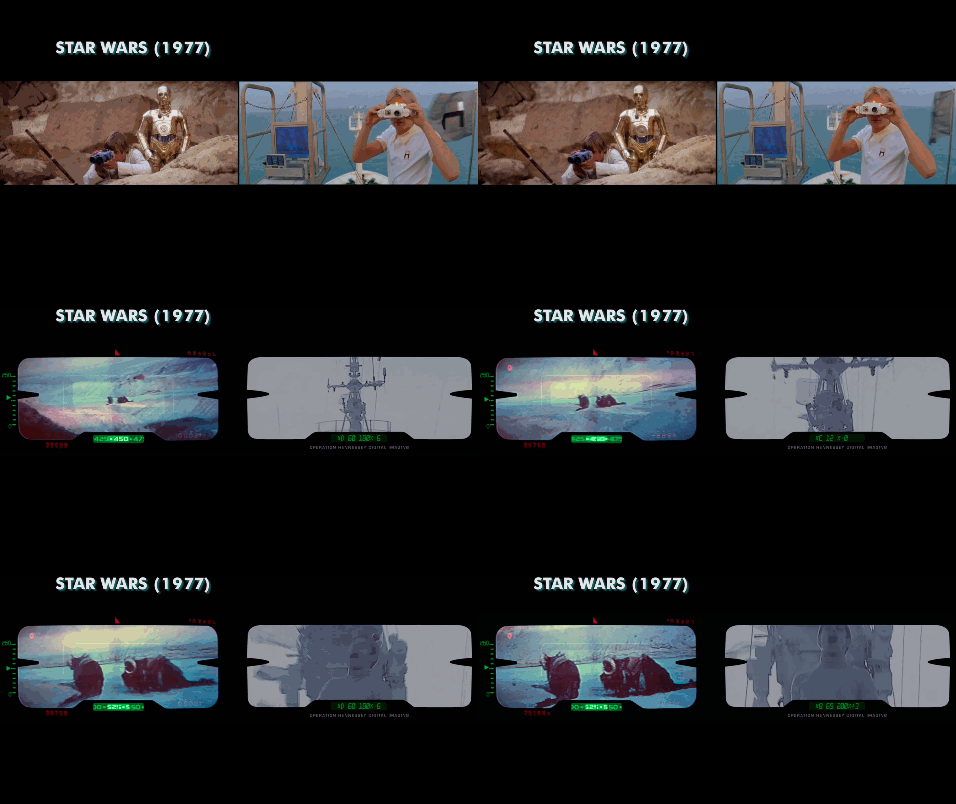
There have to be others, right? Many of Anderson’s films end with all of the characters gathered together like at the medals ceremony in Episode IV…someone even synced up the end of the movie with the closing credits music from Zissou and it works really well:
And of course, there’s Conan O’Brien’s take on what a Star Wars movie directed by Anderson might look like.
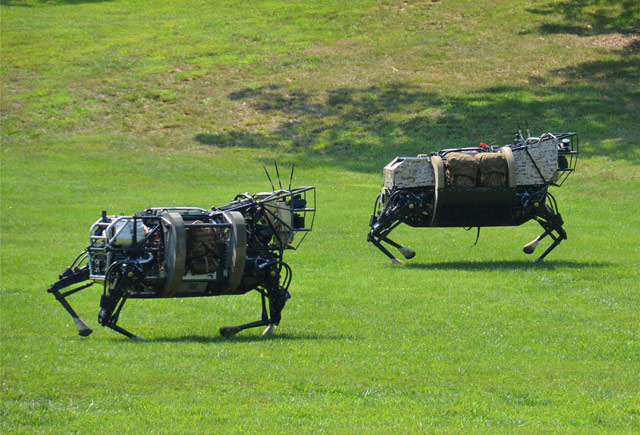
At In Focus, Alan Taylor surveys the state-of-the-art in robotics with a varied selection of photos. For example, here are two Big Dogs frolicking in the robot dog park:
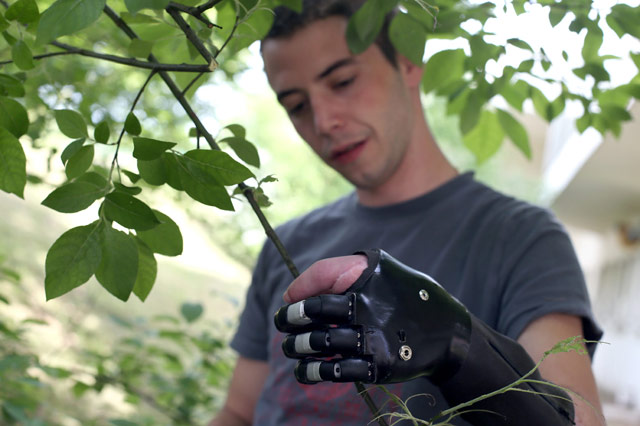
And better yet, Florian Lopes looks as though he’s enjoying his new bionic hand:
In response to a question on Quora of how significant transportation startup Uber is, Michael Wolfe offers an answer that isn’t so much about Uber in particular as it is a way of looking at businesses from the perspective of the owners/investors.
If you think of Uber as a town car company operating in a few cities, it is not big.
If you think of Uber as dominating and even growing the town car market in dozens of cities, it gets bigger. (Data point: there are now more Uber black cars in San Francisco than there were ALL black cars before Uber started).
If you think of Uber as absorbing the taxi markets, it gets pretty huge.
[…]
If you think of Uber as a giant supercomputer orchestrating the delivery of millions of people and items all over the world (the Cisco of the physical world), you get what could be one of the largest companies in the world.
Good companies always seem to be playing a different game than you think they are…outsiders see only the tactics and not the strategy. And the best ones succeed.
Mike Tyson’s life as a young thug orig. from Oct 21, 2013
* Q: Wha? A: These previously published entries have been updated with new information in the last 24 hours. You can find past updates here.
You pull up to the fast-food drive-through window and pull out your wallet. But the cashier tells you to put your money away because the person in the car in front of you already paid for your meal. For some reason, that’s been happening to more and more people.
Whereas paying it forward in drive-throughs occurred maybe once or twice a year a decade ago, now fast-food operators said it might happen several times a day.
Last December, 228 consecutive cars paid it forward at a fast food joint in Winnipeg. According to one woman who pays it forward at least once a week:
It’s about giving, and letting people see not everybody is bad, and there are nice people out there and maybe we can turn it around.
Pretty cool. But these folks ought to pay forward some fruits and vegetables once in a while.
For the New York Review of Books, theoretical physicist and Nobel laureate Steven Weinberg gives us an update on what we know and don’t know about physics.
It turns out that particles already known to us are not enough to account for the mass of the hot matter in which the sound waves must have propagated. Fully five sixths of the matter of the universe would have to be some kind of “dark matter,” which does not emit or absorb light. The existence of this much dark matter in the present universe had already been inferred from the fact that clusters of galaxies hold together gravitationally, despite the high random speeds of the galaxies in the clusters. So this is a great puzzle: What is the dark matter? Theories abound, and attempts are underway to catch ambient dark matter particles or remnants of their annihilation in detectors on Earth or to create dark matter in accelerators. But so far dark matter has not been found, and no one knows what it is.
In New York Magazine this week, Mike Tyson writes about growing up in Brooklyn and his discovery of boxing as a way out and up.
Having to wear glasses in the first grade was a real turning point in my life. My mother had me tested, and it turned out I was nearsighted, so she made me get glasses. They were so bad. One day I was leaving school at lunchtime to go home and I had some meatballs from the cafeteria wrapped up in aluminum to keep them hot. This guy came up to me and said, “Hey, you got any money?” I said, “No.” He started picking my pockets and searching me, and he tried to take my fucking meatballs. I was resisting, going, “No, no, no!” I would let the bullies take my money, but I never let them take my food. I was hunched over like a human shield, protecting my meatballs. So he started hitting me in the head and then took my glasses and put them down the gas tank of a truck. I ran home, but he didn’t get my meatballs. I still feel like a coward to this day because of that bullying. That’s a wild feeling, being that helpless. You never ever forget that feeling. That was the last day I went to school. I was 7 years old, and I just never went back to class.
The piece is adapted from Tyson’s upcoming memoir, Undisputed Truth. Tyson wrote the book with Larry Sloman, author of Reefer Madness who has also ghostwritten for Howard Stern, Anthony Kiedis, and KISS’s Peter Criss.
Update: Spike Lee directed a documentary version of Undisputed Truth; it’ll air on HBO on November 16. Here’s the trailer:
David Sedaris remembers, in a way, his sister Tiffany, who committed suicide earlier this year.
Compared with most forty-nine-year-olds, or even most forty-nine-month-olds, Tiffany didn’t have much. She did leave a will, though. In it, she decreed that we, her family, could not have her body or attend her memorial service.
“So put that in your pipe and smoke it,” our mother would have said.
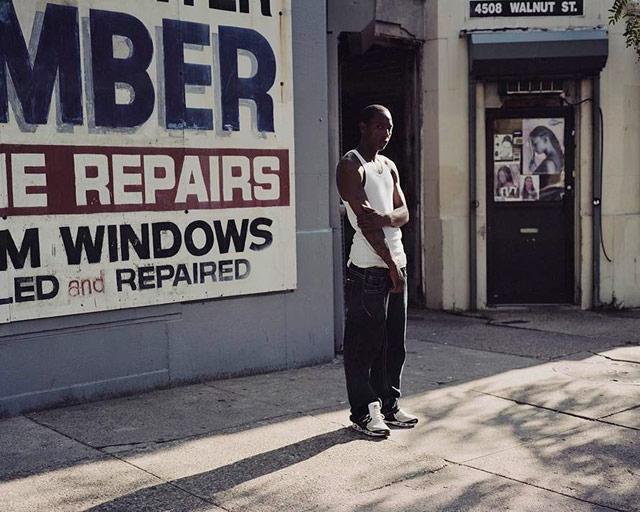
In her series City of Brother Love, Hannah Price photographs the men who catcall her on the street. A selection of her images and a short interview is available on The Morning News.
Once a guy catcalls me, depending on the situation, I would either candidly take their photograph or walk up to them and ask if I can take their photograph. They usually agree and we talk about our lives as I make their portrait.
An interesting approach to sexist heckling. Here’s another by jogger Anna Hart:
But sometimes, a heckler still makes himself heard, like the wheezing smoker on a park bench who called out to me: “I could give you a better workout, love,” as I ran past him earlier this week.
I suddenly thought of that 16-year-old stuck indoors on the treadmill, and turned around. “You know what I want?” I said, as he shrank back in alarm. “I want you to never, ever speak to another woman or girl like that, you pathetic old fool.” I was very sweaty, very pink and very angry, and he was plainly terrified.
On Quora, Yishan Wong shares his foolproof technique for parallel parking.
The directions for parallel parking (that you get from the DMV, or in your driver’s ed course) are actually very precise and if you follow them exactly, you will park your car perfectly every time. You do not need to practice, you just need to fucking follow the directions.
Vsevolod Pudovkin was a Soviet film director who developed influential theories of film editing. In this 12-minute video, Evan Richards uses clips from films like 2001, Lawrence of Arabia, and The Godfather to illustrate Pudovkin’s editing techniques.
Pudovkin’s book, Film Technique and Film Acting, which is available to read for free online. Stanley Kubrick was a fan:
The most instructive book on film aesthetics I came across was Pudovkin’s Film Technique, which simply explained that editing was the aspect of film art form which was completely unique, and which separated it from all other art forms. The ability to show a simple action like a man cutting wheat from a number of angles in a brief moment, to be able to see it in a special way not possible except through film — that this is what it was all about. This is obvious, of course, but it’s so important it cannot be too strongly stressed. Pudovkin gives many clear examples of how good film editing enhances a scene, and I would recommend his book to anyone seriously interested in film technique.
Flinder Boyd follows streetballer TJ Webster on a cross-country bus trip for an opportunity to play his way onto a team in the prestigious EBC tournament at storied Rucker Park.
Despite his small size and light frame, he carries, like a weapon stashed under a vest, a 38” vertical jump. Along with his self-proclaimed “great” outside jump shot, he knows that during this 20-minute open tryout he’ll have to do enough to impress one of the handful of coaches glaring at him from the stands. They represent teams in the upcoming Entertainer’s Basketball Classic, an eight-week long tournament and the jewel of New York’s basketball summer circuit.
Just two days ago, TJ stepped off a cross-country bus with every penny to his name wedged into the bottom of his bag for a chance to change his life. It’s a long shot; he understands that, and so do the other nine players on the court. There are only two ways to make an EBC team, either by reputation or by being selected after your performance in the open run.
Each year, one, maybe two players, at most will be good enough to be granted a jersey and, in essence, a pass inside the halls of the cathedral of street basketball; a chance to feel the nearly religious power of Rucker Park - the same court that has hosted some of the greatest players to ever play the game.
Sometimes dreams are best kept that way.
Here’s how Balthazar, one of Manhattan’s busiest and most-beloved restaurants, serves 1500 meals every single day.
Roughly one in 10 people who enter Balthazar orders the steak frites. It is far and away the restaurant’s best-selling dish, and Balthazar can sell as many as 200 on a busy day. A plate of steak and potatoes requires a tremendous input of labor if you’re going to charge $38 for it. At a smaller restaurant, cooks are typically responsible for setting up their own mise-en-place — preparing food for their stations — before each service begins, but at Balthazar, things are necessarily more atomized. The fries, for example, go through numerous steps of prep, done by a few different people, before they wind up on a plate.
Step 1 begins at about 6:30 a.m., when Diogene Peralta and Ramon Alvino, the prep cooks in charge of potatoes, each grab a 50-pound case of GPODs, from the Idaho company that sources Russet Burbank potatoes, known for their consistency, and place a massive plastic tub on the floor behind them. This morning, Alvino is flying, his left hand’s fingers imperceptibly rotating the potato between upward strokes of the peeler, blindly flipping the naked spuds over his shoulder into the tub. I pull up my phone’s stopwatch to time him for a minute, treating each potato as a lap: his slowest is 10.7 seconds, his quickest 6.4. Alvino, a shy man from the Dominican Republic, has been doing this same job for 15 years. “Like anything else, it was difficult at first,” he says, but he caught his rhythm after a couple of months. Peralta has been at it for 14 years. Today, they will peel and chip about 600 pounds of potatoes. (Since russet supplies are short in late summer, Balthazar stockpiles thousands of cases of potatoes in a New Jersey warehouse.) Next, they will soak them in water that must be changed three times in order to leach out starch. The potatoes that are peeled today won’t be fried, actually, until tomorrow, and then refried — but that’s another guy’s job.
What an intricately designed system; even the menu is designed to drive profit.
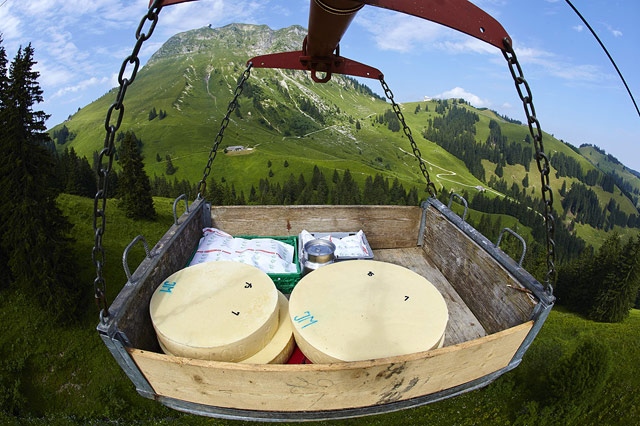
If you’re into cheese, you’ll want to take this photographic journey into a season with Swiss cheesemakers.
In Gruyeres, western Switzerland, from mid-May to mid-October, the fifth generation of the Murith family produces its distinctive mountain pasture Gruyere cheese. Each wheel of cheese weighs between 25 and 40 kilograms, and takes a minimum of six months to mature. The family produces 200 wheels each year to sell locally, using unpasteurized milk from their own herd of cows. Reuters photographer Denis Balibouse spent time with the Murith family over this past grazing season, capturing days and nights in the alpine pastures of Switzerland.
Michael Bay took to his website to describe an incident on the Transfomer’s 4 set in Hong Kong involving an air conditioning unit and the fortuitous wearing of Air Max sneakers.
Every vendor where we shot got paid a fair price for our inconvenience, but he wanted four times that amount. I personally told this man and his friends to forget it we were not going to let him extort us. He didn’t like that answer. So an hour later he came by my crew as we were shooting, carrying a long air conditioner unit. He walked right up to me and tried to smack my face…
And I’mma let you finish, Michael Bay, but Questlove has the best celebrity stories of all time.
More than 80 photos of marvelous wood type alphabets in this Flickr set.

The scans are from Rob Roy Kelly’s 100 Wood Type Alphabets. (via @H_FJ)
The Roaring Twenties web site is “an interactive exploration of the historical soundscape of New York City”.
The Roaring ‘Twenties website is dedicated to that challenge, attempting to recreate for its listeners not just the sound of the past but also its sonic culture. It offers a sonic time machine; an interactive multimedia environment whereby site visitors can not just hear, but mindfully listen to, the noises of New York City in the late 1920s, a place and time defined by its din.
(via paleofuture)
Older posts






Socials & More