Entries for March 2013
Dustin Cohen made a lovely little film about shoemaker Frank Catalfumo, who has been making and repairing shoes in Brooklyn since before World War II.
Frank Catalfumo is a 91 year old shoemaker and repairer in Bensonhurst, Brooklyn. He first opened the doors to F&C Shoes in 1945 and continues to work five days a week alongside his son Michael. If you’re ever in the area, make sure to stop by the shop and listen to one of Frank’s amazing stories about life in Brooklyn back in the day.
Earlier in the week I posted about how climate change is affecting wine. Turns out that coffee is in trouble as well.
But in recent years, keeping the world’s coffee drinkers supplied has become increasingly difficult: The spread of a deadly fungus that has been linked to global warming and rising global temperatures in the tropical countries where coffee grows has researchers scrambling to create new varieties of coffee plants that can keep pace with these new threats without reducing quality.
While coffee researchers can do little to prevent climate change, they’re hard at work to keep up as Earth braces for temperature increases of several degrees over the next several decades.
“Coffee is the canary in the coal mine for climate change,” says Ric Rhinehart, executive director of the Specialty Coffee Association of America. “If you can’t think about the long term risk for planetary impacts, think about the short term risk for your coffee. Know that a day without coffee is potentially around the corner.”
(via nextdraft)
Veniamin Konstantinovich Balika recently used false paperwork to load his 18 wheeler with 42,000 pounds of Muenster cheese worth about $200K. Balika’s plan was to sell the cheese to retailers on the east coast.
“There’s a black market for everything,” said Sissman. “We’ve seen everything stolen. We’ve found stolen beer, stolen food, stolen machine parts, but this is the first time, we’ve found stolen cheese.
I wanted the opinion of an industry professional so I reached out to Aaron Foster, Head Buyer at Murray’s Cheese Shop.
I’ve seen a lot of people wondering how the culprit was planning to unload 40,000 lbs of cheese without raising suspicion. Is there such a thing as a cheddar fence? In my opinion, it really wouldn’t be that hard. While the larger retailers and chains — and, of course, Murray’s — have all become much more conscious of food safety and food security, there remains plenty of retailers who would jump at the chance to buy their product for pennies on the dollar, no questions asked. Literally as I wrote this, I received a vague email with the subject “RE: Special sale - Mega aged WI Cheddar”. I’ll pass, thanks. Groceries, specialty shops, and bodegas that work with perishables need every edge they can get to scrape by. Think about that next time you order your egg and cheese from the corner store.
And then I couldn’t help but find out more about stolen cheese. Cheese theft isn’t actually that uncommon. In fact, cheese is the most stolen food item of all with up to 4% of all cheese stolen at some point in it’s journey from maker to mouth. A cursory Google search turned up trunks full of stolen cheese in Michigan, 52-year old naked library denizens arrested with knives and stolen cheese, stolen government cheese in 1983(!), stolen cheese spread all over a Hy-Vee men’s room, video of brazen cheese wheel thieves, “the crushing authoritarianism of the Crown of England,” a cheese thief in Brooklyn, and a shoplifting celebrity chef. (thx, drew)
David Bauer writes about how the year 2000, which used to seem futuristic, seems very distant now.
After a refreshing shower — pretty much like you remember it from 2013 — you make yourself comfortable at the breakfast table. You’re an early adopter, so you have your laptop right there with you to check the news. While you wait for the computer to start up, you have time to brew some coffee.
Time to check Twitter for the latest…ah well, no Twitter yet. So let’s see what your friends are up to over on Face…doesn’t exist either. Not even MySpace. Heck, not even Friendster.
The upside is this: You’re in for distraction-free news reading. You head over to Newsunlimited.com, the online version of The Guardian, then to The New York Times On The Web. You glance at the newspaper across the table, knowing it provides the better news fix.
I turned 27 in 2000, lived in San Francisco, worked as a web designer, and had been using the web since 1994…and most of the people I knew were similar. We were a bunch of outliers, people with lots of knowledge about and access to technology and the internet. So a lot of what he writes doesn’t ring true to me, especially the bit above, and extra especially the newspaper providing “the better news fix”.
News sites worked just fine in 2000 and the growing network of weblogs worked even better…they were news and social networks all rolled up into one. Google Maps didn’t exist, but Mapquest did. Wikipedia didn’t exist, but you could still find information about Ghana through Google and Altavista. I owned a digital camera in 1998 and many people I knew had them in 2000. Napster (and the other P2P networks that sprung up around that time) was an amazing music discovery resource. Sharing relatively large files with friends a la Dropbox was possible because we all had our own web sites and FTPing something to your server so someone else could grab it was simple. Things went viral through weblogs and mailing lists. Travel was easy to book online; Expedia launched in 1996. You could shop for groceries online. You could get almost anything delivered same-day to your door with Kosmo.
So yeah, there were no iPods or wifi-enabled laptops or iPhones or Twitter, but if you were an early adopter who lived in a big US city and spent lots of time online, 2000 isn’t as distant as it might seem for everyone else.
Zoe Spawton often photographs a particularly well-dressed man who passes her cafe in Berlin each day. She’s documenting the results at What Ali Wore.

Wonderful. Ali used to be a doctor but is now working as a tailor.
Anderson has finished filming his next movie, The Grand Budapest Hotel, with the likes of Tilda Swinton, Jude Law, Bill Murray, and Owen Wilson. Screen Daily has some plot details:
The Grand Budapest Hotel tells of a legendary concierge at a famous European hotel between the wars and his friendship with a young employee who becomes his trusted protégé. The story involves the theft and recovery of a priceless Renaissance painting, the battle for an enormous family fortune and the slow and then sudden upheavals that transformed Europe during the first half of the 20th century.
I’m currently reading The Emperor of All Maladies: A Biography of Cancer (which is excellent) and I’m up to the chapters on prevention, specifically the prevention of lung cancer through reduction of cigarette smoking. I had no idea cigarette smoking was so uncommon in the US as recently as 1870…but we caught up quickly.
In 1870, the per capita consumption in America was less than one cigarette per year. A mere thirty years later, Americans were consuming 3.5 billion cigarettes and 6 billion cigars every year. By 1953, the average annual consumption of cigarettes had reached thirty-five hundred per person. On average, an adult American smoked ten cigarettes every day, an average Englishman twelve, and a Scotsman nearly twenty.
For some context on that 3500/yr per person number (and the unbelievable 7000/yr Scottish rate), the current rate in the US is around 1000/yr and the highest current rate in the world is in Serbia at almost 2900/yr per person.
In some countries, filing taxes is a fast and simple process. But in the U.S., it only seems to get more complex and laborious. There are a lot of reasons we haven’t reached simplicity. But as ProPublica points out, “it doesn’t help that it’s been opposed for years by the company behind the most popular consumer tax software — Intuit, maker of TurboTax.”
A somewhat surprising list of the least visited countries in the world in that North Korea is not even in the top 15. Somalia, with 500 annual tourists, is #2:
Why so few?
War, lack of a government for many years, violent muslim extremists, sharia law. The reputation of Somalia is extremelly close to rock bottom.
Why you may still want to visit
The government has started to function again. Mogadishu is now relatively safe and businesses are thriving. Turkish Airlines has even opened a direct twice weekly route from Istanbul.
What else
Go to the beach just outside Mogadishu or visit the Bakaara market where you can even buy your own semi-genuine Somalian passport. You may not want to use it anywhere, though. Your travel experience doesn’t extend beyond the Bahamas, Paris or Gran Canaria, you say? First of all; Why are you reading this blog post? Secondly, do not go to Somalia!
The author of the list, Gunnar Garfors, has visited 196 of the 198 countries in the world; he’s hitting the last two in the next few months: Kiribati and Cape Verde. (via @DavidGrann)
Intricate body calligraphy orig. from Mar 27, 2013
* Q: Wha? A: These previously published entries have been updated with new information in the last 24 hours. You can find past updates here.
Wow. In 1978, George Lucus gathered together Steven Spielberg and screenwriter Lawrence Kasdan to go over ideas for a film Lucas had wanted to make about a swashbuckling archeologist, i.e. Raiders of the Lost Ark. Their sessions were recorded and there’s a transcript available online.
Lucas - Now, several aspects that we’ve discussed before: The image of him which is the strongest image is the “Treasure Of Sierra Madre” outfit, which is the khaki pants, he’s got the leather jacket, that sort of felt hat, and the pistol and holster with a World War One sort of flap over it. He’s going into the jungle carrying his gun. The other thing we’ve added to him, which may be fun, is a bull whip. That’s really his trade mark. That’s really what he’s good at. He has a pistol, and he’s probably very good at that, but at the same time he happens to be very good with a bull whip. It’s really more of a hobby than anything else. Maybe he came from Montana, someplace, and he… There are freaks who love bull whips. They just do it all the time. It’s a device that hasn’t been used in a long time.
Spielberg - You can knock somebody’s belt off and the guys pants fall down.
Lucas - You can swing over things, you can…there are so many things you can do with it. I thought he carried it rolled up. It’s like a Samurai sword. He carries it back there and you don’t even notice it. That way it’s not in the way or anything. It’s just there whenever he wants it.
Spielberg - At some point in the movie he must use it to get a girl back who’s walking out of the room. Wrap her up and she twirls as he pulls her back. She spins into his arms. You have to use it for more things than just saving himself.
Lucas - We’ll have to work that part out. In a way it’s important that it be a dangerous weapon. It looks sort of like a snake that’s coiled up behind him, and any time it strikes it’s a real threat.
Kasdan - Except there has to be that moment when he’s alone with a can of beer and he just whips it to him.
Patrick Radden Keefe at the New Yorker read through the whole thing and has some highlights and general thoughts.
Over the intervening decades of enormous wealth and success, both Lucas and Spielberg have carefully tended their public images, so there is a voyeuristic thrill to seeing them converse in so unguarded a manner. As the screenwriters Craig Mazin and John August pointed out recently on the Scriptnotes podcast, one delight of reading the transcript is watching Spielberg throw out bad ideas, and then noting how Lucas gently shuts him down. Spielberg, who had sought to direct a Bond movie-and, astonishingly, been rejected-thought that their hero should be an avid gambler. Lucas replied that perhaps they shouldn’t overload him with attributes. (Lucas himself had briefly entertained, then mercifully set aside, the notion that his archaeologist might also be a practitioner of kung fu.) There’s a good reason we seldom get to spy on these conversations: really good spitballing, like improv comedy, requires a high degree of social disinhibition. So the writers’ room, like a therapist’s office, must remain inviolable.
(via @jcn)
Food and beverages where terroir is a big factor will be the first to be affected by climate change. This is already happening in the world of wine…wine production is happening in Denmark, French wines are changing flavors, and some places may become too hot to grow grapes at all.
As new frontiers for grape growing open up, the viability of some traditional production areas is under threat from scorching temperatures and prolonged droughts.
And in between the two extremes, some long-established styles are being transformed. Some whites once renowned for being light and crisp are getting fatter and more floral while medium-bodied reds are morphing into heavyweight bruisers.
(via @CharlesCMann)
Israeli artist Ronit Bigal does intricate calligraphy on the human body and photographs the results.
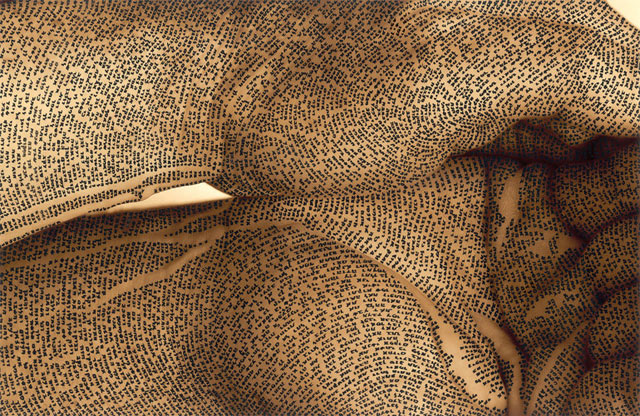
Update: I read the page wrong…the calligraphy is printed on the photographs to follow the contour of the skin, not on the skin itself. Still cool. (thx, @lorp)
This is an episode of Computer Chronicles from 1995 showing what you could do on the internet.
(via mental floss)
Paris even does rainbows better than the rest of the world. This is a photo of a horizon rainbow taken over the Parisian skyline last week by Bertrand Kulik.

What the heck is going on there? Astronomy Picture of the Day explains:
Why is this horizon so colorful? Because, opposite the Sun, it is raining. What is pictured above is actually just a common rainbow. It’s uncommon appearance is caused by the Sun being unusually high in the sky during the rainbow’s creation. Since every rainbow’s center must be exactly opposite the Sun, a high Sun reflecting off of a distant rain will produce a low rainbow where only the very top is visible — because the rest of the rainbow is below the horizon.
(via @DavidGrann)
From the team that brought you Dark Sky, an app that has saved (or at least kept dry) my bacon more times than I can count, comes Forecast, a weather web site that incorporates several of the features that made Dark Sky great. From the announcement:
Rather than cram these things into Dark Sky, we decided to do something grander: create our own full-featured weather service from scratch, complete with 7-day forecasts that cover the whole world, beautiful weather visualizations, and a time machine for exploring the weather in the past and far future. You can access it from all of your devices, whether it be your laptop, iPhone, Android phone, or tablet.
On top of all that, we’re providing this data to other developers, in the hopes that a truly independent weather community can thrive in the era of increasing corporate consolidation.
Pentagram’s Daniel Weil has designed a new chess set that is currently being used at the World Chess Championship Candidates Tournament in London. The set is beautifully iconic and simple.
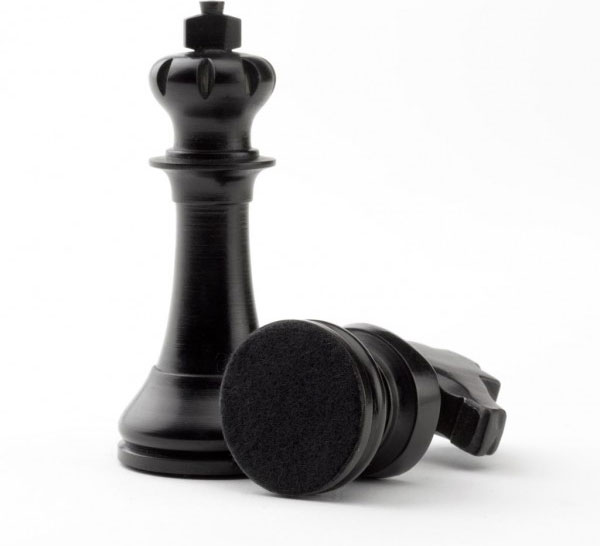
The set is available for sale for £200 or with the board for £300.
Vice made a 24-minute documentary film about Cody Wilson, who is designing a semi-automatic weapon that can be printed out on a 3-D printer. You just download the plans, print it out, and there you go.
“Gun control is a fantasy” indeed.
Buzz Bissinger, author of Friday Night Lights and volatile tweeter, is addicted to high-end leather fashion, to the tune of more than $500,000 over the past few years.
The only clothing I ever tried on before buying it was from Gucci. But many of the online purchases were fantastic-the patent leather trench coat from Burberry, a cropped leather jacket from Versace, a brown leather jacket from Ralph Lauren, a studded leather jacket from Cavalli, boots from Jimmy Choo, leather gloves from Ines in Amsterdam and Madova in Florence. I bought dozens of stretch jeans and leather leggings and leather pants that sculpted my lower body the way I wanted, with no room for speculation. I bought dozens of leather gloves that actually did fit like a glove. I bought dozens of boots, some with a flat or low heel that any man can wear, some with five-inch heels that only a man with real balls could wear.
Lisa in general liked the rocker look. But there were times I was too outrageous for her taste, and she began to feel like she was living with a hoarder. The kids liked the flair, maybe, but there were times they seemed embarrassed, or simply stunned. My friends, particularly those from Philadelphia, were appalled and confused and amused. With the exception of Lisa, nobody had any real idea of the extent of my addiction.
Too many of the purchases were sheer compulsiveness multiplying into more compulsion like split atoms. I bought an orange leather motorcycle jacket and matching orange leather pants from Alexander McQueen that made me look, well, very, very orange. The same went for a blue ensemble that made me look, well, very, very blue. I bought dozens upon dozens of leather jackets-bolero-style, waist-length, above the knee, below the knee-in which the gradations of difference were microscopic. I bought a pair of knee-length Stuart Weitzman boots and then two weeks later bought the exact same pair because I had forgotten I bought the first pair. I bought at least a dozen items that cost over $5,000 each but did not fit, the hazard of online purchasing, since sizing by high-end retailers is often like Pin the Tail on the Donkey. I bought items I wore once, or never wore at all, the tags still hanging from the collar. Yet I returned very little: The more the closets in the house filled, the more discerning I became, the more expensive the items, the more I got off on what I had amassed.
Well, this is interesting. Graphene is a substance discovered relatively recently that has a number of unusual properties. In 2004, physicists at the University of Manchester and the Institute for Microelectronics Technology in Russia used ordinary scotch tape to isolate single-layer sheets of graphene. Once isolated, the sheets could be tested for the unusual properties I mentioned. The 2010 Nobel Prize in Physics was awarded for this work.
In 2012, a group of researchers at UCLA discovered they could make single-layer sheets of graphene by coating a DVD with graphite oxide and then “playing” the disc in a plain old DVD drive. And then in a happy accident, they found that graphene has unusually high supercapacitance properties, which could mean that graphene could be used, for example, as a mobile phone battery that lasts all day, charges in a few seconds, and can be thrown into a compost bin after use.
(via io9)
So says education researcher Teresa Belton:
The academic, who has previously studied the impact of television and videos on children’s writing, said: “When children have nothing to do now, they immediately switch on the TV, the computer, the phone or some kind of screen. The time they spend on these things has increased.
“But children need to have stand-and-stare time, time imagining and pursuing their own thinking processes or assimilating their experiences through play or just observing the world around them.”
It is this sort of thing that stimulates the imagination, she said, while the screen “tends to short circuit that process and the development of creative capacity”.
A long piece in this week’s New Yorker by Marc Fisher about more alleged sexual abuse at The Horace Mann School, a prep school in the Bronx. Fisher’s piece focuses on Robert Berman, an English teacher at the school for many years.
One group of boys stood apart; they insisted on wearing jackets and ties and shades, and they stuck to themselves, reciting poetry and often sneering at the rest of us. A few of them shaved their heads. We called them Bermanites, after their intellectual and sartorial model, an English teacher named Robert Berman: a small, thin, unsmiling man who papered over the windows of his classroom door so that no one could peek through.
Assigned to Berman for tenth-grade English, I took a seat one September morning alongside sixteen or seventeen other boys. We waited in silence as he sat at his desk, chain-smoking Benson & Hedges cigarettes and watching us from behind dark glasses. Finally, Mr. Berman stood up, took a fresh stick of chalk, climbed onto his chair, and reached above the blackboard to draw a horizontal line on the paint. “This,” he said, after a theatrical pause, “is Milton.” He let his hand fall a few inches, drew another line, and said, “This is Shakespeare.” Another line, lower, on the blackboard: “This is Mahler.” And, just below, “Here is Browning.” Then he took a long drag on his cigarette, dropped the chalk onto the floor, and, using the heel of his black leather loafer, ground it into the wooden floorboards. “And this, gentlemen,” he said, “is you.”
The next day, I asked to be transferred. I was not alone. By the end of the week, Berman’s class had shrunk by about half. The same thing happened every year; his classes often ended up as intimate gatherings of six to eight. Many students found Berman forbidding, but some of the teachers referred to him as a genius. Boys competed to learn tidbits about him. It was said, with little or no evidence, that he was an artist and a sculptor, that he knew Sanskrit, Russian, and Urdu, and that his wife and child had been killed in a horrific car crash. Though he was only in his mid-thirties, a graduate of the University of Michigan, it was rumored that he had been a paleontologist and had taught at Yale. Administrators told students and their parents that Horace Mann was incredibly lucky to have him, however odd he might be. The boys who remained in his classes were often caught up in his love of art, music, and literature, and in his belief that every moment of life should be spent reaching for the transcendence of the Elgin Marbles, of a fresco by Fra Angelico, even of an ordinary sunset. The boys absorbed the lists he made. “Take this down,” he’d say. “The ten greatest racehorses of all time.” Or, “This is the list of the ten greatest movies ever made-but you won’t find ‘Lawrence of Arabia’ on it, because it’s off the charts!” One day, he mounted a rearview mirror on the far wall of the classroom so that he could stare at the portrait of Milton behind his back.
In past few months, I linked to two collections of color photos of Paris taken in the 1910s and 1920s under the direction of Albert Kahn.
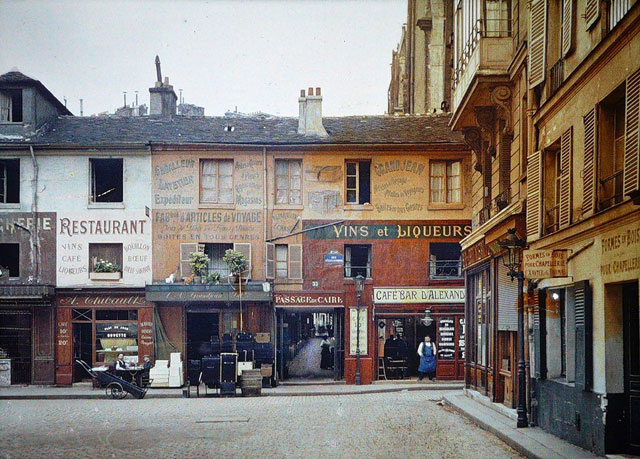
Recently Rue89 sent photographer Audrey Cerdan to recapture some of those old scenes in modern day Paris and knocked up an interface so that you can slide back and forth between the old and current photos. In some of the pairs of photos, pharmacies, tabacs, and boulangeries are in the same places. (thx, christophe)
Technically this photo was taken several years (probably in 1986 or 1987) before Radiohead officially came to be, but it features four out of the five members, back when the group was called On a Friday.
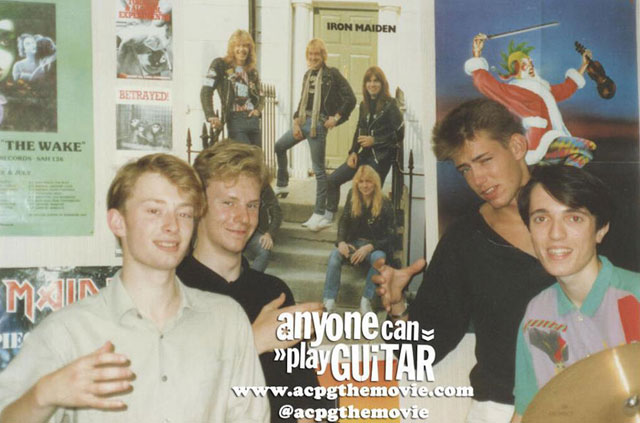
From left to right, Thom Yorke, Phil Selway, Ed O’Brien, and Colin Greenwood. This occasion marked one of the last times that Yorke smiled for a photo. (via buzzfeed)
Daft Punk is coming out with a new album called Random Access Memories. It’s out on May 21 but you can preorder on iTunes. Here’s a brief ad for the album:
At random and unannounced times throughout the year, actress (and apparently performance artist) Tilda Swinton will be sleeping in a glass box at MoMA.

It’s part of an unannounced, surprise performance piece called “The Maybe” that will be taking place on random days all year. A MoMA source told us, “Museum staff doesn’t know she’s coming until the day of, but she’s here today. She’ll be there the whole day. All that’s in the box is cushions and a water jug.”
Clearly some crowdsourced announcement system is needed…perhaps istildaswintonsleepingatmomaornot.tumblr.com? Also, in keeping with the theme of “my kid could do that” in contemporary art, both my kids slept at MoMA in chairs with wheels on them.
Stephen Coles of Typographica says that 2012 was “a strong year” for new typefaces. He asked dozens of designers and font makers to nominate their favorite 2012 typefaces and here’s what they had to say.
The independent foundry has also cemented its place as the new foundation of the industry. Most of this year’s selections are from very small shops, several of which are entirely new to the market. It’s also significant that, in addition to offering their fonts through retailers like FontShop, MyFonts, and the newly revived Fonts.com, most of these indie foundries now sell directly to customers through their own sites. In some cases they have eschewed outside distribution altogether. The “majors” have not simply laid down, however. Monotype, Linotype, Font Bureau, FontFont, and H&FJ are all represented in this year’s list, each with releases that are remarkably characteristic of their respective brands.
(via df)
Twinsters is a project on Kickstarter by a pair of women who look very similar, were both born in South Korea, both born on November 19, 1987, both adopted three months after birth, and have never met. They’re raising funds to make a documentary about their first meeting and to test their DNA to see if they are twins.
On February 21, 2013, Samantha, an American actor living in Los Angeles, received a message via Facebook that would drastically change her life. It was from Anaïs, a French fashion design student living in London. Anaïs’ friends viewed a KevJumba YouTube video featuring Samantha. They were immediately blown away by the identical appearance of Samantha & Anaïs. After a few light Google stalking sessions, Anaïs & her friends discovered that both girls were born on November 19, 1987 & adopted shortly after. Anaïs knew immediately that it was possible for Samantha to be her biological twin sister & reached out to her through Twitter & Facebook.
(thx, bethany)
We have a rule of no screen time during the week … On the weekends, they can play. I give them a limit of half an hour and then stop. Enough. It can be too addictive, too stimulating for the brain.
That quote is from a parent who develops apps for kids. The Atlantic’s Hanna Rosin went to a developer’s conference and what she heard from the parents there might surprise you: The Touch-Screen Generation.
I really enjoyed this piece by John Siracusa about why Apple should continue to make a high-end personal computer (like the Mac Pro) even though it’s not a big seller or hugely profitable. Basically, the Mac Pro is Apple’s halo car:
In the automobile industry, there’s what’s known as a “halo car.” Though you may not know the term, you surely know a few examples. The Corvette is GM’s halo car. Chrysler has the Viper.
The vast, vast majority of people who buy a Chrysler car get something other than a Viper. The same goes for GM buyers and the Corvette. These cars are expensive to develop and maintain. Due to the low sales volumes, most halo cars do not make money for car makers. When Chrysler was recovering from bankruptcy in 2010, it considered selling the Viper product line.
But car companies continue to make halo cars in part because they are great cars, or at least have the potential to be great cars, and when a car company stops caring about making great cars, they lose their identity and credibility…with consumers, with employees, with investors, and with competitors. Halo cars are the difference between being a car company and being a company that sells cars.
Normally I’m not a big fan of advice like “do what big car companies do”, but what Siracusa’s piece demontrates is one of the things that’s problematic about data: there are important things about business and success that you can’t measure. And I would go so far as to say that these unmeasurables are the most important things, the stuff that makes or breaks a business or product or, hell, even a relationship, stuff that you just can’t measure quantitatively, no matter how Big your Data is. (via df)
For Homework, their 1997 debut album, Daft Punk drew on a large number of musical influences. Here’s two wonderful hours of the music that influenced them.
It does what it says on the tin.
My favorite part is how it shoots the airplane out at the end. “Be gone, good sir, I am quite done with you!” (thx, Alex)
Because of the tea-bag effect, after a point, spirits don’t necessarily get better the longer they age. Bottled liquors don’t age positively at all which doesn’t have anything to do with tea bags.
What distinguishes these two approaches is what Pickerell refers to as “the tea-bag effect”: The first time a tea bag (or barrel) is used, there’s more flavor to draw out. Resting in brand-new barrels, bourbon needs less time to extract what Pickerell calls “wood goodies” — it sucks vanilla and caramel flavors, as well as spice-like notes, out of the wood with ease. Many of those same bourbon barrels, once emptied, make their way to Scotland, where they are used to age Scotch whisky. At this point, most of the “wood goodies” have been depleted, so scotch often needs a longer aging time to suck out the remainders. Evaporation plays a role, too: In the dry climate favored by bourbon distillers, liquid evaporates more quickly, and the product becomes concentrated more quickly.
Also, according to the article, the ideal age range for whisk(e)y is as follows:
Rye whiskey: 9-11 years.
Bourbon: 6-10 years.
Scotch: 20 years.

Maybe the most depressing part of this three part series of photographs of Iraq from the past ten years is not the photos of all the horrible things people are capable of doing to each other, not the [God, I can’t even think of the right set of rage-adjectives here] faces of Bush, Cheney, and Rumsfeld, but the fact that there is a part two to this series that starts in 2003, just after the fucking asinine MISSION ACCOMPLISHED banner.
But maybe it was all worth it? To see these happy faces riding an amusement ride? Or these young people able to express themselves? Was it the right thing done the wrong way for the wrong reasons? I dunno. I just don’t know.
Feeling totally depressed and sad and useless about this: the NRA wins again.
After Sandy Hook, after twenty children were shot and killed at a place where they should have been safe from all harm, there was some optimism among supporters of gun control: perhaps now, finally, both Democrats and Republicans could see the light — and the suffering-and revive the assault — weapons ban. It was a futile hope.
Less than a week after Adam Lanza shot up an elementary school, it was already basically clear that an assault-weapons ban could not pass Congress-that it probably couldn’t even get through the Democratic-controlled Senate, never mind the House. So it was hardly a surprise when, three months later, Senate Majority Leader Harry Reid announced that the ban would be removed from a larger gun-control package that is making its way through the upper chamber and given a separate vote that it will not survive. The scale of the defeat suffered by the ban’s supporters, though, is shocking. This wasn’t a close call; it was a body blow.
I haven’t forgotten Sandy Hook. We drive by there every time we go to Vermont. I think about those kids almost every day. Sometimes when I think about them, I close my eyes and see my 5-year-old son cowering in the corner of his classroom as a black-clad figure toting a machine gun bears down on him. And then the tears come. I can’t stand that this is what America is; that we trade our children’s lives for the opportunity to purchase items specifically invented for killing. I can’t stand it. It’s pathetic and embarrassing and barbaric.
Kilian Jornet Burgada might be the world’s best and most dominating athlete. Or at least he derserves to be in the conversation. Jornet competes in a number of sports but his two main ones are endurance running and ski mountaineering.
His versatility amazes other runners, including Jurek, who today is a friend. Jornet has been able to run the very short mountain races like a vertical kilometer race that’s over in a couple of hours, Jurek says — and then, he adds, Jornet can turn around and win the Western States 100-Mile Endurance Run in California’s Sierra mountains, arguably the world’s most prestigious ultrarun. (Jurek himself won the Western States seven consecutive times between 1999 and 2005.) It’s a little like an Olympic-champion sprinter winning the Boston Marathon.
How is Jornet able to do these things? In part because of his upbringing in the mountains:
Even among top athletes, Jornet is an outlier. Take his VO2 max, a measure of a person’s ability to consume oxygen and a factor in determining aerobic endurance. An average male’s VO2 max is 45 to 55 ml/kg/min. A college-level 10,000-meter runner’s max is typically 60 to 70. Jornet’s VO2 max is 89.5 — one of the highest recorded, according to Daniel Brotons Cuixart, a sports specialist at the University of Barcelona who tested Jornet last fall. Jornet simply has more men in the engine room, shoveling coal. “I’ve not seen any athletes higher than the low 80s, and we’ve tested some elite athletes,” says Edward Coyle, director of the Human Performance Laboratory at the University of Texas at Austin, who has studied the limits of human exercise performance for three decades.
He also seems at one with nature and the mountains more than most people:
Observers and competitors describe him as someone who draws endurance and vitality, Samson-like, from being among high peaks. Runners who have served as pacesetters for him have told me with amazement how, when he was midrace at Lake Tahoe, Jornet didn’t run with his head down in focused misery but instead brushed the hairgrass and corn lily that grew along the trail with his fingertips and brought the smell to his nose, as if he were feeding off the scenery. Sometimes in his all-day solitary runs, stopping only to eat berries, he can seem half-feral, more mountain goat than human. He likes to move fast and touch rock and feel wild, he told me; he feels most at ease and performs best when wrapped by the silence and beauty of the mountains. He can’t abide cities for more than a few hours. The sea — its unrelenting horizontality — scares him. Leading long races like Western States, he’s been known to stop and exclaim at a sunrise, or wait for friends to catch up so he can enjoy the mountains with them instead of furthering his lead. “It’s almost insulting,” Krupicka told me. But it’s just Kilian being Kilian, Krupicka said. “He’s not rubbing it in anyone’s face. He’s truly enjoying being out there in the mountains, and he’s expressing that.”
Update: In the New Yorker, Stephen Kurczy has an update on Jornet and his quest to establish a “fastest known time” on some of the world’s tallest mountains. He’s already bagged Mont Blanc, Matterhorn, and Denali with an Everest attempt forthcoming.
Perhaps the most valuable thing Jornet gained on Aconcagua was a lesson about altitude. This was the highest mountain he had ever raced, and it will inform the next leg of his project, a trip to Everest this spring, and force him to invest more time in acclimatization — a challenge for someone more accustomed to just going. Montaz-Rosset told me that the aim will be to run up and down the northern Tibet side starting from one of the last inhabited places before base camp, Rongbuk Monastery, at sixteen thousand four hundred feet. That route would translate to some twelve thousand five hundred feet of elevation gain — a little less than on Aconcagua. Jornet intends to carry only a backpack, without oxygen or the assistance of fixed ropes or other climbers.
Update: Jornet continues to do crazy running things.
The new iOS gaming hotness is Ridiculous Fishing. In it, you try to get your hook as deep as you can, then catch as many fish as you can on the way up, and finally shoot as many of the fish as you can with a gun. There are also chainsaws and an in-game Twitter clone called Byrdr. This game is ten times more charming than that Arnold on Green Acres and fun as hell. Highly recommended. If you need an extra nudge, here’s the trailer:
This is an Icelandic waterfall called Litlanesfoss and the naturally occurring rock formation is columnar jointed basalt.

The columns form due to stress as the lava cools. The lava contracts as it cools, forming cracks. Once the crack develops it continues to grow. The growth is perpendicular to the surface of the flow. Entablature is probably the result of cooling caused by fresh lava being covered by water. The flood basalts probably damned rivers. When the rivers returned the water seeped down the cracks in the cooling lava and caused rapid cooling from the surface downward. The division of colonnade and entablature is the result of slow cooling from the base upward and rapid cooling from the top downward.
One of the coolest things I have ever seen. Looks totally fake, like they built it for Fractal Falls in Polygon Gorge at Disneyland or something. Giants Causeway in Northern Ireland looks amazing as well. Check out several similar formations from around the world.
Sara Wachter-Boettcher on the relationship between vulnerability and empathy, especially when it comes to making things for other people to use.
[Empathy] means being open — truly open — to feeling emotions we may not want to feel. It means allowing another’s experiences to gut us. It means ceding control.
Empathy begins with vulnerability. And being vulnerable, especially in our work, is fucking terrifying.
(via @beep)
Yesterday, the FBI announced major advances in solving the biggest art heist in history. The break in occurred at the Isabella Stewart Gardner Museum in 1990 when a night watchman opened the door to men dressed as police. Works by Vermeer, Rembrandt, Degas, and Manet valued at over $500M were taken and have not been seen since.
“The FBI believes with a high degree of confidence in the years after the theft the art was transported to Connecticut and the Philadelphia region and some of the art was taken to Philadelphia where it was offered for sale by those responsible for the theft. With that confidence, we have identified the thieves, who are members of a criminal organization with a base in the mid-Atlantic states and New England,” Richard DesLauriers, special agent in charge of the Boston office of the FBI, said.
The guard who opened the door, Richard Abath, was looked at pretty closely again last week, though he’s not mentioned specifically this week.
There’s prior art, but this image toaster is still pretty cool.
Toastagram? Toastr? I foresee BERG putting out a smaller version of this, perhaps printing out the day’s news on a small-crumb cocktail bread; they’ll call it Little Toaster. (via sly oyster)
Hands On a Hardbody, a 1997 documentary about contestants vying to win a brand-new pickup truck, is now available in digital format for $10 (remastered and DRM-free, no less).
In S.R. Bindler’s 1997 cult classic, Hands On a Hardbody, two dozen small-town Texans compete for a brand-new “Hardbody” pickup truck at a local car dealership. The event is a contest of endurance and sleep-deprivation — whoever can remain standing the longest with one hand on the truck will get to drive it home. Capturing several days of lunacy, laughter, struggle and heartbreak, Hands On a Hardbody is more than a documentary about winning a truck. It is a remarkable study of competition, camaraderie, faith and determination-the ultimate human drama.
For an extra $5, you get 90 minutes of bonus material. The film has been unavailable in any format for years. I still have an original DVD in my squirreled-away DVD collection…it’s one of my favorite documentaries. (via @gavinpurcell)
If the advertising parts of Mad Men are your favorite bits of the show, might I recommend Taschen’s two-volume Mid-Century Ads (on Amazon).
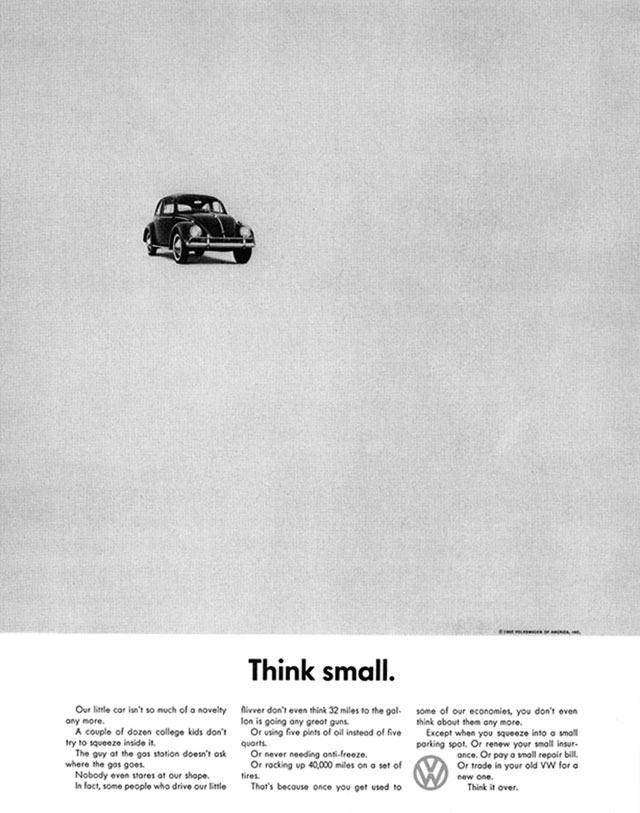
It’s a beautiful set of books, tons of ads from the 50s and 60s presented in large format.
If it’s got wheels, extreme sports enthusiasts will do tricks on it. The push scooter your five-year-old rides at the playground is no exception:
If they ever to a Back to the Future reboot, they know who to call for the downtown Hill Valley chase scene. (via @DavidSimkins1)
A Danish TV show called Dumt & Farligt (which translates as Stupid & Dangerous) films all sorts of crazy things at 2500 frames/sec with a super HD camera. You may have seen the first video from last April…here’s a follow-up that just came out:
The highlights for me were the bottle of red wine in the microwave and the rocket-powered drying rack from the first video and the bottle of Diet Coke shot with a bullet and gas leak in a camper. The Diet Coke scene is almost cinematic, the way the bottle’s clothes are blown off and “arms” flap around as the bottle spins, wobbles, and finally falls to the ground. (via digg)
There are a zillion definitions of simplicity. Here is Christoph Niemann’s, which he applied in building his new iOS app, Petting Zoo.
Simplicity is not about making something without ornament, but rather about making something very complex, then slicing elements away, until you reveal the very essence.
(via @djacobs)
Starting on April 4, Upstream Color begins its run at IFC in New York. Star/director Shane Carruth will be in attendance for post-screening Q&As for several of the shows.
McDonald’s started out as McDonald’s Bar-B-Q in San Bernardino, CA in 1940. Here’s a copy of the menu from that time:
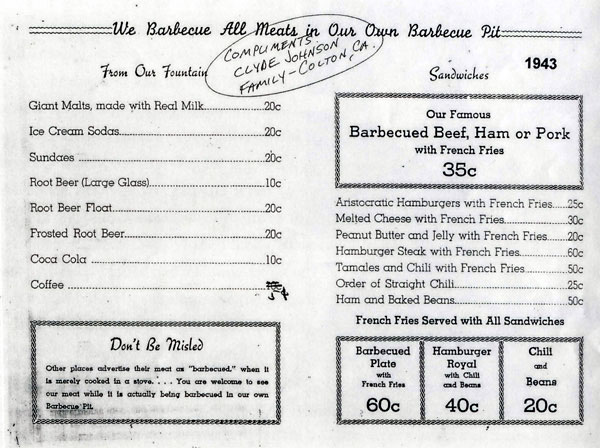
The drive-in BBQ restaurant was a great success:
The restaurant had carhops serving guests and would often see 125 cars crowding the lot on weekends. They quickly saw their annual sales topping $200,000 on a regular basis.
But competitors opened similar restaurants and they were selling more hamburgers than barbequed ham so the McDonald brothers closed their place for three months to retool. They reopened as plain old McDonald’s, serving cheap fare (like hamburgers) quickly. This is what an early version of the menu looked like:

The original McDonald’s served potato chips and pie, which were swapped out for french fries and milkshakes after the first year; that photo must have been taken sometime after the switch. Ray Kroc got involved in 1955 and opened the first McDonald’s franchise east of the Mississippi in Des Plaines, Illinois:

The version of the menu currently going around (on Reddit; I found it here) looks like it’s from the Kroc era, the arches having been introduced in 1953, shortly before he got involved:

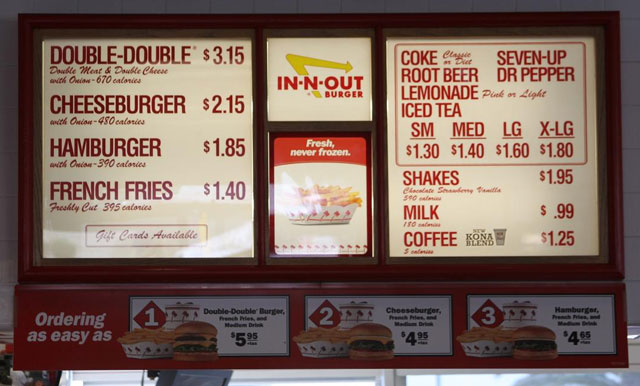
It’s interesting to compare these early McDonald’s menus to the current menus of places like In-N-Out Burger and Five Guys, especially in comparison with the sprawling McDonald’s menu of today:
After reading all these menus, you’re probably getting hungry. So here’s how to make a hamburger that tastes like an original McDonald’s hamburger from 1948 (as well as recipes for a bunch of other McDonald’s menu items, from McNuggets to the McRib to the dipping sauces). Enjoy!
Writing for the New Yorker, David Remnick covers the Bolshoi acid attack and the larger ills that afflict the historic ballet company.
At around eleven, Filin, feeling tired and eager to see his wife, steered the Mercedes into a parking lot outside his building and headed for his door. The snow was icy and thick. Filin was reaching for the security buzzer when he heard someone behind him call out his name. Then the voice said, “Tebye privet!” — literally, “Hello to you!,” but more abrupt and menacing, as though someone were relaying an ominous greeting from a third party.
Filin turned and saw a man in front of him. He was neither tall nor short. He wore a woolly hat and a scarf wrapped around his face. His right arm was crooked behind him, as if he were concealing something.
A gun, Filin thought, in that flash of confrontation: He’s holding a gun and I am dead. Bolt! But, before he could move, his attacker swung his arm out in front of him. In his hand was a glass jar filled with liquid, and he hurled its contents at Filin’s face. A security camera in the parking lot fixed the time at 23:07.
The liquid was sulfuric acid — the “oil of vitriol,” as medieval alchemists called it. Depending on the concentration, it can lay waste to human skin as quickly as in a horror movie. Scientists working with sulfuric acid wear protective goggles; even a small amount in the eyes can destroy the cornea and cause permanent blindness.
Filin was in agony. The burning was immediate and severe. His vision turned to black. He could feel the scalding of his face and scalp, the pain intensifying all the time.
Always good to read Remnick on Russia…he was The Washington Post’s Moscow correspondent for a few years in the late 1980s.
Older posts





Socials & More