kottke.org posts about chess
The chess program available on Delta Air Lines’ seatback screens is an ELO monster that can beat almost all opponents on easy mode. This guy used a series of increasingly powerful bots to see just how good the Delta chess bot is. Can it beat a grandmaster-level bot? (via clive thompson)
YouTuber Paralogical downloaded data from over 5 billion chess games to find the rarest move in chess. Slight spoiler: there are many possible moves that weren’t played in any of the games analyzed. The data and analysis programs used are available on Github:
This is a lil’ code to analyze chess .pgn files, with the goal of finding the “rarest” move in chess.
That is, the rarest move notation (standard algebraic notation) given a large number of input games (e.g. every rated game from lichess) in pgn format.
However, since there are many moves that never happen, this is moreso counting and categorizing moves of various types rather than finding one specific rare move.
Anne Kadet interviewed some chess hustlers in Washington Square Park about their chess work in the park and what they’ve learned about life playing chess.
If you want a game, I say one game, five dollars, five minutes. So we play a five-minute game for five dollars. If you said you don’t want no clock, I might say I give you one game, $10, because without the clock, it’s longer. You’re wasting time.
Some people say $5 to the winner. That means, we play each other and whoever wins gets the $5. That’s tricky, because I don’t know how strong you are. You might beat me and I lose $5. I’ve wasted time AND I’ve lost money! So I’m one of those people who don’t say $5 to the winner.
I’ll give you a lesson, a half hour for $20. I have some children that come just to see me once a week and I give them a lesson — $20 for a half hour. And there’s a lot of NYU students that come by, we give them a discount for being students. One hour for 40 bucks.
Marcel A. offered this advice that applies to nearly any situation:
The one thing I tell my students is that when you get to a confrontation of any type, you have to remain calm. When you remain calm, you can see the board a lot clearer. You can see the person you’re playing or arguing with a lot more clearly, for who and what they are. So you don’t even have to entertain that shit. You understand?
Nathaniel W. shares what he’s learned about people:
They timid, they’re not willing to take a chance. See this? [He moves a pawn forward one space.] That means sometimes people don’t want to be hurt. They have a fear of losing.
And E.G.G.S. offers perhaps the wisest advice of all:
I’m stuck right now. I can’t give any life advice.
The whole thing is worth a read.
See also The Last Chess Shop in NYC. (via fave 5)


From Yad Vashem, Israel’s official memorial to the victims of the Holocaust, a collection of chess sets used by Jews during the Holocaust. Some of the sets predate the war while others were made and used in camps and in hiding.
Playing chess helped to alleviate the suffering of Jews and allowed them a few brief moments of relief from the hunger, the cold and the fear, temporarily easing their loneliness and sense of isolation.
Watch as David Howell sets up several historical chess positions and quizzes world champion Magnus Carlsen on them. Spoiler alert: he knows them all. The one he gets in just four moves after opening is just…otherworldly.
Carlsen is one of a number of world class performers that have prodigious memory skills. See also LeBron James Has a Photographic Memory, Xavi Hernández identifying goals he scored (and the final scores of those matches), Aaron Rodgers’ memory of his significant plays, and Iker Casillas remembers the score of every match he’s played. (via robin sloan)
Update: Former world champion Garry Kasparov:
I was tested similarly in my world championship days, and yes, most Grandmasters can identify thousands of games and positions. It’s not trivial, but, as Magnus said, it’s our job! But his serious interest in the past (human!) games is also a competitive advantage.
Kasparov once gave an impressive public exhibition of this skill. (via @stevenstrogatz)
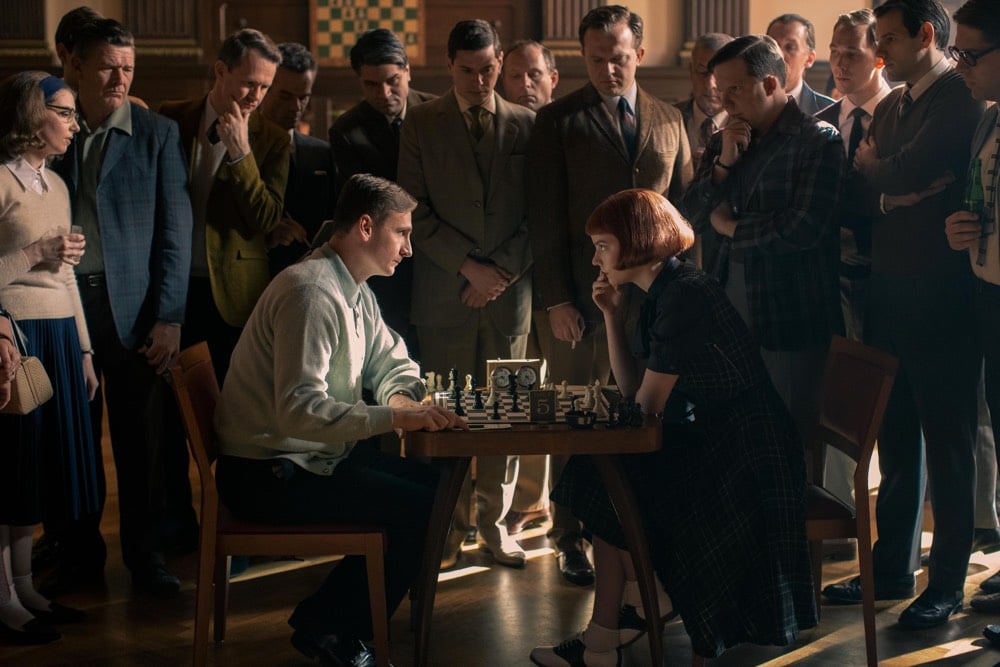
Like many of you, I watched and loved The Queen’s Gambit on Netflix (trailer). Part of the reason it’s so compelling is the care the show’s creators took in accurately portraying the chess players, games, and tournaments. Over the past few weeks, I’ve been reading articles by and interviews with chess experts on what the show got right and wrong. I’ll link to some of them below, but this interview with Garry Kasparov, one of the best chess players ever and an advisor to the show, is particularly worth reading. Here he talks about choosing a real game to be played as the final match in the series (spoilers):
Most of the games, it was not difficult, but the biggest challenge was the last game, because the last game is just, it’s a full game. And the problem is that the last game had to be played by the Queen’s Gambit. Of course I could pick up games from other openings, but it would be very much against the spirit of the book. How did I find a good game that will be played for 40 or so moves adjourned in a complicated situation? And then you have this very important element of Benny and his team calling from New York. It means the position had to be complicated. I found a few games and picked up one: Patrick Wolff against Vassily Ivanchuk, Biel Interzonal, 1993. Wolff sent me a note a couple of days after the show was released: “I recognize the game.” It was quite an obscure game. He said, “Garry, how on earth did you find it?” I said, “I had certain parameters, with the gambit, the number of pieces left, so basically, I ended up with 700 games.” It’s not perfect, because it’s not exactly as complicated as I want it, but it fit the book description: game adjourned, complicated position. And even with all the ruckus, he’s pushing the rook. The rook is trapped in the center. I preserved most of the game description and I think it helped, because that’s a climax, and the climax is something that people always recall.
The interview is interesting throughout. Here are some of the other articles I’ve read: former pro Linda Diaz, former top 10 player Judit Polgar (and others), former NY Times chess columnist Dylan Loeb McClain, chess pros Alexandra and Andrea Boetz, 2-time US champ Jennifer Shahade, and ChessBase editor Albert Silver.
In this charming short film, The Magic of Chess, some young competitors at the National Elementary Chess Championship explain what they find so intriguing about the game. From an Atlantic piece on the film:
The children interviewed in the film are articulate and wise beyond their years. “When I asked the kids questions like, ‘What has chess taught you?,’ I was surprised, given their limited life experience, that they could formulate a response beyond the obvious mechanics of the game,” Schweitzer Bell told me.
Chess “teaches you how to make a plan,” one child says in the film.
“When you lose, you learn from your mistakes,” says another.
I was curious about the tournament, so I looked up the results and the standings are so full of Asian, Indian, Latino, and other non-European language names that my browser offered to translate the page for me. Another thing that jumped out at me was that most of the top competitors in the K-6 competition were 6th graders, except for 2nd grader Aditya Arutla finishing in 8th place. Wow!
Chess is as physically demanding as many other sports due to stress and because the human brain uses a ton of energy. Many of today’s top chess players train and eat like pro tennis or soccer players.
In 2004, winner Rustam Kasimdzhanov walked away from the six-game world championship having lost 17 pounds. In October 2018, Polar, a U.S.-based company that tracks heart rates, monitored chess players during a tournament and found that 21-year-old Russian grandmaster Mikhail Antipov had burned 560 calories in two hours of sitting and playing chess — or roughly what Roger Federer would burn in an hour of singles tennis.
Robert Sapolsky, who studies stress in primates at Stanford University, says a chess player can burn up to 6,000 calories a day while playing in a tournament, three times what an average person consumes in a day. Based on breathing rates (which triple during competition), blood pressure (which elevates) and muscle contractions before, during and after major tournaments, Sapolsky suggests that grandmasters’ stress responses to chess are on par with what elite athletes experience.
“Grandmasters sustain elevated blood pressure for hours in the range found in competitive marathon runners,” Sapolsky says.
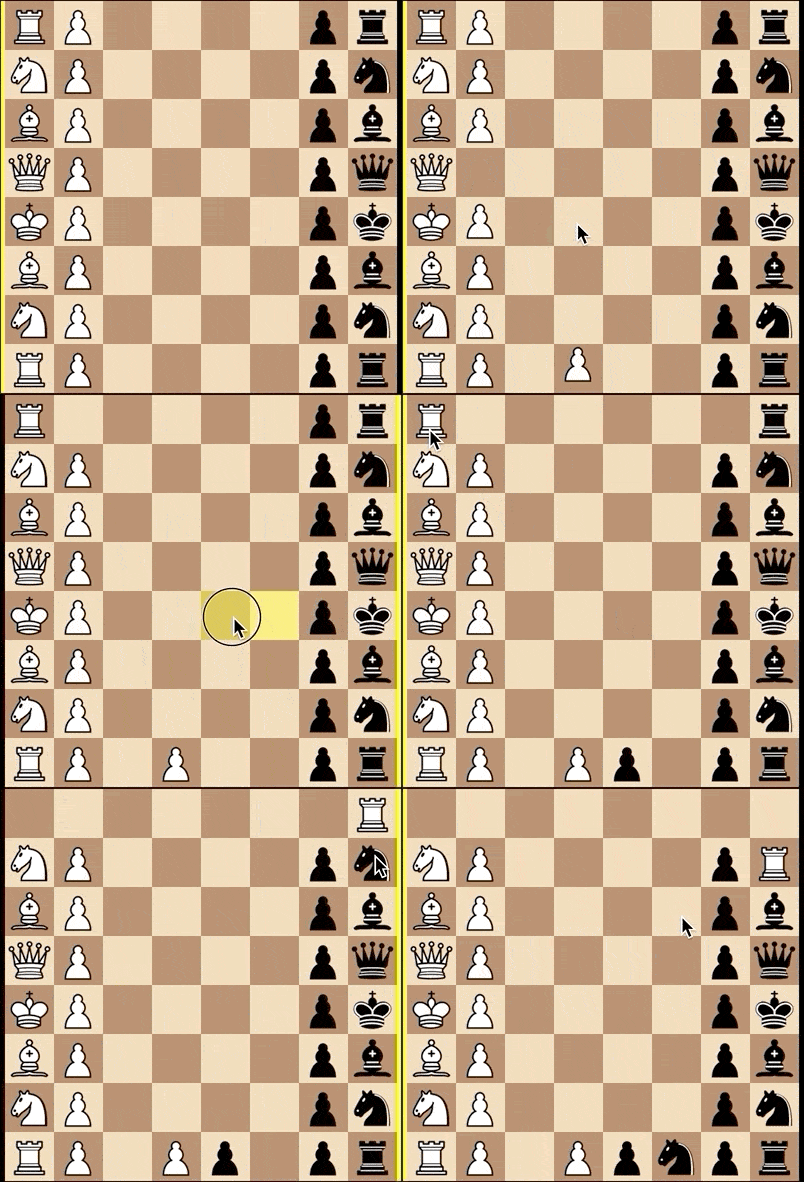
From experimental game developer Pippin Barr, several variations on the game of chess that makes the game more interesting (or at least weirder). In “Clone” mode, every time you move a piece, a copy of that piece is made. In “Chance” mode, selecting a piece causes the piece to change randomly to another type of piece (e.g. from a pawn to a rook) that you can then move. In “Gravity” mode, pieces fall to the bottom of the board unless they’re blocked by other pieces. In “Quantum” mode, a new piece is spawned in each possible new position of a selected piece.
From directors Molly Brass and Stephen Tyler, this is a really lovely & poignant short film about Chess Forum and its owner, Imad Khachan, a Palestinian refugee who came to America to get a PhD in American literature and ended up as the owner/operator of a classic NYC establishment.
Anybody who doesn’t speak any language or different languages, they can sit here and play chess. You can still hold a meaningful conversation without saying a word.
In the 90s, Khachan opened Chess Forum across the street from another chess shop, The Chess Shop, after a disagreement with its owner.
After an ownership agreement between Khachan and a former business mentor fell to pieces, Khachan opened the Chess Forum directly across the street from his former partner’s shop, The Chess Shop. His move triggered what, in New York chess circles, is still known as the Civil War on Thompson Street.
“Sometimes attack is the best defense,” Khachan said of his decision.
His move tore New York’s tight-knit chess community in two. A ceasefire eventually settled in, with each shop courting its own customers and suppliers. His business rival closed in 2012, but the feud taught Khachan a lesson as strong as any he learned on the board.
“Like any chess game it’s the thinking ahead that keeps you one step ahead of the guy who’s shooting after you and not hitting you,” he said. “You have to keep moving.”
Update: Speaking of “holding a meaningful conversation without saying a word”, Gregor McEwan sent in links to a pair of papers he co-authored that argue that game play should be considered conversation: Chess as a Conversation: Artefact-Based Communication in Online Competitive Board Games and “I’m Just Here to Play Games:” Social Dynamics and Sociability in an Online Game Site.
Our analysis provides new evidence that even simple turn-based games contain a great deal of interaction richness and subtlety, and that the different levels of communication should be considered by designers as a real and legitimate vehicle for social interaction.
In this video from the New Yorker, chess granmaster Garry Kasparov talks through his four most memorable chess games: two against Anatoly Karpov, one against Viswanathan Anand, and the final game in his rematch against Deep Blue, in which he gets wrong-footed by a move that the computer didn’t know how to make. Even if you’re not a huge fan of chess, it’s instructive to hear Kasparov talk about the importance of what’s happening not on the board — things like body language and confidence.
See also Scrabble pros recount their best and worst plays.
With just four hours of practice playing against itself and no study of outside material, AlphaZero (an upgraded version of Alpha Go, the AI program that Google built for playing Go) beat the silicon pants off of the world’s strongest chess program yesterday. This is massively and scarily impressive.
AlphaZero won the closed-door, 100-game match with 28 wins, 72 draws, and zero losses.
Oh, and it took AlphaZero only four hours to “learn” chess. Sorry humans, you had a good run.
That’s right — the programmers of AlphaZero, housed within the DeepMind division of Google, had it use a type of “machine learning,” specifically reinforcement learning. Put more plainly, AlphaZero was not “taught” the game in the traditional sense. That means no opening book, no endgame tables, and apparently no complicated algorithms dissecting minute differences between center pawns and side pawns.
This would be akin to a robot being given access to thousands of metal bits and parts, but no knowledge of a combustion engine, then it experiments numerous times with every combination possible until it builds a Ferrari. That’s all in less time that it takes to watch the “Lord of the Rings” trilogy. The program had four hours to play itself many, many times, thereby becoming its own teacher.
Grandmaster Peter Heine Nelson likened the experience of watching AlphaZero play to aliens:
After reading the paper but especially seeing the games I thought, well, I always wondered how it would be if a superior species landed on earth and showed us how they play chess. I feel now I know.
As I said about AlphaGo last year, our machines becoming unpredictable is unnerving:
Unpredictable machines. Machines that act more like the weather than Newtonian gravity. That’s going to take some getting used to.
Albert Silver has a good overview of AlphaZero’s history and what Google has accomplished. To many chess experts, it seemed as though AlphaZero was playing more like a human than a machine:
If Karpov had been a chess engine, he might have been called AlphaZero. There is a relentless positional boa constrictor approach that is simply unheard of. Modern chess engines are focused on activity, and have special safeguards to avoid blocked positions as they have no understanding of them and often find themselves in a dead end before they realize it. AlphaZero has no such prejudices or issues, and seems to thrive on snuffing out the opponent’s play. It is singularly impressive, and what is astonishing is how it is able to also find tactics that the engines seem blind to.
So, where does Google take AlphaZero from here? In a post which includes the phrase “Skynet Goes Live”, Tyler Cowen ventures a guess:
I’ve long said that Google’s final fate will be to evolve into a hedge fund.
Why goof around with search & display advertising when directly gaming the world’s financial market could be so much more lucrative?
Garry Kasparov, who is one of the top chess players ever, said that his 1999 match against Veselin Topalov was the greatest game of chess he ever played. In this video, MatoJelic goes through the game, move by move. Even if you only have a passing interest in chess, I’d recommend watching…it gets really interesting after the first 10-12 moves (which are presented without explanation) and listening to someone who is passionate about a topic is often worth it.
Also entertaining and informative was his explanation of The Game of the Century, which pitted a 13-year-old Bobby Fischer against Donald Byrne, a top-ranked American player. (via farnam street)
Magnus Carlsen and Sergey Karjakin are competing in the FIDE World Chess Championship Match in NYC and are currently tied going into the final match. By all accounts, it’s been a tense competition. But watching chess being played in real time is perhaps only for die-hard fans. Here’s video of Karjakin thinking about a move for 25 minutes:
And here’s Carlsen thinking about Karjakin thinking about the same move for 25 minutes:
(via @juririm)

Really Bad Chess is an iOS game by Zach Gage that randomizes the distribution of pieces when the board is set up, so that you might start a game with 4 queens, 3 knights, and only 2 pawns in the back row. The result is that you get a completely new strategic game each time, but you still play with the familiar tactical rules of chess. What a great idea…I can’t tell if people who really love chess will love or hate this.
Update: See also Knightmare Chess:
Knightmare Chess is played with cards that change the default rules of chess. The cards might change how a piece moves, move opponent’s pieces, create special squares on the board or otherwise alter the game.
and Chess960 invented by Bobby Fischer:
It employs the same board and pieces as standard chess; however, the starting position of the pieces on the players’ home ranks is randomized. The random setup renders the prospect of obtaining an advantage through the memorization of opening lines impracticable, compelling players to rely on their talent and creativity.
(via @JonRelf & @akasian)
Older posts





Socials & More