Entries for April 2012
Former NFL player Nate Jackson writes an open letter to future top NFL draft picks Andrew Luck and Robert Griffin III about how their lives are going to change.
After negotiating your contracts, you both will surely buy a house in an affluent suburb where no 22-year-old would be happy living. Your new neighbors will be rich as well, facelifted, lipo-sucked, Xanaxed and dripping in diamonds, simply delighted to welcome you to the neighborhood. You will commission an interior decorator, recommended by a neighbor, to furnish your home. This will guarantee it feels nothing like Home. And someday, when all of this is over, you’ll walk through and gaze upon the marble columns and the embroidered drapes like artifacts in a museum, wondering why you ever listened to that woman.
A fine companion to this letter from former NFL player Trevor Pryce.
Dozens of books have been written on this topic but for the less obsessive visitor to NYC, Serious Eats’ Carey Jones has written an excellent guide to where to eat when you come to NYC. The guide is arranged along a number of different vectors like “on the cheap”, “I’ll go anywhere”, and “five-star chefs, three-star prices”. Here’s the “with kids” section:
It’s sad but true that plenty of New York restaurants will raise an eyebrow if you bring in the kids. But plenty won’t! Consider spacious, friendly Coppelia downtown (Latin fare) or Kefi uptown (Greek) for great food that’s inexpensive for a sit-down spot and has enough simpler options that there will be something for picky eaters. The next morning, take the kids to Doughnut Plant (if you’re willing to sacrifice the notion of a balanced breakfast) for all sorts of flavors they’ll stare at wide-eyed. PB-loving kids will love Peanut Butter and Company for lunch, where they can get their favorite sandwich in a dozen ways. Other good options include Shake Shack for burgers or Bark for hot dogs, if you’re out in Park Slope.
If you need a snack uptown, the gigantic chocolate chip cookies at Levain should do the trick (take note: these are big enough to share). Kefi’s a logical choice nearby for dinner, but if you find yourself downtown, consider Mario Batali’s Otto, where parents will appreciate the sophistication and kids will love the huge plates of pasta. (Try to make a reservation as waits can be long, which might not be good with tired kids.)
If there was a “Jason shortlist” category, I would include Ssam Bar, Shake Shack, Gramercy Tavern, Marea, Per Se, Mendy’s (chix salad sandwich), Katz’s, Ma Peche, Spotted Pig, Fedora, Joseph Leonard, Parm, Despana, Xi’an Famous Foods, Colicchio and Sons, Tia Pol, The Modern Bar Room, Pastis, Patsy’s, Morandi, Murray’s Cheese Shop, Hill Country Chix, Grey Dog, Nice Green Bo, Peter Luger, Keen’s, Artisinal, Bouchon Bakery, Burger Joint, and The Beagle. Ok, not such a short list and I’m sure I forgot some of my favorites. (via @anildash)
Huh, this is an interesting idea: Apple should acquire both Foursquare and Square.
To summarize: after the deal, Apple will immediately become a giant payments company, with an installation base that is expected to encompass half of all mobile devices sold. The company will have the best local search abilities, far exceeding any existing recommendation engine. And due to its enormous reach, it will possess a payment system that merchants will line up to support.
A number of banking machines in London offer Cockney rhyming slang as a language option. Operating the machine is simple…just insert your barrel of lard and punch in your Huckleberry Finn to get your sausage and mash.

The company has also been responsible for introducing cash machines which only dispense £5 notes — fivers as they are colloquially named or Lady Godivas in cockney.
It also allows people to withdraw a pony — which is £25 to non-cockney folk.
“I was talking to Andrew Bailey, the chief cashier of the Bank of England, and he said they were trying to get more £5 notes into circulation,” Mr Delnevo reflects.
He came up with the idea that, rather than putting £5 notes in as one choice, it would be better to have £5-note only cash machines.
“We were getting to the state where we were a £20 note society - handing over £20 for an item which cost £4.50 and handed back enough metal to act as an anchor for the aircraft carrier Ark Royal,” he says.
See also ATMs in Latin. (via @nrturner)
Hyman Strachman is one of the biggest bootleggers of Hollywood movies. He’s also 92 years old, a WWII veteran, and gives his movies away to American troops serving overseas.
“Big Hy” — his handle among many loyal customers — would almost certainly be cast as Hollywood Enemy No. 1 but for a few details. He is actually Hyman Strachman, a 92-year-old, 5-foot-5 World War II veteran trying to stay busy after the death of his wife. And he has sent every one of his copied DVDs, almost 4,000 boxes of them to date, free to American soldiers in Iraq and Afghanistan.
With the United States military presence in those regions dwindling, Big Hy Strachman will live on in many soldiers’ hearts as one of the war’s more shadowy heroes.
“It’s not the right thing to do, but I did it,” Mr. Strachman said, acknowledging that his actions violated copyright law.
New essay from Errol Morris in the NY Times, What’s in a Name? In it, he talks about the two Rockefellers that appeared in the newspapers a few years ago…one an imposter and one real.
Clearly, the name was also responsible for the attention he was getting in the newspaper. Clark is not just any impostor; he is a Rockefeller impostor. And as such he becomes more important, more significant. It is as if the name gives him some of the stature and allure of a real Rockefeller. A perfect example of this is the importance given to Clark in both The New York Times and The Boston Globe. He even managed to outshine Barack Obama and Joseph Biden during the week that Obama picked his running mate. Obama and Biden get a little picture at the bottom of the right-hand side of the front page. Clark gets a photo spread — one big picture and four little ones — at the top of the left-hand side. He also got more column inches in the newspaper than Clayton, the real Rockefeller. It’s impressive.
Yesterday I linked to the massive trove of photos recently put online by the NYC Department of Records. Alan Taylor from In Focus went through a large chunk of the archive and pulled out some real gems. Great stuff.
Vatican City ATMs use Latin orig. from Apr 26, 2012
* Q: Wha? A: These previously published entries have been updated with new information in the last 24 hours. You can find past updates here.
ATMs in the Vatican City have Latin as one of the language options:

Anyone know what that means? Google Translate spits out a bunch of jibberish… (Photo by Seth Schoen)
Update: Lots of slightly different answers as to what this says, but this email from a Ph.D. candidate in Classics at Columbia is representative of the spread:
Anyhow, a super-literal translation would be something like this:
I ask that you insert [your] card in order that you come to understand the method needing to be used.
But more colloquially, we can do this:
Please insert your card to learn the instructions.
or even (although I’m really getting into sloppy translation territory here):
Please insert your card for instructions.
(thx, charles)
Update: And it may be more accurate to say that Vatican City ATMs previously offered a Latin option. According to @johnke, “they removed the Latin option with a software update sometime in late 2010/early 2011”.
Flint and Tinder is attempting to reintroduce American-made underwear back into US stores with a Kickstarter project. They’ve raised $39,000+ so far.
The factory I’m working with is family owned and operated. It’s over 100 years old. Just before the recession hit, they moved into a larger facility and invested in some of the capital improvements shown in the video (solar power etc.).
At that time they had 300+ employees and were hoping to double or triple in size. When we started this project however, with the economy in free-fall, they were down to just 90.
They’ve agreed to learn to make this new, high-end brand of American-made underwear. Here’s the fun part though: For ever 1000 pair we sell per month, 1 full-time job has to be added back to the assembly line. Hopefully, with your support, it will help them keep the doors open.
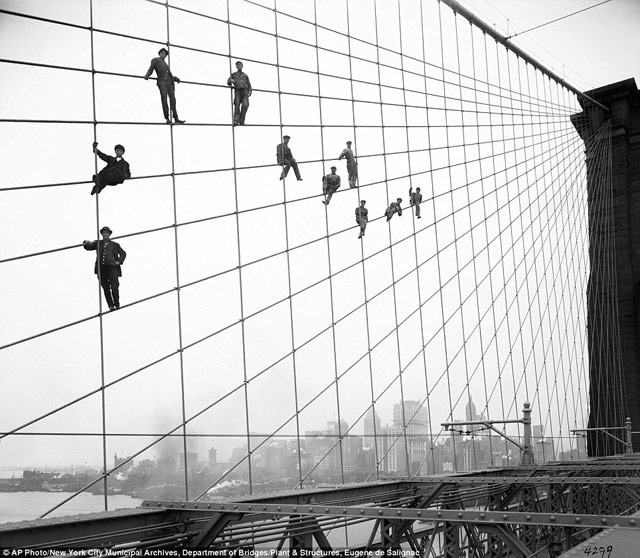
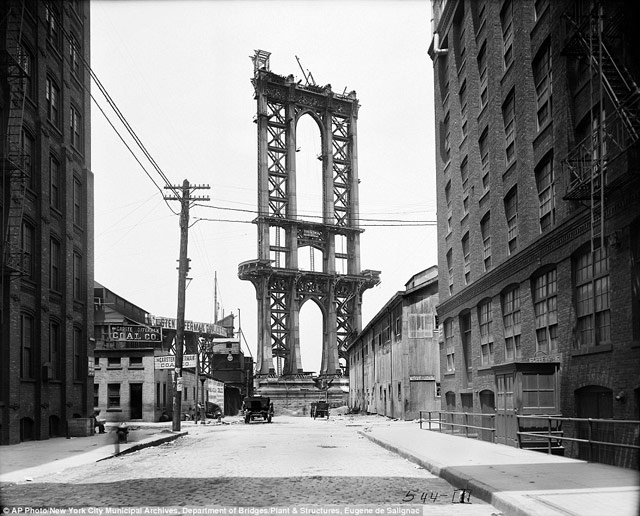
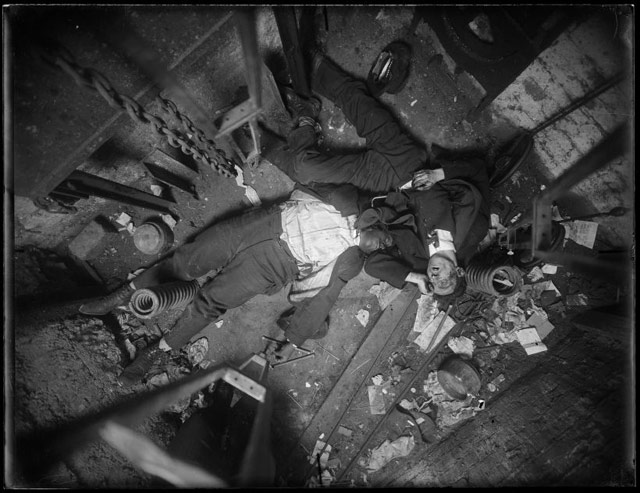
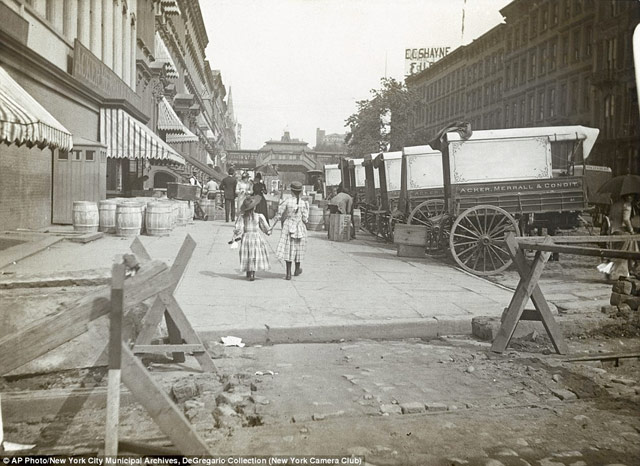
The New York City Department of Records has put a huge portion of the Municipal Archive’s collection of photos online, more than 870,000 in all. The server is overwhelmed at times due to heavy usage, the searching/browsing interface is not what you’d call cutting edge, and many of the photos are available in thumbnail size only, but this is still an incredible resource.
Painters on the Brooklyn Bridge in 1914:
The unfinished Manhattan Bridge in 1908:
A pair of men lay dead in an elevator shaft after a failed robbery attempt:
Looking east on 42nd Street, circa 1890:
More of these photos can be seen at The Daily Mail. (thx, miro)
Women’s clothing sizes are getting larger, you can stay at 6-star hotels, and schools at all levels are giving out As to ever more students. It’s the inflation of everything.
Estimates by The Economist suggest that the average British size 14 pair of women’s trousers is now more than four inches wider at the waist than it was in the 1970s. In other words, today’s size 14 is really what used to be labelled a size 18; a size 10 is really a size 14. (American sizing is different, but the trend is largely the same.) Fashion firms seem to think that women are more likely to spend if they can happily squeeze into a smaller label size. But when three out of four American adults and three out of five Britons are overweight, the danger is that size inflation reduces women’s incentive to eat less. Meanwhile, food-portion inflation has also made it harder to fight the flab. Pizzas now come in regular, large and very large. Starbucks coffees are Tall, Grande, Venti or (soon) Trenta. “Small” seems to be a forbidden word.
Inflation is also distorting the travel business. A five-star hotel used to mean the ultimate in luxury, but now six- and seven-star resorts are popping up as new hotels award themselves inflated ratings as a marketing tool. “Deluxe” rooms have been devalued, too: many hotels no longer have “standard” rooms, but instead offer a choice of “deluxe” (the new standard), “luxury”, “superior luxury” or “grand superior luxury”.
Put in a year and hear popular songs from that year with Radio Time Machine. If you have a Rdio account, you can hear full songs. See also YouTube Time Machine. (via @fchimero)
Obama slow jams the news orig. from Apr 25, 2012
* Q: Wha? A: These previously published entries have been updated with new information in the last 24 hours. You can find past updates here.
From PBS Off Book, a quick look at the thinking behind the opening titles for TV shows and movies, including Zombieland, Mad Men, and Se7en.
See also Art of the Title and A Brief History of Title Design. (via devour)
Tom Vanderbilt says Americans don’t walk as much as they used to; automobile usage has eaten into our perambulation time.
If walking is a casualty of modern life the world over — the historian Joe Moran estimates, for instance, that in the last quarter century in the U.K., the amount of walking has declined by 25 percent — why then do Americans walk even less than people in other countries? Here we need to look not at pedometers, but at the odometer: We drive more than anyone else in the world. (Hence a joke: In America a pedestrian is someone who has just parked their car.) Statistics on walking are more elusive than those on driving, but from the latter one might infer the former: The National Household Travel Survey shows that the number of vehicle trips a person took and the miles they traveled per day rose from 2.32 trips and 20.64 miles in 1969 to 3.35 and 32.73 in 2001. More time spent driving means less time spent on other activities, including walking. And part of the reason we are driving more is that we are living farther from the places we need to go; to take just one measure, in 1969, roughly half of all children lived a mile or more from their school; by 2001 three out of four did. During that same period, unsurprisingly, the rates of children walking to school dropped from roughly half to approximately 13 percent.
Sherry Turkle says young Americans don’t converse as much as they used to; usage of mobile devices like the iPhone and iPod has eaten into our chat time.
A businessman laments that he no longer has colleagues at work. He doesn’t stop by to talk; he doesn’t call. He says that he doesn’t want to interrupt them. He says they’re “too busy on their e-mail.” But then he pauses and corrects himself. “I’m not telling the truth. I’m the one who doesn’t want to be interrupted. I think I should. But I’d rather just do things on my BlackBerry.”
A 16-year-old boy who relies on texting for almost everything says almost wistfully, “Someday, someday, but certainly not now, I’d like to learn how to have a conversation.”
In today’s workplace, young people who have grown up fearing conversation show up on the job wearing earphones. Walking through a college library or the campus of a high-tech start-up, one sees the same thing: we are together, but each of us is in our own bubble, furiously connected to keyboards and tiny touch screens. A senior partner at a Boston law firm describes a scene in his office. Young associates lay out their suite of technologies: laptops, iPods and multiple phones. And then they put their earphones on. “Big ones. Like pilots. They turn their desks into cockpits.” With the young lawyers in their cockpits, the office is quiet, a quiet that does not ask to be broken.
A cockpit or perhaps the safe bubble of the automobile? Steve Jobs was fond of saying the personal computer was “a bicycle for our mind”:
I read a study that measured the efficiency of locomotion for various species on the planet. The condor used the least energy to move a kilometer. And, humans came in with a rather unimpressive showing, about a third of the way down the list. It was not too proud a showing for the crown of creation. So, that didn’t look so good. But, then somebody at Scientific American had the insight to test the efficiency of locomotion for a man on a bicycle. And, a man on a bicycle, a human on a bicycle, blew the condor away, completely off the top of the charts.
And that’s what a computer is to me. What a computer is to me is it’s the most remarkable tool that we’ve ever come up with, and it’s the equivalent of a bicycle for our minds.”
Perhaps then the iPhone is an automobile for our mind in that it allows us to go anywhere very quickly but isolates us along the way.
ps. This photo that accompanies Vanderbilt’s article is kind of amazing:

Totally speechless. I think it’s further from my desk to the bathroom here in the office than it is from that house to the bus.
Using a digital camera, Mechanical Turk, and a thermal printer, Matt Richardson’s Descriptive Camera outputs descriptions of photos instead of the photos themselves.

After the shutter button is pressed, the photo is sent to Mechanical Turk for processing and the camera waits for the results. A yellow LED indicates that the results are still “developing” in a nod to film-based photo technology. With a HIT price of $1.25, results are returned typically within 6 minutes and sometimes as fast as 3 minutes. The thermal printer outputs the resulting text in the style of a polaroid print.
This seems like a distant cousin of Unphotographable. (via hacker news)
This might be the coolest thing a sitting President has ever done. Aside from, maybe, freeing the slaves or The New Deal or winning WWII.
Update: And an amazingly depressing excerpt from a speech Obama gave earlier in the day:
But we only finished paying off our student loans — check this out, all right, I’m the President of the United States — we only finished paying off our student loans about eight years ago.
An extensive collection gathered from all over the internet of the source code and documentation for NASA’s Apollo and Gemini programs. Here’s part of the source code for Apollo 11’s guidance computer.
And here’s an interesting tidbit about the core rope memory used for the Apollo’s guidance computer:
Fun fact: the actual programs in the spacecraft were stored in core rope memory, an ancient memory technology made by (literally) weaving a fabric/rope, where the bits were physical rings of ferrite material.
“Core” memory is resistant to cosmic rays. The state of a core bit will not change when bombarded by radiation in Outer Space. Can’t say the same of solid state memory.
Woven memory! Also called LOL memory:
Software written by MIT programmers was woven into core rope memory by female workers in factories. Some programmers nicknamed the finished product LOL memory, for Little Old Lady memory.
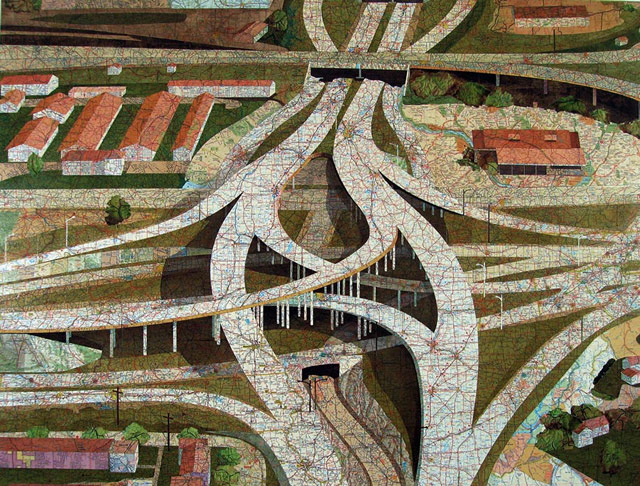
I love love love these collages made up of mappy bits from Matthew Cusick.


(thx, mouser)
If you mix calcium carbide and water, it produces acetylene. Acetylene is extremely flammable and can launch 55-gallon drums into the air when ignited.
(via ★aaroncohen)
A Super Mario Summary is a abbreviated version of the original Super Mario Bros game in which each of the levels has been squeezed into one screen. For instance, here’s World 1-1:

(via waxy)
Paul Simms lists various violations of a hypothetical restaurant mental health code. A couple of favorites:
Solo diner blows out table candle to avoid accidentally setting his newspaper on fire, only to have it relit repeatedly by busboy.
Member of all-white waitstaff barks at member of all-Hispanic busboy staff in way that makes customers feel like those who just stood by and watched in Vichy France.
Remember this New Yorker profile of Lenny Dykstra’s “improbable post-career success story”?
Dykstra ordered a Coke and French fries with ketchup: “And I’m actually going to have that as my meal-might be the oddest order of the day.” (Healthy living was never his specialty.) When the Coke arrived, he sent it back, believing it to be Diet. After the fries were delivered, he made a show of extracting a “You’re welcome” from the waiter, who had since moved on to another table. “I pay a thousand bucks a night — actually, three thousand bucks a night — and people are discourteous,” he said, shaking his head. “There’s some point in life when you have to grow up.”
For many ballplayers, the growing-up point does not arrive until after retirement, when all the freebies vanish and equipment managers and hotel maids can no longer be relied upon for regular laundry service. Dykstra last played in the majors in 1996, at age thirty-three. Improbably, he has since become a successful day trader, and he let me know that he owns both a Maybach (“the best car”) and a Gulfstream (“the best jet”). The occasion for our lunch, however, was a new venture: Dykstra is launching a magazine, intended specifically for pro athletes, called The Players Club. An unfortunate number of his former teammates have ended up broke, or divorced, or worse. The week before we met, the ex-Yankee Jim Leyritz, himself twice divorced and underemployed, had hit a woman while driving home from a bar. He never grew up.
“You’ve got the ten per cent who are going to find their way no matter what,” Dykstra said of the athlete population. “And you get the ten per cent that are fuckheads no matter what— we’ll paste an ‘L’ to ‘em.” The rest need guidance, and Dykstra, who will write a regular column called “The Game of Life,” is prepared to give it. “This will be the world’s best magazine,” he said.
Since then, Dykstra has declared bankruptcy, divorced from his wife, was sentenced to three years in state prison for grand theft auto (and several other charges), and most recently was sentenced to nine months in jail for assault and indecent exposure. He’s also awaiting trial on federal bankruptcy fraud charges.
Columnist Rex Huppke mourns the death of facts in contemporary American society.
To the shock of most sentient beings, Facts died Wednesday, April 18, after a long battle for relevancy with the 24-hour news cycle, blogs and the Internet. Though few expected Facts to pull out of its years-long downward spiral, the official cause of death was from injuries suffered last week when Florida Republican Rep. Allen West steadfastly declared that as many as 81 of his fellow members of theU.S. House of Representatives are communists.
Facts held on for several days after that assault - brought on without a scrap of evidence or reason - before expiring peacefully at its home in a high school physics book. Facts was 2,372.
“It’s very depressing,” said Mary Poovey, a professor of English at New York University and author of “A History of the Modern Fact.” “I think the thing Americans ought to miss most about facts is the lack of agreement that there are facts. This means we will never reach consensus about anything. Tax policies, presidential candidates. We’ll never agree on anything.”
Marc Cenedella found a copy of a 1916 tourist handbook for NYC on Google Books and teased out some of the more interesting bits.
For New Yorkers and visitors of this time, “Old New York” was the time of the American Revolution. The leaders and generals of that earlier time are described as real people. Even if their actions are described in the most glowing and heroic of terms, they come alive in the pages of Rider’s New York as they have not yet transcended into the mythical, distant, unrelatable figures they are today.
George Washington, for example, appears time and again in this guide, not as a statue, or a bridge, or a Square, but as a person who “landed” just south of Laight Street, bid farewell to his men in an Address at Fraunces Tavern, or was greeted on kicking-out-the-British Day (Evacuation Day) at Union Square. Same history, different level of intimacy.
Frans Hofmeester filmed his daughter Lotte once a week for the past twelve years and produced this time lapse film. We’ve seen this kind of thing before (Kalina, etc.) but the use of short snippets of video instead of still photos adds something.
Hofmeester has also filmed his son in the same manner for the past nine years. (thx, david)
Update: Lotte recently turned 16.
(via @Raaphorst)
Trevor Pryce played in the NFL for 14 years and upon retiring learned that fame and money is not much if you’re not doing what you love.
“Early retirement” sounds wonderful. It certainly did that cold night in Pittsburgh. I was going to use my time to conquer the world.
Boy, was I wrong. Now I find myself in music chat rooms arguing the validity of Frank Zappa versus the Mars Volta. (If the others only knew Walkingpnumonia was the screen name for a former All-Pro football player and not some Oberlin College student trying to find his place in the world.) I wrote a book. I set sail on the picturesque and calming waters of Bodymore, Murdaland. And when I’m in dire straits, I do what any 8-year-old does; I kick a soccer ball against the garage hoping somebody feels sorry and says, “Hey, want to play?”
With millions of Americans out of work or doing work for which they are overqualified, I consider myself lucky. But starting from scratch can be unsettling. If you’re not prepared for it, retirement can become a form of self-imposed exile from the fulfillment and the exhilaration of knowing you did a good job.
Robert Caro has a really long Johnson (biography) orig. from Apr 20, 2012
* Q: Wha? A: These previously published entries have been updated with new information in the last 24 hours. You can find past updates here.
This is an episode of Mad Men, incompletely downloaded from BitTorrent.
The video captures an episode of the popular TV show in the act of being shared by thousands of users on bittorent. The video simultaneously acts as a visualisation of bittorrent traffic and the practice of filesharing and is an aesthetically beautiful by product of the bittorrent process as the pieces of the original file are rearranged and reconfigured into a new transitory in-between state.
(via waxy)
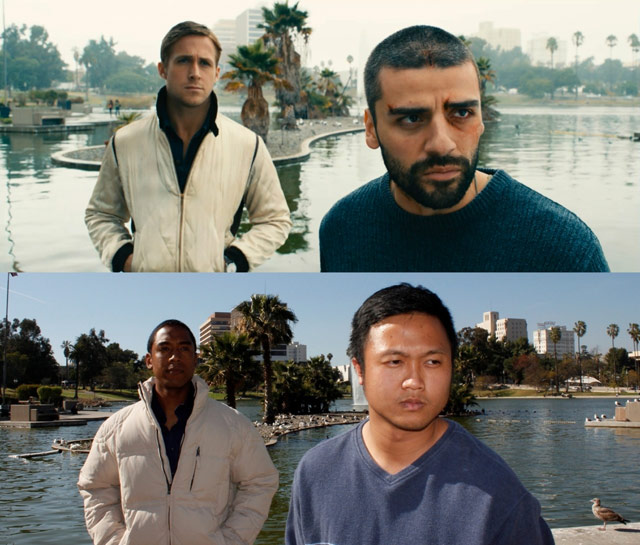
As Allen Fuqua travels around, he looks for movie locations and attempts to duplicate scenes from them. For instance, here’s Allen and a friend reenacting a scene from Drive:
(thx, stephen)
Popular in the 18th century, the Claude glass was a mirror that took the scene behind you and transformed it into something different, much like the filters in Instagram or Hipstamatic promise to do.
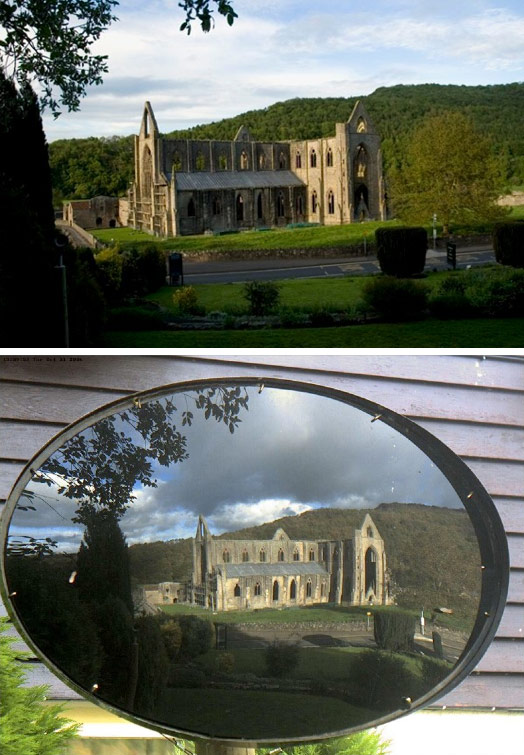
The Claude glass was a sort of early pocket lens without the camera and it was held aloft to observe a vista over one’s shoulder. The technology was simple: A blackened mirror reduced the tonal values of its reflected landscape, and a slightly convex shape pushed more scenery into a single focal point, reducing a larger vista into a tidy snapshot.
This is great…BBC America made this promo of kids narrating the Planet Earth nature documentary in place of David Attenborough.
(via boing boing)
Charles McGrath recently profiled author Robert Caro for the NY Times Magazine. Caro has been working on a multivolume biography of Lyndon Johnson since 1976…the fourth book in the series is out next month.
The idea of power, or of powerful people, seems to repel him as much as it fascinates. And yet Caro has spent virtually his whole adult life studying power and what can be done with it, first in the case of Robert Moses, the great developer and urban planner, and then in the case of Lyndon Johnson, whose biography he has been writing for close to 40 years. Caro can tell you exactly how Moses heedlessly rammed the Cross Bronx Expressway through a middle-class neighborhood, displacing thousands of families, and exactly how Johnson stole the Texas Senate election of 1948, winning by 87 spurious votes. These stories still fill him with outrage but also with something like wonder, the two emotions that sustain him in what amounts to a solitary, Dickensian occupation with long hours and few holidays.
If you’re a subscriber and haven’t gotten to it yet, the excerpt of Caro’s book in the New Yorker is very much worth reading; it covers Johnson’s activities on the day Kennedy was assassinated.
As Lyndon Johnson’s car made its slow way down the canyon of buildings, what lay ahead of him on that motorcade could, in a way, have been seen by someone observing his life as a foretaste of what might lie ahead if he remained Vice-President: five years of trailing behind another man, humiliated, almost ignored, and powerless. The Vice-Presidency, “filled with trips… chauffeurs, men saluting, people clapping… in the end it is nothing,” as he later put it. He had traded in the power of the Senate Majority Leader, the most powerful Majority Leader in history, for the limbo of the Vice-Presidency because he had felt that at the end might be the Presidency.
Update: Esquire also has a long profile of Caro in next month’s issue. (thx, aaron)
A long and thorough history of The Huffington Post from Michael Shapiro at Columbia Journalism Review. HuffPo cofounder Jonah Peretti calls it “the best article that will ever be written about the creation of the Huffington Post”.
In the course of a few hours, Peretti would watch with wonderment as Arianna Huffington eased herself from setting to setting, all the while making the person she was talking with feel like the most interesting and important person in the world, hanging on every word, never shifting her attention to check one of three BlackBerries. “I loved being a gatherer,” Huffington would later say. “I don’t really think you can make gathering mistakes.”
Peretti saw this talent through a different prism. “Arianna,” he says, “can make weak ties into strong ties.”
He returned to New York to discover that Lerer was already a few steps ahead of him. He wanted to talk about the venture the three of them would embark upon. “I remember him saying things like, ‘We don’t want to build a big website,’” Peretti would recall. “‘We want to build an influential site.’”
Sort of related: there’s an interesting article to be written about Google’s relationship with blogs. Early on, blogs provided Google’s Pagerank algorithm with plenty of links to rank (I would argue that without blogs and the personal web, Pagerank simply wouldn’t have worked…businesses didn’t link to anyone but themselves at that time) and then a few years later, with Huffington Post leading the charge, blogs filled Google with all sorts of crap and nonsense that made it less useful.
I was pleased to make an appearance on the most recent episode of Jesse Thorn’s pop culture radio show, Bullseye. I shared a couple of my favorite links from the past month, both of which worked pretty well for the radio. The whole show is available here or you can just listen to my segment:
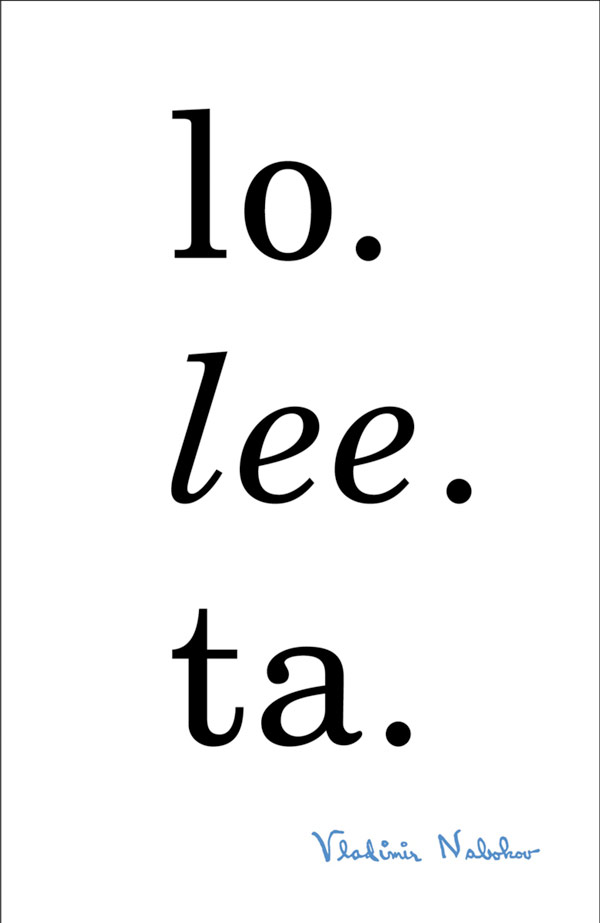
The results of a competition to design a better cover for Nabokov’s Lolita are being packaged into a book due out in June.
Among the problems Nabokov’s Lolita poses for the book designer, probably the thorniest is the popular misconception of the title character. She’s chronically miscast as a teenage sexpot-just witness the dozens of soft-core covers over the years. “We are talking about a novel which has child rape at its core,” says John Bertram, an architect and blogger who, three years ago, sponsored a Lolita cover competition asking designers to do better.
Now the contest is being turned into a book, due out in June and coedited by Yuri Leving, with essays on historical cover treatments along with new versions by 60 well-known designers, two-thirds of them women: Barbara deWilde, Jessica Helfand, Peter Mendelsund, and Jennifer Daniel, to name a few. They don’t shy away from frank sexuality, but they add layers of darkness and complication. And like Jamie Keenan’s cover — a claustrophobic room that morphs into a girl in her underwear — they provoke without asking readers to abdicate their responsibility.
Of the covers shown, Peter Mendelsund’s is a favorite:
GQ has an excerpt of Rosecrans Baldwin’s new book about the eighteen months he and his wife spent in Paris.
Bruno sat under a machine shaped like a palm tree that sucked up smoke. He lit a cigarette, unpopped a shirt button nonchalantly, ordered Sancerre, and began talking over my head. After fifteen minutes, I understood that he’d worked on the infant-nutrition project for eleven months, ever since he’d joined the agency. They’d gone through four copywriters in the same amount of time; I was number five.
Bruno said, Reservoir Dogs, did I know this film?
“Bien sur,” I said, adding, “Mr. Pink?”
“Okay, good,” Bruno said in English. “Then, Mr. Pink… do not be this. Do not be saying in the office, ‘Fuck, fuck, fuck.’”
Evidently Bruno had overheard me swearing. He wanted me to know that cursing wasn’t cool in Parisian office culture. It seemed to weigh on Bruno, speaking English like that, correcting my behavior. As though envisioning trials to come.
The book is called Paris, I Love You But You’re Bringing Me Down and is due out soooon.
Conor Friedersdorf has published his annual list of the best nonfiction writing from the past year.
Each year, I keep a running list of the most exceptional nonfiction that I encounter while publishing my twice-weekly newsletter The Best of Journalism. Along with my curating work for Byliner, this hoovering of great stories affords me the opportunity to read as many impressive narratives as any single person possibly can. The annual result is my Best of Journalism List, now in its fourth year. I could not, of course, read every worthy piece published during the year. But everything that follows deserves wider attention.
Journalist William Zinsser played a bit part in Stardust Memories, one of Woody Allen’s early films. He’d interviewed Allen early in the director’s career, ran into him in NYC, and got a call a week later from his assistant.
“Bill, honey?” said a young woman’s voice. “This is Sandra from Woody Allen’s office. Woody wondered if you’d like to be in his new movie.”
That was something new in phone calls. I had never done any acting or dreamed any theatrical dreams. But who didn’t want to be in a Woody Allen movie? I knew that he often cast ordinary people in small roles. What small plum did he have for me? I hesitated for a decently modest moment and then told Sandra I’d like to do it.
“Good,” she said. “Woody will be very pleased.” She said that someone else would be calling me with further details.
(via @coudal)
Brent Schlender interviewed Steve Jobs many times over the past 25 years and recently rediscovered the audio tapes of those interviews. What he found was in those years between his departure from Apple in 1985 to his return in 1996, Jobs learned how to become a better businessman and arguably a better person.
The lessons are powerful: Jobs matured as a manager and a boss; learned how to make the most of partnerships; found a way to turn his native stubbornness into a productive perseverance. He became a corporate architect, coming to appreciate the scaffolding of a business just as much as the skeletons of real buildings, which always fascinated him. He mastered the art of negotiation by immersing himself in Hollywood, and learned how to successfully manage creative talent, namely the artists at Pixar. Perhaps most important, he developed an astonishing adaptability that was critical to the hit-after-hit-after-hit climb of Apple’s last decade. All this, during a time many remember as his most disappointing.
The discussion of the lessons he took from Pixar and put into Apple was especially interesting.
And just as he had at Pixar, he aligned the company behind those projects. In a way that had never been done before at a technology company—but that looked a lot like an animation studio bent on delivering one great movie a year—Jobs created the organizational strength to deliver one hit after another, each an extension of Apple’s position as the consumer’s digital hub, each as strong as its predecessor. If there’s anything that parallels Apple’s decade-long string of hits—iMac, PowerBook, iPod, iTunes, iPhone, iPad, to list just the blockbusters—it’s Pixar’s string of winners, including Toy Story, Monsters, Inc., Finding Nemo, The Incredibles, WALL-E, and Up. These insanely great products could have come only from insanely great companies, and that’s what Jobs had learned to build.
Shot with a Phantom Flex at 2500 frames per second, this video shows stupid things happening in super slow motion, including Coke bottle & chainsaw and flour and candle. And lots of fireworks.
I was completely unprepared for what happened with the microwave and the bottle of red wine. (via devour)
Adam Mansbach will blurb your novel, but it’s gonna cost you. Here’s part of his price list:
You live in one of the following neighborhoods: Brooklyn Heights, Park Slope, Boerum Hill, Carroll Gardens, Williamsburg. (+$150)
You claim to be friends with a friend of mine, but that friend of mine hates you. (+$100)
The word after the gerund in your two-word title is a proper noun masquerading as a regular noun, i.e. “Losing Ground,” a novel about a man named Peter Ground. (+$250)
Your novel is a retelling of another novel from the perspective of a minor character, a piece of furniture, or a magical being who did not appear in the original. (+$275)
I literally LOL’d (LLOL?) at the last line. (via the blurb-worthy @tadfriend)
Rooftop Films is screening the first episode of Planet Earth (the Attenborough-narrated version) outside along the East River this Saturday, followed by the premiere of The Making of Planet Earth. Check here for times, location, etc.
Twitter has developed something called the Innovator’s Patent Agreement, which is an agreement between the company and its employees that their patents won’t be used in offensive lawsuits (as opposed to defensive lawsuits).
The IPA is a new way to do patent assignment that keeps control in the hands of engineers and designers. It is a commitment from Twitter to our employees that patents can only be used for defensive purposes. We will not use the patents from employees’ inventions in offensive litigation without their permission. What’s more, this control flows with the patents, so if we sold them to others, they could only use them as the inventor intended.
This is a significant departure from the current state of affairs in the industry. Typically, engineers and designers sign an agreement with their company that irrevocably gives that company any patents filed related to the employee’s work. The company then has control over the patents and can use them however they want, which may include selling them to others who can also use them however they want. With the IPA, employees can be assured that their patents will be used only as a shield rather than as a weapon.
Red Hat has had a similar policy in place for many years.

It’s viewscreens all the way down. (via george takei)
In a review of the Color Uncovered iPad app, Carl Zimmer highlights something I hadn’t heard before: Claude Monet could see in ultraviolet.
Late in his life, Claude Monet developed cataracts. As his lenses degraded, they blocked parts of the visible spectrum, and the colors he perceived grew muddy. Monet’s cataracts left him struggling to paint; he complained to friends that he felt as if he saw everything in a fog. After years of failed treatments, he agreed at age 82 to have the lens of his left eye completely removed. Light could now stream through the opening unimpeded. Monet could now see familiar colors again. And he could also see colors he had never seen before. Monet began to see — and to paint — in ultraviolet.
The condition is called aphakia.
This video is a visualization of the how ships moved goods and people around the world from the mid-18th century to the mid-19th century.
Here’s more on how it was done.
This shows mostly Spanish, Dutch, and English routes — they are surprisingly constant over the period (although some empires drop in and out of the record), but the individual voyages are fun. And there are some macro patterns — the move of British trade towards India, the effect of the American Revolution and the Napoleonic Wars, and so on.
There are times in the video when a single nation dominates all of the shipping traffic…the British in the early 1800s and the Dutch from the mid 1830s on.
In 2006, Garth Sundem and John Tierney published an equation in the NY Times that attempted to predict celebrity marriage crackups using a few metrics: age, fame, sexiness, etc. The pair recently modified the equation based on the evidence of the last five years and surprisingly, the equation is simpler.
What went right with them — and wrong with our equation? Garth, a self-professed “uber-geek,” has crunched the numbers and discovered a better way to gauge the toxic effects of celebrity. Whereas the old equation measured fame by counting the millions of Google hits, the new equation uses a ratio of two other measures: the number of mentions in The Times divided by mentions in The National Enquirer.
“This is a major improvement in the equation,” Garth says. “It turns out that overall fame doesn’t matter as much as the flavor of the fame. It’s tabloid fame that dooms you. Sure, Katie Holmes had about 160 Enquirer hits, but she had more than twice as many NYT hits. A high NYT/ENQ ratio also explains why Chelsea Clinton and Kate Middleton have better chances than the Kardashian sisters.”
Garth’s new analysis shows that it’s the wife’s fame that really matters. While the husband’s NYT/ENQ ratio is mildly predictive, the effect is so much weaker than the wife’s that it’s not included in the new equation. Nor are some variables from the old equation, like the number of previous marriages and the age gap between husband and wife.
Older posts






Socials & More