Harvard Business Review has compiled a list of breakthrough ideas for 2007. “Our annual survey of emerging ideas considers how nanotechnology will affect commerce, what role hope plays in leadership, and why, in an age that practically enshrines accountability, we need to beware of ‘accountabalism.’” The first idea on the list comes from Duncan Watts, whose research shows that it’s not so-called influentials who are responsible for driving cultural trends (as argued in The Tipping Point) but the presence of many ordinary people who are able to be influenced within a given social network.
Music industry: CD prices are being driven down by $9.99 albums on iTunes Music Store. “Physical retailers are pressuring the labels downward on price (of course, Wal-Mart is the biggest culprit) because they don’t want to be undercut by iTunes 9.99 on all single albums. We’re rapidly moving to a 9.99 world on the big sellers (the ones stocked in Target and Wal-Mart and Best Buy).”
A review of Nicholas Negroponte’s influential Being Digital, 12 years after its publication. “Page 204: Today a game like Tetris is fully understandable too quickly. All that changes is the speed. We are likely to see members of a Tetris generation who are much better at packing a station wagon, but not much more.” He wrong about Tetris *and* the future availability of station wagons. (via matt)
Flickr is switching their earliest members from a Flickr login to a Yahoo login and many of those folks are none too happy about it. Flickr is handling this tough situation very well, even though I’m personally disappointed at having to use Yahoo’s login myself. Few sites do customer service and community management better than Flickr…it’s impressive and inspiring to watch in action. They just tell people the truth, with humor, patience, and not too much spin…it’s as simple as that. (via waxy)
OhMiBod is the ultimate iPod accessory: a vibrator that hooks up to the iPod and buzzes in time with the music. “I will never listen to music the same way again.” Don’t miss the playlists compiled specifically for OhMiBod use. NSFW. (thx, tania)
Quick! Which photo sharing site community thingie is more popular: Fotolog or Flickr? You might be surprised at the answer…but first some history.
Fotolog launched in May 2002 and grew quite quickly at first. They’d clearly hit upon a good idea: sharing photos among groups of friends. As Fotolog grew, they ran into scaling problems…the site got slow and that siphoned off resources that could have been used to add new features to the site, etc. Problems securing funding for online businesses during the 3-4 years after the dot com bust didn’t help matters either.
Flickr launched in early 2004. By the end of their first year of operation, they had a cleaner design than Fotolog, more features for finding and organizing photos, and most of the people I knew on Fotolog had switched to Flickr more or less exclusively. They also had trouble with scaling issues and downtime. Flickr got the scaling issues under control and the site became one of the handful of companies to exemplify the so-called Web 2.0 revitalization of the web. The founders landed on tech magazine covers, news magazine covers, and best-of lists, the folks who built the site gave talks at technology conferences, and the company eventually sold to Yahoo! for a reported $30 million.
Fotolog eventually got their scaling and funding issues under control as well, but relative to Flickr, the site has changed little in the past couple of years. Fotolog has groups and message boards, but they’re not done as well as Flickr’s and there’s no tags, no APIs, no JavaScript widgets, no “embed this photo on your blog/MySpace”, and no helpful Ajax design elements, all supposedly required elements for a successful site in the Web 2.0 era. Even now, Fotolog’s feature set and design remains planted firmly in Web 1.0 territory.
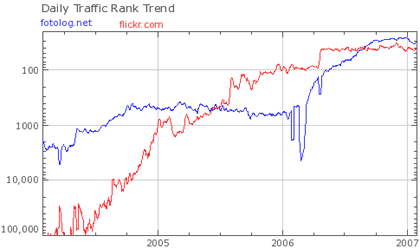
So. Then. Here’s where it gets puzzling. According to Alexa1, Fotolog is now the 26th most popular site on the web and recently became more popular than Flickr (currently #39). Here’s the comparison between the two over the last 3 years:
This is a somewhat stunning result because by all of the metrics held in high esteem by the technology media, Web 2.0 pundits, and those selling technology and design products & services, Flickr should be kicking Fotolog’s ass. Flickr has more features, a better design, better implementation of most of Fotolog’s features, more free features, critical praise, a passionate community, and access to the formidable resources & marketing power of Yahoo! And yet, Fotolog is right there with them. Perhaps this is a sign that those folks trapped in the Web 2.0 bubble are not being critical enough about what is responsible for success on the Web circa-2007. (As an aside, MySpace didn’t really fit the Web 2.0 mold either, nobody really talked about it until after it got huge, and yet here it is. And then there’s Craigslist, which is more Web 0.5 than 2.0, and is one of the most popular sites on the web. Google too.)
What’s going on here then? I can think of three possibilities (there are probably more):
1. Fotolog is very popular with Portugese and Spanish speakers, especially in Brazil. According to Wikipedia, almost 1/3rd of all Fotolog users are from Brazil and Chile. In comparing the two sites, what could account for this difference? Fotolog has a Spanish language option while Flickr does not (although I’m not sure when the Spanish version of Fotolog launched). Flickr is more verbose and text-intensive than Fotolog and much of Flickr’s personality & utility comes from the text while Fotolog is almost text-free; as a non-Spanish speaker, I could navigate the Spanish-language version quite easily. Gene Smith noted that a presentation made by a Brazilian internet company said that “Flickr is unappealing to Brazilians because they want to the customize the interface to express their individual identities”.
Cameron Marlow noticed that Orkut is set to pass MySpace as the world’s most popular social networking site (Orkut is also very popular in Brazil), saying that “Orkut’s growth reinforces the fact that the value of social networking services, and social software in general, comes from the base of active users, not the set of features they offer”. Marlow also notes that Alexa’s non-US reporting has improved over the past year, which might be the reason for Fotolog’s big jump in early 2006. If Alexa’s global reporting had been robust from the beginning, Fotolog may have been neck and neck with Flickr the whole time.
2. Flickr is more editorially controlled than Fotolog. The folks who run Flickr subtly and indirectly discourage poor quality photo contributions. Yes, upload your photos, but make them good. And the community reinforces that constraint to the point where it might seem restricting to some. Fotolog doesn’t celebrate excellence like that…it’s more about the social aspect than the photos.
3. Maybe tags, APIs, and Ajax aren’t the silver bullets we’ve been led to believe they are. Fotolog, MySpace, Orkut, YouTube, and Digg have all proven that you can build compelling experiences and huge audiences without heavy reliance on so-called Web 2.0 technologies. Whatever Web 2.0 is, I don’t think its success hinges on Ajax, tags, or APIs.
Update: You can see how much Fotolog depends on international usage for its traffic from this graph from Compete. They only use US statistics to compile their data. I don’t have access to the Comscore ratings, but they only count US usage and, like Alexa, undercount Firefox and Safari users. (thx, walter)
[1] Usual disclaimers about Alexa’s correctness apply. The point is that among some large amount of users, Fotolog is as popular (or even more) than Flickr. Whether those users are representative of the web as a whole, I dunno. ↩
Here’s a fun rumor. I heard that the staff of the Daily Show and Colbert Report upload the shows to YouTube as soon as they can after the shows air and then the next day, lawyers from Comedy Central hit YouTube with takedown requests for the uploaded shows. Which makes total sense…sort of. The people making the shows want them to be seen while the lawyers want to ensure that people are paying to see them. It’s a crazy media world we live in.
Update: A former Apple employee writes: “Almost all of the photos in iLife (the ones for the themes and so on) are from employees.” I was talking more about the Flickr part, but point taken.
Is it worth paying $700 for a bottle of wine? Well worth it, says Slate’s wine columnist, for the right bottle. “My father took a sniff of his glass, and he immediately registered a look of shock that called to mind the expression on Michael Spinks’ face when Mike Tyson first landed a glove on him in their 1988 title fight. Unlike Spinks, however, my father managed to remain upright. I took a sip of the wine and quickly pronounced the same verdict I had rendered 20 months earlier: ‘Holy shit.’”
An update on Bryant Simon, the fellow who’s studying Starbucks from around the world in order to write a book about the company. An observation from Britain: “Starbucks is dirtier in Britain. Americans have been taught to do part of the labour, and they clean up after themselves. In the US, part of Starbucks’ appeal is its cleanness.” 2006 New Yorker piece about Simon and his Temple University page. (via bb)
Map of the Land of Oz. “Oz is completely surrounded by deserts, insulating the country from invasion and discovery. The isolation may be splendid, it is not total: children from our world got through, as well as the Wizard of Oz and the more sinister Nome King. To prevent further incursions, Glinda created a barrier of invisibility around Oz.”
Reggie Watts, one-man sampling human beatbox. “None of this was manipulated by editing.” Be sure to catch the slow-motion bit starting around 3:18. I saw Reggie in person at PopTech 2006…very entertaining.
Top 10 most litigious US companies from 2001-2006 (based on trademark cases): 1. Microsoft. 2. Cendent. 3. Altria/Philip Morris. 4. Best Western. 5. Dunkin’ Donuts. 6. Lorillard Tobacco. 7. Levi Strauss. 8. Baskin-Robbins. 9. Chanel. 10. Nike. Found in the sidebar of this article on Levi Strauss suing other jeans companies for their triangle pockets.
In today’s NY Times, Robert Sullivan argues that NYC is falling behind the rest of America in making the city hospitable for pedestrians, cyclists, and takers of public transportation. “London now charges drivers a fee to enter the core business area, but here such initiatives are branded as anti-car, and thus anti-personal freedom: a congestion fee, critics say, is a tax on the middle-class car commuter. But as matters now stand, the pedestrian is taxed every day: by delays and emissions, by asthma rates that are (in the Bronx) as much as four times the national average. Though we think of it as a luxury, the car taxes us, and with it we tax others.”
Wikipedia explains R&B: “She orders a milkshake and begins to blow bubbles into it (a possible allusion to oral sex). She continues to prance throughout the restaurant and walks into the kitchen, ‘helping’ the chef remove biscuits from the oven as she purposely moves her buttocks (which the biscuits are shaped like) near his face to possibly make him wish to have sex with her, yet he shows no interest in her and she leaves in dismay.”
Steven Shapin reviews the history of vegetarianism, from Pythagoras to Hitler to organic Zambian green beans. “Recent epidemiological studies suggest that adult vegetarians tend to have lower blood pressure, lower cholesterol levels, lower rates of obesity, and, more controversially, higher childhood I.Q.s — though vegans tend to have lower I.Q.s than their carnivorous peers, and the nature of the links between vegetarianism, health, and I.Q. is unclear.”
Serious Eats is looking for a web designer who’s familiar with blogs, isn’t afraid of a little PHP code, and is located in (or is planning on relocating to) NYC. Serious Eats is a start-up that is focused on sharing food enthusiasm through blogs and online community. You’ll be working with a fine group of folks. SE is headed up by Ed Levine, who Gourmet editor-in-chief Ruth Reichl calls the “missionary of the delicious” and Meg Hourihan, who co-founded blogger.com and happens also to be married to me. Alaina Browne, formerly of A Full Belly and Mule Design, and Adam Kuban, pizza and burger expert, round out SE’s crew of passionate food people.
Fringe benefits: you can’t imagine all the culinary goodies that make their way into that office everyday. Meg comes home and casually says things like, “oh, we had a private tasting of the new Haagen-Dazs flavors in the office today” all the freaking time. If you’re a web designer with an interest in food, this is your place.
David Shenk is writing a book about genius, specifically “how science is unveiling a rich new understanding of talent, ‘giftedness,’ and brilliance — and the lessons we can all apply to our own lives”, and he’s using a blog to help him while he researches and writes it.
As promised, I’ve made some long overdue changes to the kottke.org RSS feeds and the remaindered links. I’ve combined the two kottke.org feeds — previously one contained main posts, movie posts, and book posts and the other contained the so-called remaindered links — into one feed, located here:
If you’re already subscribed to the main feed, you shouldn’t have to change a thing. If you’re subscribed to the remaindered feed, your newsreader (if it’s smart enough) should automatically and permanently redirect you to the new feed. If not, just change the subscription to point at the above feed. If you’re subscribed to both, unsubscribe from the remaindered feed. The new combined feed will mirror the front page of the site…whatever appears there will appear in the feed.
Second thing: the remaindered links are dead. Long live the remaindered links. Oh, they’re still here on the site, but it’s been a long time since they were just links…they’re more like mini posts with no titles — some of them are actually longer than the non-mini posts. The distinction made sense when they were included in the sidebar on the front page, but not anymore. Functionally that means no separate RSS feed, no separate archives, and no separate index page…they’re all gone (or will be soon). All the remaindered links posts are still available, but they’re in the main monthly archives now. The point is, you don’t need to worry about any of this. Just subscribe to the above feed or come to the front page each day and you’ll get everything that’s new on kottke.org everyday. Simple.
Things should have worked this way for, oh, the past two years, but I just never got around to changing it. What finally kicked my butt into action were two things that happened in the past two weeks. I had coffee with Cory Doctorow last weekend. He asked how things were going with kottke.org and remarked that I’m not posting nearly as much as I used to. I replied that I had been posting as much as ever, but got the feeling that Cory was only subscribed to the main RSS feed, which only accounted for about 15-20% of my total effort on the site. I wondered how many other people out there were only subscribed to the main feed and started to, oh, I guess “fret” is the right word.
Fret turned to panic when I checked my server logs. Bloglines sends along how many people are subscribed to an RSS feed in the user-agent string that’s deposited in the referer logs on the server, like so:
When I compared the number of subscribers to the main feed to the number subscribing to the remaindered feed, the main feed number was nearly 3 times higher. Even worse is when I looked at my server logs for the feeds (I stopped looking at my stats months ago)…visits to the main feed are outpacing visits to the remaindered feed 5:1. Which means that somewhere between 75-85% of the people who are reading kottke.org via RSS aren’t even getting most of what’s on the site! Which was dumb, dumb, dumb of me to let happen for all these months and why I’ve now corrected the situation. Interestingly, the stats from Rojo indicate the opposite situation…way more people are subscribed to the remaindered links feed than the main feed. Weird. (Another RSS stats tidbit: I’ve served up 58 gigabytes of RSS so far this month. That’s crazy!)
As always, your bug reports, questions, and concerns are appreciated and may be directed to [email protected].
Calvin Trillin, parallel parking expert, parks a self-parking car. “As you ease up gradually on the brake, the wheel turns on its own to make one reverse swoop into the spot. Watching the wheel turn by itself is a bit like watching a player piano, except in traffic.”
Long audio interview with Michael Lewis by economist Russ Roberts on “the hidden economics of baseball and football”. “Michael Lewis talks about the economics of sports — the financial and decision-making side of baseball and football — using the insights from his bestselling books on baseball and football: Moneyball and The Blind Side. Along the way he discusses the implications of Moneyball for the movie business and other industries, the peculiar ways that Moneyball influenced the strategies of baseball teams, the corruption of college football, and the challenge and tragedy of kids who live on the streets with little education or prospects for success.”
I don’t typically write about many new Web 2.0 products, but Do The Right Thing is doing something interesting. The site works on a modified Digg model. If you see a story you like, you click a button to declare your interest in it. But then you also rate the social impact of the subject of the story, either positive or negative. Over time and given enough users, you can look at all the stories about a company like Starbucks and see how they’re doing. This is something that people do when reading the news anyway — e.g. “I feel worse about Exxon Mobil because they outsourced 20,000 jobs to India” — and having them explicitly rate stories like this is a quick way of taking the temperature of the social climate around issues & companies and recording the results for all to see.
It would be interesting to see if people would be willing to specify some demographic information (provided that it’s not sold to a third party) like sex, age, race, religion, political party affiliation, and income bracket…that would allow the social impact data to be sliced and diced in interesting ways. Even without that data, the opportunities for data analysis are intriguing…like graphs of a company’s social impact over time.
When the Chicago Bears take the field against the Indianapolis Colts in early February for Super Bowl XLI, a former foe of the Bears will be close at hand. A kottke.org reader writes:
The “Super Bowl Shuffle” earned The Chicago Bears a [1987] Grammy nomination for best Best Rhythm & Blues Vocal Performance - Duo or Group. They lost to Prince and the Revolution’s “Kiss”.






Socials & More