kottke.org posts about video
A few months ago, I posted this video showing the restoration of a Hot Wheels car from 1971. Then today via Open Culture, I ran across the Rescue and Restore channel on YouTube, which takes rusty steel toys from as far back as the 1920s and restores them to like-new condition. Like this Tonka dump truck that I totally had when I was a kid. (Last I remember, mine was in better shape than this one, but not by much.)
It’s amazing how pristine the body is underneath all that paint and rust after he’s finished sandblasting it. Here’s a Tonka Jeep restoration:
These are surprisingly relaxing to watch, once you get past the somewhat traumatizing teardown phase.
From Evan Puschak, this explanation of how art went from almost fully representational painting to abstract impressionism in about 100 years is a 6-minute whirlwind tour of modern art, from Édouard Manet to Jackson Pollock’s drip paintings. I always love when Puschak dips back into art…the first video of ever posted of his was about Jacques-Louis David’s The Death of Socrates.
Saul Bass is one of the most celebrated designers of movie posters and title sequences in the short history of cinema. He created iconic poster designs for movies like Vertigo, The Shining, Anatomy of a Murder, and Schindler’s List. In this short film, we learn the strategy behind Bass’ designs: symbolize and summarize.
See also several rejected concepts by Bass for The Shining movie poster, with scribbled notes from Stanley Kubrick.
To celebrate their 50th anniversary, the Sesame Street gang dropped by NPR for one of their Tiny Desk Concerts. They sang the theme song, People In Your Neighborhood, and four other tunes.
See also this new six-part Jim Henson documentary. Oh and Philip Glass on Sesame Street.
Visual engineer Steve Giralt constructs bespoke robotic cameras to capture unusual scenes for TV commercials, many of which feature food. The behind-the-scenes videos of how these rigs are constructed and work are fascinating. These two short videos about Giralt’s work are a good place to start:
There are many more on his website and on Instagram, like the s’mores smush and burger flipping.
Defunctland has produced a six-part documentary series on Jim Henson. Each episode focuses on a different creative project that Henson did. Here’s the trailer:
The first four episodes are already out…here’s the second episode on Sesame Street:
You can watch the rest of them on YouTube.
Mario Royale (now renamed DMCA Royale to skirt around Nintendo’s intellectual property rights) is a battle royale game based on Super Mario Bros in which you compete against 74 other players to finish four levels in the top three. Here’s what the gameplay looked like when it was still Mario-branded:
Kotaku has coverage:
And because Mario Royale is partially a race, there are all sorts of ways to play. Do you try to get items and destroy the competition? Do you speedrun through levels? Do you take it steady and win through careful progress? These are all viable options. There’s a silliness here that makes each option a wacky spectacle, even as each option is also a worthwhile strategy. It only takes a handful of minutes to play a match, but you always walk away with a cool story.
Five years after The Atlantic published his The Case for Reparations, Ta-Nehisi Coates spoke before a House committee and once again made the case for the United States government making reparations for slavery. Here is Coates’ full opening statement, a succinct & powerful 5 minutes:
The matter of reparations is one of making amends and direct redress, but it is also a question of citizenship. In H.R. 40, this body has a chance to both make good on its 2009 apology for enslavement, and reject fair-weather patriotism, to say that this nation is both its credits and debits. That if Thomas Jefferson matters, so does Sally Hemings. That if D-Day matters, so does Black Wall Street. That if Valley Forge matters, so does Fort Pillow. Because the question really is not whether we’ll be tied to the somethings of our past, but whether we are courageous enough to be tied to the whole of them.
The Atlantic has the full text of his statement.
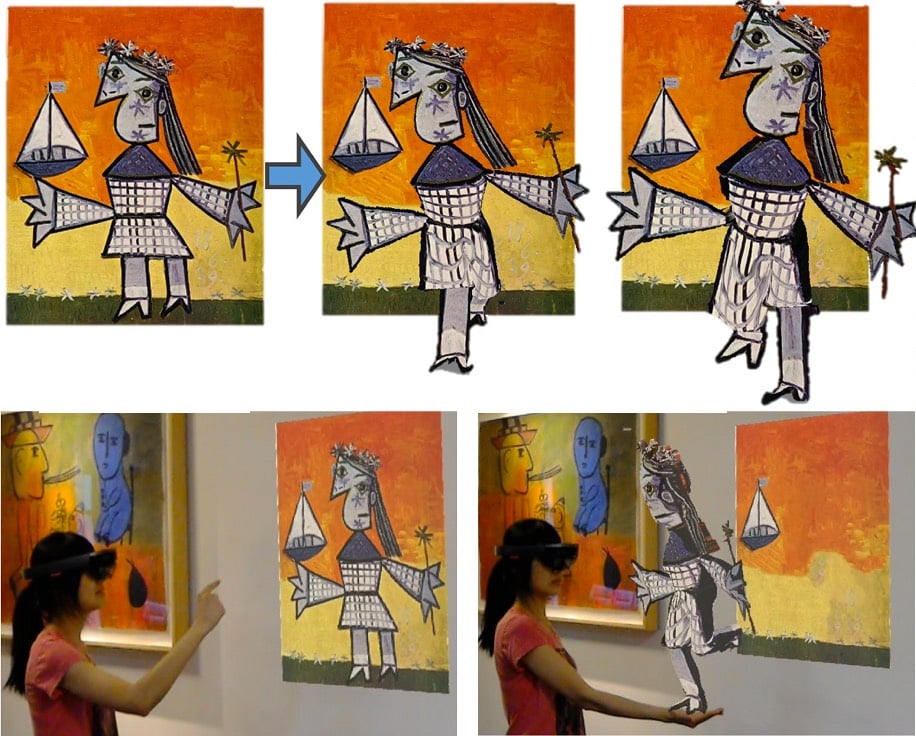
Researchers at the University of Washington and Facebook have developed an algorithm that can “wake up” people depicted in still images (photos, drawings, paintings) and create 3D characters than can “walk out” of their images. Check out some examples and their methods here (full paper):
The AR implementation of their technique is especially impressive…a figure in a Picasso painting just comes alive and starts running around the room. (thx nick, who accurately notes the Young Sherlock Holmes vibe)
The Cut asked 100 people what drugs they have done and this is what they said.
Lots of alcohol, weed, mushrooms, and molly. And one guy who smoked Altoids?
That’s My Jazz is a short documentary by Ben Proudfoot about world class pastry chef Milton Abel II, who reminisces about his father, Milton Abel Sr., a world class Kansas City jazz musician. The film is a tender and moving rumination on their relationship and the balance between achieving greatness in the world and being present in the lives of your loved ones.
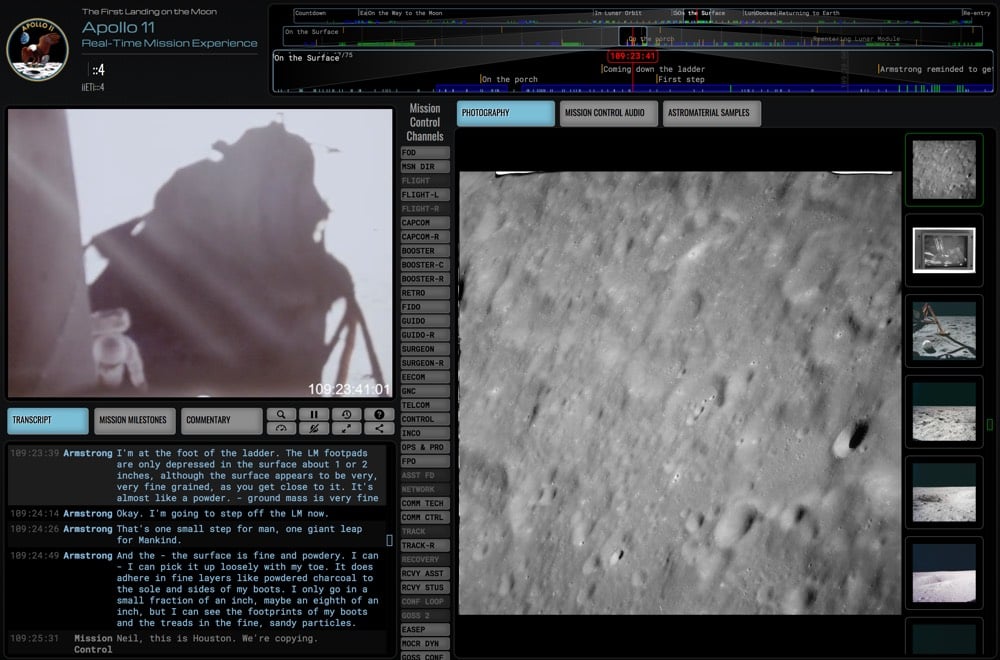
Well, this is just flat-out fantastic. Ben Feist and a team of collaborators have built Apollo 11 In Real Time, an interactive presentation of the first mission to land on the Moon as it happened.
This website replays the Apollo 11 mission as it happened, 50 years ago. It consists entirely of historical material, all timed to Ground Elapsed Time — the master mission clock. Footage of Mission Control, film shot by the astronauts, and television broadcasts transmitted from space and the surface of the Moon, have been painstakingly placed to the very moments they were shot during the mission, as has every photograph taken, and every word spoken.
You can tune in in real time beginning July 16th, watch/experience it right now from 1 minute before launch, or you can skip around the timeline to just watch the moments you want. As someone who has been hosting an Apollo 11 in real time thing for the past 9 years, this site makes me both ridiculously happy and a little bit jealous.
I’ve only ever seen footage of the first moonwalk in grainy videos as broadcast on TV, but this site shows it in the original resolution and it’s a revelation. Here’s the moonwalk, beginning with some footage of the folks in Mission Control nervously fidgeting with their hands (skip to 5:18:00 if the video doesn’t start there):
The rest of the video for the entire mission can be found here…what a trove. This whole thing is marvelous…I can’t wait to tune in when July 16th rolls around.
This is gold — a perfect 30 seconds of entertainment. I have watched this at least 10 times and Pee-Wee rolling around on the ground at the end cracks me up every time.
See also The “Welcome to Jurassic Park” Scene But With The Dinosaurs Digitally Removed and Jurassic Park but with the Dinosaurs from the 90s TV Show Dinosaurs.
The National Sound Library of Mexico says they have found the only known audio recording of Frida Kahlo’s voice. Take a listen:
The library have unearthed what they believe could be the first known voice recording of Kahlo, taken from a pilot episode of 1955 radio show El Bachiller, which aired after her death in 1954.
The episode featured a profile of Kahlo’s artist husband Diego Rivera. In it, she reads from her essay Portrait of Diego, which was taken from the catalogue of a 1949 exhibition at the Palace of Fine Arts, celebrating 50 years of Rivera’s work.
“He is a gigantic, immense child, with a friendly face and a sad gaze,” she says, as translated by Agence France-Presse. (A different English translation of the text can be found on Google Arts & Culture.)
Film footage of Kahlo is difficult to come by as well; I could only find these two clips:
The first video is in color and shows Kahlo and husband Diego Rivera in her house in Mexico City. The second shows Kahlo painting, drawing, and socializing with the likes of Leon Trotsky. At ~0:56, she walks quickly and confidently down the stairs of a ship, which is a bit surprising given what I’ve read about her health problems.
Update: According to this article (and its translation by Google), the voice on the recording isn’t Kahlo but belongs instead to actress Amparo Garrido:
Yes, I recognize myself. For me it was a big surprise because so many years had passed that I really did not even remember. […] When listening to this audio I remembered some things and I got excited because I did recognize myself.
(via @p_tricio)
Here is a video of Donald Trump, Vladimir Putin, Barack Obama, Kim Jong Un, and other world leaders lip-syncing along to John Lennon’s Imagine:
Of course this isn’t real. The video was done by a company called Canny AI, which offers services like “replace the dialogue in any footage” and “lip-sync your dubbed content in any language”. That’s cool and all — picture episodes of Game of Thrones or Fleabag where the actors automagically lip-sync along to dubbed French or Chinese — but this technique can also be used to easily create what are referred to as deepfakes, videos made using AI techniques in which people convincingly say and do things they actually did not do or say. Like this video of Mark Zuckerberg finally telling the truth about Facebook. Or this seriously weird Steve Buscemi / Jennifer Lawrence mashup:
Or Bill Hader’s face morphing into Arnold Schwarzenegger’s face every time he impersonates him:
What should we do about these kinds of videos? Social media sites have been removing some videos intended to mislead or confuse people, but notably Facebook has refused to take the Zuckerberg video down (as well as a slowed-down video of Nancy Pelosi in which she appears drunk). Congress is moving ahead with a hearing on deepfakes and the introduction of a related bill:
The draft bill, a product of several months of discussion with computer scientists, disinformation experts, and human rights advocates, will include three provisions. The first would require companies and researchers who create tools that can be used to make deepfakes to automatically add watermarks to forged creations.
The second would require social-media companies to build better manipulation detection directly into their platforms. Finally, the third provision would create sanctions, like fines or even jail time, to punish offenders for creating malicious deepfakes that harm individuals or threaten national security. In particular, it would attempt to introduce a new mechanism for legal recourse if people’s reputations are damaged by synthetic media.
I’m hopeful this bill will crack down on the malicious use of deepfakes and other manipulated videos but leave ample room for delightful art and culture hacking like the Hader/Schwarzenegger thing or one of my all-time favorite videos, a slowed-down Jeff Goldblum extolling the virtues of the internet in an Apple ad:
“Internet? I’d say internet!”
Update: Here’s another Bill Hader deepfake, with his impressions of Tom Cruise and Seth Rogen augmented by his face being replaced by theirs.
If you didn’t have the opportunity yesterday to watch Jon Stewart’s scathing and powerful opening statement before a House subcommittee about providing health benefits for surviving 9/11 first responders, you really should; it’s quite something:
As I sit here today, I can’t help but think what an incredible metaphor this room is for the entire process that getting healthcare and benefits for 9/11 first responders has come to. Behind me, a filled room of 9/11 first responders and in front of me a nearly empty Congress.
Shameful. It’s an embarrassment to the country and it is a stain on this institution. You should be ashamed of yourselves, for those that aren’t here, but you won’t be. Because accountability doesn’t appear to be something that occurs in this chamber.
On Twitter, archivist Jason Scott shared a cache of over 2300 photos taken by a worker at Ground Zero during the cleanup process in September & October 2001. These photos provide a unique and documentary view of the work being done there, work on behalf of Americans everywhere that this worker, and many others, paid for with his life. Scott:
So, it would probably be useful to interview the worker who took all these photos, who walked around the grounds, who captured these unique images of Ground Zero from all over the space, showing the effort being done to clear the wreckage.
Except we can’t.
He’s dead.


The parallels of all this to HBO’s Chernobyl miniseries is left as an exercise to the reader.
Update: The House subcommittee approved extending the compensation fund for 9/11 first responders until 2090. The bill is expected to pass a full House vote but the Senate is anyone (but Mitch McConnell’s) guess.
Update: For his efforts, one of the first responders gifted Stewart a firefighter’s jacket that belonged to a good friend of his, now deceased:
It’s hard to believe now, but television didn’t used to be a 24/7/365 affair. TV stations stopped broadcasting late at night and when they were off the air, they would commonly display a test pattern until programming resumed in the morning.
Used since the earliest TV broadcasts, test cards were originally physical cards at which a television camera was pointed, and such cards are still often used for calibration, alignment, and matching of cameras and camcorders.
From Wikimedia Commons and Present & Correct, here are some vintage test patterns:
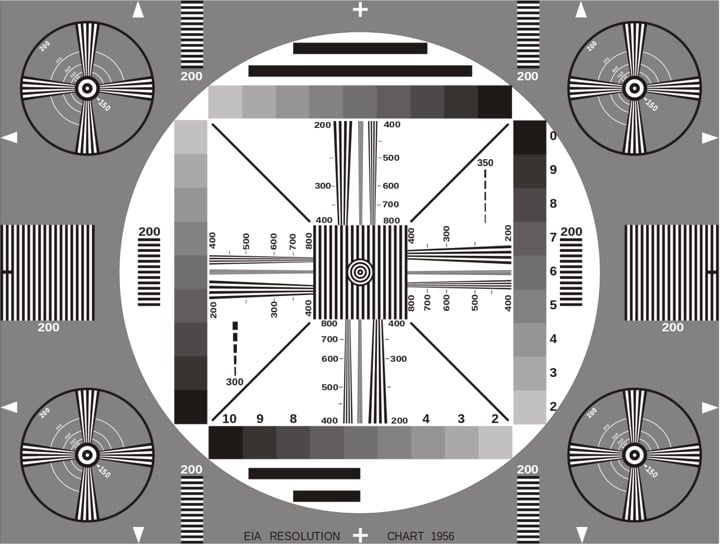

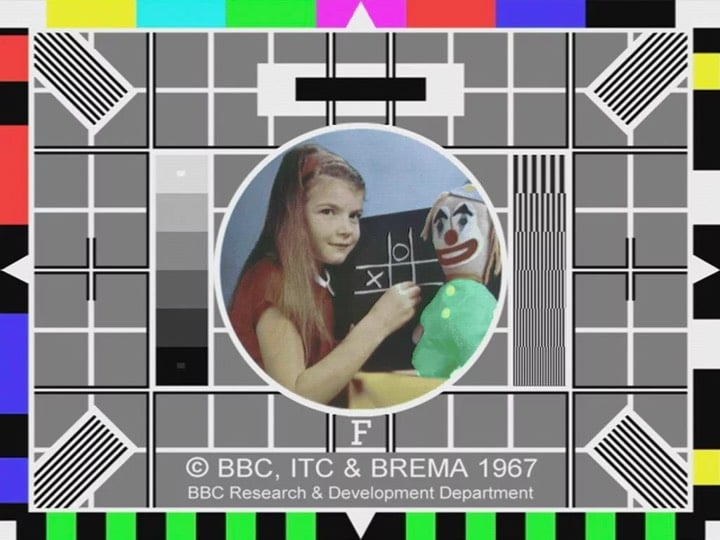

As you might expect, the BBC test card with the girl and clown has both a backstory and a cult following.
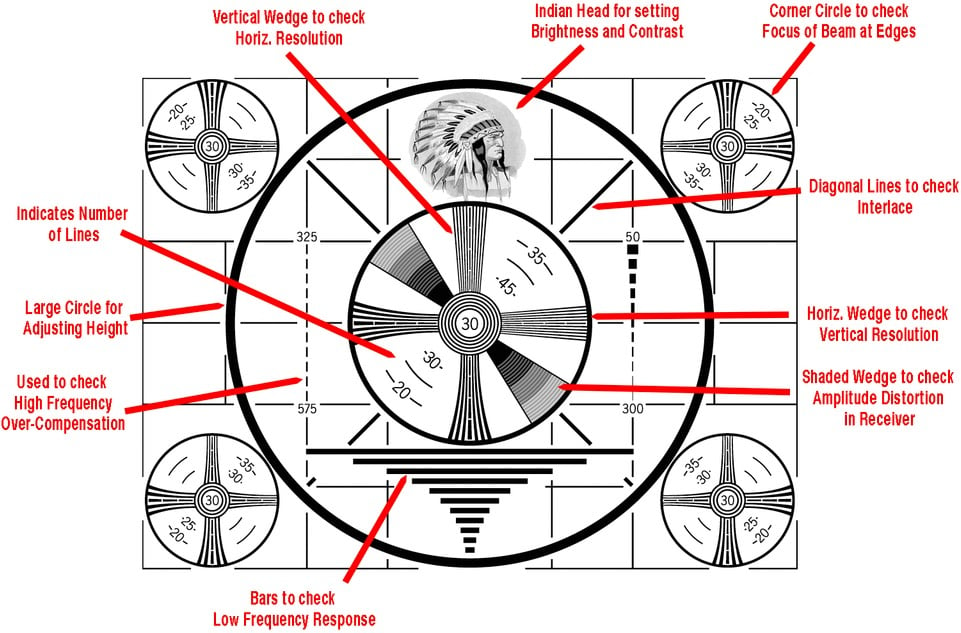
One of the most-used test images was RCA’s “Indian-head” test pattern:
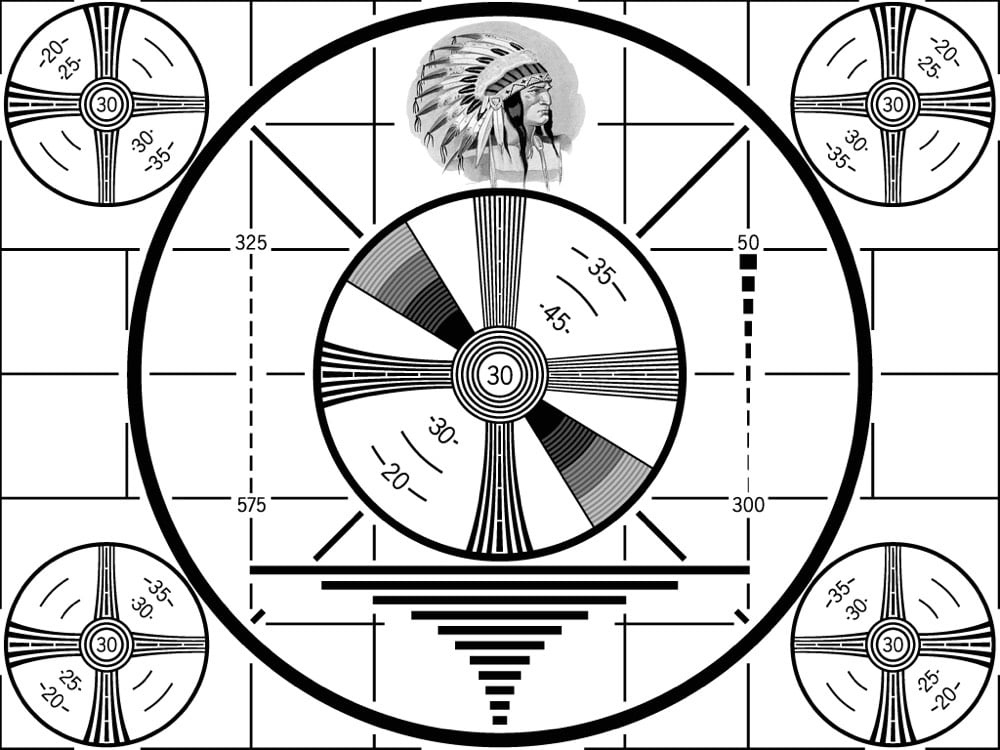
As this annotated version shows, each of the card’s elements had a specific testing purpose:
If you’re feeling extra nostalgic, here’s 36 minutes of vintage test patterns from all around the world:
The National Oceanic and Atmospheric Administration (NOAA) and Google have teamed up on a project to identify the songs of humpback whales from thousands of hours of audio using AI. The AI proved to be quite good at detecting whale sounds and the team has put the files online for people to listen to at Pattern Radio: Whale Songs. Here’s a video about the project:
You can literally browse through more than a year’s worth of underwater recordings as fast as you can swipe and scroll. You can zoom all the way in to see individual sounds — not only humpback calls, but ships, fish and even unknown noises. And you can zoom all the way out to see months of sound at a time. An AI heat map guides you to where the whale calls most likely are, while highlight bars help you see repetitions and patterns of the sounds within the songs.
The audio interface is cool — you can zoom in and out of the audio wave patterns to see the different rhythms of communication. I’ve had the audio playing in the background for the past hour while I’ve been working…very relaxing.
These YouTube goofballs built a xylophone that’s playable with die-cast cars.
Let’s play musical cars, shall we? A total of 374 black-and-white ‘65 Ford Mustangs hit some black-and-white xylophone keys to play the world’s first die-cast song.
Hot Wheels Xylophone would be a great band name too. (via bb)
In this video, you can watch a simple neural network learn how to navigate a video game race track. The program doesn’t know how to turn at first, but the car that got the furthest in the first race (out of 650 competitors) is then used as the seed for the next generation. The winning cars from each generation are used to seed the next race until a few of them make it all the way around the track in just the 4th generation.
I think one of the reason I find neural network training so fascinating is that you can observe, in a very simple and understandable way, the basic method by which all life on Earth evolved the ability to do things like move, see, swim, digest food, echolocate, grasp objects, and use tools. (via dunstan)
Oh just some flowers & plants casually strolling into my life every spring to brighten up my life after a long winter:
Watching that video almost makes me sneeze though too. From Universal Everything’s Superconsumers project…many more videos of walking things here and at Vimeo and Instagram.
Hey it’s been a little while since we checked in on Primitive Technology, so let’s see what everyone’s favorite jacked low-tech Aussie has been up to. For the past four years, this guy has been making huts, tools, weapons, furnaces, and other things in the jungle using only Stone Age tools and techniques. In his most recent video, he made some Polynesian arrowroot flour:
He’s also made some cement out of wood ash and terracotta:
And as part of his “ongoing quest to reach the iron age”, he used charcoal and iron bacteria to make small iron pellets:
You can check out his other projects on his YouTube channel.
Still Ill is a short documentary about the Beastie Boys’ career from approximately Paul’s Boutique to Ill Communication.
The 15-minute documentary tracks the Beastie Boys’ rejuvenation in the years after the release of 1989’s Paul’s Boutique — now considered a masterpiece but at the time a commercial flop — first with 1992’s Check Your Head and ultimately with Ill Communication, which produced the epic single and music video “Sabotage” and returned them to playing arenas.
Featuring interviews with Diamond and Horovitz from this March in Austin, Texas — as well as new interviews with keyboardist Mark “Money Mark” Nishita and producer Mario Caldato and rarely-seen 1990s footage of the band - Still Ill focuses heavily on late Beastie Boy Adam “MCA” Yauch and his contributions to Ill Communication. Through footage and the words of his friends, the documentary captures Yauch’s journey into activism, which would blossom with the Tibetan Freedom Concerts later in the decade, as well as his famous denunciation of misogyny in hip-hop on the single “Sure Shot”: “I want to say a little something that’s long overdue / The disrespect to women has got to be through / To all the mothers and sisters and the wives and friends / I want to offer my love and respect to the end.”
If you’re an Amazon Prime member or subscriber to Amazon Music, you can listen to a 40-minute mix of commentary from Mike D and Ad-Rock about Ill Communication and songs from the album.
In July, American Experience will air Chasing the Moon, a 6-hour documentary film about the effort to send a manned mission to the Moon before the end of the 1960s.
The series recasts the Space Age as a fascinating stew of scientific innovation, political calculation, media spectacle, visionary impulses and personal drama. Utilizing a visual feast of previously overlooked and lost archival material — much of which has never before been seen by the public — the film features a diverse cast of characters who played key roles in these historic events. Among those included are astronauts Buzz Aldrin, Frank Borman and Bill Anders; Sergei Khrushchev, son of the former Soviet premier and a leading Soviet rocket engineer; Poppy Northcutt, a 25-year old “mathematics whiz” who gained worldwide attention as the first woman to serve in the all-male bastion of NASA’s Mission Control; and Ed Dwight, the Air Force pilot selected by the Kennedy administration to train as America’s first black astronaut.
Among the stories not usually told about the Moon missions is that of Ed Dwight, NASA’s first black astronaut trainee:
Since 2019 is the 50th anniversary of the Apollo 11 mission, there’s a *lot* of stuff out there about the Space Race and Apollo program, but this film looks like it’s going to be one of the best. The film will start airing on PBS on July 8 and the Blu-ray & DVD comes out on July 9. There’s a companion book that will be available next week.
The BFI and the Royal Astronomical Society have recently rediscovered and restored a film taken in 1900 of a total solar eclipse. Here’s the minute-long film on YouTube:
The film was taken by British magician turned pioneering filmmaker Nevil Maskelyne on an expedition by the British Astronomical Association to North Carolina on 28 May, 1900. This was Maskelyne’s second attempt to capture a solar eclipse. In 1898 he travelled to India to photograph an eclipse where succeeded but the film can was stolen on his return journey home. It was not an easy feat to film. Maskelyne had to make a special telescopic adapter for his camera to capture the event. This is the only film by Maskelyne that we know to have survived.
The Royal Astronomy Society will be showing the film tomorrow May 31 at their HQ in London as part of their celebration of the centenary of the 1919 eclipse; free tickets available here.
See also my account of going to see the 2017 solar eclipse, one of the coolest things I’ve ever done. (via @UnlikelyWorlds)
The first trailer for The Dark Crystal: Age of Resistance, Netflix’s long-awaited prequel to Jim Henson’s The Dark Crystal, is finally here. From Vanity Fair:
The new series, which takes place years before the events of the original film, follows three creatures, called Gelfling, who discover the horrifying secret behind the power of a group of villainous critters called the Skeksis. The heroes — Taron Egerton’s Rian, Anya Taylor-Joy’s Brea, and Nathalie Emmanuel’s Deet — embark on an epic journey to ignite the fires of rebellion and save their world, which, at the time of the film, is dying, with sickness spreading across the land as the Skeksis control the powerful Crystal of Truth.
As you can see from the trailer, the series uses puppets and not CGI characters, just like the original. The 10-part series debuts on Netflix on August 30. In the meantime, the original 1982 movie is available on Netflix right now.
In the 1890s and 1900s, the Biograph Company sent film crews around the world to capture moving images to bring them to audiences that, up until this point, had no access to seeing what life was like outside of their own locales. This footage was acquired by MoMA in 1939 but not analyzed until recently.
This footage is astoundingly crisp and clear — one of the highlights is a short clip of Queen Victoria shot on a visit to Ireland in 1900, just a year before her death. In a shot starting at 1:45, the queen is seen sitting in a carriage, exchanging greetings with well-wishers, and wearing a pair of now-trendy tiny sunglasses.
In the moving image, you get so much more — even in something as brief as this — of the personality, the presence of this woman. This is the embodiment of the British Empire, here she is, an immediate connection with a figure that everyone would have known. She’d certainly been photographed but only when you see her like this, when she’s moving, when she’s alive, when she’s in the middle of a scene, do you get the sense of being in the same world with her and really connecting to that living being that was Queen Victoria.
The film images are so incredibly clear because Biograph shot them in 68mm at 30fps, aka “the IMAX of the 1890s”.
To avoid violating Edison’s motion picture patents, Biograph cameras from 1895-1902 used a large-format film, measuring 2-23/32 inches (68 mm) wide, with an image area of 2x2½ inches, four times that of Edison’s 35mm format. The camera used friction feed instead of Edison’s sprocket feed to guide the film to the aperture. The camera itself punched a sprocket hole on each side of the frame as the film was exposed at 30 frames per second. A patent case victory in March 1902 allowed Biograph and other producers and distributors to use the less expensive 35 mm format without an Edison license, although Biograph did not completely phase out 68 mm production until autumn of 1903.
Compare the Victoria clip above with one shot by British Pathé around the same time:
More than a century after the invention of moving images, I think we still somehow underestimate the power and impact of the connection of film & video. Even now, we thrill when we open up Instagram, TikTok, or Snapchat and “get the sense of being in the same world” (or even the same room) with people from around the world, living lives very different from our own. We may not experience the impact that early film audiences must have felt seeing their monarch in motion for the first time, but every video clip we see today is still a minor miracle, a time machine that brings far flung places, past & future, into our presence at the push of a button.
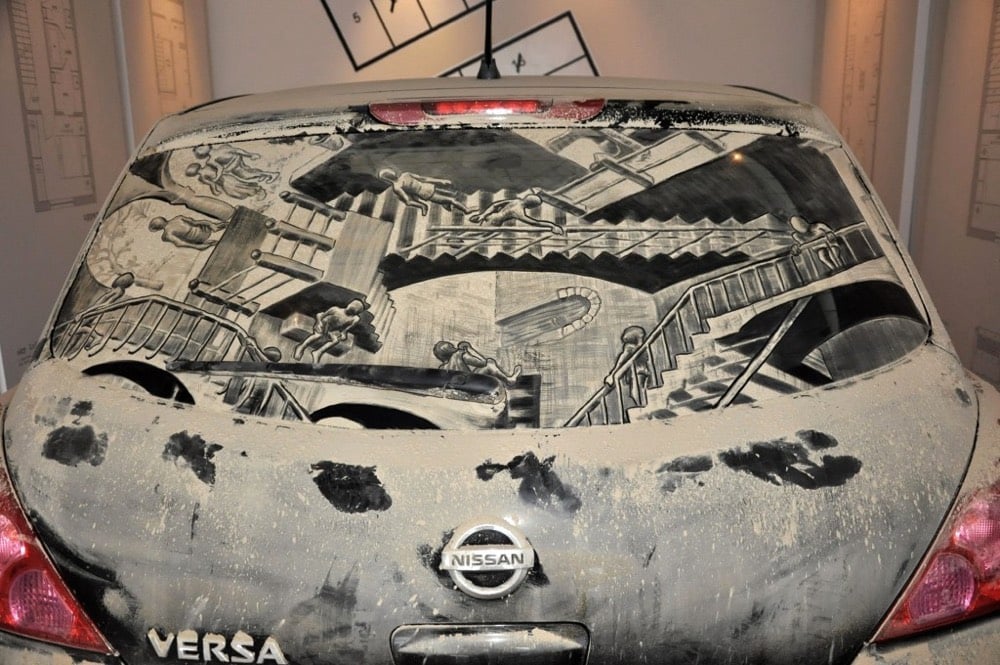
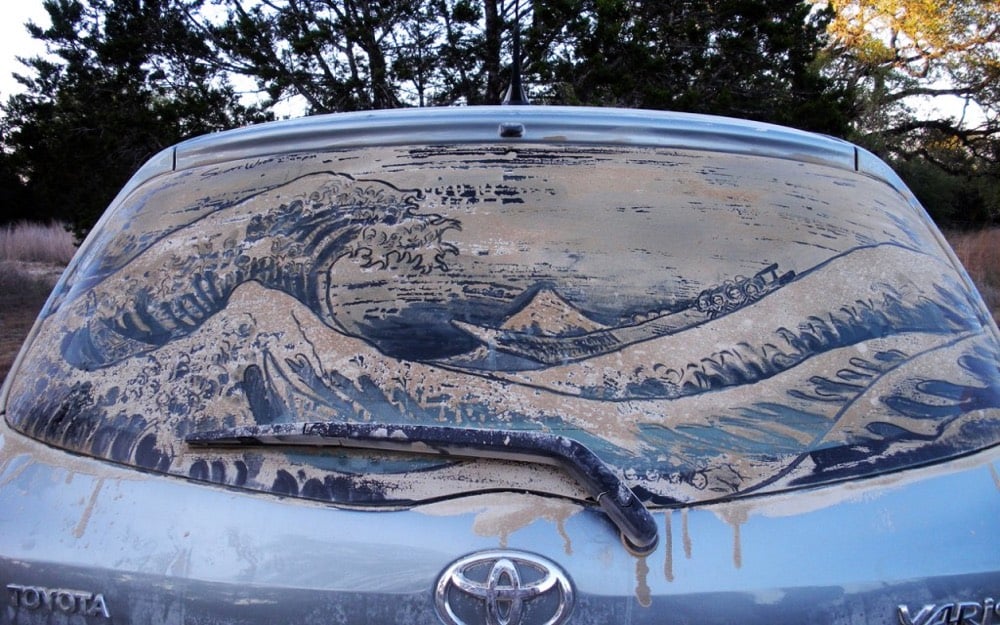
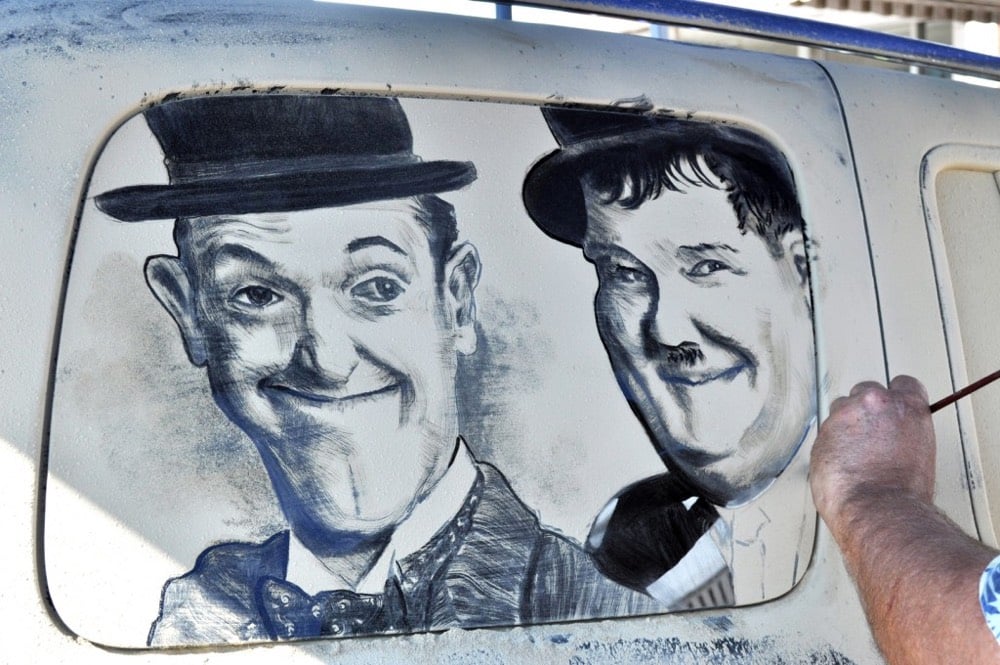
Scott Wade turns the dirty windows of cars into mobile art. Here’s a look at Wade in action:
This video is so far up my alley that I’m now charging it rent. (For parking in the alley. Yeah, I don’t know how metaphors work.) Anyway, this 20-minute film is a collection of photography of street scenes, from the very first photo ever taken of a person in 1838 (by Louis Daguerre) to a crowded market in Glasgow in 1869 to a ghostly Norwegian street scene in 1882 to NYC’s Mulberry St in 1900 to a newsie selling newspapers about the Titanic disaster in 1912 to more modern scenes, presented chronologically one photo per year. Along the way, you see the development of history, fashion, and technology — the people in the photos get crisper and clearer as shutters quicken and film improves.
My only complaint is that many of the photos after 1900 and into the 40s & 50s have been artificially colored…and distractingly so. Why not just feature the original B&W versions? Believe me, I understand the appeal & impact of seeing the past in color, but these colorized versions greatly detract from the historical value of this video. (via aeon)
I keep track of every media thing I “consume”, so here are quick reviews of some things I’ve read, seen, heard, and experienced in the past two months. I never wrote a proper report on my trip to Mexico City, so I put some of the highlights in here. I’m in the middle of several things right now. On TV, I’m watching Our Planet, In Search of Greatness, Street Food, Chernobyl, The Clinton Affair, Reconstruction: America After the Civil War, and This Giant Beast That is the Global Economy. I don’t normally watch 19 different things at one time, but life’s felt a little scattered lately. For books, I’m listening to Guns, Germs, and Steel by Jared Diamond on audiobook and I’m making good progress on Robert Caro’s Working (highly recommended).
The Silk Roads: A New History of the World by Peter Frankopan. Hard to summarize but there’s certainly something interesting on almost every page. (A-)
Fleabag. Bitingly funny and poignant, a real gem. (A+)
Skyscraper. Die Hard + the Sherlock Holmes story A Scandal in Bohemia + #sponcon for Big Duct Tape. I love a good disaster movie. (B+)
Mexico City. Great food, vegetation everywhere, beautiful architecture, culturally fascinating, super walkable/bikeable/scooterable. I am definitely visiting here again as soon as I can. (A)
Puyol Taco Omakase. Delicious & fun & a great experience, but I’m not sure the food was obviously so much better than some of the best street food I had in Mexico City. I had this same experience in Bangkok years ago…street food is tough to beat when there’s a thriving culture of markets, carts, and stalls. (B+)
The National Museum of Anthropology. One of my new favorite museums in the world. The only thing possibly more impressive than the collection is the architecture of the building. (A+)
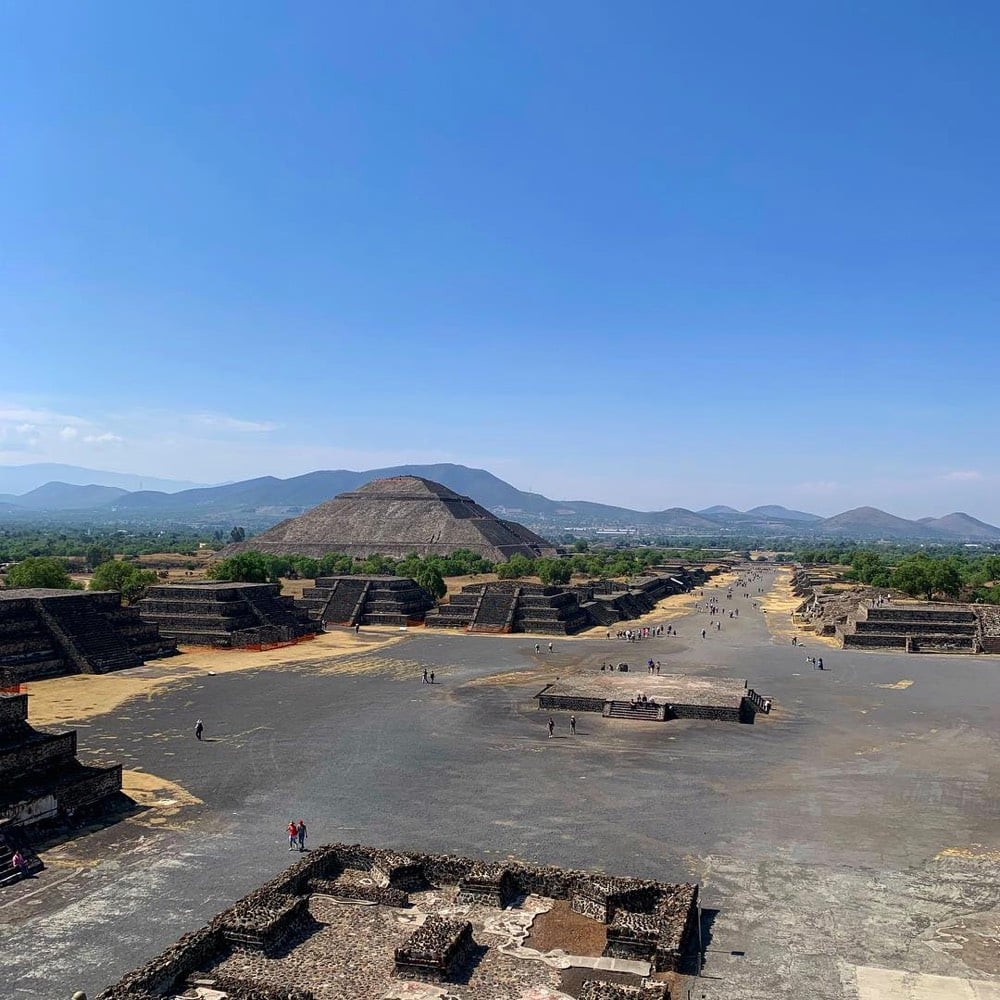
Teotihuacán. I had high hopes for this archeological site and I was still blown away by it. (A+)
AirPods. This is my favorite gadget in years, the first real VR/AR device that feels seamless (and not like a Segway for your face). The freedom of wireless headphones feels similar to when I first used a laptop, wifi, and dockless bike share. (A+)
Homecoming. So many things to love about this, but one of my favorites is the shots of the audience watching Beyoncé and the rare moments when she watches them back: “I see you.” And also the way they put a cohesive show together while showcasing individual talents and styles. (A-)
Homecoming: The Live Album. Come on, a marching band playing Beyoncé hits? That this works so well is a small miracle. (A-)
Avengers: Endgame. I liked but didn’t love it. It was like the ST:TNG finale and the Six Feet Under finale mashed together and not done as well. It also seemed too predictable. (B)
Avengers: Age of Ultron. Now that the Thanos narrative arc is complete, this is an underrated installment. (B+)
Casa Luis Barragán. This was like being in someone’s creative mind. The layering of the garden reminded me of Disney’s use of the multiplane camera in the forest scene in Bambi. (B+)
Gelatin Sincronizada Gelitin (NSFW). I was skeptical of this art performance at first — a bunch of half-naked people painting on a moving canvas using paintbrushes coming out of their butts — but it ended up being a really cool thing to experience. (B+)
Game of Thrones. I’m not quite as critical of the final season as everyone else seems to be. Still, it seems like since the show left the cozy confines of George RR Martin’s books, it has struggled at times. (B+)
Wandering Earth. Based on the short story by Liu Cixin (author of the Three Body Problem trilogy), this disaster movie is a little uneven at the start but finishes strong. (B)
Halt and Catch Fire Vol 2. The music was one of the many great things about this show. (A-)
Running from COPS. A podcast about how media and law enforcement in America intersect to great and terrible effect. (B+)
Eating bugs. I tasted crickets, grasshoppers, and grubs at the market: mostly just salty. I had beef tartare and guacamole with grasshoppers on it. They added a nice crunch to the guac. Wouldn’t exactly go out of the way for them, but they weren’t bad. (B)
Panaderia Rosetta. Did I have one of the best pain au chocolat I’ve ever had here? Yes. Yes, I did. Also extremely delicious: everything else I tried. (A-)
Against the Rules. A podcast from Michael Lewis about what’s happening to the concept of fairness in America. The episode about Salvator Mundi, the supposed Leonardo masterpiece, is particularly interesting. (A-)
Tolkien: Maker of Middle-earth. I have a new appreciation of how much Tolkien did in creating his books: writing, map making, world building, art, constructing languages. (B+)
Frida Kahlo’s Blue House. A striking house with a lush courtyard, but the highlight was seeing Kahlo’s work area much the way she left it when she died. (B+)
Street Food Essentials by Club Tengo Hambre. Mexico City is a huge place with so much to do that I wanted to hit the ground running right away, so I booked this street food tour. Definitely a good idea. We sampled so many different kinds of tacos & gorditas & quesadillas that I lost count. Highlights: huitlacoche quesadillas, al pastor tacos, fresh Oaxaca cheese at the Mercado de San Juan, and the blue corn masa used to make tlacoyos at one of our last stops — probably the best tortilla I’ve ever eaten. (A-)
The Matrix. This came out 20 years ago. I watched it with my 11-yo son the other day and he thought the special effects “held up pretty well”. (A)
Electric scooters. I used the Lime dockless electric scooters for the first time when I was in Mexico City and I loved experience. Easier than a bike and a fun & fast way to get around the city. Cons: the combo of the speed & small wheels can be dangerous and cities generally don’t have the infrastructure to accommodate them yet. (B+)
Paprika. Inventive and visually dazzling. Purportedly an influence on Christopher Nolan’s Inception. (B+)
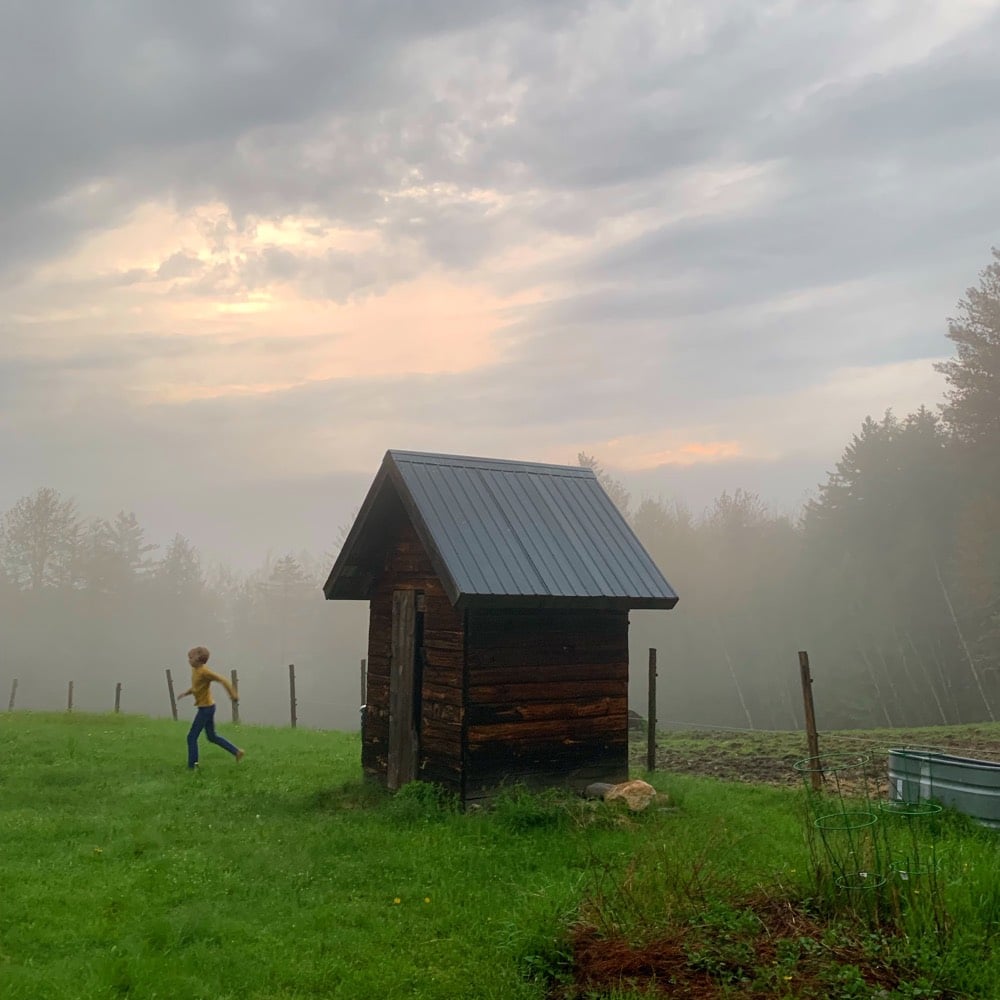
Oh and just because, here’s a photo I took recently in my backyard that makes it seem like I live in Narnia or The Shire:
Past installments of my media diet are available here.
Newer posts
Older posts



Socials & More