kottke.org posts about video
I bet you don’t think about wicker furniture that much, but Estelle Caswell does. In this video, which proves that almost anything can be interesting if the right person looks at it from the right angle, she explores how the peacock wicker chair became an unlikely pop culture icon.
The golden age of album cover design doesn’t have a specific start and end date, but many regard the late 1960s to 1970s as one of the field’s most exciting times. From the psychedelic rock covers of the ’60s to glistening airbrush covers of the ’70s, the era was a kaleidoscope of colors worthy of placement in modern art museums.
But there’s one genre of cover so ubiquitous it almost flew under the radar. The covers typically featured a wide shot of the artist sitting on a throne-like wicker chair, like a king or queen. Usually, the artist looked casual and relaxed; sometimes props would sit around them to decorate the scene. No matter what, the oversized woven chair was the main feature. This was the peacock chair album cover, and it was everywhere: Dolly Parton, Al Green, and Cher all sat in it.
Master cinematographer Roger Deakins has teamed up with director Sam Mendes on 1917, a WWI thriller that follows two soldiers tasked to deliver a message to the front lines to save the lives of thousands of men. To create a more immersive feeling, they decided to present the action of the movie in real-time and pieced together many long takes to make it seem as though the film is a single continuous 2-hour-long shot. In the video above, the filmmakers give us a behind-the-scenes look at how that impressive undertaking was accomplished.
With the emphasis on time as the film’s organizing principle, it’s not difficult to see the influence of Christopher Nolan’s Dunkirk here. Even the watch-ticking music in the trailer for 1917 is similar to Hans Zimmer’s score for Dunkirk. (via @jayjrendon)
Chicago mashup masters The Hood Internet have been pretty quiet lately — their last mixtape was released more than two years ago. But in the west, a shadow stirs… In the same vein as their 40 Years of Hip Hop video, the duo has released a musical tribute to 1979, combining 50 songs released that year into a tight 3-minute mix.
Their plan is to release a new video each week in October that will cover the subsequent four years, 1980-1983.
Update: Here is their video for 1980. I’ll share the rest of them as they post.
Here are 1981, 1982, and 1983:
A chap named Brendan Carey took footage from the 1970 animated movie The Aristocats and dubbed over Lizzo’s Truth Hurts to make this tiny masterpiece.
See also what is arguably the best video of this genre, Bert & Ernie doing M.O.P.’s Ante Up.
Pixar is always trying to push the envelope of animation and filmmaking, going beyond what they’ve done before. For the studio’s latest release, Toy Story 4, the filmmakers worked to inject as much reality into the animation as possible and to make it feel like a live-action movie shot with real cameras using familiar lenses and standard techniques. In the latest episode of Nerdwriter, Evan Puschak shares how they did that:
As I learned when I visited Pixar this summer,1 all of the virtual cameras and lenses they use in their 3D software to “shoot” scenes are based on real cameras and lenses. As the first part of the video shows, when they want two things to be in focus at the same time, they use a lens with a split focus diopter. You can tell that’s what they’re doing because you can see the artifacts on the screen — the blurring, the line marking the diopter transition point — just as you would in a live-action film.
They’re doing a similar thing by capturing the movement of actual cameras and then importing the motion into their software:
To get the motion just right for the baby carriage scene in the antique store for TS4, they took an actual baby carriage, strapped a camera to it, plopped a Woody doll in it, and took it for a spin around campus. They took the video from that, motion-captured the bounce and sway of the carriage, and made it available as a setting in the software that they could apply to the virtual camera.
Now, this is a really interesting decision on Pixar’s part! Since their filmmaking is completely animated and digital, they can easily put any number of objects in focus in the same scene or simply erase the evidence that a diopter was used. But no, they keep it in because making something look like it was shot in the real world with real cameras helps the audience believe the action on the screen. Our brains have been conditioned by more than 100 years of cinema to understand the visual language of movies, including how cameras move and lenses capture scenes. Harnessing that visual language helps Pixar’s filmmakers make the presentation of the action on the screen seem familiar rather than unrealistic.
In a 2010 interview with the BBC, Alan Rickman talked about the importance of listening as an actor:
You only speak because you wish to respond to something you’ve heard. So the notion of an actor going away and looking at a speech they have in their bedroom alone at night is a complete nonsense to me. What you have to say is completely incidental. All I want to see from an actor is the intensity and accuracy of their listening. And then what you have to say will become automatic.
I love that — “the intensity and accuracy of their listening”. It seems like good advice not only for actors but for other professions and personal relationships. How accurate is your listening? (via @tedgioia)
Artist Banksy has opened a storefront in the South London borough of Croydon called Gross Domestic Product. It’s literally a storefront and not a store…you can’t go in and buy anything. Here’s a quick tour:
The impetus behind the store, aside from the artist’s continuing discourse with capitalism, is to help settle a legal dispute with a greeting card company:

This post from Colossal has a bunch more information on the project.
The temporary installation, which will be on view for two weeks in the Croydon neighborhood, incorporates multiple window displays for a shop that is not in fact open to passersby. However, some of the items on display are available for purchase in GDP’s associated online store including the welcome mats, which Banksy hired refugees in Greek detainment camps to stitch; all proceeds go back to the refugees. Revenue from sales of the doll sets will also support the purchase of a replacement boat for activist Pia Klemp, whose boat was confiscated by the Italian government. The product line is rounded out with such oddities as disco balls made from riot gear helmets, handbags made of bricks, and signed — and partially used — £10 spray paint cans.
No fooling, I would love to cop one of those used spray paint cans.
p.s. Does anyone remember Grot, the shop Reggie opens in The Fall and Rise of Reginald Perrin? For some reason, Banksy’s shop reminds me of that.
Ants are fascinating. They’re small and individually dumb, but together they can form very complex societies capable of activities like farming and altering entire ecosystems. In this video, Kurzgesagt shows how the Argentine ant became one of the most numerous and successful species of ant in the world, forming a single mega-colony across the entire Earth, from Argentina to the US to Japan.
“The enormous extent of this population is paralleled only by human society,” the researchers write in the journal Insect Sociaux, in which they report their findings.
However, the irony is that it is us who likely created the ant mega-colony by initially transporting the insects around the world, and by continually introducing ants from the three continents to each other, ensuring the mega-colony continues to mingle.
“Humans created this great non-aggressive ant population,” the researchers write.
In this quick animated excerpt of a longer talk, political philosopher Michael Sandel critiques the idea of the meritocracy, the notion that innate talent and hard work are the main drivers of personal success and “the smug conviction of those who land on top that they deserve their fate”.
A lively sense of the contingency of our lot conduces to a certain humility. The idea that ‘there but for the grace of God, or the accident of fortune, go I’. But a perfect meritocracy banishes all sense of gift or grace or luck; it diminishes our capacity to see ourselves as sharing a common fate. And so, it leaves little room for the solidarity that can arise when we reflect on the contingency of our talents and fortunes. This is what makes merit a kind of tyranny.
Sandel’s full talk, A New Politics of Hope, is available online here.
P.S. A reminder that the term “meritocracy” was originally a satirical term invented by writer Michael Young in 1958 to describe a dystopian society. He is disappointed to see how people now wear the term as a badge of honor.
The business meritocracy is in vogue. If meritocrats believe, as more and more of them are encouraged to, that their advancement comes from their own merits, they can feel they deserve whatever they can get.
They can be insufferably smug, much more so than the people who knew they had achieved advancement not on their own merit but because they were, as somebody’s son or daughter, the beneficiaries of nepotism. The newcomers can actually believe they have morality on their side.
(via open culture)
Watch as MoMA art conservator Diana Hartman repairs some weak spots of Paula Modersohn-Becker’s 1907 self-portrait. The painting is still on the artist’s original canvas stretchers, so Hartman can’t access the back of the canvas during the repair process. So she employs a tiny curved needle made for doing eye surgeries to gently darn with some linen thread.
The first thing I like to do when I sit down is just get my tools. No tools displayed on this tray were made specifically for conservation.
Watching someone tend to a treasured object with such devotion is quite relaxing, perhaps because it’s comforting to imagine ourselves being treated with equal concern by those around us. (via colossal)
In this video, CGP Grey investigates fast and not-so-fast methods for boarding commercial airline flights. Most airlines board passengers using the relatively slow back-to-front method — with a bit of the even slower front-to-back method at the start for first, business, premium economy, and frequent flying passengers — even though boarding in a random order would be quicker. In 2008, physicist Jason Steffen determined the optimal boarding method, which involves passengers boarding in a precise order to minimize people waiting for other people putting their luggage in the overhead bin.
(Note: This post contains images of simulated crime scenes.) Frances Glessner Lee is known as “the mother of forensic science” for her role in revolutionizing how crimes were investigated. Starting in the 40s and using her skills in making miniature models that she learned as a young girl, Lee built detailed and intricate crime scene dioramas to help train homicide investigators to properly investigate and canvas a crime scene. From a Smithsonian exhibition of Lee’s work:
At the time, there was very little training for investigators, meaning that they often overlooked or mishandled key evidence, or irrevocably tampered with crime scenes. Few had any medical training that would allow them to determine cause of death. As Lee and her colleagues at Harvard worked to change this, tools were needed to help trainees scientifically approach their search for truth. Lee was a talented artist as well as criminologist, and used the craft of miniature-making that she had learned as a young girl to solve this problem. She constructed the Nutshells beginning in the 1940s to teach investigators to properly canvass a crime scene to effectively uncover and understand evidence. The equivalent to “virtual reality” in their time, her masterfully crafted dioramas feature handmade objects to render scenes with exacting accuracy and meticulous detail.
Every element of the dioramas — from the angle of minuscule bullet holes, the placement of latches on widows, the patterns of blood splatters, and the discoloration of painstakingly painted miniature corpses — challenges trainees’ powers of observation and deduction. The Nutshells are so effective that they are still used in training seminars today at the Office of the Chief Medical Examiner in Baltimore.
Here are some images of Lee’s surviving dioramas (found here):
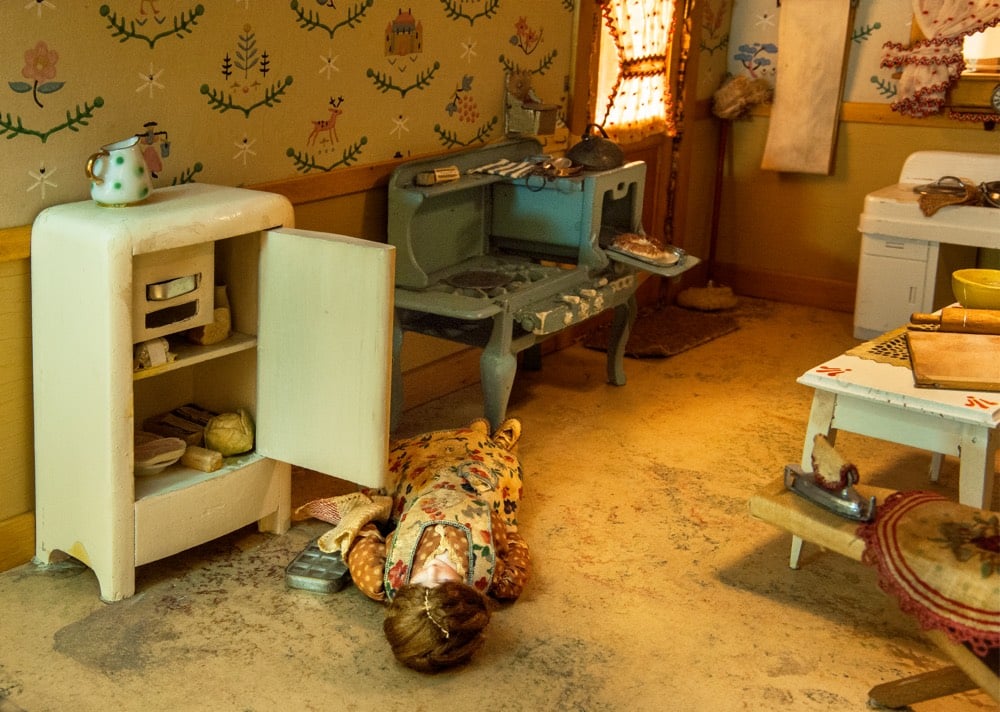
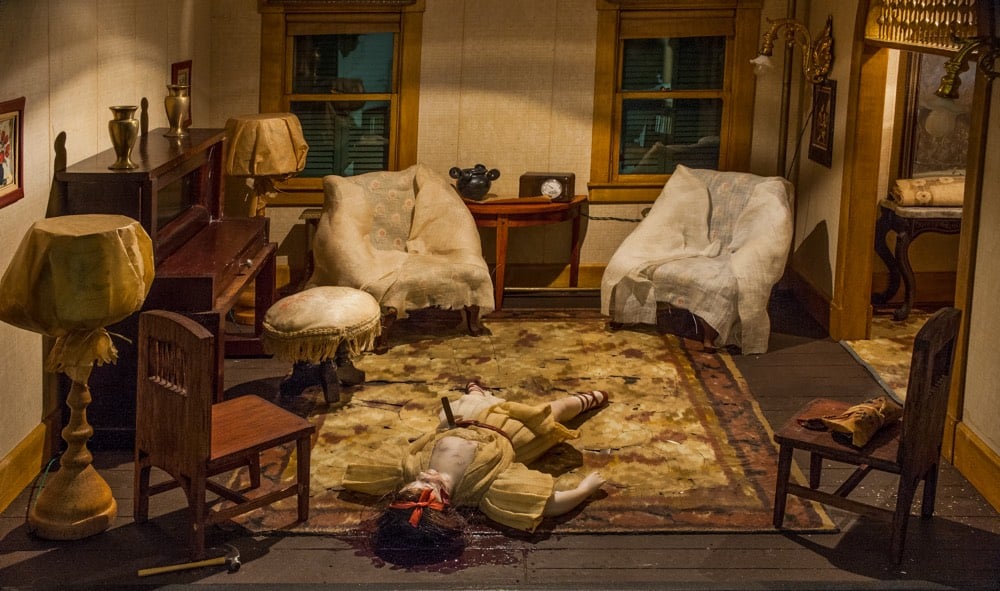
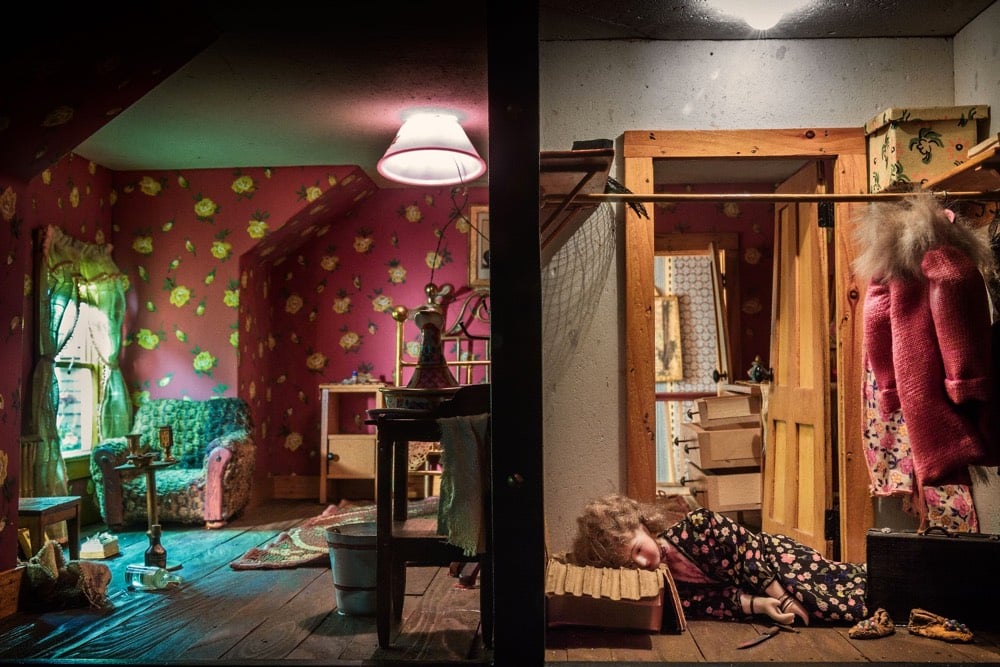
In a video about the Smithsonian exhibition, curator Nora Atkinson explains that it shows how Lee “co-opted traditionally feminine crafts to advance the male-dominated field of police investigation”:
See also this Vox video about Lee’s work, which goes into detail about the evidence at a couple of the crime scenes:
Legendary skater Tony Hawk breaks down 21 increasingly complex skateboarding tricks, from a standard ollie to a kickflip to a McTwist to a 1080 to a couple of tricks that have never been done. As someone who has always been in awe of what skaters can do but hasn’t logged much on-board time myself, I learned a lot from this.
See also a beginning skater learning how to do a kickflip in under 6 hours.
Curious about the social behaviors of cephalopods, marine biologist David Scheel brought an octopus named Heidi home to live with him and his teenaged daughter. In this clip from an upcoming PBS show called Octopus: Making Contact, you can see the octopus changing colors while colors while she sleeps, which Scheel speculates is due to actions happening in the octopus’s dream.
If she is dreaming, this is a dramatic moment. You can almost just narrate the body changes and narrate the dream. So here she’s asleep and she sees a crab and her color starts to change a little bit. Then she turns all dark; octopuses will do that when they leave the bottom. This is a camouflage, like she’s just subdued a crab and now she’s going to sit there and eat it, and she doesn’t want anyone to notice her.
This program already aired in the UK with the much snappier title of The Octopus in My House; check out a review here.
Heidi loves to play. Given a toy (an old pill bottle, say), she hurls it round as if it were a swimming aid, and she a toddler newly out of water wings. Scheel has trained her so effectively to pull on a string that activates a buzzer that in the end he has to dismantle the thing if he wants to get a night’s sleep. She loves to touch and be touched, entwining her arms with those of Laurel for minutes at a time. Does she recognise her owners? Indubitably. When Scheel approaches the tank as himself, she rushes to its side, as if in greeting. But when he approaches disguised in a rubber mask, she hides.
(thx, dunstan)
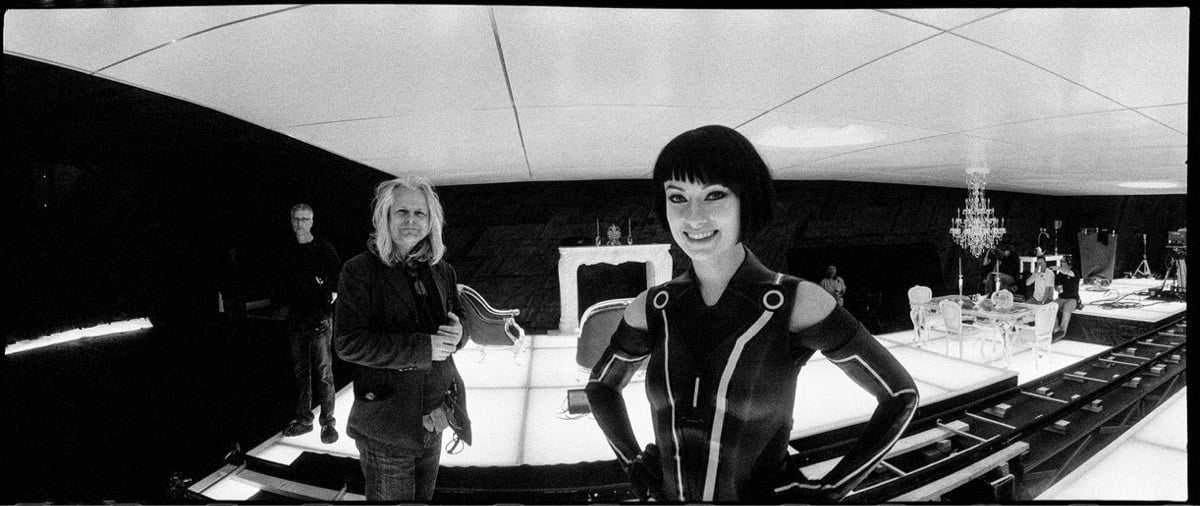
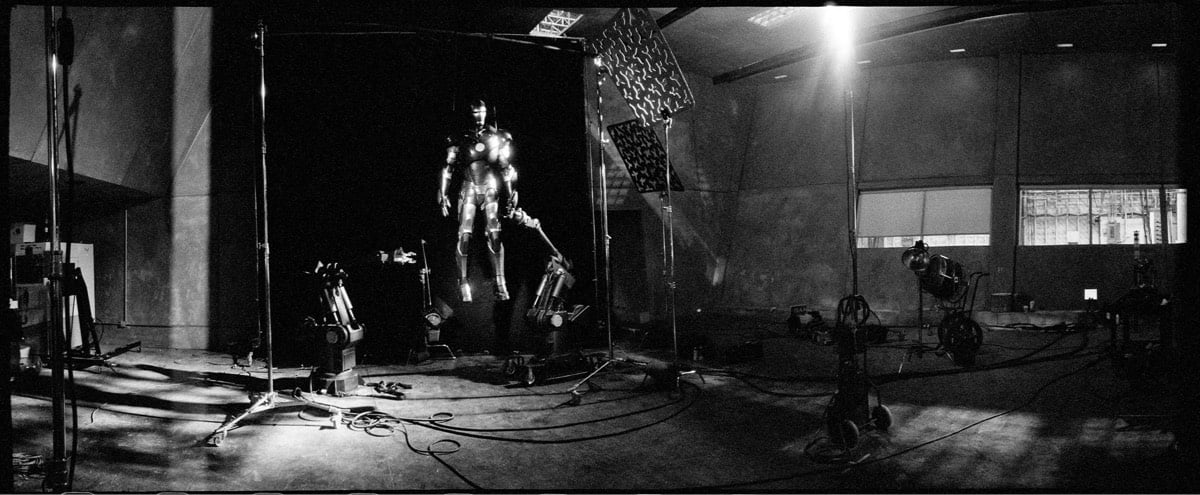
Ever since Starman in 1984, Jeff Bridges has taken photos on the set of every film he’s acted in using his Widelux F8 camera. Sometimes he compiles them into picture books for the cast and crew. Sometimes he posts them to his charmingly old school website. And sometimes he compiles them into coffee table books that you and I can have in our homes. Nick Chen recently interviewed Bridges about his photography.
Dazed: You did The Big Lebowski and True Grit with the Coen Brothers. What do they make of your photography?
Jeff Bridges: I think they get a kick out of it. They’re pretty cool cats. They don’t go overboard with praise or anything. They’re certainly wonderful to work with, and they’re true masters, so I was happy that they gave a stamp of approval on my book. That was nice.
Dazed: Does Roger Deakins ever want a co-credit for doing the lighting?
Jeff Bridges: (laughs) No, he did not ask me. But wow, talk about masters. Isn’t he terrific? My God, he does it just right.
Pictures by Jeff Bridges was released in 2003 and now a follow-up is coming out in mid-October 2019: Jeff Bridges: Pictures Volume 2. (thx, david)
Update: The International Center of Photography honored Bridges with an award in 2013 and produced this video about his photography.
Boston Dynamics programmed their Atlas robot to do a gymnastics routine.
I lost it when it did that little jump split at about 13 seconds in. That looked seriously human in a deeply unsettling way.
Every month or two for the past couple of years, I’ve shared the movies, books, music, TV, and podcasts I’ve enjoyed (or not) recently. Here’s everything I’ve “consumed” since late June. I’d tell you not to pay too much attention to the letter grades but you’re going to pay too much attention to the letter grades anyway so… (p.s. This list was shared last week in Noticing, kottke.org’s weekly newsletter.)
Fiasco (season one). Slow Burn co-creator Leon Neyfakh explores the Florida recount in the 2000 Presidential election. My key takeaway is not that anyone stole the election but that any halfway close election in the US is fundamentally unfair, can easily be swayed in one direction or another, and violates our 14th Amendment rights. I didn’t enjoy this as much as either season of Slow Burn…perhaps it was too recent for me to emotionally detach. (B+)
The Impossible Whopper. All the people saying that the Impossible patty tastes just like a real burger have either never tasted meat before or don’t pay a whole lot of attention when they eat. It’s the best veggie burger patty I’ve ever had, but it sure ain’t beef. (B)
American Factory. Completely fascinating and straight-forward look at what happens when a Chinese company takes over an old GM factory in Dayton, Ohio. Give this just 5 minutes and you’ll watch the whole thing. (A)
XOXO Festival. Always a creative shot in the arm. (A)
Norman Fucking Rockwell! I tried with this, I really did. I don’t think Lana Del Rey is my cup of tea. (C)
The Handmaid’s Tale (season 3). The show’s producers noticed how much critics praised Elisabeth Moss’s emotional closeups and now season 3 is like 80% just that. Way too much of a good thing. Still, there’s still a good show in here somewhere. (B+)
Do the Right Thing. Somehow still bold and controversial after 30 years. But I confess…I am not sure exactly what the takeaway from this movie is supposed to be. (B+)
Tycho’s 2019 Burning Man Sunrise Set. Always a treat when the latest installment of this series pops online. (A-)
Spider-Man: Far From Home. It was fine but I kept waiting for an extra gear that never came. (B)
Existing Conditions. The drinks here are very precise and well-balanced. Hit ‘em up if you miss Booker & Dax. (B+)
In the Garden of Beasts by Erik Larson. Excellent and rhymes with the present in a number of ways. I previously shared a bunch of my highlights from the book. (A)
Keep Going by Austin Kleon. A timely little book. (A-)
Stranger Things (season 3). The best part of this show is the 80s nostalgia and they overdid it this season. (B)
Weather. Tycho switched it up with this album by adding vocals. I hated them at first but they’ve grown on me. (B+)
Apollo 11. The first time around I watched this in a terrible theater with bad audio and didn’t care for it. The second time, at home, was so much better. The footage is stunning. (A)
Apollo 11 soundtrack. Love the first track on this. (A-)
Ex Machina. Still gloriously weird. (A-)
Planet Money: So, Should We Recycle? I don’t 100% agree with their conclusions, but it was interesting to think that recycling might not be the most efficient use of our resources. Pair with an earlier episode on how recycling got started in the US. (B)
Chef’s Table (Virgilio Martinez). Central sounds absolutely bonkers. I hope to make it there someday. (B+)
Silicon Cowboys. Compaq took on IBM in the personal computer space and won. The first season of Halt and Catch Fire was inspired in part by their story. (A-)
Once Upon a Time in Hollywood. Needed more plot. (B)
To Kill a Mockingbird. I listened to this on audiobook and am convinced that Sissy Spacek’s narration made it like 20% more compelling. (A)
Metropolis II. I could have watched this for hours. (A)

Redwood trees. (A+++)
The Dahlia Garden in Golden Gate Park. One of my favorite places on Earth. (A+)
Mindhunter (season 2). I love this show. (A)
The Clearing. Not the strongest true crime podcast but still worth a listen. (B)
5G. On my phone (iPhone XS, AT&T), anything less than 4 bars of “5GE” basically equals no service. And there’s no way to revert to LTE. (D+)
Atlanta Monster. Started this after watching Mindhunter s02. Too much filler and poor editing in parts. When they started talking to a conspiracy theorist who has been brainwashed by the convicted killer (or something), I had to stop listening. A pity…this story could use a good podcast. (C)
Booksmart. Second viewing and this may be my favorite movie of the year. So fun. (A)
I’ve also been watching Succession and rewatching all five seasons of The Wire (to test a hypothesis that with the hindsight of the past decade, the fifth season is not as outlandish as everyone thought it was at the time). I’ve slowed way down on listening to Guns, Germs, and Steel on audiobook and reading SPQR — both are interesting but not holding my attention so I may end up abandoning them. I watched the first episode of the second season of Big Little Lies when it was first released but might not finish the rest of it; the reviews of this season have not been great.
Past installments of my media diet are available here.
In 1965, Intel co-founder Gordon Moore predicted that the number of transistors in dense integrated circuits would double each year for the next decade. In 1975, he revised his prediction to a doubling once every two years. And for the past 45 years, Moore’s Law has more or less held. This clever bar chart race visualization shows Moore’s prediction competing through the years with hundreds of real microprocessors, from Intel’s 4004 in 1971 to 2019’s newest CPUs and GPUs.
Check out the lull in the 90s, where the microprocessor industry falls behind Moore’s Law all the way from Intel’s 486 in 1989 to the release of Intel’s Itanium 2 McKinley chip in 2002. And then in the 00s, the chipmakers put their foot on the gas again, more than doubling up on Moore’s Law at times. I wonder if the 90s slump was due more to a lack of industry competition against Intel’s near monopoly…they simply didn’t need to increase the count as quickly with no real competitors breathing down their necks. Then in the 00s, competition flourished. If so, perhaps Moore’s Law should be regarded as just as much of a business prediction (or goal) as one about technology.
Abstract: The Art of Design is back for a second season on Netflix beginning September 25. The folks featured this time around are artist Olafur Eliasson, architect & designer Neri Oxman, type designer Jonathan Hoefler (whose company provides the fonts for kottke.org), costume designer Ruth E Carter (did the costumes for Do the Right Thing and Black Panther), Ian Spalter (former head of design at Instagram), and toy designer Cas Holman.
You may remember my many posts about trials rider Danny MacAskill over the past decade (including Parkour On a Bicycle). Well, the new generation is coming up and in this video, Fabio Wibmer very kindly shows us around his native Austria, flipping, twisting, and flying off every conceivable obstacle. My favorite bit is either the escalator (~1:30) or the vehicular transfers (~5:10).
You may not be particularly into the yo-yo, but any expert’s explanation of their particular skill or craft is fascinating. In this video for Wired, world yo-yo champion Gentry Stein explains the sport, shares some basic moves, and shows off his most difficult tricks. I used to yo-yo a bit — nothing like what Stein does in that video though — and watching him makes me want to buy one of these professional yo-yos and practice up.
Tops is a short film from 1969 by legendary designers/filmmakers Charles & Ray Eames that showcases spinning toys from all over the world. The music is by composer Elmer Bernstein, who scored films like The Magnificent Seven, The Great Escape, and Ghostbusters. I don’t know about you, but I began to feel a little dizzy about halfway through watching this. (via design observer)
Even on my busiest day, I will drop everything to watch a video of pencils being made. (I am a particular sucker for sharpening pencils by belt sander.) Blame Mister Rogers and Sesame Street probably, even though they focused on crayons. Here’s a look at how Faber-Castell makes their pencils.
For a more comprehensive and less slickly produced look at how pencils are made, check out this tour of the Derwent Pencil Factory, which opened a new, more efficient facility a few years back but is still located quite near where the first graphite pencil was invented.
A detail that jumped out at me from this video is that Derwent pencils are tested for color and consistency against a group of over 1000 standard pencils, some of which date back to 1937 and are nothing more than tiny nubs now.
In going back through the archive, I realized that pencils are a bit of a thing on the site. And so, a new tag is born: check out all the kottke.org posts about pencils. (thx, jamie)
For their series The Director’s Chair, Studio Binder pulls together interviews with notable filmmakers to shine some light on how they make their films. In the latest installment, Wes Anderson explains how he writes and directs his uniquely stylistic movies.
The video covers five main points about his approach:
1. Pull from your past.
2. Build a world.
3. Focus on precision & symmetry.
4. Find your spark.
5. Just go shoot.
(#5 is a bit of a head-scratcher. Anderson is pretty much the opposite of a “just go shoot” filmmaker. But I suppose he did have to start somewhere…)
When something dark and ominous happens onscreen, there’s a good chance that the action is accompanied by a four-note snippet from the dies irae, a 13th-century Gregorian chant used at funerals. It shows up in The Lion King, The Good Place, Lord of the Rings, and It’s a Wonderful Life. This Vox video explores how this “shorthand for something grim” went from chant to Hollywood.
Think back to some of the most dramatic scenes in film history — from The Lion King, The Shining, It’s a Wonderful Life. Besides being sad or scary, they have something else in common: the dies irae. “Dies irae” translates from Latin to “Day of Wrath” — it’s a 13th-century Gregorian chant describing the day Catholics believe God will judge the living and the dead and send them to heaven or hell. And it was sung during one specific mass: funerals.
Alex Ludwig from the Berklee School of Music made a supercut of over 30 films that use dies irae.
For their latest video, Kurzgesagt takes a typically informative journey from the surface of the ocean all the way down to the deepest spot on Earth, Challenger Deep.
In the segment about marine snow — decaying matter and feces that falls from the resource-rich sliver of ocean near the surface to provide the thin sustenance for the entire rest of the ocean — I couldn’t help but think about trickle-down economics.
The light and the wind happened to be just right for Greg Harlow to catch this rainbow emanating from upper portion of Yosemite Falls. Beautiful. The 21-second time lapse version of the video makes the falls look like a rainbow flame:
It’s astounding enough that perfect curves of color appear in the sky after rainstorms, but could you imagine seeing a waterfall rainbow like this happen in real life? My head would have exploded. (via the kid should see this)
A team of researchers exploring about a mile beneath the surface of the Pacific Ocean ran across this graceful octopus that put on a show for them.
Dancing at a depth of around 1,600 meters (5,250 feet), this elegant octopus measures an estimated 1.3 m (4.2 ft) across and entertained our watch team for more than five minutes.
“It’s really putting on a show for us,” said a researcher as the cephalopod made its way toward Hercules’ camera, expanding its billowing arms like a circus tent blowing in the wind. Experts believe the octopus belongs to Cirroteuthidae, a family of cirrate octopuses, but the exact species is unknown.

For Forest — The Unending Attraction of Nature is an art installation from Klaus Littmann that features a forest made up of 300 trees in the middle of a soccer stadium in Klagenfurt, Austria.
Using 300 trees, some of which weigh up to six tonnes, landscape architect Enzo Enea will cover the entire playing field with a mixed forest characteristic of Central Europe.
From the grandstands, visitors can admire the spectacle of the trees day and night (from 10am until 10pm). Admission is free. A sight that is as unfamiliar as it is fascinating and bound to stir up a range of emotions and reactions! Depending on the time of day (or night), the trees will constitute a constantly changing landscape that is shaped by the weather as well as the autumnal turning of the leaves. The installation is a clever play on our emotions when faced with what should be a familiar sight, placed in an entirely different context. With this monumental work of art, Littmann challenges our perception of nature and sharpens our awareness of the future relation between nature and humankind.
The project also sees itself as a warning: One day, we might have to admire the remnants of nature in specially assigned spaces, as is already the case with zoo animals.
Littmann modeled the project on a 1970 drawing by Max Peintner.
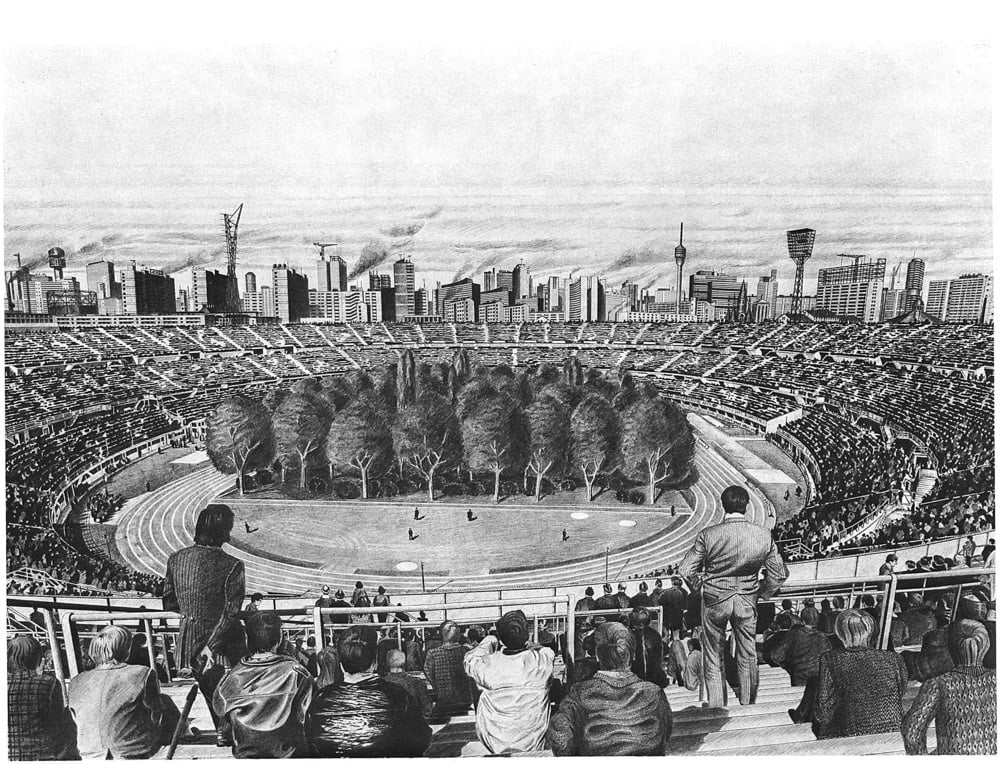
I didn’t think much of this project from just the photos, but this short video really highlights the darkly comedic experience of having to go to a soccer stadium to look at nature — not to experience nature, but to sit in a moulded plastic seat a few hundred feet away from nature to look and cheer but not to touch or walk around in.
I would love to see this in person. For Forest is on view until late October.
Treasures in the Trash is a short film by Nicolas Heller about former NYC sanitation worker Nelson Molina, who started (and still maintains) an unofficial museum of more than 45,000 objects that people have thrown out over the last few decades.
Newer posts
Older posts

Socials & More