kottke.org posts about video
Here’s the trailer for a five-episode Netflix series called The Devil Next Door.
The series is about John Demjanjuk, who was living in the US when he was accused of being “Ivan the Terrible”, a particularly brutal guard at the Treblinka death camp.
Born in Ukraine, John (Iwan) Demjanjuk was the defendant in four different court proceedings relating to crimes that he committed while serving as a collaborator of the Nazi regime.
Investigations of Demjanjuk’s Holocaust-era past began in 1975. Proceedings in the United States twice stripped him of his American citizenship, ordered him deported once, and extradited him from the United States twice to stand trial on criminal charges, once to Israel and once to Germany. His trial in Germany, which ended in May 2011, may be the last time that an accused Nazi-era war criminal stands trial. If so, it would mark the culmination of a 65-year period of prosecutions that began with the International Military Tribunal at Nuremberg in 1945.
Some facts of Demjanjuk’s past are not in dispute. He was born in March 1920 in Dobovi Makharyntsi, a village in Vinnitsa Oblast of what was then Soviet Ukraine. Conscripted into the Soviet army, he was captured by German troops at the battle of Kerch in May 1942. Demjanjuk immigrated to the United States in 1952 and became a naturalized US citizen in 1958. He settled in Seven Hills, Ohio, a suburb of Cleveland, and worked for many years in a Ford auto plant.
The Devil Next Door premieres November 4.
An alternate version of the ABC song that slows down the LMNOP part is currently going viral because of a tweet by Noah Garfinkel: “They changed the ABC song to clarify the LMNOP part, and it is life ruining.”
I tracked down the original video from 2012:
The alternate arrangement is by Matt Richelson, who runs a popular YouTube channel and several websites dedicated to offering free materials (songs, lesson plans, etc.) to help kids learn English. Here’s what Richelson says about his version of the ABC song:
About the slow l,m,n,o,p: I teach young learners of English as a foreign language, and have found this way the most effective for teaching the letters.
I love the ellemmennohpee bit as much as anyone, but his reasoning is solid.
Every month or two for the past couple of years, I’ve shared the movies, books, music, TV, and podcasts I’ve enjoyed (or not) recently. Here’s everything I’ve “consumed” since last month. It’s a little light because I’ve been working and a full rewatch of The Wire took some time. Stuff in progress includes The Wonderful Wizard of Oz (the kids and I are reading it together), The Dark Crystal: Age of Resistance, N.K. Jemisin’s The Fifth Season, and the second season of Abstract.
The Wire. Over the past two months, I rewatched all 5 seasons of The Wire. It very much holds up and is still the best TV show I’ve ever watched. Season 4 in particular is fantastic and devastating. Even season 5, which seemed a bit outlandish at the time with the serial killer plot, is great. (A+)
Downtown Abbey. Not great but it’s always nice spending some quality time with the Crowley family. (B+)
Mario Kart Tour. There’s something deeply un-Nintendo about this game. The use of all of the casino-like iOS tricks to keep you playing (and hopefully spending money on in-game currency) runs counter to the DNA of the company. $70 for 135 rubies is $20 more than the Switch version of Kart is going for right now on Amazon — ridiculous. And remember that the original Wii periodically suggested taking a break if you’d been playing for awhile? Still, racing in Mario Kart is always fun. When they turn networked multiplayer on, it might be a game-changer. (B+)
Peanut Butter Falcon. Feel-good? Eh. More like heavy-handed treacle. And LeBeouf’s character treats the kid with Down syndrome like a normal person but is creepy and borderline abusive to a girl he likes? Yuck. (C)
Succession. I hate that I love this show so much. (A)
1619. Very good podcast, particularly the third episode about the birth of American music. (A-)
Transparent Musicale Finale. I was skeptical about watching a 2-hour musical to end the series, but I ended up liking it a lot. My god, that last song though… (B+)
Parasite. Downton Abbey a la Bong Joon Ho. (A-)
Bottle Rocket. Rough but many of Anderson’s trademarks are already on display here. (A-)
Diego Maradona. Another examination by Asif Kapadia (Senna, Amy) of how talent and fame can go wrong. (A-)
Kevin Alexander on the Beginning and End of America’s Culinary Revolution (House of Carbs). Listened on a rec from a friend because Alexander’s book sounded interesting, but the bro-ness of the host is almost unbearable. What if the discussion about food was more like sports radio? No thank you. (C-)
Joker. The pre-release coverage of this movie being dangerous or problematic was mostly overblown. (B)
The new MoMA. Full review here. (A-)
Silence and the Presence of Everything (On Being). Really interesting interview with an acoustic ecologist. More here. (A-)
The Testaments. A sequel to The Handmaid’s Tale could have easily gone wrong. This very much did not. (A-)
Tonic. I used this for a few days but the recs weren’t great so I stopped. (C-)
Amazon Go. A marvelous and unnerving experience for this law-abiding introvert. Shopping without interaction was cool, but walking out without paying felt like shoplifting. (B+)
Machine Hallucination. Impressive display, like being immersed in an IMAX movie. But not sure it’s worth the $25 entry fee. (B)
Liberté, Égalité and French Fries (Rough Translation). How do we define work and community in the age of global mega-corporations? This story takes an amazing turn about 20 minutes in. (B+)
Past installments of my media diet are available here.
Have you been watching Succession? I feel bad about enjoying watching rich people be horrible to each other, but I do love the show. Evan Puschak rewatched both seasons with a careful eye and noticed the show’s preoccupation with language and how it is used and misused by the characters in the show.
Kendall: Words are just nothing. Complicated airflow.
One of the things I like most about the show is that I can’t figure out whether it’s a comedy or a drama. It’s bitingly funny and satirical but the whole thing is packaged like a drama and there are genuine emotional moments. I felt the same way about Fleabag and Transparent…the combination and subversion of these two familiar buckets of storytelling is part of what makes all of these shows great.
Today, Google announced the results of their quantum supremacy experiment in a blog post and Nature article. First, a quick note on what quantum supremacy is: the idea that a quantum computer can quickly solve problems that classical computers either cannot solve or would take decades or centuries to solve. Google claims they have achieved this supremacy using a 54-qubit quantum computer:
Our machine performed the target computation in 200 seconds, and from measurements in our experiment we determined that it would take the world’s fastest supercomputer 10,000 years to produce a similar output.
You may find it helpful to watch Google’s 5-minute explanation of quantum computing and quantum supremacy (see also Nature’s explainer video):
IBM has pushed back on Google’s claim, arguing that their classical supercomputer can solve the same problem in far less than 10,000 years.
We argue that an ideal simulation of the same task can be performed on a classical system in 2.5 days and with far greater fidelity. This is in fact a conservative, worst-case estimate, and we expect that with additional refinements the classical cost of the simulation can be further reduced.
Because the original meaning of the term “quantum supremacy,” as proposed by John Preskill in 2012, was to describe the point where quantum computers can do things that classical computers can’t, this threshold has not been met.
One of the fears of quantum supremacy being achieved is that quantum computing could be used to easily crack the encryption currently used anywhere you use a password or to keep communications private, although it seems like we still have some time before this happens.
“The problem their machine solves with astounding speed has been very carefully chosen just for the purpose of demonstrating the quantum computer’s superiority,” Preskill says. It’s unclear how long it will take quantum computers to become commercially useful; breaking encryption — a theorized use for the technology — remains a distant hope. “That’s still many years out,” says Jonathan Dowling, a professor at Louisiana State University.
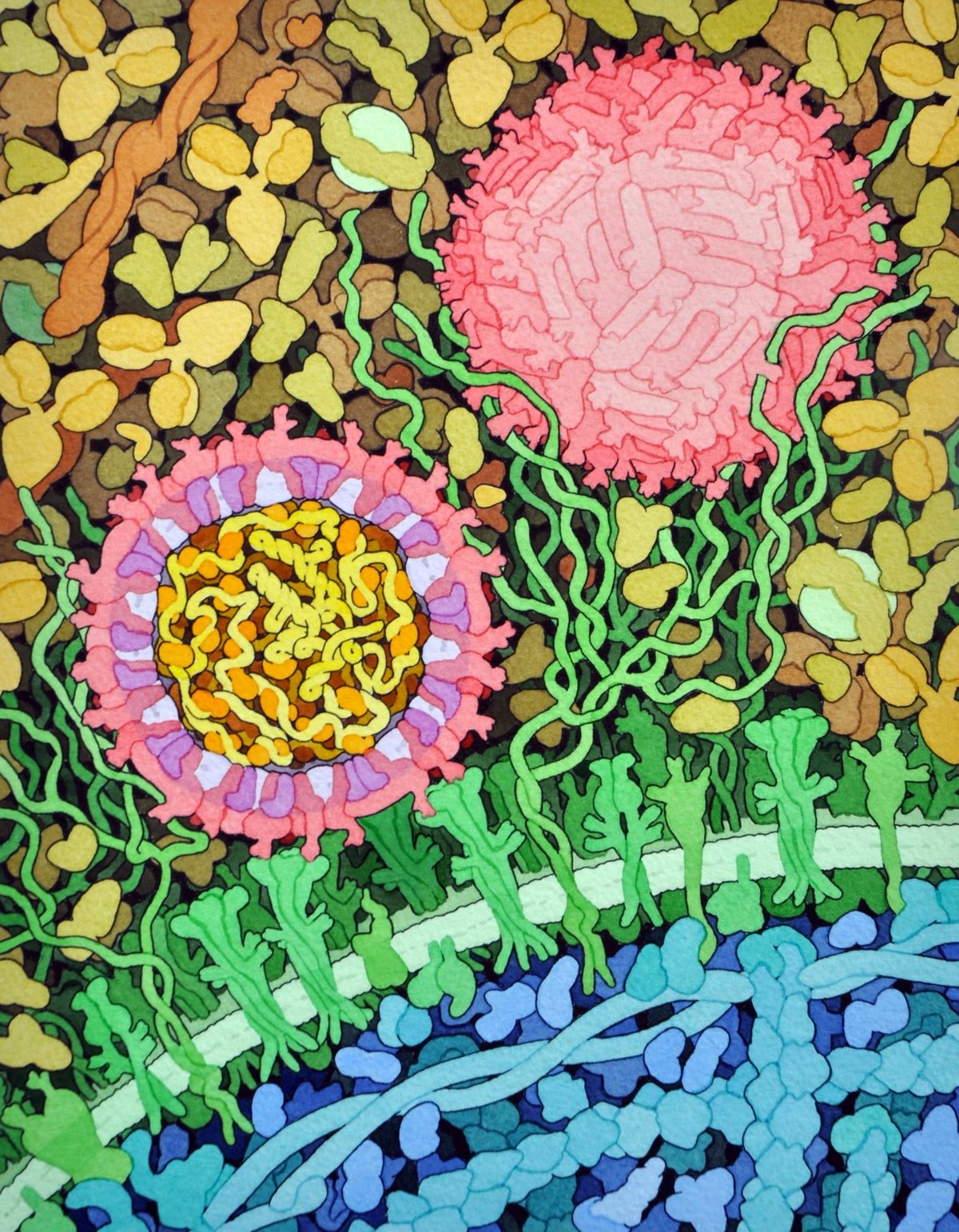
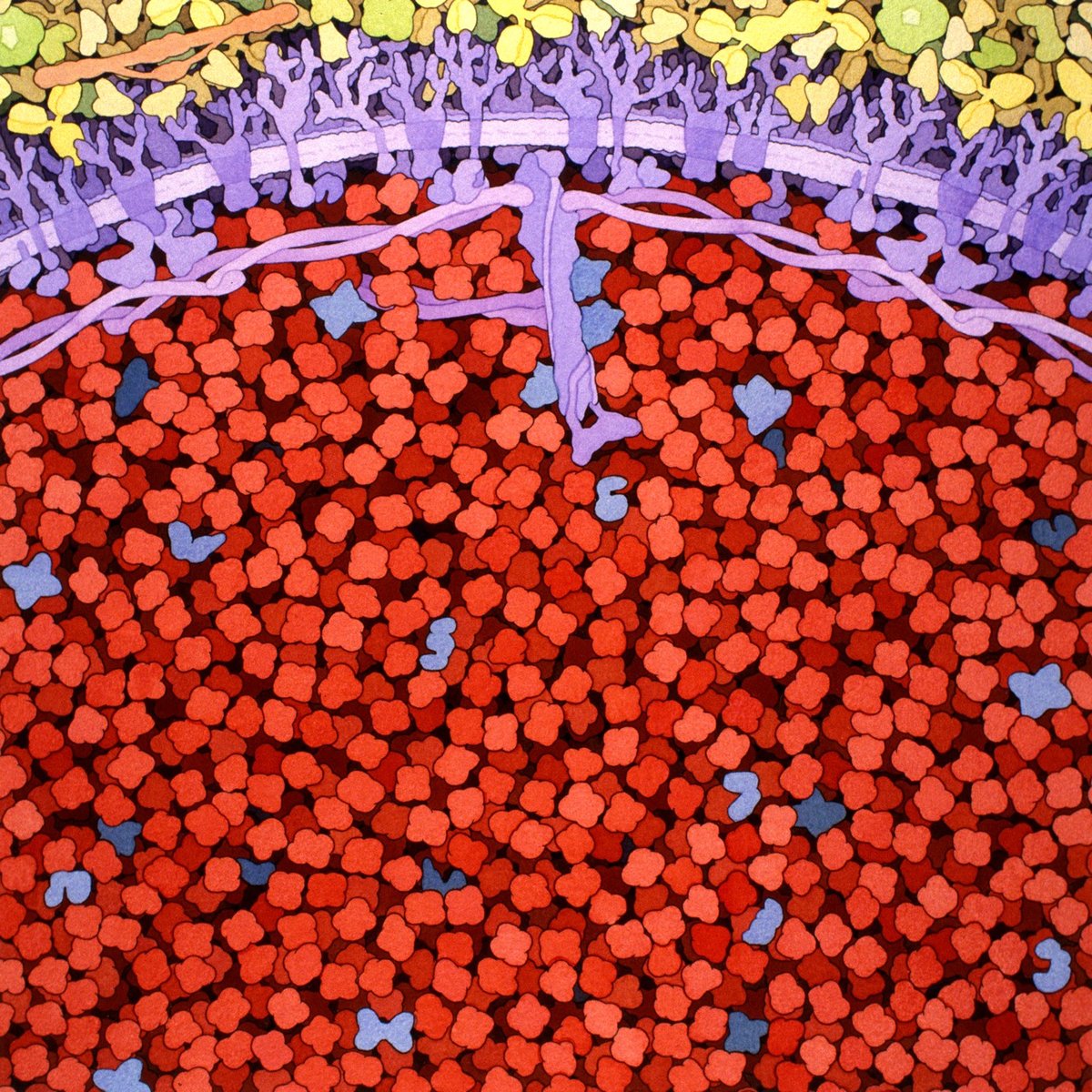
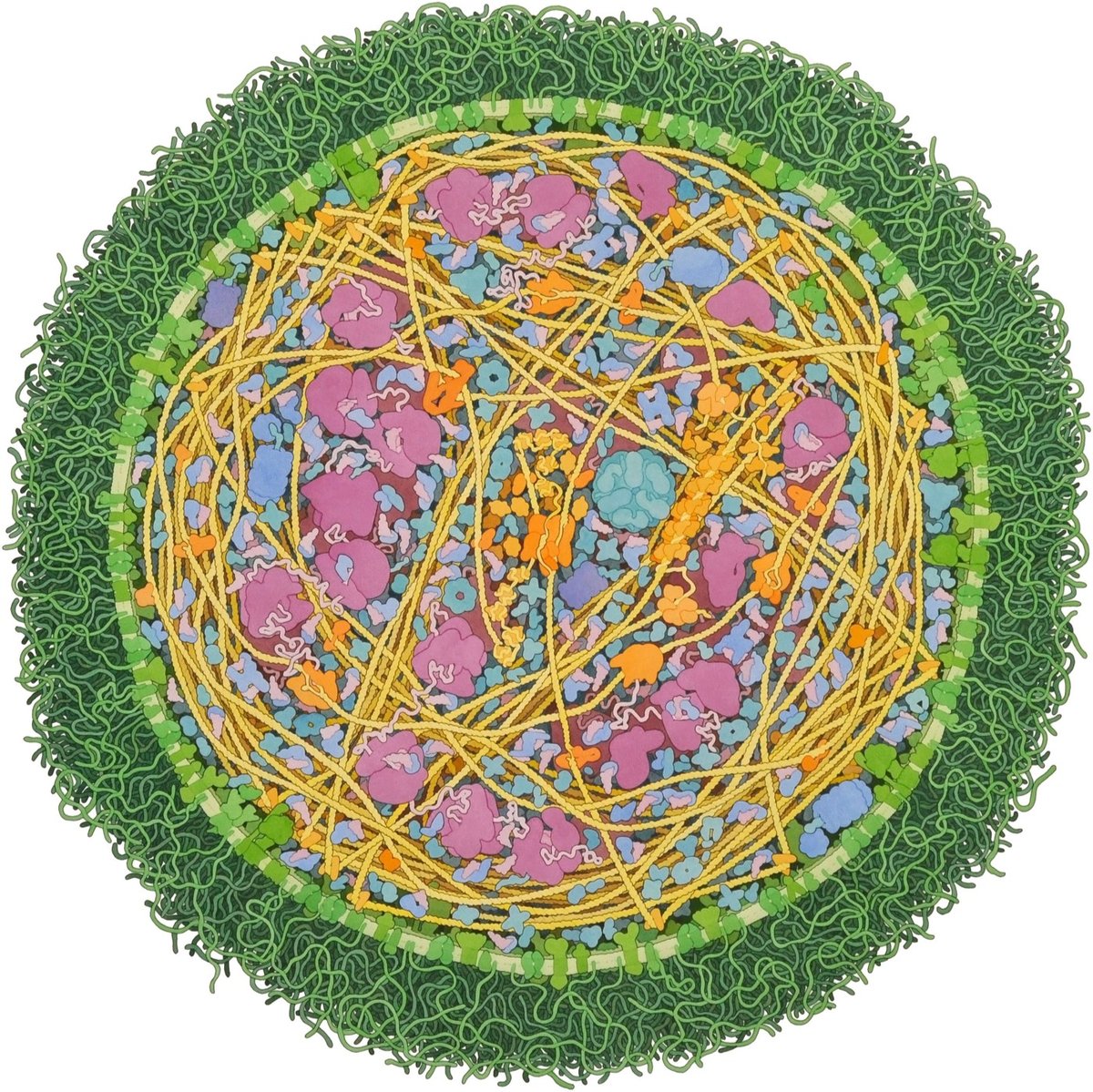
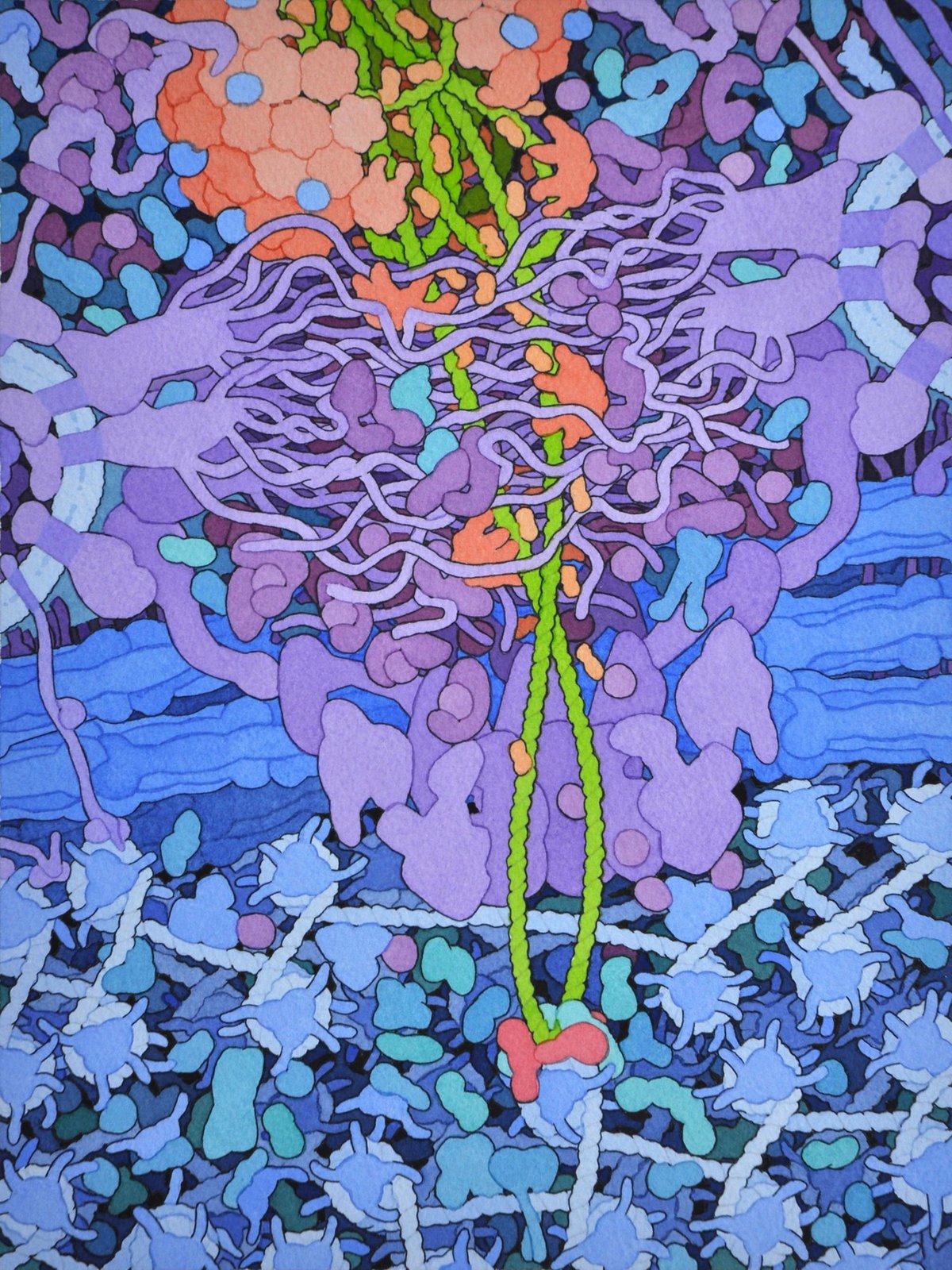
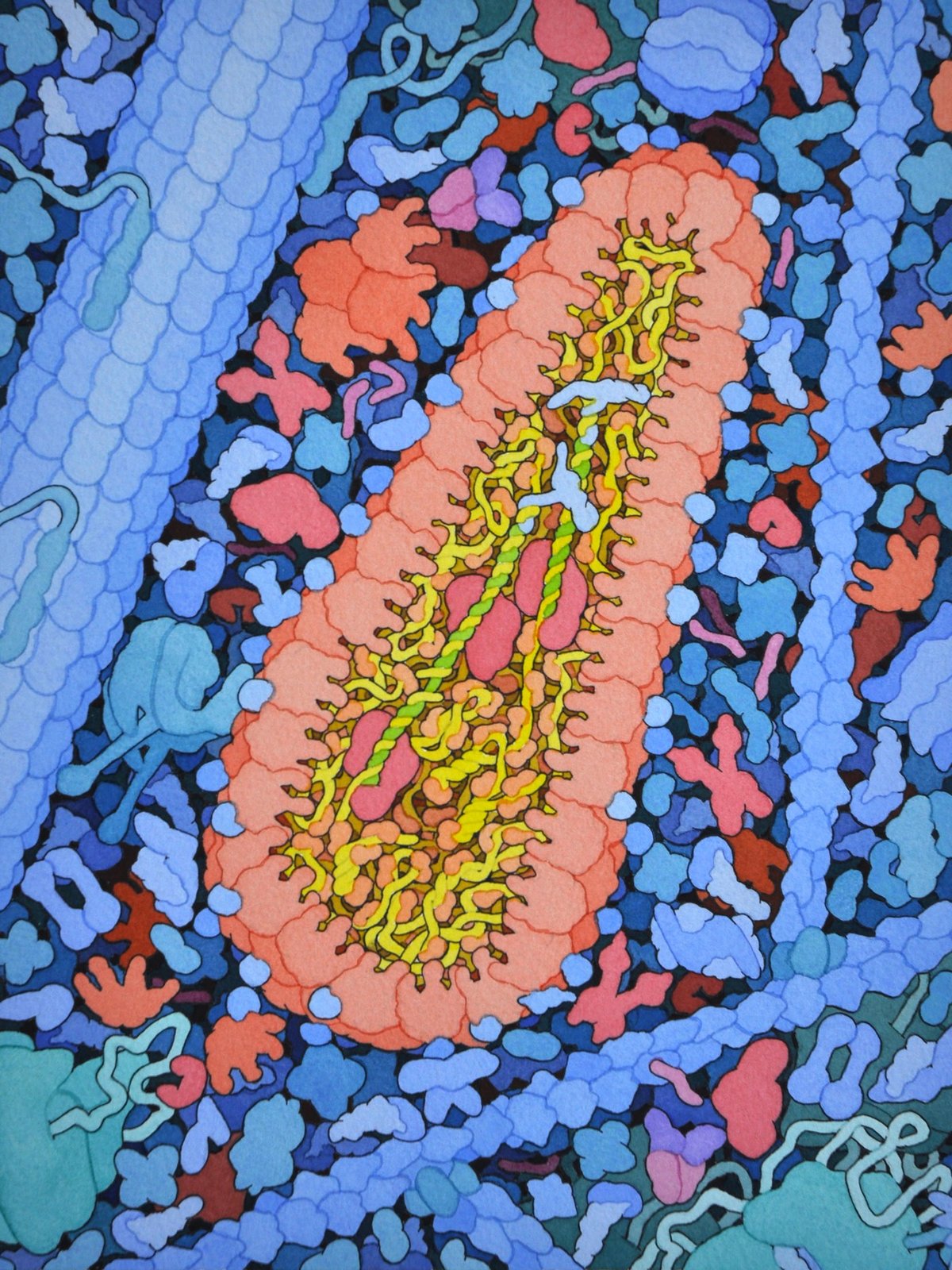
For more than 25 years, biologist David Goodsell has been making scientifically accurate paintings and illustrations of the molecular structures of things related to HIV, cancer cells, ebola, Zika, diabetes, proteins, enzymes, and hundreds of other scientific and medical processes.
Since the early 1990s, I have been working with a type of illustration that shows portions of living cells magnified so that you can see individual molecules. I try to make these illustrations as accurate as possible, using information from atomic structure analysis, electron microscopy, and biochemical analysis to get the proper number of molecules, in the proper place, and with the proper size and shape.
Much of his work is available to use for free (with attribution) and is scattered across the web: the Molecule of the Month, Molecular Landscapes, Illustrations for Public Use. He has also published several books of his paintings, the most popular of which is The Machinery of Life. Science magazine recently profiled Goodsell and his work.
In addition to studying pictures of cells from high-powered microscopes, Goodsell relies on molecular structures from electron microscopy (EM), x-ray crystallography, and nuclear magnetic resonance spectroscopy to make his paintings, which show the often crowded and complex world of cells and the microbes that infect them. He even uses the known weights of molecules if that’s all he has so that he can at least draw, say, a correctly sized circle. “I’m a scientist first,” he says. “I’m not making editorial images that are meant to sell magazines. I want to somehow inform the scientists and armchair scientists what the state of knowledge is now and hopefully give them an intuitive sense of how these things really look — or may look,” he says.
May look?
“These pictures have tons and tons and tons of artistic license,” he says. “They’re just one snapshot of something that’s intrinsically superdynamic. Every time I do a painting, the next day it’s out of date because there’s so much more data coming out.”
Here’s a quick video profile as well:
All images are by David S. Goodsell, the Scripps Research Institute. (via alexandra kammen)
The Nautilus expedition exploring the Davidson Seamount near Monterey Bay turned up something interesting last week: a relatively recent whale fall. A whale fall is when the body of a dead whale settles on the deep-sea floor, providing sustenance for the marine life in that area for decades.
While evidence of whale falls have been observed to remain on the seafloor for several years, this appears to be a relatively recent fall with baleen, blubber, and some internal organs remaining. The site also exhibits an interesting mid-stage of ecological succession, as both large scavengers like eel pouts are still stripping the skeleton of blubber, and bone-eating Osedax worms are starting to consume lipids (fats) from the bones. Other organisms seen onsite include crabs, grenadier, polychaetes, and deep-sea octopus.
The scientists were *so* excited to find this, a thriving mini ecosystem & food web in the process of formation at a depth of over 10,600 feet. They got pulled away from the carcass but went back for a closer look later.
You can read more about whale falls and their impact on deep-sea ecosystems in this New Yorker story from earlier this year.
For denizens of the seafloor, a whale fall is like a Las Vegas buffet — an improbable bounty in the middle of the desert. Rosebud had delivered about a thousand years’ worth of food in one fell swoop. The first animals to pounce had been scavengers, such as sleeper sharks and slimy, snake-like hagfish. In the course of about six months, they had eaten most of the skin and muscle. Inevitably, the scavengers had scattered pieces of flesh around the whale carcass, and native microbes had multiplied quickly around those scraps. Their feeding frenzy, in turn, had depleted oxygen in the seafloor’s top layers, creating niches for microbes that could make methane or breathe sulfate.
As Rosebud came into view, we saw colorful microbial carpets light up the screens-plush white, yellow, and orange mats, each a community of microbes precisely tuned to their chemical milieu. The whale’s towering rib cage had become a cathedral for worms, snails, and crabs, which grazed beneath its buttresses. A few hungry hagfish slithered through the skull’s eye sockets. When the cameras zoomed in, we saw that the bones were covered in red splotches. Rouse leapt from his chair and rushed to the monitors for a closer look: he suspected that the red tufts were colonies of remarkable bone-eating worms called Osedax, which had only just recently been described in a rigorous scientific study.
Let’s just all pretend that this trailer did not give me goosebumps and make me pump my fist a little, because at this point Star Wars is a sliced-n-diced and repackaged global financial instrument and very much not something a 46-year-old man who knows better should get excited about. (Jk jk, pump Mark Hamill’s gravely voice and John Williams’ soaring crescendos directly into my veins. And if James Earl Jones’ voice does not make an appearance in this movie, I will eat a Stormtrooper helmet.)
From filmmaker David Freid, Nobody Dies in Longyearbyen is a short film about Longyearbyen, Norway, the one of the northernmost towns in the world. The town of about 2100 residents is situated on the Svalbard archipelago and is the home of the Global Seed Vault. Freid went to investigate the rumor that no one is allowed to die in Longyearbyen and discovered that if climate change results in the permafrost melting in places like this, diseases from long ago may be released back into the world.
But for more than 70 years, not a single person has been buried in Longyearbyen. That’s due to the region’s year-round sub-zero temperatures: Bodies don’t decompose, but are preserved, as if mummified, in the permafrost. Should anyone die there, the government of Svalbard requires that the body is flown or shipped to mainland Norway to be interred.
See also A Trip to the Northernmost Town on Earth.
In this clip from a longer conversation in the Off Camera interview series, Zach Galifianakis talks about his brief two-week stint on Saturday Night Live and how he felt when a sketch he wrote totally bombed at the cast table read.
Here are all 10 clips of the interview. See also Robert Downey Jr. recounting his year-long SNL career.
BrickBrosProductions makes stop motion animated films featuring Lego bricks. Their most popular video is a compilation of the three short films in their “Lego In Real Life” series, where objects built from Lego interact with the real world — Lego butter, Lego apples, Lego pencils, and Lego wood.
Here’s a behind-the-scenes of the woodworking movie as well as a general tutorial about how to make Lego stop motion videos.
Kurzgesagt has partnered with the Red Cross and their “no to nukes” initiative to depict what it would be like if a nuclear weapon detonated in a major city. I’m not going to lie to you here, this is a difficult video to watch. Super bleak. There is no bright side to nuclear weapons.
The reason no government wants you to think about all this is because there is no serious humanitarian response possible to a nuclear explosion. There’s no way to really help the immediate victims of a nuclear attack. This is not a hurricane, wildfire, earthquake, or nuclear accident — it is all of these things at once, but worse. No nation on earth is prepared to deal with it.
Between the climate crisis, the rise of authoritarianism around the world, the AI bogeyman, and other things, nuclear weapons have gotten lost in the shuffle recently, but they remain a massive existential threat to society. A small group of people, some careful planning, years of patience, and you could possibly see an event that would make 9/11 look quaint.
From filmmaker Patrick Smith, a short film called Gun Shop that shows images of 2,328 guns in just over 90s seconds.
This film shows 2,328 firearms, out of the 393 million currently in the US. Arranged in a dizzying 24 frames per second progression, from handguns to semi-automatic assault rifles, “Gun Shop” encourages viewers to critically examine America’s love affair with guns.
I confess I had not properly absorbed the fact that there are an estimated 393 million firearms owed by civilians in the US. That’s 1.2 guns per person (including children), the highest per capita in the world, more than twice that of the second place country, Yemen. Collectively, civilians in the US own 46% of the guns in the world. It’s a sick and dangerous obsession. (thx, christopher)
This past weekend in Austria, Eliud Kipchoge ran the marathon distance of 26.2 miles in 1 hour, 59 minutes, and 40 seconds, the first person in recorded history to break the two-hour marathon barrier, a feat once thought impossible. Wanting to know a bit more about how Kipchoge did it, I watched a pair of videos. The first was from Mike Boyd (who you might have seen learning how to kickflip a skateboard in under 6 hours) and it’s very much from an interested fan’s perspective.
Wired has been following Kipchoge’s attempts at a faster marathon, particularly the technology angle, and in their video, they talk with the Mayo Clinic’s Dr. Michael Joyner, who predicted in a 1991 paper that a sub-2:00 marathon was possible.
Boyd’s video references this paper as well. From a piece that Joyner wrote about his paper:
During the 1980s, ideas emerged about how maximum oxygen consumption, lactate threshold and running economy interacted to determine distance running performance. During medical school around 1985, I started think about how a person could run if he/she had the best laboratory values ever recorded for all three variables. I came up with an estimated time a few seconds faster than 1:58!
So how did Kipchoge run so fast? Well, the answer has to do with another interesting thing about this whole thing: his effort did not set an official world record for the marathon. From The Atlantic, The Greatest, Fakest World Record:
The planning that went into the event was a fantasy of perfectionism. The organizers scouted out a six-mile circuit along the Danube River that was flat, straight, and close to sea level. Parts of the road were marked with the fastest possible route, and a car guided the runners by projecting its own disco-like laser in front of them to show the correct pace. The pacesetters, a murderers’ row of Olympians and other distance stars, ran seven-at-a-time in a wind-blocking formation devised by an expert of aerodynamics. (Imagine the Mighty Ducks’ “flying V,” but reversed.)
Kipchoge himself came equipped with an updated, still-unreleased version of Nike’s controversial Vaporfly shoes, which, research appears to confirm, lower marathoners’ times. He had unfettered access to his favorite carbohydrate-rich drink, courtesy of a cyclist who rode alongside the group. And the event’s start time was scheduled within an eight-day window to ensure the best possible weather.
In an official marathon attempt, you’re not allowed to have pacesetters rotating in and out, refreshment via bicycle, or a pace car lighting the way. They touch on this in the Wired video, but technology has been wrapped up in human athletic achievement for more than a century at least. Compared to a runner competing in 1960 — when the record was 2:15:16, set by Abebe Bikila in bare feet — runners today have the benefit of better training techniques, superior knowledge of human physiology, better shoes, corporate sponsorships & other assistance, lightweight clothes that wick away moisture and don’t chafe, specially designed diets, better in-race nutrition, and, let’s be honest here, performance-enhancing drugs.
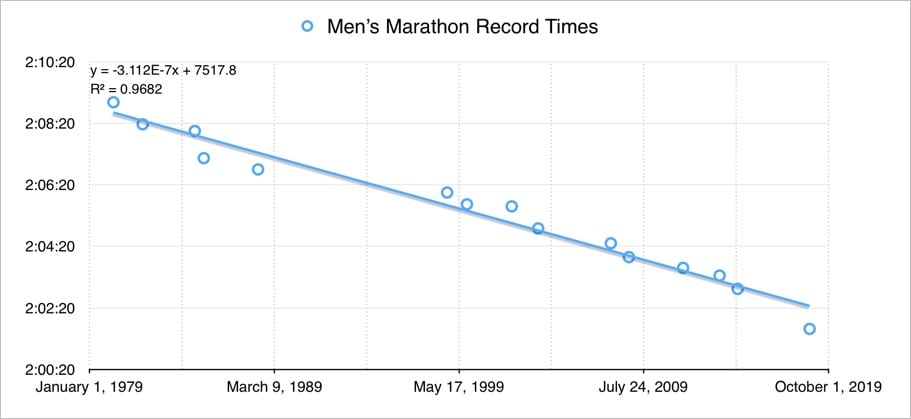
Drugs aside, all that is fine to use in an official marathon attempt, but racing alone with pacesetters (or downhill) is verboten. It’s always interesting where they draw the line on the use of technology in athletics. I think the most you can say at this point is that even with all these advantages, Kipchoge is perhaps the only person in the world right now who is capable of breaking the 2-hour barrier. But in two or three years? My guess is that 2 hours will be broken in an actual race in the next 5-7 years, even though a rough linear analysis I just did using men’s marathon record times since 1980 indicates that no one will run under 2 hours until 2033.
I pretty much stopped using iTunes for music when I switched to Rdio1 (and then to Spotify). So going back in there is like unearthing a time capsule of music I listened to from ~2003-2012. This morning, bored of my Spotify playlists, I dug around a little and rediscovered a cache of songs by The Moog Cookbook. The duo uses old school Moog synthesizers to make playful covers of rock & pop songs like Nirvana’s Smells Like Teen Spirit, Are You Gonna Go My Way? by Lenny Kravitz, and Ziggy Stardust by David Bowie. Their album of classic rock covers is available on Spotify:
Their debut album (which I like more) is a bit tougher to find, but you can listen to the whole thing here on YouTube:
This maddening little web toy on vole.wtf challenges visitors to draw a perfect circle and judges them on how well they do. After dozens of tries with a mouse, I could only manage 92.9% perfection (which looks more like 80% tbh).

Then I tried it on a touchscreen and got much closer: 95.2%. Several more tries with an Apple Pencil bumped it up to 97.7%, after which I retired so as not to waste the entire rest of my afternoon on this.
And of course, here’s the classic video of Alexander Overwijk drawing a perfect freehand circle on the blackboard in about a second.
I love everything about this video — the way he swings his arm to warm up, his drying-the-blackboard flapping motion, and the ease of his perfection. 100.0%. (via sam potts)
Pro skateboarder Felipe Nunes hails from Brazil, is 20 years old, and recently signed on to Tony Hawk’s Birdhouse team. Nunes also lost both legs when he was six. From an interview with Nunes in Thrasher:
I was six when it happened but the doctors said it was super fast. I didn’t really hesitate because I was so young. I used a wheelchair until about the age of 11. I was a kid who wanted to do everything. Regardless of not having two legs I wanted to do it all. I rode my bike, played soccer, pretty much everything out in front of my house. I was a normal kid. It didn’t even look like I was missing part of my legs. My parents were essential in my recovery because they never stopped me from doing anything. They were afraid of me getting hurt like any parents, but they never held me back. When I wanted to give up the wheelchair and ride the skateboard full time, they let me go.
You can follow Nunes on his latest exploits on Instagram. (via the morning news)
From the American Museum of Natural History in NYC, an animated timeline of human evolution, from when hominins first show up in the fossil record in Africa some seven million years ago to the appearance of Homo sapiens about 200,000 years ago. You can see artifacts and fossil remains of many of the hominins at the museum in the Hall of Human Origins. I haven’t been there in awhile…might be time for a visit.
I got this from Open Culture, where Colin Marshall goes into more detail:
And though hominins may have walked upright, they also climbed trees, but eventually lost the grasping feet needed to do so. Later they compensated with the very human-like development of making and using stone tools. Two million years ago, the well-known Homo erectus, with their large brains, long legs, and dextrous hands, made the famous migration out of Africa.
We know that by 1.2 million years thereafter Homo erectus’ brains had grown larger still, fueled by new cooking techniques. Only about 200,000 years ago do we, Homo sapiens, enter the picture, but not long after, we interbreed with the various hominin species already in existence as we spread outward to fill “every geographic niche” of the Earth.
The last bit of the video was unexpectedly sobering:
Homo sapiens were highly adaptable, quickly filling nearly every geographic niche. Other hominins went extinct. Climate pressures and competition with Homo sapiens may have wiped them out.
If we don’t change our ways soon, one way to look at the recent history of life on Earth is that modern humans came along 200,000 years ago and systematically conquered and killed the all of the animals on the planet larger than an ant. Not such a great deal for anything but people.
For their latest video, Great Big Story visits a French mill that’s been making paper for 700 years. The Richard de Bas mill has supplied paper to the likes of Picasso and Dali and is today one of the few remaining places in France where paper is still made by hand; they only produce about 2 tons of paper a year. That flower paper is incredible. My only complaint about this video is that it wasn’t 6-7 minutes longer. You can see more of the mill in this video (in French, although YT’s auto-translated captions work ok).
The mill and the associated museum in Ambert, France are open to visitors and you can buy some of their paper from the online store. A pack of dozen sheets of their floral paper is €30.
See also this 1970 short film on marbled paper, a personal favorite of mine.
Despite some reservations (a little too bro-y for one thing), I really enjoyed David Chang’s Netflix series Ugly Delicious. So I’m happy to see that he’s got a new series coming out called Breakfast, Lunch & Dinner. The trailer:
In this one, he’s traveling the world with some non-food celebs: he hits Los Angeles with Lena Waithe, Marrakesh with Chrissy Teigen, Phnom Penh with Kate McKinnon, and Vancouver with Seth Rogen. Will watch.
From Steve Begg (who I would guess is this Steve Begg, who has done VFX on the recent Bond films) comes an epilogue of Stanley Kubrick’s 2001: A Space Odyssey. The scene picks up 203 years after the events of 2001, following Frank Poole’s body as it encounters a monolith.
Ten years ago, in the midst of the 2009 swine flu pandemic, I wrote about the manufacturing process for the H1N1 flu vaccine. It involves billions of chicken eggs.
The most striking feature of the H1N1 flu vaccine manufacturing process is the 1,200,000,000 chicken eggs required to make the 3 billion doses of vaccine that may be required worldwide. There are entire chicken farms in the US and around the world dedicated to producing eggs for the purpose of incubating influenza viruses for use in vaccines. No wonder it takes six months from start to finish.
The post holds up pretty well because, according to the CDC, this is still the way most flu vaccines in America are manufactured. Here’s a look at pharmaceutical company GSK’s egg-based process:
Two other techniques for making flu vaccines were approved for use in the US in 2012 and 2013 respectively, cell-based flu vaccines:
‘Cell-based’ refers to how the flu vaccine is made. Most inactivated influenza vaccines are produced by growing influenza viruses in eggs. The influenza viruses used in the cell-based vaccine are grown in cultured cells of mammalian origin instead of in hens’ eggs.
A cell-based flu vaccine was developed as an alternative to the egg-based manufacturing process. Cell culture technology is potentially more flexible than the traditional technology, which relies upon adequate supply of eggs. In addition, the cell-based flu vaccine that uses cell-based candidate vaccine viruses (CVVs) has the potential to offer better protection than traditional, egg-based flu vaccines as a result of being more similar to flu viruses in circulation.
And recombinant flu vaccines:
NIAID and its industry partners have made progress in moving from both the egg-based and cell-based flu vaccine production methods toward recombinant DNA manufacturing for flu vaccines. This method does not require an egg-grown vaccine virus and does not use chicken eggs at all in the production process. Instead, manufacturers isolate a certain protein from a naturally occurring (“wild type”) recommended flu vaccine virus. These proteins are then combined with portions of another virus that grows well in insect cells. The resulting “recombinant” vaccine virus is then mixed with insect cells and allowed to replicate. The flu surface protein called hemagglutinin is then harvested from these cells and purified.
Both of these new techniques make production quicker, thereby resulting in more effective vaccines because they are more likely to match the strains of whatever’s “going around”.
As a reminder, you should get a flu shot every year in the fall. The CDC recommends that “everyone 6 months of age and older should get a flu vaccine every season with rare exception”, especially those “who are at high risk of serious complications from influenza”. Flu vaccines are covered by your health insurance without copay (thanks, Obama!) and are often available at drug stores without an appointment or a long wait. So go get one!
This morning, instead of crawling straight from bed to desk and diving into the internet cesspool, I went for a walk. I went because I needed the exercise, because it was a nice sunny day out, because the changing leaves are super lovely right now. (Check out my Instagram story for some of what I saw along the way.) But I also wanted to listen to this episode of On Being with Gordon Hempton called Silence and the Presence of Everything. Hempton is an acoustic ecologist who has a lot of interesting things to say about silence and natural sounds.
Oh, grass wind. Oh, that is absolutely gorgeous, grass wind and pine wind. We can go back to the writings of John Muir, which — he turned me on to the fact that the tone, the pitch, of the wind is a function of the length of the needle or the blade of grass. So the shorter the needle on the pine, the higher the pitch; the longer, the lower the pitch. There are all kinds of things like that, but the two folders where I collected, I have, oh, over 100 different recordings which are actually silent from places, and you cannot discern a sense of space, but you can discern a sense of tonal quality, that there is a fundamental frequency for each habitat.
It sounds paradoxical, but I wanted to listen to this podcast in a setting with natural sounds, rather than in my car or on a plane. I had my AirPods in because they don’t block all outside sound, so I could hear the crunch of the road beneath my shoes as I walked and listened. The nature and animal sounds in the episode sounded like they were actually coming from all around me. I paused the episode for a minute or two to listen to a burbling brook I passed along the way. The whole experience was super relaxing and informative.1
You can read more about Hempton and his efforts in preserving the world’s silence places on his website The Sound Tracker or in his book, One Square Inch of Silence. Outside magazine recently profiled Hempton, who, in cruel twist of fate, has suffered dramatic hearing loss in recent years.
The problem Hempton hopes to take on is gargantuan. To understand it, try a little experiment: when you reach the period at the end of this sentence, stop reading for a moment, close your eyes, and listen.
What did you hear? The churn of the refrigerator? The racing hiss of passing traffic? Even if you’re sitting outside, chances are you heard the low hum of a plane passing overhead or an 18-wheeler’s air horn shrieking down a not-so-distant highway.
If you heard only the sounds of birds and the wind in the trees, you’re one of a lucky few. But it’s likely that quiet won’t last.
This short documentary, Sanctuaries of Silence, follows Hempton to some of the quietest places on Earth, including the Hoh Rain Forest in Olympic National Park.
I think what I like most about listening is that I disappear.
If you’d like to disappear for awhile but don’t have access to a quiet place, you should check out some of Hempton’s recordings on Spotify — I’m listening to Forest Rain right now.
Or try out the Sound Escapes podcast to check out some of his best natural soundscapes. (thx Meg, who sent along a link to the On Being episode after reading yesterday’s post on noise pollution)
Ze Frank released the most recent video in his True Facts series about animals last month. Meet the ogre-faced spider. Admittedly I haven’t watched any of the other True Facts videos in awhile, but this one seemed unusually informative (while retaining Frank’s signature humorous asides). I would watch an entire nature series like this: funny but not dumbed down on the science side.
I was fortunate enough to make it out to Portland, OR for the 2019 XOXO festival back in September. It was my third time attending — I went the first year and in 2015 — and, goodness, the conference has changed a lot. XOXO used to be comfortably in my wheelhouse and now it’s more on the outskirts, so instead of hearing a bunch of stuff I want to hear, I trust the conference organizers to present some things that I need to hear, to keep me curiously exploring new ideas, viewpoints, and experiences unlike my own.
XOXO has started posting videos of all their talks online (one new video each weekday), and I’m going to share some of my favorites here. The first video is of Tracy Clayton’s barnburner of a talk: Log Off, Fam — Self Care in the Timeline Era.
Clayton and I overlapped at Buzzfeed (she was an employee and I had a desk there working on kottke.org) but have never met, so it was interesting to hear about her success and ultimately bad experience there.
I’ll updating this post with the rest of my favorites as they’re posted on YouTube.
Update: I enjoyed Soleil Ho’s talk about how the drive by her and others to shift the food world’s conversation on representation and cultural appropriation is starting to bear some fruit.
Update: My favorite talk, the one that hit me most squarely in the feels, was by Emily & Amelia Nagoski. It was about burnout, which I have been, I think, struggling with lately w/r/t to this here website. There were several points during this talk when I felt absolutely naked, exposed — like they were talking just to me.
Harry Brewis told us about the time when a goofy project he started spun out of his control in the most wonderful way:
To close the conference, Rhea Butcher talked about the importance of seeking without necessarily worrying about the finding:
You can find all of the 2019 talks right here.
Great Big Stories has collected five of their video short stories into a collection: 5 True Tales of Manhattan. The stories include a restaurant that serves Cuban-Chinese cuisine, Sunday night jazz concerts in a Harlem apartment, and a woman who rehabs dozens of turtles in her small apartment.
Riffing off a remark made by Guillermo del Toro that a director’s output is all part of the same movie, Andrew Saladino of The Royal Ocean Film Society looks at the many airships in Hayao Miyazaki’s films. What does the director’s continued use of flying machines tell us about filmmaking, technology, and everything else he’s trying to communicate though his films?
In 2012, a company called Dassault Systèmes launched an interactive application that allowed you to move about in a 3D historical reconstruction of Paris at different points in its history. The application seems to have fallen into disrepair so that you can’t actually use it, but the 13-minute video above offers a tour through several time periods, including:
- 52 BCE. The area was home to a Celtic group called the Parisii, just before the Romans conquered the settlement.
- 2nd century CE. The Romans ruled here until 486 CE; they called the city Lutetia.
- 1165-1350. The medieval period. Paris was one of the largest cities in Europe.
- 1789. A look at the Bastille during the French Revolution.
- 1887-1889. The construction of the Eiffel Tower for the 1889 World’s Fair. It was the tallest man-made structure in the world for more than 40 years (eclipsed by the Chrysler Building).
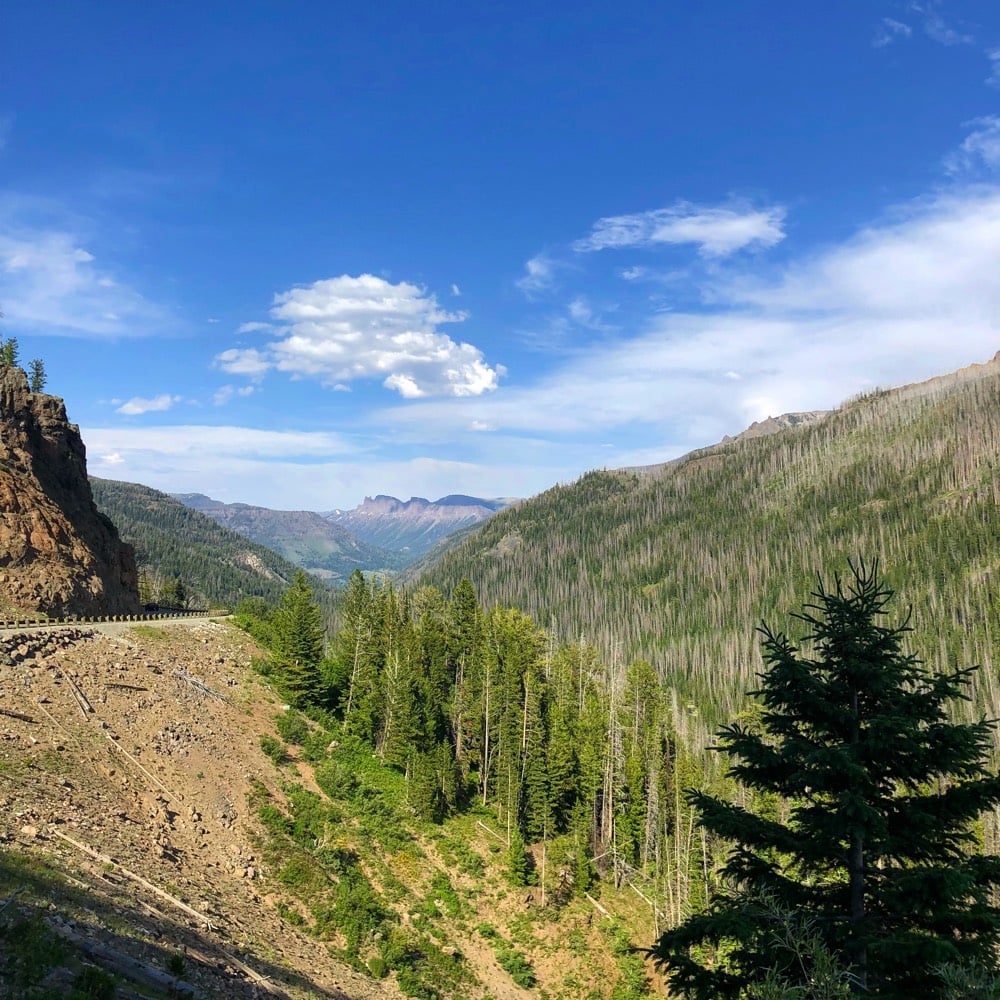
Yellowstone National Park maintains a collection of sounds and videos taken in the park that are in the public domain and free for anyone to use. The collection includes the sights and sounds of birds, geysers, bison, bubbling mud pots, fish, wolves, falling snow, storms, and all sorts of other ambient noises and videos.
YMMV, but I laughed really hard at this (sound on, obvs). Good clean Friday fun.
Newer posts
Older posts



Socials & More