kottke.org posts about video
I do not know if hearing about other people’s quarantine experiences makes going through one yourself any easier, but the story of how NASA sequestered the returning Apollo 11 astronauts away from the rest of the world for 21 days is interesting for other reasons as well. The worry was that some sort of “moon bug” or “lunar plague” was going to make its way from the Moon to the Earth in the spacecraft or the astronauts’ bodies.
From the moment the Apollo 11 astronauts arrive back on earth from their epochal visit to the moon, they will be treated not as heroes but as bearers of the most virulent, devastating plague the world has ever known.
So NASA quarantined Armstrong, Aldrin, and Collins in a series of specially designed suits and environments until August 10, 1969. At one point, the three of them lived in a modified Airstream trailer in which the air pressure was lower on the inside than outside so if there was a leak, air would rush into the trailer, not out. Armstrong even celebrated a birthday in quarantine.
After Apollo 11, NASA did similar quarantines for 12 and 14 but abandoned them after that because they figured it was safe.
Oh, and if you were curious about the Soyuz launch yesterday that sent three astronauts to the ISS and how they were going to mitigate the chances of sending any SARS-CoV-2 up there, crews on all missions are subject to a mandatory 2 week quarantine before they leave (according to this press release).
As someone who a) thinks Dr. Dre was an amazing producer, and b) read Dr. Seuss’s Fox in Socks to his children roughly 1 million times (enough to be able to, eventually, get through the entire book at a comically high rate of speed w/o any tongue twisting slip-ups), I thought Wes Tank’s video of himself rapping Fox in Socks over Dre’s beats was really fun and surprisingly well done.
Tank has also done Green Eggs and Ham (over the beats from Forgot About Dre) and The Lorax. (thx, andrew)
The James Dyson Foundation has designed a set of 44 challenges related to science & engineering specifically for kids (ages 7 & older), which are perfect for these at-home learning times. The challenges include making an air-powered car out of a balloon, strong bridges out of spaghetti, and a cardboard chair strong enough to hold a person:
Here’s the PDF with all 44 challenges. What I like about these projects is that they’re hands-on, you can do them with stuff you already have around the house, and they’re educational in the best way: there’s no “teaching” really…the challenges are designed to appeal to the natural curiosity of kids.
Reading through these, the one that blew my mind was that you can determine the speed of light by melting a chocolate bar in the microwave.
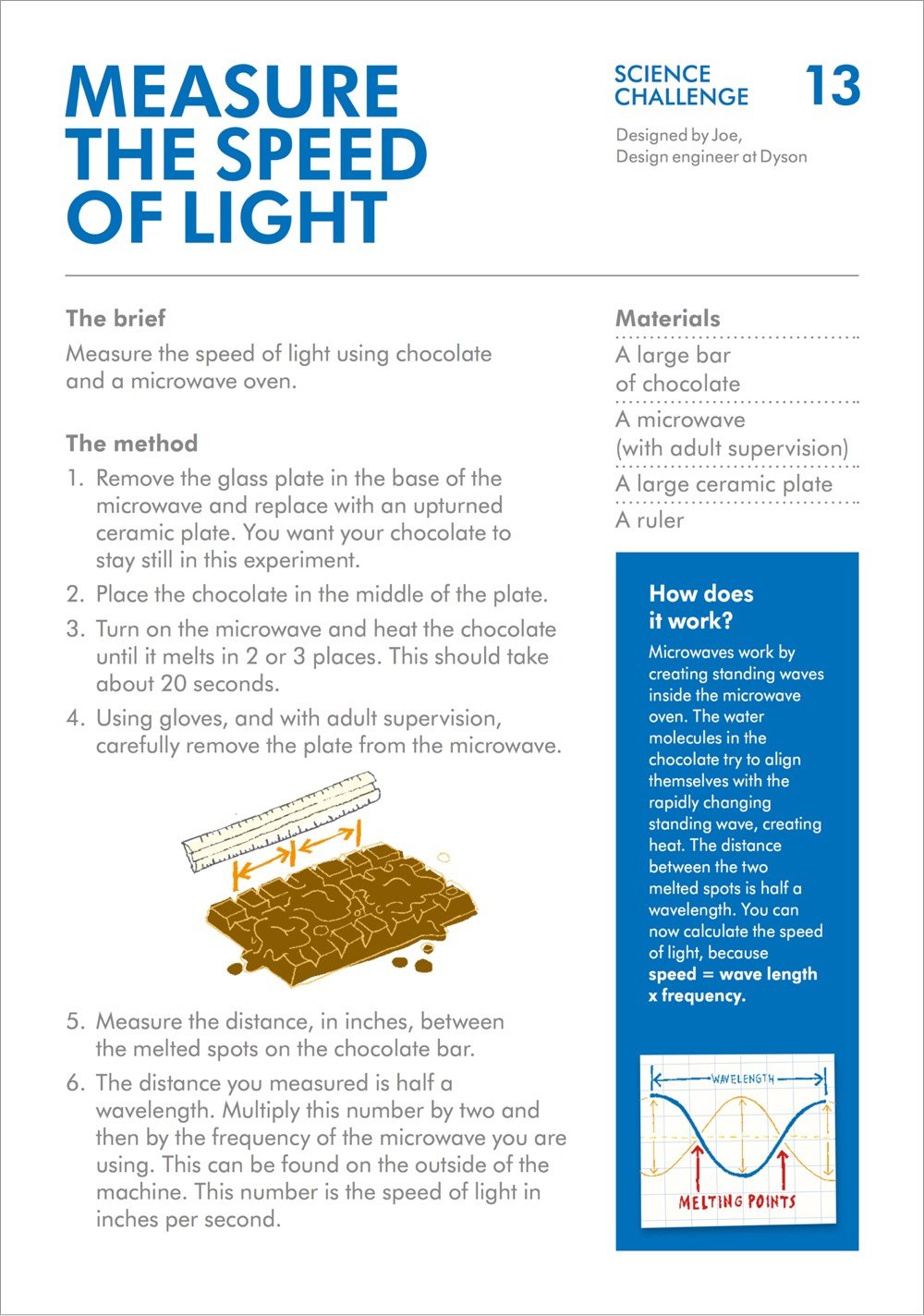
That’s so cool! (via open culture)
From Ken Burns and Dr. Siddhartha Mukherjee, The Gene: An Intimate History, a series about the history of genetics based on Mukherjee’s book of the same name. Here’s a trailer:
The series tells the story of the rapid evolution of genetic science from Gregor Mendel’s groundbreaking experiment in the 19th century to CRISPR, and the hope that newfound powers to alter DNA with pinpoint precision will transform the treatment of some of the world’s most complex and challenging diseases. The series also tackles the daunting ethical challenges that these technologies pose for humankind.
This looks great, especially if this clip about Nancy Wexler’s crusade to find a cure for Huntington’s disease is representative of the whole:
In 1968, Nancy Wexler’s mother was diagnosed with a rare genetic disease - Huntington’s. Facing a 50-50 chance of contracting Huntington’s herself, Wexler — a non-scientist — began an odyssey to find the gene that causes the disease. For three decades, Wexler searched for treatments but chose not to get tested. As time passed, she noticed changes in the way she moved. Finally, in early 2020, Wexler decided to face her fears.
Part 1 of the series is now streaming on PBS with part 2 set to premiere next week.
During a press conference last month, Canadian Prime Minister Justin Trudeau spent a couple of minutes talking directly to the nation’s children, acknowledging their hardships and role in mitigating the effects of the pandemic. Tyler Walsh and his two sons spent a week making this Lego stop motion animation of Trudeau’s address, something that kids might be more likely to watch.
In an interview with the CBC, Walsh described their process:
“[It took] a fair amount of time and hundreds and hundreds of photos,” he said.
Each working to their strengths, Walsh said the kids were primarily in charge of piecing together the Lego elements — such as a podium, as well as hair and a bearded head for Trudeau — to bring the set to life.
“I would have questions for them like, ‘I need a sad kid. Do we have any sad kid Lego heads?’”
Trudeau himself responded to the Lego version of his address:
This is really great, Tyler. I think my kids — and a whole lot of others — will get a kick out of this, all while hearing how they can help out too. Thanks for helping spread that message.
(via @auntmaureen)
This is fantastic: former beatboxing world champion Butterscotch explains the 13 levels of complexity involved in beatboxing, from the simple “bass drum” to how to breathe while beatboxing to singing to emulating real instruments.
Expert beatboxers go so fast that it’s amazing to see someone with Butterscotch’s skill level break this down — like watching a water balloon bursting in slow motion. Her short explanation & demonstration of “breathing within the beat” bleeeewww my tiny little mind. Also, she is soooo good — what a treat to watch.
See also Robert Lang on the 11 Levels of Complexity of Origami, Tony Hawk on the 21 Levels of Complexity of Skateboard Tricks, and A Demonstration of 16 Levels of Piano Playing Complexity.
Update: Phil Guillory is a speech-language pathologist and he wrote up a technical analysis of Butterscotch’s explanation of beatboxing. It is gloriously nerdy and I love it.
Humming adds a really interesting layer to this. The act of humming itself is a natural nasal sound. The soft palate, or velum, is relaxed, allowing airflow into the nasal passages. Humming requires glottic closure in order to vibrate vocal folds, and those vibrations resonate up the oropharynx and, because the lips are closed, the air then has to travel into the nasopharynx to be released. When Butterscotch adds percussive beats on top of the hum, if there truly is nasal airflow, that would mean that her velum isn’t fully contacting the pharyngeal wall, and there would be a combination of nasal and pharyngeal air flow. Obviously, a video like this won’t allow us to visualize, so we’ll have to make a couple of assumptions here: a combination of oral and nasal airflow would (1) reduce the loudness of the beats while (2) also reducing the loudness of the hum itself. This is because air would be traveling in two directions, so there would be less pressure for both, and thus, less loudness and resonance. Given that the hum sounds pretty consistent, I think it’s safe to guess that Butterscotch is able to relax her velum to allow for nasal airflow voluntarily, which is indeed a very challenging thing to do given that velar movement is largely automatic. Super cool.
So, the second episode of John Krasinski’s Some Good News might be even better than the first one (which included, if you recall, an The Office reunion with Steve Carell). I don’t want to entirely ruin it, but in the second half of the show, John and some co-conspirators totally make the day/year/century of a young Hamilton fan who missed going to the live show because of the pandemic.
In the northern hemisphere, the Covid-19 pandemic ramped up right at the tail end of the ski & ride season, so many skiers and snowboarders had to cut their seasons short.1 Philipp Klein Herrero decided to take one more run — in his living room.
Just before the current health situation locked us in, I was about to go Freeriding with my family. It was supposed to be the big adventure of the year, the one I had been eagerly awaiting for a year. Therefore, the lockdown had me thinking about skiing the whole time, so I started to think how I could ski without leaving my living room.
The result is a cute stop motion hike to the top of a mountain followed by a ski down. As my kids would say: “sick!” (via the kid should see this)
On Jimmy Kimmel the other night, F-bomb maestro Samuel L. Jackson read a new short story/poem by Adam Mansbach (author of Go the Fuck to Sleep) called Stay the Fuck at Home to promote safe behavior during the pandemic. You can skip to about 6:00 to hear the story:
The book isn’t available for sale, so Jackson, Kimmel, and Mansbach are asking people to donate to Feeding America.
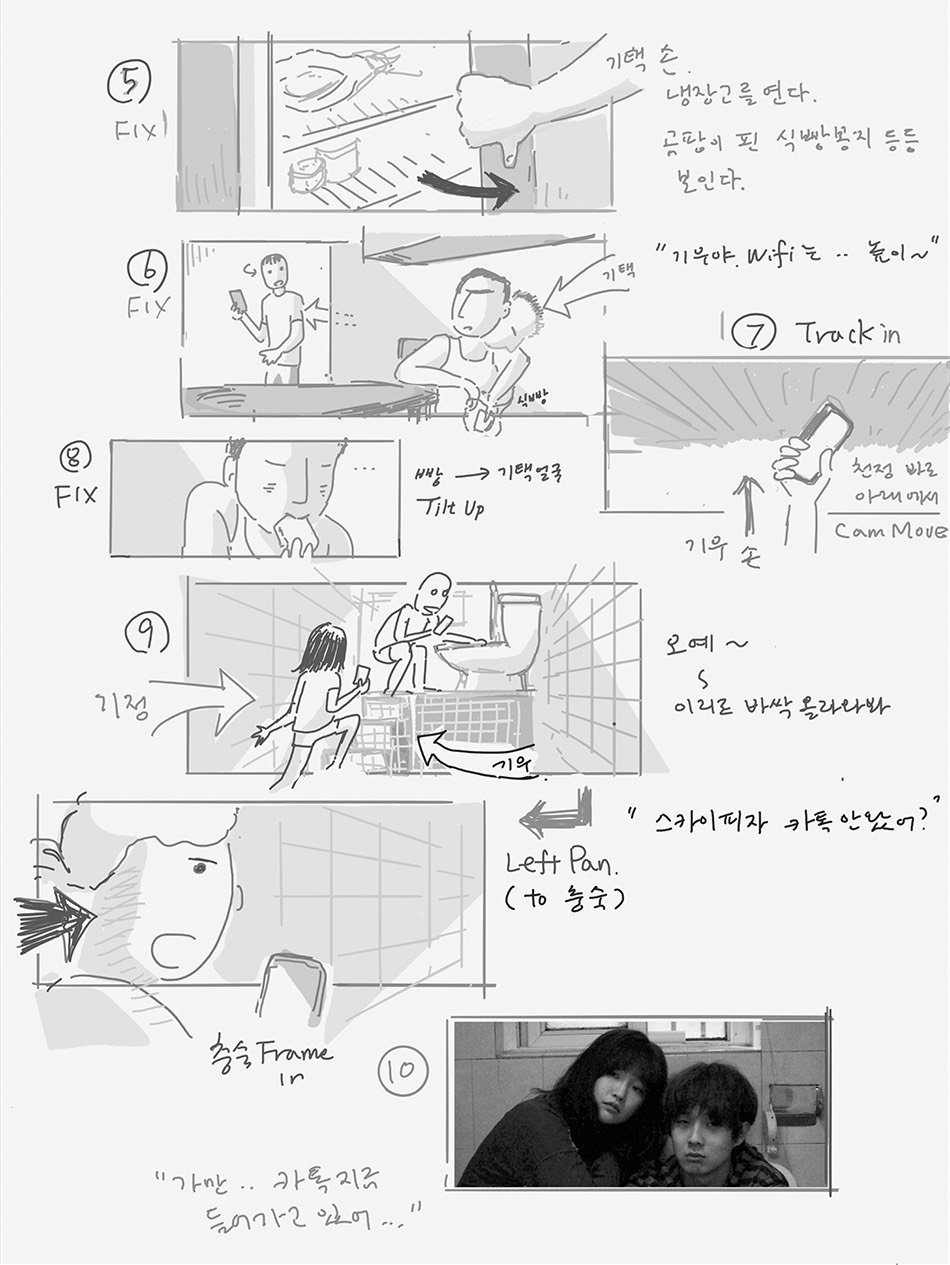
Before he begins filming any of his movies, director Bong Joon-ho draws out storyboards for every single shot of every single scene of the film. From an interview with Bong in 2017:
I’m always very nervous in my everyday life and if I don’t prepare everything beforehand, I go crazy. That’s why I work very meticulously on the storyboards. If I ever go to a psych ward or a psychiatric hospital, they’ll diagnose me as someone who has a mental problem and they’ll tell me to stop working, but I still want to work. I have to draw storyboards.
For his Oscar-winning Parasite, Bong has collected the storyboards into a 304-page graphic novel due out in mid-May: Parasite: A Graphic Novel in Storyboards.
Drawn by Bong Joon Ho himself before the filming of the Palme d’Or Award-winning, Golden Globe(R)-nominated film, these illustrations, accompanied by every line of dialog, depict the film in its entirety. Director Bong has also provided a foreword which takes the reader even deeper into the creative process which gave rise to the stunning cinematic achievement of Parasite.
The book has already been released in Korea, and Through the Viewfinder did a 5-minute video comparison of the storyboards with the filmed scenes for the peach fuzz montage scene (and another video of the flood scene).
Amazing. That’s a whole lotta film school packed into five minutes of video.
Back in November, Patrick Tanguay and I posted about Xavi Bou’s Ornitographies project, photographs of the paths traced by birds in the sky. Now Bou has released a video extension of the project, which shows the paths of starlings wheeling & swerving through the sky in huge groups called murmurations. Soothing soundtrack by Kristina Dutton. (via dunstan orchard)
A couple of weeks ago, Sarah Pavis (who has guest edited here in the past) shared some of her favorite YouTubers that post videos of themselves walking around as a way to ease our lack of mobility during the pandemic quarantine. (Remember walking around outside among other people? Ahh, those were the days…)
Most of these are of city walks, the kind of walking I miss most acutely.1 Some of the videos are narrated, but most contain just ambient city noise. You can find lots more walks, including those in more natural settings, by searching YouTube for “4K walks”, “binaural walks”, or similar terms.
See also Virtual Travel Photography in the Age of Pandemic.
Concatenation is a Rube Goldberg-esque video montage made up of cleverly arranged stock video footage. This is one of those things where I’m like, “ugh this is so good, why didn’t I think of this?” See also this clipart animation:
(via waxy)
Update: The music video for Cassius’ Go Up uses a similar technique of juxtaposing stock videos. (via @endquote)
Rebecca Marquardt works at a grocery store and has some tips/suggestions/requests for grocery shoppers on how to keep themselves and grocery store employees healthy while shopping during the pandemic.
1. Make an organized shopping list so you can get in and out.
2. Stock up (DON’T hoard) so you don’t have to come in as often.
3. Go to the bathroom at home.
4. Sanitize your hands right before you enter the store.
4 1/2. Forgot when I filmed — wipe down the shopping cart/basket.
5. Touch only what you need to.
6. Maintain space between you, other customers, AND employees.
7. Ask if we’d like you to bag your own groceries.
8. Wash your reusable bags!
9. Sanitize your hands when you leave the store.
Are people serious with #3?! Jesus. I know it can be difficult to think of something as simple and ubiquitous as grocery shopping as requiring forethought, but these are not normal times. Make a plan and stick to it. The goal is to minimize your exposure (to keep yourself and workers safe) while getting necessary supplies. Marquardt’s list is really good, but I’d add a few more things based on common sense & policies I’ve seen at other stores:
1. Send only one person per family to do the shopping. And especially don’t bring your kids into the store.
2. Wear a mask.
3. Take only what you absolutely need into the store — no big purses or bags if you can help it. Use a paper shopping list; keep your phone in your pocket. Have your credit card out of your wallet and in a pocket for ease of use. All this minimizes the things you touch and need to potentially disinfect later.
Again, I know it feels completely idiotic to have to think about going to the store like you’re Serena Williams prepping for a Grand Slam final. It seems like an overreaction. But as Williams would probably be the first to tell you, preparation and careful execution of a plan are things that can help you feel more confident, comfortable, and in control about a potentially stressful event. We owe it to Marquardt and other store workers to keep them safe during all of this while they work to keep us fed and stocked with essentials. (via digg)
In the midst of the COVID-19 pandemic, John Krasinski thought it would be worthwhile to pause and take note of some good news happening in the world in this new YouTube series. As Andy Baio noted, this hewed so closely to Ze Frank’s The Show that I kept expecting to hear him call viewers “speed racers” and ask us to make an Earth sandwich. Keep your eyes peeled for a small The Office reunion with a certain regional manager via Zoom.
People on Spring Break in Florida for the past couple of weeks were famously unconcerned with social distancing measures implementing in other areas of the country to help stem the tide of COVID-19 infections and save lives. Using cellphone location data from just the phones of the people gathered on a single beach in Fort Lauderdale, Florida, this video shows just how far those people spread across the country when they went home, possibly taking SARS-CoV-2 with them. They go everywhere.
Show of hands: who feels uncomfortable being reminded of the extent to which 3rd party companies know the location of our cellphones? With tools like the one demonstrated in the video & other easily available info, it has to be trivial to identify individuals by name using even “randomized” data and so-called metadata. (via @stewartbrand)
Back when the COVID-19 pandemic was beginning to be taken seriously by the American public, 3blue1brown’s Grant Sanderson released a video about epidemics and exponential growth. (It’s excellent — I recommend watching it if you’re still a little unclear on how things are got so out of hand so quickly in Italy and, very soon, in NYC.) In his latest video, Sanderson digs a bit deeper into simulating epidemics using a variety of scenarios.
Like, if people stay away from each other I get how that will slow the spread, but what if despite mostly staying away from each other people still occasionally go to a central location like a grocery store or a school?
Also, what if you are able to identify and isolate the cases? And if you can, what if a few slip through, say because they show no symptoms and aren’t tested?
How does travel between separate communities affect things? And what if people avoid contact with others for a while, but then they kind of get tired of it and stop?
These simulations are fascinating to watch. Many of the takeaways boil down to: early & aggressive actions have a huge effect in the number of people infected, how long an epidemic lasts, and (in the case of a disease like COVID-19 that causes fatalities) the number of deaths. This is what all the epidemiologists have been telling us — because the math, while complex when you’re dealing with many factors (as in a real-world scenario), is actually pretty straightforward and unambiguous.
The biggest takeaway? That the effective identification and isolation of cases has the largest effect on cutting down the infection rate. Testing and isolation, done as quickly and efficiently as possible.
See also these other epidemic simulations: Washington Post and Kevin Simler.
Note: Please keep in mind that these are simulations to help us better understand how epidemics work in general — it’s not about how the COVID-19 pandemic is proceeding or will proceed in the future.
From Jon Lefkovitz, Sight & Sound is a feature-length documentary film about the legendary film editor and sound designer Walter Murch, who edited and did sound design for films like The Godfather, Apocalypse Now, and The Conversation.
This feature-length documentary, viewed and enjoyed by legendary film editor and sound designer Walter Murch himself (“The Conversation”, “Apocalypse Now”), was culled by Jon Lefkovitz from over 50 hours of Murch’s lectures, interviews, and commentaries.
That’s the whole film embedded above, available online for free. Here’s the trailer in case you need some prodding. I haven’t watched the whole film yet, but I’m definitely going to tuck into it in the next few days.
See also Worldizing — How Walter Murch Brought More Immersive Sound to Film.
Maybe I’m gonna get some guff for this, but I believe that Coldplay is an underrated band. Oh sure they’re popular, but they are also good, better than their reputation suggests. Brian Eno doesn’t work with just anyone after all. Their recent Tiny Desk Concert at NPR bears this out. Backed by a fantastic nine-person choir (who previously performed with the band at a prison-reform benefit), Coldplay frontman Chris Martin and guitarist Jonny Buckland joyously perform a few of their songs (like Viva La Vida and Champion Of The World) as well as a rousing cover of Prince’s 1999.
Note: Please check the updates below for some important corrections to some of the information in this video.
From Dr. Jeffrey VanWingen MD, a video on how to ensure that your grocery shopping experience is as safe as possible and to avoid potential COVID-19 infection from plastic and metal surfaces. I’m going to be honest with you: a lot of this seems like overkill (as it should — see the Paradox of Preparation). However, this is also pretty much what I’ve been doing after grocery shopping for the past 2 weeks because I am a fastidious motherfucker1 with plenty of time to wipe down groceries. If it comes down to a choice between watching 7 more minutes of The Mandalorian or wiping down my groceries before putting them in the fridge, I’m gonna wipe them groceries. Baby Yoda can wait.
See also this PDF from Crumpton Group about how to keep your household free of the outside effects of the COVID-19 pandemic.
Household members should understand that their principal effort should be directed towards isolating the inside of the home from the pandemic effects outside. All physical thresholds of the home will serve as a cordon sanitaire. Strive to decontaminate everyone and everything to the best practical degree before entering.
Many of Dr. VanWingen’s recommendations mirror those in the PDF. See also expert guidance on COVID-19 and food safety. (thx, meg)
Update: I have not had a chance to read it yet (was attending to some other things this evening — family, trying to have some normalcy), but I’ve been told that this thread is a good response to the video above. I’ll have a closer look at it tomorrow.
Update: Ok, I’ve read Don Schaffner’s thread criticizing this video. At least I think this is the video he’s referring to because he never says it outright — which I’ll get to in a minute. (Schaffner is a professor in the food science department at Rutgers who I linked to the other day in my post on COVID-19 and food safety.) As he notes, there are a couple of factual errors and VanWingen does offer some dubious advice, particularly about washing food with soap (which I didn’t take seriously). I do not believe, however, that VanWingen was suggesting that people leave frozen items and perishables in a warm garage for 3 days and that the normal rules of food safety are somehow countermanded by potential coronavirus contamination. If you want to leave that box of Cheerios that you don’t need in the car for 3 days, go right ahead. He definitely should have been clearer on that point though.
But the bulk of VanWingen’s video was about how to handle your groceries and takeout food coming into your house to minimize the chance of infection. (And as I mentioned, much of it mirrors the advice in this document and in Dr. Michael Lin’s document from a couple of weeks ago — this isn’t just his opinon or my opinion.) If we are to take seriously a) the assumption that anyone could have COVID-19 (including yourself & grocery workers) that we are operating under w/r/t to handwashing & keeping a 6-foot distance, b) the preliminary results that suggest that SARS-CoV-2 can last on some surfaces for days, and c) that person-to-surface-to-person transfer of SARS-CoV-2 might result in infection (i.e. the reason we are doing all this handwashing and face not-touching), then we should be disinfecting surfaces that other people have been touching recently. Right? We should assume that all surfaces are contaminated. This doesn’t seem outlandish, especially when grocery stores are restocking shelves continuously — that bag of chips that you put into your cart may have been placed on the shelf only 30 minutes before. How is disinfecting your Oreos package when you get home from the store a bad idea? Sure, wash your hands before you eat, but if you have kids, you know how futile that can be sometimes, especially when Oreos are involved. So why not just clean the package? Ditto with transferring takeout food to new containers and giving it a blast in the microwave to warm it up.
Schaffner’s stance is that most surfaces aren’t contaminated to a high degree, which is undoubtably true. Having watched the video & read Schaffner’s advice (and other advice by other experts), where your personal comfort level with making sure the surfaces you and your family come into contact to are disinfected is up to you. Ultimately, advice from experts is still advice and you have to figure out whether it works for you. It’s easy to believe you should wash your hands frequently because that’s universal advice. But “you should disinfect surfaces you touch” and “you don’t have to worry too much about disinfecting your grocery packages” are genuinely conflicting bits of advice from well-meaning experts! You’ve gotta use your noggin and make up your own mind, based on your personal idea of risk and safety. It’s gonna land differently with different people.
Finally, I’m going to get a little cranky here, but I found Schaffner’s overall tone in the first few tweets of that thread mocking, ungenerous, and unhelpful. Instead of gently offering alternative authoritative advice, he subtweeted (by refusing to link to the video and calling Dr. VanWingen not by his name but referring to him as “the video MD”) and made fun of VanWingen’s outfit. I know it must be frustrating to see what you perceive as misinformation out there, but we do not need Doctor vs Doctor battles here. Everyone’s just going to get defensive and dig their heels in.
Update: From Joseph Allen of Harvard’s School of Public Health, Don’t panic about shopping, getting delivery or accepting packages.
Yes, the virus can be detected on some surfaces for up to a day, but the reality is that the levels drop off quickly. For example, the article shows that the virus’s half-life on stainless steel and plastic was 5.6 hours and 6.8 hours, respectively. (Half-life is how long it takes the viral concentration to decrease by half, then half of that half, and so on until it’s gone.)
And here’s how to take reasonable precautions when getting a package delivery or going to the grocery store:
You can leave that cardboard package at your door for a few hours - or bring it inside and leave it right inside your door, then wash your hands again. If you’re still concerned there was any virus on the package, you could wipe down the exterior with a disinfectant, or open it outdoors and put the packaging in the recycling can. (Then wash your hands again.)
What about going to the grocery store? The same approach applies.
Shop when you need to (keeping six feet from other customers) and load items into your cart or basket. Keep your hands away from your face while shopping, and wash them as soon as you’re home. Put away your groceries, and then wash your hands again. If you wait even a few hours before using anything you just purchased, most of the virus that was on any package will be significantly reduced. If you need to use something immediately, and want to take extra precautions, wipe the package down with a disinfectant. Last, wash all fruits and vegetables as you normally would.
Important caveat: the coronavirus half-life times are for room temperature. For colder temperatures (like in the fridge or especially the freezer), the virus will last longer. So maybe wipe down that bag of frozen peas even if you’re not going to use them for a couple of days.
It would have been Opening Day for baseball here in the US. Since we’re without the actual thing due to COVID-19, Ken Burns asked PBS to allow people to stream his 18-hour documentary series on baseball from 1994 for free (US & Canada). Here’s part one:
(via open culture)
This is a short drone tour of San Francisco with the shelter-in-place order in effect — it looks abandoned. Fisherman’s Wharf, downtown, Market Street, the Haight — I think I saw like 8 people total during the whole video. Heartening to see that people are taking shelter-in-place seriously.
Update: Walking through the empty streets of Rotterdam:
A similar amble through Amsterdam. Here’s NYC:
(via the morning news)
Update: And here’s Miami:
Starting from a seed, a sunflower plant grows, flowers…and then wilts. I’ve always thought these kinds of videos were wonderful, but given recent events, they are hitting with an extra poignance. Or maybe hope in a strange sort of way? I don’t know what one is supposed to be feeling about anything these days.
In this other sunflower time lapse, you can more clearly see the little seed helmets worn by the tiny plants soon after sprouting. Cute!
Thinking that some people might need high quality entertainment while shut inside due to the COVID-19 pandemic, filmmaker Gary Hustwit is streaming his films online for free, one film per week. First up (from Mar 17-24) is Helvetica, his documentary on typography and graphic design. Here’s the trailer:
Click through to watch the whole film. (via daring fireball)
Back in late December, a new comet called Comet ATLAS (or C/2019 Y4) was discovered by a robotic astronomical survey on the lookout for objects that may strike the Earth. Don’t worry, Comet ATLAS isn’t going to hit us, but it has a chance to put on quite a show.1 It didn’t seem like much at first, but since its discovery Comet ATLAS has gotten brighter much faster than scientists have expected.
When astronomers first spotted Comet ATLAS in December, it was in Ursa Major and was an exceedingly faint object, close to 20th magnitude. That’s about 398,000 times dimmer than stars that are on the threshold of naked-eye visibility. At the time, it was 273 million miles (439 million kilometers) from the sun.
But comets typically brighten as they approach the sun, and at its closest, on May 31, Comet ATLAS will be just 23.5 million miles (37.8 million km) from the sun. Such a prodigious change in solar distance would typically cause a comet to increase in luminosity by almost 11 magnitudes, enough to make ATLAS easily visible in a small telescope or a pair of good binoculars, although quite frankly nothing really to write home about.
Except, since its discovery, the comet has been brightening at an almost unprecedented speed. As of March 17, ATLAS was already magnitude +8.5, over 600 times brighter than forecast. As a result, great expectations are buzzing for this icy lump of cosmic detritus, with hopes it could become a stupendously bright object by the end of May.
But the brightening could also be a sign that the comet is ejecting a lot of material because it’s burning itself out, so grain of salt. But if keeps brightening at a good pace, it could be visible during the day in the northern hemisphere.
If Atlas manages to remain intact, some in the field have suggested it could grow from magnitude +1 to possibly -5. At the brightest extreme, it could be visible even during the day.
The location of the comet is also notable-unlike more recent comets, it will be best viewed in the Northern Hemisphere.
Chuck Ayoub recently captured the comet arcing across the night sky with his backyard astrophotography rig:
Oh I hope Comet ATLAS can keep it together. I vividly remember going outside in rural Wisconsin darkness to see the tail of Comet Hyakutake stretch halfway across the sky. One of the most amazing things I’ve ever seen.
Update: It looks as though Comet ATLAS will not be dazzling naked-eye observers later this spring — the comet seems to have broken into 3 or 4 pieces as it nears the Sun.

Space Shuttle thermal tiles conduct heat so poorly that after being in a 2200 °F oven for hours, you can pick them up with your bare hands only seconds after they come out, still glowing hot.
I don’t know if they specifically had this in mind when making it, but this video from Vox about the importance of hand washing with soap to kill coronavirus is very kid-friendly. From my pals at the excellent The Kid Should See This
Wash your hands for 20 seconds with soap and water. This is the very best way to kill viruses like coronavirus. But why? What’s happening on our hands when we use soap and water? And why do we have to wash with soap for 20 seconds? Why not ten?
The glow-in-the-dark explanation of the 20-second rule was extremely convincing.
See also How to Wash Your Hands Properly and Washing Your Hands Is Important Because Soap “Absolutely Annihilates” Coronavirus. (via tksst)
Update: Mark Rober did an experiment with a powder that glows under UV and can be transferred from surface to surface (or hand to surface). You can see the germs spreading from person to person and all over that classroom. Yikes.
This morning Kurzgesagt released their video about COVID-19 that they’ve been working on for a week, and it is excellent, particularly the first part where they explain exactly what the SARS-CoV-2 virus does to a human body and why it can be so dangerous. I hadn’t heard that described before, especially in such relatively simple terms.
The virus has not caused too much damage yet, but corona is now going to release a real beast on you: your own immune system. The immune system, while there to protect you, can actually be pretty dangerous to yourself and needs tight regulation. And as immune cells pour into the lungs to fight the virus, corona infects some of them and creates confusion. Cells have neither ears nor eyes — they communicate mostly via tiny information proteins called cytokines — nearly every important immune reaction is controlled by them. Corona causes infected immune cells to overreact and yell bloody murder. In a sense, it puts the immune system into a fighting frenzy and sends way more soldiers than it should, wasting its resources and causing damage.
Kurzgesagt always provides a list of scientific sources used to produce their videos, and the one for this video is particularly extensive and they are going to keep it updated.
Update: For more information on the coronavirus itself, SARS-CoV-2, see Ed Yong’s piece in the Atlantic and How the Coronavirus Could Take Over Your Body (Before You Ever Feel It) from New York magazine.
One of the key shortages in areas overwhelmed by COVID-19 patients (like Italy) is ventilators in hospitals. COVID-19 is a respiratory illness and respirators are essential in treating patients with acute symptoms. In the US and other countries, experts are warning of ventilator shortages and manufacturers say it will be difficult to ramp up production quickly enough to meet demand. So healthcare providers are looking for other solutions.
One potential solution is modifying ventilators to work for more than one person at a time. Based on feasibility research published in 2006, the simple technique uses inexpensive parts that hospitals already have on hand to modify machines to work with 4 patients at a time (with important caveats). One of the authors of that research paper, Dr. Charlene Babcock, explains how to hack the ventilators in this video:
Some notes from the video:
- The initial study used test lungs (not actual humans)
- You need to make sure the lung size and resistance of all four patients hooked up to a single ventilator are the same. No mixing adults and kids, for instance.
- Make sure the ventilator tubes leading to and from the patients are all the same length.
- This technique has been used successfully in the field, during the aftermath of the 2017 Las Vegas shooting.
- They did not investigate cross-contamination effects, so you have to make sure all the patients connected to one machine are COVID-19 patients in order to mitigate the risk.
In closing, Babcock says:
Now here’s my disclaimer. This is off-label use of the ventilator. The ventilator is made for one person and I’m using it here in a simulation of four patients. I always hope that you would never need to use it in this way, but you can never predict what’s going to happen in a disaster. And if it was me and I had four patients and they all needed intubation and I only had one ventilator, I would simply have a shared discussion meeting with all four families and say “I could pick one to live or we could try to have all four live”. But this is clearly off-label and likely would only be used in dire circumstance, which we may see with COVID-19.
Other people are working on designing and deploying open source ventilators and ventilators made from parts of other machines. All this reminds me of that scene in Apollo 13 where NASA engineers design a modified CO2 scrubber using only parts available on the spacecraft. A similar “failure is not an option” spirit might be called for in this case as well.
The Washington Post made this short video that shows how Fox News personalities were talking about the COVID-19 pandemic a week or two ago — it’s a Democrat hoax!! — compared to their more recent coverage that aligns closer with the truth.
For weeks, some of Fox News’s most popular hosts downplayed the threat of the coronavirus, characterizing it as a conspiracy by media organizations and Democrats to undermine President Trump.
Fox News personalities such as Sean Hannity and Laura Ingraham accused the news media of whipping up “mass hysteria” and being “panic pushers.” Fox Business host Trish Regan called the alleged media-Democratic alliance “yet another attempt to impeach the president.”
It has never been more plain that Fox News is not journalism but conservative propaganda. They, along with Trump, some conservative members of Congress, and conservative talk radio, were just straight up lying, misleading the public, and peddling conspiracy theories until it became overwhelmingly clear that this is a serious situation, as experts had been saying for weeks. The video shows completely contradictory statements made by the same people days apart; as Andrew Kaczynski says, “what a damning indictment”. I’ll go further than that: Fox News endangered the lives of Americans with their false and misleading coverage. People will suffer and die unnecessarily because of it.
I’d urge you to show this to your red state relatives and ask them to defend Fox News as journalism, but I don’t think it will actually do any good. The whole point of propaganda is to deprive people of, as Hannah Arendt puts it, the “capacity to think and to judge”.
The moment we no longer have a free press, anything can happen. What makes it possible for a totalitarian or any other dictatorship to rule is that people are not informed; how can you have an opinion if you are not informed? If everybody always lies to you, the consequence is not that you believe the lies, but rather that nobody believes anything any longer. This is because lies, by their very nature, have to be changed, and a lying government has constantly to rewrite its own history. On the receiving end you get not only one lie-a lie which you could go on for the rest of your days-but you get a great number of lies, depending on how the political wind blows. And a people that no longer can believe anything cannot make up its mind. It is deprived not only of its capacity to act but also of its capacity to think and to judge. And with such a people you can then do what you please.
Newer posts
Older posts




Socials & More