kottke.org posts about video
The Artifact Artist is a short documentary about urban archaeologist Scott Jordan, who, over the past 50 years in NYC, has dug up all sorts of historical objects that date back decades and centuries, even all the way back to the Revolutionary War. The trailer is above and you can watch the entire short film on Vimeo.
Uprooted from the forests of Connecticut to move to New York City, 9 yr. old Scott Jordan declares “I won’t be a city kid!” 45 yrs. later Scott is an urban archeologist. An Indiana Jones in Gotham. Hand digging out centuries old privies, cisterns and landfills across the five boroughs Scott is uncovering artifacts and preserving New York City history by creating artifact art with the treasures he discovers.
In the village of Al-Qaramous, Egypt, local businesses and artisans are carrying on a papyrus-making process that dates back 5000 years, updated with some modern techniques to speed up the process and improve the product.
This new video from Kurzgesagt takes a look at the possible role of nuclear energy in helping to curb the effects of our climate emergency.
Do we need nuclear energy to stop climate change? More and more voices from science, environmental activists and the press have been saying so in recent years — but this comes as a shock to those who are fighting against nuclear energy and the problems that come with it. So who is right? Well — it is complicated.
Rebecca Tuhus-Dubrow wrote about climate change activists who are embracing nuclear energy for the New Yorker back in February.
In the course of years, Hoff grew increasingly comfortable at the plant. She switched roles, working in the control room and then as a procedure writer, and got to know the workforce — mostly older, avuncular men. She began to believe that nuclear power was a safe, potent source of clean energy with numerous advantages over other sources. For instance, nuclear reactors generate huge amounts of energy on a small footprint: Diablo Canyon, which accounts for roughly nine per cent of the electricity produced in California, occupies fewer than six hundred acres. It can generate energy at all hours and, unlike solar and wind power, does not depend on particular weather conditions to operate. Hoff was especially struck by the fact that nuclear-power generation does not emit carbon dioxide or the other air pollutants associated with fossil fuels. Eventually, she began to think that fears of nuclear energy were not just misguided but dangerous. Her job no longer seemed to be in tension with her environmentalist views. Instead, it felt like an expression of her deepest values.
For more reading on the topic, check out Kurzgesagt’s list of source materials used to make their video.
Before her appearance in Star Wars, Carrie Fisher had only appeared in one film (Hal Ashby’s Shampoo) and for the role of Leia, she was going up against several other great actresses, including Karen Allen and Jodie Foster. In this footage of Fisher’s screen test from late 1975/early 1976, where she’s reading a scene with Harrison Ford about the Death Star plans, you get a tantalizing glimpse of why she ended up winning the part.
See also Mark Hamill’s screen test and several other Star Wars screen tests, including this one of Kurt Russell, who auditioned for the roles of Han and Luke.
A24 and David Lowery have adapted the Middle English poem Sir Gawain and the Green Knight for the screen. The film was scheduled to be released early last year, but the pandemic intervened; it’s now due out at the end of July.
An epic fantasy adventure based on the timeless Arthurian legend, The Green Knight tells the story of Sir Gawain (Dev Patel), King Arthur’s reckless and headstrong nephew, who embarks on a daring quest to confront the eponymous Green Knight, a gigantic emerald-skinned stranger and tester of men. Gawain contends with ghosts, giants, thieves, and schemers in what becomes a deeper journey to define his character and prove his worth in the eyes of his family and kingdom by facing the ultimate challenger. From visionary filmmaker David Lowery comes a fresh and bold spin on a classic tale from the knights of the round table.
I read this story (Simon Armitage’s translation) to my kids a year or two back and it wasn’t our absolute favorite (it paled in comparison to our previous read, Emily Wilson’s The Odyssey), so I’m curious to see how it works as a film.
Love it or hate it, we all know what Wes Anderson movies look like by now — the vibrant color palette, use of symmetry, lateral tracking shots, slow motion, etc. etc. In this video, Thomas Flight explores why Anderson uses these stylistic elements to tell affective and entertaining stories.
But what is at the core of those individual stylistic decisions? Why does Anderson choose those things? Why do all those things seem to form a very specific unified whole? And what function, if any, do they serve in telling the kinds of stories Wes wants to tell?
The sources for the video are listed in the description; one I particularly enjoyed was David Bordwell writing about planimetric composition. (via open culture)
Last month I shared a video of the Earth rising over the surface of the Moon captured by Japan’s Kaguya orbiter. It’s a good clip but quite short and over-narrated. Seán Doran took several Earthrise & Earthset sequences filmed by Kaguya, remastered & upsampled them to 4K resolution, and stitched them together into this wonderful video, set to music by Jesse Gallagher. One of the sequences, which begins around the 5-minute mark, captures a solar eclipse of the Sun by the rising Earth. I hadn’t seen this footage before and had to pick my jaw up off the floor — absolutely spectacular.
Educator and structural engineer Nehemiah Mabry sat down with Wired to talk about all the different kinds of bridges in the world (cable-stayed, suspension, arch, truss) and which types are used in which situations.
See also Fantastic 3-D Animation of How Medieval Bridges Were Built. (via the kid should see this)
In 2018, Tim Wardle’s fantastic documentary Three Identical Strangers introduced us to a set of identical triplets who were separated at birth. The film goes deeper into the story (and into nature vs nurture) and I don’t want to spoil it too much, but after it was released, some people began to suspect that they might have identical siblings out there themselves. One of those people was Michele Mordkoff, who found she had a twin sister and got in touch with Wardle, who was there at their reunion and made this short film about it (major TIS spoilers in that first paragraph).
“She is a stranger to me, but she’s also a part of me-I mean, we shared a womb,” says Michele in the film after she meets her twin for the first time.
“I’ve been struck by how instinctive, magical, and moving genetic reunions can be,” Wardle told The Atlantic in a recent interview. “This isn’t to denigrate non-genetic/adoptive relationships, which can also be wonderful, but there’s something extraordinary and almost transcendent about observing the interaction between two people who have never met before but share the same DNA. It defies rational explanation.”
If you can’t get enough of twin reunions, here are a few more to watch.
On March 19, after seismic activity in the area, an eruption occurred in Fagradalsfjall, Iceland, adding a new volcano to the country’s already charismatic geology. Because the ongoing eruption is relatively small, steady, and located fairly close to Reykjavik, it’s been well-documented, both by drone and by live webcam. YouTube user stebbigu stitched footage from the live feed into a 5-minute time lapse of the formation of the volcano that covers 18 days, from the first few hours to a couple of days ago. The night views, with all that pulsing orange lava, are especially mesmerizing.
Marvel’s newest TV series, The Falcon and the Winter Soldier, contained a scene in the third episode that featured a tantalizingly short glimpse of erstwhile villain Zemo dancing awkwardly in a nightclub. Fans clambered for more, and so Marvel released an hour-long video of Zemo dancing, cheekily called “The Zemo Cut”. Tag yourself — I’m the clapping. (For some reason, this reminds me of Mad Men’s Ken Cosgrove dancing to Daft Punk.)
If you’ve seen Ocean’s Eleven more than once, you probably noticed that Brad Pitt’s character Rusty Ryan is eating or drinking something in almost every scene he’s in. cinemATTIC made a supercut of all of those food and beverage moments from the movie. And if you’re wondering why Rusty was always eating, according to Rolling Stone:
Pitt figured that since the Ocean gang was on such a tight schedule, his character would have to grab fast-food whenever he could. The constant snacking ended up showing Rusty’s unflappability.
Someday someone will release an action or heist movie with a relevant & entertaining 15-minute sequence where the protagonists have to find a bathroom. During a recent Avengers: Endgame viewing, my son asked, “Doesn’t anyone ever have to go to the bathroom in these movies?” Then we talked about how they hardly ever eat either, aside from the occasional shawarma. But now that I’m thinking about it, there’s quite a bit of eating and drinking in Endgame: Black Widow’s peanut butter sandwich, Hulk-delivered tacos, the diner scene, Thor’s drinking, and many more.1 Ocean’s reference or nah? (via @Remember_Sarah)
Update: These folks did a Snackalong of eating everything that Rusty ate while watching the movie.
On his YouTube channel, Ninh Ly has created almost 100 short videos that clearly and simply explain the rules of all kinds of different sports. Basketball? Explained. Cricket? Explained. (I feel like I finally understand cricket!) Snooker? Explained. Jai Alai? Explained. Curling? Explained. Quidditch?! Explained! The rules of some sports are more complex than others and the explanations move along at a pretty good clip, so decreasing the playback speed (click on the gear at the bottom of the video player) is advised.
This will be essential when the next Olympic Games roll around and everyone gets intensely interested in the rules of handball, fencing, and badminton for two weeks. (via open culture)
Sure, there’s the big budget superhero & action films, but the falling cost and increasing availability of really good motion graphics tools also enables a sort of everyday surrealism that’s on display in this short video by Fernando Livschitz. (via colossal)
What do swaying bridges, flashing fireflies, clapping audiences, the far side of the Moon, and beating hearts have in common? Their behavior all has something to do with synchronization. In this video, Veritasium explains why and how spontaneous synchronization appears all the time in the physical world.
I was really into the instability of the Millennium Bridge back when it was first opened (and then rapidly closed), so it was great to hear Steven Strogatz’s explanation of the bridge’s failure.
Oh, and do go play with Nicky Case’s firefly visualization to see how synchronization can arise from really simple rules.
Thanks to a recommendation from Wander Lines, I just found the Journey to the Microcosmos channel on YouTube. The imagery is fantastic and the narration informative — my absolute favorite combo. The video above, called Microbes Don’t Actually Look Like Anything, is about how light and microscopy work together to produce images of these tiny things that humans can see and make use of. It reminds me of how many of the brilliantly colorful astronomy images we see of far-flung galaxies and nebulae don’t look anything like that in actuality.
Some of the other popular videos on the channel are Tardigrades: Chubby, Misunderstood, & Not Immortal, Diatoms: Tiny Factories You Can See From Space, and How Microscopic Hunters Get Their Lunch.
Foley artist Richard Hinton talks about how he creates sounds for nature documentaries like Planet Earth. I love watching Foley artists do their thing, but I have mixed feelings about these made-up sounds!
Despite the veneer of neutrality of nature documentaries, I know there’s no such thing as objective truth when you’re dealing with cameras and film editing. And silent video is boring. But on the other hand, just making up sounds that spiders don’t actually make — I don’t know. I’ve posted about this before, regarding a video series about how Planet Earth II was made:
I hope the third program is on sound, which has been bugging me while watching Planet Earth II. I could be wrong, but they seem to be using extensive foley effects for the sounds the animals make — not their cries necessarily, but the sounds they make as they move. Once you notice, it feels deceptive.
See also How Fake Are Nature Documentaries?
Is it manipulation? Or good storytelling? And what’s the difference between the two anyway? A silent security feed of a Walmart parking lot is not a documentary but The Thin Blue Line, with its many dramatizations and Philip Glass score, is a great documentary.
(via open culture)
Watch as YouTuber tomosteen makes a Lego chocolate cake out of Lego ingredients, from cracking the eggs to the frosting on top. The little details here are *chef’s kiss*: the transitions from food to Lego brick, the way the chocolate bar breaks imperfectly, the little peaky dollop left after piping the chocolate frosting out of the pastry bag.
Don’t care for chocolate cake? How about a Japanese breakfast (featuring tamagoyaki) or churros instead?
See also Lego In Real Life or search for Lego in real life on YouTube. (via colossal)
In this short film called Hydrotherapy, Laura Owen Sanderson talks about how she found relief from a life-changing illness through wild swimming.
I wasn’t afraid to die. I was more afraid, or angry if you’d like, that I hadn’t lived, that I hadn’t made the most of every opportunity. So I was waiting for a day that might never come — when you retire or when you’re thin enough or when the kids have grown up — and there was a sudden realization that that day might never come.
If you’d like to reconnect with nature through wild swimming or cold water swimming, check out these two videos for some handy tips on how to get started and do it safely. (via huit denim newsletter)
In the latest episode of the Vox series Glad You Asked, host Joss Fong looks at how racial and other kinds of bias are introduced into massive computer systems and algorithms, particularly those that work through machine learning, that we use every day.
Many of us assume that tech is neutral, and we have turned to tech as a way to root out racism, sexism, or other “isms” plaguing human decision-making. But as data-driven systems become a bigger and bigger part of our lives, we also notice more and more when they fail, and, more importantly, that they don’t fail on everyone equally. Glad You Asked host Joss Fong wants to know: Why do we think tech is neutral? How do algorithms become biased? And how can we fix these algorithms before they cause harm?
Can’t Get You Out of My Head: An Emotional History of the Modern World is the latest world-explaining documentary series from television journalist Adam Curtis. It’s available in the UK on BBC’s iPlayer and, unofficially as a fan upload, on YouTube; I’ve embedded the trailer and the first part above.
But what exactly is it about you might wonder, even after watching the trailer. Reading Sam Knight’s January 2021 profile of Curtis in the New Yorker might help you there:
For more than thirty years, Curtis has made hallucinatory, daring attempts to explain modern mass predicaments, such as the origins of postwar individualism, wars in the Middle East, and our relationship to reality itself. He describes his films as a combination of two sometimes contradictory elements: a stream of unusual, evocative images from the past, richly scored with pop music, that are overlaid with his own, plainly delivered, often unverifiable analysis. He seeks to summon “the complexity of the world.”
Lucy Mangan’s review for The Guardian was overwhelmingly positive:
The power dynamic, how it shifts, how it hides and how it is used to shape our world — the world in which we ordinary people must live — is Curtis’s great interest. He ranges from the literal rewriting of history by Chairman Mao’s formidable fourth wife, Jiang Qing, during the Cultural Revolution to the psychologists plumbing the depths of “the self” and trying to impose behaviours on drugged and electro-shocked subjects. He moves from the infiltration of the Black Panthers by undercover officers inciting and facilitating more violence than the movement had ever planned or been able to carry out alone, to the death of paternalism in industry and its replacement by official legislation drafted by those with hidden and vested interests. The idea that we are indeed living, as posited by various figures in the author’s landscape and (we infer from the whole) the author himself, in a world made up of strata of artifice laid down by those more or less malevolently in charge becomes increasingly persuasive.
Other reviews, particularly from those on the right, call his work incoherent and Curtis himself something of a propagandist. Admission: I haven’t seen any of Curtis’s work, save for the occasional clip here and there. I know some of you out there are big fans — should I start with this one, HyperNormalisation, Century of the Self, or….?
From Daihei Shibata, Gradations is a meditative short video of hard boundaries of color and shape turning into gradual transitions.
When we gradate the boundaries between two polarized things, the two become smoothly connected. By blurring the various boundaries, we can find complexity, diversity, and richness of information.
This is really lovely — take a couple minutes to watch. (via the equally lovely the kid should see this)
A few years ago, Beau Miles walked 56 miles to work on a college campus, leaving home with just the clothes on his back and a hat. He foraged what he needed along the way, including food, water, and a pair of shoes. Recently, he was asked to give a lecture on adventuring and, as part of his preparation, decided to walk to campus again. I really enjoyed watching this — Miles’ curiosity and drive is infectious. And his roadside scavenging reminded me of the survival scenario exercise where you need to rank salvaged items in terms of usefulness.
You may remember Miles from the “mile an hour” marathon he ran around his neighborhood over the course of 24 hours. (via craig mod)
Produced by BBC Studios Natural History Unit and narrated by David Attenborough, The Year Earth Changed is an upcoming documentary that looks at what happened to the natural world when much of the world’s human population stayed indoors for a few months.
From hearing birdsong in deserted cities, to witnessing whales communicating in new ways, to encountering capybaras in South American suburbs, people all over the world have had the chance to engage with nature like never before. In the one-hour special, viewers will witness how changes in human behavior — reducing cruise ship traffic, closing beaches a few days a year, identifying more harmonious ways for humans and wildlife to coexist — can have a profound impact on nature. The documentary, narrated by David Attenborough, is a love letter to planet Earth, highlighting the ways nature bouncing back can give us hope for the future.
The Year Earth Changed debuts on Apple+ on April 22, aka Earth Day. (I can’t believe they resisted calling this Nature Is Healing though…)
Linus Akesson noticed that without the benefit of the acoustical properties of massive churches, the sound that comes out of organ pipes sounds tinny, like 8-bit chiptune sounds.
Back in 2008 I had an epiphany about church organs: At least in theory, organ pipes produce very simple waveforms, much like 8-bit sound chips do-and the reason church organs don’t sound like chiptunes is primarily because of the acoustics of the church.
Thinking that process could be reversed, he remapped the keys of a Commodore 64 so he could play it like an accordion, ran it though a reverb machine, and created the sixtyforgan. The Bach piece he plays at the end of the video above (and a different Bach piece here) sounds so much like it’s being played on an organ.
See also Hear How Choral Music Sounded in the Hagia Sophia More Than 500 Years Ago (in which a filter is applied to choral music to make it sound as though it’s being sung in a cavernous church). (via @emanuelfeld)
In the late 80s and early 90s, a show called The Secret Life of Machines aired in the UK and the US. Each episode focused on one piece of technology (television, vacuum cleaner, refrigerator) and how it worked — the show is definitely a precursor to the hordes of explainer videos on YouTube, and, increasingly, streaming services. Show creator Tim Hunkin has been uploading digitally remastered episodes of the show to YouTube with newly added commentary from Hunkin at the end of each one. (via @TimothyHelmuth)
Update: I got distracted and forgot to include that Hunkin is doing a new series called The Secret Life of Components about things like chains, hinges, and LED lights. (thx for the reminder @rou_revisionist & @kylevanhorn)
The fantastic civil rights documentary Eyes on the Prize will soon be available for viewing on public media and online. WORLD Channel and PBS will begin airing the 14-part series in early April. The first part of the series, covering the civil rights movement from 1954-1965, will also be available to watch online starting in mid-April. Check out the press release for more info.
Eyes on the Prize, created by Executive Producer Henry Hampton, is an award-winning and critically-acclaimed in-depth documentary series on civil rights in America. Hampton set out to share his vision of what he called “the remarkable human drama that was the Civil Rights Movement” through the experiences and challenges of those fighting for justice. Produced by Blackside Inc, Eyes on the Prize tells the definitive story of the civil rights era from the point of view of the ordinary men and women whose extraordinary actions launched a movement that changed the fabric of American life and embodied a struggle whose reverberations continue to be felt today.
With contemporary interviews and historical footage, the Academy Award-nominated documentary traces the civil rights movement from the Montgomery bus boycott to the Voting Rights Act; from early acts of individual courage through the flowering of a mass movement and its eventual split into factions. The late Julian Bond, political leader and civil rights activist, narrates.
If you’ve never seen Eyes on the Prize, you should definitely take this opportunity to check it out. (via @jbenton)
In a sort of self-ventriloquism move, Gracie Scullion has learned how to make it seem as though her voice is delayed when she talks. Check out the video to see what I mean:
Neat! Scullion has a career in vaudeville ahead of her if she wants.1 (via digg)
Related to my post from last month about what a 95% or 66% efficacy rate of a vaccine even means, Vox made a clear and concise video about why comparing vaccine efficacy rates is difficult — trials were done in different countries with different variants under different conditions with different levels of disease — and why protection against severe illness, hospitalization and death is a better way to compare and evaluate these vaccines. As this chart from Dr. Eric Topol shows, all of the major vaccines show strong protection against severe illness.

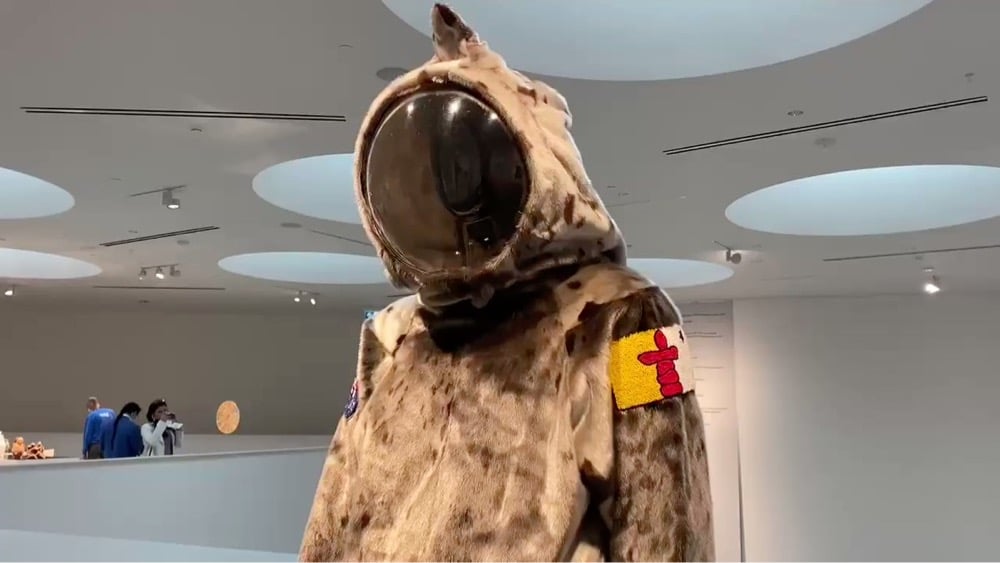
Working with Dr. Heather Igloliorte at Montreal’s Concordia University, Inuit artist Jesse Tungilik and a group of students designed and built a spacesuit made out of seal skin. Tungilik was inspired by the feelings he’d had as a child, bundled up in hunting clothes made by his mother out of caribou hide.
When Jesse Tungilik was a child, his mother made him traditional caribou hunting clothes. While wearing the bulky, heavy handmade outfit, he often imagined that he was in a spacesuit.
“That memory stuck with me when I heard about this opportunity here at Concordia, with its future-themed focus, and the two ideas met in the middle,” Tungilik says.
The image above is a still from a video taken by Brittany Hobson of the spacesuit on display in an exhibition at the Qaumajuq museum in Winnipeg. She says “the video doesn’t do it justice” but the suit looks pretty amazing in that video — I would love to see this in person someday. Dr. Igloliorte, who co-curated the exhibition, talked about the suit and its creation in this video:
Via CBC, you can see a photo of Tungilik as a kid, bundled up in his homemade “spacesuit” while out hunting with his father. Aww. (via @UnlikelyWorlds)
Newer posts
Older posts




Socials & More