kottke.org posts about video
This video focuses on one of my favorite astrophysics facts: 94% of the observable universe is permanently unreachable by humans. (Unless we discover faster-than-light travel, but that’s fantasy at this point.)
This expansion means that there is a cosmological horizon around us. Everything beyond it, is traveling faster, relative to us, than the speed of light. So everything that passes the horizon, is irretrievably out of reach forever and we will never be able to interact with it again. In a sense it’s like a black hole’s event horizon, but all around us. 94% of the galaxies we can see today have already passed it and are lost to us forever.
“Since you started watching this video, around 22 million stars have moved out of our reach forever.” And future generations, billions of years from now, won’t even be able to see any other galaxies or detect cosmic background radiation, making knowledge about the Big Bang impossible.
Quintin Jones murdered his aunt in 1999 and is scheduled to be executed on May 19, 2021. He admits his guilt, his family has forgiven him, and in this video, he shares his thoughts about personal growth & death and asks Texas governor Greg Abbott to spare his life.
During his 21 years on death row, Quin has been the epitome of a prison success story. He entered at an unimaginable low, as lost as a soul can be. And through prayer, sobriety, reconciliation with his family, and longstanding correspondence with pen pals, he has found a way to lead a meaningful life, and even to enhance the lives of others. The victim’s family — who is also Quin’s family — has forgiven him.
Emotionally, intellectually, and psychologically, human beings are ships of Theseus — we are not the same people at 30 as we were at 20 or will be at 40. The death penalty is immoral, full stop. The sooner our system of retributive justice is replaced with restorative justice, the healthier and safer our communities and society will be.
Colette is a remarkable short documentary that won the Oscar this year in the Documentary Short Subject category. You can watch the film online courtesy of The Guardian.
90-year-old Colette Marin-Catherine confronts her past by visiting the German concentration camp Mittelbau-Dora where her brother was killed. As a young girl, she fought Hitler’s Nazis as a member of the French Resistance. For 74 years, she has refused to step foot in Germany, but that changes when a young history student named Lucie enters her life. Prepared to re-open old wounds and revisit the terrors of that time, Marin-Catherine offers important lessons for us all.
Here’s an interview with the filmmakers. From our present historical distance, the horrific story and lessons of Nazism seem fairly straightforward. But as Colette shows, when you delve into the individual stories, the truth of people’s grief & experiences gets complicated. These stories are important to hear and to tell so we remember the real, human, feeling truth of how individual lives were damaged and wasted by the actions of the large and powerful.
In 2005, Thom Yorke recorded a 15-minute set for the From The Basement series — just him, a piano, and a microphone. He sang Videotape from In Rainbows and Last Flowers & Down Is the New Up from In Rainbows Disk 2. Lovely.
See also Radiohead, From The Basement.
Always a treat to watch a new time lapse storm video from Mike Olbinski. It’s in 8K as well, so if you have the bandwidth and the screen resolution, this is going to look extra good. You can see more of Olbinski’s breathtaking videos here as well as plenty more cloud content. kottke.org: home of fine cloud products. (via colossal)
The holes drilled into Arctic, Antarctic, and glacial ice to harvest ice cores can be up to 2 miles deep. One of my all-time favorite sounds is created by dropping ice down into one of these holes — it makes a super-cool pinging noise, as demonstrated in these two videos:
Ice makes similar sounds under other conditions, like if you skip rocks on a frozen lake:
Or skate on really thin ice (ok this might actually be my favorite sound, with apologies to the ice core holes):
Headphones are recommended for all of these videos. The explanation for this distinctive pinging sound, which sounds like a Star Wars blaster, has to do with how fast different sound frequencies move through the ice, as explained in this video:
(via the kid should see this)
In a career filled with iconic performances, one of the standout Prince moments came at the 2004 Rock and Roll Hall of Fame induction ceremony for George Harrison. On stage to play While My Guitar Gently Weeps were Harrison’s son Dhani, music legends Tom Petty, Jeff Lynne, and Steve Winwood, and Prince. At about 3 minutes and 30 seconds in, Prince absolutely rips the place apart with a 3-minute guitar solo for the ages. If you’ve never seen this, make sure you watch all the way to the end.
Video of the performance has been available online for years, but producer Joel Gallen recently uploaded a recut version (embedded above) that focuses more on Prince during the solo. As with all things Prince, Anil Dash shared some context for the performance, including this amazing detail about what happened to the guitar that Prince threw into the air: “long-time guitar tech Takumi Suetsugu caught the guitar & handed it to Oprah”. AS YOU DO. Dash also shared this photo by Afshin Shahidi of Prince walking, guitar in hand and seemingly unnoticed in NYC, to rehearsals for the Hall of Fame ceremony in question.
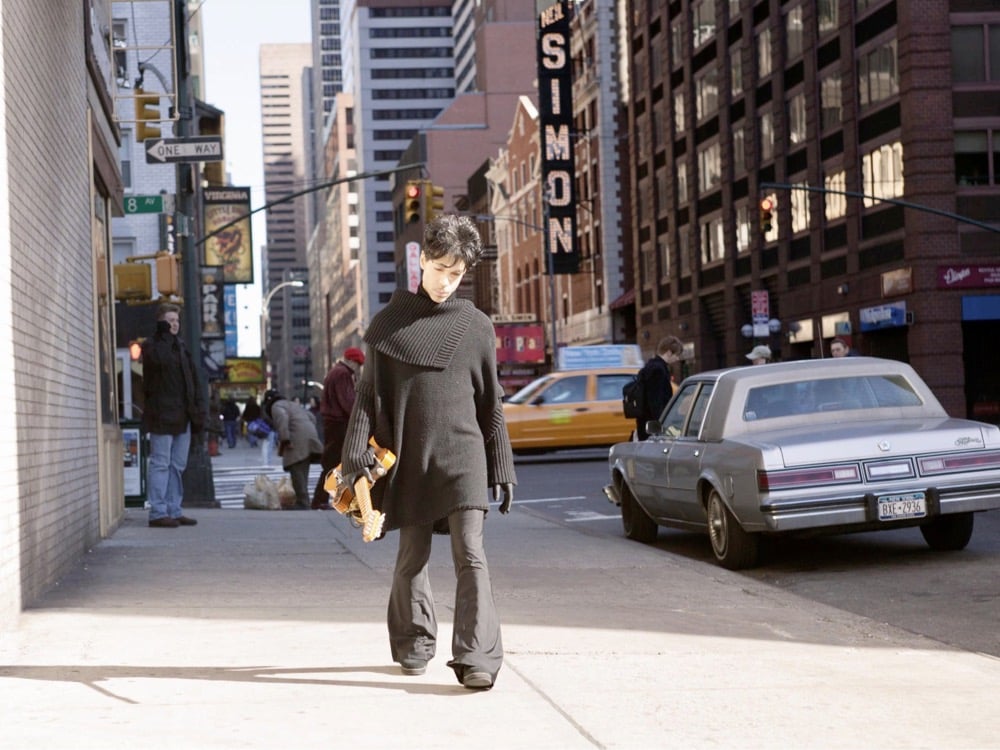
Update: This is a great oral history of the ceremony written in 2016.
Tom sort of went over to him and said, “Just cut loose and don’t feel sort of inhibited to copy anything that we have, just play your thing, just have a good time.” It was a hell of a guitar solo, and a hell of a show he actually put on for the band. When he fell back into the audience, everybody in the band freaked out, like, “Oh my God, he’s falling off the stage!” And then that whole thing with the guitar going up in the air. I didn’t even see who caught it. I just saw it go up, and I was astonished that it didn’t come back down again. Everybody wonders where that guitar went, and I gotta tell you, I was on the stage, and I wonder where it went, too.
From the US National Archives, an 8-minute film of aerial footage filmed from a dirigible piloted by Roy Knabenshue in 1914. I am not super familiar with Chicago and the architecture of the time, but given the city’s role in the development & popularization of the skyscraper, I bet there are some amazing views in here of iconic buildings not so long after they were constructed as well as some buildings and spaces that no longer exist.
If you wish, you can also watch the upsampled, colorized, and “AI enhanced” version of this video. As I’ve said before, I’m not a huge fan of these, uh, restorations. We shouldn’t accept crappy colorization of historic B&W films just because an AI did it. (via @davidplotz)
The NES version of Tetris has been out in the world for more than 30 years now. Somehow, using the same controllers and human hands that have been in use all this time, a new technique has been invented that’s resulting in scores and maneuvers that no one using The Old Ways could have dreamed of. One YouTube commenter sums it up:
The fact that we are still out here revolutionizing the mere concept of pressing a button on a controller that is almost 40 years old. I love this community.
This is a great illustration of innovation in action. There’s a clearly new invention, based on prior effort (standing on the shoulders of giants), that allows for greater capabilities and, though it’s still too early to tell in this case, seems likely to shift power to people who utilize it. And it all takes place inside a small and contained world where we can easily observe the effects.
See also Jacob Sweet’s piece from the New Yorker a couple of months ago, The Revolution in Classic Tetris, which contains this unbelievable tidbit:
Dana Wilcox, one of the highest-scoring players on the Twin Galaxies leaderboard, discovered that she’d played for twenty years without knowing that the blocks could be spun in either direction.
(via robin sloan)
Watch as David Howell sets up several historical chess positions and quizzes world champion Magnus Carlsen on them. Spoiler alert: he knows them all. The one he gets in just four moves after opening is just…otherworldly.
Carlsen is one of a number of world class performers that have prodigious memory skills. See also LeBron James Has a Photographic Memory, Xavi Hernández identifying goals he scored (and the final scores of those matches), Aaron Rodgers’ memory of his significant plays, and Iker Casillas remembers the score of every match he’s played. (via robin sloan)
Update: Former world champion Garry Kasparov:
I was tested similarly in my world championship days, and yes, most Grandmasters can identify thousands of games and positions. It’s not trivial, but, as Magnus said, it’s our job! But his serious interest in the past (human!) games is also a competitive advantage.
Kasparov once gave an impressive public exhibition of this skill. (via @stevenstrogatz)
You’re probably aware that black holes are weird. You can learn more about just how extremely odd they are by watching this animated primer on black holes by Kurzgesagt. The explanation about how long black holes live starting at ~9:30 is legitimately mindblowing — that hourglass metaphor especially.
This man’s garage is 1.55 meters wide and his car is 1.49 meters wide, leaving a clearance of just 3cm on each side. Watch him effortlessly get the car into his sponge-lined garage and then, in an exquisite geometrical dance of angles and tolerances, exit the car into his house. Someone should make this into a video game — I want to see the speedruns!
Update: Radiohead’s Everything In Its Right Place makes the perfect soundtrack to this guy parking his car.
(via @johnpavlus)
Always a pleasure to see new work from Reuben Wu, whose stuff I’ve featured here before. For this piece, Wu journeys into the audiovisual realm, combining his light-forward photography with his music production work (he’s a member of the band Ladytron). Colossal, as usual, has the skinny:
For EX STASIS, Wu programmed a stick of 200 LED lights to shift in color and shape above the calm landscapes. He captured the mesmerizing movements in-camera, and through a combination of stills, timelapse, and real-time footage, produced four audiovisual works that juxtapose the natural scenery with the artificially produced light and electronic sounds. “As it gets dark, my surroundings cease to be an exterior experience and become a subliminal space, and that’s when I feel most connected and aware of my sense of being,” Wu says. “This dynamic terrestrial chiaroscuro synchronizes with my sound design and music to form singular looping pieces.”
“Dynamic terrestrial chiaroscuro”!!! Also, this photo from Wu’s Insta is just fricking beautiful. (via colossal)
As an unapologetic fan of James Cameron’s Titanic, I really enjoyed Evan Puschak’s video love letter to the film and the genre it embodies: melodrama.
The term “melodrama” literally means drama accompanied by music, which is why film is maybe the best most natural medium for it — aside from opera. What’s important to note is that the moral core of melodrama doesn’t intellectualize the story; it adds to the emotion by giving it the flavor of virtue. You know that Rose and Jack should be together, so when they get together it feels right and righteous. And when Jack dies at the end, it’s a heartbreak that makes the whole universe seem wicked.
Miiight be time for a rewatch.
In his latest impeccably produced video, Neil Halloran looks at the science of climate change and uncertainty both in science and in the public’s trust of science.
Degrees of Uncertainty is an animated documentary about climate science, uncertainty, and knowing when to trust the experts. Using cinematic visualizations, the film travels through 20,000 years of natural temperature changes before highlighting the rapid warming of the last half century.
The vast majority of climate scientists seem pretty sure that human use of fossil fuels has warmed the Earth and that warming is increasingly having an impact on both nature and society. But how do we, as members of the public with a relatively poor understanding of science, evaluate how certain we should be?
FYI: This video includes some interactive elements that only work if you watch it on Halloran’s website.
In the 60s & 70s, country music songs about truck drivers and CB radios enjoyed popularity on the airwaves and pop charts.
“Ah, breaker one-nine, this here’s the Rubber Duck. You got a copy on me, Pigpen? C’mon.” This jumble of words is the first line of the song “Convoy,” a #1 country hit from 1976 that tells an action-packed story from the perspective of a truck driver. Songwriters Chip Davis and Bill Fries filled “Convoy” with banter and lingo based on communications they heard between trucker drivers on CB radio during the 1973 oil crisis.
The epic orchestration and colorful and quotable lyrics made “Convoy” an unlikely hit — but the song actually tapped into a long history of country music that put the spotlight on the solitary lives of long-haul truck drivers. In the video above, Estelle Caswell breaks down the golden era of trucker country with country and folk music scholars Travis Stimeling and Nate Gibson.
This style of country music is perhaps my least favorite genre of music, but the history is interesting and I’m committed to bring you every new episode of Earworm.
A new three-part nature series premiered today on Netflix: Life in Color with David Attenborough.
Animals can use color for all kinds of different reasons — whether to win a mate or beat a rival, to warn off an enemy or to hide from one. To understand how these colors work, we need to see them from an animal’s perspective. With new cameras developed especially for this series, now we can.
Last month, a video of a high school kid challenging former NBA player Brian Scalabrine to a game of 1-on-1 went viral. Scalabrine, of course, won easily: 11-0. As this Sports Illustrated article about the video put it: “Even NBA benchwarmers are ungodly basketball players.”
The video is a reminder of just how much better pro athletes are than regular Joes. Scalabrine was not a good NBA player. Considering that he played 11 years in the league, it might not be fair to call him a bad NBA player, but he was certainly one of the least productive players in the league during his career. But even almost a decade removed from his last NBA season, he’s still capable of schooling (almost) any person who hasn’t played at least college basketball. Don’t be fooled by the red hair and the fact that he tucked his hoodie into his sweatpants.
Sopan Deb interviewed Scalabrine and a couple of other NBA & WNBA players to find out if these challenges are common, why they happen, and why they almost always end the same way.
“Being a white N.B.A. player from the suburbs, I have to level up,” said Scalabrine, who is from Long Beach, Calif., and was often referred to as the White Mamba, a play on Kobe Bryant’s Black Mamba nickname.
“People don’t understand how a little bit nuts you have to be to sustain an N.B.A. career,” Scalabrine said. “Especially when you’re not that talented. You have to be ready. You have to be up for the fight. You have to be like that every day. And if you’re not, you lose your livelihood.”
Scalabrine told another challenger years ago: “I’m closer to LeBron than you are to me”.
Gene Demby’s thread about the Scalabrine video is full of stories and videos of other former elite athletes easily besting all comers. This is a favorite:
I had a friend in high school who was at a camp & David Robinson showed up. My friend was feeling cocky after dunking on the Admiral twice. The Admiral told him he’d give him $1000 if he did it again. My friend walked away with a story about how he dunked on David Robinson twice.
A few years ago, WNBA player Devereaux Peters wrote about how these types of challenges are different when you’re a woman.
I’m a tall woman at 6-foot-2, and almost everywhere I go, people notice me. The first question is: Do you play basketball? When they find out I’m a professional player, some are just impressed and want to know more about the life of a pro athlete. Most of the men I talk to, though, ask me to play one-on-one.
If you’ve ever had that impulse, let me stop you here. I’m not going to play you one-on-one. I’m never going to play you one-on-one. I have been playing basketball my entire life, and for just as long I have been challenged by men who think they are better than me. I had to prove my skill in middle school against the boys who thought girls couldn’t play basketball. I had to prove my skill in high school when the guys’ egos were hurt because the girls basketball team was more successful and more popular than theirs. I had to prove it in college when grown men started challenging me to one-on-one games because there was no way this college woman was better than they were. Time and time again, I have trounced men — far too many to count. Now I have nothing to prove.
My kids and I have been discussing a related question recently: in which sport would it be easiest for a normal person with some athletic skills to score against or produce some kind of positive result against a professional player. For example: get a hit off of a major league pitcher, beat Steph Curry 1-on-1, win a set (or even a point) against Serena, score a penalty shot in hockey, or score a rushing touchdown (or even survive the day) from the 5-yard line against an NFL team. That last one may not even be the right scenario, but you get the idea. The best answer we’ve come up with so far is scoring a penalty kick against a goalkeeper — I think if you gave a person who played soccer in high school 12-15 years ago 10 chances against a world-class keeper, I suspect they would score a few. Or perhaps that’s too easy of a challenge — after all, most penalty kicks succeed. Maybe the appropriate challenge would be to stop penalty shots from someone like Messi or Alex Morgan, surely a nearly impossible task.
Update: In 2018, BuzzFeed invited some normal folks to try scoring from the spot against MLS goalkeeper Tyler Miller. Admittedly Miller is not one of the best keepers in the world and who knows how hard he was really trying, but a few shots did get past him.
In Europe, where you’re much more likely to find folks on the street who grew up living & breathing soccer and can put the ball in the corners with some pace, I suspect the success rate would be higher, even against the likes of ter Stegen, Alisson, or Navas.
In this video, artist TM Davy demonstrates how to draw a self-portrait in 11 levels of increasing complexity. As he notes early on, this isn’t so much about the mechanics of art as the levels of thinking that go into creating a portrait. Davy defines complexity as “the layers of thinking that help us to build observational truths that are necessary for a picture that somehow feels right”.
In his journey towards complexity in portraiture, he starts with the “solar head” (basically a smiley face) and moves to individually identifying features, depicting simple volume & proportion, and the more complex geometry of the human face. From there, observation becomes increasingly important — he uses variations on “looking” or “observing” many times in his explanation — as he covers contours, light & shadow, chiaroscuro, and color.
See also Tony Hawk on the 21 Levels of Complexity of Skateboard Tricks and A Demonstration of 16 Levels of Piano Playing Complexity.

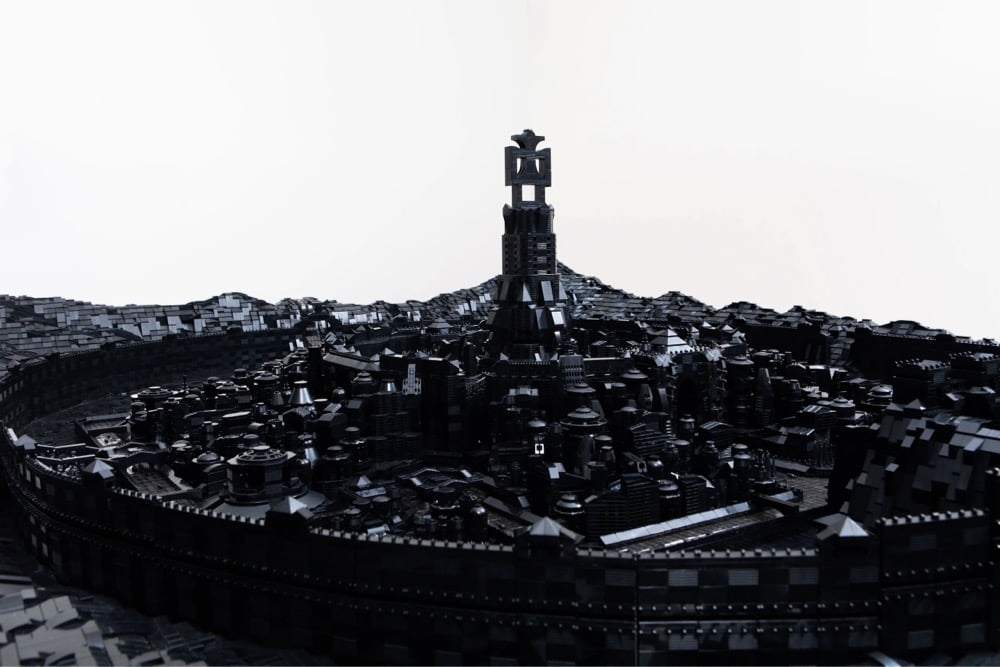


For his series called Building Black, Ekow Nimako uses only black Lego pieces to build fantastical and futuristic sculptures based on West African masks, folklore, and medieval kingdoms. From Colossal:
Running through each of these artworks is a fluid understanding of time and space that blurs the distinction between generations, locations, and histories in order to imagine a new reality. “We are all living proof of our ancestors, all their joy, love, knowledge, and pain. They live in our DNA,” the Ghanaian-Canadian artist says. “Aesthetically, I enjoy taking elements from bygone eras and creating futuristic landscapes, particularly of African utopias to imagine a liberated existence for us all.”
That blurred temporality that foregrounds his sculptures and installations parallels his own trajectory, as well. “My art practice developed when I was four years old, as I constantly told myself I want to do this (play with LEGO) forever, and sometimes it feels as though my future self communicated with my past self, astrally perhaps, to ensure this very specific destiny manifested,” he says, noting that the plastic blocks have remained a fixture in both his personal and professional life since becoming a father.
Vice did a short video feature on Nimako and his work:
(via colossal)
This is the trailer for The Underground Railroad, a limited series from Amazon based on the Pulitzer-winning novel by Colson Whitehead, directed by Barry Jenkins. The series will contain 10 episodes and be available to stream on Amazon Prime from May 14.
Apple just announced that season two of Ted Lasso will be premiering on Apple+ on July 23. That’s it, that’s the news. Watch the trailer. Rejoice. Be happy.
See also Ted Lasso, a Model for the Nurturing Modern Man.
This is pretty simple: 10,000 mealworms eating a tomato, piece of corn, and romanesco broccoli, filmed with a time lapse camera. My only comment is that for something called a mealworm, they don’t eat as quickly as I thought they would. 10,000 mealworms couldn’t polish off a tomato in less than 48 hours? You’re never going to be a beetle at that pace! (via the kid should see this)
I love this short dance video made by Taylor Pierce and Jackson Myles Chavis. For me, it’s when they slide to the side and then to the back in complete synchronized motion, like they’re on a dolly. I’ve watched this a dozen times at least. And a bunch of other videos by Pierce and Chavis. Mesmerizing.
Greta Thunberg took a year off of school to travel the world to better understand the changing planet, a journey captured in this three-part BBC series set to debut on PBS this Thursday (April 22, aka Earth Day). I found out about this from Lizzie Widdicombe’s short profile of Thunberg in the New Yorker.
Thunberg is on the autism spectrum, and the film illustrates how the condition lends a unique moral clarity to her activism. “I don’t follow social codes,” she said. “Everyone else seems to be playing a role, just going on like before. And I, who am autistic, I don’t play this social game.” She eschews empty optimism. Her over-all reaction to the coronavirus pandemic is to compare it with her cause: “If we humans would actually start treating the climate crisis like a crisis, we could really change things.”
Her uncompromising words can give the wrong impression. “People seem to think that I am depressed, or angry, or worried, but that’s not true,” she said. Having a cause makes her happy. “It was like I got meaning in my life.”
Also from that piece: Thunberg doesn’t live at home; she lives in a safe-house “in a kind of witness-protection program” situation because, one would assume, she gets a lot of threats due of her work.
One of my favorite YouTube series, Estelle Caswell’s Earworm, is back for another season. In this first episode, she looks at how a beloved Black radio tradition called Quiet Storm came about and influenced the course of popular culture for decades.
Late one evening in the summer of 1976, a Howard University student named Melvin Lindsey was tapped to fill in as a host at WHUR, the university-owned Black radio station. He chose a lineup of his favorite R&B ballads to soundtrack Washington, DC, that evening. The show was an accidental success. Shortly thereafter he was hired, and his show had a name: The Quiet Storm.
There are many steps in making traditional Japanese woodblock prints (ukiyo-e), but this short video focuses on the printing process as demonstrated by master printmaker Keiji Shinohara. This is a delight to watch — Shinohara’s deliberate precision is impressive and inspiring.
My absolute favorite part of this video is at the 3:40 mark when he precisely and firmly grasps the pressing tool (called a baren), swipes it on his face three times, and then uses it to press the paper into the inked block. This pre-press face maneuver is repeated several times but otherwise goes unremarked upon in the video — one of the commenters offers this explanation: “The oils from his face help grip the paper, making a firm and even press.” (via open culture)
One of the fun things about having a website that’s been running continuously for more than 23 years is that you get to watch the people you featured early in their careers grow and change and do bigger and better things. I’ve been posting filmmaker Casimir Nozkowski’s work on kottke.org since 2009 and now, his first feature-length film, The Outside Story, is set to debut at the end of this month. A short synopsis:
After locking himself out of his apartment, an introverted, heartbroken editor finds himself on an epic journey up, down and around his block with life-altering ramifications.
From the looks of the trailer (embedded above), The Outside Story has the same energy, playfulness, and keen lens into the interplay between humans & their environments as Nozkowski’s shorter work, which is not surprising given how it was filmed and where the inspiration came from. He told me, via email:
This is an indie film in the truest sense. Shot in 16 days on the streets of Brooklyn. It’s the biggest thing I’ve ever done and I’m just trying to get the word out any way I can. It’s loosely inspired by my short doc, 70 Hester Street where I examined my own building and block after years of taking it for granted.
You can watch 70 Hester Street here and The Outside Story will be available for purchase on all the usual streaming services on April 30.
In their series of short videos called Da Vinci Reborn, Dassault Systemes used their software to virtually recreate some of Leonardo’s most intriguing inventions, like the ornithopter (a bird-like human-powered airplane) and odometer (a device that he may have used in making this overhead map). (via open culture)
Back in the early days of the pandemic when people all over the world were staying inside in an attempt to prevent the spread of Covid-19, Radiohead dug into their vault and started putting classic live concerts up on YouTube in their entirety. Over the course of a few months, they shared more than a dozen concerts, including this one from 1994 and this one from 2018.
Starting last week, the band is once again uploading some more classic concerts “from a life that we all yearn to return to”, citing the science and vaccines that are getting us closer to that. The first show they uploaded (embedded above) is their 2008 show at 93 Feet East, played before just 1500 fans. That show is a bit infamous for Thom Yorke having a tough time playing Videotape (at ~47:00), which difficulty Estelle Caswell explained in her very first episode of Earworm. Anyway, they’re uploading a new show every Friday for the next few weeks — the next show will be Coachella from April 2017 — so check it out.
Newer posts
Older posts





Socials & More