kottke.org posts about video
Ollie Bye has created an animated time lapse of the growth of London from a small Roman town in 47 ACE to the largest city in the world (during the Victorian era) to the massive, sprawling city it is today.
See also Here Grows New York City, a Time Lapse of NYC’s Street Grid from 1609 to the Present, an example of what the creator called “an abstract representation of urbanism”. And a list of the largest cities throughout history — perhaps surprisingly, there have only been two lead changes since the 1820s. (via open culture)
Riffing on a byōbu folding screen of the Battle of Sekigahara painted in the 1700s, Yusuke Shigeta made a pixel animated version for a recent exhibition. The video above is a tantalizingly short preview of the work — I could have watched these tiny pixel vignettes all day.
What if a giant banana was orbiting the Earth at the same distance as the ISS? What would that look like? Well, it would look something like this.
See also If the Planets Were As Close As the Moon.
After a series of thousands of tiny earthquakes in the area, a small volcano has started erupting in Fagradalsfjall, Iceland. Drone pilot Bjorn Steinbekk took his brand new DJI FPV drone and flew it right into the eruption, capturing this pair of amazing videos. Said Steinbekk of the experience: “I really thought I would never see my drone again, but man, this was so thrilling to capture!!!”
Update: Here’s a live view of the erupting volcano.
Update: Steinbekk has added several new drone videos of the volcano to his YT account, including this fantastic night view of the lava from directly overhead.
Update: Steinbekk did a 12-hour stream from the volcano the other day and at the end, he sent the drone into the volcano to die:
It’s hard to describe in words, but I have actually been very emotional this morning, crying and sad but also so thankful for this experience and being able to share it with you. I realised last night when I took a walk down to say goodbye to this magnificent phenomenon that you can fall in love with a volcano.
This video of beekeeper Erika Thompson removing a hive of bees from the floor of an old shed was absolutely riveting! I loved every minute of it. Working without a beekeeping suit or even gloves, Thompson begins by locating the hive with a thermal imager, cuts open the floor, and gently lifts up the flooring to reveal the hive. After transferring the hive’s honeycomb to a new box hive, she cajoles the bees into their new home through the use of smoke, relocating the queen, and even scooping them in there with her bare hand. She ends the video with “and it was another great day of saving the bees” and that’s 100% right.
You can watch more videos by Thompson on YouTube, including this longer one of her removing bees from a camper. You can also check out her work on Instagram or read about how she started her company, Texas Beeworks.
“I didn’t become a beekeeper because I wanted to sell honey, and I think that’s what separates me from a lot of other beekeepers,” she says. “Whatever way you’re inspired by bees or to keep bees I think is wonderful. But in full transparency … I’d rather focus on creating more bees than having them produce more honey.”
Her videos have been going viral on TikTok lately, which led to an appearance on the Today Show, where she explained why she was working without protective gear.
“Most honey bees are very gentle. They’re docile and they don’t want to sting you. I’ve been doing this for a long time and over the years I’ve learned to read the bees’ behavior and these were just very calm, gentle bees. They were also very cooperative and got into their new hive. This was just one case where I could work without gear and it was safer for me and the bees.”
(via austin kleon)
Update: Pro tip: always have an extra queen on hand, just in case — it might just help you have another great day of saving the bees. (via @lauraolin)
For their latest video, Kurzgesagt ventures into What If? territory with a hypothetical exploration of what would happen if King Midas turned the entire Earth into gold. This video did not go where I thought it was going to. Ten minutes of freefall? Shrinking mountains?
Back in December 2020, Nepal and China announced that the height of Mount Everest had been remeasured and updated from a height of 8,848 meters (29,028.87 feet) to 8,848.86 meters (29,031.7 feet). Did the mountain get taller? Or the measuring more precise? And how do you measure the height of a mountain — or “sea level” for that matter — anyway?
In December of 2020, China and Nepal made a joint announcement about a new measurement for Mount Everest: 8,849 meters. This is just the latest of several different surveys of Everest since the first measurement was taken in 1855. The reasons why the height has fluctuated have to do with surveying methodology, challenges in determining sea level, and the people who have historically been able to measure Everest.
Also worth noting the (romanised) Nepalese and Tibetan names for the mountain: Sagarmāthā and Chomolungma. The section on its name at Wikipedia is pretty interesting — apparently George Everest, for whom the mountain was named, pronounced his name differently than we all do today.
From the Basement was a series of musical performances from groups like The White Stripes, Radiohead, Gnarls Barkley, PJ Harvey, and Sonic Youth recorded in the late 2000s. Above, Radiohead performs a 55-minute set of music mainly from In Rainbows (there’s also a set from King of Limbs). You can check out more performances from the series here or in their playlist of full sets. (via open culture)
How is Tesla’s full-self driving system coming along? Perhaps not so good. YouTuber AI Addict took the company’s FSD Beta 8.2 for a drive through downtown Oakland recently and encountered all sorts of difficulties. The video’s chapter names should give you some idea: Crosses Solid Lines, Acting Drunk, Right Turn In Wrong Lane, Wrong Way!!!, Near Collision (1), and Near Collision (2). They did videos of drives in SF and San Jose as well.
I realize this is a beta, but it’s a beta being tested by consumers on actual public roads. While I’m sure it works great on their immaculate test track, when irregularities in your beta can easily result in the death or grave injury of a pedestrian, cyclist, or other motorist several times over the course of 30 minutes, how can you consider it safe to release to the public in any way? It seems like Level 5 autonomy is going to be difficult to manage under certain road conditions. (via @TaylorOgan)
Some Star Wars fans in Yakutsk, Russia (aka one of the coldest inhabited places on Earth in the winter) spent the last few months building a life-size replica of the Razor Crest spacecraft from The Mandalorian. It was self-financed at the beginning (one of the creators sold his car) but attracted some sponsorship as construction progressed.
Well, add stone lithography to the list of cool hobbies I will do once I’m done sitting in this chair watching videos about things like stone lithography.
Henri de Toulouse-Lautrec revolutionised the world of graphic design with his striking posters at the end of the nineteenth century. This was in some ways due to his innovative approach to stone lithography to create his colourful designs.
If you think this video is too brief, you can check out this longer one. (via the kid should see this)
Wikipedia is a constantly changing entity with hundreds of edits occurring every minute and now you can experience that dynamism as ambient music: Listen to Wikipedia. Additions, subtractions, and new user signups to the site are tracked as they happen and represented as different tones — here’s a video recording from a few years ago:
Bells indicate additions and string plucks indicate subtractions. Pitch changes according to the size of the edit; the larger the edit, the deeper the note. Green circles show edits from unregistered contributors, and purple circles mark edits performed by automated bots. You may see announcements for new users as they join the site, punctuated by a string swell.
(via open culture)
After getting his second dose of the Covid-19 vaccine at a clinic at Berkshire Community College, Yo-Yo Ma got out his cello and performed a 15-minute impromptu concert for the others folks at the clinic.
When Ma had first visited the clinic for his first shot, he did so quietly, taking in the surroundings, staff said. But brought his cello when he returned for the second shot.
Staff described how a hush fell across the clinic as Ma began to play. “It was so weird how peaceful the whole building became, just having a little bit of music in the background,” said Leslie Drager, the lead clinical manager for the vaccination site, according to the Washington Post.
Why is it weird? Music is amazing. I know you could never get such a “frivolous” spending measure through an American deliberative body these days, but how awesome would it be for the government to commission out-of-work musicians to play at vaccination clinics? Ok maybe you couldn’t have anyone sing and the brass & woodwinds would probably have to sit this one out, but you could have strings, guitars, percussion, pianos, DJs, etc. there to play some relaxing, uplifting, or energetic music, according to local custom & culture. Bring back the WPA!
This video and blog post look at the challenges of building and maintaining a 3000-meter ice runway in Antarctica. It bears some resemblance to grooming ski slopes and maintaining ice rinks.
Once the snow is removed, the runway is inspected for cracks, pits, or any other deficiencies that would prevent a safe landing. These are repaired by crews with a mixture of cold water, ice chips, and snow that is poured on, allowed to harden, and then smoothed over.
Finally, two snow groomers with tillers grind a small layer of ice to create a top layer of crushed snow and ice that gives the runway the necessary friction for aircraft to operate. Lidström points out that equipment at Troll isn’t necessarily purpose built, ‘These are the same machines that you see on ski slopes, but with a tiller grinder attached.’
There’s even a small terminal with bathrooms and wifi, amenities which aren’t available at all Antarctic airfields.
This is an excerpt from a short film called Beyond Noh that cycles through 3,475 different masks from around the world — ceremonial masks, costume masks, gas masks, N95 masks, catcher’s masks, etc. The film is by Patrick Smith (I featured his video Gun Shop a few years back), who told Colossal:
To me, masks are an interesting way to view humanity. It seems to me that every culture in the history of the world has participated in some form of mask making, whether it’s for performance, ritual, protest, or utility.
Compilations like this will always remind me of this clip art movie from 2006 and, of course, Noah Kalina’s Everyday. The full film is available to Smith’s paying members on YouTube. (via colossal)
In order to promote the classic films available on the streaming service, HBO Max has created a selection of modern-style movie trailers for them. The re-trailered flicks include Dog Day Afternoon, Boogie Nights, Alien, Casablanca, and The Exorcist.
BTW, because of its Turner Classic Movies section, HBO Max seems like the best big streaming service for watching good, classic movies. It’s become nearly impossible to find anything on Netflix made before 2000, but on HBO Max right now you can watch Rocky, A Clockwork Orange, The 400 Blows, Seven Samurai, THX 1138, Malcolm X, 8 1/2, Solaris, Citizen Kane, Grey Gardens, North By Northwest, Rashomon, Tokyo Story, and dozens of others. (via open culture)
Tina is an upcoming documentary film about music legend Tina Turner, featuring interviews with Angela Bassett, Oprah, Kurt Loder (who co-wrote the 1986 autobiography on which the movie is based), and Turner herself.
With a wealth of never-before-seen footage, audio tapes, personal photos, and new interviews, including with the singer herself, TINA presents an unvarnished and dynamic account of the life and career of music icon Tina Turner.
Everything changed when Tina began telling her story, a story of trauma and survival, that gave way to a rebirth as the record-breaking queen of rock ‘n’ roll. But behind closed doors, the singer struggled with the survivor narrative that meant her past was never fully behind her.
Tina will begin airing on HBO on March 27. A companion playlist of Turner’s music is available at Spotify.
Update: Cassie Da Costa reviewed Tina for Vanity Fair:
Her new interview in the film allows her to speak authoritatively on her own celebrity and personal life without having to revisit the sordid details of the abuse she experienced at the hands of Ike. And though it doesn’t shy away from the darkness held within her biography, Tina turns decidedly toward the light. The result is a film that shines, both in its passion for Turner’s talent and the depth and complexity of her character.
Netflix was founded in 1997 as a DVD rental service. At the time, Blockbuster Video was a multi-billion dollar video rental behemoth, growing to over 9000 stores as recently as 2004. In 2000, Netflix offered to sell to Blockbuster for $50 million — Blockbuster declined. By 2011, Blockbuster was bankrupt and down to 2400 stores while Netflix had gone public and their streaming business was exploding. Today, Netflix has a market cap of $223 billion, is a member of the S&P 100, and will soon start showing The Last Blockbuster, a documentary about the very last Blockbuster video rental store in the world. Absolutely savage victory lap.
In 2014, John Cleese listed five of his favorite comedy sketches that he had written over the course of his career. Among them was one I’d never seen before but soon had me in stitches: The Bookshop.
I also watched another of the sketches he mentioned (The Cheese Shop) and it fell totally flat — Monty Python-style humor is very much a hit-or-miss thing for me, so YMMV. (via open culture)
In this extensive video, The Take not only explains the themes and ending of WandaVision (spoilers, obvs) but walks through all of the sitcom tropes, references, and Easter eggs present in the show, from The Dick Van Dyke Show to the beeping Stark toaster commercial to Bewitched to Full House (Olsen sisters!) to The Office. Weirdly, they kinda glide right over perhaps my favorite trope referenced in the show: the recasting of the Pietro character a la Darrin in Bewitched and Aunt Viv in The Fresh Prince of Bel-Air.
The video pairs well with this interview with WandaVision creator Jac Schaeffer.
The first thing was the notion of, how do you do this? How do you take sitcoms and combine them with Wanda and Vision who, up to this point in the M.C.U., were such self-serious characters and dramatic characters with so much sadness surrounding them. They weren’t funny. What’s the synthesis? I’m a big fan of “Lost,” and I was very inspired by shows like “Russian Doll,” “Forever” and “Homecoming.” I relished the opportunity of a slow burn. It seemed like an exciting, sneak-attack way to have a bit of a social commentary and a very large story of character and grief.
I thought how they constructed the entire show was really fantastic — I loved every minute of it.
The very first sequence of this video is of the camera — presumably perched on a drone — dropping out of the sky, flying through the door of beloved Minneapolis institution Bryant Lake Bowl, and following a bowling ball down the lane…and it just keeps going from there. Great drone piloting, choreography, sound design, and execution of concept. (via @brianmcc)
Update: ILM visual effects artist Todd Vaziri added Star Wars sound effects to the original video. He links to a few other remixes in this thread (like this Naked Gun one).
Captured by the Kaguya lunar orbiter on April 5, 2008, this is an HD video of the Earth rising over the surface of the Moon. Watching stuff like this always puts me in a different frame of mind. (Turn off the sound if you don’t want to hear the super-cheesy narration.)
In this six-minute time lapse video, you can watch a single cell grow into an alpine newt salamander. I got this via Craig Mod’s post about looking closely, in which he asks: when precisely does this collection of cells become a salamander?
The very definition of astonishing seems to be embedded in the way the cells move, as they grow from a “knowable” half-a-dozen dots to the millions and billions of the finished product. The phrase “sentience of the swarm” runs through my mind as I watch it. I am delighted and terrified: These little dots in aggregate know so much more than I ever will.
Melissa Cross is a voice coach who works with metal bands so their screaming singers don’t damage their vocal cords. Her work involves switching singers from using their voice in an emotional way to a more classical and durable approach:
What metal singers do wrong is use an emotional response that feels like anger, or anxiety, in order to make the sound. And that involves too much tension. I use my acting training to imitate it, and my know-how vocally to do it in a way that could be healthy.
As someone whose throat starts hurting after 2 minutes of singing along to a favorite song, I’m fascinated by voice training. I don’t aspire to ever sing, but if I even want to do a podcast or some such, maybe I should hire a vocal coach? (via open culture)
Banksy took some Bob Ross narration from The Joy of Painting and dubbed it over video footage that shows the street artist painting an image of an escaping inmate on the wall of a former prison in the dead of night. Colossal has more info on why Banksy picked the wall of this particular prison to do:
The expansive and unblemished prison wall was a daring and perfect spot for a Banksy piece. It’s best known for its most famous inmate: Oscar Wilde served two years in the prison from 1895-1897 for the charge of “gross indecency” for being gay. The work is clearly a tribute to the poet, as the escape mechanism appears to be a long strand of paper emerging from a typewriter in place of the usual bed sheets.
Photographer James Crombie and his friend Colin Hogg captured an amazing moment over Lough Ennell in County Westmeath, Ireland on Tuesday: a murmuration of starlings that, for a split second, looked like a huge bird. Crombie took the photo and Hogg the video:
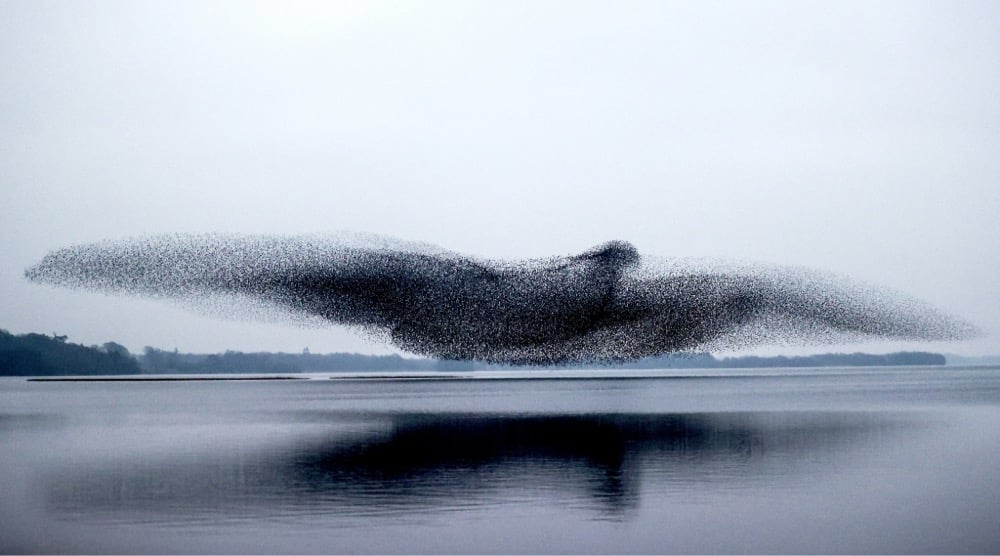
Crombie made, he thinks, about 50 trips to Lough Ennell in the past few months. “I’m usually a sports photographer, so for a while I’ve had a bit of time to think about other things. I had an image in my head,” he explains. “I could see they were making shapes. I kept going back, to get the image I had in my head.”
…
Finally, at about 6pm on Tuesday, Crombie focused his Canon EOS-1D X Mark III and got the image he wanted. That night alone he shot between 400 and 500 frames before capturing this unforgettable photograph. “It paid off,” he says.
I know there has to be a word for a collection of things that looks like an individual member of the group (like the school of fish in Finding Nemo) but I can’t find it right now. Anyone know? Or have a good suggestion? (thx, aaron)
This is the trailer for Nobody, an action film that’s a cross between John Wick, Breaking Bad, and a tiny bit of Force Majeure (although maybe I’m alone in making this connection). The film stars Bob Odenkirk as an unassuming dad who decides he wants to be assuming again — violent hijinks ensue. Looks like it’s coming out in late March, which is still a bit too early for me to want to see a movie in a theater again.
In this lovely short film, composer and pianist Kris Bowers talks to his grandfather, Horace Bowers, about his life in the Jim Crow South and how he found a new life in California as part of the Great Migration. Horace’s move across the country set in motion events that culminated in Kris premiering a concerto he wrote with the LA Philharmonic. You can read more about Horace in this 2019 profile.
Yet, in a sign of the times, Horace encountered discrimination while building his business. At the time, mainstream financial institutions rarely gave loans to Blacks and Bank of America had already denied him. His fortunes changed after he hired a White young man as a presser.
“I gave him a job and after two days, he asked me to tell the bank that he had been working for me for 30 days. He said that he needed a loan because he had just gotten divorced and was broke and wanted to borrow money to go back to Texas,” said Horace.
“Even though I was with Bank of America, they had turned me down for a loan and I did not think he could get one. But, a few days later, his loan was approved. I wondered why, but I immediately thought of the color of my skin.”
Armed with this knowledge, Horace devised another route. He visited a different branch, picked up the loan papers, completed the forms and mailed them in.
“A few days later, my loan was approved and from then on, nobody saw us. I did mostly everything by mail,” he said.
After Vladimir Putin, dictatorial leader of Russia for over 20 years now, had seemingly insulated himself against losing power through control of the media, law, elections, and the wealthy allies, a lawyer named Alexei Navalny began to expose the corruption in Putin’s regime with a series of posts to his blog and on YouTube. Navalny continued his investigations, gaining public popularity and running for public office. Putin imprisoned him and tried to have him killed. This Vox video explains in more detail why Putin wants Navalny dead.
More reading on Navalny: Vox explainer, Masha Gessen on recent pro-Navalny protests in Russia. (via open culture)
A film crew from the NY Times recently spent several days in the Covid-19 ICU in Arizona, at the time one of the hardest hit places in the world. Two of the nurses wore GoPro cameras while working to witness what they did on a daily basis — the 12-hour days, the grief, the care, the constant death. This video is incredible and incredibly difficult to watch — you actually see a patient die on camera, surrounded by nurses and family (virtually).
So many Americans have died in hospitals without family by their side, but they were not alone. Nurses brush patients’ teeth, change their catheters and hold their hands in their final moments.
At the beginning of the video, one of the nurses says, “Unless you’re actually in there, you have no idea.” Thanks to their willingness to share their experiences, now we at least have some idea.
Update: Vox talked to some ICU doctors about what it’s like for their patients when they die from Covid-19. Because of patient confidentiality and the contagious nature of the disease, society (and even the families) has been “protected and sheltered from seeing the worst of this disease”.
Imagine trying to breathe through a very narrow straw, says Jess Mandel, chief of pulmonary, critical care, and sleep medicine at UC San Diego Health. “You can do that for 15 to 20 seconds, but try doing it for two hours.” Or for days or weeks.
Patients struggling through low oxygen levels like this have told Kenneth Remy, an assistant professor of critical care medicine at Washington University School of Medicine in St. Louis, that it feels like a band across their chest or that their lungs are on fire. Or like a thousand bees stinging them inside their chest. Others might have thick secretions in their lungs that make it feel like they are trying to breathe through muck. Many people say it feels like they’re being smothered.
The ordeal is so taxing that many wish for death. “You hear the patients say, ‘I just want to die because this is so excruciating,’” Remy says. “That’s what this virus does.”
Newer posts
Older posts





Socials & More