



The Economist asks “will computer-animated humans ever
The Economist asks “will computer-animated humans ever look realistic on screen?” but with nary a mention of the uncanny valley.

This site is made possible by member support. 💞
Big thanks to Arcustech for hosting the site and offering amazing tech support.
When you buy through links on kottke.org, I may earn an affiliate commission. Thanks for supporting the site!
kottke.org. home of fine hypertext products since 1998.
Beloved by 86.47% of the web.
The Economist asks “will computer-animated humans ever look realistic on screen?” but with nary a mention of the uncanny valley.
How It Should Have Ended, alternate endings to some movies, including Star Wars, Seven, and Saving Private Ryan.
The Carpetbagger is a NY Times weblog written by David Carr that covers awards season in Hollywood.
Keeping up with all of the extras they include these days on DVDs is exhausting, to say nothing of watching all the movies themselves. But I made a point of listening to the director’s commentary for Primer and was not disappointed. If there’s a Shane Carruth fan club, sign me up. Case in point: for the single special effect in the film, he filmed a scene with a DV camera, uploaded the footage onto his computer, added the effect digitally, dumped the modified video onto tape, filmed the video playing on a camcorder screen with the film camera, and made the whole thing look like it was supposed to be done that way because he didn’t have the money to do it any other way. It’s all about constraints…which ties into the main message of the movie as well.
Also, Carruth confirmed my feeling that Primer really isn’t a sci-fi film…what’s happening with the characters emotionally is the focus of the film.
List of the top 50 greatest indie films. The top 10 includes Clerks, Reservoir Dogs, and The Usual Suspects.
Tickets are starting to become available for showings of King Kong, at least in NYC. They’re also doing the midnight showings the night before thing.
Actor Pat Morita passed away at age 73. Rest in peace, Mr. Miyagi.
Ok, one last wrap-up post about Hong Kong and then we’re focusing on the matter at hand in Bangkok (short summary: having a great time so far here). So, three things I really liked about/in Hong Kong and then some miscellaneous stuff.
1. Octopus cards. I really can’t say enough about how cool these cards are. Wikipedia provides a quickie definition: “The Octopus card is a rechargeable contactless stored value smart card used for electronic payment in online or offline systems in Hong Kong.” It’s a pay-as-you go stored value card…you put $100 bucks on it and “recharge” the card when it’s empty (or when it’s even more than empty…as long as your balance is positive when you use it, you can go into a HK$35 deficit, which you pay when you recharge the card). You can use it on pratically any public transportation in the city: buses, trains, MTR, trams, ferries, etc. It works with vending machines, at 7-Eleven, McDonald’s, Starbucks, and the supermarket. You don’t need to take it out of your wallet or purse to use it, just hold it near the sensor. Your card is not tied to your identity…there’s no PIN, you can pay cash, they don’t need to know your credit card number, SS#, or anything like that. They even make watches and mobile phones that have Octopus built it, so your phone (or watch) becomes your wallet. Mayor Bloomberg, if you’re listening, NYC needs this.
2. The on-train maps for the MTR. Here’s a (sort of blurry) photo (taken with my cameraphone):
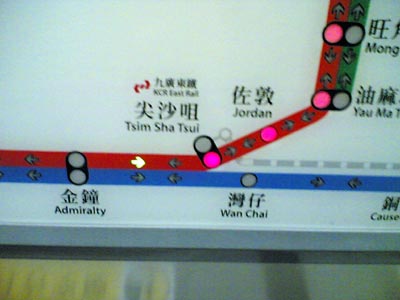
The current stop blinks red — in this case, Tsim Sha Tsui (blinking not shown, obviously) — with the subsequent stops lit in red. If the next stop connects to another line, that line blinks as well. A small green arrow indicates which direction you’re traveling and there’s an indictor (not shown) which lights up either “exit this side” or “exit other side” depending which way the doors are going to open. Great design.
3. Muji! We located one in Langham Place (an uber-story mall) in Mong Kok (for reference, the store in Silvercord in TST listed on their site has closed). Muji is kind of hard to describe if you’ve never been to one of their stores before (and if you live in the US, you probably haven’t because they’re aren’t any, aside from a small outpost in the MoMA Store). Adam (see previous link) roughly translates the name as “No Brand, Good Product”, so you can see why I like it so much. They sell a wide variety of products (take a look at their Japanese-only online store for an idea of what they carry); at the Monk Kok store, they had snacks & drinks, some furniture (made out of sturdy cardboard), their signature pens and notebooks (a display of the former was completely surrounded by a moat of teenaged girls, so much so that I didn’t get a chance to test any of the super-thin pens), some clothes (including some great pants that they didn’t have in anything approaching my size), dishes, cosmetics, bath products, and containers of all shapes, sizes, and uses. I wanted one of everything, but settled for a couple of shirts (with absolutely no logos or markings, inside or out, to indictate that they are Muji products).
m1. Big Buddha, worth the trip. It’ll better when the tram from Tung Chung and back is built, although then you’ll miss the boat ride (fun) and the bus ride (harrowing at times).
m2. The Peak Tram. Touristy, but also worth the trip. The weird/ugly anvil-shaped building at the top is currently under construction, so the views will be much better when its finished. Go at night for the best view.
m3. The view from the waterfront in Kowloon of the Hong Kong skyline at night is one of the best in the world.
m4. Speaking of, Hong Kong is a night-time city. All the buildings are lit up, there’s a nightly light show at 8pm (think Laser Floyd without the music), and buildings that appear monolithic in the daytime transform at night, either by disappearing into the darkness while leaving a graceful trace of their outline or acting as huge screens for projected light shows. Reminded me of Vegas in this respect.
m5. We had tea in the lobby of the InterContinental Hotel (go for the view, it’s incredible) and the live band played the theme song from The Lord of the Rings. I tried to get a recording of it with my phone (iPod was back in our hotel room), but it didn’t turn out so well. Very weird; we were cracking up and expecting the theme from Superman or even 3’s Company to follow.
m6. Oh, I’m sure there’s more, so I’ll add it here as I think of stuff.
Leonardo DiCaprio set to star in movie adaptation of Malcolm Gladwell’s Blink. Huh? (thx, matt)
Aidan Wasley argues that taken collectively, the six Star Wars films form the greatest postmodern art film ever made. I’ve been waiting for someone to write this article; Lucas’ art film background and interests have always been hinted at but never really examined in that much detail re: Star Wars.
Star Trek’s Sulu, George Takei, comes out. First Swoopes and now this…the self esteem of young, gay, basketball-playing Trekkies must be skyrocketing. (I keed, but seriously, pro sports and sci-fi geeks could benefit from more confident & successful gay role models for young people who’re feeling less than confident with their sexuality.)
For those of you who are Napoleon Dynamited out, how about a “Pedro Lacks Political Experience” tshirt?
The Onion AV Club explores the landscape of underrated media and comes back with The Underrated List and a whole decade-full of underrated movies. How can anyone have misunderstood Starship Troopers? It was so over-the-top.
Somehow I missed this when it came out, but last year on the 40th anniversary of the release of Dr. Strangelove, James Earl Jones wrote about his experiences in making the film. If you like the Kubrick, Coudal has a tons of Kubrick links going on today.
As I was poking around 0sil8 this morning, I ran across this list from 1998 of movies due to be released in 1999/2000. Some were released on time, some were never released, and others were released years later. My favorite is the Charlie’s Angels speculation…with Jenny McCarthy, Jada Pinkett & Michelle Yeoh as the Angels.
Well, lookie lookie. If you take a peek at the bottom of the Apple movie trailers page, they’ve added a link to an RSS file of the newest movie trailers. O’ happy day. (thx John)
Update: Dave says: “I was hoping to see permalinks to a reviews page for the movie, and an enclosure containing the trailer itself.” Me too, but baby steps, I guess.
Here’s the recipe for the sandwich that Adam Sandler makes in Spanglish; he was taught how by Thomas Keller. “I’m told that making sure that the yolk doesn’t break until you cut the sandwich is key.”
Gelf Magazine says “a new study uses shoddy stats to hold the movie industry responsible for society’s poor health choice”. “But even if we disregard the fact that people don’t necessarily take their public-health cues from films like Scary Movie and Rambo: First Blood Part II, the study has serious flaws that undermine even its tenuous claim on our attention”.
Edward Jay Epstein on why Pixar should make nice with Disney again. Bottom line: Disney owns the sequel rights to all of Pixar’s films and Pixar can’t afford to do battle against Toy Story 3 or The Incredibles 2 in future summers.
Fire strikes Aardman Animations’ warehouse and destroys entire history of the company, including sets and characters for Wallace and Gromit.
Mark Simonson gives Gangs of New York 3 out of 5 stars for its use of typography. This is the latest in a series of posts about type in movies, starting with his original Typecasting article.
September sales of SUVs were down sharply from last year. “Sales of F-Series pickup trucks plunged 30 percent. Sales of Ford’s large SUVs, including the Ford Explorer and Expedition and the Lincoln Navigator, sank by more than 55 percent each. At GM, overall sales of trucks, minivans and SUVs dropped 30 percent.” Most blame the $1/gal difference in gas prices from a year ago, but auto execs blame poor inventory after summer sales. Perhaps everyone went to the movies instead of car shopping.
Regrading this: Summer Movies Other Than March of the Penguins That Conservatives Are Rallying Behind. “The Dukes of Hazzard: Not once is the word ‘evolution’ used in this movie. Many pundits proclaim this to be a tacit endorsement of intelligent design.”
Some technical notes on how Tim Burton’s Corpse Bride was shot and edited. They shot it with a Canon dSLR; they originally wanted to use a Nikon D2H, but the darks were too noisy. More Apple-specific info here. (via df)
With attendance up in September, the movie studios are beginning to admit that, gosh, maybe crappy movies are to blame for this summer’s poor box office performance.
Awesome awesome awesome alternate trailer for Stanley Kubrick’s The Shining (local mirror). Andy calls this “one of the best video clips I’ve seen all year” and he’s not wrong.
The co-screenwriter of War of the Worlds on getting credit for said screenwriting (he wrote early drafts which were later rewritten by someone else) and then going to the NYC premiere of the film. (thx stephanie)
For what seems like the last 2 hours, I’ve been reading Kevin Smith’s blog (Flickr photos here), and I have no idea why. He calls it “Kevin’s Boring Ass Life” and that’s what it is…a typical entry is not much more than “got up, checked email, dropped off kid at school, lunch, dinner, sex with wife, then watched movies/Simpsons until asleep”. Couldn’t stop reading though…
Interview with Hayao Miyazaki about Howl’s Moving Castle and his films in general.
Here’s a sampling of the rest of the AIGA Design Conference, stuff that I haven’t covered yet and didn’t belong in a post of it’s own:
1. Design is the easy part.
2. Learn from your clients, bosses, collaborators, and colleagues.
3. Content is king.
4. Read. Read. Read.
5. Think first, then design.
6. Never forget how lucky you are. Enjoy yourself.
For more of what people are saying about the conference, check out IceRocket. There’s a bunch of photos on Flickr as well.
Socials & More