



Mad Max vs. Buster Keaton
Turns out, if you take Junkie XL’s soundtrack to Mad Max: Fury Road and pair it with a train chase scene from Buster Keaton’s silent film masterpiece The General, it works pretty well.

This site is made possible by member support. 💞
Big thanks to Arcustech for hosting the site and offering amazing tech support.
When you buy through links on kottke.org, I may earn an affiliate commission. Thanks for supporting the site!
kottke.org. home of fine hypertext products since 1998.
Beloved by 86.47% of the web.
Turns out, if you take Junkie XL’s soundtrack to Mad Max: Fury Road and pair it with a train chase scene from Buster Keaton’s silent film masterpiece The General, it works pretty well.
“The more people think you’re really great, the bigger the fear of being a fraud is.” That’s the most resonant line for me from the first trailer for The End of the Tour, the story of a five-day interview between reporter David Lipsky and David Foster Wallace that takes place in 1996, just after Infinite Jest came out.
The movie is based on a book Lipsky published called Although Of Course You End Up Becoming Yourself, which I read and thought was great.1 Jesse Eisenberg plays Lipsky and Jason Segel does as much justice to Wallace as one could hope for, I think. I am cautiously optimistic that this movie might actually be decent or even good. (via @jcormier)
I even took place in a roundtable discussion for Vulture about it.↩
Dior and I is a fashion documentary about the first haute couture collection designed by Christian Dior’s new artistic director. But from the looks of the trailer, you don’t have to know or care about the fashion industry to get something out of watching a group of people accomplish something creative, difficult, and political under extreme time constraints.
The film is playing at select theaters around the US and should be available next month for streaming and digital download. (via russell davies)
A cleverly constructed mashup of all the major Hollywood studio intros — MGM’s roaring lion, Disney’s castle, Paramount’s flying stars, Miramax’s skyline — into one mega-intro.
(via @pieratt)
Star Wars was a film that literally couldn’t be made; the technology required to bring the movie’s universe to visual life simply didn’t exist.
So George Lucas did what any enterprising young director who was destined to change the movie business would do. He invented a company to invent the technology. Wired’s Alex French and Howie Kahn take you inside the magic factory with the untold story of ILM.
In The Plot Against Trains, Adam Gopnik muses about how infrastructure in America has become dilapidated in part because we (or at least much of we) believe little good can come from the government.
What an ideology does is give you reasons not to pursue your own apparent rational interest — and this cuts both ways, including both wealthy people in New York who, out of social conviction, vote for politicians who are more likely to raise their taxes, and poor people in the South who vote for those devoted to cutting taxes on incomes they can never hope to earn. There is no such thing as false consciousness. There are simply beliefs that make us sacrifice one piece of self-evident interest for some other, larger principle.
What we have, uniquely in America, is a political class, and an entire political party, devoted to the idea that any money spent on public goods is money misplaced, not because the state goods might not be good but because they would distract us from the larger principle that no ultimate good can be found in the state. Ride a fast train to Washington today and you’ll start thinking about national health insurance tomorrow.
The ideology of individual autonomy is, for good or ill, so powerful that it demands cars where trains would save lives, just as it places assault weapons in private hands, despite the toll they take in human lives. Trains have to be resisted, even if it means more pollution and massive inefficiency and falling ever further behind in the amenities of life — what Olmsted called our “commonplace civilization.”
The way he brings it back to trains at the end is lovely:
A train is a small society, headed somewhere more or less on time, more or less together, more or less sharing the same window, with a common view and a singular destination.
Well, except when you’re on that Snowpiercer train. Although in the end (spoiler!), Curtis brought the train’s segregated society back to “a common view and a singular destination” by crashing it and killing (almost) everyone on it. Hopefully America isn’t headed toward the same end.
I have been doing a poor job keeping up with my Steve Jobs-related media. I haven’t had a chance to pick up the new Becoming Steve Jobs book yet. And I had no idea that the Aaron Sorkin-penned biopic was still in the works, much less that Michael Fassbender is playing Jobs and Danny Boyle is directing. Here’s the trailer:
The trailer debuted during last night’s series finale of Mad Men, which was possibly the most appropriate venue for it. [Slight spoilers…] Draper always had a Jobs-esque sheen to him, although the final scene showed us that, yes, Don Draper actually would like to sell sugar water for the rest of his life.
Update: A proper trailer has dropped. I don’t know how much we’ll learn about the actual Steve Jobs from the movie, but it looks like it might be good.
Update: Another trailer. This is looking like a strong film.
Beyond Clueless is a full-length documentary movie about teen movies made between the release of Clueless in 1995 and Mean Girls in 2004. A trailer:
The film was financed in part through Kickstarter.
Beyond Clueless will be the first major study — in any medium — of the teen movie revolution that occurred in the ten years that separated the releases of Clueless in 1995 and Mean Girls in 2004. Part historical account, part close textual analysis, part audiovisual mood piece and part head-over-heels love letter to the teen genre, the film will examine more than two hundred films released during this decade-long idyll, in terms of their characters, themes and what they had to say for themselves.
According to the Art of the Title, who did an interview with the filmmakers about the opening title sequence, the is constructed entirely of clips from other movies.
What if all those American teen movies from the ’90s and early 2000s took place in the same universe? What if Crash Override and Cher Horowitz and Laura Palmer all went to the same high school? In the cleverly cut opening to director Charlie Lyne’s essay film Beyond Clueless, their worlds are brought together in one long hallway of jeers and sneers, smug smiles, and adolescent longing.
Made entirely of clips, Beyond Clueless does with editing for film what the album Endtroducing… did with sampling for music. Shepherded by the voice of Fairuza Balk, the film is a bricolage of footage meticulously collected from over 200 films, weaving together an era of cliques and hierarchies, baggy pants and chokers, beepers and laptops, with a dash of apple pie and occultism.
Watch all the way to the end for some sounds that didn’t make it into the movies.
From an alternate universe in 1985, a Star Wars crossover with Star Trek that never happened in which Lord Vader has the Genesis Device.
Paging JJ Abrams. Mr. Abrams to the white courtesy phone please. (via @khoi)
The other day, I made a reference to a trailer for a TV series being “a little too trailery for my taste”. What I meant was that it too much like every other trailer (in that genre) and didn’t show enough of the character of the particular show being advertised. Action movie trailers are perhaps the worse offenders in this regard, as this meta-trailer shows:
BWAAAAAAAAM!!!
Build up to silence, then BAM!
Like I was saying, too trailery. (via devour)
Black Mass stars Johnny Depp as Whitey Bulger, real-life Boston mobster and FBI informant. The trailer is damn good and I’m hoping the rest of the movie lives up to it.
Ok, even though George Clooney’s character says “you ain’t seen nothing yet” in the trailer, I am cautiously optimistic that Tomorrowland won’t actually suck. Brad Bird is directing, for one thing.
Interesting thing about Clooney: even though he’s one of the biggest movie stars in the world, aside from Gravity, he’s never really had a big summer blockbustery sort of hit. Only six of his films have grossed more than $100 million…compare that with Will Smith or even Matt Damon, both of whom are younger.1 Perhaps Tomorrowland will be Clooney’s Pirates of the Caribbean or Bourne.
The list of actors sorted by box office gross is fascinating, btw. The top five: Tom Hanks, Morgan Freeman, Samuel L. Jackson, Harrison Ford, and Eddie Murphy, three of whom are black. The first woman on the list is Cameron Diaz at #13 (and then Cate Blanchett at 21, Helena Bonham Carter at 22, Emma Watson at 25, and Julia Roberts at 26). Sorting by average gross isn’t working for me, but I scanned through and found the top five (who have been in 6 or more films): Emma Watson (whose movies gross $191.6 million on average), Daniel Radcliffe, Taylor Lautner, Rupert Grint, and Liam Hemsworth. ↩
When the first trailer for JJ Abrams’ new Star Wars movie came out, we all assumed the rolling ball droid was CGI (and perhaps based on this 2008 xkcd post). Then an actual working model of the droid, called BB-8, showed up on stage at Star Wars Celebration. Minds blew. Industrial design student Christian Poulsen figured out how to make his own version of BB-8 by hacking a Sphero:
Update: It looks like Sphero will be manufacturing an official BB-8 droid toy, which will likely be a massive success.
Update: Sphero is selling a smartphone-controlled BB-8 droid. This is the droid you’re looking for.
Authentic Movement: Guide your BB-8 with a smartphone or tablet
Listens & Responds: BB-8 recognizes and reacts to your voice
Holographic Messaging: Record and view virtual holographic videos with BB-8
Autonomous Behavior: BB-8 has a mind of its own - explore the Star Wars galaxy together
Adaptive Personality: Your BB-8’s unique attitude and actions evolve as you interact
It’s also available at Amazon, although they are currently out of stock.
This is the teaser trailer for Quentin Tarantino’s The Hateful Eight, the movie whose script leaked, was cancelled, was planned to be released as a book, and then uncanceled.
Update: I’m getting emails and tweets saying this trailer is fake. And if it is fake, is there a non-fake leaked trailer out there or…?
Update: Just to be clear, this is totally fake and constructed from bits of other movies, etc.
Ok, this one gave me goosebumps. I hope this is good.
A new listen-while-you-code/write/design favorite.
I really liked the movie. Matt Zoller Seitz’s review captured it well.
From Cameron Beyl, a three-hour video essay on the films of Stanley Kubrick. The essay splits Kubrick’s career into five parts: the early independent features (Fear & Desire, Killer’s Kiss, The Killing), the Kirk Douglas years (Paths of Glory, Spartacus), the Peter Sellers comedies (Lolita, Dr. Strangelove), the Master Works (2001, A Clockwork Orange, Barry Lyndon, The Shining), and the final features (Full Metal Jacket, Eyes Wide Shut).
Beyl has just begun his second extended essay, on David Fincher. (via openculture)
From the AV Club, a publication by The Onion, a list of the 100 best films of the decade (so far). Good to see Her, The Grand Budapest Hotel, The Tree of Life, and Upstream Color on there, among others.
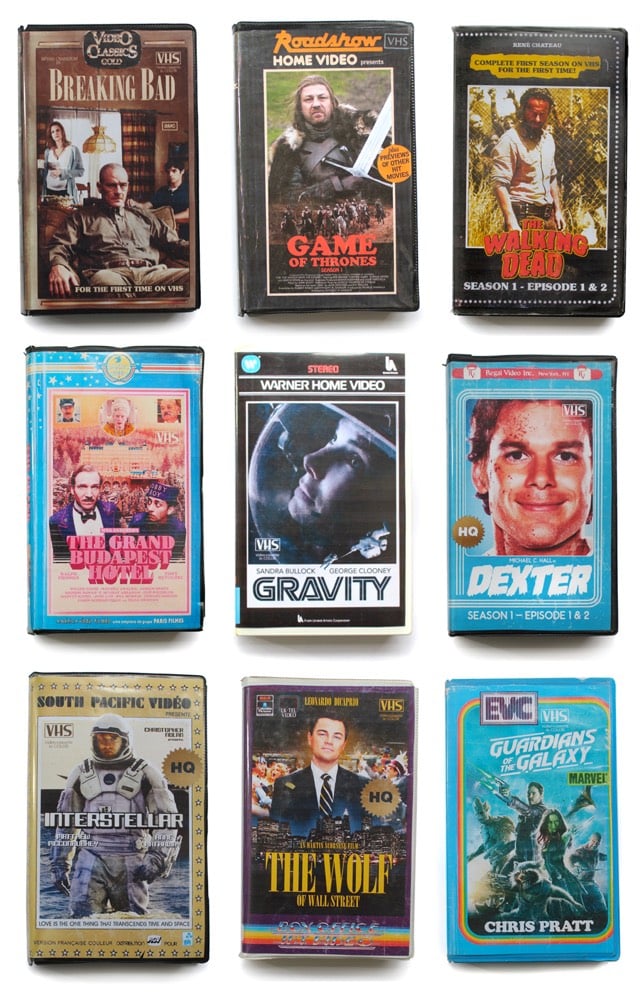
Someone pretending to be a Parisian hipster who only watches VHS versions of modern shows & movies like Game of Thrones and Interstellar created these VHS covers as an April Fools joke. These are actually pretty great. (via subtraction)
For the one-year anniversary of Every Frame a Painting, Tony Zhou goes meta and talks about how to structure a video essay, using South Park and Orson Welles’ F for Fake.
Happy anniversary EFAP!
A profile of Gregg Barbanell, who is a Hollywood Foley artist responsible for the ambient sounds (walking, clothes rustling, gunshots, etc.) in Breaking Bad, Little Miss Sunshine, and The Walking Dead. The best bits are about how specific sounds are made.
Popular apocalyptic zombie TV series The Walking Dead has no shortage of gore — and as the show’s Foley artist, Barbanell is tasked with creating most of its gruesome “blood and guts” sounds. “They’re pulling organs out of bodies, they’re slicing heads off, reaching into bodies, pulling out things,” says Barbanell, with disgust. “So, we get creative.”
For “gushy, squishy sounds” like oozing blood, Barbanell uses chamois (a leather cloth made from the skin of mountain sheep). “You soak it, then lay into it, and it just oozes — it’s something you can control really easily,” he says. “And when you put pressure on it, you get these amazing, gory noises.” Sometimes, when that extra oompf is needed, he’ll go out and buy a whole, raw chicken to stuff the chamois inside of.
For “breaking bones,” big, full stocks of celery are employed — not merely individual stocks, mind you, but HUGE bunches capable of producing layered, complex snaps. “They give you this huge, sinewy stringy sound,” adds Barbanell. “It’s very effective.”
Oh, and his collection of shoes for making different walking sounds, some of which are shown here:

I love that Foley is still something done by hand, but sometimes it’s a bit too much, less like ambient noise and more like these exaggerated Wordless Musicvideos.
To simulate unusual cloud formations in movies (like Close Encounters, Raiders of the Lost Ark, and Independence Day), special effects artists injected paint into tanks containing water with two different densities.
A cloud tank consists of a bottom layer of salt water and a top layer of fresh water and when various forms of liquid are injected into tank, clouds are produced. This was the common technique that Hollywood used for decades to capture supernatural weather.
The developer of the cloud tank effect, Scott Squires, wrote a post detailing how it was accomplished.
Next white liquid tempra paint is injected in the fresh water portion (top), usually just a few inches from the dividing line of the fresh and salt water. Think of a large syringe with an aquarium tube going into the water. When the tempra paint is injected it billows outward like cumulus clouds and will tend to sink a bit. But the salt water prevents it from going lower so the ‘cloud’ tends to flatten it’s base on the salt water line and and billow outward, similar to real clouds based on air pressure levels. Avoid going below into the saltwater since the clouds will just drop to the bottom of tank.
The Art of the Scene looks at how Raiders of the Lost Ark came to be and how the opening scene is the perfect introduction to the main character and the “look and feel” of the rest of the film.
I love that Lucas got the idea for the boulder from a Scrooge McDuck comic book. (via devour)
For years, one of the knocks on Pixar was the lack of main characters who are women in their movies. 2012’s Brave and this summer’s Inside Out have addressed this criticism to an extent1. But Alex of every flavored bean noticed that, in contrast to the diversity of male faces, female characters in Disney/Pixar’s recent movies all have the same face.
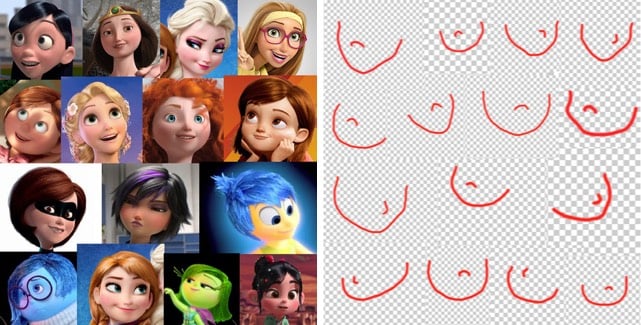
Boys in animated movies have faces that are square, round, skinny, fat, alien-looking, handsome, and ugly. The only face that girls get to have is some round snub-nosed baby face. That’s not right.
Great observation.
Update: This piece has generated some interesting comments on Good, including this one from Dan Povenmire, co-creator of Phineas and Ferb.
This is idiotic and obviously written by someone who (A) can’t draw and (B) has an axe to grind. The female characters they show have very varied faces. Yes the face shapes are all softer feminine shapes, but they purposely didn’t include female characters from those same movies with less feminine faces, like Edna Mode in The Incredibles, or the Witch or the Cook in Brave, or any of the older female characters, like the fairy godmother, or… whatever. All the princes and male romantic leads in these movies have the same face shape as well but NO, she takes old men and villains and comedy relief characters to “prove” how sexist animation is. This is just stupid.
If you want literally dozens of examples of other characters omitted from the list see the other comments below.
(via @ckoerner)
Although the gender stereotypes on display in the first trailer for Inside Out is not helping matters.↩
Martin Scorsese is reportedly set to direct a biopic on Mike Tyson with Jamie Foxx in the title role. Tyson has compiled a video of each of his 44 knockouts and wants his fans’ help in choosing his top 10 for Foxx to study.
The top 10 from this video are definite contenders.
New Every Frame a Painting! In this installment, Tony Zhou shows how Akira Kurosawa used movement in his films to terrific effect.
I really love this video featuring the opening and closing shots of fifty-five movies presented side-by-side, “First and Final Frames.” Created by Jacob T. Swinney.
My favorites: “Tree of Life,” “Raging Bull,” “Melancholia.”
Update: Swinney has released a second installment of First and Final Frames.
The “Mad Max: Fury Road” international trailer features fire and blood, colorful explosions, and Charlize Theron screaming. What a lovely day, indeed. BRB, I gotta go get in line.
(via This Isn’t Happiness)
Have you always dreamed of owning the home where Tony Montana married Elvira Hancock? The “Scarface” estate known as El Fureidis can be yours for only $34M.

But many of the classic features of the mansion are still in place: an 18-foot-high central dome adorned with 24-karat gold leaf in the Byzantine-style alcove, as well as a formal dining room ceiling depicting a scene of Alexander the Great conquering Persepolis in 330 B.C. (also designed with 24-karat gold leaf).
NB: The house isn’t in Coral Gables, FL. It’s in Montecito, CA.
Here’s a relatively exhaustive exploration of “Scarface” shooting locations, including the elevator scene and the chainsaw scene. (via Damon Brown)
Socials & More