Entries for January 2020
I love echo - any kind of reverberation or atmosphere around a voice or a sound effect that tells you something about the space you are in.
That’s a quote from legendary film editor and sound designer Walter Murch. In the 70s, he pioneered a technique called worldizing, for which he used a mix of pristine studio-recorded and rougher set-recorded sounds to make a more immersive soundscape for theater audiences. He used it in The Godfather, Apocalypse Now, and American Graffiti:
George [Lucas] and I took the master track of the two-hour radio show with Wolfman Jack as DJ and played it back on a Nagra in a real space — a suburban backyard. I was fifty-or-so-feet away with a microphone recording that sound onto another Nagra, keeping it in sync and moving the microphone kind of at random, back and forth, as George moved the speaker through 180 degrees. There were times when microphone and speaker were pointed right at each other, and there were other times when they were pointed in completely opposite directions. So that was a separate track. Then, we did that whole thing again.
When I was mixing the film, I had three tracks to draw from. One of them was what you might call the “dry studio track” of the radio show, where the music was very clear and sharp and everything was in audio focus. Then there were the other two tracks which were staggered a couple of frames to each other, and on which the axis of the microphone and the speakers was never the same because we couldn’t remember what we had done intentionally.
The 50 best car commercials of all time. About half of these are for Volkswagen.
The Prelude in G Major to Johann Sebastian Bach’s Cello Suite No. 1 is one of the world’s most recognizable pieces of music. You’ve likely heard Yo-Yo Ma play it — he’s been trying to master it for almost 60 years now. In a new episode of Earworm, Estelle Caswell and cellist Alisa Weilerstein break the song down to see what makes it such an effective and interesting piece of music.
In the early 1700s, Johann Sebastian Bach did something few, if any, composers had ever done. He composed six suites for the cello — a four stringed instrument that, at the time, was relegated to the role of accompaniment in larger ensembles.
Each suite consists of movements named for various dances, and they all begin with a prelude — an improvisatory movement meant to establish the key of the suite, as well as reoccurring themes and motifs. These suites are all masterpieces in music and considered a rite of passage for cellists to study and master.
But there’s one movement in particular, the Prelude in G Major, that has taken on a life of its own in the minds of musicians and music lovers alike.
If you hear the first few measures you’ll likely recognize it. A simple G major arpeggiated chord played expressively on the cello opens a short, but harmonically and melodically rich, 42 measures of music. Bach makes a single instrument sound like a full ensemble. How does he do it?
An immersive multimedia presentation of the Sherlock Holmes adventure, A Scandal in Bohemia. “To Sherlock Holmes she is always the woman. I have seldom heard him mention her under any other name.”
The machines that cut the pasta at Brooklyn pasta company Sfoglini are mesmerizing to watch.
I predict that a 10-minute super slow-motion film of this pasta cutter would easily win best short film at the Oscars.
Ariel Waldman and her microscopes spent five weeks in Antarctica investigating the microbes that live in the seas, lakes, and glaciers. One of the outcomes of the trip is Life Under the Ice, a website that showcases some of the tiny critters, plants, and miscellaneous things she found.
Typically when we think about Antarctica, we think of a place that’s barren and lifeless… except for a few penguins. But Antarctica should instead be known as a polar oasis of life, host to countless creatures that are utterly fascinating. They’ve just been invisible to us — until now. Life Under the Ice enables anyone to delve into the microscopic world of Antarctica as an explorer; as if you had been shrunk down and were wading through one large petri dish of curiosities.
Ahhh, look at this tardigrade at 20X magnification:
The tardigrade was found while extremophile hunting on a glacier.
I am always on the lookout for good music to write, design, and code to and video game music is definitely one of my go-to genres. Chris Gonzales wrote up a pair of guides to Mobile Games with Fantastic Soundtracks (part 2). Represented soundtracks include those from Monument Valley, Alto’s Odyssey, Gorogoa, and Stardew Valley.
Andy Cheung made a Spotify playlist of all the recommendations:
One that I listen to a lot that’s not on either list is Ben Prunty’s Ftl soundtrack (on Spotify).


The National Science Foundation has just released the very first images of the Sun taken with the new Inouye Solar Telescope in Hawaii. They are the highest resolution images ever taken of the Sun’s surface, showing three times more detail than was possible using previous imaging techniques. Those cells you see in the image…they’re each about the size of Texas.
Building a telescope like this is not an easy task — there’s a lot of heat to deal with:
To achieve the proposed science, this telescope required important new approaches to its construction and engineering. Built by NSF’s National Solar Observatory and managed by AURA, the Inouye Solar Telescope combines a 13-foot (4-meter) mirror — the world’s largest for a solar telescope — with unparalleled viewing conditions at the 10,000-foot Haleakala summit.
Focusing 13 kilowatts of solar power generates enormous amounts of heat — heat that must be contained or removed. A specialized cooling system provides crucial heat protection for the telescope and its optics. More than seven miles of piping distribute coolant throughout the observatory, partially chilled by ice created on site during the night.
Scientists have released a pair of mesmerizing time lapse videos as well, showing ten minutes of the roiling surface of the Sun (wide angle followed by a close-up view) in just a few seconds:
The Daniel K. Inouye Solar Telescope has produced the highest resolution observations of the Sun’s surface ever taken. In this movie, taken at a wavelength of 705nm over a period of 10 minutes, we can see features as small as 30km (18 miles) in size for the first time ever. The movie shows the turbulent, “boiling” gas that covers the entire sun. The cell-like structures — each about the size of Texas — are the signature of violent motions that transport heat from the inside of the sun to its surface. Hot solar material (plasma) rises in the bright centers of “cells,” cools off and then sinks below the surface in dark lanes in a process known as convection. In these dark lanes we can also see the tiny, bright markers of magnetic fields. Never before seen to this clarity, these bright specks are thought to channel energy up into the outer layers of the solar atmosphere called the corona. These bright spots may be at the core of why the solar corona is more than a million degrees!
Man, I hope we get some longer versions of these time lapses — I would watch the hell out of one that ran for 10 minutes. (via moss & fog)
In 2019, more Americans went to the library than to the movies. “Visiting the local library remains by far the most common cultural activity Americans engage in.”
In his new music video, My Vote Dont Count, rapper YelloPain provides an excellent 4-minute summary in the sprit of Schoolhouse Rock of the importance of voting, particularly in midterm elections and with a focus on Congress and state legislatures.
So you know how back in ‘08, when we all voted for Obama? We was all supposed to go back in 2010 and vote for the Congress. Cause they the ones that make child support laws. They the ones choose if your kids at school get to eat steak or corn dogs. The state house makes the courthouse. So if the country fail you can’t say it’s them, it’s your fault, cause ya ain’t know to vote for Congress members that was for y’all. And they don’t gotta leave after four years; we just let ‘em sit. See, they don’t want to tell you this, they just want you to focus on the President.
The video was co-produced by Desiree Tims, a Democrat who is running for the House in Dayton, YelloPain’s home town. Tims appears in the closing seconds of the video to deliver this message:
Every time you stay home, someone is making a decision about you. Making decisions about the air you breath, the water you drink, the food your kids eat, and how much money you bring home every two weeks. So every time you sit out an election, every time you don’t show up because you think it doesn’t matter, someone else is happy that you didn’t show up, so they can make that decision for you. Vote!
Even though it’s not explicitly labeled as such, this might be one of the best political advertisements I’ve ever seen. It’s entertaining, informative, and authentic.
By digitally elongating them in a glitchy sort of way, motion graphics designer Theodore John transforms the buttes and mesas of the American southwest into a vaguely sci-fi scene in his new short, American Totem. (via colossal)
Here’s the trailer for Beastie Boys Story, a feature-length documentary about the band directed by Spike Jonze. The film will debut in early April in IMAX theaters and be out on Apple+ later that month. From Rolling Stone:
The documentary is a live extension of 2018’s Beastie Boys Book, a memoir that paid tribute to Yauch, who died of cancer in 2012. “Looking back, it’s like, oh shit, that was crazy — how did we live through that?” Horovitz told Rolling Stone of the memoir. “And look at us now. We’re grown-ups. We have to think about mortgages. I gotta get dog food.”
Live portions of the documentary were taken from Horovitz and Diamond’s recent show at Kings Theatre in Brooklyn; it was all part of a live tour directed by Jonze that consisted of Q&A segments, readings, and guest moderators.
There’s nothing more entertaining than watching Boston-area natives do over-the-top Bawston accents, but it’s always a precarious undertaking. If you don’t get the accent right…yeesh. When Hyundai named their new automated parking feature “Smart Park”, those two words demanded that they give the Boston angle a shot, and the team of Chris Evans, John Krasinski, and Rachel Dratch delivered. The bit that really set the hook for me was when Krasinski called Evans “kid”.
John Gruber: The iPad Awkwardly Turns 10. “Great though it is in so many ways, overall it has fallen so far short of the grand potential it showed on day one.”
This clever stop motion animation by Charlotte Arene features a bedroom taking on the characteristics of an increasingly angry sea, before the morning calm sets in. Pillows, the comforter, a sleeping woman’s hair, candles on the windowsill, they all move like waves washing ashore to a seaside soundtrack.
The name of the short is “La mer à boire”, which Google translates as “unrealizable” but is literally something more like “drinking the sea”.1 “Ce n’est pas la mer à boire” is a French expression that means “it’s not that big a deal” (it’s not like drinking the sea), which is what the Google translation is hinting at, I think. Anyway, good title! (via colossal)
The BBC and Hulu are producing a 12-part TV series based on Sally Rooney’s book Normal People (which I excerpted here). The first trailer is above and I have to say, color me intrigued. (via the recently relaunched recs)
Men’s legacies vs women’s safety. “If Bryant’s fans are looking for a way to reconcile their love and grief with the accusation, one way would be to consider this apology as a sign of someone who seemed to be taking stock of the hurt he caused.”
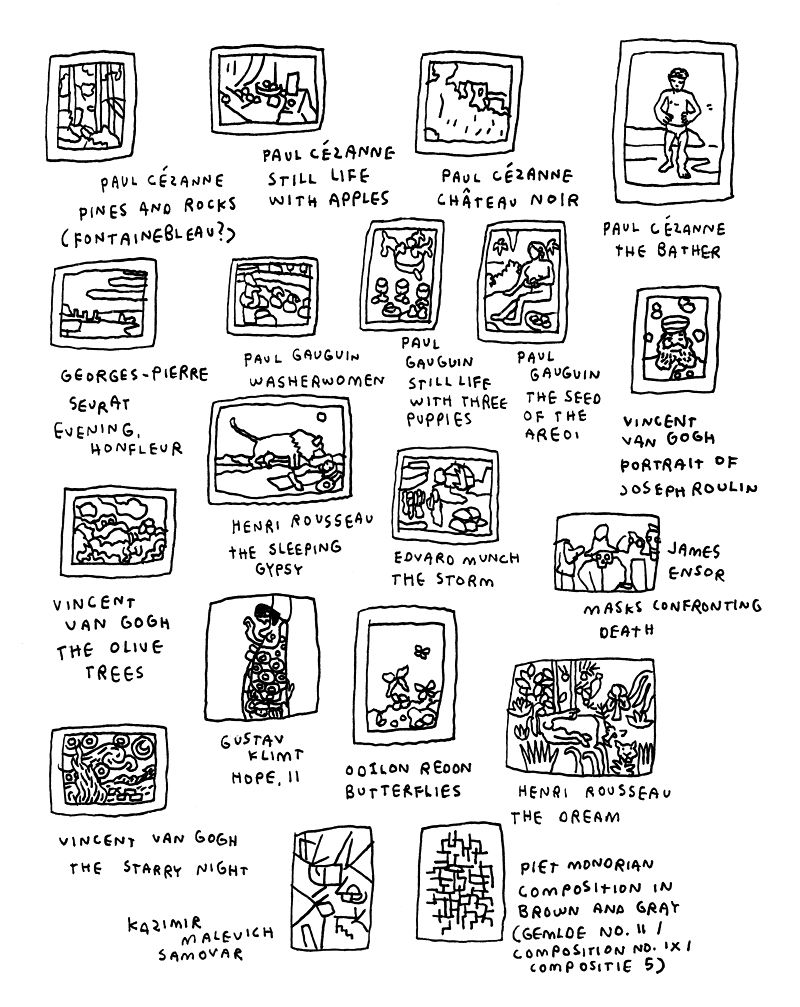
New York artist Jason Polan has passed away at the age of 37. The cause was colon cancer. From the NY Times obituary:
Mr. Polan’s signature project for the last decade or so was “Every Person in New York,” in which he set himself the admittedly impossible task of drawing everyone in New York City. He kept a robust blog of those sketches, and by the time he published a book of that title in 2015 — which he envisioned as Vol. 1 — he had drawn more than 30,000 people.
These were not sit-for-a-portrait-style drawings. They were quick sketches of people who often didn’t know they were being sketched, done on the fly, with delightfully unfinished results, as Mr. Polan wrote in the book’s introduction.
“If they are moving fast, the drawing is often very simple,” he wrote. “If they move or get up from a pose, I cannot cheat at all by filling in a leg that had been folded or an arm pointing. This is why some of the people in the drawings might have an extra arm or leg — it had moved while I was drawing them. I think, hope, this makes the drawings better.”
See also obituaries and remembrances from Gothamist and Ghostly. You can check out his blog and buy some of his work from 20x200.
I never met Polan in person — we corresponded via email occasionally, were admirers of each other’s work (I have several of his drawings), and I linked to his stuff sometimes (not enough) — but many of my friends knew him well and are reeling. There was a gentleness, a loving attention, that really came through in his work and in talking with the folks who knew him, that’s the way he was in person too. A kind soul, gone too soon. Rest in peace, Jason.
Update: Polan’s friend and long-time collaborator Jen Bekman posted a lovely tribute to him on 20x200.
Jason noticed. This was his thing. The effortlessness with which he could hone in on a person in the endless stream of the city, pick out just one or two details that made them unique and make art of them. People often asked me if I thought he had a photographic memory, and yea, maybe he did, but it wasn’t really the source of his genius. The source, I think, was his bottomless empathy and interest.
One of my favorite video series is Estelle Caswell’s Earworm for Vox — you can check out my posts about it here. It had been a few months since the last episode, so I went to see if she’d made any other videos in the meantime and, lo, Caswell produced a video about the Metropolitan Opera’s production of the opera Akhnaten by Philip Glass, one of my favorite composers.
The video above gives a behind-the-scenes look at the Metropolitan Opera’s production of Akhnaten. We follow Anthony Roth Costanzo, who plays Akhnaten, through the various phases of rehearsal, from working with his vocal coach in a Manhattan apartment to taking the stage for a dress rehearsal in a costume covered in doll heads.
I’ve only seen one opera at the Met (years ago) and was blown away by the production. I remember walking out of there thinking, “Do people know how good this is? Why isn’t opera a massive thing?” (Although I guess I answered my own question by not ever going back?)
For The Guardian, Mark O’Connell writes about experiencing something called a wilderness solo. The basic idea is that you go alone into the woods and spend 24+ hours, usually without food, in a small area doing essentially nothing but being there.
When you’re actually in it, the reality of the solo is, at least at first, one of total boredom. I cannot stress enough how little there is to do when you have confined yourself to the inside of a small circle of stones and sticks in a forest. But it is an instructive kind of boredom, insofar as boredom is the raw and unmediated experience of time. It is considered best practice not to have a watch, and to turn off your phone and keep it somewhere in the bottom of a bag so as to avoid the temptation to constantly check how long you’ve been out and how long you have left. And as you become untethered from your accustomed orientation in time — from always knowing what time it is, how long you have to do the thing you’re doing, when you have to stop doing it to do the next thing — you begin to glimpse a new perspective on the anxiety that arises from that orientation. Because this anxiety, which amounts to a sort of cost-benefit analysis of every passing moment, is a quintessentially modern predicament.
See also Outward Bound’s “Solo” experiences.
When humans domesticated barnyard animals (goats, sheep, cows) starting around 10,000 years ago, they stumbled upon one of the most amazing schemes of all time. Instead of relying on the few human-edible plants scattered around for their energy needs, humans could raise animals that ate the plain old grass that was growing anywhere & everywhere and converted it into ultra-nutritious and energy-rich superfoods like meat and milk. Land back then was plentiful and the scheme allowed humans to produce many more calories with less effort using an energy source (the grass) that they didn’t otherwise have much use for.
But how does milk fit into the picture these days? It’s still a superfood that’s very beneficial to people in many parts of the world where adequate nutrition isn’t available from other sources. But as Kurzgesagt explains in this video, our land use has changed in the past 10,000 years, and cow’s milk production is a major source of carbon emissions (when compared to foods w/ similar nutritional value):
And don’t forget to check out the list of sources they used in producing the video.
What the…? Dean Kamen, inventor of the Segway (and many other more useful inventions), also invented the Coca-Cola Freestyle machine (the one w/ 160+ flavors)?!
The Spotted Pig is closing. Am I reading between the lines correctly that Friedman is closing it down so he doesn’t have to pay his victims?
The premise is pretty simple and there’s no need to oversell it because you can imagine what this is going to sound like going in and it delivers perfectly: George Costanza’s father’s voice dubbed over Darth Vader’s dialogue in Star Wars. Serenity now!
(Quickly: Luke = Jerry, Han = George, Leia = Elaine, Chewie = Kramer. Does that even work? (Obi-Wan = Uncle Leo? Is 3PO Newman?))
Something shitty just happened to me. (Don’t worry, I’m alright!) But after it happened, I was pretty preoccupied by the whole thing: feeling victimized, rehashing the stupid mistake I’d made in my mind, wondering what I should have done differently, feeling shame about it all. This incident was on its way to ruining my day and perhaps even my next few days. Then I remembered one of the stories from the lovely Zen Shorts, a book I used to read with the kids.
The tale of two monks and a woman is a well-known Buddhist parable. The story goes that two monks were traveling together, a senior and a junior. They came to a river with a strong current where a young woman was waiting, unable to cross alone. She asks the monks if they would help her across the river. Without a word and in spite of the sacred vow he’d taken not to touch women, the older monk picks her up, crosses, and sets her down on the other side.
The younger monk joins them across the river and is aghast that the older monk has broken his vow but doesn’t say anything. An hour passes as they travel on. Then two hours. Then three. Finally, the now quite agitated younger monk can stand it no longer: “Why did you carry that women when we took a vow as monks not to touch women?”
The older monk replies, “I set her down hours ago by the side of the river. Why are you still carrying her?”
The story is a reminder to not dwell on the past in a way that interferes with living in the present moment. I’m glad to have remembered it today — I’m feeling much better now.
The long-time host of PBS NewsHour Jim Lehrer died this week at the age of 85. In this age of news as entertainment and opinion as news, Lehrer seems like one of the last of a breed of journalist who took seriously the integrity of informing the American public about important events. In a 1997 report by The Aspen Institute, Lehrer outlined the guidelines he adhered to in practicing journalism:
- Do nothing I cannot defend.*
- Do not distort, lie, slant, or hype.
- Do not falsify facts or make up quotes.
- Cover, write, and present every story with the care I would want if the story were about me.*
- Assume there is at least one other side or version to every story.*
- Assume the viewer is as smart and caring and good a person as I am.*
- Assume the same about all people on whom I report.*
- Assume everyone is innocent until proven guilty.
- Assume personal lives are a private matter until a legitimate turn in the story mandates otherwise.*
- Carefully separate opinion and analysis from straight news stories and clearly label them as such.*
- Do not use anonymous sources or blind quotes except on rare and monumental occasions. No one should ever be allowed to attack another anonymously.*
- Do not broadcast profanity or the end result of violence unless it is an integral and necessary part of the story and/or crucial to understanding the story.
- Acknowledge that objectivity may be impossible but fairness never is.
- Journalists who are reckless with facts and reputations should be disciplined by their employers.
- My viewers have a right to know what principles guide my work and the process I use in their practice.
- I am not in the entertainment business.*
In his 2006 Harvard commencement address, Lehrer reduced that list to an essential nine items (marked with an * above).
These are fantastic guidelines; as veteran journalist Al Thompkins said recently: “I would like to add a 10th rule: Journalists should be more like Jim Lehrer.”
Addendum: Even though this is a mere blog that has different goals and moves at a different pace than traditional journalism, I try (try!) to adhere to Lehrer’s guidelines on kottke.org as much as possible. I found out about his rules on Twitter in the form of a context-free screenshot of an equally context-free PDF. Lehrer would not approve of this sort of sourcing, so I started to track it down.
All initial attempts at doing so pointed to the truncated list (as outlined in the Harvard speech and in this 2009 episode of the NewsHour), so I wrote up a post with the nine rules and was about to publish — but something about the longer list bugged me. Why would someone add more rules and attribute them to Lehrer? It didn’t seem to make sense, so I dug a little deeper and eventually found the Aspen report in bowels of Google and rewrote the post.
In doing all this, I rediscovered one of the reasons why Lehrer’s guidelines aren’t followed by more media outlets: this shit takes time! And time is money. It would have taken me five minutes to find that context-free PDF, copy & paste the text, throw a post together, and move on to something else. But how can I do that when I don’t know for sure the list is accurate? Did he write or say those things verbatim? Or was it paraphrased or compiled from different places? Maybe the transcription is wrong. Lehrer, of all people, and this list, of all lists, deserves proper attribution. So this post actually took me 45+ minutes to research & write (not counting this addendum). And this is just one little list that in the grand and cold economic scheme of things is going to make me exactly zero more dollars than the 5-minute post would have!
Actual news outlets covering actual news have an enormous incentive to cut corners on this stuff, especially when news budgets have been getting squeezed on all sides for the better part of the last two decades. It should come as no big surprise then that the media covers elections as if they were horse races, feasts on the private lives of celebrities, and leans heavily on entertaining opinions — that all sells better than Lehrer’s guidelines do — but we should think carefully about whether we want to participate in it. In the age of social media, we are no longer mere consumers of news — everyone is a publisher and that’s a powerful thing. So perhaps Lehrer’s guidelines should apply more broadly, not only for us as individuals but also for media companies like Google, Facebook, and Twitter that amplify and leverage our thoughts and reporting for their own ends.
Are You Ready to Have Friends With Kids? “Once you have friends with kids, your life is no longer about you. It’s about your friends’ kids.”
As a defense against predators, these juvenile striped eel catfish from Jemeluk Bay near Bali organize themselves into an ambling, pulsating sea creature that looks like something out of a Miyazaki film. The Kid Should See This:
Try rewatching the video, picking one fish and following it the entire time. Then pick another fish and watch the video again. The juvenile striped eel catfish seem to cycle through positions within the school as the entire swarm moves forward.
Like riders in a peleton, each taking their turn braving danger at the front.
See also A Talented Pufferfish Creates an Underwater “Crop Circle”.
Andrei Kashcha’s City Roads tool will draw you a map of just the roads in any city around the world. I’m in Saigon right now, so I did that one first:

And this is Paris:
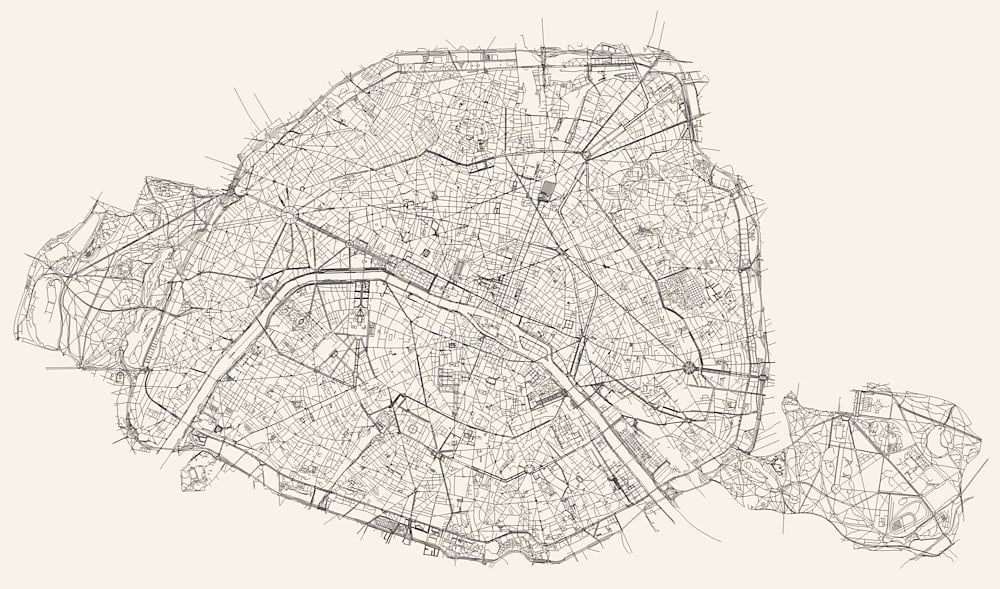
I love that the whitespace reveals more of a city than just roads — you can also see rivers, parks, train lines, stadiums, and airports.
See also Ben Fry’s All Streets project and Nelson Minar’s map of all the rivers in the US.
Update: Javier Pastor compiled a list of similar services that create artistic maps. The article is in Spanish but Google Translate works well on it.
With the Wuhan coronavirus in the news, this is a timely release from Netflix: Pandemic is a 6-part series on the inevitable worldwide disease outbreak and what’s being done to stop it, or at least to mitigate its effects.
Google’s ads look just like the search results now. The company hasn’t been a “search engine” for a long time now, but the takeover of the company by biz dev & sales folks is complete.
This is a few years old, but is it ever clever: some thieves in Brazil put an entire fake ATM interface (screen, card reader, keypad) over the real ATM to skim card numbers and PINs.
Krebs on Security wrote up a report on the scheme:
Interestingly, much like grammatical and spelling errors that often give away phishing emails and Web sites, the thieves who assembled the video for the screen for the fake ATM used in the April robbery appear have made a grammatical goof in spelling “país,” the Portuguese word for “country”; apparently, they left off the acute accent.
Most skimming attacks (including the two mentioned here) take place over the weekend hours. Skimmer scammers like to place their devices at a time when they know the bank will be closed for an extended period, and when foot traffic to the machine will be at its highest.
This is like when the T-1000 in Termintor 2 can impersonate any person that it touches, except with cash machines. (I would read a book entirely composed of clever thieves’ inventions and techniques. I assume this already exists?)
In the 1850s, the well-heeled residents of Manhattan were convinced the city needed a grand park like the European capitals had. And so, a park located in the middle of the city was proposed, a Central Park, if you will. The only problem? There were people living in the park’s proposed location, including Seneca village, a small, integrated, predominately black neighborhood.
It’s a story that goes back to the 1820s, when that part of New York was largely open countryside. Soon it became home to about 1,600 people. Among them was a predominantly black community that bought up affordable plots to build homes, churches and a school. It became known as Seneca Village. And when Irish and German immigrants moved in, it became a rare example at the time of an integrated neighborhood.
See also ‘The City Needed Them Out’.
Older posts



Socials & More