Entries for December 2018






From top to bottom: Christine Blasey Ford by Win McNamee, Emma Gonzalez by Jonathan Ernst, White House rally by Carolyn Kaster, Indian LGBT activist by Abhishek Chinnappa, Nakosha Smith of the Caramel Curves motorcycle club by Akasha Rabut, and a young churchgoer at Orthodox Easter service by Mikhail Svetlov.
That’s just a tiny slice of 2018…check out these sites for many more photos from the year that was:
2018 in Photos (part 2, part 3), Top 25 News Photos of 2018, The Most 2018 Photos Ever, and Hopeful Images From 2018, all from The Atlantic.
Best photos of 2018 from National Geographic.
Pictures of the year 2018 from Reuters.
These Are The Most Powerful Photos From 2018 from Buzzfeed.
Year in Pictures 2018 from Bloomberg.
The Year in Pictures 2018 from the NY Times.
2018 Year in Photos from Associated Press.
2018: The year in pictures from CNN.
Top 100 Photos of 2018 from Time.
52 things learned in 2018. “As late as 1939, the United States had a well-developed plan to invade Canada.”
Equipped with only a magnifying glass and the light of the Sun, it’s pretty easy to start a fire.1 So, with a much bigger glass, could you start a fire with moonlight?
First, here’s a general rule of thumb: You can’t use lenses and mirrors to make something hotter than the surface of the light source itself. In other words, you can’t use sunlight to make something hotter than the surface of the Sun.
There are lots of ways to show why this is true using optics, but a simpler — if perhaps less satisfying — argument comes from thermodynamics:
Lenses and mirrors work for free; they don’t take any energy to operate.[2] If you could use lenses and mirrors to make heat flow from the Sun to a spot on the ground that’s hotter than the Sun, you’d be making heat flow from a colder place to a hotter place without expending energy. The second law of thermodynamics says you can’t do that. If you could, you could make a perpetual motion machine.
In a better world, Randall Munroe would be writing middle school science textbooks.
In an issue of The Discourse, Sean Blanda shared a list of rules for interacting with others online while maintaining your sanity. Among them are:
4. Take a second.
6. If an online space makes more money the more time you spend on it, use sparingly.
8. Try to give people the benefit of the doubt, be charitable in how you read people’s ideas.
10. Create the kind of communities and ideas you want people to talk about.
12. You don’t always have the moral high ground. You are not always right.
Guesstimate is a spreadsheet for making estimated calculations. “Guesstimate uses Monte Carlo sampling to correctly estimate uncertain results.”
I Was A Cable Guy. I Saw The Worst Of America. “‘It’s just, when he has Fox, he has Obama to hate. If he doesn’t have that …’ She kept looking over her shoulder. She was terrified of him.”



Manet, Degas, Renoir, Monet, and Morisot. You’ve likely not heard of that last one, but Berthe Morisot was one of the founding members of painting’s Impressionist movement and because of a new retrospective exhibition, she’s finally getting her due. Berthe Morisot: Woman Impressionist is a collaboration among five museums from around the world and is currently on display at The Barnes Foundation in Philadelphia (though only until January 14). Peter Schjeldahl’s review for the New Yorker calls Morisot “the most interesting artist of her generation”.
About half of the sixty-eight paintings in the show remain in private collections. But, aside from a few partial failures that instructively exemplify risks Morisot took, they are all more than museum-worthy. Morisot is still emerging from the margins of the Impressionist club of certified alphas, betas, and minions, but the priority for valuing her work is not just the issuing of retroactive membership. It’s re-seeing and rethinking the whole history of modern art from the perspective of women who never stood a chance of major attainment. In a different world, Morisot would be the doyenne of an established tradition that built and expanded on her example.
If you miss the show at the Barnes, the exhibition will be touring the other supporting museums, including the Dallas Museum of Art (Feb 24 - May 26, 2019) and the Musée d’Orsay (June 18, Sept 22, 2019).
The New York Times is running a series of editorials on the erosion of women’s rights in the American judicial system at the expense of extending rights to “clusters of cells that have not yet developed into viable human beings”.
You might be surprised to learn that in the United States a woman coping with the heartbreak of losing her pregnancy might also find herself facing jail time. Say she got in a car accident in New York or gave birth to a stillborn in Indiana: In such cases, women have been charged with manslaughter.
In fact, a fetus need not die for the state to charge a pregnant woman with a crime. Women who fell down the stairs, who ate a poppy seed bagel and failed a drug test or who took legal drugs during pregnancy — drugs prescribed by their doctors — all have been accused of endangering their children.
The introduction also contains a reminder that Republicans were for abortion rights until they realized it was politically advantageous for them to rail against them to rile up evangelicals and divide Democrats:
Out of concern for individual freedom, the Republican Party once treated abortion as a private matter. When Ronald Reagan was governor of California, he signed one of the most liberal abortion laws in the land, in 1967. As late as 1972, a Gallup poll found that 68 percent of Republicans thought that the decision to have an abortion should be made solely by a woman and her doctor.
Apple is offering 6 free audiobooks read by celebrity narrators. Titles include Pride and Prejudice, The Time Machine, and Frankenstein.
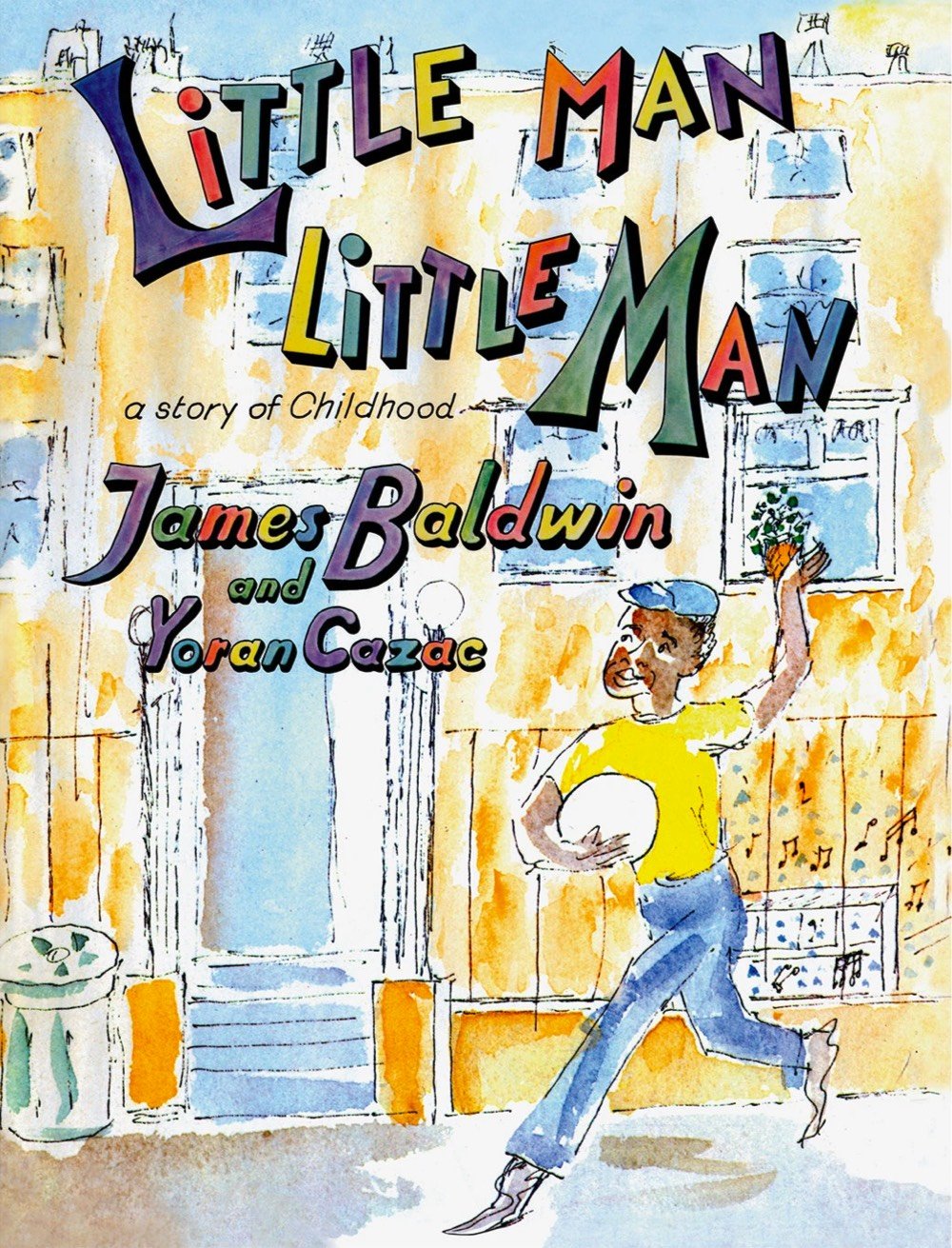
In 1976, James Baldwin and artist Yoran Cazac released a children’s book called Little Man Little Man: A Story of Childhood.
Four-year-old TJ spends his days on his lively Harlem block playing with his best friends WT and Blinky and running errands for neighbors. As he comes of age as a “Little Man” with big dreams, TJ faces a world of grown-up adventures and realities. Baldwin’s only children’s book, Little Man, Little Man celebrates and explores the challenges and joys of black childhood.
The book received mixed reviews and quickly went out of print. Baldwin’s family pushed for a reissue and a few months ago, an updated edition was released, which includes essays from Baldwin’s nephew and niece (who were the inspiration for two of the book’s characters) and Baldwin scholars. The NY Times review has more on how the book and the reissue came about.
Baldwin was daunted by the assignment. When he spoke to a group of students in 1979, he described how challenging it was to write a children’s book.
“I must tell you, I was very frightened to try to write a children’s story or a story for children, because first of all, I think children object to being called children,” he said. “The one thing a child cannot bear is to be talked down to, to be patronized, to be talked to in baby talk. So what I tried to do was put myself inside the minds of the kids in my story, trying to remember what I myself was like when I was a kid, and the way I sounded, and the way TJ sounds.”
As he does every year, President Obama shared his favorite reads of the year on Facebook, books that he found “thought-provoking, inspiring, or just plain loved”. Among them are:
Becoming by Michelle Obama.
Americanah by Chimamanda Ngozi Adichie.
Why Liberalism Failed by Patrick Deneen.
Warlight by Michael Ondaatje.
How Democracies Die by Steven Levitsky and Daniel Ziblatt.
This year, Obama also shared his favorite movies and songs. The movie list contains some pretty interesting entries: Annihilation, The Death of Stalin, Shoplifters, Won’t You Be My Neighbor. I wonder if he sees these in the theater or via Netflix/Apple/Amazon or he just gets a ton of screeners from the studios?
And Mr. President, let me know if you ever want to contribute a guest media diet post…I will try to squeeze you into my editorial calendar.
It’s the dawn of the age of insightful computers. But how long will it last for us slow-witted humans?

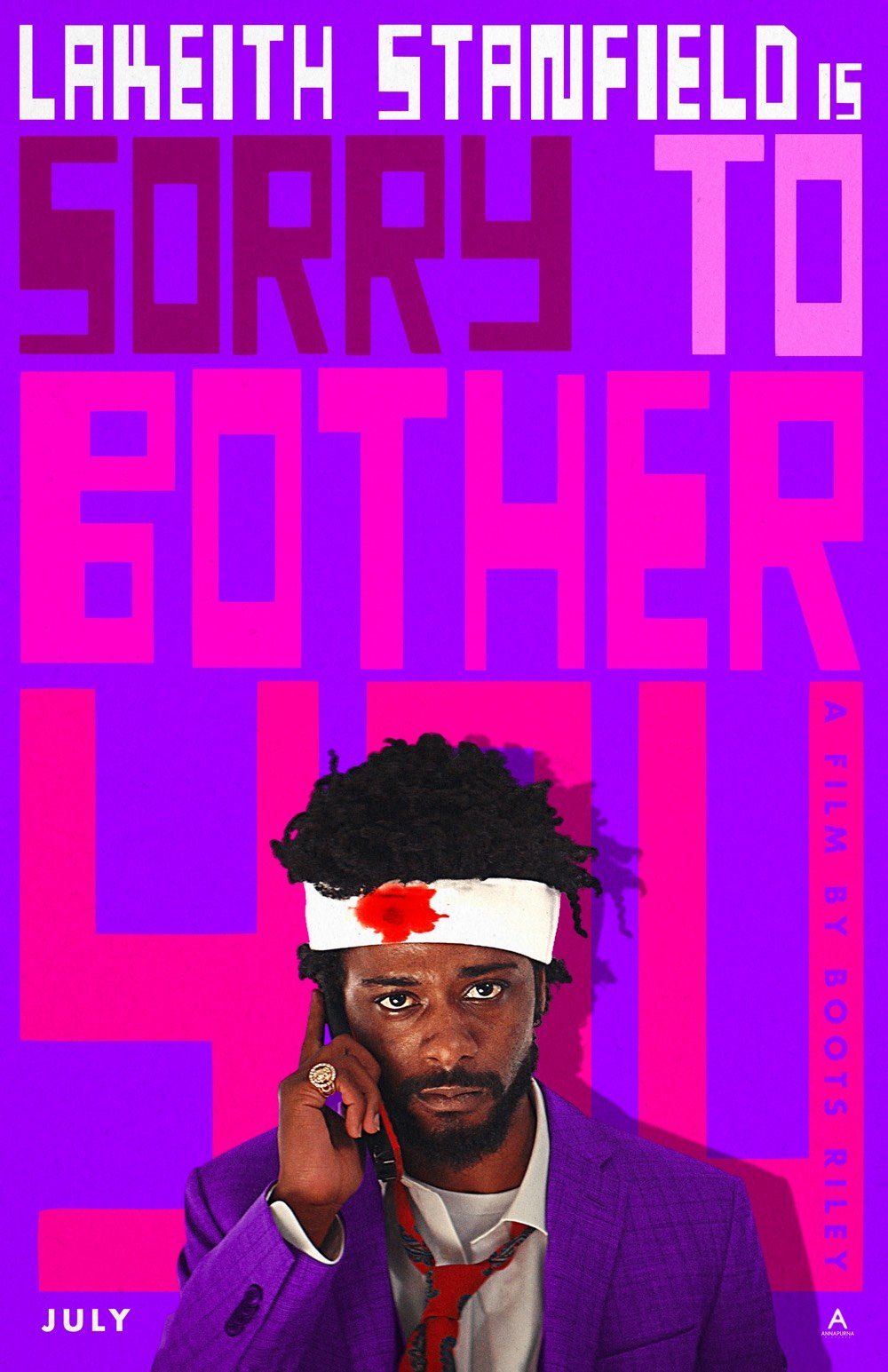
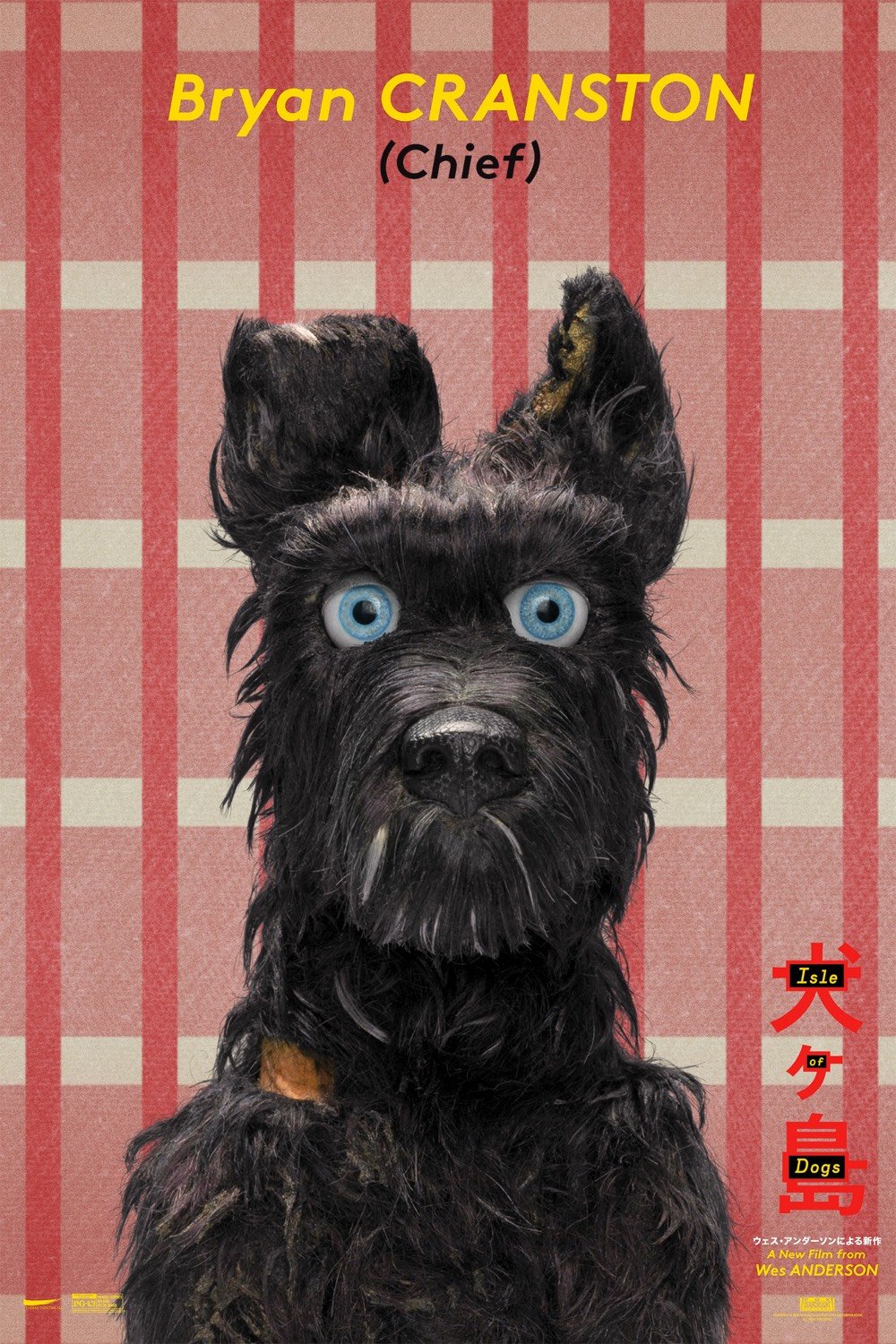

Check out these and many other top posters of the year at Creative Review, The Playlist, Little White Lies, and MUBI Notebook.
My pal Bryan Boyer has built a device he calls a VSMP (Very Slow Movie Player). It’s an e-paper display that shows a movie not at 24 frames/sec but at 24 frames per hour.
Films are vain creatures that typically demand a dark room, full attention, and eager eyeballs ready to accept light beamed from the screen or projector to your visual cortex. VSMP inverts all of that. It is impossible to “watch” in a traditional way because it’s too slow. In a staring contest with VSMP you will always lose. It can be noticed, glanced-at, or even inspected, but not watched. That’s one of the things I like about the Bill Viola pieces. You don’t watch them because they’re not films; they’re portraits so you see them, and it just so happens that you see them in four dimensions.
Ahhh, look at this gloriously retro aesthetic:
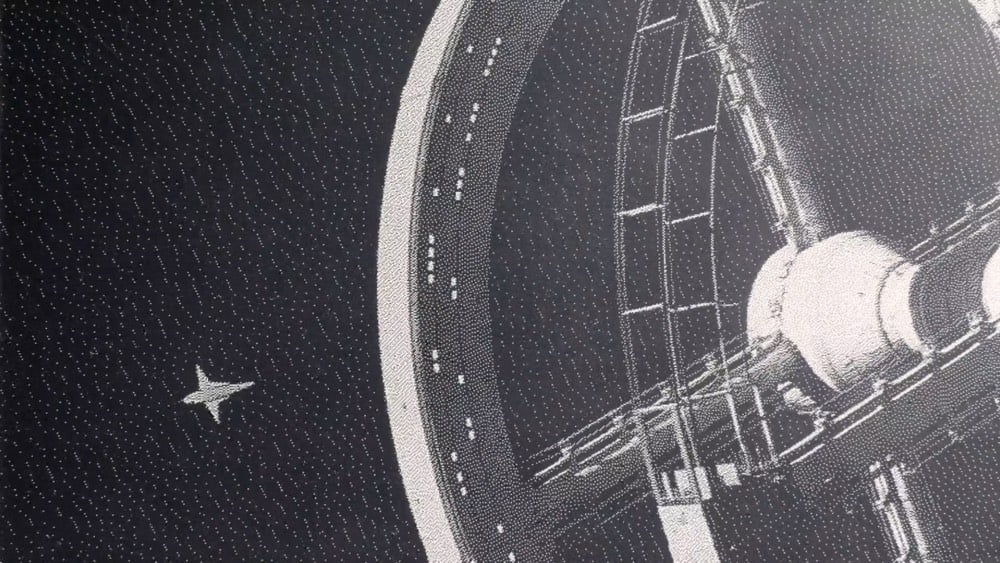
His whole essay about the project is worth reading for the thoughtful insights throughout. I totally want a wall-sized VSMP in my bedroom.
Update: Inspired by the VSMP, Jon Bell built a web page that will show Sofia Coppola’s Lost In Translation stretched out over the course of the next year. You can watch here.
Update: Inspired by the projects above, Nic Magnier made Yearlong Koyaanisqatsi, a Twitter bot that will show Godfrey Reggio’s Koyaanisqatsi very slowly over the course of the next year, one frame every 6 hours.
Update: Tom Whitwell recently built a VSMP and it’s quite a bit easier now — no soldering or anything like that.
This is a relatively straightforward project. There’s no soldering and no hardcore coding. If you’re at all comfortable using a command line, and you’ve seen Python script before then you’ll be fine. The e-paper screen, Pi, SD Card and IKEA frame cost me about £120 in total.
In an effort to discover what effect populist leaders have on democratic institutions, a pair of researchers, Harvard’s Yascha Mounk and Jordan Kyle of the Tony Blair Institute for Global Change, compiled a list of 46 populist leaders & parties that have been in power in democracies from 1990 until now. Then they looked at how those leaders affected those governmental systems in those countries. Their conclusions were not encouraging: “Populists are highly skilled at staying in power and pose an acute danger to democratic institutions.”
Populists aren’t just more likely to win reelection once or twice; they are also much more likely to remain in power for well over a decade. Six years after they are first elected, populist leaders are twice as likely as non-populist leaders to still be in power; twelve years after they are first elected, they are more than five times as likely.
Arguably, these findings are not, in themselves, all that concerning: The longer survival rate for populists may simply reflect their efficiency or popularity. But among populist leaders who entered office between 1990 and 2015, only a small minority left office as a result of the normal democratic process.
In fact, only 17 percent of populists stepped down after they lost free and fair elections. Another 17 percent vacated high office after they reached their term limits. But 23 percent left office under more dramatic circumstances — they were impeached or forced to resign. Another 30 percent of all populist leaders in our database remain in power to this day. This is partially a function of the recent rise of populism: Thirty-six percent of those populist rulers who still remain in power were elected over the past five years. But even more of them have been in office long enough to raise serious concerns: About half have led their country for at least nine years.
The most important issue, however, is neither how long populists stay in office nor even how they ultimately leave, but what they do with their power-and, in particular, whether their tenure causes what political scientists call “democratic backsliding,” a significant deterioration in the extent to which the citizens enjoy basic rights.
Here, too, our findings were sobering, to say the least: In many countries, populists rewrote the rules of the game to permanently tilt the electoral playing field in their favor. Indeed, an astounding 50 percent of populists either rewrote or amended their country’s constitution when they gained power, frequently with the aim of eliminating presidential term limits and reducing checks and balances on executive power.
Their full paper is available here, which shows that left-wing populism is almost as bad as right-wing populism:
Between 1990 and 2014, 13 right-wing populist governments were elected; of these, five have significantly curtailed civil liberties and political rights, as measured by Freedom House. Over the same period, 15 left-wing populist governments were elected; of these, the same number reduced such freedoms. (Over the same period, there were also 17 populist governments that cannot easily be classified as either right- or left-wing; again, five of these governments diminished civil liberties and political rights.) Although this indicates a slightly higher rate of backsliding among right-wing populists than left-wing ones (38 per cent vs. 33 per cent), these data clearly contradict the belief that left-wing populism does not pose a threat to democracy.
Author Elizabeth Wurtzel finds out the truth about her parents. “It turns out that the man I have spent 50 years believing to be my father is not my father.”
The opening line of Madeline Miller’s Circe is: “When I was born, the name for what I was did not exist.” In Miller’s telling of the mythological story, Circe was the daughter of a Titan and a sea nymph (a lesser deity born of two Titans). Yes, she was an immortal deity but lacked the powers and bearing of a god or a nymph, making her seem unnervingly human. Not knowing what to make of her and for their own safety, the Titans and Olympic gods agreed to banish her forever to an island.
Here’s a photograph of a woman who could also claim “when I was born, the name for what I was did not exist”:

The previous line contains two lies: this is not a photograph and that’s not a real person. It’s an image generated by an AI program developed by researchers at NVIDIA capable of borrowing styles from two actual photographs of real people to produce an infinite number of fake but human-like & photograph-like images.
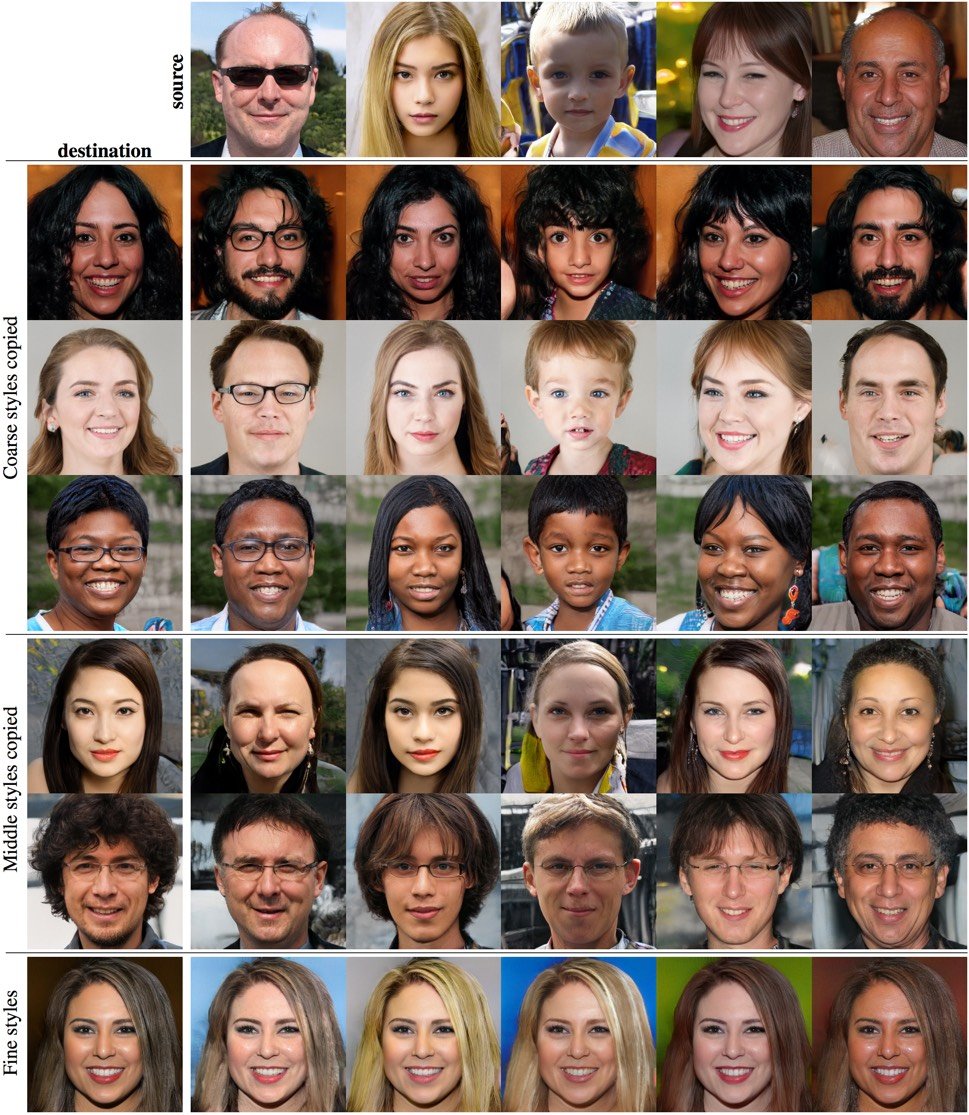
We propose an alternative generator architecture for generative adversarial networks, borrowing from style transfer literature. The new architecture leads to an automatically learned, unsupervised separation of high-level attributes (e.g., pose and identity when trained on human faces) and stochastic variation in the generated images (e.g., freckles, hair), and it enables intuitive, scale-specific control of the synthesis.
The video offers a good look at how this works, with realistic facial features that you can change with a slider, like adjusting the volume on your stereo.
Photographs that aren’t photographs and people that aren’t people, born of a self-learning machine developed by humans. We’ll want to trust these images because they look so real, especially once they start moving and talking. I wonder…will we soon seek to banish them for our own safety as the gods banished Circe?
Update: This Person Does Not Exist is a single serving site that provides a new portrait of a non-existent person with each reload.
The trailer for Black Mirror: Bandersnatch, a feature-length special premiering tomorrow (12/28) on Netflix:
In 1984, a young programmer begins to question reality as he adapts a sprawling fantasy novel into a video game and soon faces a mind-mangling challenge. Welcome back.
What if Stranger Things but Black Mirror?
Update: There were rumors that an upcoming Black Mirror episode would feature a Choose Your Own Adventure style narrative. Well, it appears that Bandersnatch is that episode. From Variety:
“Bandersnatch” comes with five possible endings. Viewers who choose the quickest path, and decide against any do-overs, can make it through the film in around 40 minutes. The average viewing time is around 90 minutes.
Altogether, there are over a trillion unique permutations of the story. However, this also includes relatively simple iterations that don’t necessarily alter the story itself. For instance, one of the first decisions is helping Stefan to choose which cereal to eat in the morning. “We want [viewers] to have a successful choice early on,” said Engelbrecht.
From the Art of the Title, the picks for the best opening credits sequences of the year. Their #1 is Babylon Berlin, which would have been my pick as well.
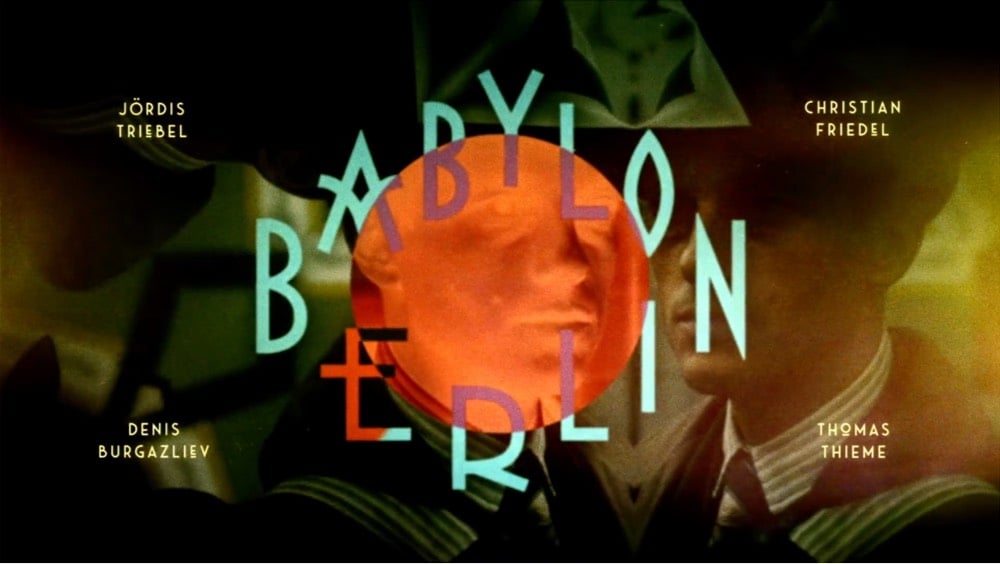
The list also includes the titles for Spider-Man: Into the Spider-Verse, which might be the most visually inventive box office #1 in recent memory.
Interestingly, two of the sequences on the list aren’t from film or TV but from conferences: Semi Permanent 2018 and Made In The Middle 2018. Only three out of the ten were from movies.
From Popular Science, the 100 greatest innovations of 2018. This is a good list…they dig beyond gadgets & apps into aerospace, health, etc.
For the past few hundred million years, the legs of vertebrate animals have evolved into many different forms and shapes. But for many animals, there’s an underlying similarity as well. In his book Chuck Amuck, legendary animator Chuck Jones used a simple technique to help visualize how to accurately draw the feet and legs of various animals: he drew shoes and socks on them.
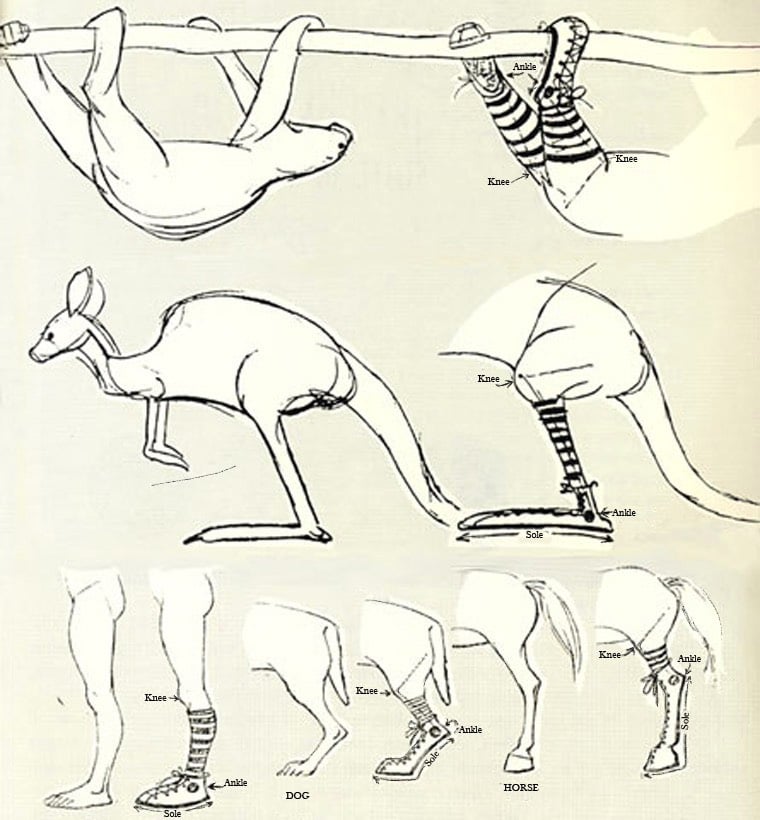
Using a Chuck Taylor-style shoe, Jones’s intuitive drawings show where each animal’s ankle and knee are simply by the placement of circular “All-Star” patch on the shoe and the height of the socks just below the knee. These are keen and illuminating anatomical observations that would have made Leonardo da Vinci proud.
Ok, that’s footwear all sorted. But how should a dog wear pants?

Or a chicken?
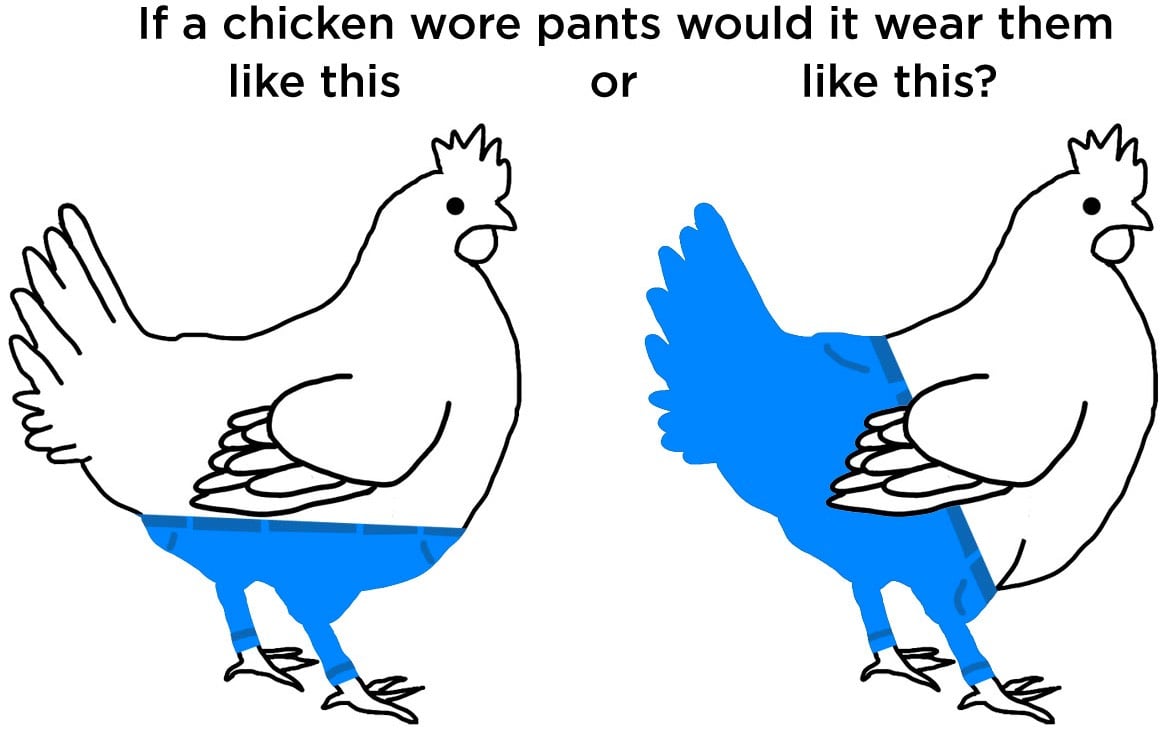
Or an AT-AT?

I wish Jones was still around to settle this.
I’ve been keeping track of every media thing I “consume”, so here are quick reviews of some things I’ve read, seen, heard, and experienced in the last month or so. Look for 2018 media recap sometime later this week.
Small Fry by Lisa Brennan-Jobs. Under-read and under-remarked upon by the tech press…but if you read this just for the Steve Jobs bits, you’re really missing out. (A)
The Good Place. Not quite as charmed by this as everyone else, but I’d definitely listen to a weekly hour-long podcast that goes deeper into the philosophy featured in each episode. (B+)
Outlaw King. Not so bad if you’re in the mood for medieval battles. (B)
Fantastic Beasts: The Crimes of Grindelwald. A letdown after the first film, which has gotten better every time I’ve rewatched it. Way too much exposition and not enough fun. By the end, I was bored. My kids said they liked it but without much conviction in their voices. (C+)
Bodyguard. Some shows, even my all-time favorites, took a few episodes to get into. Bodyguard hooked me after 5 minutes. (A-)
Function. A podcast on “how technology is shaping culture and communications” hosted by my pal Anil Dash. (I listened to the Should Twitter Have an Edit Button? episode.) The podcast reproduces to a remarkable degree the experience & content of dinner conversation with Anil. (B+)
Andy Warhol - From A to B and Back Again. I was personally underwhelmed by this, possibly because I’ve seen so much Warhol and read so much about him and his work? (B)

Hilma af Klint: Paintings for the Future. Absolutely thrilling, like discovering a secret room in your house. Many thanks to Chrysanthe for the nudge. (A)
The Odyssey translated by Emily Wilson. Finally finished reading this with the kids. Everyone loved it. (A)
Yotam Ottolenghi’s green gazpacho. It was hardly the season for it, but I was jonesing for the green gazpacho dish that my favorite restaurant used to serve. I took a guess that they used Ottolenghi’s recipe…naaaaaailed it. Delicious with some shrimp and croutons. Will use less garlic next time though. (A-)
Deceptive Practice: The Mysteries and Mentors of Ricky Jay. There’s probably a better movie to be made of Jay’s life, but this was sufficient for my purposes. (B)
Fawlty Towers. Passing on the family tradition of watching old British comedies to my children. Some of the best television ever made, yessiree. (A)
Ralph Breaks the Internet. Perhaps this is small-minded, but I really wanted to see a little kottke.org shop in the background when Ralph and Vanellope are bopping around Internet City, like a tiny boutique next to BuzzzTube or something. (B+)
The Favourite. Delightful and fun. Loved it. (A-)
The Ballad of Buster Scruggs. The Coen brothers, perfectly tuned to the streaming TV format. The stories reminded me a bit of Roald Dahl’s The Tales of the Unexpected. (A-)
Can You Ever Forgive Me? Great acting, particularly from Melissa McCarthy. She reminded me of a young Kathy Bates in this. (B+)
The Day After Tomorrow. I’ve seen this movie probably 10 times and it seems more and more plausible with each viewing. (A)
Circe by Madeline Miller. I am enjoying this trend of old stories told from new vantage points. (A-)
The Marvelous Mrs. Maisel. I was charmed by the first three episodes but the rest wasn’t as entertaining. People kept changing their entire personalities from episode to episode and we’re supposed to just go along with that? I don’t agree with all of it, but I loved reading Emily Nussbaum’s pan of the show for the New Yorker. (B-)
Spider-Man: Into the Spider-Verse. Visually dazzling and by far my favorite Spider-Man movie, but I preferred Black Panther and Avengers: Infinity War. This movie is much more “comics-y” than the live-action Marvel movies and despite much effort, I am just not a comics guy. (B)

Dr. Mario. Used to play this a lot when I was a kid. Still fun. Would love a networked version to play against friends. (B+)
My Brilliant Friend. About halfway through and enjoying it, but it’s just not the book (which I loved). (B+)
My Brilliant Friend soundtrack. Max Richter, enough said. (A-)
Summer Games. This track off of Drake’s Scorpion has grabbed my attention lately. I love the Chariots of Fire + NES Track and Field vibe of the music. (B+)
On Being with Anand Giridharadas. An interview about his book, Winners Take All. (B+)
The Ezra Klein Show with Anand Giridharadas. This episode was referenced in the On Being interview above and is slightly better because Klein pushes back on Giridharadas’s argument and makes him work a little harder. (B+)
Why Is This Happening? with Ta-Nehisi Coates. They talk politics & racism but also how to focus on what’s important to you, even if it means quitting Twitter. (B+)
Past installments of my media diet are available here.
Trailer for “Tidying Up with Marie Kondo”. This series on the KonMari method is coming to Netflix on Jan 1.


ESA’s Mars Express mission recently photographed the Korolev crater on Mars, filled almost to the brim with water ice.1 When I first saw this image I thought, oh cute!, assuming the crater was maybe a few dozen feet across. But no, it’s about 51 miles across and the thickest part of the ice is over a mile thick.
This ever-icy presence is due to an interesting phenomenon known as a ‘cold trap’, which occurs as the name suggests. The crater’s floor is deep, lying some two kilometres vertically beneath its rim.
The very deepest parts of Korolev crater, those containing ice, act as a natural cold trap: the air moving over the deposit of ice cools down and sinks, creating a layer of cold air that sits directly above the ice itself.
Behaving as a shield, this layer helps the ice remain stable and stops it from heating up and disappearing. Air is a poor conductor of heat, exacerbating this effect and keeping Korolev crater permanently icy.
Update: Just to clarify slightly, the top image was generated using photographs taken by Mars Express and a terrain map, so it’s technically not a photograph but is like the oblique view in Google Maps. The bottom image is a composite of five photographs. (via @ryanguill)
A call to arms, a manifesto! by @jason_koebler. “My original sin wasn’t making a Facebook account, it was abandoning my own website that I controlled.”

Subscribers to Noticing, the Kottke.org newsletter, have already seen our two-part Best of 2018 series, published on Thursday the 20th and Friday the 21st. We decided to split the best-of into two parts, with the first letter, the A-Sides, focusing on the 50 most popular posts of the year, and the second, the B-Sides, collecting our personal favorites.
For the B-Sides, Jason and I each submitted lists of posts we wanted to include, and after discarding redundancies, it turned out that the number of “favorite” posts was an even 100. I’d expected to write up about fifty, which was the number of the first newsletter. But that century mark felt like a sign, and a challenge I wanted to meet. So, fuck it; we wrote up the full 100.
Here’s an excerpt from the first newsletter:
Mapping cities, the planet, the stars
A number of the year’s best posts, as always, featured maps. A literal world map stars countries with the literal translations of their names. A map of the world after four degrees of warming is sobering, if not outright depressing. (Spoiler: most of the places where lots of people live will become hostile to the point of unliveable.) A map of the world where the sizes of countries is determined by their population has a similar “whoa!” effect, making you rethink the distribution of the planet. But maybe nothing is more “whoa!” than a timeline map of the 200,000 year history of human civilization, starting with migrations out of sub-Saharan Africa and following human travel and development through to the present.
We’ve reached the point in our development where we don’t necessarily need cartography to map our surroundings; photography will do the job. Even in 1920, photographers were able to capture stunning aerial photographs like cities, like these snaps of Edinburgh. These days, you can take aerial panoramas from 20,000 feet using as something as ubiquitous as an iPhone. Or use a fractal lens to take pictures of Tokyo, bending yourself into the future from that great contemporary city.
We now know what high-resolution photos of the Earth taken from the surface of the moon look like. We know how our seemingly geometric road grids subtly correct themselves for the curvature of the Earth’s surface. And we can even photograph black holes — or rather, watch stars in orbit around black holes, using a twenty-year time lapse. (Twenty years? Huh.)
That “twenty years” bit is a callback, as Kottke.org turned 20 this year.
And here is an excerpt from the B-Sides issue, which is, let’s just say, more dense:
The Year In Inspiration

Consider the fable of the dragon-tyrant. Literally, it’s about the possibility of extending the human lifespan and human flourishing, instead of sacrificing the young and old alike to the tyranny of death. But allegorically, as Jason writes, “humanity has lots of dragons sitting on mountaintops, devouring people, waiting for a change in the world’s perspective or technology or culture to meet its doom.”
Consider, too, the calmness of airline pilots. In the midst of disaster, good pilots actually get calmer, and this helps them solve their problems.
Do you need to get yourself out of a funk? Or console or otherwise help a grieving friend? Think about what Augustine says about hope: hope stretches us out across time. It makes our hearts bigger in order to contain it. And all our secular hopes help to prepare us for the great hope to come, that all might be redeemed and made perfect, and we can find our true place in the cosmos. Think about Dean Allen, one of the kindest and most talented people in the tech universe, and whether or not he’s found the peace that eluded him — that eludes us all — on Earth.
We are, all of us, explorers and hermits, both searching for adventure and longing for routine. This is why, despite it all, it is some small comfort to know that humans right now are better at Tetris than they have ever been. And that if we decide to move to Los Angeles, we’ll have to solve a lot of problems with ourselves first: “How do you help care for the city that drew you in, rather than allow your presence to steamroll its culture?” And, to generalize: how can we care for 2019, as we’re drawn inexorably into its vortex, rather than allow it to steamroll us all?
It’s been a great year. I’ve loved writing this newsletter, and being able to chime in with my Friday posts and occasional guest weeks. (Guest editor Chrysanthe Tenentes put up some great posts this year as well.) Cheers to Jason for continuing to host the best blog in the universe. Here’s to more and better in 2019. Here’s to blogs making their inevitable comeback. Here’s to another twenty years.

Writing in Wired, Craig Mod expertly dissects both the e-book revolution that never happened and the quieter one that actually did:
The Future Book was meant to be interactive, moving, alive. Its pages were supposed to be lush with whirling doodads, responsive, hands-on. The old paperback Zork choose-your-own-adventures were just the start. The Future Book would change depending on where you were, how you were feeling. It would incorporate your very environment into its story—the name of the coffee shop you were sitting at, your best friend’s birthday. It would be sly, maybe a little creepy. Definitely programmable. Ulysses would extend indefinitely in any direction you wanted to explore; just tap and some unique, mega-mind-blowing sui generis path of Joycean machine-learned words would wend itself out before your very eyes.
Prognostications about how technology would affect the form of paper books have been with us for centuries. Each new medium was poised to deform or murder the book: newspapers, photography, radio, movies, television, videogames, the internet.
That isn’t what happened. The book was neither murdered nor fundamentally transformed in its appearance, its networked quality, or its multimedia status. But the people and technologies around the book all did fundamentally change, and arguably, changed for the better.
Our Future Book is composed of email, tweets, YouTube videos, mailing lists, crowdfunding campaigns, PDF to .mobi converters, Amazon warehouses, and a surge of hyper-affordable offset printers in places like Hong Kong.
For a “book” is just the endpoint of a latticework of complex infrastructure, made increasingly accessible. Even if the endpoint stays stubbornly the same—either as an unchanging Kindle edition or simple paperback—the universe that produces, breathes life into, and supports books is changing in positive, inclusive ways, year by year. The Future Book is here and continues to evolve. You’re holding it. It’s exciting. It’s boring. It’s more important than it has ever been.
This is all clever, sharply observed, and best of all, true. But Craig is a very smart man, so I want to push him a little bit.
What he’s describing is the present book. The present book is an instantiation of the future book, in St. Augustine’s sense of the interconnectedness and unreality of the past, future, and eternity in the ephemerality of the present, sure. But what motivated discussions of the future book throughout the 20th and in the early 21st century was the animating force of the idea that the book had a future that was different from the present, whose seeds we could locate in the present but whose tree was yet to flourish. Craig Mod gives us a mature forest and says, “behold, the future.” But the present state of the book and discussions around the book feel as if that future has been foreclosed on; that all the moves that were left to be made have already been made, with Amazon the dominant inertial force locking the entire ecosystem into place.
But, in the entire history of the book, these moments of inertia have always been temporary. The ecosystem doesn’t remain locked in forever. So right now, Amazon, YouTube, and Kickstarter are the dominant players. Mailchimp being joined by Substack feels a little like Coke being joined by Pepsi; sure, it’s great to have the choice of a new generation, but the flavor is basically the same. So where is the next disruption going to come from?
I think the utopian moment for the future of the book ended not when Amazon routed its vendors and competitors, although the Obama DOJ deserves some blame in retrospect for handing them that win. I think it ended when the Google Books settlement died, leading to Google Books becoming, basically abandonware, when it was initially supposed to be the true Library of Babel. I think that project, the digitization of all printed matter, available for full-text search and full-image browsing on any device, and possible conversion to audio formats and chopped up into newsletters, and whatever way you want to re-imagine these old and new books, remains the gold standard for the future of the book.
There are many people and institutions still working on making this approach reality. The Library of Congress’s new digital-first, user-focused mission statement is inspiring. The Internet Archive continues to do the Lord’s work in digitizing and making available our digital heritage. HathiTrust is still one of the best ideas I’ve ever heard. The retrenchment of the Digital Public Library of America is a huge blow. But the basic idea of linking together libraries and cultural institutions into an enormous network with the goal of making their collections available in common is an idea that will never die.
I think there’s a huge commercial future for the book, and for reading more broadly, rooted in the institutions of the present that Craig identifies: crowdfunding, self-publishing, Amazon as a portal, email newsletters, etc. etc. But the noncommercial future of the book is where all the messianic energy still remains. It’s still the greatest opportunity and the hardest problem we have before us. It’s the problem that our generation has to solve. And at the moment, we’re nowhere.
W.H. Auden, Jacques Barzun, and Lionel Trilling once published a rather unusual review of James Joyce’s Finnegans Wake. In it, they write:
What a relief to resist what one can entirely respect and even admire! What a comfort it is to be not always defending oneself from vulgarity, or enlightened stupidity, or the masked cliché, or smallness of aim, but sometimes to stand out against the force of greatness.
Peter Jackson’s They Shall Not Grow Old is not Finnegans Wake, but it is a stunning technical achievement made by a filmmaker and producer at the top of their form. If I had seen it in my twenties, when I was obsessed with the Great War, with war in general, and with films that emphasized both the quotidian and the unthinkable nature of violence, I would have doubtlessly been very taken with it. But as I am today, given everything I’ve learned about cinema and the universe, I can’t help but refuse and reject this picture in the strongest possible terms. It is a brilliant film that is also, unfortunately, a total mistake.
I’m not interested in films that plunge themselves headlong into violence any more. I’m not interested in the manipulation of multitudinous evidence to tell a simple, linear story. I’m not interested in British soldiers fighting Germans on the Western Front, telling stories about their time in the trenches. I came to the film looking for a story I hadn’t seen or heard before, and those stories were nowhere to be found.
To be sure, the best parts of the film are about the everyday life of soldiers: what they ate, what they wore, the things they carried, how they kept themselves clean, how they occupied themselves in downtime, how they made tea using water heated by tank chassis and took a shit by sitting six abreast on a long pole. This is rich material.
The problem, however, is principally who gets to tell their story, and how their story is told. Peter Jackson took hundreds of hours of archival film footage, and later audio recordings of veterans made by the BBC, and artfully juxtaposes the two.
Despite the many voices, it is almost as if a single soldier is telling his story: he enlisted young because he felt a peculiarly British call of duty, and to alleviate boredom on the home front; he trained and drilled relentlessly until his body was whipped into shape; he was dispatched to fight and kill Germans in defense of France; he visited brothels and became a man; he was gassed and recovered, wounded and recovered; he dodged artillery shells launched by both the enemy and his own side; and he killed Germans in a heroic over-the-top charge across the no-man’s land that soon ended the war; he returned to ungrateful civilians who couldn’t possibly understand the horrors he’d seen, and how they’d forever changed him.
Any differences between these men, of class, of region, of age or experience, of height and weight, of rank or distinction achieved during the war, are completely washed away. They are simply young British infantrymen, made entirely generic and interchangeable. This is whose experience we’re getting in the film: not any particular men with individual stories, but a monolith.
Jackson can do this because he’s already selected these soldiers for their homogeneity. He tells us after the film that he’s discarded any footage that falls outside what really is a quite narrow view of the war and the people who fought it. He’s not interested in any of the other fronts of the war or the nations who fought in it. He has hours of footage of aircraft and pilots. He doesn’t use them. He has footage of women working as nurses and drivers and support staff, on and around the battlefield. He discards it. He has really quite stunning footage of women working in factories to produce the arms and gear that he so lovingly dotes on when they’re in his beloved soldiers’ possession. He throws it away. And, he tells us, he chose not to tell the story of the British colonial soldiers, men from all over the world, or their allies, including Chinese soldiers who fought on the Western front, or white or black Americans or anyone else.
He takes the “world” out of the first world war. And then, he tells us, unbelievably, that this extremely diluted, abstract take on the British soldier could stand in for any soldier who fought in the war. Whether they were German, Canadian, American, Polish, Turkish, or Russian, he thinks their experience of the war was likely very much the same as the British soldiers whose stories he smashes together.
Ask a black American soldier, fighting in a segregated regiment, whether his experience of the war was the same as the British soldiers he fought besides. Ask one of the Arab irregulars immortalized and distorted in Lawrence of Arabia what it was like to fight across German soldiers, who turned out to be really not so different after all, in trenches. Ask the African soldiers who fought and died in Europe. Ask what their equipment situation was, whether they got paid, or what their lives were like when the war ended. Ask the civilians whose lives were uprooted by these soldiers killing and destroying the countryside in their midst. Ask one of the women who cranked out artillery shells in the factory only to be turned away from her job at the war’s end whether or not anyone else could really understand her wartime experience.
Go ahead, ask them. I’ll wait.
Because Jackson didn’t have any footage of hand-to-hand combat, he chose instead to do a kind of Ken-Burns-effect dramatic pan over contemporary cartoons from war magazines. The trouble is that, as Jackson notes, these were racist propaganda magazines that he just happened (for some reason?) to have a complete personal collection of. But, he promises, he and his editors avoided the most egregiously racist images.
Jackson’s depiction of violence in this movie is jolting. One technique he loves is to pick a voice-over of a veteran describing the death of a friend that he witnessed, laying this audio over a zoom-in of a soldier smiling and laughing, then quick-cutting to a dead body lying in a heap, with blood and bodily matter everywhere. The blood isn’t the matted black stuff of reality that the men saw, but a sickly, B-movie red.
If you loved watching orcs get their heads split open in The Lord of the Rings, you will love this movie. If you loved Schindler’s List and Saving Private Ryan, or any war movie that substituted blood and guts for gritty realism, you will love this movie. If however, you think, as I do, that these films, while works of a kind of genius, ultimately worked to manipulate our emotions and make us less feeling and less human, you will have huge problems with this movie.
Ultimately, at this point in my life, when movies like Moonlight and If Beale Street Could Talk and Creed and Spider-Man: Into the Spider-Verse exist, I’m less interested in brutality for brutality’s sake, and much more interested in the possibility of love between fully realized, lovingly rendered human beings. I’m much less interested in white people’s stories, and the white man’s gaze, especially when they are stories we have heard so many times before, from a point of view that everyone is expected to pretend has no differences from their own.
You will learn nothing about love in They Shall Not Grow Old. You will learn nothing about World War 1 that you didn’t already know if you’d read a few Wilfred Owen poems and skimmed a high school history book. You honestly learn very little that you don’t learn from the trailer.
You get no sense of what the war was about, why it was fought, how it changed anything, or why it mattered, or even if it did matter. The world that it shows is seen through a peephole in a trench, made by a boy who fantasized about reliving his grandfather’s experiences.
That peephole is not a door that can take you anywhere. The shift from a narrow, small black and white screen to a full-screen 3D color experience is just a camera trick. You never left Kansas, not even for a minute.
In an ideal world, Jackson will return to all that footage he left behind, and make the film he should have made, telling the stories of the war that truly have not already been told. As it stands, though, this film is a paltry thing, a tattered coat upon a stick. In trying to celebrate their heroism, it distorts and distends the memories of all those who died in the war, who didn’t return to tell their stories.
There died a myriad,
And of the best, among them,
For an old bitch gone in the teeth,
For a botched civilization.
Charm, smiling at the good mouth,
Quick eyes gone under earth’s lid,
For two gross of broken statues,
For a few thousand battered books.
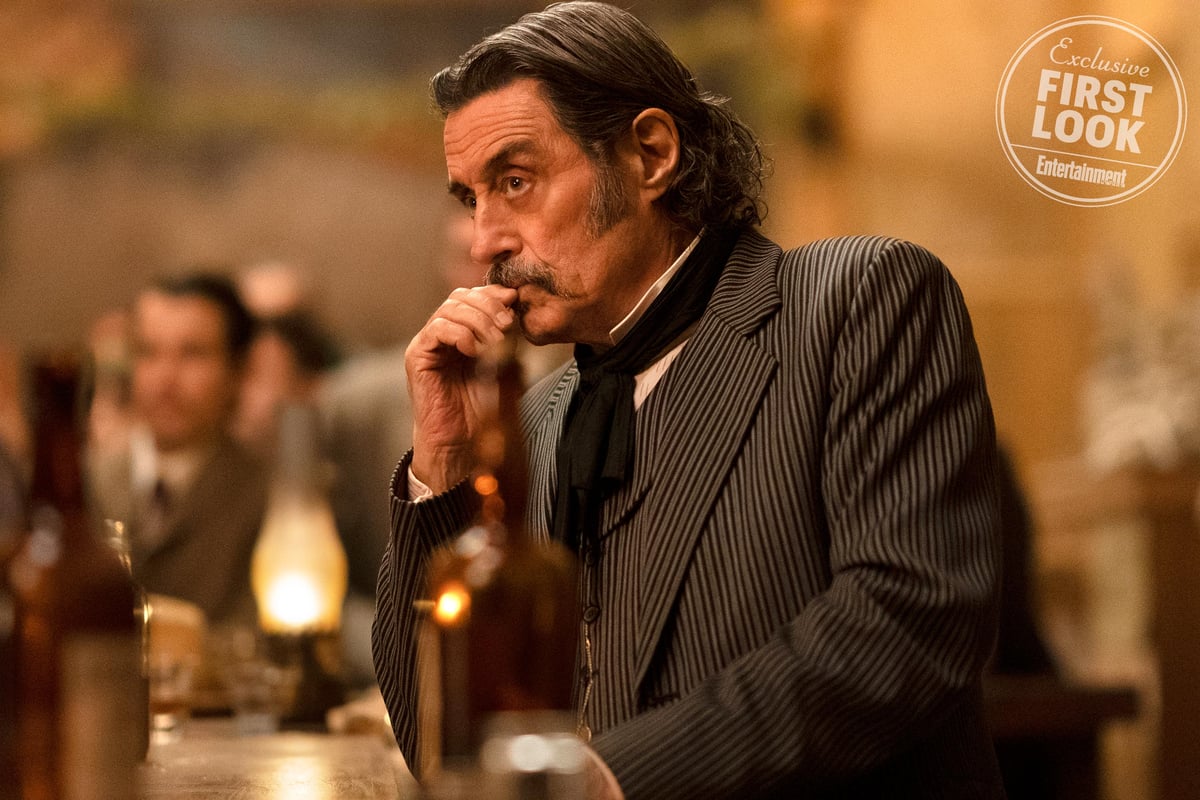
More than twelve years after the original, beloved TV series was cancelled, the Deadwood movie is very real. The entire core cast has been reassembled, shooting began this fall, and Entertainment Weekly has behind-the-scenes stills that are, well, very exciting.
That’s 76-year-old Ian McShane as barman Al Swearengen above, and below is Timothy Olyphant as now-venerable lawman Seth Bullock. Jesus, they both look great.
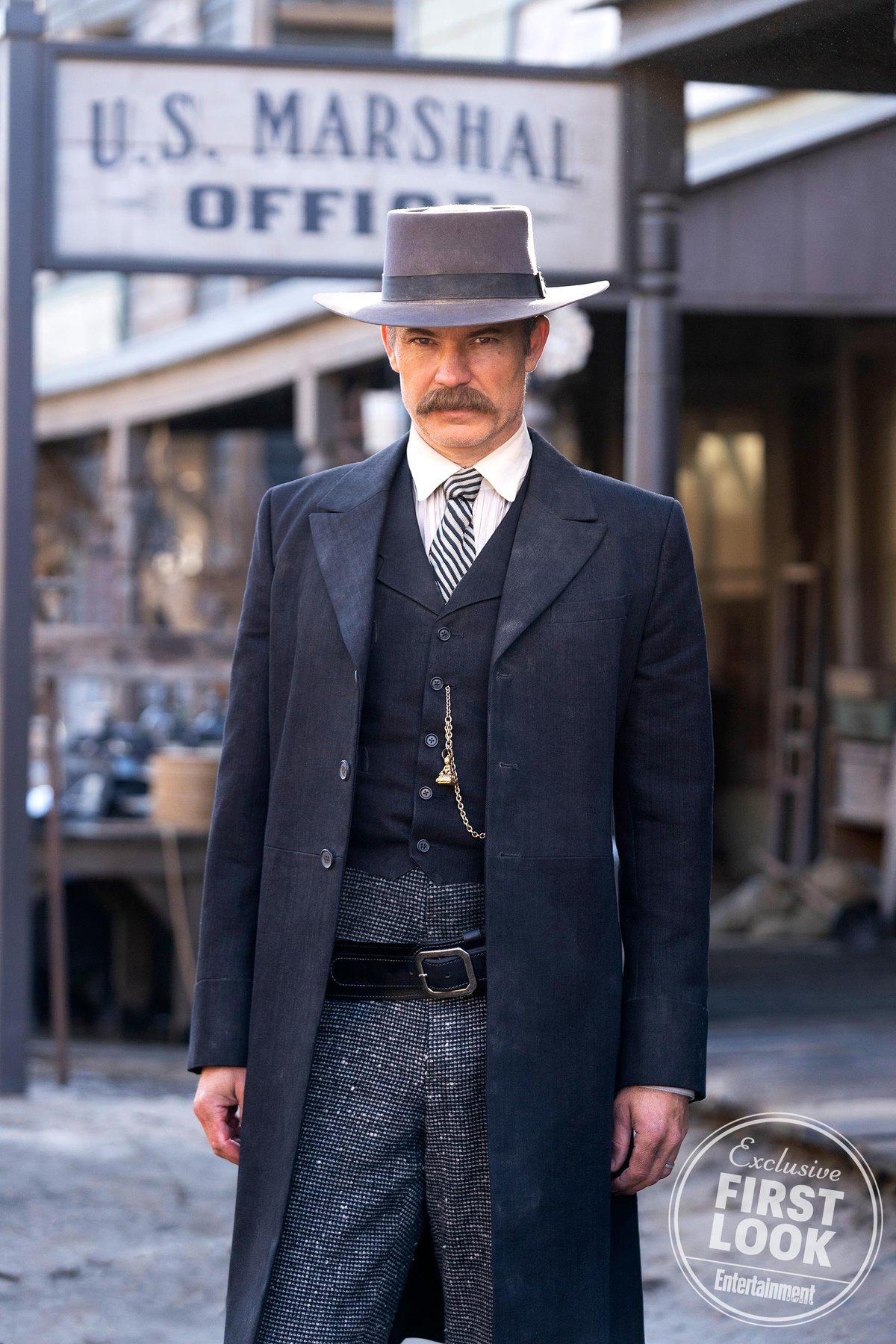
Producer Carolyn Strauss gives the following notes on where the Deadwood movie is taking these characters:
The movie is set in 1889 as the town prepares to celebrate South Dakota joining the Union as the 40th state. What’s the film about, basically?
If you ask David, it’s about the passage of time. The toll of time on people. It’s mellowed some people and hardened others. And it’s about the town’s maturing and becoming part of the Union and what that event sets in motion, in a very personal way for the people that it brings in town and what ensues. The toll of time has not just struck Deadwood and the characters but all the people making it as well, you get to see the faces of people 12 years later. And it was really profound. Actors were crying at the table read — not necessarily from the script but the emotion of being back and doing something we all loved doing so much. You normally have a great experience and then it’s over. You don’t normally get the chance to do this in life. It was kind of a gift.
Al Swearengen was of the driver of much of the action in the series, can you give us a sense of what he’s up to?
The time has taken its greatest toll on Swearengen. He’s the person who really drove so much of the life of the town and there’s a sense of that power waning somewhat, and what ensues of that is a big part of the story.
I can go back and forth on the relative “greatest TV show ever” merits of The Wire or The Sopranos, but Deadwood is the show that’s meant the most to me. I’ll always contend that the first season is the best single season of television ever. And the scene below, when Bullock confronts Alma Garrett’s reprobate father who’s out to steal her gold mine, is the single greatest sequence in television history.
It’s just so magnificently constructed. The wordless, claustrophobic tension, as seemingly the entire town (except Al — Al’s not leaving his bar) intuits that lightning is about to strike in the middle of their camp. The actors’ wordless gestures to each other, that convey so much care and nervous energy. The artful cutting from one part of town to the next, without ever breaking from the overall impression that everything is happening in real time. The barely concealed sexuality of it all, in the middle of the violence. And the beautiful use of rack focus, as single shots flip from one character’s reaction to another. It’s claustrophobic and expansive all at once.
And as Joanie Stubbs tells Alma later, “if he was here, I’d wish a beating on my daddy mornings and evenings like your pa took today.”
I have a quote that I’ve kept in my Twitter bio for years. “Everything changes — don’t be afraid.” It’s a motto I’ve tried to live my life by, and it is, of course, from Deadwood.
Another scene that’s meant a lot to me is Reverend Smith’s quoting from 1 Corinthians at Wild Bill Hickok’s funeral. “For the body is not one member, but many” becomes, in David Milch’s reworking, a spiritually animated philosophy of community. It is a politics, and a form of politics we would do well not to forget.
The New Yorker’s 2005 profile of writer/creator/showrunner/polymath David Milch is one of my favorite pieces ever to appear in the magazine. It does an outstanding job of expanding on the philosophy encapsulated in the Reverend’s speech:
When Milch speaks, it’s with a natural storyteller’s alert, legato fluidity. His hands stay busy and he projects a cerebral intensity. He has brown eyes, a wide mouth, a strong nose, dark hair that he refuses to let go gray—he turns sixty this year—and the pale fleshiness of someone who doesn’t expose himself much to sunlight. “There’s a story by Hawthorne, ‘Ethan Brand,’ about a man who goes out looking for the unpardonable sin,” he continued. “He discovers that it’s the violation of the sanctity of another person’s heart. To use an instrument to open up another person without a loving, terrified humility is the unpardonable sin. That’s what medicine does, and Cochran has done it too much. At the beginning, he falls back on his fear. But then, in apprehending for just a moment the suffering of the others in the room with Swearengen, he’s able to go past it and he finds that the minute one person is brave the spirit comes alive. What I’m trying to suggest to the actors is that the modern situation is predicated upon the illusion of the self’s isolation—that business of ‘I’m alone, you’re alone, we can bullshit each other when we’re fucking or whatever else, but the truth is we’re alone. Right?’ Well, I believe that that is fundamentally an illusion.”
The Deadwood movie is now easily my most anticipated movie/TV show/anything of 2019.
Perhaps the most fundamental way to think about the Universe is in terms of energy. Even when you get away from physics and chemistry (where energy is obviously central) and into a topic like human history or economics, following how and where energy flows can be enlightening. In 1964, Soviet astronomer Nikolai Kardashev proposed thinking about the progress of human civilization in terms of how much energy we were capable of harnessing. On the Kardashev scale, a Type I civilization would be capable of using all of the energy available on their planet, a Type II civilization could use all the energy from their local star, and a Type III civilization could harness all the energy in a galaxy.
According to an equation suggested by Carl Sagan, humans are currently sitting at ~73% of a Type I civilization. But once we reach that milestone in perhaps a few hundred years (assuming we don’t blow ourselves up in the process), the construction of a Dyson sphere or, more likely, a Dyson swarm around the Sun is probably the key to eventually hitting Type II. In the video above, Kurzgesagt explores what would go into building some type of Dyson structure capable of harvesting most of the Sun’s energy. For starters, we’d probably have to completely dismantle the planet Mercury in order to have enough raw materials to build the swarm.
Older posts





Socials & More