



Genetic analysis suggests that all the world’s yeasts originated in China

Advertise here with Carbon Ads
This site is made possible by member support. 💞
Big thanks to Arcustech for hosting the site and offering amazing tech support.
When you buy through links on kottke.org, I may earn an affiliate commission. Thanks for supporting the site!
kottke.org. home of fine hypertext products since 1998.
Beloved by 86.47% of the web.
Entries for July 2018
Being the book, an interview with an audiobook narrator
If you grew up in the 80s, you might remember Bronson Pinchot as Balki Bartokomous in Perfect Strangers or Serge in Beverly Hills Cop. But Pinchot has built a second career as an award-winning audiobook narrator. I recently listened to him read A Man on the Moon and while the story of the Apollo program is engrossing all by itself, his narration is fantastic. This interview of Pinchot by Jeff VanderMeer (author of the Southern Reach trilogy) is really interesting, particularly the bits about how he approaches his work.
Q: Do you have a philosophy of how to create the perfect audiobook experience?
A: I do, though, like all philosophical resolutions, I only intermittently achieve it. The essential task facing the narrator is to identify or invent a vivid personal definition of what “narrating” ought to be. I am uncomfortable with the chilliness of the word narration. It sounds very much outside the action - the voice on a National Geographic educational film intoning, “These giraffes are just learning how to mate”; or my mother, upon Audrey Hepburn’s entrance in My Fair Lady, informing the room: “She used to have such big doe eyes; what happened to her eyes?”
Simply “reading a book” aloud in an airless audio booth is the kind of mental and physical punishment only ever glimpsed in the lower section of Michelangelo’s Last Judgment. I decided early on that I should not “read” the book but “be” the book, the way I imagine Homer, in performance, “was” the Odyssey. We know he wasn’t “reading” it. In any case, if an audiobook listener doesn’t have the time to curl up with the actual physical text, he or she still yearns for, and deserves, the experience of being carried away by the author’s vision.
A 20-year time lapse of stars orbiting a massive black hole
The European Southern Observatory’s Very Large Telescope in Chile has been watching the supermassive black hole in the center of our galaxy and the stars that orbit it. Using observations from the past 20 years, the ESO made this time lapse video of the stars orbiting the black hole, which has the mass of four million suns. I’ve watched this video like 20 times today, my mind blown at being able to observe the motion of these massive objects from such a distance.
The VLT was also able to track the motion of one of these stars and confirm for the first time a prediction made by Einstein’s theory of general relativity.
New infrared observations from the exquisitely sensitive GRAVITY, SINFONI and NACO instruments on ESO’s Very Large Telescope (VLT) have now allowed astronomers to follow one of these stars, called S2, as it passed very close to the black hole during May 2018. At the closest point this star was at a distance of less than 20 billion kilometres from the black hole and moving at a speed in excess of 25 million kilometres per hour — almost three percent of the speed of light.
S2 has the mass of about 15 suns. That’s 6.6 × 10^31 pounds moving at 3% of the speed of light. Wowowow.
A quick visual story about welfare myths and food aid in America
From CityLab visual storyteller Ariel Aberg-Riger, How the Other Half Eats, a look at the myths surrounding welfare and how food aid (in the form of SNAP) works in the US.
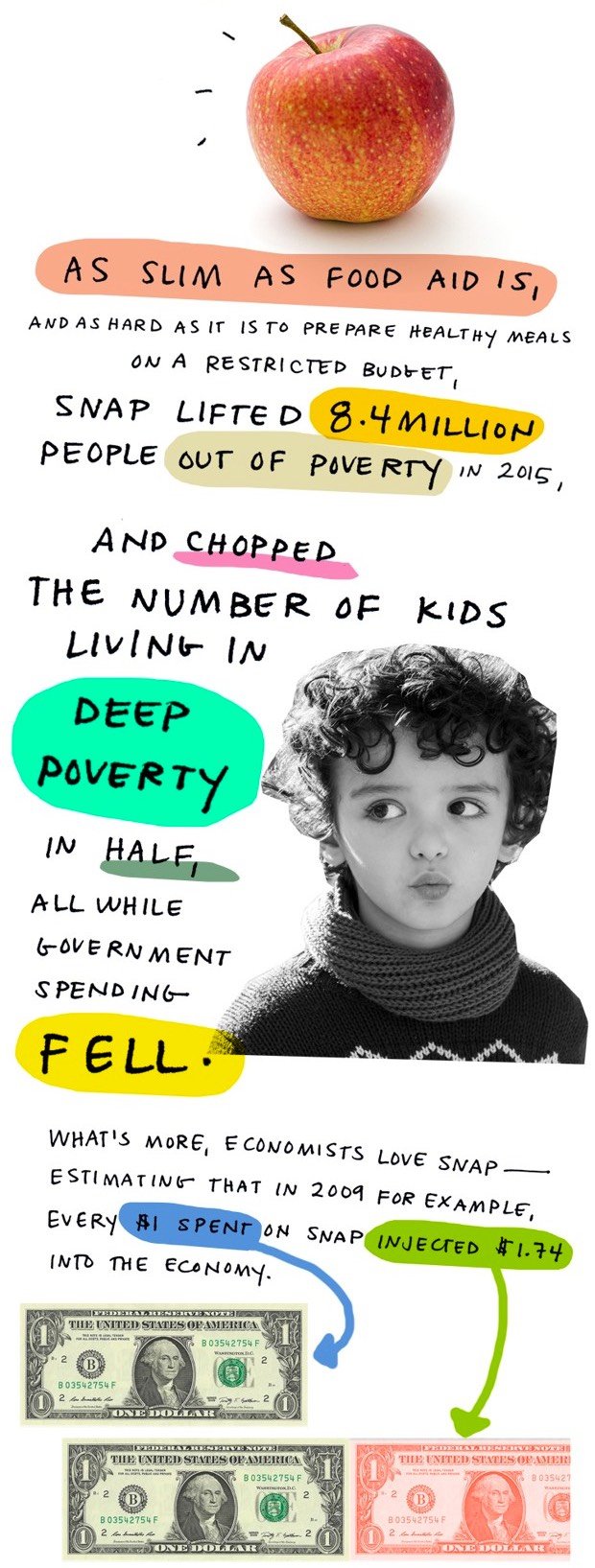
And don’t skip the extensive list of sources and recommended reading at the end of the piece…lots to dig into there.
The Mission Impossible movies are all heist films. From Lessons from the Screenplay, here’s how the filmmakers construct such compelling heists.
Five reasons why US restaurants are so loud. “5. Americans are loud.”
Cows, trees, corn, and golf - how America uses its land
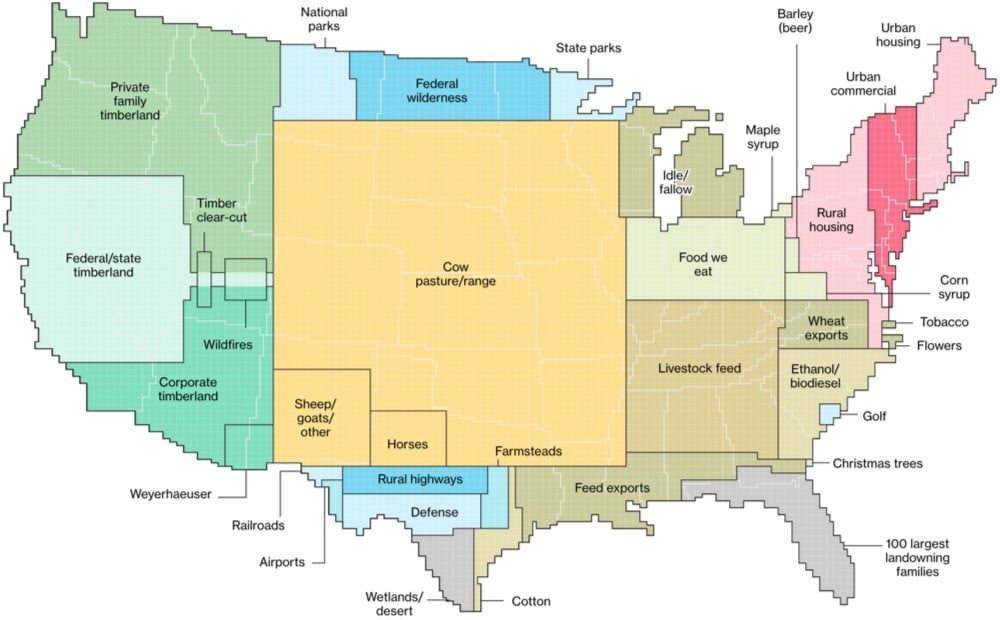
Here’s How America Uses Its Land is a nice presentation by Bloomberg on land use in the US. The land and resources used for livestock makes a great case for Americans eating more vegetarian.
More than one-third of U.S. land is used for pasture — by far the largest land-use type in the contiguous 48 states. And nearly 25 percent of that land is administered by the federal government, with most occurring in the West. That land is open to grazing for a fee.
There’s a single, major occupant on all this land: cows. Between pastures and cropland used to produce feed, 41 percent of U.S. land in the contiguous states revolves around livestock.
Urban areas take up relatively less space but are growing the fastest. And only 100 people own a space the size of Florida? Wow.
On a percentage basis, urban creep outpaces growth in all other land-use categories. Another growth area: land owned by wealthy families. According to The Land Report magazine, since 2008 the amount of land owned by the 100 largest private landowners has grown from 28 million acres to 40 million, an area larger than the state of Florida.
It would be interesting to see this data sliced and diced in a few different ways. I’d love to see land use by state or area of the country or how much each category is growing or shrinking, with projections 5, 10, 20 years into the future.
What Do 90-Somethings Regret Most? “‘Do you wish you accomplished more?’ He responded, ‘No, I wished I loved more.’”
How one man rigged McDonald’s Monopoly and stole millions
For years, Jerry Jacobson was in charge of the security of the game pieces for McDonald’s Monopoly, one of the most successful marketing promotions in the fast food giant’s history. And for almost as long, Jacobson had been passing off winning pieces to family, friends, and “a sprawling network of mobsters, psychics, strip club owners, convicts, drug traffickers”, to the tune of more than million in cash & prizes.
Dent’s investigation had started in 2000, when a mysterious informant called the FBI and claimed that McDonald’s games had been rigged by an insider known as “Uncle Jerry.” The person revealed that “winners” paid Uncle Jerry for stolen game pieces in various ways. The $1 million winners, for example, passed the first $50,000 installment to Uncle Jerry in cash. Sometimes Uncle Jerry would demand cash up front, requiring winners to mortgage their homes to come up with the money. According to the informant, members of one close-knit family in Jacksonville had claimed three $1 million dollar prizes and a Dodge Viper.
When Dent alerted the McDonald’s headquarters in Oak Brook, Illinois, executives were deeply concerned. The company’s top lawyers pledged to help the FBI, and faxed Dent a list of past winners. They explained that their game pieces were produced by a Los Angeles company, Simon Marketing, and printed by Dittler Brothers in Oakwood, Georgia, a firm trusted with printing U.S. mail stamps and lotto scratch-offs. The person in charge of the game pieces was Simon’s director of security, Jerry Jacobson.
One of the winners, Jerry Columbo, a partner of Jacobson’s who was allegedly a member of the Mafia, even appeared in this TV commercial holding an oversized novelty key to a car he had “won”:
At the height of the scam, no normal person won any of the best Monopoly prizes…they were all arranged by Jacobson. This has to become a movie, right?
I remember when the Monopoly game started. We didn’t eat out that much when I was a kid, but we still played a few times here and there. But I distinctly remember studying the game board, looking at the odds of winning, and figuring out how they must restrict some single game pieces to make it all work. You could get Park Places all day long, but you’d never ever see a Boardwalk. After that realization, I lost interest in playing. It was an early lesson about not spending too much time and energy striving for unattainable goals. Besides, those delicious McDonald’s fries were reward enough.
Update: Ah, a movie version of the story is in the works with Matt Damon playing Jacobson and Ben Affleck directing.
Here comes the sunscreen


The three toughest things about being a parent are the sleep deprivation, knowing when to let kids push their boundaries vs keeping them safe, and applying sunscreen to a toddler. The NY Times has a slideshow of parents applying sunscreen to their kids and the struggle is real!
The good news for you parents of young children is that eventually they learn how to apply their own sunscreen. The bad news? They still would rather have a finger lopped off than to do it without complaining Every. Single. Freaking. Time.
Over the next six months, Ben Lecomte is swimming across the Pacific Ocean, from Japan to San Francisco. Follow his progress here.
Cross-section time lapse of a kidney bean growing into a plant
It’s fun to watch this kidney bean grow into a plant over the course of 25 days to the strains of The Blue Danube waltz by Johann Strauss. Thanks to this cross-sectional view, you can see the main root push down into the soil and the tendrils branching out to anchor the plant for its remarkable vertical growth to come.
Moon 101, a quick explainer video from National Geographic about the Moon
I have been going a little Moon crazy lately. There was the whole Apollo 11 thing, I finished listening to the excellent audiobook of Andrew Chaikin’s A Man on the Moon (which made me feel sad for a lot of different reasons), and am thinking about a rewatch of From the Earth to the Moon, the 1998 HBO series based on Chaikin’s book. This video from National Geographic answers a lot of questions about the Moon in a short amount of time.
Design-related baby names for creative parents (incl. Ascii, Lorem, Baskerville, and Zapf)
Virtually reality
From Vladimir Tomin, a fun augmented reality video where he uses a set of image editing tools to manipulate the scenery in fanciful ways. (It’s kinda hard to describe this…just give it 5 seconds and you’ll get the idea.)
(via Instagram’s explore page (yes, I’m the guy who uses the IG explore page))
What made Darth Vader such a visually iconic character
Darth Vader was only on screen in the original Star Wars movie for 8 minutes and for a little under 34 minutes in the whole original trilogy. In the latest Nerdwriter episode, Evan Puschak examines how the cinematography of the films (particularly Empire Strikes Back) helped make Vader into an iconic character despite such little screentime.
Today seems to be movie villain day on kottke.org: see also this morning’s post on Black Panther’s Killmonger.
Welcome to Marwen
Mark Hogancamp was beaten by five men outside a bar and left for dead. He spent nine days in a coma, lost his memory, and spent over a year in physical therapy. As part of his recovery, Hogancamp built a meticulously constructed WWII town in his backyard that he called Marwencol.
When his state-sponsored rehabilitative therapies ran out, Mark took his recovery into his own hands. In his backyard, he created a new world entirely within his control — a 1:6 scale World War II town he named Marwencol. Using doll alter egos of his friends and family, his attackers and himself, Mark enacted epic battles and recreated memories, which he captured in strikingly realistic photographs. Those photos eventually caught the eye of the art world, which lead to a series of gallery exhibitions, the award-winning documentary “Marwencol,” the acclaimed book “Welcome to Marwencol,” and a new identity for a man once ridiculed for playing with dolls.
Robert Zemeckis has turned Hogancamp’s story into a movie starring Steve Carell called Welcome to Marwen. Here’s the trailer; it comes out in December 2018:
In 2010, Jeff Malmberg made a documentary about Hogancamp & and his project. It’s a little hard to find these days despite a 98% rating on Rotten Tomatoes, but you can watch it on Amazon w/ a trial subscription or buy it on iTunes. Here’s the trailer:
Hogancamp also collected some of the photos of Marwencol into a book.
The SSL cert on didn’t get renewed. It should be fixed soon. For now, you can all go outside and play.
The artist who paints music
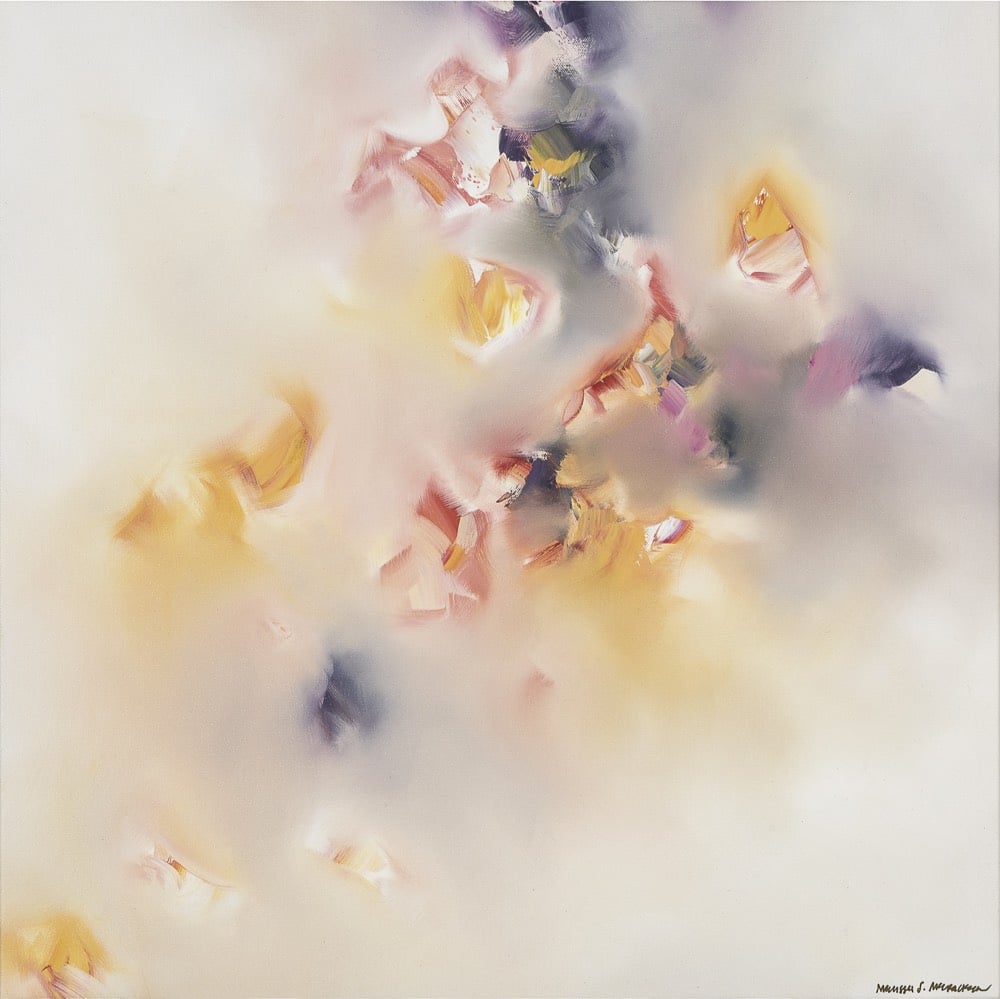

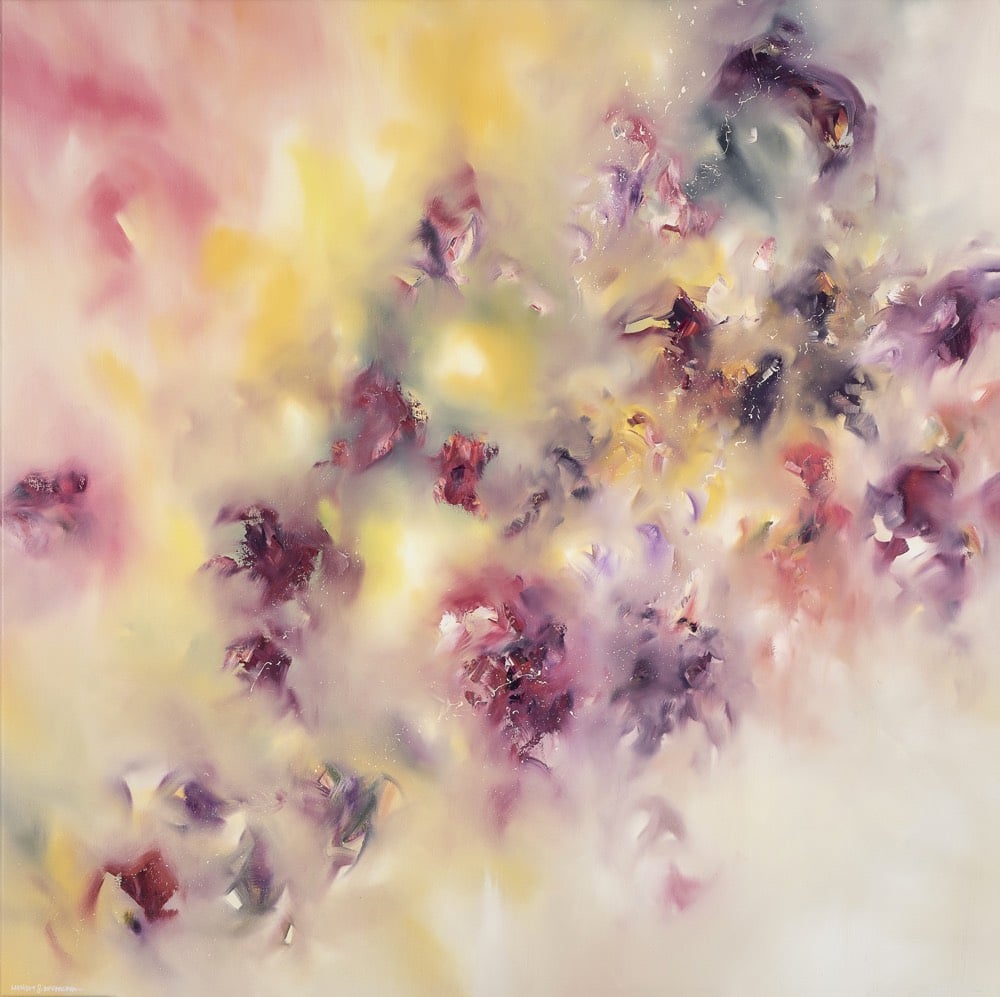
Melissa McCracken has synesthesia and experiences seeing the music she listens to as shifting colors. In an old artist statement, McCracken explained how she sees the world differently than many people:
Basically, my brain is cross-wired. I experience the “wrong” sensation to certain stimuli. Each letter and number is colored and the days of the year circle around my body as if they had a set point in space. But the most wonderful “brain malfunction” of all is seeing the music I hear. It flows in a mixture of hues, textures, and movements, shifting as if it were a vital and intentional element of each song.
Great Big Story did a short video profile of McCracken a couple of years ago:
I like how she says she dislikes how some songs sound but likes how they look. What a cool way to be able to experience the world.
McCracken is a bit coy on her site and Instagram about which songs inspired which paintings, but the paintings above are titled Love Is Touching Souls (from a Joni Mitchell lyric), Life on Mars (David Bowie), and Wasn’t It Kind of Wonderful (lyrics from a Lianne La Havas song?).
An interview with old school internet art collective JODI. “You can still make websites nowadays.”
How Black Panther created an empathetic antagonist for the hero
What makes a good movie villain? In this video, Lessons from the Screenplay discusses what I thought was the best and most interesting aspect of Black Panther: the empathetic villain in the form of Killmonger.
Killmonger is a great example of how an antagonist can challenge the hero not just through confrontation and violence, but by representing something that affects the hero emotionally.
Rather than pitting T’Challa against some “generically evil” villain, the filmmakers gave him a true foil that both he and the audience could empathize with. And by the end, Killmonger actually changes T’Challa’s mind on the central issue in the film and it felt earned.
Fire in Cardboard City
What happens when a city made entirely of cardboard catches fire? Nothing good, as Phil Brough’s 3D animated short film clearly illustrates. Fire in Cardboard City has been playing at film festivals around the world and now thanks to the New Yorker, you can watch the whole thing online. Sarah Larson talked with Brough about how the film came together.
The results look so realistic that they could almost be stop-motion. “I built a big virtual set, I guess, is how you could describe it,” he said. “The characters are like stop-motion marionettes in a way; they have joints to the arms and the knees and all of that, and controllers.” He then used a low-budget motion-capture process — a D.I.Y. version of Hollywood’s green screens and Ping-Pong-ball suits — using the XBox Kinect and special software. “It sees you doing the motions you want the character to do, and then you can transfer that to the animation so you can transfer that onto your characters,” he said. He considered having a giant robot attack Cardboard City, and then settled on fire: that looked kind of cool, too.
I *love* the DIY corrugated cardboard look of this film…I’d happily watch a feature-length version of this. See also Caine’s Arcade. (thx, karen)
Maps of the spread of the Agricultural & Industrial Revolutions
This is a map showing the spread of the cultivation of crops across Europe.
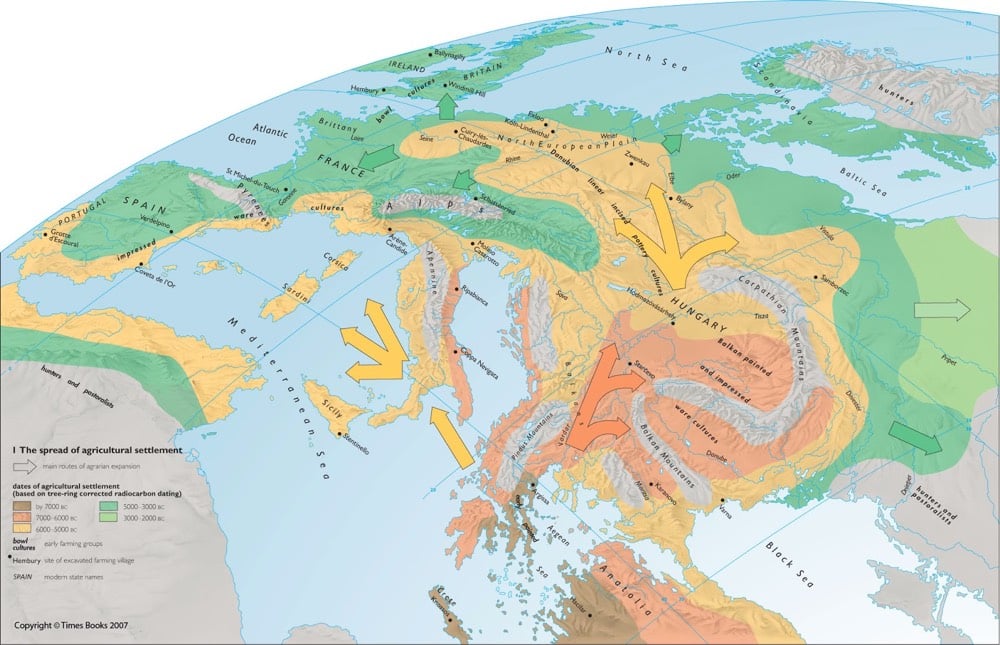
The legend is a bit hard to read, but the map indicates that it took ~2000-4000 years for farming to spread from Turkey to Britain. Several thousand years later, the Industrial Revolution boomeranged back out from Britain across Europe:
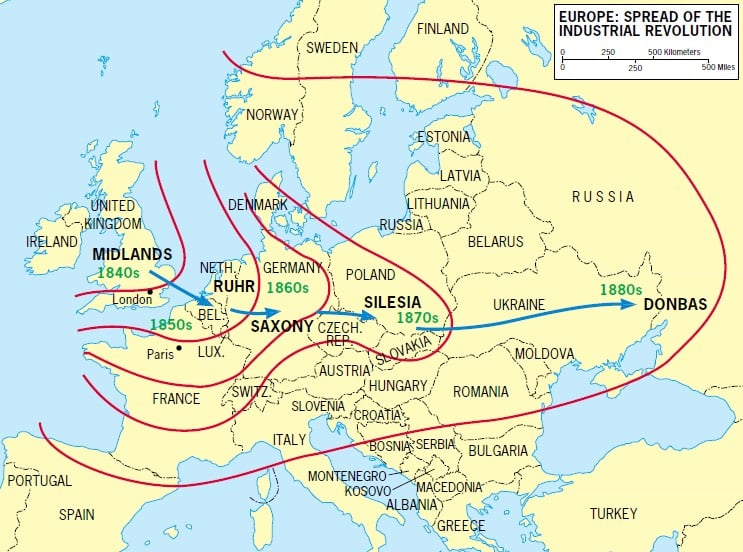
The dates and areas on both of these maps are rough & approximate1 but the important thing to notice here is the acceleration of the pace of technology. The technology of farming (seeds, techniques, tools, etc.) took thousands of years to spread across Europe but the expansion of industrial technology happened on the order of decades in the mid 19th century. That’s an incredible quickening.
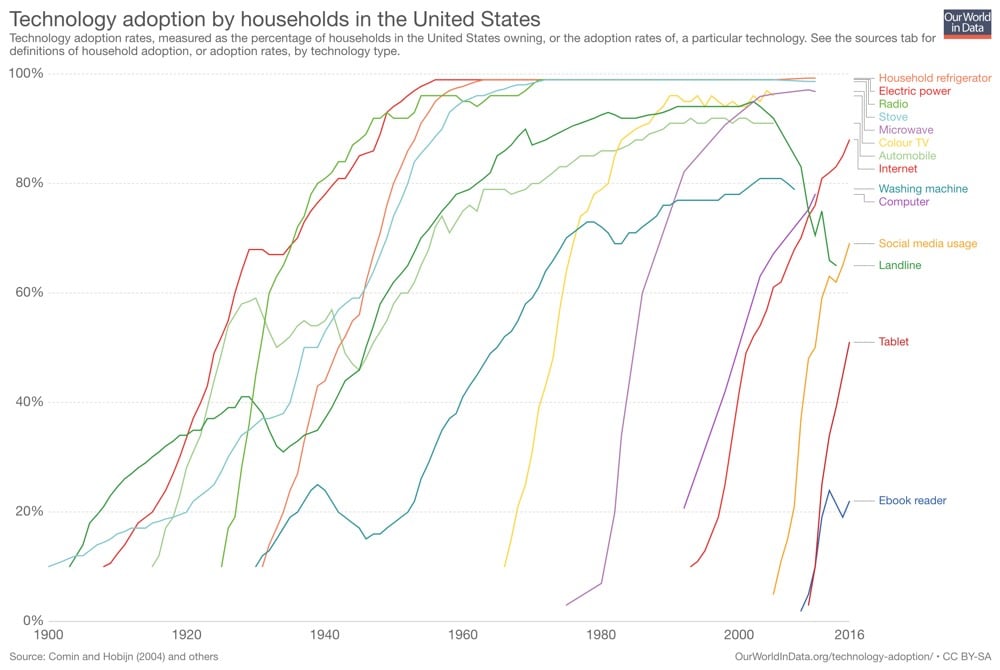
And now? Seconds.2 An app launched in China can be downloaded moments later in a cottage in England or a cabin in Quebec and cutting edge scientific papers published in Brazil can be accessed almost instantaneously in India or Kenya. That’s fast enough that plotting it on a map doesn’t make sense…charts like these tell the story of technology adoption much better:

Maps like these are necessarily approximate, interpretive, and can change due to new discoveries and such. I’m not gonna give you a full rundown on the current state of the research into the spread of farming and industrialization. Check out Wikipedia (farming, industrialization) and work your way elsewhere if you’re really interested.↩
Acknowledging that just because something can be distributed worldwide in a couple seconds doesn’t mean everything is equally available in every part of the world. Even now, the William Gibson quote still holds: “The future is already here — it’s just not very evenly distributed.”↩
Natural selection in action: a pair of hurricanes changed the lizard population on Turks and Caicos. The post-hurricane lizards have bigger toes and legs for better grip in the wind.
City street orientations from around the world
Urban data scientist Geoff Boeing graphed the orientation of the streets in 50 cities from around the world. Here are 10 cities from his analysis:
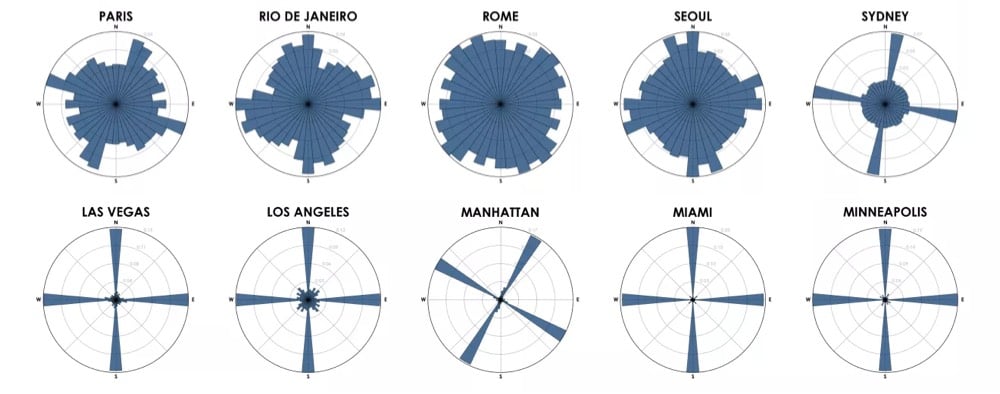
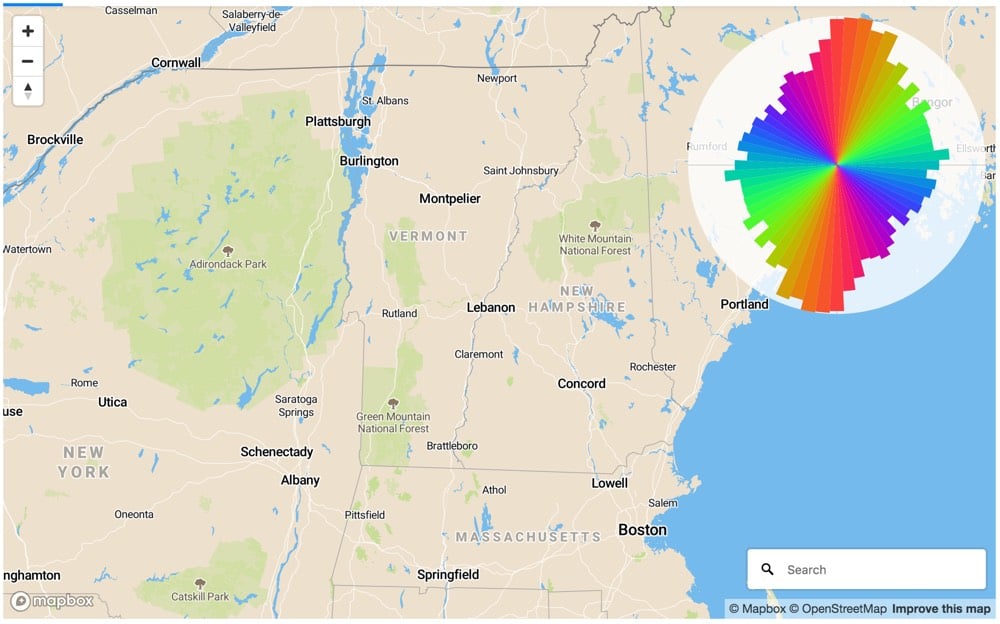
Each of the cities above is represented by a polar histogram (aka rose diagram) depicting how its streets orient. Each bar’s direction represents the compass bearings of the streets (in that histogram bin) and its length represents the relative frequency of streets with those bearings.
Looking at these graphs, you get a real sense of just how planned American cities are compared to much of the rest of the world, where cities grew more organically over longer periods of time. (Although I’m curious to see what the graph for all of NYC would look like…a bit more like Boston perhaps.)
Update: Using Mapbox, you can generate street orientation charts for any map view. I used it to verify that north-south roads outnumber east-west roads in New England, which is why it takes so long to go 30 miles across VT compared to up or down.
(via @dokas)
The Notorious Ruth Bader Ginsburg
I watched RBG last night, the documentary film about Supreme Court Justice Ruth Bader Ginsburg. What a remarkable person she is. Here’s the trailer:
If you’ve seen the movie (or even if you haven’t), Jeffrey Toobin’s 2013 New Yorker profile of Ginsburg goes easier on the memes and deeper into her legal process and views.
At this point, Ginsburg was a leader on the legal side of the women’s movement, especially when she became the first tenured woman at Columbia Law School, in 1972. She co-founded the first law review on women’s issues, Women’s Rights Law Reporter, and co-authored the first casebook on the subject. Also in 1972, she co-founded the women’s-rights project at the American Civil Liberties Union. When Sally Reed took her case to the Supreme Court, Ginsburg volunteered to write her brief.
“In very recent years, a new appreciation of women’s place has been generated in the United States,” the brief states. “Activated by feminists of both sexes, courts and legislatures have begun to recognize the claim of women to full membership in the class ‘persons’ entitled to due process guarantees of life and liberty and the equal protection of the laws.” In an opinion for a unanimous Court in Reed v. Reed, Chief Justice Burger overturned the Idaho law as “the very kind of arbitrary legislative choice forbidden by the Equal Protection Clause of the Fourteenth Amendment.” Sex discrimination, in other words, was unconstitutional. Susan Deller Ross, a professor at Georgetown University Law Center, who also worked as a lawyer on sex-discrimination cases during this period, said of Ginsburg, “She helped turn the Court a hundred and eighty degrees, from a very hands-off attitude, which had often been expressed very cavalierly, to one where they struck down law after law that treated the sexes differently.”
Building on the Reed precedent, Ginsburg launched a series of cases targeting government rules that treated men and women differently. The process was in keeping with Ginsburg’s character: careful, step by step. Better, Ginsburg thought, to attack these rules and policies one at a time than to risk asking the Court to outlaw all rules that treated men and women differently. Ginsburg’s secretary at Columbia, who typed her briefs, gave her some important advice. “I was doing all these sex-discrimination cases, and my secretary said, ‘I look at these pages and all I see is sex, sex, sex. The judges are men, and when they read that they’re not going to be thinking about what you want them to think about,’” Ginsburg recalled. Henceforth, she changed her claim to “gender discrimination.”
The piece mentions an impromptu serenade of opera fan Ginsburg by Plácido Domingo at Harvard…it’s a cute moment:
For a deeper dive, the best books about Ginsburg are The Legacy of Ruth Bader Ginsburg by Scott Dodson, My Own Words (a collection of her writing), and the more fun Notorious RBG: The Life and Times of Ruth Bader Ginsburg by Irin Carmon & Shana Knizhnik.
My media diet for early Summer 2018, special roadtrip edition
I’ve been keeping track of every media thing I “consume”,1 so here are quick reviews of some things I’ve read, seen, heard, and experienced in the past two months or so. My summer has been a little slow, media-wise…the World Cup, my roadtrip, and time spent enjoying the outdoors have conspired to limit my reading and watching time. This is not a bad thing. I’m still working my way through The Odyssey w/ the kids (now on hold b/c they’re at camp) and David Christian’s Origin Story. I wanted to get way more reading done this summer than I have…maybe I can pick up the pace in August. (Ignore the letter grades. Or don’t!)
Solo: A Star Wars Story. The movie was fine, but I liked the branding for it more. I would watch an Enfys Nest movie though. (B)
The Dave Chang Show w/ Helen Rosner. Chang is an engaging interviewer, and Rosner is a great guest. (B+)
RBG. What an extraordinary person. (B+)
American Innovations. Engaging and informative podcast hosted by Steven Johnson. (B)
Ocean’s 8. Pretty good but would have benefitted from a slightly more clever plot and direction by Soderbergh. (B+)
ye. As I’ve heard from more than one person: I hate that I like this album. (B+)
Skin in the Game: Hidden Asymmetries in Daily Life by Nassim Nicholas Taleb. This book contains a valuable central message and several fascinating insights but the constant ad hominems, irrelevant tangents, stereotyping, and general antagonistic tone of the writing makes for tough reading. I wish Taleb were a more generous writer. (B)
Incredibles 2. A solid sequel. Kids gave it two thumbs up. (A-)
Everything is Love. Ok, “The Carters”, but they smartly made this a Beyoncé album feat. Jay-Z. This has been on heavy rotation in my car. (A-)
The Disaster Artist. Gave up on this about 30 minutes in…zero interest. (-)
Justice League. Not as terrible as I was led to believe. But maybe DC can trade Wonder Woman to Marvel? (C+)
Caliphate. Finished this…what a great and important series. I know a lot of people think Serial is the podcast gold standard, but this was better and more significant. (A)
Seabiscuit. This one always gets me right in the feels. (B+)
Scorpion. Kanye’s latest album is 23 minutes long while Drake went for a full 90 minutes. I know there’s some controversy about it, but it was genuinely great hearing new music from Michael Jackson. (B)
The Handmaid’s Tale. The remainder of the second season was brutal. (A-)
A Man on the Moon: The Voyages of the Apollo Astronauts by Andrew Chaikin. An epic story of adventure and discovery, expertly told. (A)
Sharp Objects. This one is a slow burn, but I will watch Amy Adams in anything…she is mesmerizing. (B+)
Star Trek: Voyager. Still making progress on this…I’m about 70% of the way through. It’s better in the middle seasons than a lot of people give it credit for. (B)
Solo roadtrips. The world is a fascinating place…get out and explore it if you can. (A+)
Pacific Rim Uprising. They could have done more with this, but they didn’t. They really didn’t. (C+)
The 2018 FIFA World Cup. I missed most of the knockout stage because I was traveling, but I still loved every minute of this World Cup. (A-)
Jaws. My first time seeing it. (Yes, yes, I know.) Amazing to see so many of Spielberg’s filmmaking techniques on display so early in his career. (A-)
Westworld. This show asks, over and over again, “Is any of this real?” The result is a complete inability on my part to suspend my disbelief…I’m always very aware that what I’m watching is fake. (C-)
Hot Fuzz. Will watch this anytime. (A-)
Past installments of my media diet are available here.
You probably dislike the use of the word “consume” when it comes to media. So do I. It conjures up an image of mindlessly feeding on things that talented and artistic people have worked hard on. (See also “media diet”.) But different forms of work have different verbs associated with them: TV shows & movies are watched, books are read, podcasts are listened to, theme parks are experienced. What one word works for all of those? Enjoyed? I surely don’t enjoy all the stuff I watch/listen to/watch/experience (see!!). Experienced? That suggests a passiveness that doesn’t apply to how I watch/read things. “Consumed” works, for better or worse. Does anyone have a better suggestion? I am ready to consume it… ↩
Sci-fi spaceship designs inspired by everyday objects



Eric Geusz takes everyday objects like can openers, tongs, and potato peelers and turns them into spaceships that wouldn’t look out of place in Star Wars or Star Trek.
What a musical conductor actually does on stage
I love hearing people talk about how they work. In this quick video, conductor James Gaffigan explains what it is he does on stage and how different composers like Leonard Bernstein shape and enhance the performance of the musicians they’re leading.
If you’ve ever seen an orchestra perform you’ve probably had a difficult time looking away from the person dead center on the stage — the conductor. It’s hard to miss someone as they swing their arms around pointing at the musicians that seem to be focused instead on their music stands. So what exactly is the conductor doing?
The Russian Prison Tapping Code. “Through the grim stone wall we could sense the joy of the man on the other side. At last we had understood!”
The web’s transition from nomadism to feudalism
This comparison by designer Alexander Singh of the development of the web from home pages to massive content farms like Facebook with the development of agriculture really got some of the ol’ neurons firing.
Over the past 25 years, the web appears to have transitioned from a primarily nomadic culture to a mostly agrarian one, mirroring the Neolithic Revolution 10,000 years ago.
The simplicity of HTML-only site building, spaces like Geocities & Angelfire, and cultural artifacts such as web rings coupled with poor search engine tech saw us navigate the web like nomads: from point to point, link to link.
The web has developed & so have the skills necessary to build within it. HTML was easy. CSS took a little more time & JS more again, alienating most and establishing a class hierarchy. Discovery was solved, weakening point-to-point navigation.
The literate Priesthood can still build & interface with the web, but the vast majority of people are relegated to the peasantry. “Fortunately” for them, motivated benefactors have offered a Faustian bargain to make their lives “easier”.
Corporate Feudalism has emerged to create centralized, “safe” spaces for the peasantry to work & play. Attention is farmed and sold in exchange for convenience, protection, mediated self-expression & an indifferent audience. You can do anything if it’s within their borders.
Very interesting. What comes next? What does the web’s Renaissance or Enlightenment look like? (via @pieratt)
Socials & More