kottke.org posts about video
Poetry in America is an upcoming 12-part series exploring poetry on a variety of topics. Each episode features the discussion of a single poem — “I cannot dance upon my toes” by Emily Dickinson, “Skyscraper” by Carl Sandburg, “N.Y. State of Mind” by Nas — with a collection of notable people — Samantha Power, Shaquille O’Neal, E.O. Wilson, Yo Yo Ma, Bill Clinton. The first episode airs this week but is already available on Amazon.
Microorganisms are so small compared to humans that you might be tempted to think that they’re all about the same size. As this video shows, that is not at all the case. The rinovirus and polio virus are 0.03 micrometers (μm) wide, a red blood cell is 8 μm, a neuron 100 μm, and a frog’s egg 1 mm. That’s a span of 5 orders of magnitude, about the same difference as the height of a human to the thickness of the Earth’s atmosphere.
Watching the animation, you might have noticed the T4 bacteriophage, which looks like a cross between the aliens in Arrival and a lunar lander. Can’t be real, right? Bacteriophages are really real and terrifying…if you happen to be a bacteria. Bacteriophages attack by attaching themselves to bacteria, piercing their outer membranes, and then pumping them full of bacteriophage DNA. The phage replicates inside of the bacteria until the bacteria bursts and little baby bacteriophages are exploded out all over the place, ready to attack their own bacteria.
Dieter Rams is one of the world’s most influential designers. Rams acolyte and Apple design chief Jony Ive has said of him:
Dieter Rams’ ability to bring form to a product so that it clearly, concisely and immediately communicates its meaning is remarkable… He remains utterly alone in producing a body of work so consistently beautiful, so right, and so accessible.
Gary Hustwit, director of Helvetica and Objectified, is making a documentary about Rams called Rams. Here are three short clips from the film:
Rams will include in-depth conversations with Dieter, and dive deep into his philosophy, his process, and his inspirations. But one of the most interesting parts of Dieter’s story is that he now looks back on his career with some regret. “If I had to do it over again, I would not want to be a designer,” he’s said. “There are too many unnecessary products in this world.” Dieter has long been an advocate for the ideas of environmental consciousness and long-lasting products. He’s dismayed by today’s unsustainable world of over-consumption, where “design” has been reduced to a meaningless marketing buzzword.
The movie will have original music by Brian Eno and will be released sometime later this year.
Update: Wallpaper has a trailer for the film, which looks minimalistic af.
In this short video, MIT literature professor Arthur Bahr reads brief selections from Beowulf and Sir Gawain and the Green Knight in their original languages, respectively Old English and Middle English. You’ll notice that they sound almost completely like foreign languages. From Open Culture:
After the Viking and Norman invasions, Old English became “the third language in its own country,” notes Luke Mastin at his History of English site. More spoken than written, it “effectively sank to the level of a patois or creole,” with several distinct regional variants. English seemed at one time “in dire peril” of dying out but “showed its resilience once again, and, two hundred years after the Norman Conquest, it was English not French that emerged as the language of England,” though it remained a diffuse collection of dialects.
The entire page on Middle English at the History of English site — “how English went from an obscure German dialect to a global language” — is worth a read.
See also Shakespeare in its original pronunciation.
I don’t know who my old favorite archaeologist was, but my new favorite archaeologist is Doris Jones. Jones is 90 years old and is one of the top volunteer space archaeologists on GlobalXplorer, a site that crowdsources the process of locating potential archaeological sites on satellite imagery. People like Jones look at satellite images for telltale signs of past human activity and promising locations are then passed on to field archaeologists working in the area.
From Evan Puschak, a quick video on dark patterns, UI design that tricks users into doing things they might not want to do. For instance, as he shows in the video, the hoops you need to jump through to delete your Amazon account are astounding; it’s buried levels deep in a place no one would ever think to look. This dark pattern is called a roach motel — users check in but they don’t check out. I wonder how much this single pattern has added to Jeff Bezos’ personal net worth?

At Sushiya no Nohachi in Tokyo, you can eat sushi that is made using a single grain of rice. The tiny sushi came about when a customer challenged the owner’s son to make the smallest possible sushi.
The most difficult tiny sushi are the ones with nori seaweed — those are the sea urchin and egg. For sea urchin, he has to put a small piece of nori around a grain of rice horizontally. For egg, he has to wrap the nori around the egg and grain of rice. It’s pretty impressive to witness.
You can see the small sushi being made in this video:
That said, when we asked how often they need to make a plate of small sushi, we were surprised.
“Just a few times a week and at most five times in a day.” Though when customers from overseas order, they tend to be extra enthusiastic about the tiny sushi.
He told us that one woman from Europe burst into tears and cried for an hour and a half after seeing the cute, little sushi.
(thx, jason)
Somehow, I happily watched all 26 minutes of this video on how to make 29 different pasta shapes by hand. Pasta architecture is fascinating!
Semolina pasta is a southern Italy specialty. From that dough, Luca makes cavatelli, malloreddus, lorighittas, cencioni, capunti, strascinati, culurgionis, and sagne incannulate. From the egg dough, D’Onofrio makes fusilli al ferretto, tagliatelle, tortellini, farfalle, garganelli, anolini, cappelletti, tagliolini, agnolotti, sacchetti. From the spinach dough, Luca makes foglie d’ulivo, trofie, fagiolini, and pappardelle. From the cuttlefish squid ink pasta dough, D’Onofrio makes orecchiette, strichetti, fettuccine, and corzetti.
(via the kid should see this)
John Boswell, aka melodysheep, created this tribute video for Stephen Hawking using the late physicist’s words drawn from a variety of different speeches and interviews. It begins:
I am very aware of the preciousness of time. I was given two to three years to live. I faced a life unable to properly communicate. Fortunately my mind was unaffected. While all around me people have passed the day deep in conversation, I have often been transported afar, lost inside my own thoughts, trying to fathom how the universe works.
When you’re watching a Wes Anderson movie, you are never not aware that you’re watching a Wes Anderson movie. In this video, ScreenPrism examines the 13 aspects common to most of the director’s films. There’s the art-directed microworlds (the sub in The Life Aquatic, the house on Archer Avenue in Tenenbaums), the distinctive camera language (wide-angle shots, symmetry), the extensive use of musical deep cuts from the 60s and 70s (These Days by Nico in Tenenbaums), performances within the films (the plays in Rushmore, Tenenbaums, and Moonrise Kingdom), the exacting & deadpan dialogue, and children who act like adults and adults who act like children (which Anderson got from Charles Schulz).
If you remember the honest trailer for every Wes Anderson movie from last week, this is the nicer version of that.
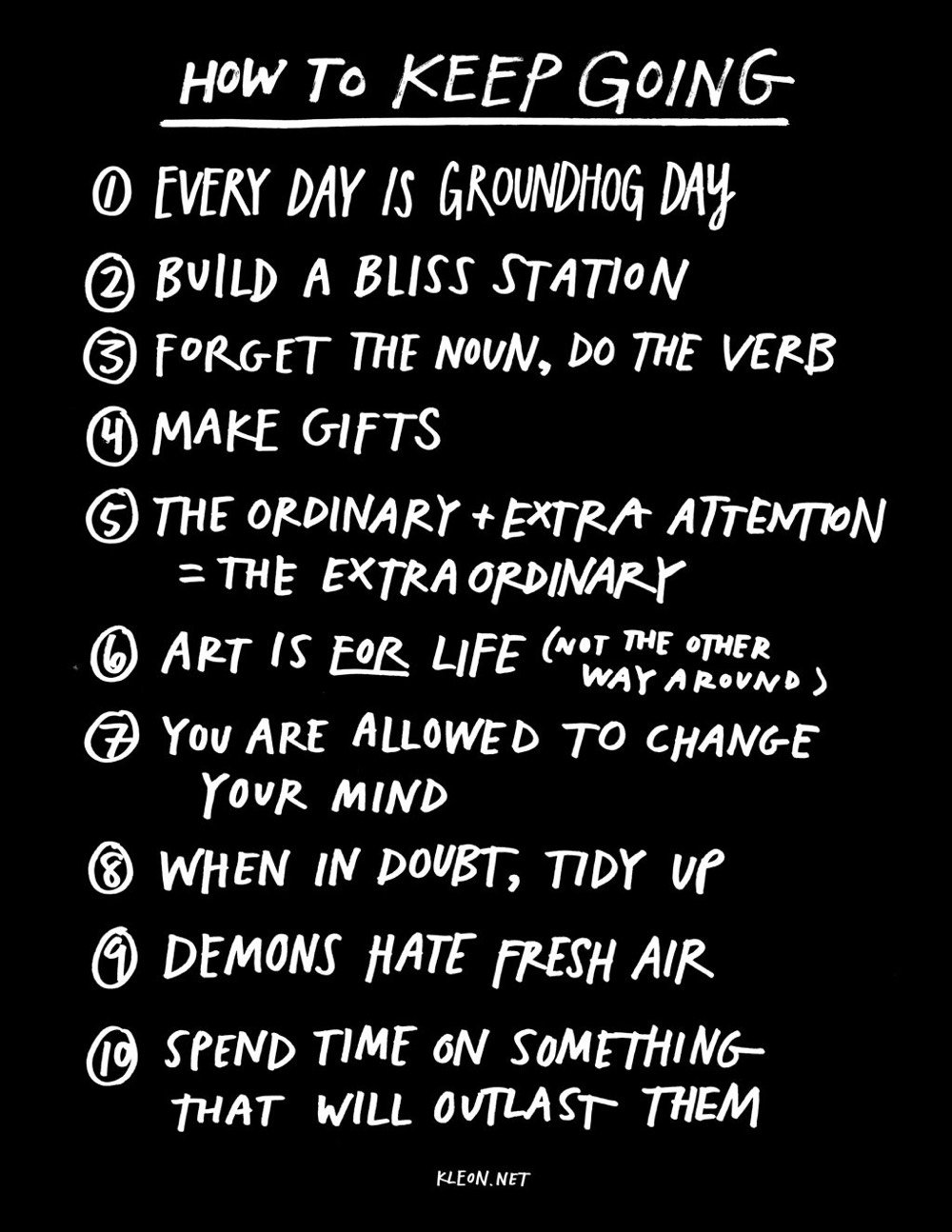
I really enjoyed listening to Austin Kleon’s recent talk about how to press forward when doing creative work, even when times get challenging. He talked about ten strategies for keeping yourself moving forward. In addition to “you’re allowed to change your mind”, I particularly liked “forget the noun, do the verb” (don’t worry about being a writer, focus on writing) and “the ordinary + extra attention = the extraordinary” (because sometimes I feel like 80% of what I do on this here site is pay more attention than everyone else…like, that’s the secret sauce).
Update: Kleon posted a transcript of his talk on Medium. Here’s a list of his 10 ways to keep going:
Being Serena is a five-art HBO documentary series on Serena Williams that focuses on her pregnancy, the birth of her daughter, and her determination to get back on the court and compete at a championship level.
I don’t know if there’s anything left for me in tennis, but I’m not done yet.
The first episode will air on May 2. Deadline has further details.
A turntable orchestra that includes several past DJ world champions recently performed Mendelssohn’s Concerto in E Minor, which was the first LP released back in 1948.
I love everything about this: the history, the music, and the aesthetic of the performers sitting on the floor with their shoes off, wearing tuxedos with optional non-fancy headwear.
For her Gender Shades project, MIT researcher Joy Buolamwini fed over 1000 faces of different genders and skin tones into three AI-powered facial recognition systems from Microsoft, IBM, and Face++ to see how well they could recognize different kinds of faces.
The systems all performed well overall, but recognized male faces more readily than female faces and performed better on lighter skinned subjects than darker skinned subjects. For instance, 93.6% of gender misclassification errors by Microsoft’s system were of darker skinned people.

Her message near the end of the video is worth heeding:
We have entered the age of automation overconfident yet underprepared. If we fail to make ethical and inclusive artificial intelligence, we risk losing gains made in civil rights and gender equity under the guise of machine neutrality.
A group of high school friends has been playing an elaborate game of tag since reconnecting at a reunion almost 30 years ago. A few years ago, one of the players wrote a piece for The Guardian about the game.
Since we had busy lives and lived hundreds of miles apart, we agreed on three rules. First, we would play it only in February each year; second, you were not allowed immediately to tag back the person who had tagged you; and finally, you had to declare to the group that you were “it”.
Now we are grown men, we don’t run like Usain Bolt, so subterfuge and collusion have become our weapons. Eleven months of the year are spent planning. Collaborating with a friend is where the fun is — we can spend hours discussing approaches.
I was tagged spectacularly a few years back when a friend popped round to show me his new car. As I approached it, Sean sprang out of the boot where he’d been hiding and tagged me. He’d flown 800 miles from Seattle to San Francisco just to stop being “it” — to shrug off the “mantle of shame”, as we call it. My wife was so startled she fell and injured her knee, but she wasn’t angry; she was pleased to see Sean.
Hollywood, who knows a winning idea when they see one,1 has now based a movie on the game. Tag stars Jon Hamm, Ed Helms, Jeremy Renner, and Rashida Jones; here’s the trailer:
And if you think some of the tagging scenarios in the movie are too good to be true (a funeral, really?)…yeah, no:
Some things we did early on we wouldn’t do now — like when Mike sneaked into Brian’s house at night, crept into the bedroom and woke him up to tag him, surprising the life out of him and his girlfriend.
Perhaps one of the most unexpected tags was during Mike’s father’s funeral. During the service, he felt a hand on his shoulder and turned to find Joe mouthing, “You’re it.” Afterwards, he said his father would have approved, because he found our game hilarious.
A decades-long game of adult tag is exactly the type of thing I love reading about but would never participate in. I am a huge stick-in-the-mud, but I’ve made my peace with it.
For the final show of The Arsenio Hall Show, Queen Latifah organized a huge amount of hip hop talent for a tribute. It’s amazing. Some more details here. The segment features Yo-Yo, MC Lyte, Naughty by Nature, A Tribe Called Quest, Fu-Schnickens, CL Smooth, Guru from Gang Starr, Das EFX, GZA and few others from Wu-Tang Clan, KRS-One, and Mad Lion, and, as mentioned previously, is amazing. (via @mattwhitlockPM)
In this episode of the Nerdwriter, Evan Puschak imagines a film school class that studies the influences of Call Me By Your Name, which include a pair of Merchant Ivory films, A Room With a View and Maurice. One of the best love stories I’ve seen in recent years, Call Me By Your Name is one of those movies I’m waiting to watch again after some time, saving it like the last chocolate in the box.
As Isle of Dogs prepares to enter theaters,1 Honest Trailers created a bitingly truthful trailer for all of Wes Anderson’s films, in which they ding the director for symmetry, nostalgia, whimsey, whip pans, the overwhelming maleness of his ennui-suffering & disaffected protagonists, and Bill Murray on a tiny motorcycle in a profile shot. The description of his films as “meticulously crafted awkward family fables that make you kinda happy, kinda sad, and kinda unsure when you’re supposed to laugh or not” is pretty much spot-on and the reason I like them so much.
In 2012, before the release of Moonrise Kingdom, Anderson talked about his approach to movies on NPR’s Fresh Air:
I have a way of filming things and staging them and designing sets. There were times when I thought I should change my approach, but in fact, this is what I like to do. It’s sort of like my handwriting as a movie director. And somewhere along the way, I think I’ve made the decision: I’m going to write in my own handwriting. That’s just sort of my way.
And that’s why he’s “your barista’s favorite director”.
I always feel a little silly when I click through to watch videos with titles like “Plane Miraculously Flies To Safety After Sudden Engine Failure”, like I’m indulging in clickbait, a sugary online snack when I’m supposed to be consuming healthier fare. But my dad was a pilot when I was a kid, so I will watch any flying video that comes along (along with 35 minutes of “related videos” on YouTube…send help!)
But this one in particular is worth a look because all the drama lasts for less than a minute and the first person view from the camera (which is mounted on the pilot’s head) puts you right into the cockpit.1 One of the coolest things about wearable cameras like the GoPro is that ability to put the viewer into the action, to create a visceral sense of empathy with that person doing that thing. That pilot’s eyes are our eyes for those 60 seconds. You see the engine fail. Your arm reaches out to the controls and attempts to address the problem. You pull the plane up into a glide. You look around for somewhere to ditch. Ah, there. You turn the plane. You keep trying to restart the engine… I don’t know about you, but my palms were pretty sweaty by the time that video was over.
I’ve been paying way more attention to the different ways in which filmmakers use the camera to create this sort of empathy since watching Evan Puschak’s video on how David Fincher’s camera hijacks your eyes. The first-person camera view, where the camera moves as if it were swiveling around on a real person’s neck, is a particularly effective technique. Even if the scene in this video weren’t real, it would be difficult to convince your brain otherwise given your vantage point. (via digg)
Morgan Neville’s documentary about Fred Rogers will be out in theaters on June 8; the trailer above just dropped today.
Fred Rogers led a singular life. He was a puppeteer. A minister. A musician. An educator. A father, a husband, and a neighbor. Fred Rogers spent 50 years on children’s television beseeching us to love and to allow ourselves to be loved. With television as his pulpit, he helped transform the very concept of childhood. He used puppets and play to explore the most complicated issues of the day — race, disability, equality and tragedy. He spoke directly to children and they responded by forging a lifelong bond with him-by the millions. And yet today his impact is unclear. WON’T YOU BE MY NEIGHBOR? explores the question of whether or not we have lived up to Fred’s ideal. Are we all good neighbors?
You can watch a clip of the film here.
When she was 16, Charlotte Eades was diagnosed with glioblastoma, an extremely aggressive form of brain cancer. About a year after the diagnosis, she began documenting her illness and her life on her YouTube channel. After Eades died, her family made the video above, a short tribute to her life and video blog.
This video, a collaboration between Kurzgesagt and economist Max Roser, makes a compelling argument for empowering the maximum amount of people around the world to become happier/wealthier/more free, so that everyone can all work on solutions to problems that affect everyone. The main gist is that while pre-industrial conditions favored zero-sum thinking, the Industrial & Green Revolutions and global telecommunications have created a situation in which non-zero-sum thinking is favored.
I couldn’t help thinking of the Lost Einsteins due to inequality in America.
I encourage you to take a moment to absorb the size of these gaps. Women, African-Americans, Latinos, Southerners, and low- and middle-income children are far less likely to grow up to become patent holders and inventors. Our society appears to be missing out on most potential inventors from these groups. And these groups together make up most of the American population.
The key phrase in the research paper is “lost Einsteins.” It’s a reference to people who could “have had highly impactful innovations” if they had been able to pursue the opportunities they deserved, the authors write. Nobody knows precisely who the lost Einsteins are, of course, but there is little doubt that they exist.
In addition to the ethical and moral arguments for improving the lives of all humans, the non-zero-sumness of today’s world makes a powerful economic argument for doing so as well. How to accomplish this is left as an exercise to the reader…
Using Beanie Babies, Chicken McNuggets, and the comedy talents of Keegan-Michael Key, John Oliver tries to explain the wild world of Bitcoin, blockchain, and cryptocurrency, the latter of which he describes as “everything you don’t understand about money combined with everything you don’t understand about computers”.
My favorite part was the explanation of how difficult hacking the blockchain is: “[like] turning a Chicken McNugget back into a chicken”.
This was very hard to keep watching after Oliver started detailing cryptocurrency scams and charlatans trying to take advantage of people. One of Oliver’s targets, Brock Pierce, was actually canned from the company he co-founded after the segment aired.
As a promo for Wes Anderson’s Isle of Dogs, snippets from the cast interviews were animated using the dog characters played by Tilda Swinton, Bill Murray, Scarlett Johansson, Bob Balaban, and others. It’s amazing how much some of the dogs’ features & expressions mirror those of the actors who provide the voices. The bit starting at 2:30 with Jeff Goldblum is just straight flames.
Remember the Broccoli Tree and its eventual fate?
For the past few years, Patrik Svedberg has been taking photos of a beautiful Swedish tree he dubbed The Broccoli Tree. In a short time, the tree gained a healthy following on Instagram, becoming both a tourist attraction and an online celebrity of sorts. (I posted about tree two years ago.) Yesterday, Svedberg posted a sad update: someone had vandalized the tree by sawing through one of the limbs.
Very soon after, it was decided by some authority that the vandalism meant the entire tree had to come down. A work crew arrived and now it’s gone.
In a short video, John Green shares his perspective on the loss of the tree and the meaning of sharing with others in the age of social media.
To share something is to risk losing it, especially in a world where sharing occurs at tremendous scale and where everyone seems to want to be noticed, even if only for cutting down a beloved tree. […] And the truth is, if we horde and hide what we love, we can still lose it. Only then, we’re alone in the loss.
Wylie Overstreet and Alex Gorosh took a telescope around the streets of LA and invited people to look at the Moon through it. Watching people’s reactions to seeing such a closeup view of the Moon with their own eyes, perhaps for the first time, is really amazing.
Whoa, that looks like that’s right down the street, man!
I often wonder what the effect is of most Americans not being able to see the night sky on a regular basis. As Sriram Murali says:
The night skies remind us of our place in the Universe. Imagine if we lived under skies full of stars. That reminder we are a tiny part of this cosmos, the awe and a special connection with this remarkable world would make us much better beings — more thoughtful, inquisitive, empathetic, kind and caring. Imagine kids growing up passionate about astronomy looking for answers and how advanced humankind would be, how connected and caring we’d feel with one another, how noble and adventurous we’d be.
8K resolution. Time lapse. 360º view. Aurora borealis. Lunar eclipse. I’m not really sure how you could pack much more into this video. Probably best experienced with some sort of VR rig, but for those of us without access to such a thing, watching it several times on a large screen while dragging the view around is a more than adequate substitute. If seeing the aurora borealis in person wasn’t already on your bucket list, it is now. Dang. (via the kid should see this)
In the latest installment of Nerdwriter, Evan Puschak explains why Francisco Goya’s painting Saturn Devouring His Son is so disturbing, not only from the standpoint of the subject matter but also the circumstances surrounding its creation.
I am especially fond of Art History Nerdwriter because the first video of his I ever watched was on Jacques-Louis David’s The Death of Socrates. I’ve been a fan ever since.
Check out these army ants building an ant bridge across a gap that suddenly widens:
Army ants have tiny brains and no one’s in charge. So how do they organize themselves into building bridges? They rely on their strength in numbers and simple rules.
To see how this unfolds, take the perspective of an ant on the march. When it comes to a gap in its path, it slows down. The rest of the colony, still barreling along at 12 centimeters per second, comes trampling over its back. At this point, two simple rules kick in.
The first tells the ant that when it feels other ants walking on its back, it should freeze. “As long as someone walks over you, you stay put,” Garnier said.
This same process repeats in the other ants: They step over the first ant, but — uh-oh — the gap is still there, so the next ant in line slows, gets trampled and freezes in place. In this way, the ants build a bridge long enough to span whatever gap is in front of them. The trailing ants in the colony then walk over it.
See also How many stupid things become smart together.
(via fairly interesting)
In his short film Dance Dance, director Thomas Blanchard represents all four seasons by showing flowers blooming, submerged in water that freezes over, burning, and shrouded in clouds of colorful inks. I could have watched the flowers freezing over part for many more minutes. (via colossal)
Newer posts
Older posts



.jpg)
Socials & More