kottke.org posts about video
In this SNL sketch featuring host Nate Bargatze as George Washington, the commander of the Continental Army gives a rousing speech to a group of his soldiers about…measurement systems. So good.
Also good from the same episode: a soul food cooking competition:
As Tressie McMillan Cottom says: “Every time he says ‘I’m sorry’, it gets funnier.”
Just hit play on this one and watch it. Absolutely magical…it sent shivers down my spine. The organization that arranged this is called Choir! Choir! Choir! and they also did a version of this in Dublin with 1000 people singing in tribute:
I’ve previously featured the group singing David Bowie’s Heroes with David Byrne, who said this of the experience:
What happens when one sings together with a lot of other people?
A couple of things I immediately noticed. There is a transcendent feeling in being subsumed and surrendering to a group. This applies to sports, military drills, dancing… and group singing. One becomes a part of something larger than oneself, and something in our makeup rewards us when that happens. We cling to our individuality, but we experience true ecstasy when we give it up.
(via open culture)
This story is a few years old but it charmed me too much this morning to let it slide. In 2017, four years after its grand reopening, Amsterdam’s Rijksmuseum welcomed its 10-millionth visitor, a man named Stefan Kasper. His lucky timing resulted in getting to spend the night in the museum, where he dined and slept underneath Rembrandt’s the Night Watch.
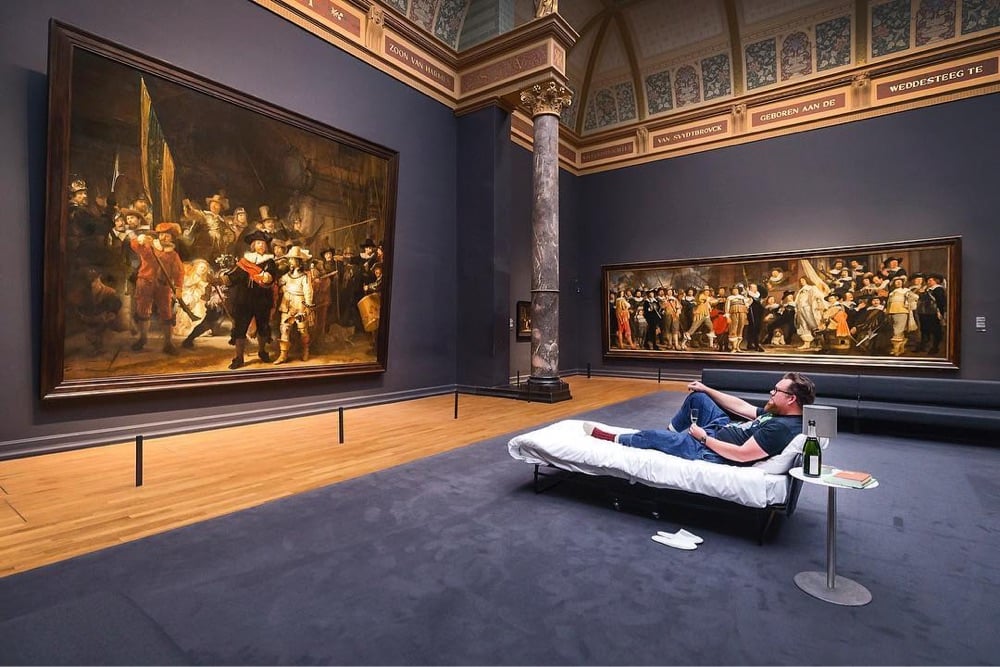
Here’s a short video of Kasper’s time in the museum:
I still can’t believe it. I discovered characters that I have never seen before. They came to life in front of me. It’s an experience that is forever etched in my memory.
Not the same, but I got to go to a press preview when the MoMA reopened a few years ago after renovations and it was quite an experience to wander those familiar galleries pretty much by myself. I stood in front of Starry Night and One: Number 31, 1950 for a really long time that morning.
This is wonderful: at the 1976 Grammys, Mel Tormé asked Ella Fitzgerald how she explains to people what jazz is and then the pair of them effortlessly launch into a scat duet that is just fantastic to listen to. Ella Fitzgerald, what a voice! Mel Tormé, what a voice! Here’s the pair performing together in the 60s:
Even if you haven’t seen Stop Making Sense, you are likely familiar with the herky jerky dance moves of Talking Heads’ frontman David Byrne. In this video, which has only recently been made public, you can see Byrne practicing his now-iconic moves.
40 years ago, David Byrne rehearsed dances for Talking Heads’ upcoming Speaking in Tongues tour by recording video of himself to determine which moves worked better than others, which developed into many of the iconic moves seen in the Stop Making Sense movie, filmed at the end of 1983 and released in 1984. It was recently rereleased by A24 in restored 4K. These videos, recorded in David Byrne’s loft, have been mentioned before in interviews and now after 40 years the footage is finally available!
If you don’t want to sit through the full 25-minute video, here’s an hors d’oeuvres version:
(via open culture)
One of the best uses of technology is to make people laugh. In this three-part series, the Numerical YouTube channels uses some simple editing to increase the size of the goal until some laughably off-the-mark strikes by professional footballers Ousmane Dembélé, Harry Kane (his penalty miss vs France), and Nicolas Jackson finally find their targets. The misses just get more and more funny as the goal gets bigger.
One of my recent favorite YouTube channels is James Payne’s Great Art Explained, which does exactly what it says on the tin, showcasing works of art like Starry Night, the Great Wave, and A Sunday on La Grande Jatte. Payne recently launched a new channel in the same vein: Great Books Explained. Here’s a trailer, featuring a short clip of his exploration of Alice’s Adventures in Wonderland.
Being an avid reader, I always wanted to do a book channel as well, but did not have the time, so these films are collaborations with different writers who are passionate about certain books, and the first release will be James Joyce’s Ulysses (in this case co-created with Henry Mountford). This will be followed by Alice.
The video on James Joyce’s Ulysses is out now:
(via open culture)
At their recent creativity conference, Adobe showed off Project Primrose, in the form of a dress that changes colors and patterns at the click of a button. The garment could also display animations, including ones that respond to the wearer’s movements. From The Kid Should See This:
Created with small scales or petals that are programmed with Adobe software, the futuristic ‘fabric’ can be used for clothing, handbags, curtains, furniture, and endless other surfaces.
Research Scientist Christine Dierk and her team designed and programmed everything about it. Dierk also stitched it together.
This is a heck of a time capsule: back in 2011, Chris Floyd photographed 140 people that he followed on Twitter over the course of a year and made a video featuring their portraits and audio of them “talking about Twitter and it’s effect on the way we communicate and form relationships in the modern era”. It’s almost quaint hearing people talk about the site in the time before Gamergate, 4chan, and other factors helped twist it into a very different place.
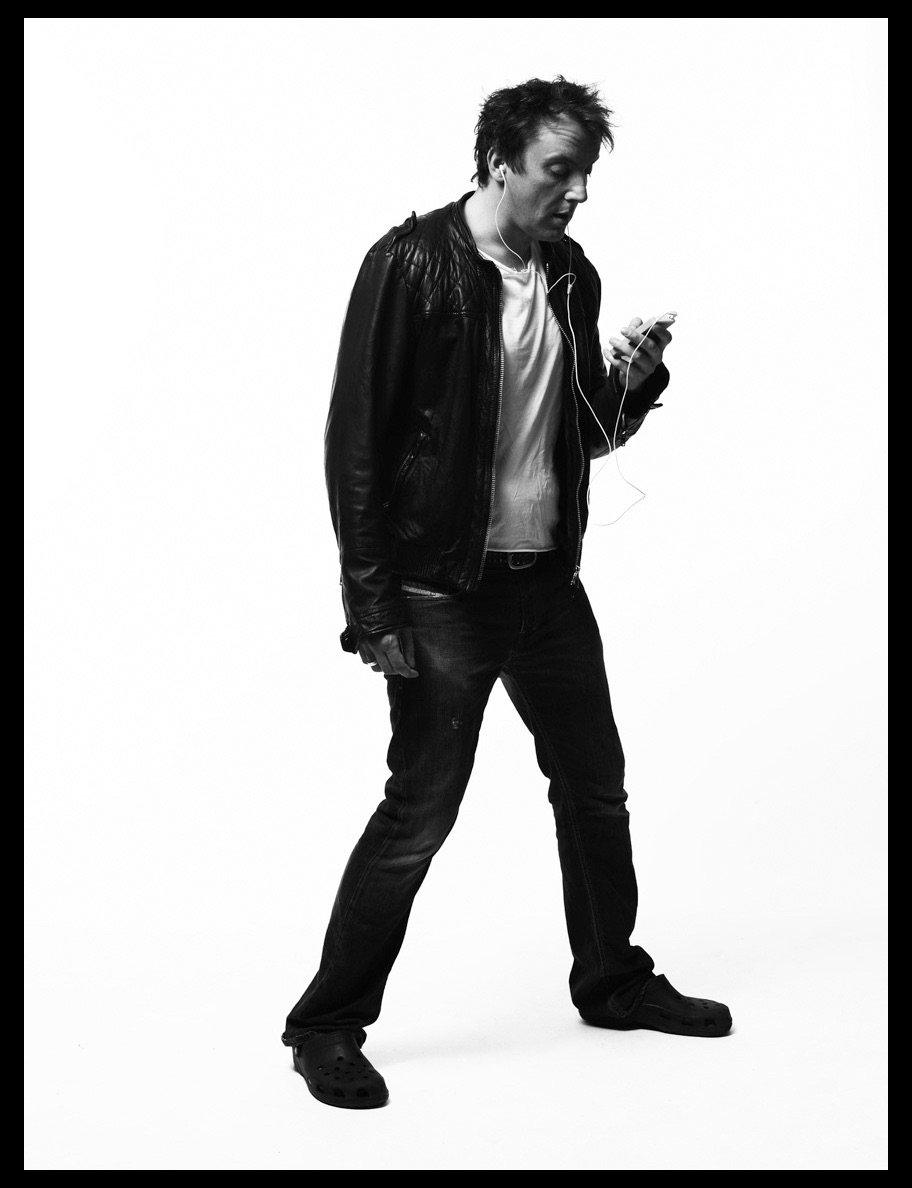
You can check out more of Floyd’s photographs and people’s stories on the One Hundred & Forty Characters blog. (via noah kalina)
A.V. Club has taken on the task of ranking the best 50 music videos, from the first video ever played on MTV (Video Killed the Radio Star by The Buggles, featuring none other than soundtrack composer Hans Zimmer on keys) to Thriller, Sabotage, Addicted to Love, and Sledgehammer. You can watch the whole list via this playlist on YouTube.
I loved the video for Sledgehammer. I was 12 years old the summer it came out. We didn’t have cable TV then, but I’d turn on MTV anywhere I could, hoping for a glimpse of it. My dad used to take my sister and me on roadtrips all over the country and I vividly remember the rare times we got to stay in a motel (they had to have a swimming pool with a diving board), turning on MTV, and catching that Sledgehammer video a few times every hour. It was only years later, after becoming a Wallace and Gromit fan, that I learned that — of course! — Aardman had done the animation for Sledgehammer.
This is great and I loved it to bits: a 15-minute video from the Life Where I’m From YouTube channel about a tiny izakaya (13 seats!) in Tokyo owned and operated by a woman called “Mama” by her regulars.
When Mama is busy, regulars at this izakaya will serve themselves, get their own beers, get their “bottle-keep” and make their own drinks. They’ll also help out Mama-san by serving other customers as well. […] Bottle keep is when a customer buys a bottle and the shop holds on to it for them. Then the next time they visit they can drink from that bottle again.
I’ve got lots of thoughts about this and connections to make! The izakaya’s casual help-yourself atmosphere reminded me of a post I made here more than 20 years ago called Business Lessons From the Donut and Coffee Guy.
“Next!” said the coffee & donut man (who I’ll refer to as “Ralph”) from his tiny silver shop-on-wheels, one of many that dot Manhattan on weekday mornings. I stepped up to the window, ordered a glazed donut (75 cents), and when he handed it to me, I handed a dollar bill back through the window. Ralph motioned to the pile of change scattered on the counter and hurried on to the next customer, yelling “Next!” over my shoulder. I put the bill down and grabbed a quarter from the pile.
I followed that up with another post a few years later:
I get my occasional donut in another part of town now, but I noticed something similar with my new guy. Last Friday, the woman in front of me didn’t order anything but threw down a $20, received a coffee with two sugars a moment after she’d stepped to the window, and no change. As they chatted, I learned that the woman pays for her coffee in advance. The coffee guy asked her if she was sure she owed today. “Yep,” she replied, “It’s payday today; I get paid, you get paid.” Handy little arrangement.
Get to know your customers and trust them — it’s a simple thing that even some small businesses never master.
If this place was on my commute home, I would definitely be a regular — it seems more like someone’s living room than a bar. But there are definitely spots with similar vibes in all sorts of places in the world. Last year, I went to a restaurant in Philadelphia called Her Place that also felt like this. From my sabbatical media diet:
A unique dining experience that’s not unlike going over to someone’s house for a dinner party. There are two seatings a night, at 6:00 and 8:30; all parties are seated at the same time. It’s a set menu with no substitutions and everyone in the restaurant is served at the same time. Every course or two, the chef quiets the diners to explain what’s coming up, who cooked it, where the ingredients are from, and anything else she thinks is relevant. It’s operationally smart and creates a great dining environment. Esquire just named it one of the best new restaurants in America.
Great meal and experience. I felt like a regular even though I’d never been there before. Speaking of, I wrote about being a regular back in 2013:
This is a totally minor thing but I love it: more than once, I’ve come in early in the evening, had a drink, left without paying to go run an errand or meet someone somewhere else, and then come back later for another drink or dinner and then settle my bill. It’s like having a house account without the house account.
I really miss that place — I moved away several years ago now but went back to visit as often as I could. But Covid (and an asshole landlord) killed it.
One last thing Mama’s izakaya reminded me of is when I visited a restaurant in Istanbul called Meşhur Filibe Köftecisi.
While I waited for my food, I noticed an order of köfte going out of the kitchen…to a diner at the restaurant across the street. When he was finished, the staff at that place bussed the dishes back across the way. Meanwhile, my meal arrived and the köfte were flavorful and tender and juicy, exactly what I wanted…no wonder the place across the street had outsourced their meatballs to this place. I’d noticed the owner, the waiter, and the cook drinking tea, so after I finished, I asked if I could get a tea. The owner nodded and started yelling to a guy at the tea place two doors down. A few minutes later, a man bearing a tray with four glasses of tea arrived, dropping one at my table and the other three for the staff. Just then, a server from the place across the street came over to break a 100 lira bill. Me being a big nerd, this all reminds me of Unix and the internet, all of these small pieces loosely joined together to create a well-functioning and joyous experience. There’s only one thing on the menu at Meşhur Filibe Köftecisi, but you can get anything else within yelling distance. I declined dessert…who knows where that would have come from.
(via andy, who correctly guessed this was up my alley)
Pete Davidson hosted Saturday Night Live last night and somehow said exactly the right thing to open a comedic television program after an unspeakably tragic week.
Last month we got a glimpse of the newest season of the Apple+ series For All Mankind (“Imagine a world where the global space race never ended.”) in the form of a teaser trailer that did not give a whole lot away. Well, a proper trailer has dropped and it looks like the gang will be colonizing Mars and harvesting precious metals from asteroids. As I wrote last month:
Is it just me or, if you tilt your head and squint, can you see For All Mankind as a prequel/origin story for The Expanse?
It is maybe too much to ask of a prestige drama these days, but it would be cool to see the birth & development of a Belter-like language a la the beginnings of an Antarctic accent.
How do I navigate grief and hopelessness after a tragedy? How can I get through my grief and sadness? Sitting with grief can feel like we’re frozen in shock or being pulled between heavy feelings and numbness. In this calming visualization, Headspace Meditation and Mindfulness Teacher Dora Kamau teaches us that grief is non-linear and how to practice self-compassion throughout each phase of grief. We’ll learn ways to be present with our grief or intense sadness so that we can allow our emotions to move through us instead of feeling stuck.
See also How Do You Help a Grieving Friend?, How to help a friend through a tough time, according to a clinical psychologist, What To Do About Our Collective Pandemic Grief Before It Overwhelms Us, Grief Is Unexpressed Love, and How to Process Our Collective Global Trauma. (via the kid should see this)
Over 130 animators, actors, filmmakers, and even puppeteers joined forces to remake a 1994 episode of the TV show Frasier called My Coffee With Niles. The episode was split into 185 sections, each 6-12 seconds long, and a different animator or filmmaker took charge of each section. Love this…just an incredible array of styles on display here.
You can read more about the project on their Instagram account. (via @spiritduplicator.bsky.social)
Update: Cartoon Brew has an interview with the project leader about how it all came together.
This new series from Netflix looks pretty good — and it’s got an impeccable pedigree: it’s based on Anthony Doerr’s All the Light We Cannot See, a Pulitzer Prize winner, National Book Award finalist, and a bestseller to boot. The four-part limited series premieres November 2nd.
You have likely heard Yo-Yo Ma play his most famous piece before. Maybe even dozens of times. But Ma’s rendition of Bach’s Cello Suite No. 1 takes on a whole new dimension when accompanied by a babbling brook and bird calls in the forests of the Great Smoky Mountains. A lovely moment of peace in a world that could really use some right now.
Planet Earth III will begin airing later this year on BBC and, presumably, at some later time in the US. The latest installment in the legendary series, 17 years after the first one was released, will once again be presented by Sir David Attenborough, now 97 years old and still as enthusiastic about sharing the wonders of nature as he ever was.
‘The opening of the series with David was filmed in the beautiful British countryside in exactly the location where Charles Darwin used to walk whilst thinking-over his Earth-shaking ideas about evolution. It seemed the perfect place for David to introduce Planet Earth III and remind us of both the wonders and the fragility of our planet. ….and for him, of course, the sun shined under blue skies one of the only days it did all summer!.’
The video above is a quick first look at the series and here’s a trailer as well:
Looking forward to this…the Planet Earth series is still the gold standard for nature documentaries.
This video from Practical Engineering offers a brief explanation of dozens of different types of railcars, from passenger train cars like the dining car & sleeper car to freight cars like the boxcar, tank car, and hopper cars (for hauling things like sand or grain) to specialized cars the rail companies use to build and maintain their routes like rail grinders, snowplows, and track geometry cars.
Trains are one of the most fascinating engineered systems in the world, and they’re out there, right in the open for anyone to have a look! Once you start paying attention, its pretty satisfying to look for all the different types of railcars that show up on the tracks.
They even made a little checklist to use for your beginner trainspotting. (via the kid should see this)
Erik Wernquist made his short film One Revolution Per Minute to explore his “fascination with artificial gravity in space”. The film shows what it would be like to travel on a large, circular space station, 900 meters (0.56 miles) in diameter that rotates a 1 rpm. Even at that slow speed, which generates 0.5 g at the outermost shell, I was surprised to see how quickly the scenery (aka the Earth, Moon, etc.) was rotating and how disorienting it would be as a passenger.
Realistically - and admittedly somewhat reluctantly — I assume that while building a structure like this is very much possible, it would be quite impractical for human passengers.
Putting aside the perhaps most obvious problem with those wide windows being a security hazard, I believe that the perpetually spinning views would be extremely nauseating for most humans, even for short visits. Even worse, I suspect — when it comes to the comfort of the experience — would be the constantly moving light and shadows from the sun.
I calculated that the outer ring of the space station is moving at 105.4 mph with respect to the center. That’s motoring right along — no wonder everything outside is spinning so quickly.
Fall always brings brisker days, earlier sunsets, and a whole raft of new books that are impossible to find the time to read. Add this memoir by Patrick Stewart to the pile next to your bed: Making It So (bookshop.org). The Hollywood Reporter has a great video excerpt with audio from the audiobook (narrated by Stewart himself, naturally) about his early days on Star Trek: The Next Generation:
From an accompanying article:
So when he was on set shooting the show’s debut season and co-stars like Jonathan Frakes, Denise Crosby and Brent Spiner would tease him or ad-lib a joke or laugh when they flubbed their lines, it would low-key infuriate him.
“I could be a severe bastard,” he writes. “My experiences at the Royal Shakespeare Company and the National Theatre had been intense and serious… On the TNG set, I grew angry with the conduct of my peers, and that’s when I called that meeting in which I lectured the cast for goofing off and responded to Denise Crosby’s, ‘We’ve got to have some fun sometimes, Patrick’ comment by saying, ‘We are not here, Denise, to have fun.’”
“In retrospect,” Stewart continues, “everyone, me included, finds this story hilarious. But in the moment, when the cast erupted in hysterics at my pompous declaration, I didn’t handle it well. I didn’t enjoy being laughed at. I stormed off the set and into my trailer, slamming the door.”
Update: Gideon Lichfield has a great interview with Stewart for Wired.
Q: There’s a passage where you say that, from your father, “I drew Picard’s stern, intimidating tendencies. But I like to think that my mother is in the captain too, in his moments of warmth and sensitivity.” Do you see Picard as your way of reconciling that conflict between your parents?
A: Very much so, yes. Both Star Trek and therapy have been responsible for that. Having to open the doors into my childhood in order to be an actor became utterly intriguing to me in a way that it never had been before. And I regret that when I look back on some of the roles I played, what I might have brought to them if I just released myself a little bit more.
(via @samuelwade)
This is a treat: almost 25 minutes of legendary director Martin Scorsese talking about how he made his most iconic movies, from Mean Streets and Raging Bull to Gangs of New York and The Irishman. You have to laugh at the number of times he says, “Well, I didn’t want to make this film, but…” From an accompanying profile/interview with Scorsese (which is quite good as well):
It is a peculiar fact about Martin Scorsese that he does not enjoy actually making movies. “I don’t mean to be funny,” he said, “but, the thing is, you get up real early.” And Scorsese has never been a morning person. For most of his life, he recalled, “I’d stay up late watching movies on TV or reading late, or doing homework late, or trying to write scripts late. I lived at night and the streets were dark, and I never saw the light. It took me many years to understand where the sun set and where the sun rose. I didn’t know. I’m not kidding. I learned it in LA. When you’re going on Sunset Boulevard and you hit the Pacific Coast Highway and it’s seven o’clock and the sun is setting — it’s right there.”
He likes to borrow a complaint from Kubrick. “They said, ‘What’s the hardest thing about directing?’ He said, ‘Getting out of the car.’ Because once you get out of the car, the questions start.” Now, when Scorsese gets out of the car in the morning, he looks at his AD and says, “What can’t I have today?”
You really have to applaud the effort here: YouTuber Todd in the Shadows made a 33-minutes supercut of every song he could find that stops, even momentarily, on the word “stop”. Here are the ground rules:
If there was even the briefest of stops, I counted it. It’s okay if the band holds the note rather than complete silence. But the entire band has to stop, not just a couple instruments; the singer can keep singing though.
I gotta say I did not watch the whole thing, but the very last clip is *kisses fingers*. (via @peterme)
Perhaps the most prominent part of the most well-known painting of Henry VIII (a now-lost work by Hans Holbein the Younger) is the giant codpiece poking through the male-heirless king’s tunic. Evan Puschak analyzes the painting and fills us in on what makes this a particularly effective work of 16th-century propaganda.
Puschak had some fun with this one…I lol’d at “triple dick”, which under no circumstances should you google (like I did) at work or really anywhere else. Although, “triple dick art history” did lead me to this interesting piece on “ostentatio genitalium”:
Ostentatio genitalium (the display of the genitals) refers to disparate traditions in Renaissance visual culture of attributing formal, thematic, and theological significance to the penis of Jesus.
This bit got me laughing again:
…these Renaissance images shock us because they are so frequently ithyphallic: Christ has risen, but not in the way we have come to expect.
These days, instead of writing down lyrics and bringing them to the studio to record, many rappers are using the improvisational “punch-in method” to craft songs during the recording session.
Is this good for the music? The jury is out, even within hip-hop. But in this behind-the-scenes video — the latest entry in our Diary of a Song series, which documents how popular music is created — we track the generational shift through exclusive studio footage of young rappers like Doechii, Veeze and Lil Gotit, plus interviews with genre veterans including the artist Killer Mike and the producer Just Blaze, to track this creative shift and its effects on the still-experimental genre of hip-hop, 50 years after its birth.
Interesting technique, but there is definitely some music in that video that is not for me.
There I Ruined It is fast becoming one of my favorite web delights — musician Dustin Ballard remixes and mashes beloved songs in an attempt to ruin them. The video embedded above features Eminem’s Lose Yourself sung to the tune of the Super Mario Bros theme song…and it makes me laugh every time I watch it.
You can check out more of There I Ruined It on YouTube, TikTok, and Instagram.
P.S. My idea for a song to ruin: the Happy Days theme song, but it just keeps repeating the days of the week (“Sunday Monday happy days / Tuesday Wednesday happy days…”) in a loop, using the Shepard tone to (seemingly) keep the pitch ever-rising.
European cities are transitioning to the use of cargo e-bikes and other micro-mobility solutions for package and other urban deliveries because they are safer, cleaner, and even faster in some cases than using vans or large trucks. The US isn’t making that same shift right now — this video from Vox explores why…and how we can move in that direction.
Fortunately, there’s a hero waiting in the wings: the e-cargo bike. Not only can these bad boys deliver packages in urban environments just as quickly (and sometimes faster) than delivery vans, they take up far less space and are much less likely to cause pedestrian deaths. Companies like Amazon, DHL, and UPS are using them in several European cities, but American cities haven’t followed suit.
In this video, we explore why that is, and lay out some of the big steps American cities would need to take to join the e-bike delivery revolution.
See also No Cars Allowed in This Swiss Town (Except Tiny Electric Ones).
As a tribute to Brian Eno, visual artist Thomas Blanchard made this video of Emerald and Stone, a 2010 song that Eno collaborated on with Jon Hopkins & Leo Abrahams. According to Blanchard, he made the video with no digital visual effects — “the visual compositions have been created out of paint, oil and soap liquid.”
Eno himself is still working and mentoring younger artists…he and Fred Again released an ambient album back in May.
Here’s a fun thought experiment: can you destroy a black hole? Nuclear weapons probably won’t work but what about antimatter? Or anti black holes? In this video, Kurzgesagt explores the possibilities and impossibilities. This part baked my noodle (in a good way):
Contrary to widespread belief, the singularity of a black hole is not really “at its center”. It’s in the future of whatever crosses the horizon. Black holes warp the universe so drastically that, at the event horizon, space and time switch their roles. Once you cross it, falling towards the center means going towards the future. That’s why you cannot escape: Stopping your fall and turning back would be just as impossible as stopping time and traveling to the past. So the singularity is actually in your future, not “in front of you”. And just like you can’t see your own future, you won’t see the singularity until you hit it.
🤯
Using a phrase popularized by reproductive justice activist Renee Bracey Sherman, The National Network of Abortion Funds teamed up with Molly Crabapple and Padma Lakshmi to produce a video about their mission to support abortion access in the US.
In order for abortion to be truly an option, it must not only be legal, but actually available, without the shame. It’s time we worked together towards a world where all people have the power and resources to care for and support their bodies, identities, and health — for themselves and their families. We need to take the hassle, hustle, and harassment out of healthcare. It’s time to change the conversation about abortion, to make it a real option, available to all people without shame or judgment. We all love someone who has had an abortion, whether we know it or not.
The video is three years old and from the very first line (“Abortion is legal in all 50 states”), you can tell how much the situation has changed in the United States — and how the NNAF’s mission is even more urgent. If you’d like to join me in donating, step right this way.
Newer posts
Older posts





Socials & More