kottke.org posts about politics
Stephen Walt on what truths US foreign policy officials will never admit in public.
#2: “We don’t actually care that much about human rights.” Presidents, diplomats, and other politicians talk about human rights all the time, and both Congress and the Executive Branch often bully small countries over their human rights performance, especially when we have other differences with them). But when human rights concerns conflict with other interests, our ethical concerns take a back seat nearly every time. Most Americans didn’t care when the U.S.-led sanctions program against Iraq caused the deaths of several hundred thousand Iraqis (many of them children), and none of the senior officials who authorized torture during the Bush administration has faced indictment or even serious investigation (Just imagine how much we’d be howling if we suspected some foreign government had been waterboarding captive Americans!). The United States has plenty of allies whose human rights performance ranges from questionable to awful, and we continue to trade and invest in China despite its own lax human rights standards. I’m not suggesting that the U.S. government is totally indifferent to such concerns, of course; what I’m saying is that we are rarely willing to do very much or pay significant costs in order to advance human rights, unless our strategic interests run parallel. Like most countries, in short, we talk a better game on human rights than we actually deliver. But you’re not going to hear many American politicians admit it.
(via digg)
Tom Junod has been on the drone beat since writing The Lethal Presidency of Barack Obama in July.
Sure, we as a nation have always killed people. A lot of people. But no president has ever waged war by killing enemies one by one, targeting them individually for execution, wherever they are. The Obama administration has taken pains to tell us, over and over again, that they are careful, scrupulous of our laws, and determined to avoid the loss of collateral, innocent lives. They’re careful because when it comes to waging war on individuals, the distinction between war and murder becomes a fine one. Especially when, on occasion, the individuals we target are Americans and when, in one instance, the collateral damage was an American boy.
Individual targetting isn’t exclusively done by military drones, but they are the favored method. Junod notes that even as Obama said that “a decade of war is now ending” in his inauguration speech, a drone strike killed three suspected Al Qaeda members in Yemen.
President Obama’s second inaugural was supposed to sound something like Lincoln’s: the speech of a man tired of war, and eager to move the nation beyond its bloody reach. In truth, it was the speech of a man who has perfected a form of war that can be written off as a kind of peace. He was able to put the pain of war in the past because his efforts to expand painless war have come to fruition.
Here’s the full report on the recent Yemeni strikes from the AP:
An American drone strike on Monday on a car east of Sana, the capital, killed three people suspected of being members of Al Qaeda, said Yemeni security officials. On Saturday, two American drone strikes killed eight people in Marib Province. Yemen, aided by the United States, has been battling the local branch of Al Qaeda. The United States rarely comments on its military role in Yemen but has acknowledged targeting Qaeda militants in the past.
Dangerous dangerous precedent here. If George W. Bush were doing this sort of thing, we’d be marching in the streets about it. Why does Obama get a free pass? (And on Bradley Manning? And on Guantanamo?) Anyone in the press want to ask the President about the legality & moral stickiness of drone strikes at his next press conference?
At a press conference today, Vice President Biden and President Obama introduced their plan to reduce the nation’s gun violence. Here are main points:
Require criminal background checks for all gun sales.
Take four executive actions to ensure information on dangerous individuals is available to the background check system.
Reinstate and strengthen the assault weapons ban.
Restore the 10-round limit on ammunition magazines.
Protect police by finishing the job of getting rid of armor-piercing bullets.
Give law enforcement additional tools to prevent and prosecute gun crime.
End the freeze on gun violence research.
Make our schools safer with more school resource officers and school counselors, safer climates, and better emergency response plans.
Help ensure that young people get the mental health treatment they need.
Ensure health insurance plans cover mental health benefits.
Here’s the press conference in its entirety:
The NY Times has an overview of their remarks.
In November, some serious individuals created a petition on the The White House’s We the People website requesting the construction of a Death Star in 2016. The petition received the 25K signatures required for a response, and in a Friday night news dump, the White House responded with a memo full of Star Wars puns.
Reasons for rejection include:
*The construction of the Death Star has been estimated to cost more than $850,000,000,000,000,000. We’re working hard to reduce the deficit, not expand it.
*The Administration does not support blowing up planets.
*Why would we spend countless taxpayer dollars on a Death Star with a fundamental flaw that can be exploited by a one-man starship?
The petitions submitted to the We the People site aren’t always treated as a joke, here’s the response to the people who signed petitions about seceding from the United States.
On Friday afternoon, a government advisory committee released a draft of a federal climate assessment report, which pretty much meant that no one saw it, aside from the few journalists who were tasked, at that late hour of the week, with writing something about it. The upshot of the report? Bad news and there’s not much anyone is doing about it. From Mother Jones:
Say what you want about the Obama administration’s relative ignoring of climate issues: Many of his top scientists are paying rapt attention, and they think we’re about to get our butts kicked — although dumping the news at 4 p.m. on a Friday gives some indication of where it sits in federal priorities.
Anyway, what does the report say? From Nature:
Coming just days after news that the United States experienced its hottest year on record in 2012, the draft report says average US temperatures have increased by more than 0.8° Celsius since 1895, with a sharp spike since 1980. It also provides an update on the litany of impacts being analyzed by scientists. There is “strong evidence” that global warming has roughly doubled the likelihood of extreme heat events, contributing to droughts and wildfires, according to the report. Permafrost is melting in Alaska, while much of the country is experiencing more extreme rainfall and winter snowstorms.
And from Bloomberg:
The 60-member panel approved and released a draft report today that says many coastal areas face “potentially irreversible impacts” as warmer temperatures lead to flooding, storm surges and water shortages.
“The chances of record-breaking, high-temperature extremes will continue to increase as the climate continues to change,” the panel said in its report. Temperatures are predicted to increase, on average, by 2 degrees to 4 degrees in the next few decades, according to the report.
The panel of scientists from academia, industry, environmental groups and the government prepared the report, and its findings are the closest to a consensus about global warming in the U.S. Reports in 2000 and 2009 by the U.S. Global Change Research Program concluded carbon-dioxide emissions since the Industrial Revolution have led to a warming of the Earth’s temperature, which threatens to cause extreme weather, drought and floods.
The report also highlighted decreasing air quality as a side effect of the changing climate. This weekend, the air quality in Beijing was off the scale for about 18 hours. The scale goes from 0-500:
Good: 0-50
Moderate: 51-100
Unhealthy for Sensitive Groups: 101-150
Unhealthy: 151-200
Very Unhealthy: 201-300
Hazardous: 301-500
The readings in Beijing topped out at 755. My friend Youngna is there and these two photos she took of the CCTV building two days apart shows how bad the pollution is there:

When President Obama did an interview on Reddit in August, one of the questions he got was:
Would you rather fight 100 duck-sized horses or one horse-sized duck?
Obama declined to answer the question, but Conor Friedersdorf decided to ask a waterfowl expert what he thought and the answer involves an interesting mix of science:
With such a huge body, the problem of surface area to body volume comes into play. The terror-ducktyl would have a problem losing heat. Hence, a possible tactic would be to get it running around chasing me and it might overheat, stroke out, and die. Birds have higher body temperatures than mammals in any case (often very close to the 40 degrees Celsius upper lethal limit) so it might not take too much to push the duck over the metabolic cliff. Merits consideration.
and politics:
After engaging his graduate students in conversation, he came to realize that it would be politically disastrous for Obama to fight the duck-sized horses. Think about it. In America, the duck lobby is composed of duck hunters. The horse lobby is made up of horse lovers who succeeded in stopping Californians from buying horse meat. The young women voters essential to the Democratic coalition are far more sympathetic to veritable ponies than a giant, rape-obsessed mallard. Shooting the duck would be perfectly legal under existing law, or would at worst result in a citation for hunting without a license.
See also The Biology of B-Movie Monsters by Michael LaBarbera, a classic and one of my favorite internet things ever.
When the Incredible Shrinking Man stops shrinking, he is about an inch tall, down by a factor of about 70 in linear dimensions. Thus, the surface area of his body, through which he loses heat, has decreased by a factor of 70 x 70 or about 5,000 times, but the mass of his body, which generates the heat, has decreased by 70 x 70 x 70 or 350,000 times. He’s clearly going to have a hard time maintaining his body temperature (even though his clothes are now conveniently shrinking with him) unless his metabolic rate increases drastically.
Luckily, his lung area has only decreased by 5,000-fold, so he can get the relatively larger supply of oxygen he needs, but he’s going to have to supply his body with much more fuel; like a shrew, he’ll probably have to eat his own weight daily just to stay alive. He’ll also have to give up sleeping and eat 24 hours a day or risk starving before he wakes up in the morning (unless he can learn the trick used by hummingbirds of lowering their body temperatures while they sleep).
During her reign, Queen Elizabeth II of England has met 10 sitting US Presidents, every one from Eisenhower to Obama except for Lyndon Johnson. She also met Harry Truman as a princess in 1951 and former President Herbert Hoover in 1957.
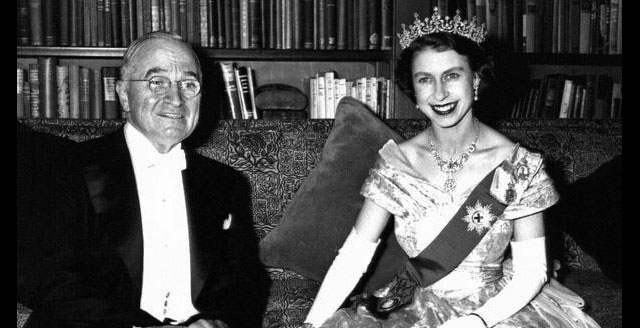
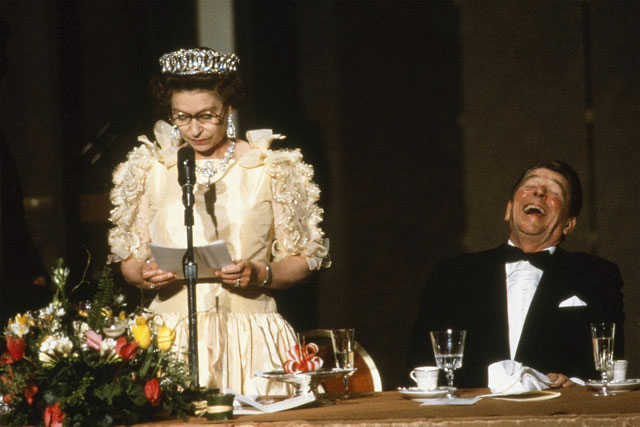
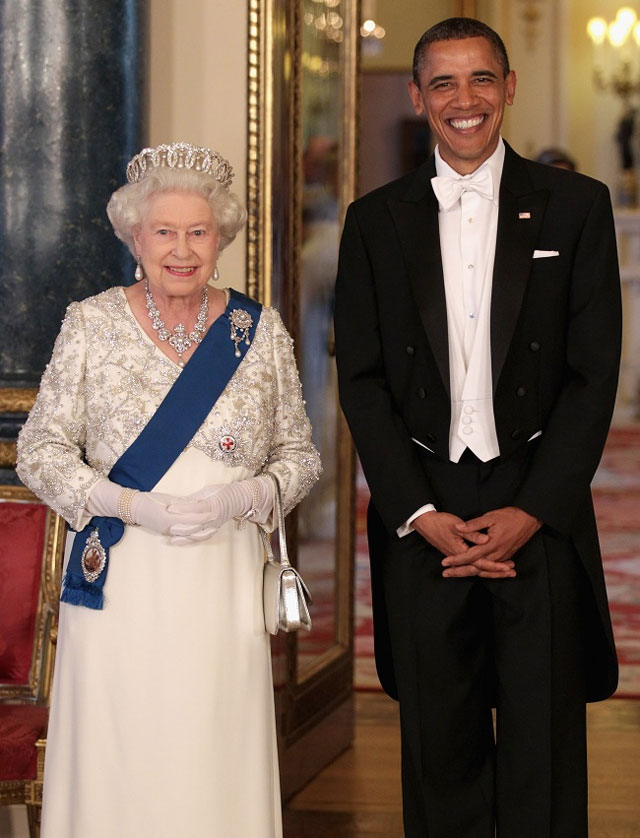
You can see the entire progression here or here. QEII is more definitely a human wormhole.
BTW, Elizabeth is creeping up on Queen Victoria as the longest-reigning British monarch, just another two-and-a-half years to catch her. Victoria reigned during the terms of 19 different Presidents but never met any of them and had an unfair advantage…lots of short terms and one-term Presidencies back then. (via mlkshk)
NYC Mayor Michael Bloomberg has been one the most powerful voices calling for increased gun control in the wake of the Newtown shootings…see here and here. But earlier this year, NYC sold spent shell casings to an ammunition dealer.
In June, the City of New York sold 28,000 pounds of spent shell casings to a an ammunition dealer in Georgia, where they were to be reloaded with bullets. Anyone with $15 can buy a bag of 50, no questions asked, under Georgia law. As The New York Times reported, the city has previously sold shell casings — which are collected at the police target shooting range — to scrap metal dealers, but in this case the highest bidder was the ammunition store.
The city destroys guns but sells spent casing to be recycled. When challenged on this point, Bloomberg got testy:
Then one of the most experienced and professional of New York television reporters, Mary Murphy of WPIX, asked Mr. Bloomberg if the city was going to change its policy and not sell shell casings to ammunition dealers. Mr. Bloomberg set forth into a minisermon about how it was an act of integrity.
“This is the public’s money that we are stewards of, and deliberately deciding to sell things at lower prices than the marketplace commands makes no sense at all, and if you think about it, would create chaos and corruption like you’ve never seen,” he said.
Ms. Murphy pressed on: “Does it send the wrong message though?”
The mayor scolded her as if she were an errant schoolgirl.
“Miss, Miss,” Mr. Bloomberg said. “Either you want to ask a question and I give you an answer, or please come to the next press conference and stand in the back.”
Hmm.
In an editorial for the NY Times in 1993 called Guns Don’t Kill People. Bullets Do., US Senator Daniel Patrick Moynihan described a bill he introduced in the Senate which would have levied a 10,000% tax on hollow-point bullets.
“So far this year, 342 New Yorkers have been killed by stray bullets. And in the past few days, two young women were shot in their pregnant bellies.” A. M. Rosenthal wrote that on this page last Tuesday, the day of the Long Island shooting. By Thursday there were 11 more homicides. If we are to stop it, or come anywhere close, we have to get hold of the ammunition.
On Nov. 3, I introduced a bill that would levy a 10,000 percent tax on Winchester hollow-tipped “Black Talon” bullets, specifically designed to rip flesh. (Colin Ferguson, the suspect in the Long Island shootings, had some 40 of them.)
The tax would effectively raise the price of Black Talons from $20 a box to $2,000. On Nov. 22, 19 days after my bill was introduced, Winchester announced that it would cease sale of Black Talons to the public. Which suggests that the munitions manufacturers are more responsive than the automobile companies were a generation ago. It is also important to note that in 1986 Congress banned the Teflon-coated “cop killer” bullet, which penetrates police body armor. The Swedes are now making a new kind of armor-piercing round. We got that banned in the Senate version of this year’s crime bill without a murmur.
The Long Island shootings Moynihan refers to resulted in the deaths of six people and the injury of nineteen more. (via @Rebeccamead_NYC)
Thomas Jefferson, in a letter written to Samuel Kercheval in 1816, had this to say about the law and human progress:
I am certainly not an advocate for for frequent and untried changes in laws and constitutions. I think moderate imperfections had better be borne with; because, when once known, we accommodate ourselves to them, and find practical means of correcting their ill effects. But I know also, that laws and institutions must go hand in hand with the progress of the human mind. As that becomes more developed, more enlightened, as new discoveries are made, new truths disclosed, and manners and opinions change with the change of circumstances, institutions must advance also, and keep pace with the times. We might as well require a man to wear still the coat which fitted him when a boy, as civilized society to remain ever under the regimen of their barbarous ancestors.
(via df)
Today NYC mayor Michael Bloomberg urged the President and Congress to take action on gun violence. Here are three of his six specific suggestions:
Pass the legislation of Fix Gun Checks Act that would require a criminal background check for all gun sales including all private sales and online sales
Ban deadly, military-style assault weapons and high-capacity magazines, which were previously banned under the now expired Federal assault weapons ban
Pass legislation to make gun trafficking a felony
The US has ratified a new amendment to the Constitution, the 28th such alteration. The Onion has the scoop:
“The provisions of the 28th Amendment will fully protect the right of all individuals to spend every waking moment utterly terrified at the thought of a deranged stranger with a semiautomatic combat rifle gunning them down,” said House Speaker John Boehner (R-OH), explaining that the measure also permits Americans to suffer panic attacks anytime their loved ones go to work, school, malls, or virtually any other public location.
As I said on Friday, The Onion is perhaps our most emotionally honest media source.
What will it take for the US government to enact tougher gun control laws? Even with the Newtown shootings as impetus, it will be a politically difficult row to hoe.
What does it take? If a congresswoman in a coma isn’t sufficient grounds to reevaluate the role that firearms play in our national life, is a schoolhouse full of dead children? I desperately want to believe that it is, and yet I’m not sure that I do. By this time next week, most of the people who are, today, signing petitions and demanding gun control will have moved on to other things. If you want to understand why the gun debate can occasionally feel rigged, this is the answer: the issue is characterized by a conspicuous asymmetry of fervor. The N.R.A. has only four million members — a number that is probably dwarfed by the segment of the U.S. population that feels uneasy about the unbridled proliferation of firearms. But the pro-gun constituency is ardent and organized, while the gun control crowd is diffuse and easily distracted. In the 2012 election cycle, N.R.A. spending on lobbying outranked spending by gun control groups by a factor of ten to one.
What that means in practice is that in the aftermath of contemporary gun tragedies, we don’t see new gun legislation. What we do see is a spike in gun sales. After the shooting last summer in Aurora, Colorado, gun sales went up. After the Giffords shooting, there was a surge in purchases of the very Glock semiautomatic that wounded her. Certainly, the firearm industry and lobby will confront some bad P.R. in the coming weeks, but they can likely find succor in an uptick in business. Following the Newtown shooting, Larry Pratt, the Executive Director of Gun Owners for America, suggested that these massacres might be avoided in the future, if only more teachers were armed.
Despite promises leading up to the 2008 Presidential election of strengthening the nation’s gun control laws, President Obama has done nothing but offer condolences to those affected by mass shootings.
There has been no shortage of sorrow-filled words from Barack Obama following each of the tragic mass killings that have afflicted his presidency.
Obama described the wounding of congresswoman Gabrielle Giffords and deaths of six other people, including a young girl, in Tucson, Arizona, last year as a “tragedy for our entire country” and called for a “national dialogue” on how Americans treat each other.
He struck much the same theme in July following the killing of 12 people at a Colorado cinema. A month later, Obama called for “soul searching” on how to reduce violence after a white supremacist murdered six people at a Sikh temple in Wisconsin.
The searing awfulness of Newtown on Friday saw the president in tears, declaring: “We’ve endured too many of these tragedies in the past few years.
“We’re going to have to come together and take meaningful action to prevent more tragedies like this, regardless of the politics,” he said.
Although Obama didn’t mention gun control, that is what he was widely assumed to be talking about.
But critics say that the president, for all his sorrowful words after each mass killing, has not only visibly failed to address gun control, he has quietly acquiesced in a slew of national, state and local laws in recent years that have generally made it easier to buy and carry weapons.
President Obama pledged to use “whatever power this office holds to engage my fellow citizens, from law enforcement, to mental health professionals, to parents and educators, in an effort aimed at preventing more tragedies like this” in his speech last night at a prayer vigil in Newtown, CT.
A full transcript of the speech is available.
And then there were the scenes of the schoolchildren helping one another, holding each other, dutifully following instructions in the way that young children sometimes do, one child even trying to encourage a grownup by saying, “I know karate, so it’s OK; I’ll lead the way out.”
As a community, you’ve inspired us, Newtown. In the face of indescribable violence, in the face of unconscionable evil, you’ve looked out for each other. You’ve cared for one another. And you’ve loved one another. This is how Newtown will be remembered, and with time and God’s grace, that love will see you through.
But we as a nation, we are left with some hard questions. You know, someone once described the joy and anxiety of parenthood as the equivalent of having your heart outside of your body all the time, walking around.
With their very first cry, this most precious, vital part of ourselves, our child, is suddenly exposed to the world, to possible mishap or malice, and every parent knows there’s nothing we will not do to shield our children from harm. And yet we also know that with that child’s very first step and each step after that, they are separating from us, that we won’t — that we can’t always be there for them.
They will suffer sickness and setbacks and broken hearts and disappointments, and we learn that our most important job is to give them what they need to become self-reliant and capable and resilient, ready to face the world without fear. And we know we can’t do this by ourselves.
It comes as a shock at a certain point where you realize no matter how much you love these kids, you can’t do it by yourself, that this job of keeping our children safe and teaching them well is something we can only do together, with the help of friends and neighbors, the help of a community and the help of a nation.
And in that way we come to realize that we bear responsibility for every child, because we’re counting on everybody else to help look after ours, that we’re all parents, that they are all our children.
This is our first task, caring for our children. It’s our first job. If we don’t get that right, we don’t get anything right. That’s how, as a society, we will be judged.
And by that measure, can we truly say, as a nation, that we’re meeting our obligations?
Can we honestly say that we’re doing enough to keep our children, all of them, safe from harm?
Can we claim, as a nation, that we’re all together there, letting them know they are loved and teaching them to love in return?
Can we say that we’re truly doing enough to give all the children of this country the chance they deserve to live out their lives in happiness and with purpose?
I’ve been reflecting on this the last few days, and if we’re honest with ourselves, the answer’s no. We’re not doing enough. And we will have to change. Since I’ve been president, this is the fourth time we have come together to comfort a grieving community torn apart by mass shootings, fourth time we’ve hugged survivors, the fourth time we’ve consoled the families of victims.
The New Yorker’s editor in chief David Remnick strongly urges President Obama to take decisive action on gun control.
Barack Obama has been in our field of vision for a long time now, and, more than any major politician of recent memory, he hides in plain sight. He is who he is. He may strike the unsympathetic as curiously remote or arrogant or removed; he certainly strikes his admirers as a man of real intelligence and dignity. But he is who he is. He is no phony. And so there is absolutely no reason to believe that his deep, raw emotion today following the horrific slaughter in Connecticut-his tears, the prolonged catch in his voice-was anything but genuine. But this was a slaughter-a slaughter like so many before it-and emotion is hardly all that is needed. What is needed is gun control-strict, comprehensive gun control that places the values of public safety and security before the values of deer hunting and a perverse ahistorical reading of the Second Amendment. Obama told the nation that he reacted to the shootings in Newtown “as a parent,” and that is understandable, but what we need most is for him to act as a President, liberated at last from the constraints of elections and their dirty compromises-a President who dares to change the national debate and the legislative agenda on guns.
A statement from NYC Mayor Mike Bloomberg on today’s events:
With all the carnage from gun violence in our country, it’s still almost impossible to believe that a mass shooting in a kindergarten class could happen. It has come to that. Not even kindergarteners learning their A,B,Cs are safe. We heard after Columbine that it was too soon to talk about gun laws. We heard it after Virginia Tech. After Tucson and Aurora and Oak Creek. And now we are hearing it again. For every day we wait, 34 more people are murdered with guns. Today, many of them were five-year olds. President Obama rightly sent his heartfelt condolences to the families in Newtown. But the country needs him to send a bill to Congress to fix this problem. Calling for ‘meaningful action’ is not enough. We need immediate action. We have heard all the rhetoric before. What we have not seen is leadership — not from the White House and not from Congress. That must end today. This is a national tragedy and it demands a national response. My deepest sympathies are with the families of all those affected, and my determination to stop this madness is stronger than ever.
And it’s not because they have guns. They’ve got money and political influence.
While the NRA wins court fights, laws allowing more guns in more public places continue to spread, often for reasons that defy logic. For example, take the reasoning offered by Alabama state Sen. Roger Bedford, a Democrat, when explaining to Bloomberg earlier this week why he introduced a bill that would allow people to keep their guns in their cars in the workplace parking lot. “This provides safety and protection for workers who oftentimes travel 20 to 50 miles to their jobs,” Bedford said. What does this mean? If there’s a workplace shooting, people need to be able to have their guns in the parking lot to turn the place into a true shootout? Or does he just mean that maybe people need to be able to shoot to kill while driving down the highway on the way to work?
Writing for the New Yorker, Alex Koppelman says that today is the right day to talk about guns.
Carney’s response was a predictable one. This is the way that we deal with such incidents in the U.S.-we acknowledge them; we are briefly shocked by them; then we term it impolite to discuss their implications, and to argue about them. At some point, we will have to stop putting it off, stop pretending that doing so is the proper, respectful thing. It’s not either. It’s cowardice.
It is cowardice, too, the way that Carney and President Obama and their fellow-Democrats talk about gun control, when they finally decide the time is right. They avoid the issue as much as possible, then mouth platitudes, or promise to pass only the most popular of measures, like the assault-weapons ban. And then they do nothing to follow through.
In an op-ed for the NY Times, Warren Buffett proposes a minimum tax on high incomes, specifically “30 percent of taxable income between $1 million and $10 million, and 35 percent on amounts above that”. He argues that higher tax rates will not curtail investment activity.
Between 1951 and 1954, when the capital gains rate was 25 percent and marginal rates on dividends reached 91 percent in extreme cases, I sold securities and did pretty well. In the years from 1956 to 1969, the top marginal rate fell modestly, but was still a lofty 70 percent - and the tax rate on capital gains inched up to 27.5 percent. I was managing funds for investors then. Never did anyone mention taxes as a reason to forgo an investment opportunity that I offered.
Under those burdensome rates, moreover, both employment and the gross domestic product (a measure of the nation’s economic output) increased at a rapid clip. The middle class and the rich alike gained ground.
(via df)
The Blaze has a collection of county-by-county election maps for every US Presidential election since 1900.
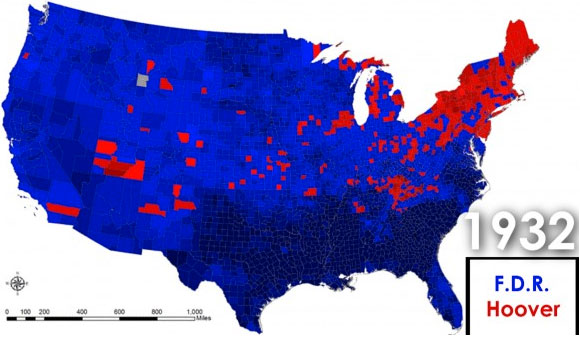
The video at the bottom is worth watching to witness the shift between a north/south divided country to a urban/rural divided country over the past 20 years.
The campaign website for Dole/Kemp ‘96 is still available on the web. The entire front page at its actual size fits in this image…man, screens used to be tiny.

The Clinton/Gore ‘96 site no longer seems to be available (cg96.org is a parked domain, covered with ads), but 4president.us has some archived screenshots and a press release of some remarks by Al Gore on the site’s launch. We’ve come a long way since then.
This is the first thing you see when you go to our home page, and it has a couple of innovative features for those of you who are familiar with the Internet and the World Wide Web. It’s not very common to have this kind of ticker with a changing message at the bottom constantly moving or to have a server pushing new pictures onto the page with regularity right to your own computer.
Anyway, this is the first thing that you see, and then we go to the main menu. Since 1992, Bill Clinton has been working tirelessly to insure that America forges ahead and leads the world in the information age. He has brought technology into our classrooms and libraries, he signed the historic telecommunications reform bill to make sure that all of our cabinet agencies are online. Together, not long after we got into the White House, we became the very first President and Vice-President to have e-mail addresses and to set up a White House Website. I hope all of you have had the opportunity to visit the White House Website.
4president.us also has screenshots from other campaign sites that year, including those of Steve Forbes and Pat Buchanan. (via @kdawson)
Kent Brewster’s Who Likes Mitt allows you to watch Mitt Romney’s Facebook fans unlike him in real time. Before the election, I wondered how either candidate would utilize their social media platforms in the event of their loss, as both Mitt Romney and Barack Obama had several million followers on Twitter and Facebook. We’ll have quite some time to see the answer because at the current and unsustainable rate of abandonment, Mitt’s last follower will unlike him in just over 3 years. *181 Facebook fans left Mitt while this post was written. (via ★akuban)
Update: Now, with graphs! (thx, @colossal)
The New Yorker’s David Remnick urges President Obama to address climate change during his second term in a Kennedy-esque “we choose to go to the Moon” fashion.
Barack Obama can take pride in having fought off a formidable array of deep-pocketed revanchists. As President, however, he is faced with an infinitely larger challenge, one that went unmentioned in the debates but that poses a graver threat than any “fiscal cliff.” Ever since 1988, when NASA’s James Hansen, a leading climate scientist, testified before the Senate, the public has been exposed to the issue of global warming. More recently, the consequences have come into painfully sharp focus. In 2010, the Pentagon declared, in its Quadrennial Defense Review, that changes in the global climate are increasing the frequency and the intensity of cyclones, droughts, floods, and other radical weather events, and that the effects may destabilize governments; spark mass migrations, famine, and pandemics; and prompt military conflict in particularly vulnerable areas of the world, including the Middle East, Southeast Asia, and sub-Saharan Africa. The Pentagon, that bastion of woolly radicals, did what the many denialists in the House of Representatives refuse to do: accept the basic science.
The economic impact of weather events that are almost certainly related to the warming of the earth — the European heat wave of 2003 (which left fifty thousand people dead), the Russian heat waves and forest fires of 2010, the droughts last year in Texas and Oklahoma, and the preelection natural catastrophe known as Sandy — has been immense. The German insurer Munich Re estimates that the cost of weather-related calamities in North America over the past three decades amounts to thirty-four billion dollars a year. Governor Andrew Cuomo, of New York, has said that Sandy will cost his state alone thirty-three billion. Harder to measure is the human toll around the world-the lives and communities disrupted and destroyed.
Now’s probably a good time to remind you of this Flickr set of prominent Republicans Photoshopped to look like clowns.
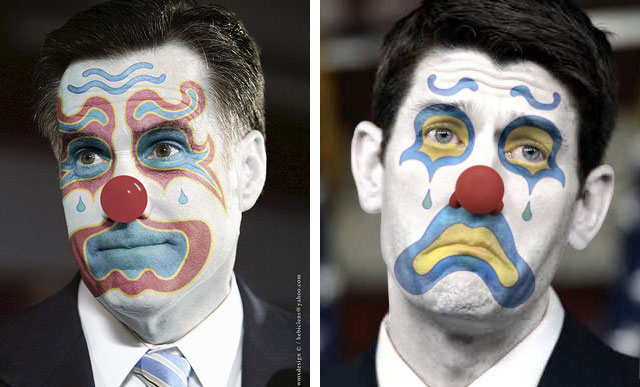
Before you accuse me of crass and childish partisanship, I will also take this opportunity to urge you to stop what you’re doing to “express your hatred, shame, and outright disgust with anyone you know who voted Democrat”, boycott businesses that accept EBT, and allow your dog to crap on Democrat lawns.
This year’s election reminded me of a piece that Anil Dash wrote almost ten years ago on our culture’s tendency towards liberalism. It’s my favorite thing he’s ever written and is one of the few pieces of writing that instantly shifted my thinking in a significant way.
Our ideas are winning, you see. When Reagan ordered the bombing of Libya in 1986, he didn’t make sure to urge Americans to have tolerance for people of Libyan descent living among us. But a scant 15 years later, President Bush made repeated calls for tolerance towards muslims in this country, not just out of what I see as his genuine motivation to do what was right, but also because the tenor of public discourse has changed that rapidly due to the tolerant influence of liberal philosophy. Gay marriage is still a big point of debate, but the presence of openly gay characters in mass media has changed in the same decade and a half from being scandalous to being clich’ed. It will be the burden of the next generation to hold the today’s conservatives to their record of homophobia, but it’s only a matter of time until that happens.
George W. Bush put out a message from the White House in honor of Kwanzaa. We’re winning.
It’s probably that sense of a slow, inexorable loss that makes conservatives terrified, causing them to respond with a desperate clinging to the past that only serves to further doom their cause. The best solutions, of course, lie in the future.
Tuesday’s election — an event that included reelecting a mixed-race President, legalizing marijuana in some states, legalizing same-sex marriage in some states, electing women to the Senate in record numbers, the election of the first openly gay Senator, and the defeat of many hard-line social conservatives — serves as a reminder that the country continues to move in a more liberal direction.
It’s been a tough few weeks here in NYC. Sandy. Power outages. Food and gas shortages. The hurricane aftermath. Those two kids murdered by their nanny. The NYPD officer who was planning to kill and cook women. The election has been weighing heavily on my heart, more heavily than I realized. The Presidential campaign has been difficult for me to follow…so little substance and so so so much sound and fury, signifying nothing.
I’ve been pretty apathetic about politics in the past and I’ll never be the type of person to proselytize for one candidate over another (well, not too much anyway) but I would have waited in line for 12 hours today in order to cast my vote. Voting this morning1 felt like the first hopeful thing that’s happened in quite awhile.
[1] For Obama/Biden, I don’t mind telling you, not least because of the Republican Party’s contempt for the rights of the majority of the population, aka our wives, daughters, mothers, grandmothers, aunts, etc. ↩
It was not my intent to be so politically oriented this morning but here we are. This is a chart that tracks the ideologies of the Democratic and Republican members of Congress from 1789 to 2010. As you can see, the shift away from the center by the Republicans since 1975 is unprecedented, perhaps matched only by the shift toward the center by the Democrats beginning in 1921 and ending in 1945.

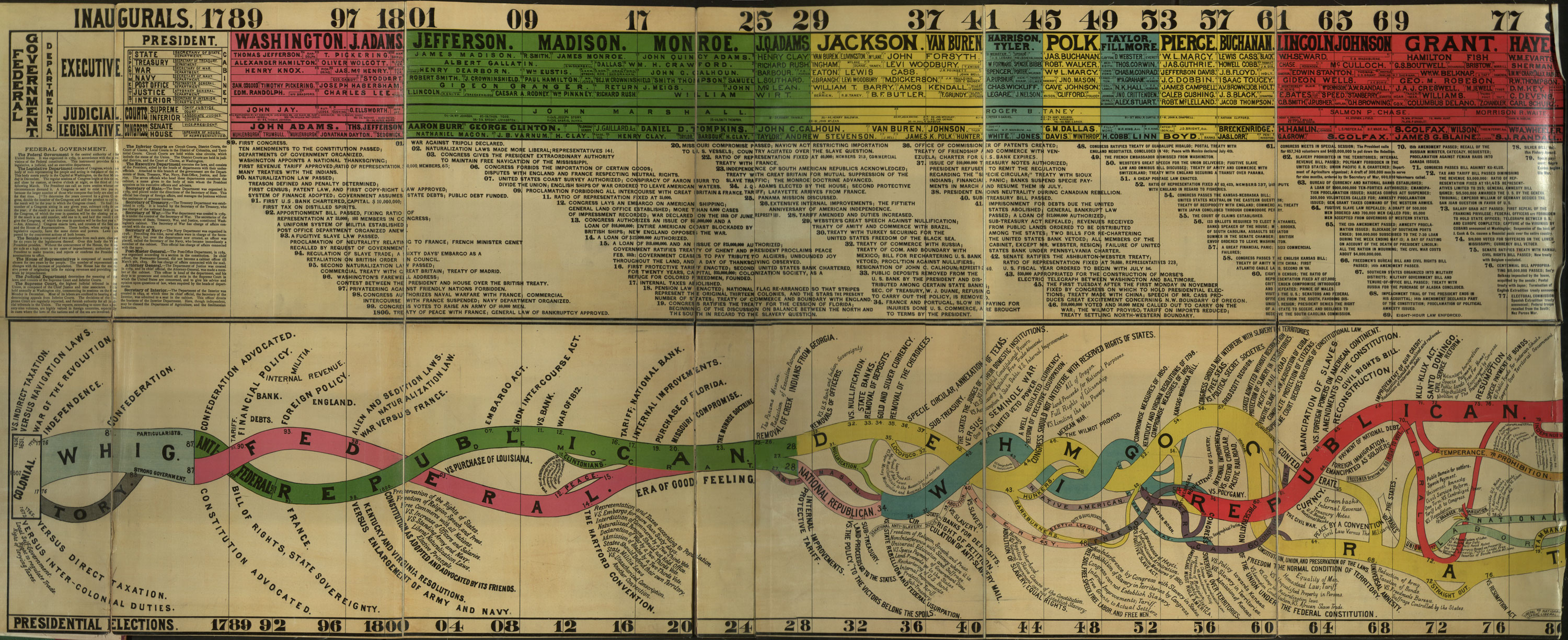
This reminds me of a timeline created circa 1880 for a book called Conspectus of the History of Political Parties and the Federal Government:
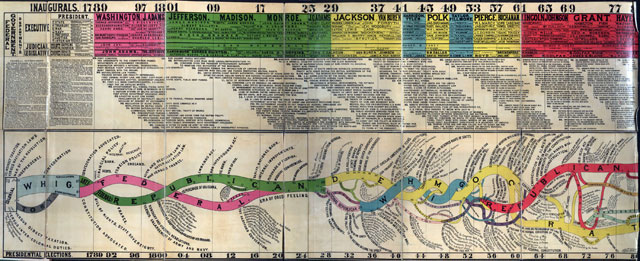
Bigger version here. (via @joecarryon)
Following up on her piece in the New Yorker on how hedge fund billionaires have become disillusioned with President Obama, Chrystia Freeland says that the 1% are repeating a mistake made many times throughout history of moving from an inclusive economic system to an extractive one.
Extractive states are controlled by ruling elites whose objective is to extract as much wealth as they can from the rest of society. Inclusive states give everyone access to economic opportunity; often, greater inclusiveness creates more prosperity, which creates an incentive for ever greater inclusiveness.
Freeland is riffing on an argument forwarded by Daron Acemoglu and James Robinson in Why Nations Fail. Their chief example cited by Freeland is that of Venice:
In the early 14th century, Venice was one of the richest cities in Europe. At the heart of its economy was the colleganza, a basic form of joint-stock company created to finance a single trade expedition. The brilliance of the colleganza was that it opened the economy to new entrants, allowing risk-taking entrepreneurs to share in the financial upside with the established businessmen who financed their merchant voyages.
Venice’s elites were the chief beneficiaries. Like all open economies, theirs was turbulent. Today, we think of social mobility as a good thing. But if you are on top, mobility also means competition. In 1315, when the Venetian city-state was at the height of its economic powers, the upper class acted to lock in its privileges, putting a formal stop to social mobility with the publication of the Libro d’Oro, or Book of Gold, an official register of the nobility. If you weren’t on it, you couldn’t join the ruling oligarchy.
The political shift, which had begun nearly two decades earlier, was so striking a change that the Venetians gave it a name: La Serrata, or the closure. It wasn’t long before the political Serrata became an economic one, too. Under the control of the oligarchs, Venice gradually cut off commercial opportunities for new entrants. Eventually, the colleganza was banned. The reigning elites were acting in their immediate self-interest, but in the longer term, La Serrata was the beginning of the end for them, and for Venetian prosperity more generally. By 1500, Venice’s population was smaller than it had been in 1330. In the 17th and 18th centuries, as the rest of Europe grew, the city continued to shrink.
BTW, Acemoglu and Robinson have been going back and forth with Jared Diamond about the latter’s geographical hypothesis for national differences in prosperity forwarded in Guns, Germs, and Steel. I read 36% of Why Nations Fail earlier in the year…I should pick it back up again.
Not a surprise really, but the New Yorker’s endorsement of Obama for President is a clear headed assessment of his first term and an effect critique against the “increasingly reactionary and rigid” Republican Party which Romney, to his discredit, has aligned himself with.
Perhaps inevitably, the President has disappointed some of his most ardent supporters. Part of their disappointment is a reflection of the fantastical expectations that attached to him. Some, quite reasonably, are disappointed in his policy failures (on Guantánamo, climate change, and gun control); others question the morality of the persistent use of predator drones. And, of course, 2012 offers nothing like the ecstasy of taking part in a historical advance: the reëlection of the first African-American President does not inspire the same level of communal pride. But the reëlection of a President who has been progressive, competent, rational, decent, and, at times, visionary is a serious matter. The President has achieved a run of ambitious legislative, social, and foreign-policy successes that relieved a large measure of the human suffering and national shame inflicted by the Bush Administration. Obama has renewed the honor of the office he holds.
This paragraph is terrifying:
In pursuit of swing voters, Romney and Ryan have sought to tamp down, and keep vague, the extremism of their economic and social commitments. But their signals to the Republican base and to the Tea Party are easily read: whatever was accomplished under Obama will be reversed or stifled. Bill Clinton has rightly pointed out that most Presidents set about fulfilling their campaign promises. Romney, despite his pose of chiselled equanimity, has pledged to ravage the safety net, oppose progress on marriage equality, ignore all warnings of ecological disaster, dismantle health-care reform, and appoint right-wing judges to the courts. Four of the nine Supreme Court Justices are in their seventies; a Romney Administration may well have a chance to replace two of the more liberal incumbents, and Romney’s adviser in judicial affairs is the embittered far-right judge and legal scholar Robert Bork. The rightward drift of a court led by Justices Roberts, Scalia, Thomas, and Alito — a drift marked by appalling decisions like Citizens United — would only intensify during a Romney Presidency. The consolidation of a hard-right majority would be a mortal threat to the ability of women to make their own decisions about contraception and pregnancy, the ability of institutions to alleviate the baneful legacies of past oppression and present prejudice, and the ability of American democracy to insulate itself from the corrupt domination of unlimited, anonymous money. Romney has pronounced himself “severely conservative.” There is every reason to believe him.
The endorsements of major newspapers can be tracked here.
Newer posts
Older posts





Socials & More