kottke.org posts about politics
In The Atlantic, Adam Serwer writes about the parallels between the present moment and Reconstruction, the post-Civil War period where the biggest strides toward racial justice in America were taken. In response to the protests happening in American streets this summer, Trump pulled out Nixon’s “law and order” playbook but that move backfired on Trump, much like the way that Andrew Johnson’s push for the US government to remain white during the early years of Reconstruction did.
The shift that’s occurred this time around “wasn’t by happenstance,” Brittany Packnett Cunningham, an activist and a writer, told me, nor is it only the product of video evidence. “It has been the work of generations of Black activists, Black thinkers, and Black scholars that has gotten us here” — people like Angela Davis, Kimberlé Crenshaw, Michelle Alexander, and others. “Six years ago, people were not using the phrase systemic racism beyond activist circles and academic circles. And now we are in a place where it is readily on people’s lips, where folks from CEOs to grandmothers up the street are talking about it, reading about it, researching on it, listening to conversations about it.”
All of that preparation met the moment: George Floyd’s killing, the pandemic’s unmistakable toll on Black Americans, and Trump’s callous and cynical response to both.
Still, like Andrew Johnson, Trump bet his political fortunes on his assumption that the majority of white Americans shared his fears and beliefs about Black Americans. Like Johnson, Trump did not anticipate how his own behavior, and the behavior he enabled and encouraged, would discredit the cause he backed. He did not anticipate that the activists might succeed in convincing so many white Americans to see the protests as righteous and justified, that so many white Americans would understand police violence as an extension of his own cruelty, that the pandemic would open their eyes to deep-seated racial inequities.
“I think this country is at a turning point and has been for a little while. We went from celebrating the election of the first Black president in history to bemoaning a white nationalist in the White House,” Alicia Garza told me. “People are grappling with the fact that we’re not actually in a post-racial society.”
If the reaction to eight years of Obama was a white nationalist President, then maybe the reaction to that is, finally, the beginning of true racial justice and equality in America. But here is the big question:
In the past, the dream of remaking society has faltered when white Americans have realized what they would have to sacrifice to deliver freedom. The question now is whether this time is different.
And further:
Believing in racial equality in the abstract and supporting policies that would make it a reality are two different things. Most white Americans have long professed the former, and pointedly declined to do the latter. This paradox has shown up so many times in American history that social scientists have a name for it: the principle-implementation gap. This gap is what ultimately doomed the Reconstruction project.
A research paper on the principle-implementation gap puts it plainly:
White Americans accept equality as an ideal yet reject interventions designed to achieve that ideal.
Serwer goes on to say that the sticking point is often economic justice — versus the easier-to-swallow civic justice. Ok, just go read the whole thing before I quote it all. (via @michaelharriot, who called the piece “spectacular”)
The Story of Fascism is an hour-long TV special from travel guru Rick Steves about the history of fascism in Europe, from its post-WWI rise in Italy and Germany to the defeat of the fascist powers in WWII to efforts by modern-day right-wing ideologues to revive it.
We’ll trace fascism’s history from its roots in the turbulent aftermath of World War I, when masses of angry people rose up, to the rise of charismatic leaders who manipulated that anger, the totalitarian societies they built, and the brutal measures they used to enforce their ideology. We’ll see the horrific consequences: genocide and total war.
Because Steves hosts a travel show, they visit some of the places where this history played out, including Nuremberg, Auschwitz, and Rome, talk to historians and tour guides, and discuss fascist and anti-fascist art, including Picasso’s Guernica.
The combination of the weighty subject matter and Steves’ jaunty TV voice is a bit jarring at first, but this packs a lot of information and context into an hour. There are obviously parallels throughout to contemporary leaders and their tactics, but check out Benito Mussolini’s mannerisms and facial expressions starting at 11:05 and see if they remind you of the current inhabitant of the White House. (via open culture)
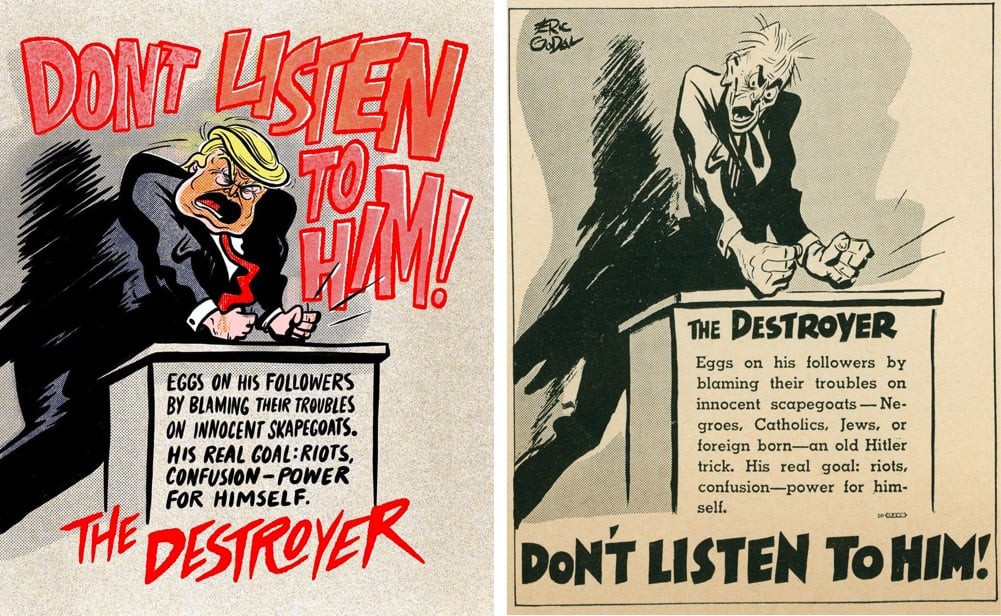
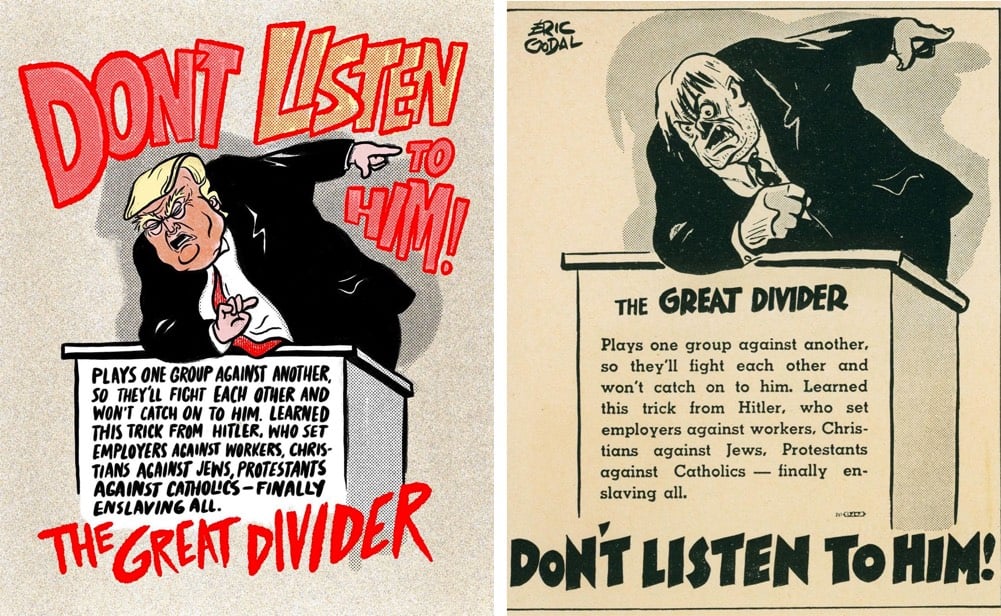
In the 1930s and 40s, artist Eric Godal drew some anti-fascist political cartoons that urged people not to listen to right-wing authoritarians who want to destroy and pillage society for their own ends. Godal, a German Jew, had escaped the clutches of Nazi Germany in the 30s and labored to warn America and the world about the fate of the Jews in Europe.1
Illustrator Chris Piascik has updated Godal’s drawings for 2020 to feature our own corrupt crackpot wannabe dictator. Calling Donald Trump a fascist is hardly controversial these days — he clearly is. What his supporters need to reckon with is: are they?
Greg Larsen on Twitter this morning:
Name someone who is universally agreed to be evil (genocidal dictator, serial killer etc) and I’ll defend them and their actions using conservative logic.
Here are some of his responses, starting with serial murderer John Wayne Gacy:
Great now the left is trying to besmirch a man who literally worked at CHILDREN’S HOSPITALS helping to cheer up sick kids by being a clown! Is there any low that the left won’t sink to, attacking a children’s entertainer? It’s just sad.
Wile E. Coyote:
Convenient that the footage starts on Wile E Coyote but we don’t see what Roadrunner was doing before hand. So this violent antifa roadrunner could be speeding around, looking for trouble and violence and the footage starts right when the Coyote is defending himself.
Emperor Palpatine:
When a leftist opposes law and order you have to wonder their motivations. Seems to me the Empire brought peace to the galaxy and it was radical leftist terrorists that were destroying that peace. Why? Because they were sad that the government wasn’t giving them handouts?
Jack the Ripper:
Criticize him all you want, but in a way he was good for the economy. Books, films, tourism, a whole genre of entertainment sprung up around him. Think of how many lives he has saved an enriched by helping the British economy. Facts don’t care about your feelings.
Kim Jong Un:
Show me literally one photo, one piece of footage, literally anything of Kim Jong Un killing anyone, or doing anything bad to anyone. I’ll wait.
And SARS-CoV-2:
Literally the hardest working virus in 2020. Creating healthcare work, bringing people together, and by every measurable standard a raging success in the virus world but that doesn’t fit the leftist narrative of “success = evil”
(thx, mark)
I ran across this Facebook post by Shannon Welch the other day and while I don’t agree with some of it (more about that in a bit), I do think there’s something to her argument that the density of the place you grew up in or have spent a lot of time in has an effect on how you view the world, your neighbors, and your political situation.
So why does this matter? Because how you were raised and how you live has a huge impact on what matters to you from your politicians and your government.
Those I know that grew up in less dense areas had to be self-reliant. When calling 911 means you’re likely waiting 20 minutes or longer for police, an ambulance, or a fire truck. You have to be able to defend yourself, handle your own first aid, and rely on your neighbors to help in critical emergency situations. When I tell people in Southern California that where I grew up had volunteer firefighters and EMTs they don’t believe me.
The more rural you are, the less you rely on government entities for your day-to-day needs. The most rural have well water, septic systems, take their trash to the dump, if it snows, they have a vehicle that can plow, and the truly rural use propane for power and heat. They are not reliant on most services provided by the public utilities. They use guns as tools to protect their animals and their family from prey and from vermin. They do not really encounter homeless people, as even the poorest can usually find a shack to live out of and require a vehicle to get around. These people in less dense areas do not depend on the government to solve their problems. They’d prefer government stay out of their lives completely. Less taxes, less oversight, less being told what to do. To the rural, it seems like every time the government interferes in their life, they lose another freedom, and their quality of life diminishes.
Those I know that grew up in more dense areas are used to calling 911 to handle emergencies. Their streets are swept in the summer and plowed in the winter. Their trash is picked up on the same day weekly. They don’t have space for cars and tools, so they tend to take public transportation or walk. They call someone when something breaks that requires tools they don’t own. They are used to encountering the homeless on the streets as part of their daily life. The truly poor and homeless usually end up in cities as the services to help the sick, mentally ill and the poorest among us are more available in dense areas. So the wealthy interact with the poor in cities far more than they do in rural areas. Those in higher density areas are willing to pay for government services because they are a regular part of their daily lives and make life more manageable. Without these services, the quality of life they know would not exist.
But I don’t think the following is at all accurate though — perhaps a case of overstatement to prove a point:
I truly believe our population density experience matters more to our political views than education, income, race, gender or sexuality.
Many people inside and outside the USPS have raised concerns over the past few weeks about changes implemented by new Postmaster General Louis DeJoy that could be interpreted as an attempt to sabotage the delivery of the expected surge in mail-in ballots this November. Two days ago, DeJoy issued a statement addressing these concerns:
I came to the Postal Service to make changes to secure the success of this organization and its long-term sustainability. I believe significant reforms are essential to that objective, and work toward those reforms will commence after the election. In the meantime, there are some longstanding operational initiatives — efforts that predate my arrival at the Postal Service — that have been raised as areas of concern as the nation prepares to hold an election in the midst of a devastating pandemic. To avoid even the appearance of any impact on election mail, I am suspending these initiatives until after the election is concluded.
He also promised that “mail processing equipment and blue collection boxes will remain where they are” and “and we reassert that overtime has, and will continue to be, approved as needed”. During a call with Speaker of the House Nancy Pelosi yesterday, DeJoy stated that “he has no intention of replacing the sorting machines, blue mailboxes and other infrastructure that have been removed”. Vice’s Aaron Gordon shared internal USPS emails that say sorting machines already removed or disconnected should not be reconnected:
Shortly after USPS Postmaster General Louis DeJoy issued a public statement saying he wanted to “avoid even the appearance” that any of his policies would slow down election mail, USPS instructed all maintenance managers around the country not to reconnect or reinstall any mail sorting machines they had already disconnected, according to emails obtained by Motherboard.
“I will not be setting that building on fire in the future,” says the arsonist as the building burns behind him. This reminds me of a story that Robert Caro told about Robert Moses in this interview.
I remember his aide, Sid Shapiro, who I spent a lot of time getting to talk to me, he finally talked to me. And he had this quote that I’ve never forgotten. He said Moses didn’t want poor people, particularly poor people of color, to use Jones Beach, so they had legislation passed forbidding the use of buses on parkways.
Then he had this quote, and I can still hear him saying it to me. “Legislation can always be changed. It’s very hard to tear down a bridge once it’s up.” So he built 180 or 170 bridges too low for buses.
We used Jones Beach a lot, because I used to work the night shift for the first couple of years, so I’d sleep til 12 and then we’d go down and spend a lot of afternoons at the beach. It never occurred to me that there weren’t any black people at the beach.
So Ina and I went to the main parking lot, that huge 10,000-car lot. We stood there with steno pads, and we had three columns: Whites, Blacks, Others. And I still remember that first column — there were a few Others, and almost no Blacks. The Whites would go on to the next page. I said, God, this is what Robert Moses did. This is how you can shape a metropolis for generations.
The situation here is reversed — e.g. “it’s very hard to rebuild a bridge once it’s torn down” — but the lesson is the same. If you take mailboxes off the streets and junk sorting machines, it’s difficult to put them back, particularly when everyone’s baseline shifts over the next few months and the decreased capacity and delays are normalized (and then exploited for political advantage). Destroying the United States Post Office would be far easier and cheaper than rebuilding it.
In her impassioned speech on the first night of the Democratic National Convention, Michelle Obama made her case for Americans to come together and vote Donald Trump out of office. In her remarks, she zeroed in on his incompetence, his total lack of empathy for anyone but himself, and his desire for division.
So let me be as honest and clear as I possibly can. Donald Trump is the wrong president for our country. He has had more than enough time to prove that he can do the job, but he is clearly in over his head. He cannot meet this moment. He simply cannot be who we need him to be for us. It is what it is.
Now, I understand that my message won’t be heard by some people. We live in a nation that is deeply divided, and I am a black woman speaking at the Democratic convention. But enough of you know me by now. You know that I tell you exactly what I’m feeling. You know I hate politics. But you also know that I care about this nation. You know how much I care about all of our children.
So if you take one thing from my words tonight, it is this: if you think things cannot possibly get worse, trust me, they can, and they will if we don’t make a change in this election. If we have any hope of ending this chaos, we have got to vote for Joe Biden like our lives depend on it.
And voting this year means putting in some extra work so that our votes count:
But this is not the time to withhold our votes in protest or play games with candidates who have no chance of winning. We have got to vote like we did in 2008 and 2012. We’ve got to show up with the same level of passion and hope for Joe Biden. We’ve got to vote early, in person if we can. We’ve got to request our mail-in ballots right now, tonight, and send them back immediately and follow up to make sure they’re received. And then, make sure our friends and families do the same.
We have got to grab our comfortable shoes, put on our masks, pack a brown-bag dinner and maybe breakfast too, because we’ve got to be willing to stand in line all night if we have to.
You can read the entire transcript of her speech or watch it above. It’s worth your time.

An anonymous USPS employee has written about the recent changes at the Post Office since new Postmaster General Louis DeJoy (“a lifelong Republican, a Trump mega-donor/fundraiser, and a high ranking RNC official”) took over and has set about gutting it from the inside.
All of the potential angles for corruption make DeJoy’s aims pretty tough to figure out. He’s a small market conservative from the private sector running a massive government agency. He’s a Trump ally running the agency responsible for ballots during an election year. He also has a direct financial interest in seeing us fail. Take your pick. You’re probably right no matter what. And judging by the chaos he’s unleashed into USPS in just his first two months, “all of the above” might be your best bet.
See, up until just two months ago, every letter carrier, clerk, mail handler, truck driver, etc, worked under one pretty simple philosophy: every piece, every address, every day. Everyone in the chain of custody for mail made sure every piece got as far along in the system as it could, and if it made it to my hands, in my office, it was getting delivered. That’s how I’ve done it for my career, how the guys who have been doing it for forty years have always done it, and that’s literally how Ben Fucking Franklin’s guys did it. You can almost hear Aaron Sorkin’s orgasm as he punches up the Bradley Whitford speech about the majesty of it all.
But two months ago is also when that abruptly stopped. After a couple hundred years, it just…stopped. On the ground floor, there’s a lot of arguing about who is ordering what, and what’s going to be permanent, and what’s going to be a trial run, but at the end of the day, the result is obvious: I go into my job, every single morning, and don’t deliver hundreds of pieces of available mail that used to get delivered. The only reason given is some vague nonsense about “operational efficiency” and “cost savings.”
And this was written before reports of sorting machines being removed without explanation ahead of a presumed huge surge of election-related mail. I think we should actually be pretty alarmed by this. Here’s Jamelle Bouie on Trump’s election night strategy (and how to counter it: vote in person):
There’s no mystery about what President Trump intends to do if he holds a lead on election night in November. He’s practically broadcasting it.
First, he’ll claim victory. Then, having spent most of the year denouncing vote-by-mail as corrupt, fraudulent and prone to abuse, he’ll demand that authorities stop counting mail-in and absentee ballots. He’ll have teams of lawyers challenging counts and ballots across the country.
He also seems to be counting on having the advantage of mail slowdowns, engineered by the recently installed Postmaster General Louis DeJoy. Fewer pickups and deliveries could mean more late-arriving ballots and a better shot at dismissing votes before they’re even opened, especially if the campaign has successfully sued to block states from extending deadlines. We might even see a Brooks Brothers riot or two, where well-heeled Republican operatives stage angry and voluble protests against ballot counts and recounts.
(via waxy)
On Tuesday, Joe Biden announced that Senator Kamala Harris would be his vice-presidential running mate. The campaign was quickly updated to include a new Biden-Harris logo designed by Hoefler&Co. in collaboration with Biden campaign advisor Robyn Kanner:

But the designer of the logo wasn’t told who the running mate would be beforehand, so how did the campaign get it out so quickly? According to Jonathan Hoefler, the design team designed a whole collection of logos for potential candidates gleaned from reading the media tea leaves.
A consequential decision at an unpredictable time, conducted under absolute secrecy, poses an interesting dilemma to the typographer: how do you create a logo without knowing for certain what the words will say? Logos, after all, are meaningfully informed by the shapes of their letters, and a logo designed for an eisenhower will hardly work for a taft. The solution, naturally, involves the absurd application of brute force: you just design all the logos you can think of, based on whatever public information you can gather. Every credible suggestion spotted in an op-ed was added to the list that we designers maintained, and not once did the campaign even hint at a preference for one name over another.
I would love to see some of those alternate designs (Biden-Warren!), but there’s no way in hell they’ll ever see the light of day, especially before the election.
Update: Several designers weigh in on the new logo. I love Debbie Millman’s take:
I never, ever thought I’d say this after a lifetime in professional branding, but on the spectrum of good branding versus effective branding, I’d say at this point it is irrelevant. Frankly, the Biden-Harris logo could have been scribbled on a napkin and I’d be happy. Trump’s brand is beyond repair and is now more dangerous than ever. The soul of our country is at stake.
That logos don’t matter that much (unless they are either great or horrible) is probably true more often than designers and branding folks would care to admit.
Kirby Ferguson, creator of the Everything Is a Remix and This Is Not a Conspiracy Theory video series, has a new video out that attempts to explain the rise of QAnon, conspiracy theories, and magical thinking in America.
Ferguson zeros in on the divide between two different ways people make sense of a complex, chaotic, and uncertain world: evidence seeking and magical thinking. All of us employ both of these techniques to help ease our anxiety about the world, but those who tend towards magical thinking arrive at explanations that are based primarily on instinct, emotion, feelings, and gut reaction while evidence seekers mostly rely on scientific and empirical reasoning.
He also identifies six main aspects of magical thinking:
1. Obsession with symbols and codes (e.g. pizza as a “deep state” code for child trafficking)
2. Dot connecting (e.g. linking 5G with Covid-19)
3. Behind every event is a plan concocted by a person (e.g. Soros and the “deep state” conspiracy)
4. Purity (e.g. the Satanic panic and heavy metal music)
5. Apocalypse is nigh (e.g. the “deep state” again)
6. Preoccupation with good and evil (e.g. liberals are not only wrong but evil)
For me, the key quote about magical thinking is this one for late in the video: “These are not systems of knowledge, and they cannot build solutions. They can only criticize and second-guess.”
At John Lewis’s funeral yesterday, Barack Obama delivered a eulogy for his friend and mentor, praising him for his achievements in the struggle for civil rights. He also took the opportunity to suggest what politicians might do to honor Lewis and to continue his struggle, beyond just words. From the text of his speech:
If politicians want to honor John, and I’m so grateful for the legacy of work of all the Congressional leaders who are here, but there’s a better way than a statement calling him a hero. You want to honor John? Let’s honor him by revitalizing the law that he was willing to die for. And by the way, naming it the John Lewis Voting Rights Act, that is a fine tribute. But John wouldn’t want us to stop there, trying to get back to where we already were. Once we pass the John Lewis Voting Rights Act, we should keep marching to make it even better.
By making sure every American is automatically registered to vote, including former inmates who’ve earned their second chance.
By adding polling places, and expanding early voting, and making Election Day a national holiday, so if you are someone who is working in a factory, or you are a single mom who has got to go to her job and doesn’t get time off, you can still cast your ballot.
By guaranteeing that every American citizen has equal representation in our government, including the American citizens who live in Washington, D.C. and in Puerto Rico. They are Americans.
By ending some of the partisan gerrymandering — so that all voters have the power to choose their politicians, not the other way around.
And if all this takes eliminating the filibuster — another Jim Crow relic — in order to secure the God-given rights of every American, then that’s what we should do.
From We Can Eliminate Covid-19 if We Want To by Andy Slavitt:
We can virtually eliminate the virus any time we decide to. We can be back to a reasonably normal existence: schools, travel, job growth, safer nursing homes and other settings. And we could do it in a matter of weeks. If we want to.
Take New Zealand. With its fancy curve and life back to normal. Why can’t we? Not fair, you say. It’s an island nation. Okay. What about Germany? Not an island nation, large, growing diversity. Don’t like that comparison? What about countries that have been in big trouble? There’s Italy, France, and Spain. Those countries had it reasonably bad the same time we did. In fact, pick virtually any country you want.
But don’t tell me the United States can’t take action if we want to. And we can’t face the families of 150,000 people who didn’t have to die and tell them this had to happen. And I think it’s why our national political leaders won’t go near these families and the grieving process.
The good news — and it is good news — is we are always four to six weeks from being able to do what countries around the world have done.
I know this article is supposed to be hopeful and optimistic, but people have known what to do about Covid-19 since at least March. Instead the United States has not done it and indeed has done mostly the opposite. The “we” that are supposed to decide to lead this effort won’t because they don’t want to put in the work (it’s easier to blame the virus, Democrats, and China), they don’t want to just give money to people to stay home (a huge no-no for Republicans), and they don’t care that much about who is dying (urbanites, low-income, the elderly, Black & brown people).
As long as Republicans control the Senate and White House, the current scattershot approach of each state/county/city/person deciding what is best (or most in their self-interest) is what we’re stuck with. Treatments will improve, vaccines will be developed, many people will do the right thing and mostly stay home for many more months (sacrificing their mental health to do so), and Covid-19 will eventually come under control, but hundreds of thousands more people will die, many more will recover but carry chronic illnesses for years, vital years of the survivors’ lives will have been lost, and we will collectively grieve these losses for generations.
From Alex Vitale, author of The End of Policing, a list of 10 Ways To Reduce Our Reliance On Policing And Make Our Communities Safer For Everyone, which includes proposals like having mental health and social workers to respond to crises, have crime labs operate independently of law enforcement, and replacing cops in schools with counselors & safety coaches.
For children growing up during the era of mass incarceration, seeing armed officers in their schools is commonplace. Federal grants have supported more and more cops in schools. Federal programs like the Community Oriented Policing Services (“COPS”) have provided millions of dollars to hire and train local police, including police in schools.
Police officers do not have specialized training in adolescent or childhood development. They are not mental health experts, social workers with licensed degrees, psychologists, or school counselors. They are not educators. To be clear, school resource officers are career law enforcement officers, with arresting authority, and a license to carry a weapon. Police officers patrol school hallways just like they do city streets. More than one and a half million students attend schools with an SRO, but no counselor.
There are better, safer, and cheaper alternatives. In 2016, Intermediate School District 287, a school west of the Twin Cities with a high concentration of students with special needs and mental health needs that can result in behavior issues, replaced their school resource officers with Student Safety Coaches. The Student Safety Coaches specialize in mental health, restorative justice, de-escalation, and building positive relationships with their students. Arrests decreased by 80 percent in the pilot school after implementation of the program.
The common, and commonsense, thread through all of these proposals is to replace armed, untrained responders who make difficult situations less safe with people & organizations that are specifically trained to help people in distress or crisis.
See also Police Abolition: The Growing Movement to Defund the Police.
Donald Trump’s idiotic brag about how well he did on a cognitive test (“Person. Woman. Man. Camera. TV.”) set to Daft Punk’s Harder, Better, Faster, Stronger.
You just have to laugh because if you actually stop to think about how much harm this man has done and will continue to do in his remaining time in office, the incandescent rage might make you pass out.
Earlier this week, Republican Representative Ted Yoho accosted Democratic Representative Alexandria Ocasio-Cortez on the steps of the Capitol Building and called her “disgusting”, “crazy”, “dangerous”, and, as a parting shot, a “fucking bitch”. After Yoho offered a non-apology on the House floor, Ocasio-Cortez responded to both the incident and his remarks in a short speech before the House.
The video is only 10 minutes long — I urge you to watch the whole thing if you haven’t seen it. It’s masterful. Here are some excerpts from the transcript.
This is not new, and that is the problem. Mr. Yoho was not alone. He was walking shoulder to shoulder with Representative Roger Williams, and that’s when we start to see that this issue is not about one incident. It is cultural. It is a culture of lack of impunity, of accepting of violence and violent language against women, and an entire structure of power that supports that. Because not only have I been spoken to disrespectfully, particularly by members of the Republican Party and elected officials in the Republican Party, not just here, but the President of the United States last year told me to go home to another country, with the implication that I don’t even belong in America. The governor of Florida, Governor DeSantis, before I even was sworn in, called me a “whatever that is”. Dehumanizing language is not new, and what we are seeing is that incidents like these are happening in a pattern. This is a pattern of an attitude towards women and dehumanization of others.
…
I do not need Representative Yoho to apologize to me. Clearly he does not want to. Clearly when given the opportunity he will not and I will not stay up late at night waiting for an apology from a man who has no remorse over calling women and using abusive language towards women, but what I do have issue with is using women, our wives and daughters, as shields and excuses for poor behavior. Mr. Yoho mentioned that he has a wife and two daughters. I am two years younger than Mr. Yoho’s youngest daughter. I am someone’s daughter too. My father, thankfully, is not alive to see how Mr. Yoho treated his daughter. My mother got to see Mr. Yoho’s disrespect on the floor of this House towards me on television and I am here because I have to show my parents that I am their daughter and that they did not raise me to accept abuse from men.
As a reminder, properly apologizing to someone requires:
1. An expression of regret - this, usually, is the actual “I’m sorry.”
2. An explanation (but, importantly, not a justification).
3. An acknowledgment of responsibility.
4. A declaration of repentance.
5. An offer of repair.
6. A request for forgiveness.
As Ocasio-Cortez correctly notes, Yoho’s attempt does not make the grade.
And so what I believe is that having a daughter does not make a man decent. Having a wife does not make a decent man. Treating people with dignity and respect makes a decent man, and when a decent man messes up as we all are bound to do, he tries his best and does apologize. Not to save face, not to win a vote, he apologizes genuinely to repair and acknowledge the harm done so that we can all move on.
Lastly, what I want to express to Mr. Yoho is gratitude. I want to thank him for showing the world that you can be a powerful man and accost women. You can have daughters and accost women without remorse. You can be married and accost women. You can take photos and project an image to the world of being a family man and accost women without remorse and with a sense of impunity. It happens every day in this country. It happened here on the steps of our nation’s Capitol. It happens when individuals who hold the highest office in this land admit, admit to hurting women and using this language against all of us.
Again, I urge you to watch the whole thing — it’s full of powerful truths expertly and passionately delivered. Among many thoughts I had while watching it, one in particular kept rising in my mind: Alexandria Ocasio-Cortez will one day be President of the United States and we will be very lucky to have her.
Update: Ocasio-Cortez didn’t write out her speech ahead of time; she jotted down a few notes just minutes before she started speaking.
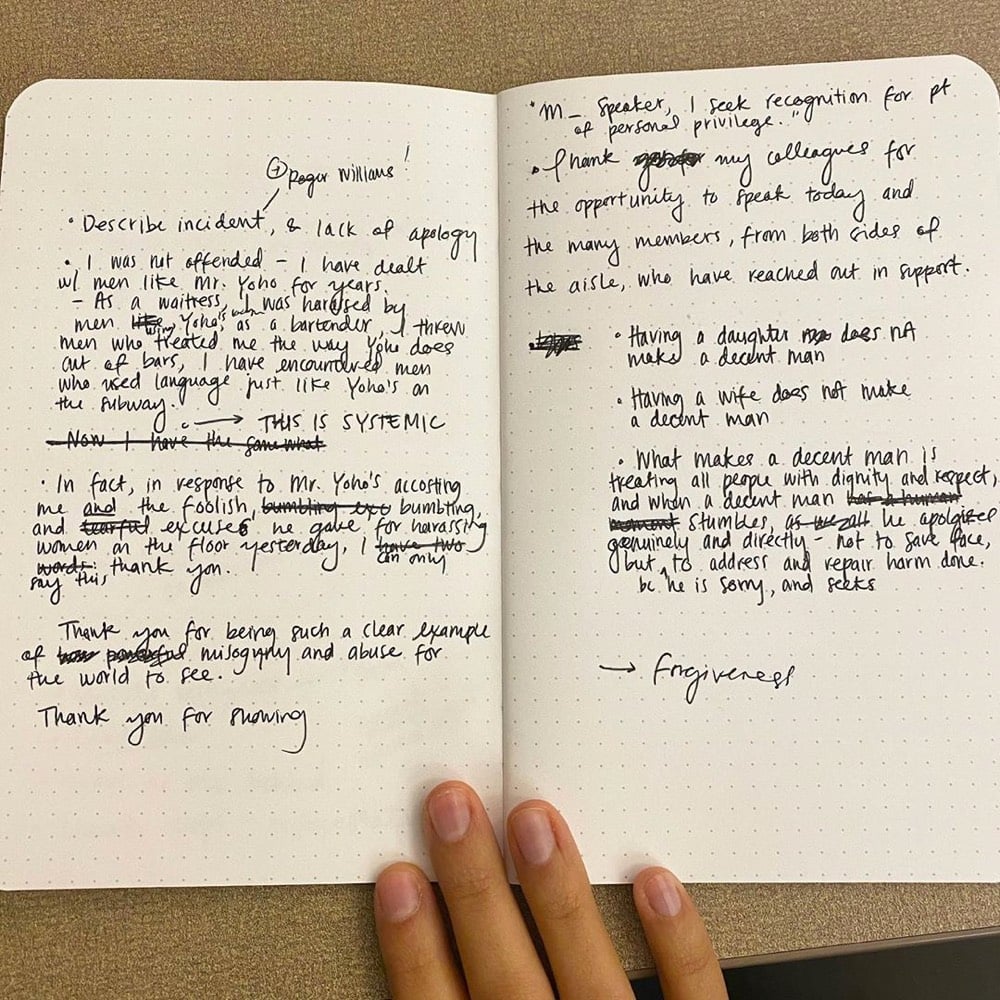
Many have asked me if my speech was pre-written. The answer is no. But in some ways, yes. Yes because this speech was a recounting of thoughts that so many women and femme people have carried since the time we were children. It flowed because every single one of us has lived this silent script: stay silent (why?), keep your head down (for whom?), suck it up (to whose benefit?). But my chosen words were largely extemporaneous. I got to the House floor about ten minutes before my speech and scribbled down some quick notes after reflecting on what had transpired over the last few days. Pictured here are all the notes I had, and from there I improvised my composition and spoke live.
Update: In a profile of Ocasio-Cortez in Vanity Fair, a new detail in this story:
This part hasn’t been reported: The next day Ocasio-Cortez approached Yoho and told him, “You do that to me again, I won’t be so nice next time.” She felt his actions had violated a boundary, stepping “into the zone of harassment, discrimination.” His mocking response, straight out of Veep: “Oh, boo-hoo.” Publicly, Yoho doubled down, issuing a non-apology on the House floor, citing his wife and daughters as character witnesses.
Newer posts
Older posts





Socials & More