kottke.org posts about politics
On Last Week Tonight last night, John Oliver took on the #brand running for President known as Donald Trump. Or, as he would have been known had one of his ancestors not changed his last name, Donald Drumpf. If you’d like to play along at home, you can install the Drumpfinator Chrome extension, which will replace any mentions of “Trump” on the web with “Drumpf”.


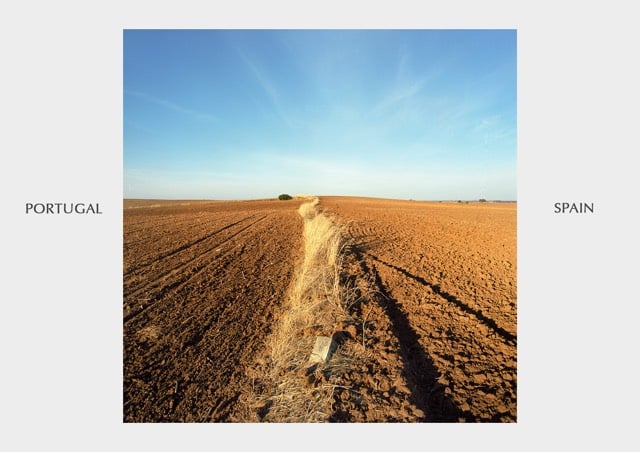
Valerio Vincenzo’s project, Borderline, the Frontiers of Peace, consists of photos of the erased borders between countries in Europe’s Schengen Area.
The Schengen Area is the area comprising 26 European countries that have abolished passport and any other type of border control at their common borders, also referred to as internal borders. It mostly functions as a single country for international travel purposes, with a common visa policy.
While visiting friends in France a few years ago, we passed the checkpoint between France and Switzerland several times a day and didn’t even bother taking our passports with us. It felt weird but good. (via @neilhalloran)
What a completely delightful video of 106-year-old Virginia McLaurin visiting the White House and meeting President and Mrs. Obama. This is the Webster’s definition of pure joy.
I don’t know much about McLaurin’s life story — she’s originally from South Carolina, first married at 14 — but when she was 10, the Civil War had ended only 55 years earlier. As a child, she likely knew and talked with people who were former slaves. And now she’s dancing with a black President in the White House. The Great Span continues to work its magic.
From the NY Times and Redglass Pictures, a video in which political advisor Mark McKinnon details how to win an election. His short answer: “successful campaigns tell a good story”. My “favorite” part is after discussing his irresponsible fear-mongering campaign for Bush in 2004, McKinnon talks about bowing out of the McCain campaign because he believed Obama was a good man and good for the country and he didn’t want to smear him. Wish he could have moved procuring a conscience up a few years. NSFW if you, like me, see George W. Bush and involuntarily start loudly swearing like a sailor.
Laura June likes Bernie Sanders in many ways but is going to vote for Hillary Clinton because Clinton is a woman.
As with many issues that stem from the fact of my motherhood — breast-feeding, co-sleeping — I speak only for myself, and cannot generalize my experience from “I am” to “you should.” I only know in my heart that I simply don’t want my daughter to grow up in a world where a woman has never been president. And if not now, when?
I’m a woman, and a mother, and I’m voting for Hillary Clinton for my daughter, and for her future.
If I had a vote to cast in the upcoming NY Democratic primary, I would also vote for Hillary Clinton and also because she is a woman. I believe the most important and longest-lasting effect of Barack Obama’s election in 2008 is that tens of millions of kids (of all racial backgrounds) got to experience an African American being President. Those kids are going to grow up knowing, and not just theoretically, that a non-white person can be elected (and even re-elected) President of the United States. Clinton’s election would send a similar message to those same kids (both girls and boys): a woman can be elected President. I think it would have a huge future effect, more than any of the policy differences between her and Sanders, especially back-to-back with an Obama presidency.
President Obama announces a ban on the use of solitary confinement for juveniles in federal prisons.
How can we subject prisoners to unnecessary solitary confinement, knowing its effects, and then expect them to return to our communities as whole people? It doesn’t make us safer. It’s an affront to our common humanity.
Here’s Obama’s Op-Ed on the topic.
“It crushes your spirit and weakens your resistance more effectively than any other form of mistreatment.” That’s a quote on solitary from John McCain from an old New Yorker piece from Atul Gawande: Hellhole. (via nextdraft)
Last week, after the State of the Union address, President Obama was interviewed by three prominent YouTube users. Oh, the outcry that arose! (Even though he did the same thing last year.) The President giving valuable country-running time over to mere social media stars, what has this country come to?
Well, it turns out if you get different kinds of people asking different kinds of questions, you’re going to get answers you normally wouldn’t hear. Case in point: Ingrid Nilsen was one of the three YouTubers chosen to interview the President. She asked him to talk about a meaningful item from his house and the President told a wonderful story about what he carries in his pockets every day:
Obama continues to be delightful and Nilsen might be my new favorite person after watching her YT channel for a bit this morning. I mean, just watch the first few minutes of this video where she came out to her viewers.
They should have roped Mothersbaugh in on the music, but this was actually really informative! And the Bobby Jindal slow-mo was [kiss-fingers emoji].
From a current Washington DC resident and father, an opinion piece in the NY Times called Guns Are Our Shared Responsibility.
Even as I continue to take every action possible as president, I will also take every action I can as a citizen. I will not campaign for, vote for or support any candidate, even in my own party, who does not support common-sense gun reform. And if the 90 percent of Americans who do support common-sense gun reforms join me, we will elect the leadership we deserve.
All of us have a role to play - including gun owners. We need the vast majority of responsible gun owners who grieve with us after every mass shooting, who support common-sense gun safety and who feel that their views are not being properly represented, to stand with us and demand that leaders heed the voices of the people they are supposed to represent.
The gun industry also needs to do its part. And that starts with manufacturers.
As Americans, we hold consumer goods to high standards to keep our families and communities safe. Cars have to meet safety and emissions requirements. Food has to be clean and safe. We will not end the cycle of gun violence until we demand that the gun industry take simple actions to make its products safer as well. If a child can’t open a bottle of aspirin, we should also make sure she can’t pull the trigger of a gun.
I applaud the President for his actions, but I am skeptical of technological solutions to social and political problems about guns. I don’t know about you, but my son has been able to open child-proof medicine bottles since he was about 5 years old. Two-year-olds can unlock iPhones and make in-app purchases. The idea of a “safe gun” is a dangerous oxymoron — there’s always the matter of the metal designed to rip through human flesh.
President Obama is meeting with Attorney General Loretta Lynch today to discuss possible executive actions to curb gun violence.
Recalling the 2012 school shooting in Newtown, Conn., that killed 26 people — 20 of them children — and left many grimly hopeful it would lead to an overhaul of the nation’s gun laws, the president accused lawmakers of bowing to the gun lobby and blocking necessary changes.
“All across America, survivors of gun violence and those who lost a child, a parent, a spouse to gun violence are forced to mark such awful anniversaries every single day,” Mr. Obama said. “And yet Congress still hasn’t done anything to prevent what happened to them from happening to other families.”
Good.
Update: Obama announced his plans for increased gun control today in an emotional speech. Vox has an explanation of the actions that will be taken.
In the midst of this piece by Matt Taibbi on Republican presidential candidates blaming media bias for their outright falsehoods are two paragraphs which perfectly sum up the state of contemporary news media:
It’s our fault. We in the media have spent decades turning the news into a consumer business that’s basically indistinguishable from selling cheeseburgers or video games. You want bigger margins, you just cram the product full of more fat and sugar and violence and wait for your obese, over-stimulated customer to come waddling forth.
The old Edward R. Murrow, eat-your-broccoli version of the news was banished long ago. Once such whiny purists were driven from editorial posts and the ad people over the last four or five decades got invited in, things changed. Then it was nothing but murders, bombs, and panda births, delivered to thickening couch potatoes in ever briefer blasts of forty, thirty, twenty seconds.
If Americans are getting intellectually fat and lazy binging on junk news, perhaps the solution is something akin to “Eat food, not too much, mostly plants,” Michael Pollan’s advice for healthy eating: Follow the news, not too much, mostly facts.
Update: I was reminded that Clay Johnson wrote an entire book called The Information Diet (at Amazon).
The modern human animal spends upwards of 11 hours out of every 24 in a state of constant consumption. Not eating, but gorging on information ceaselessly spewed from the screens and speakers we hold dear. Just as we have grown morbidly obese on sugar, fat, and flour-so, too, have we become gluttons for texts, instant messages, emails, RSS feeds, downloads, videos, status updates, and tweets.
We’re all battling a storm of distractions, buffeted with notifications and tempted by tasty tidbits of information. And just as too much junk food can lead to obesity, too much junk information can lead to cluelessness. The Information Diet shows you how to thrive in this information glut-what to look for, what to avoid, and how to be selective. In the process, author Clay Johnson explains the role information has played throughout history, and why following his prescribed diet is essential for everyone who strives to be smart, productive, and sane.
Johnson spoke at Webstock the same year I did…here’s a video of his talk about Industrialized Ignorance. (via @philipashlock)
Tyler Cowen on Republican presidential candidate Ben Carson and our selective preference for some religious beliefs over others.
Loyal MR readers will know that I am myself a non-believer. But what I find strangest of all is not Ben Carson’s pyramids beliefs, but rather the notion that we should selectively pick on some religious claims rather than others. The notion that it is fine to believe something about a deity or deities, or a divine book, as long as you do not take that said belief very seriously and treat it only as a social affiliation or an ornamental badge of honor.
To the non-believer, the Scientologist’s belief in thetans and the vengeful sky god of Christianity are both equally implausible.
In the New Yorker, Nicholas Lemann writes about “the Southernization of American politics”. In 1865, the United States won the Civil War against the South, but the current US has been significantly shaped by the ideals, politics, and values of the South.
In order to become the richest and most powerful country in the world, the United States had to include the South, and its inclusion has always come at a price. The Constitution (with its three-fifths compromise and others) awkwardly registered the contradiction between its democratic rhetoric and the foundational presence of slavery in the thirteen original states. The 1803 Louisiana Purchase-by which the U.S. acquired more slaveholding territory in the name of national expansion-set off the dynamic that led to the Civil War. The United States has declined every opportunity to let the South go its own way; in return, the South has effectively awarded itself a big say in the nation’s affairs.
(via @jimray)
It’s the Pope’s first time in America and we sent him straight to Congress. That doesn’t exactly seem like we’re putting our best foot forward. In his historic speech to a joint session of Congress, Pope Francis addressed climate change, capitalism, the death penalty and immigration. MoJo pulled out the ten most important lines from the speech.
“This Pope often operates through symbolism and gestures that convey his intentions in ways that words never could.” The New Yorker on Pope Francis and his little Fiat.
At Vox, David Roberts argues that tech nerds are too dismissive and ignorant of politics, particularly if they are as interested as they say they are in changing the world. The piece includes this fascinating one-paragraph take on the state of contemporary American politics:
So that’s where American politics stands today: on one side, a radicalized, highly ideological demographic threatened with losing its place of privilege in society, politically activated and locked into the House; on the other side, a demographically and ideologically heterogeneous coalition of interest groups big enough to reliably win the presidency and occasionally the Senate. For now, it’s gridlock.
Larry Lessig is raising funds for running for President in the 2016 election. Lessig would run as a “referendum president”, whose single task would be to pass a package of reforms called the Citizens Equality Act of 2017, and then resign to allow his Vice President to take over.
The Citizens Equality Act of 2017 consists of three parts: make it as easy as possible to vote, end the gerrymandering of political districts, and base campaign funding on all eligible voters, not just corporations or the wealthy.
Four years ago, Cenk Uygur of The Young Turks told Netroots Nation, “There is only one issue in this country,” and he was referring to the corrupt funding of public elections.
That corruption is part of a more fundamental inequality that we’ve allowed the politicians to create: we don’t have a Congress that represents us equally.
Every issue - from climate change to gun safety, from Wall Street reform to defense spending - is tied to this “one issue.” Achieving citizens equality in America is our one mission.
Read why he wants to run and watch his pitch:
This is a long shot (and he likely knows it), but I wish him well…it’s a worthy and important goal.
Update: Lessig has dropped the resignation option from his campaign. He is all in on running for President.
Jon Stewart visited the White House. And Obama visited The Daily Show. That gives you some idea of the influence — on both sides of the aisle — Jon Stewart has built up over his tenure.
Jon Stewart slipped unnoticed into the White House in the midst of the October 2011 budget fight, summoned to an Oval Office coffee with President Barack Obama that he jokingly told his escort felt like being called into the principal’s office.
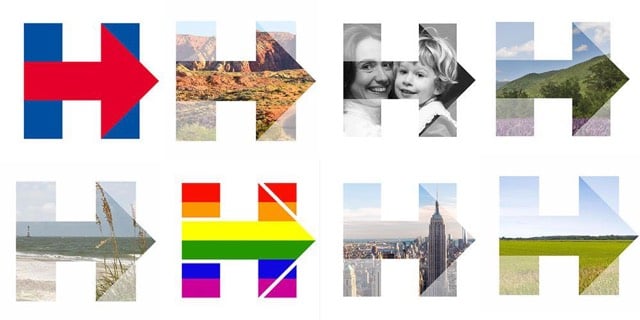
Soon after the logo for Hillary Clinton’s campaign was revealed, I wrote “I am not a big fan of the arrowed H”. Well, the campaign’s clever use of the logo has won me over. Quartz’s Annalisa Merelli explains.
It is through all these iterations that Clinton’s logo fully displays its iconic value: It is highly recognizable despite the changes, and the much-criticized right-facing red arrow is now appears as it was likely meant to: pointing the way forward. The different backgrounds aren’t just an innovative graphic solution-they are the visual embodiment of the values Clinton is building her campaign around. It vehicles a leadership based on collectivity and inclusiveness rather than the elitist individualism Clinton is often accused of.
I saw Mad Max: Fury Road yesterday (enjoyed it) but have a few questions.
1. With gasoline in such short supply, I’m surprised the various groups in the movie didn’t take more advantage of solar power to generate energy for electric vehicles and such. Sunshine is obviously abundant in post-apocalyptic Australia and from the looks of what was scavenged from before the nuclear war and the ingenuity on display in getting what they found to function, they should have been able to find even rudimentary solar cells and get them to work.
2. Speaking of energy scarcity, I wonder if the troop-pumping-up and opponent-intimidating function of the flamethrowing guitar player was worth all of the fuel spewed out of the end of his instrument and energy consumed by the incredible number of speakers on his rig.
3. The roads in the movie were in remarkable shape, aside from the swampland. Who was responsible for their upkeep? Even dirt roads need maintenance or they develop potholes and washboarding. And for what reason were they kept in such good condition outside of the Citadel/Gas Town/Bullet Farm area? Aside from Furiosa’s Rig, the chase party, and two smallish motorcycle gangs, I saw no other vehicular traffic on the roads…and who would have been semi-regularly traveling out past the canyon anyway? To where? For what?
4. What was the political and economic arrangement between the Citadel, Gas Town, and the Bullet Farm? Did the Citadel trade their water and crops for gas and bullets? Or was Immortan Joe, as the defender of the lone source of abundant fresh water in the region, the defacto leader of all three groups? The People Eater and Bullet Farmer certainly came a’running when Joe needed help retrieving his wives. There were obviously other sources of water in the region — how else did the biker gangs survive? — so you’d think that Gas Town and the Bullet Farm could have teamed up to squeeze Joe into giving them a better deal or even overthrowing him. Point is, there seemed to be a surprising lack of political friction between the three groups, which seems odd in an environment of scarcity.
5. Surely land was plentiful enough that large solar stills could have generated enough fresh water for people to live on without having to rely on the Citadel for it.
Update: Reddit has a go at answering some of these questions. (via @pavel_lishin)
In The Plot Against Trains, Adam Gopnik muses about how infrastructure in America has become dilapidated in part because we (or at least much of we) believe little good can come from the government.
What an ideology does is give you reasons not to pursue your own apparent rational interest — and this cuts both ways, including both wealthy people in New York who, out of social conviction, vote for politicians who are more likely to raise their taxes, and poor people in the South who vote for those devoted to cutting taxes on incomes they can never hope to earn. There is no such thing as false consciousness. There are simply beliefs that make us sacrifice one piece of self-evident interest for some other, larger principle.
What we have, uniquely in America, is a political class, and an entire political party, devoted to the idea that any money spent on public goods is money misplaced, not because the state goods might not be good but because they would distract us from the larger principle that no ultimate good can be found in the state. Ride a fast train to Washington today and you’ll start thinking about national health insurance tomorrow.
The ideology of individual autonomy is, for good or ill, so powerful that it demands cars where trains would save lives, just as it places assault weapons in private hands, despite the toll they take in human lives. Trains have to be resisted, even if it means more pollution and massive inefficiency and falling ever further behind in the amenities of life — what Olmsted called our “commonplace civilization.”
The way he brings it back to trains at the end is lovely:
A train is a small society, headed somewhere more or less on time, more or less together, more or less sharing the same window, with a common view and a singular destination.
Well, except when you’re on that Snowpiercer train. Although in the end (spoiler!), Curtis brought the train’s segregated society back to “a common view and a singular destination” by crashing it and killing (almost) everyone on it. Hopefully America isn’t headed toward the same end.
Seymour Hersh, writing for the London Review of Books, says that the American account of how Osama bin Laden was located, captured, and killed is not entirely true. In particular, he alleges that bin Laden was being held in Pakistan since 2006 and that members of the Pakistani military knew of and supported the raid.
It’s been four years since a group of US Navy Seals assassinated Osama bin Laden in a night raid on a high-walled compound in Abbottabad, Pakistan. The killing was the high point of Obama’s first term, and a major factor in his re-election. The White House still maintains that the mission was an all-American affair, and that the senior generals of Pakistan’s army and Inter-Services Intelligence agency (ISI) were not told of the raid in advance. This is false, as are many other elements of the Obama administration’s account. The White House’s story might have been written by Lewis Carroll: would bin Laden, target of a massive international manhunt, really decide that a resort town forty miles from Islamabad would be the safest place to live and command al-Qaida’s operations? He was hiding in the open. So America said.
And the plan all along was to kill bin Laden…the Pakistanis insisted on it.
It was clear to all by this point, the retired official said, that bin Laden would not survive: ‘Pasha told us at a meeting in April that he could not risk leaving bin Laden in the compound now that we know he’s there. Too many people in the Pakistani chain of command know about the mission. He and Kayani had to tell the whole story to the directors of the air defence command and to a few local commanders.
‘Of course the guys knew the target was bin Laden and he was there under Pakistani control,’ the retired official said. ‘Otherwise, they would not have done the mission without air cover. It was clearly and absolutely a premeditated murder.’ A former Seal commander, who has led and participated in dozens of similar missions over the past decade, assured me that ‘we were not going to keep bin Laden alive - to allow the terrorist to live. By law, we know what we’re doing inside Pakistan is a homicide. We’ve come to grips with that. Each one of us, when we do these missions, say to ourselves, “Let’s face it. We’re going to commit a murder.”’ The White House’s initial account claimed that bin Laden had been brandishing a weapon; the story was aimed at deflecting those who questioned the legality of the US administration’s targeted assassination programme. The US has consistently maintained, despite widely reported remarks by people involved with the mission, that bin Laden would have been taken alive if he had immediately surrendered.
Hersh is a regular contributor to the New Yorker — he broke the Abu Ghraib story in the pages of the magazine — so I wonder why this story didn’t appear there? Perhaps because it goes against the grain of their own reporting on the subject?
Update: Max Fisher writes in Vox that Hersh’s story has many problems — inconsistencies and thin sourcing to start — and is indicative of Hersh’s “slide off the rails” from investigative journalism to conspiracy theories.
On Sunday, the legendary investigative journalist Seymour Hersh finally released a story that he has been rumored to have been working on for years: the truth about the killing of Osama bin Laden. According to Hersh’s 10,000-word story in the London Review of Books, the official history of bin Laden’s death — in which the US tracked him to a compound in Abottabad, Pakistan; killed him a secret raid that infuriated Pakistan; and then buried him at sea —- is a lie.
Hersh’s story is amazing to read, alleging a vast American-Pakistani conspiracy to stage the raid and even to fake high-level diplomatic incidents as a sort of cover. But his allegations are largely supported only by two sources, neither of whom has direct knowledge of what happened, both of whom are retired, and one of whom is anonymous. The story is riven with internal contradictions and inconsistencies.
The story simply does not hold up to scrutiny — and, sadly, is in line with Hersh’s recent turn away from the investigative reporting that made him famous into unsubstantiated conspiracy theories.
The single source for most of the juiciest details in the piece was the most glaring issue. My Spidey Sense started tingling as I read the latter third…it sounded like Hersh was quoting some dude in a bar who “had a friend who told me this story”. I wonder how much of this was fact-checked and corroborated?
And on Hersh’s affiliation with the New Yorker, they repeatedly rejected the story:
(Indeed, when I first heard about Hersh’s bin Laden story a few years from a New Yorker editor — the magazine, the editor said, had rejected it repeatedly, to the point of creating bad blood between Hersh and editor-in-chief David Remnick — this was the version Hersh was said to favor.)
If you look at Hersh’s page at the NYer, his contributions have dropped off. His only piece in the past two years was a revisiting of his earlier reporting on My Lai. (via @tskjockey)
Update: From Gabriel Sherman at New York Magazine, Why Seymour Hersh’s ‘Alternative’ bin Laden History Did Not Appear in The New Yorker.
When I spoke to Hersh earlier today, it was clear that there is tension. Hersh told me that he published the piece in the LRB because Remnick was not interested in having him write a magazine piece on the bin Laden raid. Hersh explained that, days after the May 2, 2011 SEAL operation, he told Remnick that his intelligence sources were saying Obama’s account was fiction. “I knew right away that there were problems with the story,” Hersh told me. “I just happen to have sources. I’m sorry, but I do.” Hersh told Remnick he wanted to write a piece for the magazine.
“David said, ‘Do a blog,’” Hersh recalled. “I said, ‘I don’t want to do a blog.’ It’s about money. I get paid a lot more writing a piece for The New Yorker [magazine] … I’m old and cranky.” (Remnick declined to comment).
Through reporting of its own, NBC News has confirmed parts of Hersh’s story.
The NBC News sources who confirm that a Pakistani intelligence official became a “walk in” asset include the special operations officer and a CIA officer who had served in Pakistan. These two sources and a third source, a very senior former U.S. intelligence official, also say that elements of the ISI were aware of bin Laden’s presence in Abbottabad. The former official was emphatic about the ISI’s awareness, saying twice, “They knew.”
R.J. Hillhouse claims she should get credit for breaking this story because of two pieces she wrote in 2011, using information from “clearly different” sources.
Inspired by the logo for Hillary Clinton’s 2016 Presidential run, designer Rick Wolff created an entire uppercase alphabet for a typeface he’s calling Hillvetica.
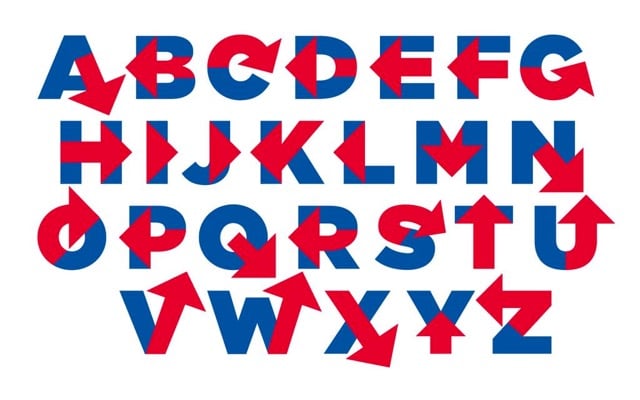
From his Twitter stream, it appears that Wolff is attempting to make an actual Hillvetica font so stay tuned. FYI, Pentagram partner Michael Bierut designed the logo. The simplicity is appealing, but overall I am not a big fan of the arrowed H.
Update: The Washington Post made a little text editor so you can write whatever you want in Hillvetica. The Clinton campaign has already put it to use:
President Obama delivered two key messages during his speech in Selma over the weekend. One, it’s a mistake to suggest that racism is banished in America.
We don’t need the Ferguson report to know that’s not true.
And two, we’ve made a lot of progress:
If you think nothing’s changed in the past 50 years, ask somebody who lived through the Selma or Chicago or L.A. of the Fifties. Ask the female CEO who once might have been assigned to the secretarial pool if nothing’s changed. Ask your gay friend if it’s easier to be out and proud in America now than it was thirty years ago. To deny this progress — our progress — would be to rob us of our own agency; our responsibility to do what we can to make America better.
It’s worth putting politics and cynicism aside long enough to consider that on Saturday, a black President spoke at the foot of the Edmund Pettus Bridge in Selma. There’s a long way to go, but that’s a hell of a 50 years.
This collection of political cartoons depict the FCC’s recent ruling on net neutrality as Big Government throttling the free internet, except that every caption has been replaced with “the cartoonist has no idea how net neutrality works”. Here’s one example followed by the unadulterated cartoon:
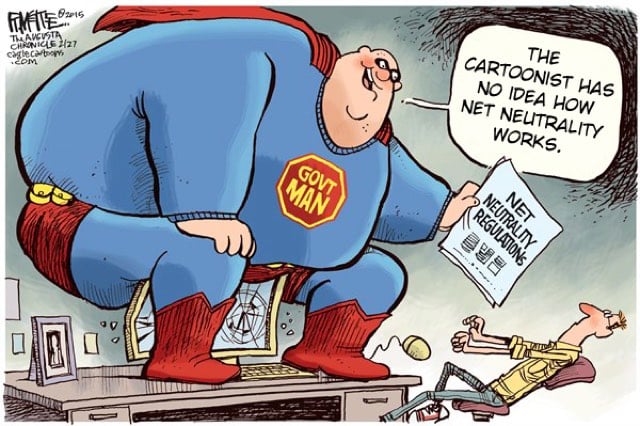
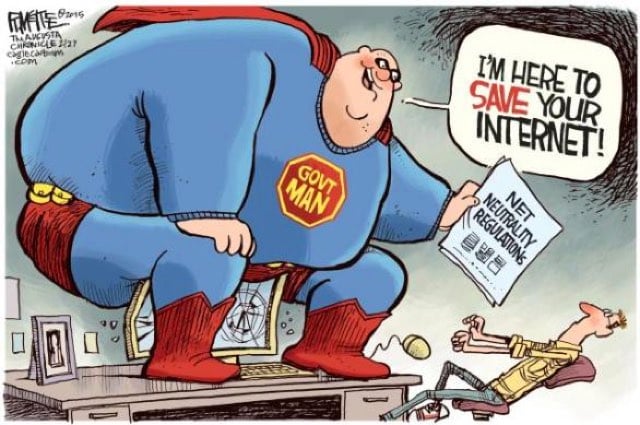
The zingers get zinged. (via @john_overholt)
Today I learned that the US government considers the US border as extending 100 miles into the country. This means that states like Maine, Michigan, and Florida are entirely within the border area and 2/3 of the US population lives within the border.
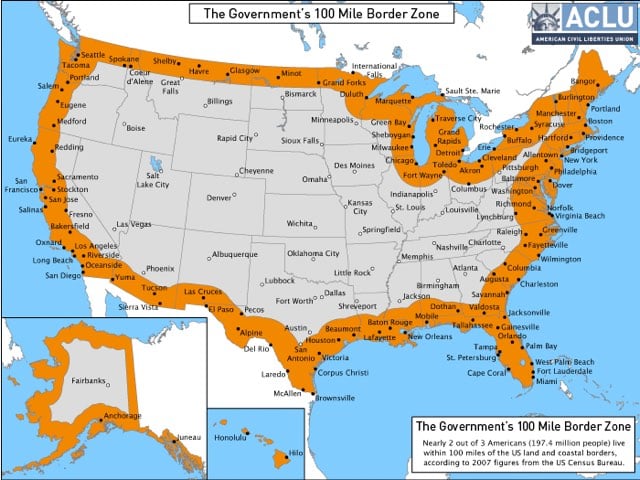
The problem with this, from the standpoint of the ACLU, is that Border Patrol agents have “certain extra-Constitutional powers” within this area and “routinely” overstep their bounds and violate the constitutional rights of innocent people.
See also 35 maps that explain how America is a nation of immigrants. (via @tcarmody)
Update: So, as you may know, I am not a Constitutional lawyer or even a regular lawyer. The ACLU presumably employs and/or utilizes experts on Constitutional and immigration law. But they have a viewpoint, right? They are interested in the civil liberties of individual Americans. Anyway, Scott Bomboy of the National Constitution Center (who is also not a lawyer), notes that the US has a couple of different ideas of what a border is and what can be done at or within each kind of border is slightly different.
Legally, the 100-mile-wide region is called the “extended border” of the U.S., as defined by Title 8 of the Federal Code of Regulations. There is also something called the “functional equivalent” border, which is the area around international airports in the interior region of the U.S.
The DHS ruling from last Friday said its “warrantless searches” applied to the U.S. “border and its functional equivalent,” with no mention of the extended 100-mile border.
Two analysis papers from the Congressional Research Service from 2009 offer some legal insight into what tactics agents can follow within the 100-mile-wide extended border, and why the distinction between the extended border and the other two borders is important.
Searches within the 100-mile extended border zone, and outside of the immediate border-stop location, must meet three criteria: a person must have recently crossed a border; an agent should know that the object of a search hasn’t changed; and that “reasonable suspicion” of a criminal activity must exist, says the CRS. (The service had done the legal analyses to prepare Congress members for legislation.)
“Although a search at the border’s functional equivalent and an extended border search require similar elements, the extended border search entails a potentially greater intrusion on a legitimate expectation of privacy. Thus, an extended border search always requires a showing of ‘reasonable suspicion’ of criminal activity, while a search at the functional equivalent of the border may not require any degree of suspicion whatsoever,” the CRS says.
In November of 2014, This American Life aired a piece on several people who record on video their interactions with Border Patrol agents at inland checkpoints.
So if you haven’t spent much time in the Southwest, you might not know about this. But there are these Border Patrol checkpoints that are just like in the middle of highway interstates and other roads, not at the border, not even near the border. They’re as far as 100 miles from the border.
There are dozens of these interior or inland checkpoints across the country. They’re mostly in California, Arizona, New Mexico, and Texas. But now there are a couple in Vermont, New Hampshire, and Washington state. You know that you’re approaching one of these checkpoints, because the speed limit will suddenly drop to 45 miles an hour and then 25. You’ll slow down, and you stop, you see these orange cones coming up. And then often there’s this big sort of tent-looking structure, like, right in the middle of the highway.
And then you stop, and you’re right in the middle of the highway. And an agent in uniform, an armed agent walks up and asks you questions like, are you an American citizen? Sometimes he asks to look in your trunk. All this so they can catch undocumented immigrants and drug smugglers.
I’ve been through one of these checkpoints in VT, about 40-50 miles from the Canadian border, and hey, these checkpoints really make you feel like a criminal…like if you seem nervous they’re going to pull you over and detain you because you seem like you’ve done something wrong. And that’s what the ACLU is concerned about: Border Agents routinely treating law-abiding US citizens as criminals far from their true areas of jurisdiction. Again from This American Life, one guy got his car window broken at a checkpoint because he did not want to cooperate with the agents:
Violence like this doesn’t happen a lot in these videos, but it does happen. Agents also broke the window of that pastor I mentioned earlier, Steven Anderson. They tased him and bloodied his face.
In Robert’s case, he says the agents seized his cameras, put him in handcuffs, drove him far away to a holding cell, and detained him for hours. Then they drove them even farther away to El Cajon, California, let him out late at night at a bus station, and drove off.
You can watch the video here:
The glass is broken at ~11:00. (thx, @harryh & martha)
Steven Brill has written a book about the making of the Affordable Care Act called America’s Bitter Pill: Money, Politics, Backroom Deals, and the Fight to Fix Our Broken Healthcare System.
America’s Bitter Pill is Steven Brill’s much-anticipated, sweeping narrative of how the Affordable Care Act, or Obamacare, was written, how it is being implemented, and, most important, how it is changing — and failing to change — the rampant abuses in the healthcare industry. Brill probed the depths of our nation’s healthcare crisis in his trailblazing Time magazine Special Report, which won the 2014 National Magazine Award for Public Interest. Now he broadens his lens and delves deeper, pulling no punches and taking no prisoners.
Malcolm Gladwell has a review in the New Yorker this week.
Brill’s intention is to point out how and why Obamacare fell short of true reform. It did heroic work in broadening coverage and redistributing wealth from the haves to the have-nots. But, Brill says, it didn’t really restrain costs. It left incentives fundamentally misaligned. We needed major surgery. What we got was a Band-Aid.
I haven’t read his book yet, but I agree with Brill on one thing: the ACA1 did not go nearly far enough. Healthcare and health insurance are still a huge pain in the ass and still too expensive. My issues with healthcare particular to my situation are:
- As someone who is self-employed, insurance for me and my family is absurdly expensive. After the ACA was enacted, my insurance cost went up and the level of coverage went down. I’ve thought seriously about quitting my site and getting an actual job just to get good and affordable healthcare coverage.
- Doctors aren’t required to take any particular health insurance. So when I switched plans, as I had to when the ACA was enacted, finding insurance that fit our family’s particular set of doctors (regular docs, pediatrician, pediatric specialist that one of the kids has been seeing for a couple of years, OB/GYN, etc.) was almost impossible. We basically had one plan choice (not even through the ACA marketplace…see next item) or we had to start from scratch with new doctors.
- Many doctors don’t take the ACA plans. My doctor doesn’t take any of them and my kids’ doc only took a couple. And they’re explicit in accepting, say, United Healthcare’s regular plan but not their ACA plan, which underneath the hood is the exact same plan that costs the same and has the same benefits. It’s madness.
- The entire process is designed to be confusing so that insurance companies (and hospitals probably too) can make more money. I am an educated adult whose job is to read things so they make enough sense to tell others about them. That’s what I spend 8+ hours a day doing. And it took me weeks to get up to speed on all the options and pitfalls and gotchas of health insurance…and I still don’t know a whole lot about it. It is the most un-user-friendly thing I have ever encountered.
The ACA did do some great things, like making everyone eligible for health insurance and getting rid of the preexisting conditions bullshit, and that is fantastic…the “heroic work” mentioned by Gladwell. But the American healthcare system is still an absolute shambling embarrassment when you compare it to other countries around the world, even those in so-called “developing” or “third world” countries. And our political system is just not up to developing a proper plan, so I guess we’ll all just limp along as we have been. Guh.
This is disgusting and awful and monstrous and I don’t even know what to say about it. The NY Times lists seven key points (full article) from a report released by the Senate Select Committee on Intelligence about the CIA’s torture practices. We knew it was bad, suspected it was worse, but this is just beyond.
The report describes extensive waterboarding as a “series of near drownings” and suggests that more prisoners were subjected to waterboarding than the three prisoners the C.I.A. has acknowledged in the past. The report also describes detainees being subjected to sleep deprivation for up to a week, medically unnecessary “rectal feeding” and death threats. Conditions at one prison, described by a clandestine officer as a “dungeon,” were blamed for the death of a detainee, and the harsh techniques were described as leading to “psychological and behavioral issues, including hallucinations, paranoia, insomnia, and attempts at self-harm and self-mutilation.”
This is surely the shit sandwich on top of an already unbearable year. I agree wholeheartedly with Vermont Senator Bernie Sanders, who issued this statement about the report:
A great nation must be prepared to acknowledge its errors. This report details an ugly chapter in American history during which our leaders and the intelligence community dishonored our nation’s proud traditions. Of course we must aggressively pursue international terrorists who would do us harm, but we must do so in a way that is consistent with the basic respect for human rights which makes us proud to be Americans.
“The United States must not engage in torture. If we do, in an increasingly brutal world we lose our moral standing to condemn other nations or groups that engage in uncivilized behavior.
This Frank Rich interview with Chris Rock is fantastic, full of keen comedic, political, and sociological insights from Rock.
Q: What do you think of how he’s done? Here we are in the last two years of his presidency, and there’s a sense among his supporters of disappointment, that he’s disengaged.
A: I’m trying to figure out the right analogy. Everybody wanted Michael Jordan, right? We got Shaq. That’s not a disappointment. You know what I mean? We got Charles Barkley. It’s still a Hall of Fame career. The president should be graded on jobs and peace, and the other stuff is debatable. Do more people have jobs, and is there more peace? I guess there’s a little more peace. Not as much peace as we’d like, but I mean, that’s kind of the gig. I don’t recall anybody leaving on an up. It’s just that kind of job. I mean, the liberals that are against him feel let down because he’s not Bush. And the thing about George Bush is that the kid revolutionized the presidency. How? He was the first president who only served the people who voted for him. He literally operated like a cable network. You know what I mean?
Q: He pandered to his target audience.
A: He’s the first cable-television president, and the thing liberals don’t like about Obama is that he’s a network guy. He’s kind of Les Moonves. He’s trying to get everybody. And I think he’s figured out, and maybe a little late, that there’s some people he’s never going to get.
And this:
Q: What would you do in Ferguson that a standard reporter wouldn’t?
A: I’d do a special on race, but I’d have no black people.
Q: Well, that would be much more revealing.
A: Yes, that would be an event. Here’s the thing. When we talk about race relations in America or racial progress, it’s all nonsense. There are no race relations. White people were crazy. Now they’re not as crazy. To say that black people have made progress would be to say they deserve what happened to them before.
Q: Right. It’s ridiculous.
A: So, to say Obama is progress is saying that he’s the first black person that is qualified to be president. That’s not black progress. That’s white progress. There’s been black people qualified to be president for hundreds of years. If you saw Tina Turner and Ike having a lovely breakfast over there, would you say their relationship’s improved? Some people would. But a smart person would go, “Oh, he stopped punching her in the face.” It’s not up to her. Ike and Tina Turner’s relationship has nothing to do with Tina Turner. Nothing. It just doesn’t. The question is, you know, my kids are smart, educated, beautiful, polite children. There have been smart, educated, beautiful, polite black children for hundreds of years. The advantage that my children have is that my children are encountering the nicest white people that America has ever produced. Let’s hope America keeps producing nicer white people.
Q: It’s about white people adjusting to a new reality?
A: Owning their actions. Not even their actions. The actions of your dad. Yeah, it’s unfair that you can get judged by something you didn’t do, but it’s also unfair that you can inherit money that you didn’t work for.
The US and China, the two largest carbon polluters in the world, have struck an accord on climate change.
As part of the agreement, Mr. Obama announced that the United States would emit 26 percent to 28 percent less carbon in 2025 than it did in 2005. That is double the pace of reduction it targeted for the period from 2005 to 2020.
China’s pledge to reach peak carbon emissions by 2030, if not sooner, is even more remarkable. To reach that goal, Mr. Xi pledged that so-called clean energy sources, like solar power and windmills, would account for 20 percent of China’s total energy production by 2030.
Here’s the official statement from the White House. The NY Times calls the agreement “ambitious” and a “landmark”, but Tyler Cowen says:
People, the China emissions “deal” isn’t much more than a press release…
But James Fallows, who has written extensively on China recently, is more positive.
The United States and China have apparently agreed to do what anyone who has thought seriously about climate has been hoping for, for years. As the No. 1 (now China) and No. 2 carbon emitters in the world, and as the No. 1 (still the U.S.) and No. 2 economies, they’ve agreed to new carbon-reduction targets that are more ambitious than most people would have expected.
Today, President Obama came out strongly for net neutrality and asked for the FCC’s help in implementing his plan.
More than any other invention of our time, the Internet has unlocked possibilities we could just barely imagine a generation ago. And here’s a big reason we’ve seen such incredible growth and innovation: Most Internet providers have treated Internet traffic equally. That’s a principle known as “net neutrality” — and it says that an entrepreneur’s fledgling company should have the same chance to succeed as established corporations, and that access to a high school student’s blog shouldn’t be unfairly slowed down to make way for advertisers with more money.
That’s what President Obama believes, and what he means when he says there should be no gatekeepers between you and your favorite online sites and services.
Tim Wu, who coined the term “net neutrality”, reacted positively to the President’s statement.
With another compromise looming, the President today released a video that suggests, in short, that he’s had it. In unusually explicit terms, he has told the agency exactly what it should do. Enough with the preëmptive compromises, the efforts to appease the carriers, and other forms of wiggle and wobble. Instead, the President said, enact a clear, bright-line ban on slow lanes, and fire up the agency’s strongest legal authority, Title II of the 1934 Communications Act, the “main guns” of the battleship F.C.C.
Motherboard notes that the classification of the internet as a utility would not include rate regulations.
To do this, Obama said the FCC should reclassify internet services as a utility, but should do it in a way that has slightly different rules than say, an electric company. Obama’s suggested rules focus specifically on net neutrality and service interruption, not prices, a concession to big telecom companies.
“I believe the FCC should reclassify consumer broadband service under Title II of the Telecommunications Act — while at the same time forbearing from rate regulation and other provisions less relevant to broadband services,” he said.
In a series of tweets, historian Yoni Appelbaum connects the dots between net neutrality and the Affordable Care Act a bit more elegantly than Ted Cruz did:
Obama’s call for net neutrality his latest effort to grow the economy by defending equality of opportunity. The ACA is the biggest boon for entrepreneurs in generations, allowing individuals to take economic risks without risking their health. The common thread here is a policy framework giving individuals the same access to essential resources as enormous institutions. Obama prefers to stress commonalities than to define his policies in such oppositional terms. But still, that’s what he’s doing here.
This makes me think of Tom Junod’s piece on increased access passes at a water park, The Water-Park Scandal and the Two Americas in the Raw: Are We a Nation of Line-Cutters, Or Are We the Line?
It wouldn’t be so bad, if the line still moved. But it doesn’t. It stops, every time a group of people with Flash Passes cut to the front. You used to be able to go on, say, three or four rides an hour, even on the most crowded days. Now you go on one or two. After four hours at Whitewater the other day, my daughter and I had gone on five. And so it’s not just that some people can afford to pay for an enhanced experience. It’s that your experience — what you’ve paid full price for — has been devalued. The experience of the line becomes an infernal humiliation; and the experience of avoiding the line becomes the only way to enjoy the water park. You used to pay for equal access; now you have to pay for access that’s more equal than the access afforded others. The commonality of experience is lost, and the lines are striated not simply by who can pay for a Flash Pass and who can’t; they’re also striated by race and class. The people sporting the Flash Passes are almost exclusively white, and they tend to be in better shape than those stuck on line. They tend to have fewer tattoos, and to look less, well, pagan. And by the end of the day, they start cutting lines where Flash Passes don’t even apply — because they feel entitled to — and none of them, not even their kids, will so much as look at you.
I think 2008 and 2012 Obama voters are nodding their heads here at Appelbaum’s and Junod’s thoughts…Obama’s statement on net neutrality and the rationale behind it is what they voted for. If you watched any of Ken Burns’ The Roosevelts on PBS, you’ll recognize this is right out of TR’s and FDR’s playbooks. Worth noting also that Teddy was a Republican and FDR a Democrat.
Newer posts
Older posts





Socials & More