kottke.org posts about politics

In the 1930s, almost a decade before the nation’s young men would be shipped overseas to combat the foul stench of Hitler wafting across Europe, official and unofficial rallies for the Nazi party were held in Madison Square Garden.
Shortly after Adolf Hitler’s appointment as Chancellor of Germany in January 1933, the Nazis consolidated control over the country. Looking to cultivate power beyond the borders of Germany, Deputy Führer Rudolf Hess charged German-American immigrant Heinz Spanknobel with forming a strong Nazi organization in the United States.
Combining two small extant groups, Spanknobel formed Friends of New Germany in July 1933. Counting both German nationals and Americans of German descent among its membership, the Friends loudly advocated for the Nazi cause, storming the offices of New York’s largest German-language paper, countering Jewish boycotts of German businesses and holding swastika-strewn rallies in black-and-white uniforms.
A later group, which only disbanded at the end of 1941, were prominently pro-American and featured iconography of George Washington as “the first Fascist”. (I would have gone for “the Founding Fascist”…catchier.)
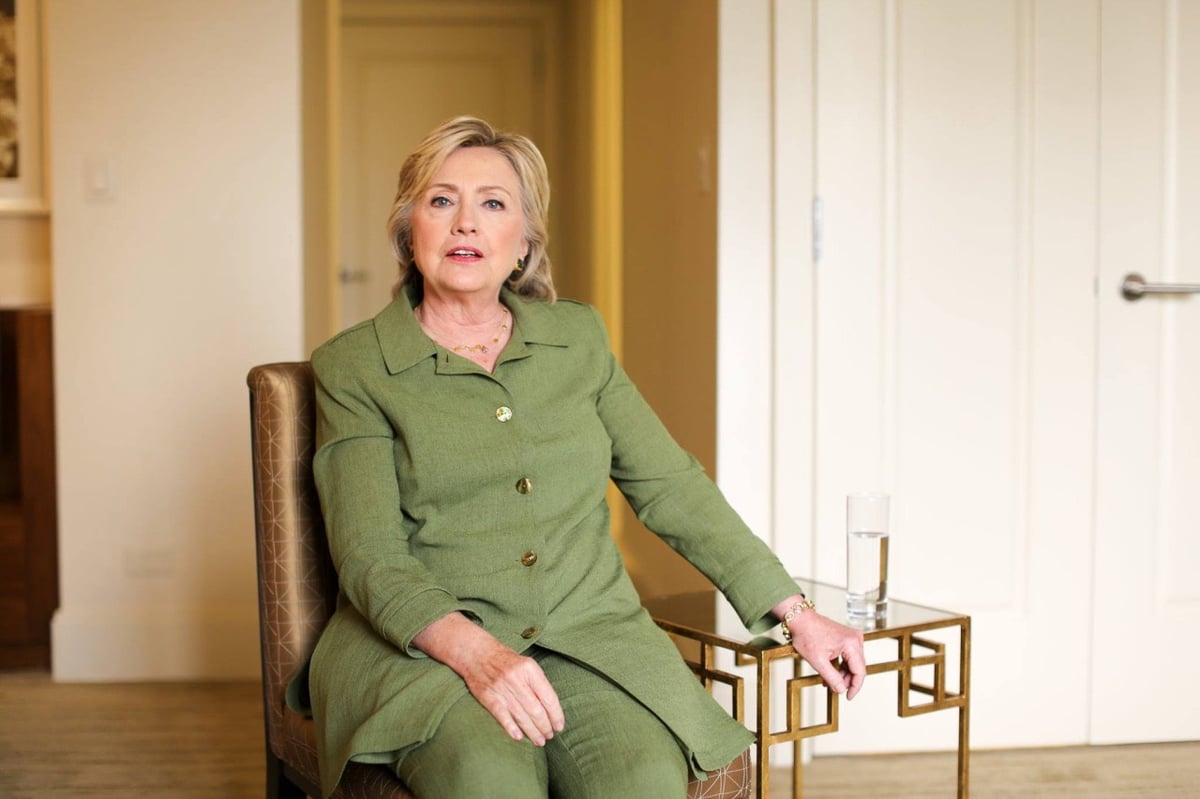
Humans of New York recently caught up with Hillary Clinton and she talked about how her public persona came to be.
I know that I can be perceived as aloof or cold or unemotional. But I had to learn as a young woman to control my emotions. And that’s a hard path to walk. Because you need to protect yourself, you need to keep steady, but at the same time you don’t want to seem ‘walled off.’ And sometimes I think I come across more in the ‘walled off’ arena. And if I create that perception, then I take responsibility. I don’t view myself as cold or unemotional. And neither do my friends. And neither does my family. But if that sometimes is the perception I create, then I can’t blame people for thinking that.
Clinton is just a different type of politician than her husband or Obama, for good reason.
Women are seen through a different lens. It’s not bad. It’s just a fact. It’s really quite funny. I’ll go to these events and there will be men speaking before me, and they’ll be pounding the message, and screaming about how we need to win the election. And people will love it. And I want to do the same thing. Because I care about this stuff. But I’ve learned that I can’t be quite so passionate in my presentation. I love to wave my arms, but apparently that’s a little bit scary to people. And I can’t yell too much. It comes across as ‘too loud’ or ‘too shrill’ or ‘too this’ or ‘too that.’ Which is funny, because I’m always convinced that the people in the front row are loving it.
When she says “it’s not bad,” that’s a perfect illustration of not being able to say exactly what you want how you want. A woman gets excited and she seems deranged or unhinged but a man gets excited and he’s seen as passionate? That seems bad to me.
P.S. Clinton is reading Elena Ferrante’s Neapolitan novels!
“You know what I have started reading and it’s just hypnotic is the Neapolitan novels by Elena Ferrante,” she tells Linsky, commenting on Ferrante’s intoxicating novels about female relationships in Naples, Italy that have an intense cult following. “I had to stop myself so I read the first one. I could not stop reading it or thinking about it.”
They’re the best fiction I’ve read in ages…so sad I’ve finished them all.
This video for Nobody Speak by DJ Shadow feat. Run The Jewels is one of the best music videos I’ve seen in a long time.
Says DJ Shadow: “We wanted to make a positive, life-affirming video that captures politicians at their election-year best. We got this instead.”
Says Run The Jewels’ Killer Mike: “It’s such a dope video. It’s what I really wish Trump and Hillary would just do and get it over with…And even in that fight I think Hillary would win — and that’s not an endorsement.”
The album is one of my faves so far…you get listen to it here or here.
You could argue that the world has never been better: war is increasingly rare, medical science has cured a number of the deadliest diseases, global poverty is down, life expectancy is up, and crime in America is down. But it sure doesn’t seem that way, especially with Brexit, climate change, Trump, Syria, and terrorist incidents around the world. Oliver Burkeman explores some of the reasons why we think the sky is continually falling and what we can do to be happy anyway. I have been thinking about this aspect of it recently:
And there is another, subtler reason you might find yourself convinced that things are getting worse and worse, which is that our expectations outpace reality. That is, things do improve — but we raise our expectations for how much better they ought to be at a faster rate, creating the illusion that progress has gone into reverse.
See also George Saunders’ manifesto from People Reluctant To Kill for an Abstraction.
The Clinton campaign is currently wrestling with how to prepare for the first debate with Trump coming up at the end of September. Part of that challenge is picking a proper sparring partner for the mock debates.
It’s one of the most uncomfortable and important jobs in Democratic politics: trying to embarrass the woman who could be the next president.
The person picked to be Hillary Clinton’s sparring partner in her upcoming debate prep sessions is expected to confront her about the death of Vincent Foster, label her a rapist’s enabler, and invoke the personally painful memories of Monica Lewinsky and Gennifer Flowers.
I’ve been thinking about this since the Republican convention and there’s an obvious choice here: Stephen Colbert. Clinton needs to prepare to deftly counter energetically delivered nonsense, personal insults, and things no politician would ever say. Does that sound like the host of a certain Comedy Central show? Colbert’s smart, quick, knows the issues, and, with his talent, could tweak his Colbert Report persona toward the Trumpesque. He wouldn’t have a problem tearing Clinton down in person; he did the same thing to George W. Bush at the 2006 White House Correspondents Dinner. I bet he’d jump at the chance to do it too. Let’s make this happen, America!
Update: They’re getting closer…
At least a few old Clinton hands have suggested enlisting professional entertainers, like Jon Stewart or Alec Baldwin.
Colbert! He could do it with his eyes shut!
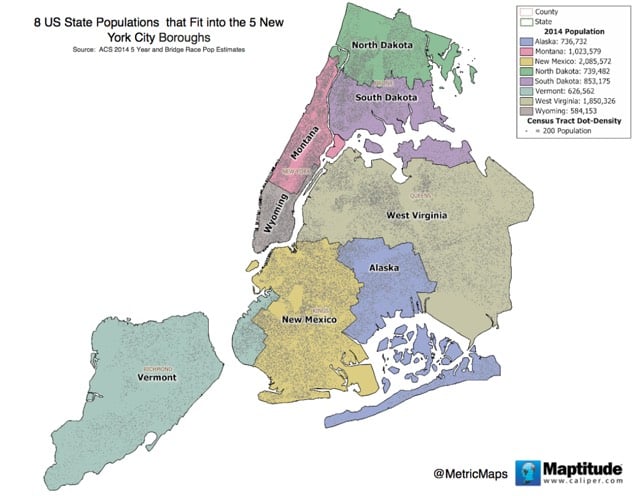
The population of NYC is equal to the combined populations of Vermont, Alaska, New Mexico, North Dakota, South Dakota, Wyoming, Montana, and West Virginia. Here’s what that looks like on a map.
Put another way: 16 US Senators represent as many people in those states as a fraction of one of New York States’ Senators represent the population of NYC. A Senator from Wyoming represents 290,000 people while one from New York represents 9.8 million people…and in California, there are 19 million people per Senator. That gives a Wyoming resident 65 times the voting power of a California resident.
Billy West, who does the voice of Futurama’s Zapp Brannigan, is taking quotes from Donald Trump and speaking them in Brannigan’s voice. This is silly and dumb, but I can’t help loving these.
Update: The addition of Kif’s reactions really takes these to the next level.
Kif sighs for all of America. And this one, I mean…if they wrote this dialogue for the show it would be rejected because not even Zapp is that outlandishly dim and egotistical.
In the biggest water miracle since Christ walked on the Sea of Galilee,1 Israel has turned certain drought into a surplus of water. Conservation helped — low-flow shower heads, recycling waste water for crop irrigation — but much of the gain came from vastly improved desalinization techniques, which they hope can spread across the region and the world.
We are standing above the new Sorek desalination plant, the largest reverse-osmosis desal facility in the world, and we are staring at Israel’s salvation. Just a few years ago, in the depths of its worst drought in at least 900 years, Israel was running out of water. Now it has a surplus. That remarkable turnaround was accomplished through national campaigns to conserve and reuse Israel’s meager water resources, but the biggest impact came from a new wave of desalination plants.
Perhaps the world won’t end in water wars after all.
Update: Of course, technological advances can affect politics in many ways. Instead of sharing the tech, Israel can use their water advantage to put political pressure on their neighbors, as when Israel cut water supplies to the West Bank earlier this year during Ramadan.
Even without politics, desalinization is problematic…there’s the small matter of where to put all that salt:
Brine disposal is a big problem in much of the Middle East. The gulf, along with the Red and Mediterranean seas, are turning saltier because of desalination by-products — and the region is the epicenter of desalination worldwide, with the United Arab Emirates, Saudi Arabia, Kuwait, Qatar, Bahrain and Oman making up 45 percent of global desalination capacity. This brine is typically twice as salty as seawater, and advanced desalination plants still produce approximately two cubic meters of waste brine for every one cubic meter of clean water.
(thx, jennifer & nathan)
Now that Donald Trump’s officially the Republican candidate, here’s a summary of how a party once led by Abraham Lincoln came to select Mr. Orange as their #1. The Republican Party hasn’t been “the party of Lincoln” for many decades now, but I’m sure Abe is spinning particularly rapidly in his grave over his party’s latest turn. (As I’m sure Andrew Jackson and Jefferson Davis have been doing as well over the past eight years.)
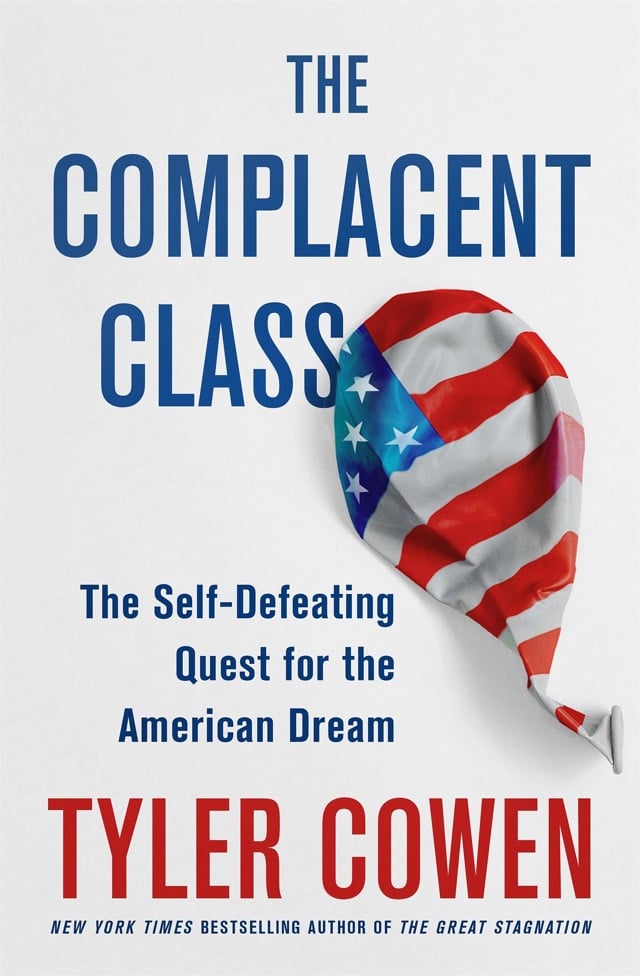
The Complacent Class is a forthcoming book by Tyler Cowen.
Since Alexis de Tocqueville, restlessness has been accepted as a signature American trait. Our willingness to move, take risks, and adapt to change have produced a dynamic economy and a tradition of innovation from Ben Franklin to Steve Jobs.
The problem, according to legendary blogger, economist and bestselling author Tyler Cowen, is that Americans today have broken from this tradition — we’re working harder than ever to avoid change. We’re moving residences less, marrying people more like ourselves and choosing our music and our mates based on algorithms that wall us off from anything that might be too new or too different. Match.com matches us in love. Spotify and Pandora match us in music. Facebook matches us to just about everything else.
Of course, this “matching culture” brings tremendous positives: music we like, partners who make us happy, neighbors who want the same things. We’re more comfortable. But, according to Cowen, there are significant collateral downsides attending this comfort, among them heightened inequality and segregation and decreased incentives to innovate and create.
Cowen is also releasing another book called Stubborn Attachments: A Vision for a Society of Free, Prosperous, and Responsible Individuals.
In that work, I outline a true and objectively valid case for a free and prosperous society, and consider the importance of economic growth for political philosophy, how and why the political spectrum should be reconfigured, how we should think about existential risk, what is right and wrong in Parfit and Nozick and Singer and effective altruism, how to get around the Arrow Impossibility Theorem, to what extent individual rights can be absolute, how much to discount the future, when redistribution is justified, whether we must be agnostic about the distant future, and most of all why we need to “think big.”
It is only available by emailing him that you’ve pre-ordered The Complacent Class. Oh, and a reminder about how I (try to) read books.
From the transcript of the video:
Disturbingly, many of Trump’s early measures didn’t require mass repression. His speeches exploited people’s fear and ire to drive their support behind him and the Republican party. Meanwhile, businessmen and intellectuals, wanting to be on the right side of public opinion, endorsed Trump. They assured themselves and each other that his more extreme rhetoric was only for show.
Oh sorry, looks like autocorrect misspelled “Hitler” a couple times there. (Boy, Godwin’s law makes it difficult to talk about the historical comparisons, although Mike Godwin himself sanctioned the comparison if “you’re thoughtful about it and show some real awareness of history”. Not sure I’m meeting the standard here, but at least we’ve learned something about Hitler?)
As Elon Musk plans to introduce a fleet of completely autonomous self-driving vehicles to America’s roads, another PayPal co-founder is giving a speech in support of Donald Trump at the Republican National Convention. But why exactly is a canny libertarian with a penchant for undermining the fundamental pillars of democracy to forward his own personal aims supporting Trump? Jeff Bercovici has a not-so-crazy theory:
I think Peter Thiel supports Donald Trump because he believes it’s a once-in-a-lifetime opportunity to weaken America’s attachment to democratic government.
I’m not accusing Thiel of any ambitions he hasn’t more or less copped to. In an often-quoted 2009 essay, Thiel declared, “I no longer believe that freedom and democracy are compatible.”
He also wrote that his fellow libertarians were on a “fool’s errand” trying to achieve their ends through political means: “In our time, the great task for libertarians is to find an escape from politics in all its forms — from the totalitarian and fundamentalist catastrophes to the unthinking demos that guides so-called ‘social democracy.’”
Here’s the essay Bercovici refers to: The Education of a Libertarian. Tyler Cowen, who interviewed Thiel last year and admires him (or at least finds his views interesting), has another take on Thiel’s support of Trump, which is perhaps related to Bercovici’s:
The Straussian interpretation of the Republican Convention is the correct one, which is perhaps one reason why Peter Thiel will be speaking there. They are not saying what they are saying, in fact they are saying “the world is going to hell, and many of those amongst us have been traitorously disloyal. That is why we scream out stupidities, debase ourselves, and court attention by waving our arms in ridiculous ways. We are a small church seeking to become larger.” Is that not how many smaller churches behave? Is that not how some of the early branches of the Christian church behaved? Did they have any influence?
What does Donald Trump actually want? What does Thiel want? What do Republican voters want? I’d wager their actual goals have less to do with the party’s official platform and what people are saying at the convention and more to do with broader opportunities to gain power that arise from disruption and the energetic application of fear.
Norman Ornstein and Thomas Mann argue that the Republican Party has been radicalized and Trump is the result.
Trumpism may have parallels in populist, nativist movements abroad, but it is also the culmination of a proud political party’s steady descent into a deeply destructive and dysfunctional state.
While that descent has been underway for a long time, it has accelerated its pace in recent years. We noted four years ago the dysfunction of the Republican Party, arguing that its obstructionism, anti-intellectualism, and attacks on American institutions were making responsible governance impossible. The rise of Trump completes the script, confirming our thesis in explicit fashion.
A number of political thinkers have penned a non-partisan letter to supporters of Donald Trump. The letter is striking for its non-confrontational tone in nevertheless painting Trump as a dangerous authoritarian.
We aren’t criticizing or praising Mr. Trump’s policy proposals or his likely appointments. Our objection to him is deeper-we believe that his entire way of behaving represents a rejection of the essential character traits (the “qualities”) that our democracy requires of its leaders. We of course acknowledge that policy positions matter. But doesn’t political behavior inimical to democracy matter more?
A good read, but I’m skeptical of its impact. I keep thinking of Tyler Cowen’s description of the Brexit vote as “the one lever” for sending a political message to the country’s leaders:
Cities such as Bradford, while still predominantly white, no longer feel as English (and German!) as they once did. And if you are thinking that voting “Leave” does not at all limit Pakistani immigration, you are truly missing the point; this vote was the one lever the English were given for sending a message to their politicians.
Many Americans share a frustration of the current political system and how it is wielded against us in our name by skilled political practitioners, but I do not believe the US is a country filled with small-minded, intolerant racists, despite the perplexing level of national support for a proudly dishonest and bigoted TV personality, whatever his keen political instincts. Trump is the one lever being given to those frustrated voters for sending a message to their politicians and many are choosing to use it despite many of the reasons listed in that letter. Sending that message is more important than its potential consequences. (via @marcprecipice)
Evan Puschak examines the rise of the independence movement in Britain, from their entrance into the European Community in 1973 to Thatcher’s rumblings about EU governance to UKIP’s rise, culminating in Brexit last week. I thought this was a pretty succinct summary of right-wing political tactics:
And that’s the point about far-right political organizations: they use the fulcrum of populism and fear to lift many times their weight in people.
Update: More on the history of the movement to withdraw Britain from the EU from Gary Younge in The Guardian.
According to the first national election forecast by FiveThirtyEight, Hillary Clinton has an 80.3% chance of winning the Presidency.
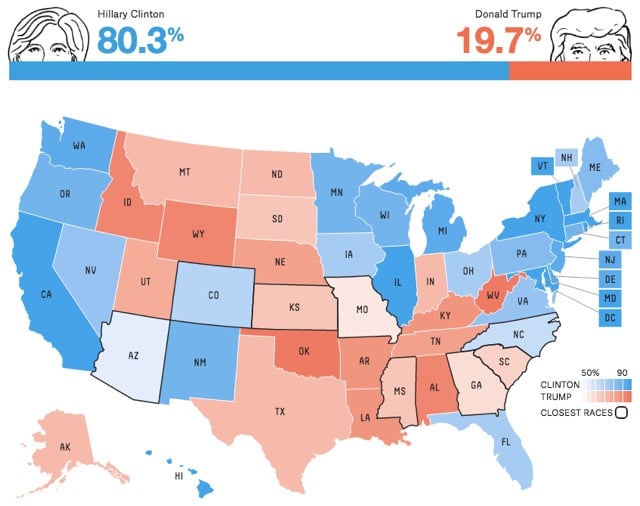
A 20% Trump chance is waaaaay too close for my comfort…that’s better odds than ending up dead playing one round of Russian roulette. We gotta Mondale that Cheeto-faced shitgibbon.
Perhaps it’s just wishful thinking or the social media filter bubble I’m in, but there seems to be a more-than-zero chance that Britain won’t actually leave the European Union, despite last Thursday’s vote. For one thing, as I mentioned in my Friday AM post about Brexit, the vote is not legally binding. The Prime Minister needs to invoke Article 50 of the Treaty on European Union, which has not happened yet.
But there’s no requirement that the UK invoke Article 50 in a timely fashion. Indeed, both Cameron and Johnson have said they think it’s appropriate to dawdle; Cameron says he’ll leave the decision to invoke to his successor, and Johnson has said there’s no rush.
It wouldn’t be tenable for the government to just completely ignore the vote forever, even though that is legally permissible.
But perhaps not untenable. A Guardian commenter speculates that Cameron did something politically canny when he passed the buck to his successor. As the full ramifications of Leave become apparent, it may be that the consequences of leaving will be transferred from the voters to the person who decides to invoke Article 50…i.e. it may become politically untenable to leave.
Throughout the campaign, Cameron had repeatedly said that a vote for leave would lead to triggering Article 50 straight away. Whether implicitly or explicitly, the image was clear: he would be giving that notice under Article 50 the morning after a vote to leave. Whether that was scaremongering or not is a bit moot now but, in the midst of the sentimental nautical references of his speech yesterday, he quietly abandoned that position and handed the responsibility over to his successor.
And as the day wore on, the enormity of that step started to sink in: the markets, Sterling, Scotland, the Irish border, the Gibraltar border, the frontier at Calais, the need to continue compliance with all EU regulations for a free market, re-issuing passports, Brits abroad, EU citizens in Britain, the mountain of legistlation to be torn up and rewritten … the list grew and grew.
The referendum result is not binding. It is advisory. Parliament is not bound to commit itself in that same direction.
The Conservative party election that Cameron triggered will now have one question looming over it: will you, if elected as party leader, trigger the notice under Article 50?
Who will want to have the responsibility of all those ramifications and consequences on his/her head and shoulders?
There’s also been talk that Scotland could veto Brexit.
Scotland’s First Minister Nicola Sturgeon has told the BBC that Holyrood could try to block the UK’s exit from the EU.
She was speaking following a referendum on Thursday which saw Britain vote by 52% to 48% to leave Europe.
However, in Scotland the picture was different with 62% backing Remain and 38% wanting to go.
SNP leader Ms Sturgeon said that “of course” she would ask MSPs to refuse to give their “legislative consent”.
But perhaps the most heartening bit of information comes courtesy of David Allen Green: that boat never did get named “Boaty McBoatface”, vote or no vote. Prime Minister David Attenborough anyone?
Update: From Gideon Rachman at the FT: I do not believe Brexit will happen.
Any long-term observer of the EU should be familiar with the shock referendum result. In 1992 the Danes voted to reject the Maastricht treaty. The Irish voted to reject both the Nice treaty in 2001 and the Lisbon treaty in 2008.
And what happened in each case? The EU rolled ever onwards. The Danes and the Irish were granted some concessions by their EU partners. They staged a second referendum. And the second time around they voted to accept the treaty. So why, knowing this history, should anyone believe that Britain’s referendum decision is definitive?
Update: John Cassidy writing for the New Yorker:
As reality sets in, E.U. leaders may well be content to let the Brits stew in their own juices for a while. Initial talk of forcing the U.K. to begin the process of leaving straight away has been replaced by calls for patience. Monday’s edition of the Wall Street Journal quoted Angela Merkel’s chief of staff, Peter Altmaier, as saying, “Politicians in London should have the possibility to think again about the fallout from an exit.” To leave now, he added, “would be a deep cut with far-reaching consequences.” A majority of the politicians at Westminster probably agree with Altmaier’s analysis. But what, if anything, can they do to reverse the march toward Brexit?
I awoke at 3am last night, perhaps having sensed a disturbance in the Force, read a late-night text from a friend that said, “BREXIT!!” and spent the next two hours reading, shocked and alarmed, about Britain’s voting public’s decision to leave the European Union. Although according to a piece by David Allen Green in the FT, the decision is not legally binding and nothing will immediately change with regard to Britain’s laws or EU member status, the outcome is nevertheless distressing for the reasons outlined succinctly by an FT commenter.
A quick note on the first three tragedies. Firstly it was the working classes who voted for us to leave because they were economically disregarded and it is they who will suffer the most in the short term from the dearth of jobs and investment. They have merely swapped one distant and unreachable elite for another one. Secondly, the younger generation has lost the right to live and work in 27 other countries. We will never know the full extent of the lost opportunities, friendships, marriages, and experiences we will be denied. Freedom of movement was taken away by our parents, uncles, and grandparents in a parting blow to a generation that was already drowning in the debts of our predecessors. Thirdly and perhaps most significantly, we now live in a post-factual democracy. When the facts met the myths they were as useless as bullets bouncing off the bodies of aliens in a HG Well novel. When Michael Gove said ‘the British people are sick of experts’ he was right. But can anybody tell me the last time a prevailing culture of anti-intellectualism has lead to anything other than bigotry?
Reading this and casting your mind to Trump and the upcoming US election is not that difficult.
I’ve been thinking a lot about a book I read several years ago by Robert Wright called Nonzero: The Logic of Human Destiny. In it, Wright argues that cooperation among individuals and ever-larger groups has been essential in pushing biological and cultural evolution forward. From the first chapter of the book:
The survey of organic history is brief, and the survey of human history not so brief. Human history, after all, is notoriously messy. But I don’t think it’s nearly as messy as it’s often made out to be. Indeed, even if you start the survey back when the most complex society on earth was a hunter-gatherer village, and follow it up to the present, you can capture history’s basic trajectory by reference to a core pattern: New technologies arise that permit or encourage new, richer forms of non-zero-sum interaction; then (for intelligible reasons grounded ultimately in human nature) social structures evolve that realize this rich potential — that convert non-zero-sum situations into positive sums. Thus does social complexity grow in scope and depth.
This isn’t to say that non-zero-sum games always have win-win outcomes rather than lose-lose outcomes. Nor is it to say that the powerful and the treacherous never exploit the weak and the naive; parasitic behavior is often possible in non-zero-sum games, and history offers no shortage of examples. Still, on balance, over the long run, non-zero-sum situations produce more positive sums than negative sums, more mutual benefit than parasitism. As a result, people become embedded in larger and richer webs of interdependence.
The atmosphere of xenophobia on display in the US, Britain, and elsewhere in Europe is affecting our ability to work together for a better future together. World War II ended more than 70 years ago, long enough in the past that relatively few are still alive who remember the factors that led to war and the sort of people who pushed for it. Putin, Brexit, Trump, the Front National in France…has the West really forgotten WWII? If so, God help us all.
P.S. I also have a couple of contemporary songs running through my head about all this. The first is What Comes Next? from the Hamilton soundtrack:
What comes next?
You’ve been freed
Do you know how hard it is to lead?
You’re on your own
Awesome. Wow
Do you have a clue what happens now?
And the second is a track from Beyonce’s Lemonade, Don’t Hurt Yourself:
When you hurt me, you hurt yourself
Try not to hurt yourself
When you play me, you play yourself
Don’t play yourself
When you lie to me, you lie to yourself
You only lying to yourself
When you love me, you love yourself
Britain just played itself.
Update: Excellent op-ed in the LA Times by Brian Klaas and Marcel Dirsus.
This is the glaring contradiction in the muscular nationalism of right-wing populism, blended with isolationism, that seeks to withdraw from international unions: It cannot shape a better world by shutting the world out. The same people who cheer when Trump laments the decline of American leadership want to ignore key global issues and put “America First.” The people who voted for Brexit, attempting to create a border between Britain and challenges such as the refugee crisis, seem to think Britain can solve such problems without consulting Germany or France or, worst of all to them, Brussels.
The world doesn’t work that way, and it hasn’t for decades. Ever-increasing globalization has created an unprecedented surge in prosperity, but it has also ushered in jarring changes. The rough edges of those changes can only be overcome with more aggressive cooperation and engagement, not less. Whether it’s the risks of terrorism, the tragic flow of refugees, or economic shocks, Britain cannot solve problems alone and neither can the United States.
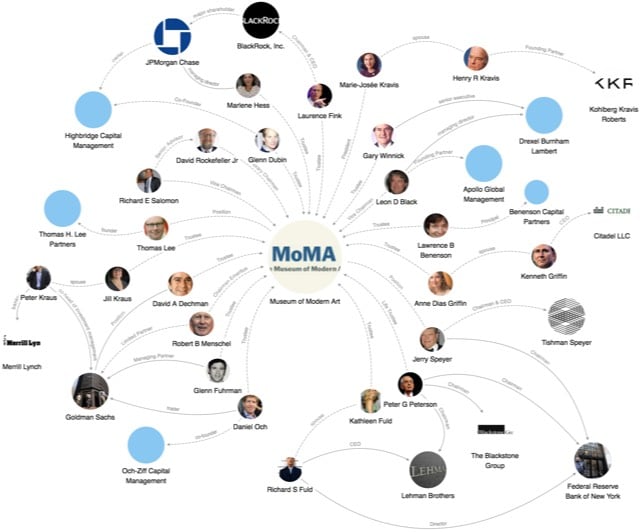
LittleSis is a freely available database that documents personal and business connections in the worlds of government and business. For instance, here’s George Soros. And Dick Cheney. Love the Lombardi-esque influence maps. (via @kellianderson)
(P.S. Does anyone remember the name of a similar project done in Flash many years ago by one of the hotshot Flash developers? Can’t find it…)
Update: The Flash site was They Rule by Josh On “with the indispensable assistance of LittleSis.org”. Well, how about that. (via @ajayskapoor)
In this video, Harry Frankfurt, author of On Bullshit, talks about what bullshit is and how dangerous it is to society.
The reason why there’s so much bullshit I think is that people just talk. If they don’t talk, they don’t get paid. The advertiser wants to gain sales. The politician wants to gain votes. Now, that’s ok but they have to talk about things that they don’t really know much about. So, since they don’t have anything really valid to say, they just say whatever they think will interest the audience, make it appear they know what they’re talking about. And what comes out is bullshit.
The bullshitter is more creative. He’s not submissive. It’s not important to him what the world really is like. What’s important to him is how he’d like to represent himself. He takes a more adventurous and inventive attitude towards reality, which may be sometimes very colorful, sometimes amusing, sometimes it might produce results that are enjoyable. But it’s also very dangerous.
It’s at this point that the video cuts to Donald Trump, who is the Lionel Messi of bullshitting; it is his singular dazzling gift. He cultivates convenient facts and deliberately remains ignorant of inconvenient ones so as to be most effective. As Frankfurt notes, bullshit is a serious threat to the truth because it’s not the opposite of truth…it cannot be refuted like a lie can:
Liars attempt to conceal the truth by substituting something for the truth that isn’t true. Bullshit is not a matter of trying to conceal the truth, it is a matter of trying to manipulate the listener, and if the truth will do, then that’s fine and if the truth won’t do, that’s also fine. The bullshitter is indifferent to the truth in a way in which the liar is not. He’s playing a different game.
It is Trump’s indifference to the truth that makes him so effective and so powerful. Much of what I read from people who oppose Trump attempts to counter his rhetoric with facts. That hasn’t worked and is not going to work. The truth is not the antidote for bullshit. So how do you defeat the bullshitter? This has been a genuine problem for his political opponents thus far. Frankfurt doesn’t offer any advice in the video (perhaps his book does?), and I’m at a loss as well, but I do know that factual refutation will not make any difference. I hope someone figures it out soon though.
Cass Sunstein, author of the recently published The World According to Star Wars, says that while most people might dislike the three Star Wars prequels, they function well as “a quick guide to current political struggles”.
A long time ago, in a galaxy far, far away, paralyzing political divisions threatened democratic governments. Disputes over free trade, and the free movement of people and goods, were a big reason. Stymied by polarization and endless debates, the Senate proved unable to resolve those disputes.
As a result, nationalist sentiments intensified, leading to movements for separation from centralized institutions. People craved a strong leader who would introduce order — and simultaneously combat growing terrorist threats.
A prominent voice, Anakin Skywalker, insisted, “We need a system where the politicians sit down and discuss the problem, agree what’s in the interest of all the people, and then do it.” And if they didn’t, “they should be made to.”
Eventually, something far worse happened. The legislature voted to give “emergency powers” — essentially unlimited authority — to the chief executive. An astute observer, Padme Amidala, noted, “So this is how liberty dies… with thunderous applause.”
Well, that was kind of terrifying to read. My ill-feeling peaked at “a democratic body, a senate, not being able to function properly because everybody’s squabbling” as a cause of Hitler’s rise in Germany. As Sunstein notes, the parallels between that situation and our do-nothing Congress & the authoritarian gentleman currently running for President are obvious and possibly significant.
In Trump Taps Into the Anxiety of American White Males, Anand Giridharadas writes:
Yet there is some evidence that a sizable number of white men see the push toward diversity, along with the larger changes it telegraphs, as less about joining and more about replacement, and a country that is less hospitable to them.
That sentiment is perhaps expressed in a quote widely circulated online in these discussions, though the origin is unknown: “When you’re accustomed to privilege, equality feels like oppression.”
This is perhaps what Tyler Cowen was getting at with his highly speculative and provocative What the hell is going on?
The contemporary world is not very well built for a large chunk of males. The nature of current service jobs, coddled class time and homework-intensive schooling, a feminized culture allergic to most forms of violence, post-feminist gender relations, and egalitarian semi-cosmopolitanism just don’t sit well with many…what shall I call them? Brutes?
Quite simply, there are many people who don’t like it when the world becomes nicer. They do less well with nice. And they respond by in turn behaving less nicely, if only in their voting behavior and perhaps their internet harassment as well.
I wouldn’t recommend it, but a spin through the comments on Cowen’s piece provides some examples of what he’s talking about.
I was just thinking about Hamilton1 and Captain America: Civil War, two of pop culture’s current obsessions, and thought, hmm, what if you made a superhero movie about the early years of American democracy? And then I quickly realized that Civil War in some ways echoes the political battle between Hamilton’s Federalists and Jeffersonian Republicans.
In the film (or at least the first part of it), Tony Stark is a Federalist; he realizes the need for regulation and oversight of the Avengers by the government. Captain America is a Republican; he believes in the rights of the smaller group (states’ rights!) and that regulation comes at the cost of essential freedoms. Karen Walsh wrote much more about the parallels between the two.
Captain America: Civil War begins with a focus on the Sokovia Accords. As the Avengers split into two groups, Iron Man and his cronies focus on granting the Accords validity in order to remain a unified front and gain popular trust. Cap and his cohorts determine that sacrificing their freedom to the government allows for errors that overshadow the purpose of their ability to protect the people who most need them.
In essence, Iron Man and his team represent the Federalist belief that a strong central government is essential to aggregating the trust and the will of the people.
Update: Two more takes on the parallels between Hamilton and Captain America: Captain America, Aaron Burr, And The Politics Of Killing Your Friends and Best of Frenemies. (via @Chan_ing)
In Twelfth Man, a short film by Duane Hopkins, you’ll witness the chaotic and occasionally ugly run-up to a football match in one of the most heated rivalries in England, the Tyne-Wear derby pitting Sunderland against Newcastle United. Watching it, I was reminded of the rhetoric and confrontations happening around the US in the presidential primaries. Turns out, equating politics with sports is not far off the mark in this case.
Sunderland and Newcastle are situated 12 miles apart in North East England. After first meeting in 1883, the teams have played a total of 155 matches, with each winning 53 matches (with 49 draws). According to Wikipedia (and ultimately sourced from a pair of texts on the two cities), the rivalry between the two cities dates back to the English Civil War in the 17th century:
The history of the Wear-Tyne derby is a modern-day extension of a rivalry between Sunderland and Newcastle that dates back to the English Civil War when protestations over advantages that merchants in Royalist Newcastle had over their Wearside counterparts led to Sunderland becoming a Parliamentarian stronghold.
Sunderland and Newcastle again found themselves on opposite sides during the Jacobite Rebellions, with Newcastle in support of the Hanoverians with the German King George, and Sunderland siding with the Scottish Stuarts.
If you’re unfamiliar with English football, the entire entry is worth a read, particularly the sections on policing and banning fans during away games and hooliganism. There’s even an entire section on players (and a couple of managers) who have played for both teams, a reminder that although rivalries may stretch back centuries and be rooted in deep political differences, money holds a powerful attraction. (Which brings us right back to the US presidential primaries…)
Update: Matches between the two teams may be hard to come by next year. With a 3-0 win over Everton on May 11, Sunderland secured a place in the Premier League next year and caused Newcastle to be relegated to the Championship, the league below the Premier League. The bitter rivalry rolls on.
Update: See also Viceland’s The Eternal Derby about a football rivalry in Serbia. Here’s the trailer for the episode:
And some footage of a pre-match riot. Intense.
In his 1975 song Jungleland, Bruce Springsteen laments, “the poets down here don’t write nothing at all, they just stand back and let it all be.” I was reminded of that line when Springsteen canceled his North Carolina concert to protest the state’s recently passed bathroom law. In this case, the poet wrote. While it’s not unusual for musicians and other artists to use their public podiums for protest, it’s less common for corporations to do the same. At least, that used to be the case. But recently, many top CEOs are using their corporate muscle to influence social and political decisions across the country. When you wondered who would stand up for individual and equal rights in America, it’s unlikely that you thought of the The Boss and The Man. Here’s The New Yorker’s James Surowiecki with more on these unlikely alliances.
A few days ago, I watched An Honest Liar, a documentary about the magician and charlatan-debunker The Amazing Randi. I had forgotten that in the 70s and 80s in America, belief in psychics like Uri Geller, faith healers like Peter Popoff, extraterrestrial abductions, and the like was not all that far from the mainstream. Such events and people were covered in newspapers, on the evening news, and featured on talk shows, including The Tonight Show with Johnny Carson.
The media is awash in pieces attempting to explain the success of the Presidential campaign of Donald Trump. Many are puzzled…how could this happen in America!? After watching Randi debunking hoaxes, I’m no longer surprised at Trump’s success. Maria Konnikova, author of a recent book on scams and cons, wrote about Trump and con artists for the New Yorker.
A line, thin but perceptible, divides even egregious liars from confidence men. People deceive one another for all sorts of reasons: they might lie to stay out of trouble, for example, or to make themselves seem more interesting, or to urge a business deal toward its consummation. David Maurer, a linguist turned historian of the con, said, “If confidence men operate outside the law, it must be remembered that they are not much further outside than many of our pillars of society who go under names less sinister.” Still, there is a meaningful difference between an ordinary liar and a con artist. A grifter takes advantage of a person’s confidence for his own specific ends — ends that are often unknowable to the victim and unrelated to the business at hand. He willfully deceives a mark into handing over his trust under false pretenses. He has a plan. What ultimately sets con artists apart is their intent. To figure out if someone is a con artist, one needs to ask two questions. First, is their deception knowing, malicious, and directed, ultimately, toward their own personal gain? Second, is the con a means to an end unrelated to the substance of the scheme itself?
She doesn’t express an opinion on whether Trump is a con artist — it’s difficult to tell without knowing his intent — but it’s clear that like Uri Geller and Peter Popoff, Trump is adept at making people believe what he is saying without a lot of hard evidence. Like The Amazing Randi said in the movie: “no matter how smart or well educated you are, you can be deceived.” Hopefully, like Geller, Popoff, and UFOs eventually did, the idea of Trump as a viable candidate for President will soon disappear back into the fringes of American discourse.
A huge cache of data has leaked from a Panama-based tax firm that shows how some of the world’s politicians and the rich hide their money in offshore tax havens. The video above, from the Guardian, is a quick 1:30 introduction on how these offshore havens work.
The documents show the myriad ways in which the rich can exploit secretive offshore tax regimes. Twelve national leaders are among 143 politicians, their families and close associates from around the world known to have been using offshore tax havens.
A $2bn trail leads all the way to Vladimir Putin. The Russian president’s best friend — a cellist called Sergei Roldugin — is at the centre of a scheme in which money from Russian state banks is hidden offshore. Some of it ends up in a ski resort where in 2013 Putin’s daughter Katerina got married.
Among national leaders with offshore wealth are Nawaz Sharif, Pakistan’s prime minister; Ayad Allawi, ex-interim prime minister and former vice-president of Iraq; Petro Poroshenko, president of Ukraine; Alaa Mubarak, son of Egypt’s former president; and the prime minister of Iceland, Sigmundur Davíð Gunnlaugsson.
Here is an important bit:
Are all people who use offshore structures crooks?
No. Using offshore structures is entirely legal. There are many legitimate reasons for doing so. Business people in countries such as Russia and Ukraine typically put their assets offshore to defend them from “raids” by criminals, and to get around hard currency restrictions. Others use offshore for reasons of inheritance and estate planning.
Are some people who use offshore structures crooks?
Yes. In a speech last year in Singapore, David Cameron said “the corrupt, criminals and money launderers” take advantage of anonymous company structures. The government is trying to do something about this. It wants to set up a central register that will reveal the beneficial owners of offshore companies. From June, UK companies will have to reveal their “significant” owners for the first time.
There is much more here, including Lionel Messi’s involvement.
Update: The Panama Papers have claimed their first political victim. The now-former prime minister of Iceland has resigned because of his family’s offshore investments.
If you’ve been following along, various politicians at all levels of the government have basically been kicking the can down the road when it comes to taking responsibility for the water crisis in Flint, MI.
[Michigan Governor Rick] Snyder and [Environmental Protection Administrator Gina] McCarthy were both asked, strongly and repeatedly, to resign. The two officials, for their part, blamed each other: The governor faulted the EPA for its slow and “ineffective” response, while McCarthy took aim at state officials for obfuscating the poor water quality. Both also suggested they weren’t fully aware of the problem’s scope until far too late.
Dave Pell from Nextdraft says:
This is a common refrain we’ve heard from national, state and local officials. We’ve had hearings, debates, and nationally televised town halls. What we don’t have is a solution for the people bathing in bottled water. In times of war, we can get running water to the deserts of Iraq. But all we can get to Flint is politics as usual.
Also via Nextdraft, Erin Brockovich wrote about Flint and the other places around the country where similar things are happening.
In their latest video, Kurzgesagt tackles the War on Drugs. The Stop the Harm website, which they mention at the end of the video, says this about the failed efforts to curb drug use:
The global drug policy system is well and truly broken. Despite aiming to ‘protect’ people from drugs, its punitive approach has instead increased the harms of these substances, punishing and demonizing the people and communities most impacted by them. This punishment has disproportionately impacted people and communities of color, indigenous peoples, and the economically marginalized, while stoking public health crises by restricting access to essential medicines and exacerbating the spread of HIV, hepatitis C, and other blood borne viruses.
Newer posts
Older posts





Socials & More