kottke.org posts about politics
In this week’s New Yorker, Chrystia Freeland writes about how the ultra-rich have taken a dislike to President Obama and his anti-business policy and rhetoric, even though the President “has served the rich quite well”. This article is infuriating, a bunch of very powerful men (and they are all men) sitting around crying about their powerlessness. A few choice quotes:
Cooperman regarded the comments as a declaration of class warfare, and began to criticize Obama publicly. In September, at a CNBC conference in New York, he compared Hitler’s rise to power with Obama’s ascent to the Presidency, citing disaffected majorities in both countries who elected inexperienced leaders.
Strong argument there. Per Godwin, that should have been the end of it.
Evident throughout the letter is a sense of victimization prevalent among so many of America’s wealthiest people. In an extreme version of this, the rich feel that they have become the new, vilified underclass.
Underclass! Boo hoo! Do you want some cheese with that 2005 Petrus?
T. J. Rodgers, a libertarian and a Silicon Valley entrepreneur, has taken to comparing Barack Obama’s treatment of the rich to the oppression of ethnic minorities — an approach, he says, that the President, as an African-American, should be particularly sensitive to.
Yes, I can imagine the President nodding, upset at missing the obvious parallel here. The police chasing hedge fund managers through the streets of lower Manhattan with firehoses is a scene that I will never forget.
[Founding partner of the hedge fund AQR Capital Management Clifford S. Asness] suggested that “hedge funds really need a community organizer,” and accused the White House of “bullying” the financial sector.
Clifford S. Asness swinging from the bathroom door knob by his underwear. Clifford S. Asness called “Assness” in trigonometry class. Nude photos taken of Clifford S. Asness in the locker room and distributed to the freshman girls. Clifford S. Asness teased so mercilessly about his acne that he has to stay home from school throwing up from the emotional pain of being so thoroughly and callously rejected by one’s peers.
In 2010, the private-equity billionaire Stephen Schwarzman, of the Blackstone Group, compared the President’s as yet unsuccessful effort to eliminate some of the preferential tax treatment his sector receives to Hitler’s invasion of Poland.
Hitler again! Obama is obviously a fascist communist.
“You know, the largest and greatest country in the free world put a forty-seven-year-old guy that never worked a day in his life and made him in charge of the free world,” Cooperman said. “Not totally different from taking Adolf Hitler in Germany and making him in charge of Germany because people were economically dissatisfied.
Hitler, take three. Stick with what you know.
He was a seventy-two-year-old world-renowned cardiologist; his wife was one of the country’s experts in women’s medicine. Together, they had a net worth of around ten million dollars. “It was shocking how tight he was going to be in retirement,” Cooperman said. “He needed four hundred thousand dollars a year to live on. He had a home in Florida, a home in New Jersey. He had certain habits he wanted to continue to pursue.
Shocking. Needed. Certain habits.
People don’t realize how wealthy people self-tax. If you have a certain cause, an art museum or a symphony, and you want to support it, it would be nice if you had the choice.
We didn’t realize that. And it’s such an either-or thing too…can’t pay your taxes *and* help the Met buy a Vermeer.
In partnership with sciencedebate.org, Scientific American asked both major party candidates to answer questions about the important scientific questions of the day. Here are the results.
I am not a scientist myself, but my best assessment of the data is that the world is getting warmer, that human activity contributes to that warming, and that policymakers should therefore consider the risk of negative consequences. However, there remains a lack of scientific consensus on the issue — on the extent of the warming, the extent of the human contribution, and the severity of the risk — and I believe we must support continued debate and investigation within the scientific community.
I’m surprised and mostly pleased that the Supreme Court has upheld President Obama’s Patient Protection and Affordable Care Act.
The Court’s ruling means, that unless Congress acts, in 2014 all Americans will be required to purchase health insurance in the most sweeping overhaul of the nation’s health care system since the Great Society. The Court, according to early analysis, redefined the mandate as a tax, skirting some Constitutional questions but offering a dramatic affirmation to Obama’s key initiative.
Update: Josh Marshall speaks for me here.
This is an imperfect law. But what’s most important is that it provides a structure under which the country can make a start not only on universal coverage — as an ethical imperative — but on doing away with the waste and inefficiencies created by the chronic market failure of the US health insurance system. Again, that matters. And I suspect that there’s no going back.
Stephen King is rich, wants to pay more federal taxes, and is pretty pissed off about it.
Mitt Romney has said, in effect, “I’m rich and I don’t apologize for it.” Nobody wants you to, Mitt. What some of us want — those who aren’t blinded by a lot of bullshit persiflage thrown up to mask the idea that rich folks want to keep their damn money — is for you to acknowledge that you couldn’t have made it in America without America. That you were fortunate enough to be born in a country where upward mobility is possible (a subject upon which Barack Obama can speak with the authority of experience), but where the channels making such upward mobility possible are being increasingly clogged. That it’s not fair to ask the middle class to assume a disproportionate amount of the tax burden. Not fair? It’s un-fucking-American is what it is. I don’t want you to apologize for being rich; I want you to acknowledge that in America, we all should have to pay our fair share. That our civics classes never taught us that being American means that — sorry, kiddies-you’re on your own. That those who have received much must be obligated to pay — not to give, not to “cut a check and shut up,” in Governor Christie’s words, but to pay — in the same proportion. That’s called stepping up and not whining about it. That’s called patriotism, a word the Tea Partiers love to throw around as long as it doesn’t cost their beloved rich folks any money.
Stephen Walt wonders how US policy might have been different over the past 20 years if realists (as opposed to the neocons or liberal interventionists) had been in charge.
#2: No “Global War on Terror.” If realists had been in charge after 9/11, they would have launched a focused effort to destroy al Qaeda. Realists backed the war against the Taliban in Afghanistan, and a realist approach to the post-9/11 threat environment would have focused laser-like on al Qaeda and other terrorist groups that were a direct threat to the United States. But realists would have treated them like criminals rather than as “enemy combatants” and would not have identified all terrorist groups as enemies of the United States. And as noted above, realists would not have included “rogue states” like Iran, Iraq, and North Korea (the infamous “axis of evil”) in the broader “war on terror.” Needless to say, with realists in charge, the infamous 2002 National Security Strategy calling for preventive war would never have been written.
This might be the coolest thing a sitting President has ever done. Aside from, maybe, freeing the slaves or The New Deal or winning WWII.
Update: And an amazingly depressing excerpt from a speech Obama gave earlier in the day:
But we only finished paying off our student loans — check this out, all right, I’m the President of the United States — we only finished paying off our student loans about eight years ago.
Columnist Rex Huppke mourns the death of facts in contemporary American society.
To the shock of most sentient beings, Facts died Wednesday, April 18, after a long battle for relevancy with the 24-hour news cycle, blogs and the Internet. Though few expected Facts to pull out of its years-long downward spiral, the official cause of death was from injuries suffered last week when Florida Republican Rep. Allen West steadfastly declared that as many as 81 of his fellow members of theU.S. House of Representatives are communists.
Facts held on for several days after that assault - brought on without a scrap of evidence or reason - before expiring peacefully at its home in a high school physics book. Facts was 2,372.
“It’s very depressing,” said Mary Poovey, a professor of English at New York University and author of “A History of the Modern Fact.” “I think the thing Americans ought to miss most about facts is the lack of agreement that there are facts. This means we will never reach consensus about anything. Tax policies, presidential candidates. We’ll never agree on anything.”
American Experience is airing a four-hour documentary on Bill Clinton starting on Feb 20.
Clinton follows the president across his two terms as he confronted some of the key forces that would shape the future, including partisan political warfare and domestic and international terrorism, and as he struggled with uneven success to define the role of American power in a post-Cold War world. Most memorably, it explores how Clinton’s conflicted character made history, even as it enraged his enemies and confounded his friends.
The first twelve minutes of the film is available to watch on the PBS web site right now.
From the February 2012 issue of Esquire, an interview with former President Bill Clinton about the current political and governmental landscape in America.
One of the real dilemmas we have in our country and around the world is that what works in politics is organization and conflict. That is, drawing the sharp distinctions. But in real life, what works is networks and cooperation. And we need victories in real life, so we’ve got to get back to networks and cooperation, not just conflict. But politics has always been about conflict, and in the coverage of politics, information dissemination tends to be organized around conflict as well. It is extremely personal now, and you see in these primaries that the more people agree with each other on the issues, the more desperate they are to make the clear distinctions necessary to win, so the deeper the knife goes in.
Writing on his Tumblr blog (!!), former Secretary of Labor Robert Reich makes the case for a Clinton/Biden swap that would lead to an unstoppable Obama/Clinton presidental ticket in 2012.
My political prediction for 2012 (based on absolutely no inside information): Hillary Clinton and Joe Biden swap places. Biden becomes Secretary of State - a position he’s apparently coveted for years. And Hillary Clinton, Vice President.
So the Democratic ticket for 2012 is Obama-Clinton.
Why do I say this? Because Obama needs to stir the passions and enthusiasms of a Democratic base that’s been disillusioned with his cave-ins to regressive Republicans. Hillary Clinton on the ticket can do that.
(via ★djacobs)
I wish these were bipartisan, but this suprisingly large collection of prominent Republicans made up with clown paint is still pretty amazing. Here’s Texas governor Rick Perry:

Journalist Walt Harrington has known George W. Bush for more than twenty-five years and wrote an article for The American Scholar about his conversations with the former President over the years.
President Bush — and he was, no doubt, by then a real president — talked expansively about Afghanistan, Iraq, Iran, China, Korea, Russia. He talked about his reelection strategies, Iran’s nuclear ambitions, WMD and how he still believed they would be found, Colin Powell and Condoleezza Rice, Vladimir Putin. He talked about his aides and how tough their lives were, the long hours and stress and time away from their families, about how difficult it was for his daughters. He said that compared with everyone around a president, the president had the easiest job. He was the same confident, brash man I had met years ago, but I no longer sensed any hint of the old anger or the need for self-aggrandizement.
(via ★bryce)
Published in The Onion more than 10 years ago after George W. Bush took office, Bush: ‘Our Long National Nightmare Of Peace And Prosperity Is Finally Over’ is just getting more and more prescient.
Bush swore to do “everything in [his] power” to undo the damage wrought by Clinton’s two terms in office, including selling off the national parks to developers, going into massive debt to develop expensive and impractical weapons technologies, and passing sweeping budget cuts that drive the mentally ill out of hospitals and onto the street.
During the 40-minute speech, Bush also promised to bring an end to the severe war drought that plagued the nation under Clinton, assuring citizens that the U.S. will engage in at least one Gulf War-level armed conflict in the next four years.
“You better believe we’re going to mix it up with somebody at some point during my administration,” said Bush, who plans a 250 percent boost in military spending. “Unlike my predecessor, I am fully committed to putting soldiers in battle situations. Otherwise, what is the point of even having a military?”
They probably should get a Pulitzer. (thx, andrew)
On the day before the 1996 US presidential election, the NY Times ran a crossword puzzle that correctly predicted the winner.
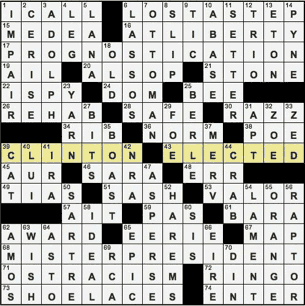
Click through to see how they did it.
A few days after the fact, but still a fascinating read on how the political sausage gets made.
Over time, however, championing same-sex marriage had become personal for Mr. Cuomo. He campaigned on the issue in the race for governor last year, and after his election, he was staggered by the number of gay couples who sought him out at restaurants and on the street, prodding him, sometimes tearfully, to deliver on his word.
The pressure did not let up at home. Mr. Cuomo’s girlfriend, Sandra Lee, has an openly gay brother, and she frequently reminded the governor how much she wanted the law to change.
Something else weighed on him, too: the long shadow of his father, Mario, who rose to national prominence as the conscience of the Democratic Party, passionately defending the poor and assailing the death penalty. During his first few months in office, the younger Mr. Cuomo had achieved what seemed like modern-day miracles by the standards of Albany - an austere on-time budget and a deal to cap property taxes. But, as Mr. Cuomo explained by phone to his father a few weeks ago, he did not want those accomplishments to define his first year in office.
“They are operational,” he told his father. Passing same-sex marriage, by contrast, “is at the heart of leadership and progressive government.”
“I have to do this.”
The US military is often thought of by many Americans as being identified with conservative politics, making it an unlikely blueprint for progressive reform. But a recent pair of articles demonstrates that the US as a whole might have something to learn about the US Armed Forces’ liberal leanings. In the NY Times, Nicholas Kristof argues that the US military’s universal healthcare and focus on education is worth looking at as a model:
The military is innately hierarchical, yet it nurtures a camaraderie in part because the military looks after its employees. This is a rare enclave of single-payer universal health care, and it continues with a veterans’ health care system that has much lower costs than the American system as a whole.
Perhaps the most impressive achievement of the American military isn’t its aircraft carriers, stunning as they are. Rather, it’s the military day care system for working parents.
While one of America’s greatest failings is underinvestment in early childhood education (which seems to be one of the best ways to break cycles of poverty from replicating), the military manages to provide superb child care. The cost depends on family income and starts at $44 per week.
And the WSJ recently covered remarks made by Sgt. Maj. Micheal Barrett, the top non-commissioned officer in the Marine Corps and general all-around hardass, about gays in the military:
Article 1, Section 8 of the Constitution is pretty simple, It says, ‘Raise an army.’ It says absolutely nothing about race, color, creed, sexual orientation. You all joined for a reason: to serve. To protect our nation, right? How dare we, then, exclude a group of people who want to do the same thing you do right now, something that is honorable and noble? … Get over it. We’re magnificent, we’re going to continue to be. … Let’s just move on, treat everybody with firmness, fairness, dignity, compassion and respect. Let’s be Marines.
Now that’s some semper fi I can get behind. (thx, meg)
This is a very smart take on the Anthony Weiner situation from Amy Davidson at the New Yorker. Davidson argues that Weiner’s recent sextual actions are politically relevant because they demonstrate that he’s not very good at evaluating risk.
Measuring risk is what politicians do for a living — from when they decide to run, to voting to hire policemen or teachers or to go to war. One doesn’t want them to be completely, or even mostly cautious: politicians who never say anything that causes anyone to cringe, and never take a political risk, are useless. […] That is why it is, sad to say, a matter of legitimate interest that Weiner’s wife was pregnant when he sent those tweets. It widens our sense of just how careless he is with the lives of others, particularly those of people who are more vulnerable than he is. That is good to know about a politician; it is distinct from the question of whether someone who lies to his wife will lie to the public and, I’d argue, is more important.
Jeff Smith was a Missouri State Senator who ended up in jail for a year; here’s an account of his experience in the klink.
Before I was shown my new digs, the staff processed me. That meant going repeatedly through the standard battery of questions. The third questioner finished and sent me to a heavyset woman.
“Height and weight?” she asked.
“5’6”, 120.”
She examined my slight frame and frowned. “Education level?”
I winced. “Ph.D.”
She shot me a skeptical look. “Last profession?”
“State Senator.”
She rolled her eyes. “Well, I’ll put it down if you want. If you wanna play games, play games. We got ones who think they’re Jesus Christ, too.”
Well, from political life anyway.
For years, the Dalai Lama, the Tibetan spiritual leader, has spoken of his desire to cede political authority, or “retire,” as he has sometimes put it. But in Thursday’s speech he made it official, announcing that he would propose the change during the session of the Tibetan Parliament in exile that begins next week in Dharamsala, India.
“My desire to devolve authority has nothing to do with a wish to shirk responsibility,” he said, according to a prepared text of his speech. “It is to benefit Tibetans in the long run.”
Retired perhaps, but still tweeting.
The political soundbite has gotten progressively shorter over the past few decades.
A professor at the University of California had just published research showing that the length of the average TV sound bite had dropped dramatically, from 43 seconds in the 1968 presidential election to a mere nine seconds in the 1988 election. And this drop had led to lots of hand-wringing — from professors, from journalists, and from politicians themselves. “If you couldn’t say it in less than 10 seconds,” Michael Dukakis complained about the previous campaign, “it wasn’t heard because it wasn’t aired.”
It’s currently just under eight seconds…which, perhaps not coincidentally, is about how long it would take someone to speak a text or tweet.
Matthew Ericson tracked down the first national election map published in the NY Times; it showed William McKinley’s victory over William Jennings Bryan.
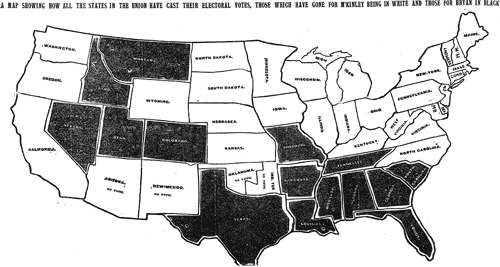
The speed with which the results made it into print boggles the mind given the technology of the day (especially considering that in the last few elections in the 2000s, with all of the technology available to us, there have been a number of states that we haven’t been able to call in the Wednesday paper).
(thx, tyson)
Unless you’re from the UK (or watched Spitting Image and all sorts of other British comedies on PBS as an impressionable youth in Wisconsin), the observations of Parliamentary sketchwriter Simon Hoggart about the prime ministers he has covered might be too inside baseball, but I couldn’t help sharing this Thatcher anecdote about her unwitting skill with double entendre:
But Thatcher saved the best of all for her victory tour of the Falkland Islands. She was taken to inspect a large field gun, basically a ride-on lawnmower with a barrel several feet long. It was on a bluff, overlooking a plain on which another Argentine invasion might one day materialise. She admired the weapon, and the soldier manning it asked if she would like to fire a round.
“But mightn’t it jerk me off?” she replied. Chris Moncrieff of the Press Association, who was covering the visit, recorded the manful struggle of the soldier to keep his face, indeed his whole body, straight.
Actually, all the Thatcher stories are quite good. (thx, tom)
Remember the whole thing Clarence Thomas and Anita Hill with the pubic hair on the can of Coke and the Supreme Court hearings and all that? Me neither. But Clarence Thomas’ wife does; she left a voicemail on Anita Hill’s work phone asking her to apologize for what she did to her husband.
“Good morning Anita Hill, it’s Ginni Thomas,” it said. “I just wanted to reach across the airwaves and the years and ask you to consider something. I would love you to consider an apology sometime and some full explanation of why you did what you did with my husband.” Ms. Thomas went on: “So give it some thought. And certainly pray about this and hope that one day you will help us understand why you did what you did. O.K., have a good day.”
That’s either really passive aggressive, straight-up batshit insane, or the oxycontin talking. Ms. Thomas referred to the call as “extending an olive branch”, which I guess is true if she meant that the branch was stripped of leaves and the end sharpened to a point.
Long interview with Barack Obama in Rolling Stone. Most of it is politics, but they also discussed music.
My iPod now has about 2,000 songs, and it is a source of great pleasure to me. I am probably still more heavily weighted toward the music of my childhood than I am the new stuff. There’s still a lot of Stevie Wonder, a lot of Bob Dylan, a lot of Rolling Stones, a lot of R&B, a lot of Miles Davis and John Coltrane. Those are the old standards.
A lot of classical music. I’m not a big opera buff in terms of going to opera, but there are days where Maria Callas is exactly what I need.
Thanks to Reggie [Love, the president’s personal aide], my rap palate has greatly improved. Jay-Z used to be sort of what predominated, but now I’ve got a little Nas and a little Lil Wayne and some other stuff, but I would not claim to be an expert. Malia and Sasha are now getting old enough to where they start hipping me to things. Music is still a great source of joy and occasional solace in the midst of what can be some difficult days.
Jeffrey Goldberg visited with Fidel Castro recently and has two posts on his Atlantic blog about his meetings with the former Cuban head of state: part one and part two.
After this first meeting, I asked Julia to explain the meaning of Castro’s invitation to me, and of his message to Ahmadinejad. “Fidel is at an early stage of reinventing himself as a senior statesman, not as head of state, on the domestic stage, but primarily on the international stage, which has always been a priority for him,” she said. “Matters of war, peace and international security are a central focus: Nuclear proliferation climate change, these are the major issues for him, and he’s really just getting started, using any potential media platform to communicate his views. He has time on his hands now that he didn’t expect to have. And he’s revisiting history, and revisiting his own history.”
This is substantial reporting but I’ll admit my favorite line was:
I’ve never seen someone enjoy a dolphin show as much as Fidel Castro enjoyed the dolphin show.
Because of Goldberg’s reportage on Castro’s remarks regarding anti-Semitism, Venezuelan President Hugo Chavez (and strong critic of Israel) announced yesterday that he would meet with Venezuela’s Jewish leaders. Someone get Errol Morris down to Cuba to make a sequel to his film about Robert McNamara. The Fog of Cold War perhaps? (via @kbanderson)
Vanity Fair has a really interesting but depressing look at how The President of the United States spends a typical day navigating the upfuckedness of national American politics and its capital, Washington DC — which Rahm Emanuel calls Fucknutsville.
We think of the presidency as somehow eternal and unchanging, a straight-line progression from 1 to 44, from the first to the latest. And in some respects it is. Except for George Washington, all of the presidents have lived in the White House. They’ve all taken the same oath to uphold the same constitution. But the modern presidency — Barack Obama’s presidency — has become a job of such gargantuan size, speed, and complexity as to be all but unrecognizable to most of the previous chief executives. The sheer growth of the federal government, the paralysis of Congress, the systemic corruption brought on by lobbying, the trivialization of the “news” by the media, the willful disregard for facts and truth — these forces have made today’s Washington a depressing and dysfunctional place. They have shaped and at times hobbled the presidency itself.
For much of the past half-century, the problems that have brought Washington to its current state have been concealed or made tolerable by other circumstances. The discipline of the Cold War kept certain kinds of debate within bounds. America’s artificial “last one standing” postwar economy allowed the country to ignore obvious signs of political and social decay. Wars and other military interventions provided ample distraction from matters of substance at home. Like many changes that are revolutionary, none of Washington’s problems happened overnight. But slow and steady change over many decades — at a rate barely noticeable while it’s happening — produces change that is transformative. In this instance, it’s the kind of evolution that happens inevitably to rich and powerful states, from imperial Rome to Victorian England. The neural network of money, politics, bureaucracy, and values becomes so tautly interconnected that no individual part can be touched or fixed without affecting the whole organism, which reacts defensively. And thus a new president, who was elected with 53 percent of the popular vote, and who began office with 80 percent public-approval ratings and large majorities in both houses of Congress, found himself for much of his first year in office in stalemate, pronounced an incipient failure, until the narrowest possible passage of a health-care bill made him a sudden success in the fickle view of the commentariat, whose opinion curdled again when Obama was unable, with a snap of the fingers or an outburst of anger, to stanch the BP oil spill overnight. And whose opinion spun around once more when he strong-armed BP into putting $20 billion aside to settle claims, and asserted presidential authority by replacing General Stanley McChrystal with General David Petraeus. The commentariat’s opinion will keep spinning with the wind.
(via waxy)
Designing Obama, a book chronicling how the visual branding of the Obama campaign came about, is available in several formats, most notably in a completely free online version. Written by the campaign’s design director, the making of the book was funded through the first big Kickstarter campaign.
The New Yorker has a long profile of Francis Collins, the ardent Christian whom Obama picked to head up the NIH, and the NIH’s role in embryonic stem cell research.
A year later, Obama’s appointment of Collins seemed an inspired choice. The President had found not only a man who reflected his own view of the harmony between science and faith but an evangelical Christian who hoped that the government’s expansion of embryonic-stem-cell research might bring the culture war over science to a quiet end. On August 23rd, however, Judge Royce C. Lamberth, of the Federal District Court for the District of Columbia, halted federal spending for embryonic-stem-cell research, putting hundreds of research projects in limbo and plunging the N.I.H. back into a newly contentious national debate.
Newer posts
Older posts





Socials & More