kottke.org posts about politics
In his 2018 review of several books about Nazism and Adolf Hitler, Alex Ross notes that Hitler took inspiration for the Third Reich’s anti-Semitism and the Holocaust from the United States’ genocide against indigenous peoples, treatment of African Americans (both during and after slavery), and restrictive immigration policies.
The Nazis were not wrong to cite American precedents. Enslavement of African-Americans was written into the U.S. Constitution. Thomas Jefferson spoke of the need to “eliminate” or “extirpate” Native Americans. In 1856, an Oregonian settler wrote, “Extermination, however unchristianlike it may appear, seems to be the only resort left for the protection of life and property.” General Philip Sheridan spoke of “annihilation, obliteration, and complete destruction.” To be sure, others promoted more peaceful-albeit still repressive-policies. The historian Edward B. Westermann, in “Hitler’s Ostkrieg and the Indian Wars” (Oklahoma), concludes that, because federal policy never officially mandated the “physical annihilation of the Native populations on racial grounds or characteristics,” this was not a genocide on the order of the Shoah. The fact remains that between 1500 and 1900 the Native population of U.S. territories dropped from many millions to around two hundred thousand.
America’s knack for maintaining an air of robust innocence in the wake of mass death struck Hitler as an example to be emulated. He made frequent mention of the American West in the early months of the Soviet invasion. The Volga would be “our Mississippi,” he said. “Europe — and not America — will be the land of unlimited possibilities.” Poland, Belarus, and Ukraine would be populated by pioneer farmer-soldier families. Autobahns would cut through fields of grain. The present occupants of those lands — tens of millions of them — would be starved to death. At the same time, and with no sense of contradiction, the Nazis partook of a long-standing German romanticization of Native Americans. One of Goebbels’s less propitious schemes was to confer honorary Aryan status on Native American tribes, in the hope that they would rise up against their oppressors.
Jim Crow laws in the American South served as a precedent in a stricter legal sense. Scholars have long been aware that Hitler’s regime expressed admiration for American race law, but they have tended to see this as a public-relations strategy — an “everybody does it” justification for Nazi policies. Whitman, however, points out that if these comparisons had been intended solely for a foreign audience they would not have been buried in hefty tomes in Fraktur type. “Race Law in the United States,” a 1936 study by the German lawyer Heinrich Krieger, attempts to sort out inconsistencies in the legal status of nonwhite Americans. Krieger concludes that the entire apparatus is hopelessly opaque, concealing racist aims behind contorted justifications. Why not simply say what one means? This was a major difference between American and German racism.
In a clip from a TV advertisement for the SDP-Liberal Alliance, John Cleese entertainingly talks about the benefits of extremism.
The biggest advantage of extremism is that it makes you feel good — because it provides you with enemies. Let me explain. The great thing about having enemies is that you can pretend that all the badness in the whole world is in your enemies and all the goodness in the whole world is in you.
Even if you don’t believe that moderate politics is the way forward (and I wonder if anyone does anymore), you can appreciate the truth that having external enemies can prevent you from discovering and addressing your views and practices that are harming others and that you need to work on.
In recent weeks as antiracism and anti-police violence protests continue around the country, the movement to defund and abolish policing in America has rapidly gained momentum. As Black communities have asserted for decades, people have begun to wonder in earnest what purpose police serve. They’re asking when there’s a problem in our communities, do we really need a person with a gun showing up to solve it? What would a system oriented around public safety look like if it was designed from scratch rather than just piling more responsibility onto and funding into increasingly militarized and unaccountable police departments?
There are a lot of resources out there about police abolition right now, so here are some that I’ve found helpful in understanding it.
Alex Vitale’s The End of Policing, which came out in 2017, is a well-reviewed critique of modern policing.
This book attempts to spark public discussion by revealing the tainted origins of modern policing as a tool of social control. It shows how the expansion of police authority is inconsistent with community empowerment, social justice — even public safety. Drawing on groundbreaking research from across the world, and covering virtually every area in the increasingly broad range of police work, Alex Vitale demonstrates how law enforcement has come to exacerbate the very problems it is supposed to solve.
In contrast, there are places where the robust implementation of policing alternatives—such as legalization, restorative justice, and harm reduction — has led to a decrease in crime, spending, and injustice. The best solution to bad policing may be an end to policing.
Verso, the book’s publisher, is offering the ebook version for free for a limited time. The Paris Review has an excerpt that addresses the difficulties with reforms (such as the #8cantwait initative):
This does not mean that no one should articulate or fight for reforms. However, those reforms must be part of a larger vision that questions the basic role of police in society and asks whether coercive government action will bring more justice or less. Too many of the reforms under discussion today fail to do that; many further empower the police and expand their role. Community policing, body cameras, and increased money for training reinforce a false sense of police legitimacy and expand the reach of the police into communities and private lives. More money, more technology, and more power and influence will not reduce the burden or increase the justness of policing. Ending the War on Drugs, abolishing school police, ending broken-windows policing, developing robust mental health care, and creating low-income housing systems will do much more to reduce abusive policing.
The Intercept interviewed Vitale in October 2017.
We should understand policing as the most coercive form of state power … and the reason is that policing has historically and inherently been at the root of reproducing fundamental inequalities of race, class, and immigration status. Trump, the police, ICE — this is just a continuation of a history of exclusion and repression going back to the exclusion of Chinese immigrants in the 19th century, Texas Rangers driving out Mexican landholders and indigenous populations to make room for white settlers, the transformation of slave patrols and urban slave management systems into what became Jim Crow policing in the South and ghetto policing in the North. Police have historical origins in relation to both the formation and disciplining of the industrial working class; early 19th century forms of policing in Europe and the United States shaped rural agricultural workers into urban industrial workers, and then suppressed their movements to form labor unions and win better living conditions.
The point of all this is to fundamentally question this liberal notion that police exist primarily as a tool for public safety and therefore, we should embrace their efforts uncritically, when in fact, there are lots of different ways to produce safety that don’t come with the baggage of colonialism, slavery, and the suppression of workers’ movements.
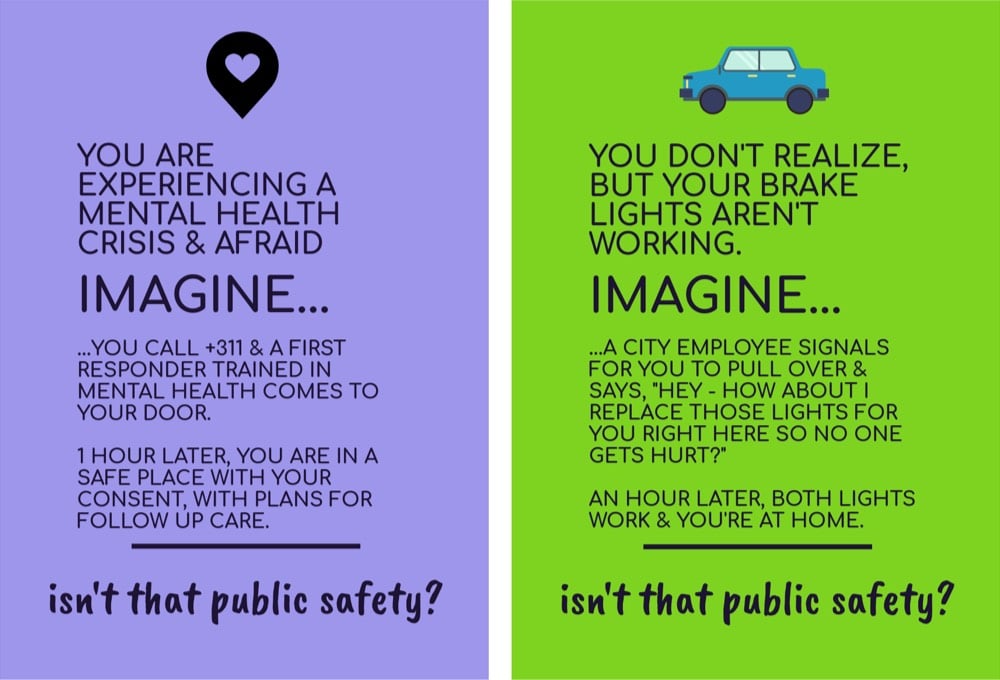
In 2018, Amber Hughson designed a series of flyers outlining some alternatives to policing. The “Isn’t this public safety?” question at the end of each flyer is really compelling.
Christy Lopez (co-director of Georgetown Law School’s Innovative Policing Program) writing in The Washington Post: Defund the police? Here’s what that really means.
To fix policing, we must first recognize how much we have come to over-rely on law enforcement. We turn to the police in situations where years of experience and common sense tell us that their involvement is unnecessary, and can make things worse. We ask police to take accident reports, respond to people who have overdosed and arrest, rather than cite, people who might have intentionally or not passed a counterfeit $20 bill. We call police to roust homeless people from corners and doorsteps, resolve verbal squabbles between family members and strangers alike, and arrest children for behavior that once would have been handled as a school disciplinary issue.
Police themselves often complain about having to “do too much,” including handling social problems for which they are ill-equipped. Some have been vocal about the need to decriminalize social problems and take police out of the equation. It is clear that we must reimagine the role they play in public safety.
MPD150, a grassroots organization working towards a police-free Minneapolis, has a bunch of resources on their website, including What are we talking about when we talk about “a police-free future?” and an 8-page FAQ zine for folks trying to get up to speed on police abolition.
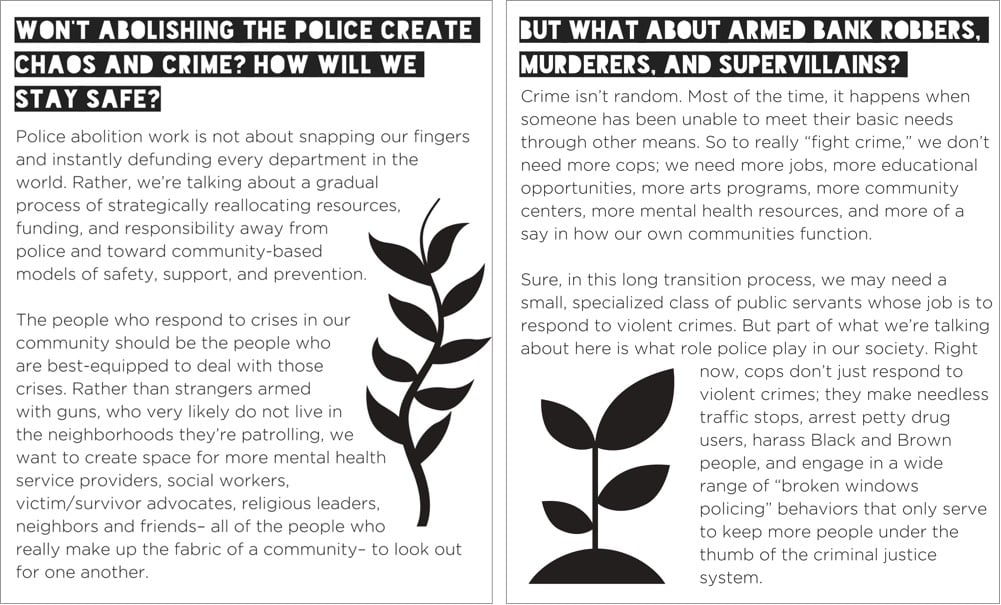
Many people already live in a world without police. If you grew up in a well-off, predominantly white suburb, how often did you interact with cops? Communities with lots of good jobs, strong schools, economies, and social safety nets are already, in some ways, living in a world without police.
Annie Lowrey makes a fiscal argument in Defund the Police.
A thin safety net, an expansive security state: This is the American way. At all levels of government, the country spends roughly double on police, prisons, and courts what it spends on food stamps, welfare, and income supplements. At the federal level, it spends twice as much on the Pentagon as on assistance programs, and eight times as much on defense as on education. The wars in Iraq and Afghanistan will ultimately cost something like $6 trillion and policing costs $100 billion a year. But proposals to end homelessness ($20 billion a year), create a universal prekindergarten program ($26 billion a year), reduce the racial wealth gap through baby bonds ($60 billion a year), and eliminate poverty among families with children ($70 billion a year) somehow never get financed. All told, taxpayers spend $31,286 a year on each incarcerated person, and $12,201 a year on every primary- and secondary-school student.
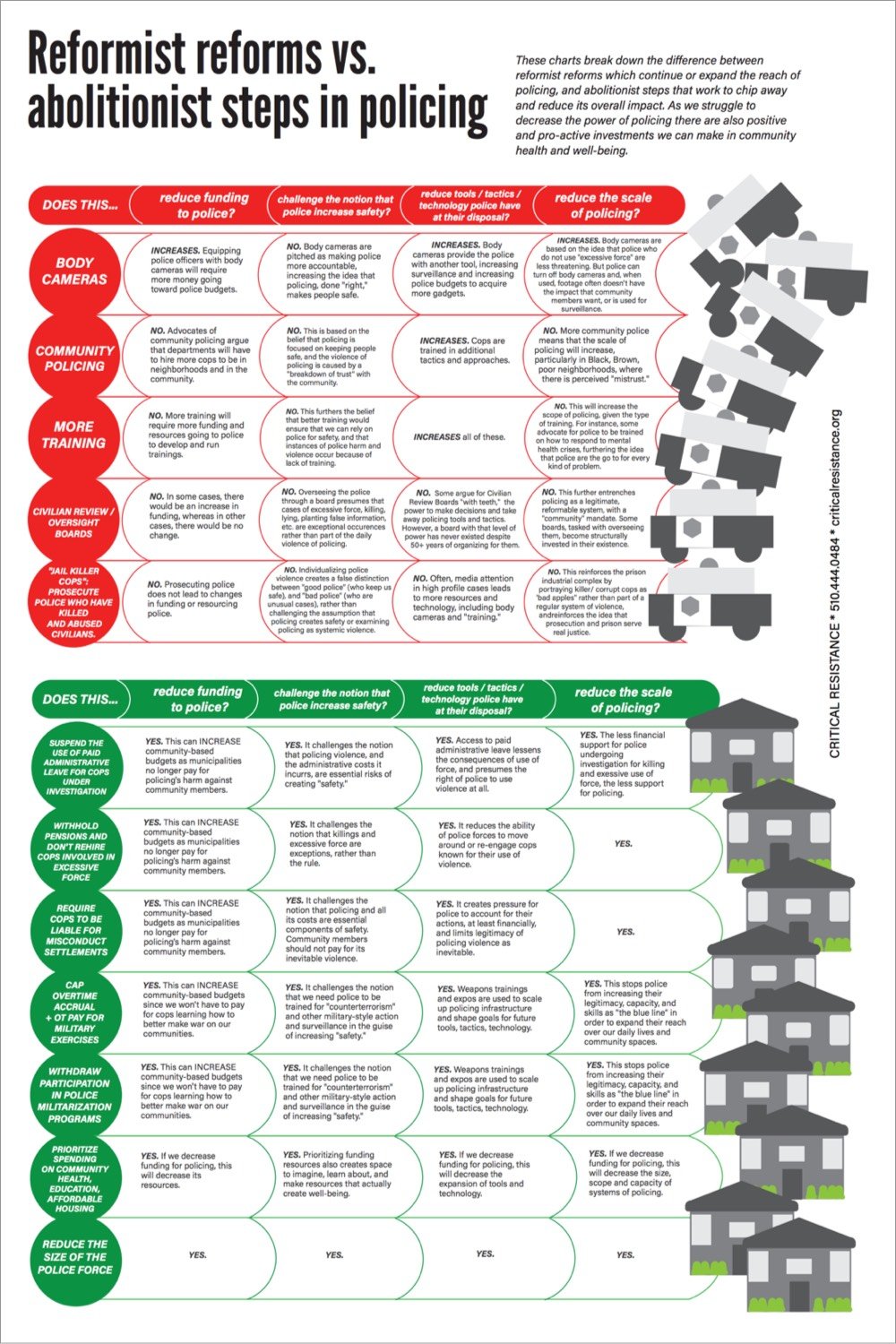
Critical Resistance has a police abolition resources page that many activists are recommending, including this toolkit and this chart comparing reforms vs abolition.
The Marshall Project is maintaining a collection of links about police abolition.
I liked the framing of this Twitter thread by Gabrielle Blair:
This is how I, a 45-year-old white woman and mother of 6, currently at her peak Karen power, went from assuming police work was a necessary part of functional communities, to becoming a passionate advocate for #abolishthepolice #defundthepolice, over the course of one week.
She continues:
“I suppose it is tempting, if the only tool you have is a hammer, to treat everything as if it were a nail.” Do you know that saying? Apply it to police. If you’re always prepared to easily inflict violence, then the chances of inflicting unwarranted violence go way up.
Cat in a tree? Got locked out of your car? Kids prank called 911? Found a brutally murdered body? When called, police will arrive at all four of these scenes equally armed to the teeth. Why would we ever be okay with that? It is INSANE.
Vox’s podcast Today, Explained did an episode on What “abolish the police” means. From the transcript:
SEAN: And for the people who are worried about how this you know, how this might affect the way our society functions, like, let’s just say, you know, it’s a Friday night, 4th of July or something like that, like like the Fourth of July. That’s coming up real soon. And, you know, you’re worried about drunk drivers on the road. Who’s getting your back on drunk drivers?
BRANDON: You’re going to be able to call the police. The police are still going to be out there enforcing traffic violations, maybe not with weapons, though, maybe they have some other tools to de-escalate situations.
SEAN: And what about, like, you’re scared that this jilted ex lover of yours is going to come after you and kill you? Same situation?
BRANDON: You know, we can continue to go through these hypotheticals. I want to be very clear here. Police don’t listen to black women as it exists today. Black women are often the victims of sexual assault, sexual violence, and they are not listened to. They’re not deemed credible by police officers. So we’ve got to ask yourself, is policing working? Maybe it’s working for certain communities, white communities in particular. Now, police are going to be there when you call and say, hey, look, there’s someone harassing me. They’re going to have the better trained police officer come and diffuse the situation if the perpetrator is still there.
I have not listened to this yet, but next up in my podcast queue is a two-episode series of Intercepted with host Chenjerai Kumanyika and long-time prison abolitionist Ruth Wilson Gilmore.
Journalist and lawyer Josie Duffy Rice:
many people in america already exist in a world where police and prisons do not exist. go to any middle to upper class suburb in america. cops arent wandering the streets. people aren’t being arrested. neighbors aren’t being sent to prison. and generally everyone is….fine.
many people say they cannot imagine this world. what most of them cannot imagine is someone not policing black brown and poor people. THAT is what is unimaginable to them. not the absence of law enforcement. if you are lucky, you already functionally live with that absence.
Garrett Felber details the history of the police and prison abolition movements that stretch back for decades: The Struggle to Abolish the Police Is Not New.
Although abolition was not a central demand of the midcentury civil rights movement — despite informing the activism of many of its key figures — it took hold in the 1970s. This revolutionary ethos — what Chicano poet Raul Salinas called the “prison rebellion years” — was linked to mass uprisings in the streets; the state repression, jailing, and murder of black and brown radicals; and opposition to the Vietnam War and imprisonment of conscientious objectors. Quaker Fay Honey Knopp’s pivotal 1976 Instead of Prisons: A Handbook for Prison Abolitionists, for example, had its genesis in her visits to conscientious objectors in prison during the Vietnam War and her participation in feminist, civil rights, gay rights, and prisoners’ rights struggles.
Update: Abolition activist Mariame Kaba writes in a NY Times opinion piece: Yes, We Mean Literally Abolish the Police.
Minneapolis had instituted many of these “best practices” but failed to remove Derek Chauvin from the force despite 17 misconduct complaints over nearly two decades, culminating in the entire world watching as he knelt on George Floyd’s neck for almost nine minutes.
Why on earth would we think the same reforms would work now? We need to change our demands. The surest way of reducing police violence is to reduce the power of the police, by cutting budgets and the number of officers.
But don’t get me wrong. We are not abandoning our communities to violence. We don’t want to just close police departments. We want to make them obsolete.
We should redirect the billions that now go to police departments toward providing health care, housing, education and good jobs. If we did this, there would be less need for the police in the first place.
In The Atlantic, epidemiologists Julia Marcus and Gregg Gonsalves explain why public health officials are not being hypocritical in their support of the antiracism protests around the country.
At its core, the argument being leveled against public-health experts is that the reason for the protests shouldn’t matter. The coronavirus doesn’t care whether it’s attending an anti-lockdown protest or an anti-racism one. But these two kinds of protests are not equivalent from a public-health perspective. Some critics might argue that the anti-lockdown protests promoted economic activity, which can help stave off the health implications of poverty. (On this count, public-health experts were ahead of the curve: Many — including one of us — were advocating for a massive infusion of assistance to individual Americans as early as March.) But these protests were organized by pro-gun groups that believe the National Rifle Association is too compromising on gun safety. Egged on by the president to “save your great 2nd Amendment,” anti-lockdown protesters stormed government buildings with assault rifles and signs reading COVID-19 IS A LIE. The anti-lockdown demonstrations were explicitly at odds with public health, and experts had a duty to oppose them. The current protests, in contrast, are a grassroots uprising against systemic racism, a pervasive and long-standing public-health crisis that leads to more than 80,000 excess deaths among black Americans every year.
If “conservative commentators” cared at all about keeping people safe from Covid-19 infection, they would have denounced the I-Need-A-Haircut protests as reckless and they didn’t. Instead, they engage in these bad faith arguments that are just designed to stir up outrage.
Gonsalves wrote a thread on Twitter a few days ago that’s relevant here as well.
The risk to all of us was inflamed by an absolute decision at the highest levels that this epidemic was not worth an all-out, coordinated, comprehensive national mobilization. It took weeks for the President to even agree that the epidemic wouldn’t go away on its own.
The US, the richest nation in the world, then couldn’t get it together to scale-up the number of tests we needed to understand what was going on in our communities with SARS-COV-2, and in the end said it was up to the states to figure it all out.
And then this is the last word as far as I’m concerned:
We’ve all been put at far more jeopardy during this pandemic by our political leaders than by the people on the streets over the past week or so.
In 1971, Richard Nixon kicked off America’s “war on drugs”, focusing not on the societal problems that lead to drug abuse but on categorizing drug users as criminals.
In Nixon’s eyes, drug use was rampant in 1971 not because of grand social pressures that society had a duty to correct, but because drug users were law-breaking hedonists who deserved only discipline and punishment.
Over the next several decades, the US government (and particularly Ronald Reagan) took Nixon’s lead and imprisoned millions of people for drug offenses, including a disproportionate number of Black men. Michelle Alexander wrote about this in her 2010 book The New Jim Crow. From the about page:
Alexander shows that, by targeting black men through the War on Drugs and decimating communities of color, the U.S. criminal justice system functions as a contemporary system of racial control, even as it formally adheres to the principle of colorblindness.
In 1994, former Nixon aide and Watergate co-conspirator John Ehrlichman proudly told writer Dan Baum that racial control and discrimination was in fact the purpose of the war on drugs.
At the time, I was writing a book about the politics of drug prohibition. I started to ask Ehrlichman a series of earnest, wonky questions that he impatiently waved away. “You want to know what this was really all about?” he asked with the bluntness of a man who, after public disgrace and a stretch in federal prison, had little left to protect. “The Nixon campaign in 1968, and the Nixon White House after that, had two enemies: the antiwar left and black people. You understand what I’m saying? We knew we couldn’t make it illegal to be either against the war or black, but by getting the public to associate the hippies with marijuana and blacks with heroin, and then criminalizing both heavily, we could disrupt those communities. We could arrest their leaders, raid their homes, break up their meetings, and vilify them night after night on the evening news. Did we know we were lying about the drugs? Of course we did.”
An astonishing thing to admit but hardly a rare tactic for the cynical Republican Party. See also how they decided to champion abortion as an issue to attract the support of white evangelical Christians and shifted from indifference to scientific denialism on climate change in order to oppose the Obama administration and advance the interests of wealthy donors.
Thanks to Ibram X. Kendi’s How to Be an Antiracist for reminding me of Ehrlichman’s admission.
Nick Baumann on the militarization of the American police:
“You create this world where you’re not just militarizing the police — you equip the police like soldiers, you train the police like soldiers. Why are you surprised when they act like soldiers?” Rizer, a former police officer and soldier, said. “The mission of the police is to protect and serve. But the premise of the soldier is to engage the enemy in close combat and destroy them. When you blur those lines together with statements like that … It’s an absolute breakdown of civil society.”
American police officers generally believe that carrying military equipment and wearing military gear makes them feel like they can do more, and that it makes them scarier, Rizer’s research has found. Officers even acknowledge that acting and dressing like soldiers could change how the public feels about them. But “they don’t care,” he said.
In 2015, after the militarized police response to the protests in Ferguson, Mo., President Obama restricted the sales of military equipment by the Pentagon to police departments.
Mr. Obama ordered a review of the Pentagon program in late 2014 after the police responded to protests with armored vehicles, snipers and riot gear. The images of police officers with military gear squaring off against protesters around the country angered community activists who said law enforcement agencies were reacting disproportionately.
In addition to the prohibitions on certain military surplus gear, he added restrictions on transferring some weapons and devices, including explosives, battering rams, riot helmets and shields.
The Pentagon said 126 tracked armored vehicles, 138 grenade launchers and 1,623 bayonets had been returned since Mr. Obama prohibited their transfer.
In 2017, Donald Trump fully restored the practice of transferring military goods to police, grenade launchers and all.
Update: Would just like to note that the 1033 Program was signed into law by Bill Clinton, has historically enjoyed bipartisan support, and was greatly expanded under Obama.
A recent study show that, under the Pentagon’s 1033 program, enacted in 1997, the value of military weapons, gear and equipment transferred to local cops did not exceed $34 million annually until 2010, the second year of the Obama administration, when it nearly tripled to more than $91 million. By 2014, the year that Michael Brown was shot down — and when the full Congress, including 32 members of the Congressional Black Caucus, rejected a bill that would have shut down the 1033 program — Obama was sending three quarters of a billion dollars, more than $787 million a year, in battlefield weaponry to local police departments. In other words, President Obama oversaw a 24-fold (2,400%) increase in the militarization of local police between 2008 and 2014. Even with the scale-back announced in 2015, Obama still managed to transfer a $459 million arsenal to the cops — 14 times as much weapons of terror and death than President Bush gifted to the local police at his high point year of 2008.
(thx, chuck)
From an April 17th Facebook post by Paul Field, a succinct summary of how the pandemic exposes American deficiencies. It’s tough to not just quote the whole thing, so here’s the beginning:
Everyone is entitled to their own opinion, but you need to know how silly you look if you post some variation of, “Welcome to Socialism…”
You are not seeing Socialism. What you are seeing is one of the wealthiest, geographically advantaged, productive capitalist societies in the world flounder and fail at its most basic test. Taking care of its people.
This crisis is not about the virus.
This crisis is about the massive failure of our, “Booming economy,” to survive even modest challenges. It is about the market dissonance of shortages in stores, even as farmers/producers destroy unused crops and products. This crisis is about huge corporations needing an emergency bailout within days of the longest Bull Market in our history ending and despite the ability to borrow with zero percent interest rates.
The pandemic has revealed that American democracy and our economic system is extremely fragile. Ok, unless you’re wealthy, in which case you’re going to be fine, all part of the plan, etc.

Several countries have had solid responses to the Covid-19 pandemic: Taiwan, South Korea, New Zealand, and Hong Kong. But Indi Samarajiva thinks we should be paying much more attention to Mongolia, a country of 3.17 million people where no one has died and no locally transmitted cases have been reported.1 Let’s have that again: 3.17 million people, 0 local cases, 0 deaths. How did they do it? They saw what was happening in Wuhan, coordinated with the WHO, and acted swiftly & decisively in January.
Imagine that you could go back in time to January 23rd with the horse race results and, I dunno, the new iPhone. People believe you. China has just shut down Hubei Province, the largest cordon sanitaire in human history. What would you scream to your leaders? What would you tell them to do?
You’d tell them that this was serious and that it’s coming for sure. You’d tell them to restrict the borders now, to socially distance now, and to get medical supplies ready, also now. You’d tell them to react right now, in January itself. That’s 20/20 hindsight.
That’s exactly what Mongolia did, and they don’t have a time machine. They just saw what was happening in Hubei, they coordinated with China and the WHO, and they got their shit together fast. That’s their secret, not the elevation. They just weren’t dumb.
When you go to World In Data’s Coronavirus Data Explorer and click on “Mongolia” to add their data to the graph, nothing happens because they have zero reported cases and zero deaths. They looked at the paradox of preparation — the idea that “when the best way to save lives is to prevent a disease rather than treat it, success often looks like an overreaction” — and said “sign us up for the overreacting!”
Throughout February, Mongolia was furiously getting ready - procuring face masks, test kits, and PPE; examining hospitals, food markets, and cleaning up the city. Still no reported cases. Still no let-up in readiness. No one was like “it’s not real!” or “burn the 5G towers!”
The country also suspended their New Year celebrations, which are a big deal in Asia. They deployed hundreds of people and restricted intercity travel to make sure, though the public seemed to broadly support the move.
Again — and I’ll keep saying this until March — there were still NO CASES. If you want to know how Mongolia ended up with no local cases, it’s because they reacted when there were no local cases. And they kept acting.
For example, when they heard of a case across the border (ie, not in Mongolia) South Gobi declared an emergency and put everyone in masks. The center also shut down coal exports — a huge economic hit, which they took proactively.
As you can see, at every turn they’re reacting like other countries only did when it was too late. This looked like an over-reaction, but in fact, Mongolia was always on time.
I have to tell you true: I got really upset reading this. Like crying and furious. The United States could have done this. Italy could have done this. Brazil could have done this. Sweden could have done this. England could have done this. Spain could have done this. Mongolia listened to the experts, acted quickly, and kept their people safe. Much of the rest of the world, especially the western world — the so-called first-world countries — failed to act quickly enough and hundreds of thousands of people have needlessly died and countless others have been left with chronic health issues, grief, and economic chaos.
After 2+ months of lockdown in most areas, a small minority of Americans want our country to go back to “normal” despite evidence and expert advice to the contrary. They want to get haircuts, not wear masks in public, go to crowded beaches, and generally go about their lives. These folks couch their desires in terms of freedom & liberty: the government has no right to infringe on the individual freedoms of its citizens.
But governments routinely do just that for all kinds of good reasons — e.g. you can’t murder someone just because you feel like it — and as Johns Hopkins’ public health historian Graham Mooney points out, there’s a precedent for a different way of thinking about freedom in the context of public health.
In response to these vehement appeals to individual freedom, public-health leaders in London, Liverpool, Manchester and elsewhere developed a powerful counterargument. They too framed their argument in terms of freedom — freedom from disease. To protect citizens’ right to be free from disease, in their view, governments and officials needed the authority to isolate those who were sick, vaccinate people, and take other steps to reduce the risk of infectious disease.
One of the most important reformers was George Buchanan, the chief medical officer for England from 1879 to 1892. He argued that cities and towns had the authority to take necessary steps to ensure the communal “sanitary welfare.” He and other reformers based their arguments on an idea developed by the 19th-century English philosopher John Stuart Mill, who is, ironically, remembered largely as a staunch defender of individual liberty. Mill articulated what he called the “harm principle,” which asserts that while individual liberty is sacrosanct, it should be limited when it will harm others: “The sole end for which mankind are warranted, individually or collectively, in interfering with the liberty and action of any of their number, is self-protection,” Mill wrote in On Liberty in 1859. Public-health reformers argued that the harm principle gave them the authority to pursue their aims.
An essay published in The Lancet in 1883 sums up this view nicely: “We cannot see that there is any undue violation of personal liberty in the sanitary authority acting for the whole community, requiring to be informed of the existence of diseases dangerous to others. A man’s liberty is not to involve risk to others,” the author wrote. “A man with smallpox has the natural liberty to travel in a cab or an omnibus; but society has a right that overrides his natural liberty, and says he shall not.”
Recent polling compiled by Randall Munroe indicates that Americans agree on what to do about the Covid-19 pandemic to a greater extent than they “feel positively about kittens” or even “enjoy apple pie”.
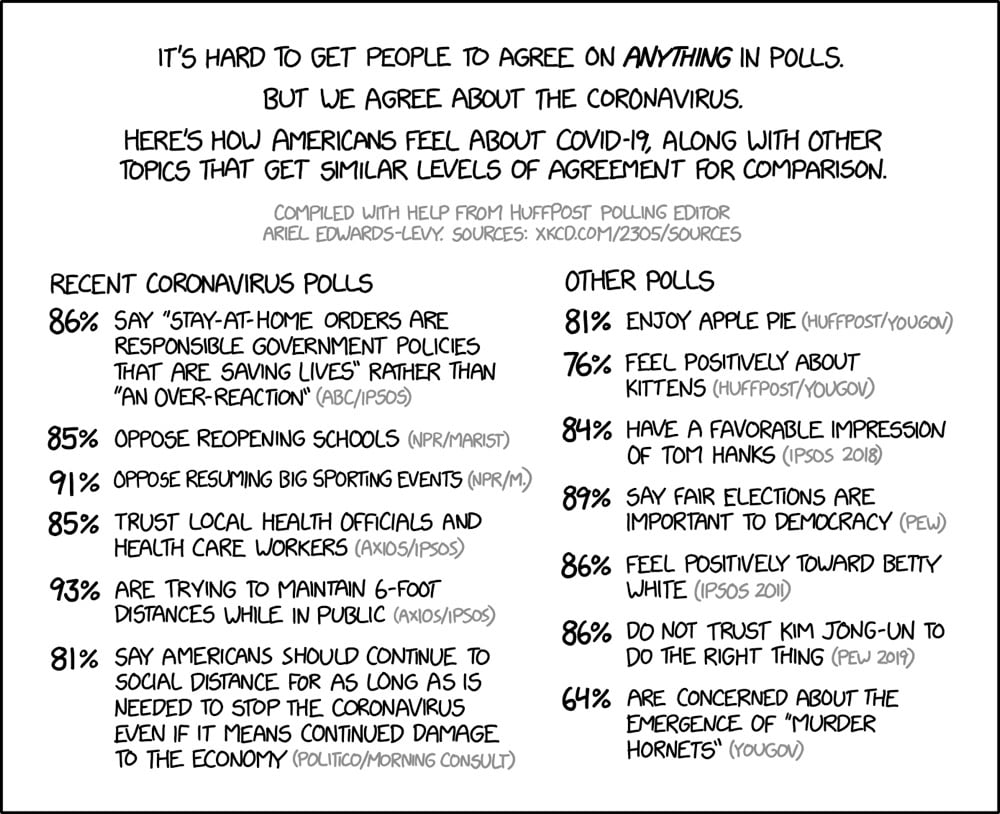
Here’s a list of his sources.
There are a lot of different lenses you can use to look at how the United States and its government have confronted the Covid-19 pandemic. Race is a particularly useful one. As a reminder, here’s America’s current operating racial contract (from an Atlantic piece by Adam Serwer):
The implied terms of the racial contract are visible everywhere for those willing to see them. A 12-year-old with a toy gun is a dangerous threat who must be met with lethal force; armed militias drawing beads on federal agents are heroes of liberty. Struggling white farmers in Iowa taking billions in federal assistance are hardworking Americans down on their luck; struggling single parents in cities using food stamps are welfare queens. Black Americans struggling in the cocaine epidemic are a “bio-underclass” created by a pathological culture; white Americans struggling with opioid addiction are a national tragedy. Poor European immigrants who flocked to an America with virtually no immigration restrictions came “the right way”; poor Central American immigrants evading a baroque and unforgiving system are gang members and terrorists.
Serwer goes on to argue that the recently shifting American response to the pandemic, primarily in conservative circles, is due to an increasing awareness of which groups are bearing the brunt of the crisis: black and Latino Americans.
That more and more Americans were dying was less important than who was dying.
The disease is now “infecting people who cannot afford to miss work or telecommute-grocery store employees, delivery drivers and construction workers,” The Washington Post reported. Air travel has largely shut down, and many of the new clusters are in nursing homes, jails and prisons, and factories tied to essential industries. Containing the outbreak was no longer a question of social responsibility, but of personal responsibility. From the White House podium, Surgeon General Jerome Adams told “communities of color” that “we need you to step up and help stop the spread.”
This is a response that America is quite comfortable with because it fits with our racial contract, under which Jim Crow never actually ended. The US isn’t the only place this is happening btw. Early on, Singapore was praised for its response to the pandemic, but their reliance on and mistreatment of an underclass of migrant workers caused a secondary surge in cases.
Singapore is a small city-state with a population of just under 6 million inhabitants. On a per capita basis, it’s the second-richest country in Asia.
But its economy relies heavily on young men from Bangladesh, India and other countries who work jobs in construction and manufacturing. Singapore has no minimum wage for foreign or domestic employees. The foreign workers’ salaries can be as low as US$250 per month, but a typical salary is $500 to $600 a month.
This short description by Jay Rosen accurately describes the Trump administration’s plan for dealing with the Covid-19 pandemic.
The plan is to have no plan, to let daily deaths between one and three thousand become a normal thing, and then to create massive confusion about who is responsible — by telling the governors they’re in charge without doing what only the federal government can do, by fighting with the press when it shows up to be briefed, by fixing blame for the virus on China or some other foreign element, and by “flooding the zone with shit,” Steve Bannon’s phrase for overwhelming the system with disinformation, distraction, and denial, which boosts what economists call “search costs” for reliable intelligence.
Stated another way, the plan is to default on public problem solving, and then prevent the public from understanding the consequences of that default. To succeed this will require one of the biggest propaganda and freedom of information fights in U.S. history, the execution of which will, I think, consume the president’s re-election campaign.
While his actions often have complex effects, Trump has never been a complicated person. This “plan” fits with what we know about Trump’s personality & behavior, plays to his strengths by relying on reactions & tactics and not strategy, is consistent with Occam’s razor, allows his administration to continue pursuing his aggressive agenda (restricting immigration, strengthening big business, weakening public institutions, enriching himself, consolidating power, getting re-elected), and whips his base into a frenzy. As Dave Eggers put it in a satirical opinion piece for the NY Times:
Having no plan is the plan! Haven’t you been listening? Plans are for commies and the Danish. Here we do it fast and loose and dumb and wrong, and occasionally we have a man who manufactures pillows come to the White House to show the president encouraging texts. It all works! Eighteen months, 800,000 deaths, no plan, states bidding against states for medicine and equipment, you’re on your own, plans are lame.
There’s no galaxy brain here, only a twitchy muscle attached to a frayed nerve.
As I’m writing this, according to Johns Hopkins’ Covid-19 tracker, Germany has recorded 100,186 confirmed cases of Covid-19 (fourth most in the world) and 1590 deaths — that’s a death rate of about 1.6%. Compare that to Italy (12.3%), China (4%), the US (2.9%), and even South Korea (1.8%) and you start to wonder how they’re doing it. This article from the NY Times details why the death rate is so low in Germany.
Another explanation for the low fatality rate is that Germany has been testing far more people than most nations. That means it catches more people with few or no symptoms, increasing the number of known cases, but not the number of fatalities.
“That automatically lowers the death rate on paper,” said Professor Kräusslich.
But there are also significant medical factors that have kept the number of deaths in Germany relatively low, epidemiologists and virologists say, chief among them early and widespread testing and treatment, plenty of intensive care beds and a trusted government whose social distancing guidelines are widely observed.
This article is a real punch in the gut if you’re an American. Obviously there are bureaucracies and inefficiencies in Germany like anywhere else, but it really seems like they listened to the experts and did what a government is supposed to do for its people before a disaster struck.
“Maybe our biggest strength in Germany,” said Professor Kräusslich, “is the rational decision-making at the highest level of government combined with the trust the government enjoys in the population.”
This whole crisis is really laying bare many of the worst aspects of American society — it’s increasingly obvious that the United States resembles a failed state in many ways. I can’t be the only American whose response to the pandemic is to think seriously about moving to a country with a functioning government, good healthcare for everyone, and a real social safety net.
From Ed Yong at the Atlantic, a great article on the current state of the pandemic in the United States, what will happen over the next few months, how it will end, and what the aftermath will be.
With little room to surge during a crisis, America’s health-care system operates on the assumption that unaffected states can help beleaguered ones in an emergency. That ethic works for localized disasters such as hurricanes or wildfires, but not for a pandemic that is now in all 50 states. Cooperation has given way to competition; some worried hospitals have bought out large quantities of supplies, in the way that panicked consumers have bought out toilet paper.
Partly, that’s because the White House is a ghost town of scientific expertise. A pandemic-preparedness office that was part of the National Security Council was dissolved in 2018. On January 28, Luciana Borio, who was part of that team, urged the government to “act now to prevent an American epidemic,” and specifically to work with the private sector to develop fast, easy diagnostic tests. But with the office shuttered, those warnings were published in The Wall Street Journal, rather than spoken into the president’s ear. Instead of springing into action, America sat idle.
Rudderless, blindsided, lethargic, and uncoordinated, America has mishandled the COVID-19 crisis to a substantially worse degree than what every health expert I’ve spoken with had feared. “Much worse,” said Ron Klain, who coordinated the U.S. response to the West African Ebola outbreak in 2014. “Beyond any expectations we had,” said Lauren Sauer, who works on disaster preparedness at Johns Hopkins Medicine. “As an American, I’m horrified,” said Seth Berkley, who heads Gavi, the Vaccine Alliance. “The U.S. may end up with the worst outbreak in the industrialized world.”
If you’ve been reading obsessively about the pandemic, there’s not a lot new in here, but Yong lays the whole situation out very clearly and succinctly (he easily could have gone twice as long). The section on potential after effects was especially interesting:
Pandemics can also catalyze social change. People, businesses, and institutions have been remarkably quick to adopt or call for practices that they might once have dragged their heels on, including working from home, conference-calling to accommodate people with disabilities, proper sick leave, and flexible child-care arrangements. “This is the first time in my lifetime that I’ve heard someone say, ‘Oh, if you’re sick, stay home,’” says Adia Benton, an anthropologist at Northwestern University. Perhaps the nation will learn that preparedness isn’t just about masks, vaccines, and tests, but also about fair labor policies and a stable and equal health-care system. Perhaps it will appreciate that health-care workers and public-health specialists compose America’s social immune system, and that this system has been suppressed.
Aspects of America’s identity may need rethinking after COVID-19. Many of the country’s values have seemed to work against it during the pandemic. Its individualism, exceptionalism, and tendency to equate doing whatever you want with an act of resistance meant that when it came time to save lives and stay indoors, some people flocked to bars and clubs. Having internalized years of anti-terrorism messaging following 9/11, Americans resolved to not live in fear. But SARS-CoV-2 has no interest in their terror, only their cells.
I really hope that Betteridge’s law is wrong about that headline I wrote.
According to an ongoing investigation at The Atlantic, the US has tested only about 14,000 people for COVID-19 so far (a stat CDC data seems to confirm). 14,000 out of 330 million people. Olga Khazan writes about the four main reasons why the US is so behind in testing for the virus.
Interviews with laboratory directors and public-health experts reveal a Fyre-Festival-like cascade of problems that have led to a dearth of tests at a time when America desperately needs them. The issues began with onerous requirements for the labs that make the tests, continued because of arcane hurdles that prevented researchers from getting the right supplies, and extended to a White House that seemed to lack cohesion in the pandemic’s early days. Getting out lots of tests for a new disease is a major logistical and scientific challenge, but it can be pulled off with the help of highly efficient, effective government leadership. In this case, such leadership didn’t appear to exist.
Here’s another take on the problem from a few days ago in the NY Times.
The US has bungled the situation so badly that a pair of Chinese foundations announced this morning that they were donating 500,000 testing kits and 1 million masks to the US. Last month in my Asian travelogue, I wrote that my main observation after spending three weeks in Asia was: “America is a rich country that feels like a poor country”. That we have to rely on foreign aid in situations like this is a good example of what I was referring to.
I was reading this NY Times piece on their policies for reporters and editors around impartiality and politics — “newsroom staff members may not participate in political advocacy, like volunteering for candidates’ campaigns or making contributions” — and ran across this from the paper’s chief White House correspondent, Peter Baker:
As reporters, our job is to observe, not participate, and so to that end, I don’t belong to any political party, I don’t belong to any non-journalism organization, I don’t support any candidate, I don’t give money to interest groups and I don’t vote.
I try hard not to take strong positions on public issues even in private, much to the frustration of friends and family. For me, it’s easier to stay out of the fray if I never make up my mind, even in the privacy of the kitchen or the voting booth, that one candidate is better than another, that one side is right and the other wrong.
And similar perspectives from a 2008 Politico piece. Maybe it’s just me, but this seems like a deeply weird approach — and ultimately an intellectually dishonest one. Not voting is taking a political position — a passive one perhaps, but a political position nonetheless.1 There’s no direct analogy to not voting or not taking private positions on political issues for other areas of reporting, but just imagine being a technology reporter who doesn’t own a mobile phone or computer because they don’t want to show favoritism towards Apple or Samsung, a food reporter who is unable to dine at restaurants outside of work, or a style reporter who can’t wear any clothes they didn’t make themselves. Absurd, right? We do live in an age of too much opinion dressed up as news, but pretending not to have opinions ultimately does harm to a public in need of useful contextual information.
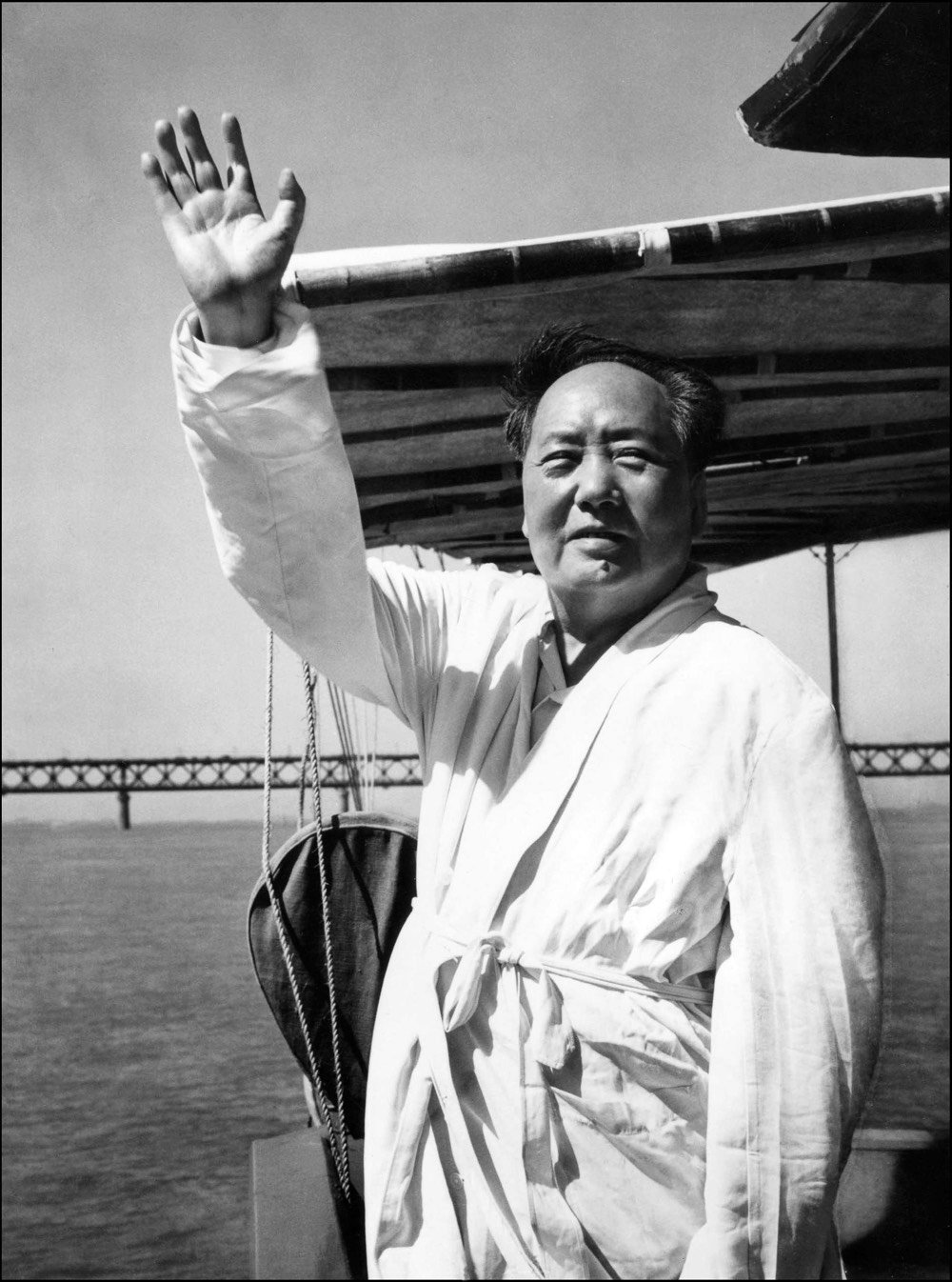
In 1966, Chinese leader Mao Zedong had a PR problem. His Great Leap Forward policy had resulted in tens of millions of deaths from famine, his health was rumored to be failing, and he was afraid, following the recent de-Stalinization of the Soviet Union, that his legacy was not secure. So he went for a swim.
Mao wanted to leave behind a powerful Communist legacy, like Marx and Lenin before him. And in order to do so, he needed to connect with the younger generation before he died. So after announcing his Great Proletarian Cultural Revolution, he swam across the Yangtze River. Mao had done the same swim 10 years earlier to prove his vitality, and he hoped it would work again.
His “Cultural Revolution” was a call to hunt down and eliminate his enemies, and reeducate China’s youth with the principles Maoism. Led by the fanatical Red Guards, the Cultural Revolution was a devastating 10-year period in Chinese history that didn’t end until Mao died in 1976.
You can read and watch more about the Cultural Revolution.
Brent Simmons writes about the Democratic primaries and keeping our eyes on the real prize:
Odds are that your favorite is not going to be the nominee. And that nominee, whoever it is, needs to not have been already labeled a garbage candidate by you and by everyone whose favorite he or she isn’t.
Here’s the thing: we’re fighting to stop the spread of right-wing extremism. It will get so much worse if we reelect the president. It has to be stopped now. No other issue matters, because nothing else can be done without doing this.
I feel like there’s a deep sickness in our culture in how people express solidarity with the side they’ve chosen. It’s most visible in sports and politics and is related to nationalism versus patriotism. Many people tend to root for their preferred team or candidate in a nationalistic way (destructive, antagonistic) rather than a patriotic way (productive, positive) — more “Bernie rules, all the other candidates can suck it” versus “Bernie is my candidate because he supports several issues I care about”. That’s not to say that there isn’t room for strident activism or for criticism addressing real problems with candidates or entire political parties (gestures broadly), but as Simmons notes, this belligerent attitude is counterproductive, no matter how good it might feel personally.
And this bit is sadly true and I have not heard anyone else really talking about it:
I don’t care about any of the wonderful liberal and progressive policies our candidates propose — because they’re not going to get through.
(Well, I do care about them, deeply, but the point stands.)
It’s not that it would take 60 Democratic senators — it would take more like 65 or even more, and that’s not going to happen. We can elect the most wonderful progressive person ever and they’ll just beat their head against the wall.
There’s no magic coming. There’s no amount of will-of-the-people that will move Republican senators. All of the policy we talk about is just fantasy.
In his new music video, My Vote Dont Count, rapper YelloPain provides an excellent 4-minute summary in the sprit of Schoolhouse Rock of the importance of voting, particularly in midterm elections and with a focus on Congress and state legislatures.
So you know how back in ‘08, when we all voted for Obama? We was all supposed to go back in 2010 and vote for the Congress. Cause they the ones that make child support laws. They the ones choose if your kids at school get to eat steak or corn dogs. The state house makes the courthouse. So if the country fail you can’t say it’s them, it’s your fault, cause ya ain’t know to vote for Congress members that was for y’all. And they don’t gotta leave after four years; we just let ‘em sit. See, they don’t want to tell you this, they just want you to focus on the President.
The video was co-produced by Desiree Tims, a Democrat who is running for the House in Dayton, YelloPain’s home town. Tims appears in the closing seconds of the video to deliver this message:
Every time you stay home, someone is making a decision about you. Making decisions about the air you breath, the water you drink, the food your kids eat, and how much money you bring home every two weeks. So every time you sit out an election, every time you don’t show up because you think it doesn’t matter, someone else is happy that you didn’t show up, so they can make that decision for you. Vote!
Even though it’s not explicitly labeled as such, this might be one of the best political advertisements I’ve ever seen. It’s entertaining, informative, and authentic.
I was travelling yesterday and so missed observing Martin Luther King Jr. Day on the site, but I ran across this quote from him on Instagram and wanted to highlight it. It’s from a radio speech King gave called To Minister to the Valley and like many of King’s speeches and writing, it concerns economic justice & equality.
Whenever the government provides opportunities in privileges for white people and rich people they call it “subsidized” when they do it for Negro and poor people they call it “welfare.” The fact that is the everybody in this country lives on welfare. Suburbia was built with federally subsidized credit. And highways that take our white brothers out to the suburbs were built with federally subsidized money to the tune of 90 percent. Everybody is on welfare in this country. The problem is that we all to often have socialism for the rich and rugged free enterprise capitalism for the poor. That’s the problem.
The quote and its sentiment reminds me of the White Affirmative Action episode (transcript) of the excellent Seeing White podcast series, in which Deena Hayes-Greene of the Racial Equity Institute asserts affirmative action in America has overwhelmingly favored and benefitted white people.
Emma Marris has a five-point plan for dealing with the psychological toll of climate change — the constant news of fire! famine! war! floods! Republicans! — and working towards solutions to our collective global problem. Step 1, she writes, is to let go of the shame:
The first step is the key to all the rest. Yes, our daily lives are undoubtedly contributing to climate change. But that’s because the rich and powerful have constructed systems that make it nearly impossible to live lightly on the earth. Our economic systems require most adults to work, and many of us must commute to work in or to cities intentionally designed to favor the automobile. Unsustainable food, clothes and other goods remain cheaper than sustainable alternatives.
And yet we blame ourselves for not being green enough. As the climate essayist Mary Annaïse Heglar writes, “The belief that this enormous, existential problem could have been fixed if all of us had just tweaked our consumptive habits is not only preposterous; it’s dangerous.” It turns eco-saints against eco-sinners, who are really just fellow victims. It misleads us into thinking that we have agency only by dint of our consumption habits — that buying correctly is the only way we can fight climate change.
Marris’ focus on systems (political, capital, etc.) mirrors that of other climate thinkers (like David Wallace-Wells) and is exactly right IMO:
My point is that the climate crisis is not going to be solved by personal sacrifice. It will be solved by electing the right people, passing the right laws, drafting the right regulations, signing the right treaties — and respecting those treaties already signed, particularly with indigenous nations. It will be solved by holding the companies and people who have made billions off our shared atmosphere to account.
This is a big ass field of presidential candidates, though it’s gotten smaller in recent weeks. There are plenty of polls circulating which rank the candidates via the scientific method of asking strangers who they’re supporting and then weighting those responses to create a list of candidates. The candidates are then listed in descending order by level of support.
This list below, also reasonably scientific, though far less useful, ranks the candidates in the order of popularity of their first name according to the handy dandy Popular Baby Names website helpfully maintained by the Social Security Administration. So what does this list tell us? Not much! Former MA Governor Bill Weld probably isn’t going to top any other list this election cycle, while Vermont Senator Bernie Sanders will likely not be on the bottom anywhere else.
3. William Weld
13. Elizabeth Warren
14. Michael Bennet, Michael Bloomberg (Number 1 name from 1961-1998, so that’s a lot)
23. Joseph Biden, Joseph Walsh
27. John Delaney
43. Andrew Yang
49. Thomas Steyer
211. Peter Buttigieg
205. Amy Klobuchar
526. Donald Trump (Has really small hands)
904. Cory Booker
943. Bernard Sanders (Last ranked 2008)
Never ranked:
Tulsi Gabbard
Deval Patrick
Also notable: The name Donald is getting slowly but steadily less popular. Going from 217th most popular name in 2000, to 376th most popular name in 2010, to 526th most popular name in 2018.
(For the record, the name Aaron was ranked 60th and Jason was 100th, so eat it, nerd.)
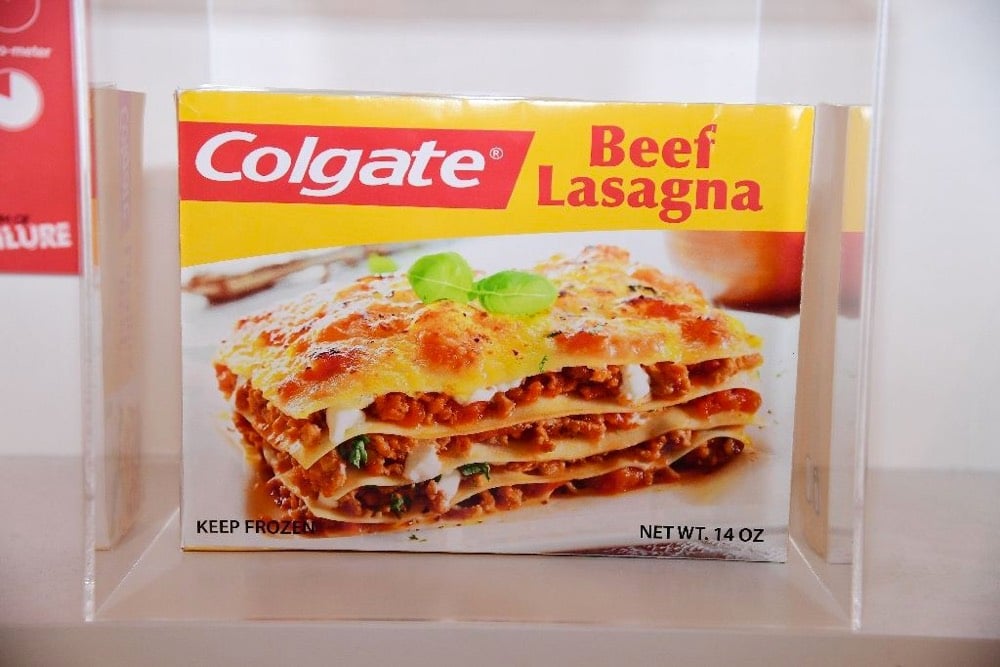
This paper, about the curious phenomenon of “harbinger customers” and “harbinger zip codes”, is really interesting. These harbinger customers tend to buy unpopular products like Crystal Pepsi or Colgate Kitchen Entrees and support losing political candidates.
First, the findings document the existence of “harbinger zip codes.” If households in these zip codes adopt a new product, this is a signal that the new product will fail. Second, a series of comparisons reveal that households in harbinger zip codes make other decisions that differ from other households. The first comparison identifies harbinger zip codes using purchases from one retailer and then evaluates purchases at a different retailer. Households in harbinger zip codes purchase products from the second retailer that other households are less likely to purchase. The analysis next compares donations to congressional election candidates; households in harbinger zip codes donate to different candidates than households in neighboring zip codes, and they donate to candidates who are less likely to win. House prices in harbinger zip codes also increase at slower rates than in neighboring zip codes.
It’s fascinating that these people’s preferences persist across all sorts of categories — it’s like they’re generally out of sync with the rest of society.
Perhaps the most surprising aspect of the harbinger customer effect is that the signal extends across CPG categories. Customers who purchase new oral care products that flop also tend to purchase new haircare products that flop. Anderson et al. (2015) interpret their findings as evidence that customers who have unusual preferences in one product category also tend to have unusual preferences in other categories. In other words, the customers who liked Diet Crystal Pepsi also tended to like Colgate Kitchen Entrees (which also flopped).
(via bb)
In The Role of the Artist in the Age of Trump, playwright Lin-Manuel Miranda reflects on how truth inherent in art means that “all art is political”.
At the end of the day, our job as artists is to tell the truth as we see it. If telling the truth is an inherently political act, so be it. Times may change and politics may change, but if we do our best to tell the truth as specifically as possible, time will reveal those truths and reverberate beyond the era in which we created them. We keep revisiting Shakespeare’s Macbeth because ruthless political ambition does not belong to any particular era. We keep listening to Public Enemy because systemic racism continues to rain tragedy on communities of color. We read Orwell’s 1984 and shiver at its diagnosis of doublethink, which we see coming out of the White House at this moment.
In a 1969 piece, Kurt Vonnegut asserted that art is an early warning system for society:
I sometimes wondered what the use of any of the arts was. The best thing I could come up with was what I call the canary in the coal mine theory of the arts. This theory says that artists are useful to society because they are so sensitive. They are super-sensitive. They keel over like canaries in poison coal mines long before more robust types realize that there is any danger whatsoever.
While not specifically about art, here’s a bit of what I wrote in a January 2017 post, How to Productive in Terrible Times.
I’ve always had difficulty believing that the work I do here is in some way important to the world and since the election, that feeling has blossomed into a profound guilt-ridden anxiety monster. I mean, who in the actual fuck cares about the new Blade Runner movie or how stamps are designed (or Jesus, the blurry ham) when our government is poised for a turn towards corruption and authoritarianism?
I have come up with some reasons why my work here does matter, at least to me, but I’m not sure they’re good ones. In the meantime, I’m pressing on because my family and I rely on my efforts here and because I hope that in some small way my work, as Webb writes, “is capable of enabling righteous acts”.
(via laura olin)
On Monday, I posted a link to David Leonhardt’s NY Times piece, The Rich Really Do Pay Lower Taxes Than You.
For the first time on record, the 400 wealthiest Americans last year paid a lower total tax rate — spanning federal, state and local taxes — than any other income group, according to newly released data. That’s a sharp change from the 1950s and 1960s, when the wealthy paid vastly higher tax rates than the middle class or poor. Since then, taxes that hit the wealthiest the hardest — like the estate tax and corporate tax — have plummeted, while tax avoidance has become more common. President Trump’s 2017 tax cut, which was largely a handout to the rich, plays a role, too. It helped push the tax rate on the 400 wealthiest households below the rates for almost everyone else.
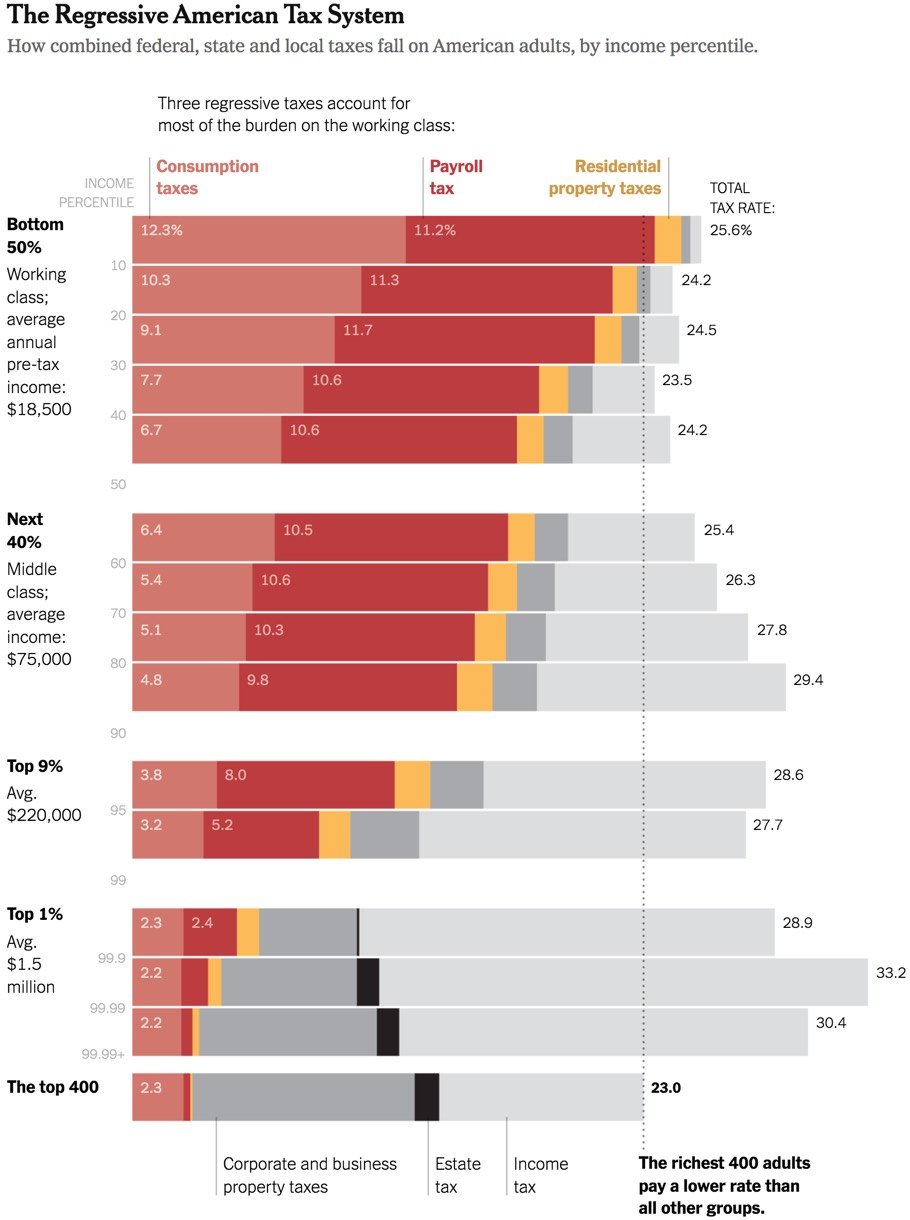
The result is a tax system that is much less progressive than it used to be. And unjust. The economists who compiled this data, Emmanuel Saez and Gabriel Zucman, have written a book called The Triumph of Injustice: How the Rich Dodge Taxes and How to Make Them Pay. In this piece called How to Tax Our Way Back to Justice, the pair lay out the problem and how we can fix it to make our tax system more just for the majority of Americans.
The good news is that we can fix tax injustice, right now. There is nothing inherent in modern technology or globalization that destroys our ability to institute a highly progressive tax system. The choice is ours. We can countenance a sprawling industry that helps the affluent dodge taxation, or we can choose to regulate it. We can let multinationals pick the country where they declare their profits, or we can pick for them. We can tolerate financial opacity and the countless possibilities for tax evasion that come with it, or we can choose to measure, record and tax wealth.
If we believe most commentators, tax avoidance is a law of nature. Because politics is messy and democracy imperfect, this argument goes, the tax code is always full of “loopholes” that the rich will exploit. Tax justice has never prevailed, and it will never prevail. […] But they are mistaken.
The partnership between China and Western governments & corporations has hit a rough patch recently, namely the Hong Kong protests and how the NBA, Apple, and gaming company Blizzard have handled various responses to them on their platforms. I don’t have a lot to add on the matter, but I have read some interesting takes in the past few days that you might also want to take a look at.
Ben Thompson, The Chinese Cultural Clash:
I am not particularly excited to write this article. My instinct is towards free trade, my affinity for Asia generally and Greater China specifically, my welfare enhanced by staying off China’s radar. And yet, for all that the idea of being a global citizen is an alluring concept and largely my lived experience, I find in situations like this that I am undoubtedly a child of the West. I do believe in the individual, in free speech, and in democracy, no matter how poorly practiced in the United States or elsewhere. And, in situations like this weekend, when values meet money, I worry just how many companies are capable of choosing the former?
John Gruber riffing on Thompson’s piece:
The gist of it is that 25 years ago, when the West opened trade relations with China, we expected our foundational values like freedom of speech, personal liberty, and democracy to spread to China.
Instead, the opposite is happening. China maintains strict control over what its people see on the Internet — the Great Firewall works. They ban our social networks where free speech reigns, but we accept and use their social networks, like TikTok, where content contrary to the Chinese Community Party line is suppressed.
Farhad Manjoo, Dealing With China Isn’t Worth the Moral Cost:
The People’s Republic of China is the largest, most powerful and arguably most brutal totalitarian state in the world. It denies basic human rights to all of its nearly 1.4 billion citizens. There is no freedom of speech, thought, assembly, religion, movement or any semblance of political liberty in China. Under Xi Jinping, “president for life,” the Communist Party of China has built the most technologically sophisticated repression machine the world has ever seen. In Xinjiang, in Western China, the government is using technology to mount a cultural genocide against the Muslim Uighur minority that is even more total than the one it carried out in Tibet. Human rights experts say that more than a million people are being held in detention camps in Xinjiang, two million more are in forced “re-education,” and everyone else is invasively surveilled via ubiquitous cameras, artificial intelligence and other high-tech means.
None of this is a secret.
Om Malik, Our Collective Chinese Conundrum:
We in the West should very well know what and who we are dealing with — China might be decked out in Louis Vuitton, but underneath, it is still a single-party, quasi-communist nation. Knowing the Western desperation for growth and the insatiable needs of the stock markets, China also knows it can yank anyone’s chain.
Huawei isn’t a recent problem. It was a problem a decade ago. The dynamic in this spat between the NBA and China isn’t new — China gets what China wants, not the other way around. Why are we being outraged now? The West signed up for this.
Malik quotes from Ian Bremmer’s newsletter:
in the west, the past decades have been marked by a view that china would eventually adapt to western norms, institutions, political and economic systems. but from an asian perspective, the opposite appears more likely. after all, of the last 2,000 years, china and india have led the global economy for the first 1800; europe and the united states only flipped the script for the last 200. now that’s about to change. and when it does, it’s going to happen quickly, powered by 1.4 billion increasingly urban, educated and technologically-connected chinese citizens. take the long view (and an asian perspective) and it’s a better bet that the west will adapt to the realities of chinese economic power, not the other way around.
In an opinion piece for the NY Times, Thomas Edsall asks the provocative question: How and when will President Trump leave the White House? In the course of attempting to define and then answer the question, he talks with a number of political experts about how a successful impeachment or a 2020 election defeat could play out. When he asked “eminently reasonable scholar” David Leege about it, Leege said:
We should not assume that either a 2020 election defeat or impeachment/conviction will remove Trump from the White House.
Both before Trump was elected in 2016 and during his term, he has made frequent references to “my 2nd Amendment friends”’ and increasingly the “patriots” who constitute the military.
As president, Trump has resisted any effort to curb citizen access to guns and ammo. He puts on a modest show of concern when a particularly bad gun massacre occurs but, in the end, he sees armed citizens as a significant personal asset.
And if the 2020 election is at all close, you’d might see something like what happened in 2000 with Bush/Gore, except way worse, given today’s hyper-partisan political atmosphere. Here is Harvard’s Steven Levitsky:
It is possible that Republicans would close ranks behind Trump, resulting in a constitutional crisis. If right-wing media and the G.O.P. politicians were to remain solidly behind Trump, as they largely have thus far in previous scandals, there would be no easy constitutional exit.
I’ve had a bad feeling about just this possibility for a few years now. From a post I wrote in Sept 2017:
But watching Trump as President over the past few months, is it really that difficult to imagine him going full OJ here when confronted with losing his powerful position? Instead of Simpson being driven around LA in the white Bronco by Al Cowlings followed by a phalanx of police cruisers, on January 20, 2021, it’ll be Trump locked in the White House with Senator Kid Rock, taunting the military via Twitter to come in and get him. That sounds more plausible than Trump genteelly hosting the incoming Democratic President for tea in what USA Today calls “the 220-year-old ritual that has become a hallmark of American democracy: The orderly transition of power that comes at the appointed hour when one president takes the oath of office and his predecessor recedes into history”. Aside from “power”, not a single other word in that sentence even remotely describes anything Trump has ever cared about.
It will indeed be interesting and terrifying to see what happens here.
UK Prime Minister Boris Johnson appears to be strategically using particular words and phrases in speeches and appearances as SEO bait to bury unfavorable news about himself in Google’s search results. My pal Matt Webb has collected three examples of this devious practice over the past month.
Not only has Boris used his infamous ‘dead cat strategy’ to move the conversation away from him and Carrie Symonds and his plans for Brexit, he’s managed to push down his past mistakes on Google, too — making it more difficult for people to get a quick snapshot of relevant information. He’s not just controlling the narrative here — he’s practically rewriting it. And judged by the standards of an SEO campaign, it’s hard to describe it as anything other than a resounding success.
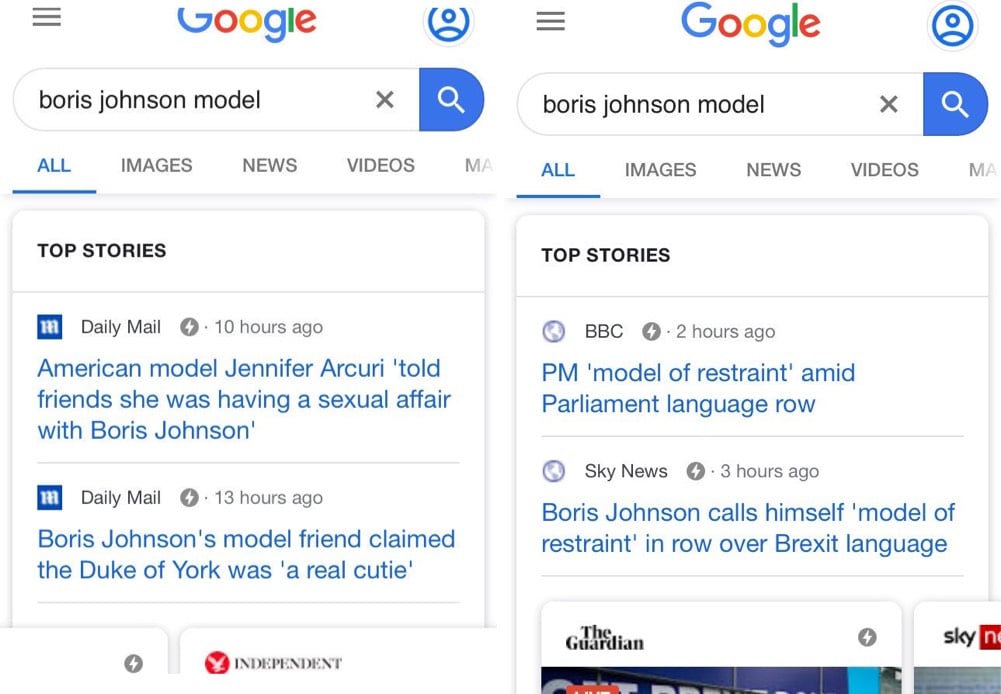
In the latest instance, Johnson used the phrase “model of restraint” in a TV appearance, which then came up in search results for “boris johnson model” instead of articles about the allegations that he’d had a sexual relationship with a former model whose business he funneled money & favors to while mayor of London.
Wired has more information on the PM’s potential SEO scam.
His speech in front of the police was meant to distract from reports that the police were called to the flat he shared with girlfriend Carrie Symonds following an alleged domestic dispute, while the kipper incident was meant to downplay connections with UKIP (whose supporters are called kippers). The claim about painting buses, finally, was supposedly intended to reframe search results about the contentious claim that the UK sends £350 million to Europe branded on the side of the Brexit campaign bus.
“It’s a really simple way of thinking about it, but at the end of the day it’s what a lot of SEO experts want to achieve,” says Jess Melia of Parallax, a Leeds-based company that identified the theory with Johnson’s claim to paint model buses.
“With the amount of press he’s got going on around him, it’s not beyond the realm of possibility that someone on his team is saying: ‘Just go and talk about something else and this is the word I want you to use’,” says Melia.
Update: If you didn’t click through to the Wired article by Chris Stokel-Walker, the piece presents a number of reasons why Johnson’s supposed SEO trickery might not work:
For one thing, Google search results are weighted towards behavioural factors and sentiment of those searching for terms — which would mean that such a strategy of polishing search results would be shortsighted. The individual nuances of each user are reflected in the search results they see, and the search results are constantly updated.
“What we search for influences what we find,” says Rodgers. “Not all search results are the same. That front page of Google, depending on what I’ve searched for in the past. It’s very hard to game that organic search.”
Current searches for the terms in question show that any effect was indeed short-lived. On Twitter, Stokel-Walker says that “No, Boris Johnson isn’t seeding stories with odd keywords to reduce the number of embarrassing stories about him in Google search results” (and calls those who believe Johnson is doing so “conspiracy theorists” (perhaps in mock frustration)) but the piece itself doesn’t provide its readers such a definitive answer,1 instead offering something closer to “some experts say he probably isn’t deliberately seeding search keywords and others disagree, but even if he is, it is unlikely to work as a long-term strategy”. Since we don’t really know — and won’t, unless some Johnson staffer or PR agency fesses up to it — that seems like an entirely reasonable conclusion for now.
In this quick animated excerpt of a longer talk, political philosopher Michael Sandel critiques the idea of the meritocracy, the notion that innate talent and hard work are the main drivers of personal success and “the smug conviction of those who land on top that they deserve their fate”.
A lively sense of the contingency of our lot conduces to a certain humility. The idea that ‘there but for the grace of God, or the accident of fortune, go I’. But a perfect meritocracy banishes all sense of gift or grace or luck; it diminishes our capacity to see ourselves as sharing a common fate. And so, it leaves little room for the solidarity that can arise when we reflect on the contingency of our talents and fortunes. This is what makes merit a kind of tyranny.
Sandel’s full talk, A New Politics of Hope, is available online here.
P.S. A reminder that the term “meritocracy” was originally a satirical term invented by writer Michael Young in 1958 to describe a dystopian society. He is disappointed to see how people now wear the term as a badge of honor.
The business meritocracy is in vogue. If meritocrats believe, as more and more of them are encouraged to, that their advancement comes from their own merits, they can feel they deserve whatever they can get.
They can be insufferably smug, much more so than the people who knew they had achieved advancement not on their own merit but because they were, as somebody’s son or daughter, the beneficiaries of nepotism. The newcomers can actually believe they have morality on their side.
(via open culture)
For years, researchers have identified a link between a person’s “moral foundations” and their political views. In a piece for The Atlantic, Olga Khazan summarized it like so:
According to the researchers who invented the quiz, the issues that most concern political liberals tend to fall under the category of “individualizing” moral foundations, which have more to do with personal standards: care versus harm and fairness versus cheating. Political conservatives, meanwhile, tend to be more concerned about group-focused “binding” foundations: loyalty versus betrayal, authority versus subversion, and disgust versus purity. If loyalty is extremely important to you, the research suggests, you might care deeply about supporting the troops, and therefore you might be more likely to be politically conservative.
She then goes on to describe the results of a new study that suggest that maybe our morals are determined by our political affiliation and not the other way around.
In a series of analyses published recently in the American Journal of Political Science, the three researchers found that people’s moral codes don’t cause or predict their political ideology; instead, people’s ideology appears to predict their answers on the moral-foundations questionnaire. As Peter Hatemi, one of the study’s authors and a political-science professor at Pennsylvania State University, puts it: “We will switch our moral compass depending on how it fits with what we believe politically.”
This could explain how the Republicans’ opinion of Russia changed so quickly in the wake of allegations that Donald Trump colluded in Russia’s meddling in the 2016 election, the Republican flip-flop on climate change, the evangelical Christian embrace of the most immoral President in recent history, and the leftward swing of many Democratic Party members, following their most visible politicians (Bernie, Warren, AOC) & most vocal supporters away from Obama’s centrism.
Newer posts
Older posts





Socials & More