kottke.org posts about physics
This short animation from NASA shows the sizes of some of the supermassive black holes that feature at the center of galaxies. Some are relatively small:
First up is 1601+3113, a dwarf galaxy hosting a black hole packed with the mass of 100,000 Suns. The matter is so compressed that even the black hole’s shadow is smaller than our Sun.
While others are much larger than the solar system…and this isn’t even the biggest one:
At the animation’s larger scale lies M87’s black hole, now with a updated mass of 5.4 billion Suns. Its shadow is so big that even a beam of light — traveling at 670 million mph (1 billion kph) — would take about two and a half days to cross it.
I saw this video on the front page a YouTube a couple of weeks ago and ignored it. Like, of course water can solve a maze, next! But then it got the Kid Should See This seal of approval so I gave it a shot. It turns out: water can solve a maze…but specifics are super interesting in several respects. Steve Mould, who you may remember from the assassin’s teapot video not too long ago, built four mazes of different sizes and shapes, each of them useful for demonstrating a different wrinkle in how the water moves through a maze. Recommended viewing for all ages.
The assassin’s teapot is certainly an eye-catching name for pottery, but there’s also an interesting bit of physics going on here. The teapot in question has two separate chambers for holding liquid, and the flow out of the pot from each chamber can be controlled by covering or uncovering small holes located on the handle. So, as the legend goes, a would-be assassin could pour themselves a perfectly fine drink from one chamber and then pour a poisoned drink to their prey from the other chamber, just by discreetly covering and uncovering the proper holes with their fingers. As the video explains, the mechanism here has to do with surface tension and air pressure.
You can get your own assassin’s teapot right here.

This is super-interesting: in papers written by Leonardo da Vinci collected in the Codex Arundel, he documents experiments that show that gravity is a form of acceleration and also calculated the gravitational constant to within 97% accuracy, hundreds of years before Newton formalized gravity in theory.
In an article published in the journal Leonardo, the researchers draw upon a fresh look at one of da Vinci’s notebooks to show that the famed polymath had devised experiments to demonstrate that gravity is a form of acceleration — and that he further modeled the gravitational constant to around 97 percent accuracy.
Da Vinci, who lived from 1452 to 1519, was well ahead of the curve in exploring these concepts. It wasn’t until 1604 that Galileo Galilei would theorize that the distance covered by a falling object was proportional to the square of time elapsed and not until the late 17th century that Sir Isaac Newton would expand on that to develop a law of universal gravitation, describing how objects are attracted to one another. Da Vinci’s primary hurdle was being limited by the tools at his disposal. For example, he lacked a means of precisely measuring time as objects fell.
As the piece notes, Leonardo didn’t get things exactly right:
Da Vinci sought to mathematically describe that acceleration. It is here, according to the study’s authors, that he didn’t quite hit the mark. To explore da Vinci’s process, the team used computer modeling to run his water vase experiment. Doing so yielded da Vinci’s error.
“What we saw is that Leonardo wrestled with this, but he modeled it as the falling object’s distance was proportional to 2 to the t power [with t representing time] instead proportional to t squared,” Roh says. “It’s wrong, but we later found out that he used this sort of wrong equation in the correct way.” In his notes, da Vinci illustrated an object falling for up to four intervals of time-a period through which graphs of both types of equations line up closely.
But it’s still pretty impressive how far he did get. The piece also notes that this work was discovered because the codex was made available online to the general public, demonstrating the value of easy access of materials like this.
A group of astronomers say they have evidence that links supermassive black holes at galactic centers with dark energy, the mysterious force that accounts for roughly 68% of the energy in the universe. Here’s the news release and the paper. From the Guardian:
Instead of dark energy being smeared out across spacetime, as many physicists have assumed, the scientists suggest that it is created and remains inside black holes, which form in the crushing forces of collapsing stars.
“We propose that black holes are the source for dark energy,” said Duncan Farrah, an astronomer at the University of Hawaii. “This dark energy is produced when normal matter is compressed during the death and collapse of large stars.”
The claim was met with raised eyebrows from some independent experts, with one noting that while the idea deserved scrutiny, it was far too early to link black holes and dark energy. “There’s a number of counter-arguments and facts that need to be understood if this claim is going to live more than a few months,” said Vitor Cardoso, a professor of physics at the Niels Bohr Institute in Copenhagen.
And here’s a short video explainer:
It’s a radical claim to be sure — it’ll be interesting to see how it shakes out in the weeks and months to come as other scientists interpret the results.
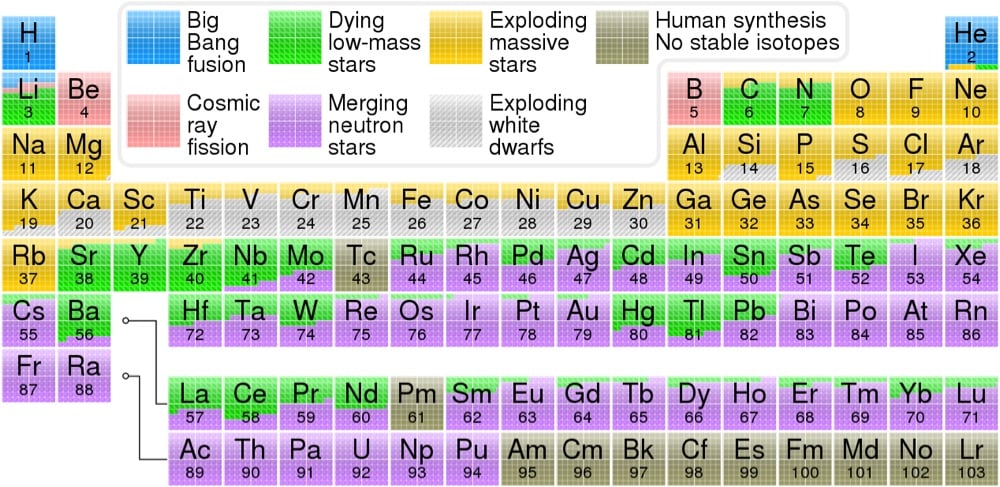
From Wikipedia contributor Cmglee and Astronomy Picture of the Day, a color-coded periodic table that displays which cosmic events — the Big Bang, exploding stars, merging neutron stars, etc. — was responsible for creating each element, according to our present understanding of the universe.
The hydrogen in your body, present in every molecule of water, came from the Big Bang. There are no other appreciable sources of hydrogen in the universe. The carbon in your body was made by nuclear fusion in the interior of stars, as was the oxygen. Much of the iron in your body was made during supernovas of stars that occurred long ago and far away. The gold in your jewelry was likely made from neutron stars during collisions that may have been visible as short-duration gamma-ray bursts or gravitational wave events.
The data for the table came from OSU’s Jennifer Johnson, who quotes Carl Sagan:
The nitrogen in our DNA, the calcium in our teeth, the iron in our blood, the carbon in our apple pies were made in the interiors of collapsing stars. We are made of starstuff.
(thx, caroline)
It is Friday and this is the perfect Friday sort of post. BeamNG is a video game of sorts that’s “a dynamic soft-body physics vehicle simulator capable of doing just about anything”. In the simulator, you can quickly devise all sorts of situations with a variety of cars and then press play to see what happens, with (mostly) realistic physics and collisions. For instance, here’s Cars vs Big Bulge:
Chained Cars vs Bollards:
Cars vs 100 Fallen Trees:
Trains vs Giant Pit:
And many many more. My god if this simulator had been around when I was 12 years old, I might not have done anything else. Hell, if I downloaded and installed this right now, I might not ever get anything done ever again. (via @tvaziri)
No doubt motivated by this month’s release of Moonfall, the latest movie from disaster shlockmeister Roland Emmerich, Kurzgesagt has made a video that shows what would happen to civilization should the Moon somehow get knocked from its orbit and head straight for the Earth. Spoiler: the Moon doesn’t even need to reach us to kill almost all life on the planet.
See also A Scientific Simulation of Seveneves’ Moon Disaster.
The James Webb Space Telescope is designed to be positioned near one of the five Lagrange Points in the Sun/Earth system, special areas of gravitational equilibrium that keep objects stationary relative to both the Earth and the Sun. Here’s how Lagrange Points work and why they are so useful for spacecraft like the Webb.
See also What Makes Lagrange Points Special Locations In Space.
The James Webb Space Telescope is still winging its way to its permanent home at the L2 point1 about 930,000 miles from Earth — it’s due to arrive in about 4 days. It’s a massive and fascinating project and for his YouTube series Smarter Every Day, Destin Sandlin talked to Nobel laureate John Mather, the senior project scientist for the JWST, about how the telescope works.
Also worth a watch is Real Engineering’s The Insane Engineering of James Webb Telescope:
It really is a marvel of modern science & engineering — I can’t wait to see what the telescope sees once it’s fully operational.
In this clever simulation, bouncing balls obeying the laws of physics somehow arrange themselves, mid-chaos, into neat patterns. This is immensely satisfying.
Spoiler: the trick here is a pair of simulations stitched together, like a physics Texas Switch: “Each sequence is obtained by joining two simulations, both starting from the time in which the balls are arranged regularly. One simulates forward in time, one backwards.”
Charles and Ray Eames’ 1977 short film Powers of Ten is one of the best bits of science communication ever created…and a personal favorite of mine. Here’s a description of the original film:
Powers of Ten takes us on an adventure in magnitudes. Starting at a picnic by the lakeside in Chicago, this famous film transports us to the outer edges of the universe. Every ten seconds we view the starting point from ten times farther out until our own galaxy is visible only a s a speck of light among many others. Returning to Earth with breathtaking speed, we move inward — into the hand of the sleeping picnicker — with ten times more magnification every ten seconds. Our journey ends inside a proton of a carbon atom within a DNA molecule in a white blood cell.
As an homage, the BBC and particle physicist Brian Cox have created an updated version that reflects what we’ve learned about the universe in the 45 years since Powers of Ten was made. The new video zooms out to the limits of our current observational powers, to about 100 billion light years away, 1000X wider than in the original. (I wish they would have done the zoom in part of the video too, but maybe next year!)
And if you’d like to explore the scales of the universe for yourself, check out the Universe in a Nutshell app from Tim Urban and Kurzgesagt — you can zoom in and out as far as you want and interact with and learn about objects along the way.
How do you steer a bike? You turn the handlebars to the left to go left, correct? Actually, you don’t: you turn the handlebars to the right to go left…at least at first. And also? Bikes don’t even need riders to remain upright…they are designed to steer themselves.
If you’d like to play around with your own bicycle geometries, try this web app for analyzing bicycle dynamics.
I have been a fan of how things are made videos since my Mister Rogers and Sesame Street days, so I was not expecting to be so surprised watching the video above about how bowling balls are made. It’s a ball — how complicated could it be? Well, it turns out that modern bowling balls contain an asymmetric weight block in the middle that looks a little like a car’s starter. Weird, right?
As I started to wonder why it would be advantageous to include such a lopsided core in a ball you want to roll predictably down a lane, I noticed YouTube’s algorithm doing its job in recommending that I watch Veritasium’s recent video on How Hidden Technology Transformed Bowling, which totally explains the wonky weight block thing:
The weight blocks are wonky in a precise way. They’re designed to cause the ball to contact the lane over more of the surface of the ball, giving it more traction once it hits the unoiled part of the lane, which is desirable for expert bowlers looking for a wicked hook. So cool! (thx, mick)
Update: Brendan Koerner wrote a piece for Wired several months ago about Mo Pinel, who revolutionized bowling with the asymmetric cores described in the video above.
Pinel toured Faball’s factory and examined a freshly made core that the company used in its Hammer brand. It had a symmetrical and unexciting shape — the center looked like a lemon, and there were two convex caps of equal size on either side. In a moment that has now passed into ball-design legend, Pinel grabbed the core, which was still soft because the polyester had yet to cure, and sliced off the ends with a palette knife. Then he smooshed the caps back on into positions that were slightly askew, so that the contraption now looked like a Y-wing fighter from Star Wars.
The ball that contained this revamped core, the Hammer 3D Offset, would become Pinel’s signature achievement. “That ball sold like hotcakes for three years, where the average life span of a ball was about six months,” says Del Warren, a former ball designer who now works as a coach in Florida. “They literally couldn’t build enough of them.” In addition to flaring like few other balls on the market, the 3D Offset was idiot-proof: The core was designed in such a way that it would be hard for a pro shop to muck up its action by drilling a customer’s finger holes incorrectly, an innovation that made bowlers less nervous about plunking down $200 for a ball.
(via @danhwylie)
So let’s say, for the sake of argument and against all scientific evidence to the contrary, the Earth was flat instead of being an oblate spheroid. What would life on a flat Earth be like? Well for one thing, gravity would present some challenges. From a 2018 piece by Doug Main at the Columbia Climate School:
People who believe in a flat Earth assume that gravity would pull straight down, but there’s no evidence to suggest it would work that way. What we know about gravity suggests it would pull toward the center of the disk. That means it would only pull straight down at one point on the center of the disk. As you got increasingly far from the center, gravity would tug more and more horizontally. This would have some strange impacts, like sucking all the water toward the center of the world, and making trees and plants grow diagonally, since they develop in the opposite direction of gravity’s pull.
And even more than that, gravity would tend to pull a flat disc shape back into a spheroid, so absent an intense spinning force (for which there is zero evidence) or some other completely unknown effect, a flat Earth couldn’t even exist:
For Earth to take the shape of a flat disk in the first place, gravity — as we know it — must be having no effect. If it did, it would soon pull the planet back into a spheroid.
A flat Earth would also likely not have a magnetic field (or at least one that is scientifically possible), meaning no atmosphere:
Deep below ground, the solid core of the Earth generates the planet’s magnetic field. But in a flat planet, that would have to be replaced by something else. Perhaps a flat sheet of liquid metal. That, however, wouldn’t rotate in a way that creates a magnetic field. Without a magnetic field, charged particles from the sun would fry the planet. They could strip away the atmosphere, as they did after Mars lost its magnetic field, and the air and oceans would escape into space.
Oh and no tectonic plates, volcanos, mountains, etc. Or GPS. Or weather. Or satellites. Or different night skies in, say, South Africa and Denmark. Or the Sun behaving the way it does in respect to the Earth. Or air travel. Or plant and animal life as it exists presently. To suppose a flat Earth also supposes that physics doesn’t explain our observable universe the way in which it reliably and comprehensively does. The simplest, best evidence for a round Earth is that we’re here living on it in the manner in which we are living on it.

See also What If the Earth Suddenly Turned Flat?, Flat Earthers and the Double-Edged Sword of American Magical Thinking, and Flat Earthers Listening to Daft Punk.
Newer posts
Older posts





Socials & More