kottke.org posts about photography
The beauty of this photo by The Sartorialist is not in the clothes or the model but in the way that everything in shot leans down and to the right: the sidewalk sloping away toward the curb, the higher cuff on her right leg, her left foot slightly in front of her right, hips slouched so that her belt is parallel to the sidewalk, the neckline on her shirt. And then that big wave of hair thrown over the other way, balancing everything else out.
Culled primarily from the Charles W. Cushman collection, a selection of color photographs of NYC taken in the 40s, 50s, and 60s: Downtown 1941, Downtown 1960, Lower East Side, and Miscellaneous. Here’s a shot of Canal St in 1942 (with cobblestones!):
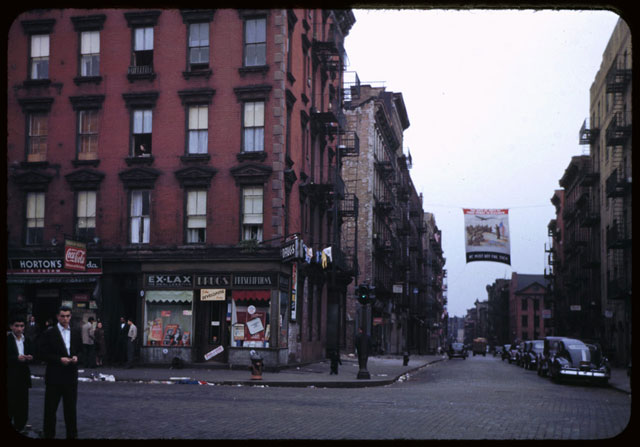
Does anyone know which corner this is? (Here’s another view.) I poked around on Google Maps for a bit trying to find it, but I fear that building is long gone…Canal St, particularly the western part, is much changed since the 1940s.
This is a photo taken by a pinhole camera:

Can you guess what’s in the photo before clicking through? Hint: it’s not a Blade Runner-esque hi-rise looming over a residential neighborhood. (via ben fry)
I got a look at the Henri Cartier-Bresson exhibit at MoMA the other day and loved it. Seeing his work, especially his earlier on-the-street stuff, makes me want to drop everything and go be a photographer. If you’re into photography at all, this show is pretty much a must-see.
(BTW, I chuckled when I saw this photo on the wall…it was the subject of an epic Flickr prank a few years back.)
The Selby has some shots of Cindy Gallop’s apartment, which has to be one of most personality-drenched living spaces I’ve seen since Martha Stewart’s house. (Not that I’ve seen Martha Stewart’s house. But I can imagine.) Here is, for example, Gallop’s Gucci chainsaw:
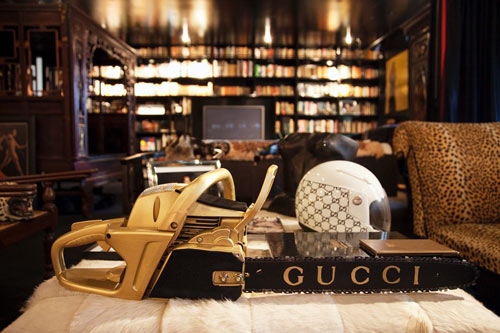
There is also a video tour on Vimeo and a 2006 New York magazine article about how Gallop turned a former YMCA locker room into her “ultimate bachelorette pad”.
She had a specific vision for her new home. “I was looking for something dramatic,” she says. So she told her designer, Stefan Boublil of the Apartment, a creative agency in Soho, “When night falls, I want to feel like I’m in a bar in Shanghai.”
This is probably the best way to see the Sistine Chapel aside from getting on a plane to Rome.
From The Big Picture, a bunch of photos of record setters. This girl has the world’s largest (non-virtual) Pokemon collection.
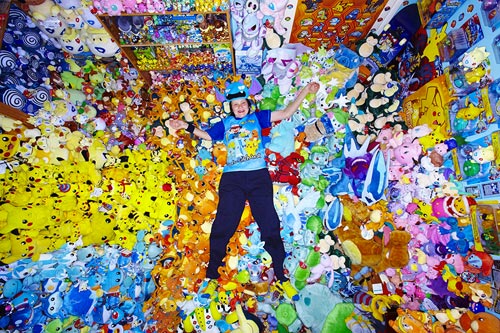
And the contenders for the silliest record are:
The Most Number of Dishes On Display, In a Single Day
The Largest Cycling Class
The Biggest Plate of Hummus
The Most People Running Dressed as Santa
The Largest Meatball
But I have to admit, this is almost poetic in its neat summary of the modern condition:
Sultan Kosen, the world’s tallest man, unveils the world’s largest gingerbread man at an Ikea store in Oslo.
The Big Picture has an awesome set of photos from the 2010 Winter Paralympic Games in Vancouver. Handicapped my ass…most of these events look much tougher than their regular Olympic counterparts.
A 26-gigapixel image of Paris. Fully zoomable and pannable. Sacré-Coeur starts out as a tiny speck and you can zoom in to see a bunch of people sitting on the steps outside.
Photographer Greg du Toit spent months in the disease-infested water of a Kenyan watering hole to catch intimate images of animals drinking.
Sitting in my hide, I would have to remain motionless for hours as I watched the zebra herd’s painfully tentative approach. The sound of my shutter alone, would send them running.
In addition to the photos (larger versions here), du Toit contracted snail fever, malaria (twice), hook worm, and several other parasites.
This visualization represents a year in color (summer is at the top, winter at the bottom).
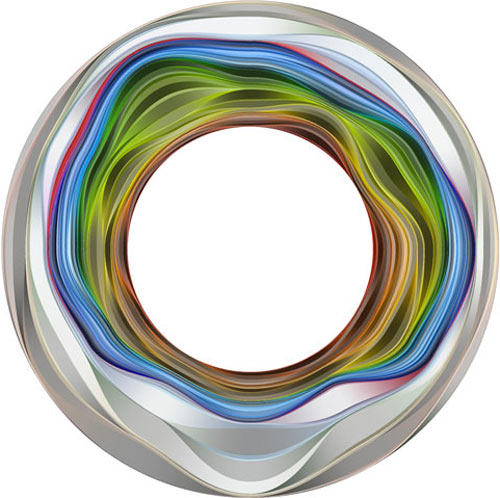
The images were taken of the Boston Common, courtesy of Flickr.
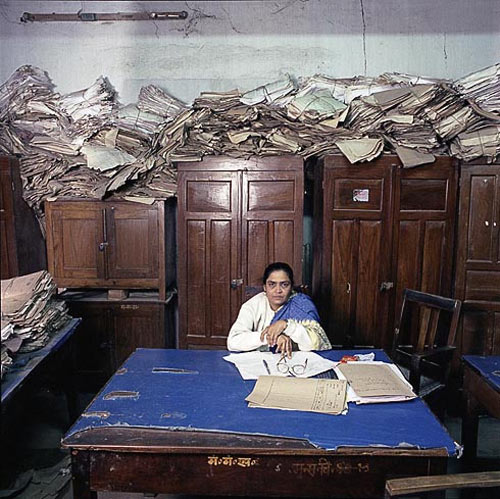
From Jan Banning’s series entitled Bureaucratics.
For the ten of you who watch The Wire *and* know who Terry Richardson is, this is for you.
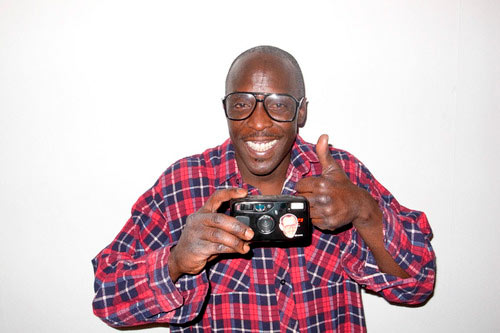
This handsome fellow is the Kodak Bantam Special, a limited-edition camera from 1936.
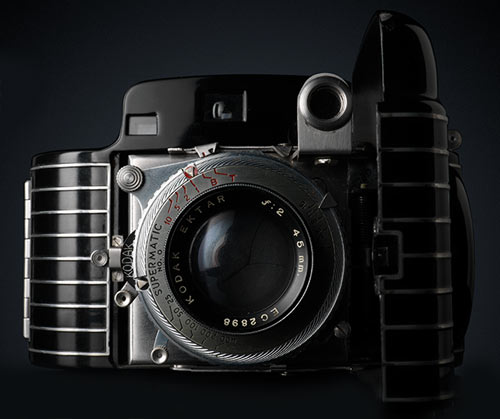
Manufactured by Kodak, designed by Teague. (via monoscope)

God, I am such a sucker for aerial photography. David Maisel has some especially fine examples: The Mining Project, The Forest, The Lake Project, Terminal Mirage, and Oblivion.
Another fantastic feature from Pictory: The One Who Got Away features lost loves, hard choices, and former friends.
My friend and I grew up together: went through big losses early, endured school, survived through everything. This is her writing her final essay for law school, in late summer. I used to love this photo because it meant that we made it, at last. Then, after she became a lawyer, she helped my neighbor sue my family. We just got the letter from her, no warning. If I try hard, I understand her point of view. Business is business. As another good friend said: Welcome to adult issues.
Photographer Phillip Toledano explores the concept of human beauty at a time when people, through surgery and drugs, are able to re-make themselves.
Perhaps we are creating a new kind of beauty. An amalgam of surgery, art, and popular culture? And if so, are the results the vanguard of human induced evolution?
NSFW.
The winning photographs in the 2010 World Press Photo Contest.
A number of designers, artists, and photographers share how they combat creative block. One solution begins:
Slice and chop 2 medium onions into small pieces.
Put a medium sized pan on a medium heat with a few glugs of olive oil.
Add the onions to the pan, and a pinch of salt and pepper.
Celebrity photographer Terry Richardson has a blog to which he posts quick snaps. Sorta like everyone else on the planet except that oh, there’s Kate Moss and there’s Mary Kate and Ashley Olsen and there’s Justin Theroux and there’s Doutzen Kroes and there’s Tracy Morgan.
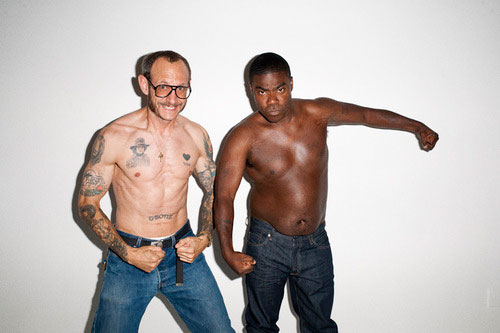
Somewhat NSFW in places.
Photographs of curves found in nature and the graphs and functions that go with them.
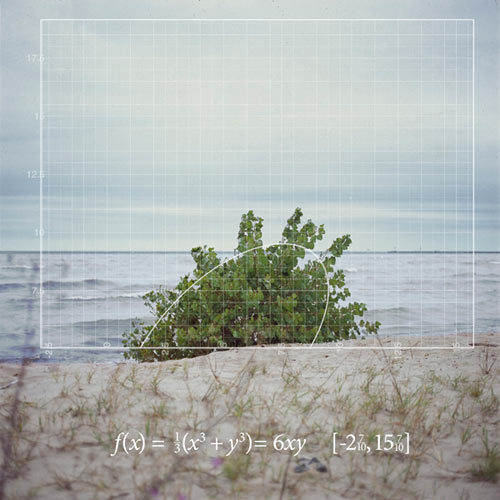
(via snarkmarket)
A collection of upside down faces presented as if they were right side up.
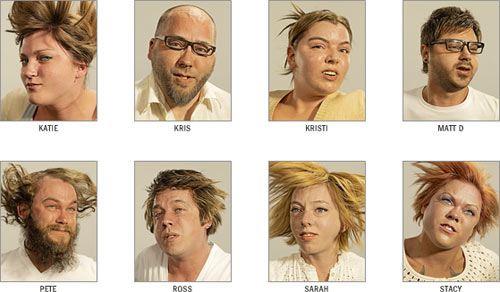
I like best the ones where the hair doesn’t give it away and you have to look to the cheeks or the eyes for evidence of upside down-ness. (via @brainpicker)
The US National Archives have added a number of photos to the Flickr Commons project. Flickr is quietly building the greatest collection of historical documents on the web.
Martin Becka and Cedric Delsaux are a pair of photographers who feature Burj Dubai in their work. Becka’s Burj comes from his Dubai, Transmutations project in which he uses the photogravure processing technique to make images of brand-new Dubai that look as though they were taken in 1880.
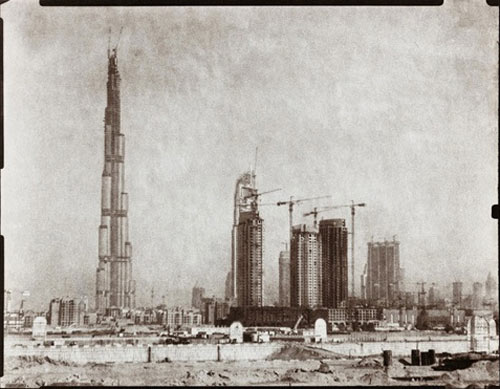
Delsaux’s Burj image comes from a project called The Dark Lens, which features images of Star Wars characters populating the circa-2008 Earth. I believe that’s the Millennium Falcon docking at the Burj:
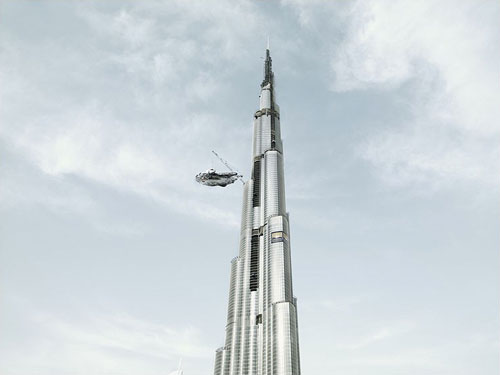
Many more of The Dark Lens images are available on Delsaux’s site.
A 1970 interview with photographer Garry Winogrand on how he’s not trying to say anything with his work. Instead, he sets up photographic challenges for himself, which he then attempts to solve.
My only interest in photographing is photography.
Upcoming at MoMA: a retrospective of the work of Henri Cartier-Bresson.
For more than twenty-five years, he was the keenest observer of the global theater of human affairs — and one of the great portraitists of the twentieth century. MoMA’s retrospective, the first in the United States in three decades, surveys Cartier-Bresson’s entire career, with a presentation of about three hundred photographs, mostly arranged thematically and supplemented with periodicals and books.
After MoMA, the exhibition will visit Chicago, SF, and Atlanta. Quite excited for this one.
Those wildly colorful Hubble telescope photos…how do they get them to look like that?
The colors in Hubble images, which are assigned for various reasons, aren’t always what we’d see if we were able to visit the imaged objects in a spacecraft. We often use color as a tool, whether it is to enhance an object’s detail or to visualize what ordinarily could never be seen by the human eye.
See also this informative Reddit thread.
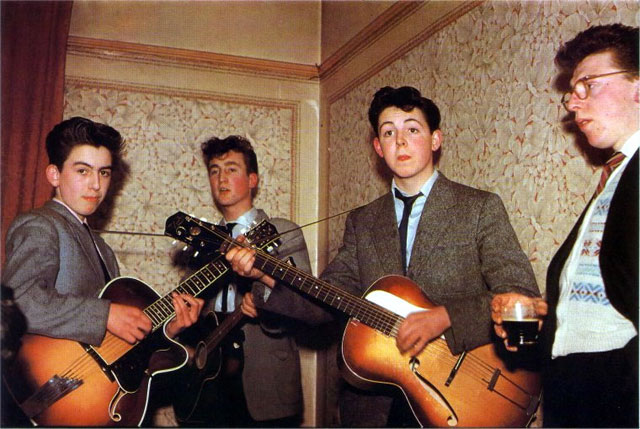
Well, not so much The Beatles as The Quarrymen, a band formed by John Lennon and some schoolmates that was the precursor to The Beatles. (via @brainpicker)
Vincent Fournier has made a series of photos of astronauts training and of the interiors of the Chinese, Russian and US space agencies.
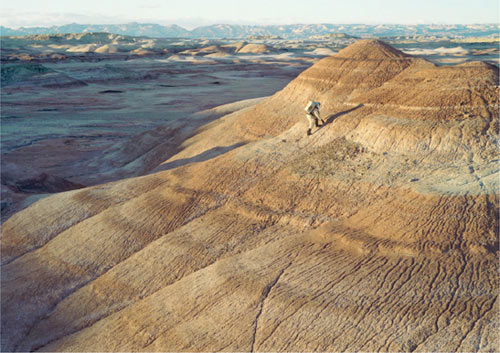
Looks alien, doesn’t it?
Newer posts
Older posts



Socials & More