kottke.org posts about photography
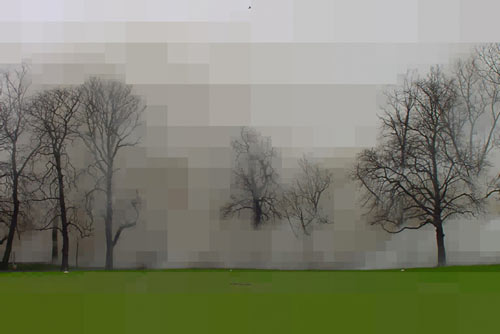
American Pixels is a project by Joerg Colberg that uses jpeg compression algorithms to create compelling images. From the technical notes:
ajpeg is a new image compression algorithm where the focus is not on making its compression efficient but, rather, on making its result interesting. As computer technology has evolved to make artificial images look ever more real - so that the latest generation of shooter and war games will look as realistic as possible - ajpeg is intended to go the opposite way: Instead of creating an image artificially with the intent of making it look as photo-realistic as possible, it takes an image captured from life and transforms it into something that looks real and not real at the same time.
Rachel Loshak is posting two photos a day on her A Year in the Day - 2010 blog; one taken in 2000 and one taken in 2010. The juxtaposition, as they say in the art world, is interesting. (via @ironicsans)
Ryan (the intern) from The Office has a photo blog.
Yes, acceptance is a theme of this photo, as well as all my photos; even the photos I take that capture isolationism have a theme of acceptance, a lack of acceptance. It is the ultimate compliment that this photo not only captured my soul, but yours as well.
The apartment that American writer William S. Burroughs inhabited while he lived in New York has been preserved since his death in 1997. Photographer Peter Ross took some photos of some of the contents, including a worn pair of shoes, some nunchucks, and a book called Medical Implications of Karate Blows.
Well, I bet I’ll go through half a dozen iPhones in the time it would have taken Burroughs to resole those shoes. That makes me feel greedy, wasteful, and self-indulgent. Maybe I’d be better off keeping the modern world out. Maybe we all would. Let’s all just grab our nunchucks, put on our shoes and hat and walk the streets of Manhattan.
Photographer Noah Sheldon took a series of photos of Biosphere 2 in Arizona. BLDGBLOG has more info.
The largest sealed environment ever created, constructed at a cost of $200 million, and now falling somewhere between David Gissen’s idea of subnature — wherein the slow power of vegetative life is unleashed “as a transgressive animated force against buildings” — and a bioclimatically inspired Dubai, Biosphere 2 even included its own one million-gallon artificial sea.
Images from Paris cafes and nightlife in 1962, the same week Yves St. Laurent’s runway show vaulted Dior to new heights. Many scenes around Les Halles (which no longer exists as it did then).
From the collection, a photo of some Les Halles butchers enjoying a drink at Au Pied de Cochon:
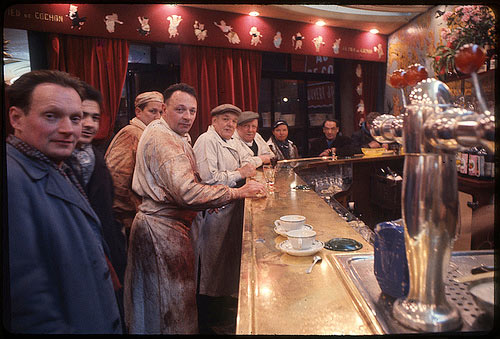
Update: As Wikipedia notes, Saint Laurent’s fabled show took place in 1958; Dior was gone from Dior by ‘62. Not sure whether the caption is wrong or the photos are really from 1958. (thx, alex)
In 1944, Popular Photography magazine asked several people, including photographers Berenice Abbott and László Moholy-Nagy, to speculate about the future of photography.
Their opinions differ. Yet somehow all seem to feel that the second hundred years will see the camera put to use as never before with the amateur often leading the way.
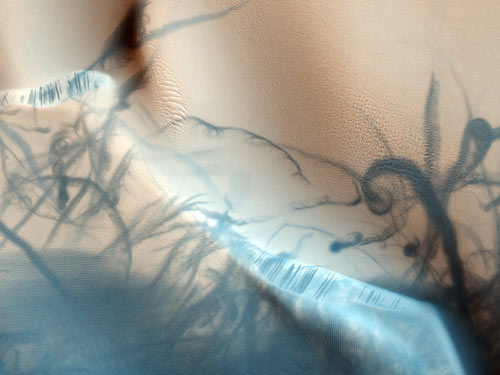
One of the better lists out there: the top astronomy photos of the year. From the list, this is a more detailed view of the Martian landscape than we’re used to seeing:
My personal favorite, the photos taken by the LRO of Apollo 11’s landing site, made the list as well.
While looking for something else at the Los Angeles Public Library, Gerard Van der Leun stumbled across some 1940s photos of LA taken by Ansel Adams. They had not been seen for a long while.
So I would conclude that with the LAPL material we are getting a rare chance to look at photographs a great photographer chose not to show the world. Obviously none of these images even touches upon the vast and central work that establish Adams as one of the greatest American photographers, but they do provide an interesting footnote to what Ansel Adams saw and thought worthy of photographing while ambling about Los Angeles during the opening months of World War II.
In 2004, the Hubble Space Telescope took an image called the Hubble Ultra Deep Field; basically astronomers pointed the Hubble toward an “empty” part of space and took a long-exposure shot in the visible spectrum. What they found were thousands of far away galaxies from early in the development of the universe. Now the Hubble has peered even deeper into the universe in near-infrared and captured this image:
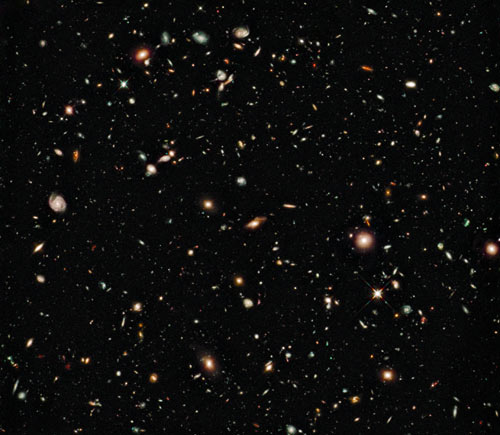
Each one of those little specks is an entire galaxy, some only 600 million years old. Here’s a zoomed-in section:

At a United Nations meeting in September, New Yorker staff photographer Platon took photos of as many world leaders as her could get his hands on. Here’s a slideshow of the results.
What did the Israeli Prime Minister, Benjamin Netanyahu, ask the photographer before the shutter clicked? “Platon,” he said, “make me look good.”
The December 2009 issue of Vogue Italia has a spread of photos taken by Steven Meisel presented in the style of Twitpic.
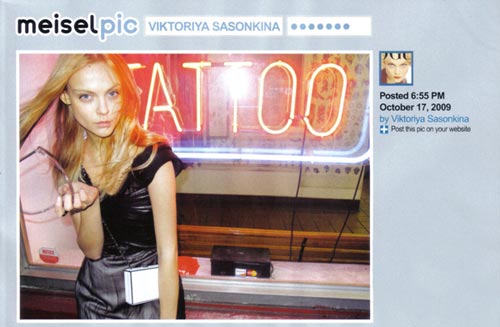
That’s Viktoriya Sasonkina; also represented are Karlie Kloss, Naomi Campbell, Christy Turlington, and Gisele Bundchen.
Oobject has a collection of before-and-after photographs of cities, most of which have been hit by bombs (economic or otherwise): Hiroshima, Dubai, Warsaw.
Photos of Dubai in decline are the new photos of Detroit in decline.
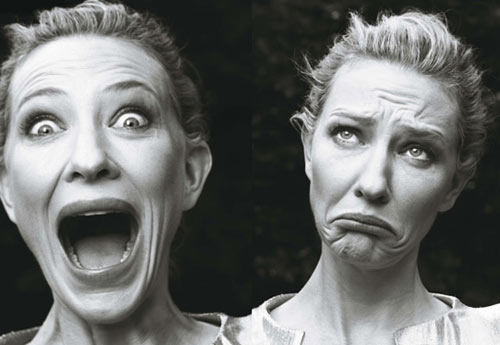
Photo by Annie Leibovitz for Vogue, December 2009. (via djacobs)
Andrew Zuckerman’s photos of birds are flat-out incredible.

That handsome fellow is the African Fish Eagle. The images are collected in a book called Bird.
The landing page for Natalie Daoust’s Tokyo Girls project (sorry no direct link because of Flash) presents you with a grid of 45 small animated photos of women performing stripteases.
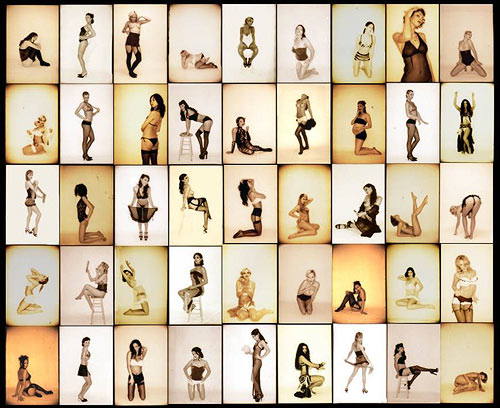
It is kinda mesmerizing. NSFW. (via swissmiss)
I’m sure there will be many of these published today. Send me more if you run across any and I’ll add them to the list.
Photos by Peter Turnley taken in Romania, Berlin, Czechoslovakia, Soviet Union, and Hungary, most of them in late 1989.
Update: Pictures from a Vanished Country by Magnum’s Thomas Hoepker.
Earlier this year I realized we would celebrate the 20th anniversary of the fall of the Berlin Wall. I went back into my archive and discovered that I had boxes full of negatives that I had never seen before, taken in East Germany over the past 50 years. It was a treasure which had to be unearthed.
(thx, bojan)
Update: The Berlin Wall: Rise and Fall, photos from Life magazine.
Mediabistro has collected video of how the news was reported on American television.
Update: The Big Picture weighs in: The Berlin Wall, 20 years gone.
The NY Times asked their readers to submit photos of the Wall: The View From the Wall.
The Times also has some nice split-screen photos of before and after the Wall fell. (thx, mau)
Photos from Poland in the 1980s. (thx, tomek)
From the WSJ: Wall’s Rise and Fall. (thx, paul)
The Denver Post followed high school graduate Ian Fischer as he enlisted in the Army, went through training, left for Iraq, and returned home; the photos tell quite a story.
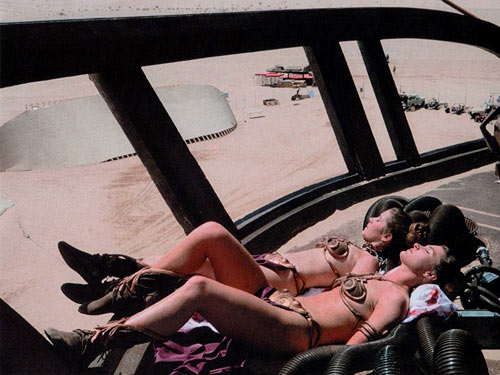
This did unsurprisingly well when I posted it to Twitter, so I’ve archived it here for posterity. This is Carrie Fischer and her stunt double taking a nap under the Tatooine suns during the filming of Jedi.
Paho Mann takes photos of Circle K convenience stores that have since transformed into other businesses.

The slow individualization of re-inhabited Circle Ks caused by years of choices and actions caught my attention. These buildings do not show a linear progression of the corporatization and homogenization of suburbia, but rather serve as evidence of a more circular system — a system driven by a delicate negation between same and different, between complicated sets of actions and choices that shape our built environment.
(via do)
Julia Baum took photos of suburban homes in Santa Clara, CA that were all built from the same architectural plan.
As I take a second look at these neighborhoods, I’ve found vast differences in what was once a uniform typology. Over the past 50 years these Houses have transformed from modest white cubes into a vibrant display of personality and present a rebellion against conformity.

This one is *really* happy. (via conscientious)
This is a 36-second wax cylinder recording of Walt Whitman reading a few lines from his poem, America. You may recognize the recording from its use in Levi’s new ad campaign:
I thought for sure that Ryan McGinley had directed this and the O Pioneers! commercial but it turns out he just (just!) did the photos for the print campaign. (via slate)
Update: The audio clip used in that commercial might not be Whitman after all. From the inbox:
The Walt Whitman recording that is being used by the Levi’s commercial that you posted on the 28th is actually not Whitman, and is now considered by most audio archivists to be a hoax.
More information about this most interesting recording can be found in Vol. X, No. 3 of Allen Koenigsberg’s Antique Phonograph Monthly magazine from 1992, pages 9-11.
Among things pointed out, one is that the speech on the soundtrack ends with the quote, “Freedom Law and Love,” whereas the original printed version of the poem ends with “Chair’d in the adamant of Time.”
Koenigsberg also points out that Whitman’s last years were chronicled on a daily basis by his personal secretary, and being wheelchair-bound, such a visit for Whitman would have been difficult, unprecedented, and undoubtedly noted.
(thx, jack)
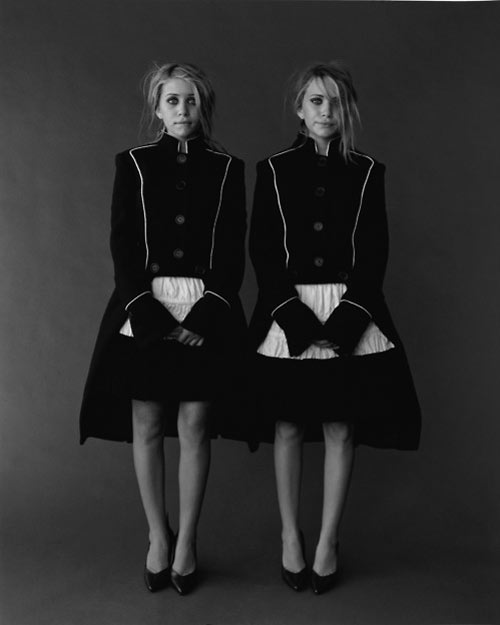
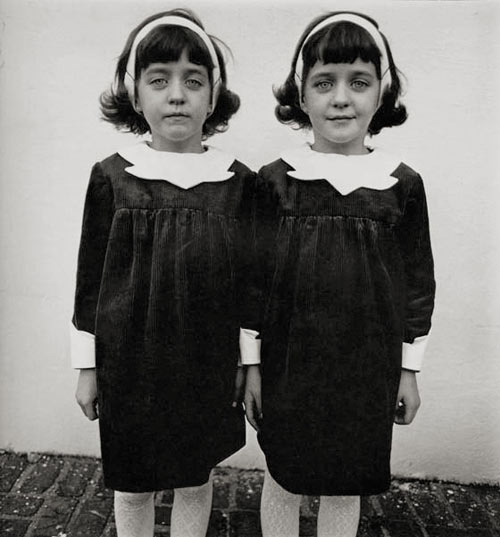
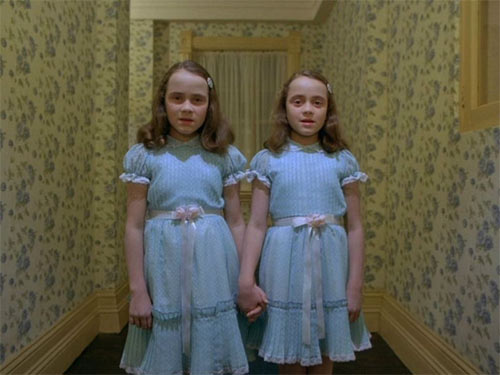
T to B: The Olsen twins (photographer unknown), Identical Twins, Roselle, New Jersey, 1967 by Diane Arbus, the Grady twins from The Shining by Stanley Kubrick. (via hysterical paroxysm)
You can tag people directly in Flickr photos now.
You say to me “light photos” and I say “zzzzz”, but Alan Jaras’ light patterns captured on film are probably what the universe looked like at an early age.

(via justin blanton)
In his newest multipart essay for the NY Times, Errol Morris examines evidence of photo manipulations by the photographers of the Farm Security Administration during the Great Depression, including Walker Evans, Arthur Rothstein, and Dorothea Lange. Were they dispassionate observers of American life in the 1930s or employees after a certain type of story?
If one can imagine the political animosity that would have been generated if, as part of the current stimulus package, President Obama introduced a national documentary photography program, then it is possible to understand the opposition that the F.S.A. faced. Fiscal conservatives did not want to see their hard-earned tax dollars spent on relief, let alone a government photography program, of all things.
The Iconic Photos blog reminds me a bit of Letters of Note (and Footnotes of Mad Men). It’s one notable photo per post plus some context.
Newer posts
Older posts



Socials & More