



Kubrick’s Use of One-Point Perspective
Wes Anderson likes overhead shots, Quentin Tarantino prefers to peer up from below, Darren Aronofsky uses sharp sounds, and Stanley Kubrick often uses one-point perspective.

This site is made possible by member support. 💞
Big thanks to Arcustech for hosting the site and offering amazing tech support.
When you buy through links on kottke.org, I may earn an affiliate commission. Thanks for supporting the site!
kottke.org. home of fine hypertext products since 1998.
Beloved by 86.47% of the web.
Wes Anderson likes overhead shots, Quentin Tarantino prefers to peer up from below, Darren Aronofsky uses sharp sounds, and Stanley Kubrick often uses one-point perspective.
Aleksandar Hemon scored a rare chance to profile the publicity-averse Wachowskis as they prepare to unleash Cloud Atlas onto the world.
I first met the Wachowskis in December, 2009, when they were in the midst of their struggle to find financing for “Cloud Atlas.” Uncomfortable with being idle while they waited, they were also developing “Cobalt Neural 9,” a project that had grown out of their frustration with the Bush Presidency and the wars in Iraq and Afghanistan. Curious about how the early aughts would be perceived in the future, the Wachowskis imagined a documentary film made eight decades from now, looking back at the country’s plunge into imperial self-delusion. In order to write a script for “Cobalt Neural 9,” the Wachowskis were filming interviews with people, from Arianna Huffington to Cornel West, who they thought might be able to help them elucidate their concerns. I was invited to participate and was costumed to look as if I were speaking in 2090. Dressed like a Bosnian Isaac Hayes (with sparkling lights attached to my skull, a psychedelic shirt, and a New Age pendant), I ranted about the malignant idiocy of the Bush regime. Lana sat next to the camera, asking most of the questions, while Andy was somewhere beyond the lights, his voice occasionally booming from the void.
Usually, I experience an erosion of confidence around famous people-an inescapable conviction that they know more than I do, because the world is somehow more available to them. But I got along splendidly with the Wachowskis. Seemingly untouched by Hollywood, they did not project the jadedness that is a common symptom of stardom. Lana was one of the best-read people I’d ever met; Andy had a wry sense of humor; they were both devout Bulls fans. We also shared a militant belief in the art of narration and a passionate love for Chicago.
Eventually, I asked them to consider letting me write about the making of “Cloud Atlas.” They talked it over and decided to do it. By then, they’d sent the script to every major studio, after Warner Bros. had declined to exercise its option. Everyone passed. “Cloud Atlas” seemed too challenging, too complex. The Wachowskis reminded Warner Bros. that “The Matrix” had also been deemed too demanding, and that it had taken them nearly three years to get the green light on it. But the best the studio could do for “Cloud Atlas” was to keep open the possibility of buying the North American distribution rights, payment for which would cover a portion of the projected budget.
I read the book while on vacation and after rewatching the trailer, I am beyond excited for this movie. Still don’t understand how it’s not 14 hours long, but hey.
Back in July, we covered the Criterion Collection release of The Royal Tenenbaums. Recently, Criterion Collection posted a gallery of 9 books and magazines from the movie, which because of said gallery, I want to watch right now.
Everyone knows [X], what this post presupposes is maybe [Y].
See also The Royal Tenenbaum portraits. (thx, alex)
Steven Spielberg is re-releasing Raiders of the Lost Ark in IMAX theaters for a one week engagement in early September.
Mr. Spielberg, who with the sound designer Ben Burtt supervised the conversion of “Raiders of the Lost Ark” to Imax, said that no special effects or other visual elements of the film were changed. The audio, he said, had been enhanced for surround sound: “When the boulder is rolling, chasing Indy through the cave, you really feel the boulder in your stomach, the way you do when a marching band passes by, and you’re standing right next to it.”
All four Jones movies will be out on Blu-ray in mid-September. (via df)
Where have I seen this before, a massive long-lasting Arctic storm that looks a lot like a hurricane? Oh right, The Day After Tomorrow.
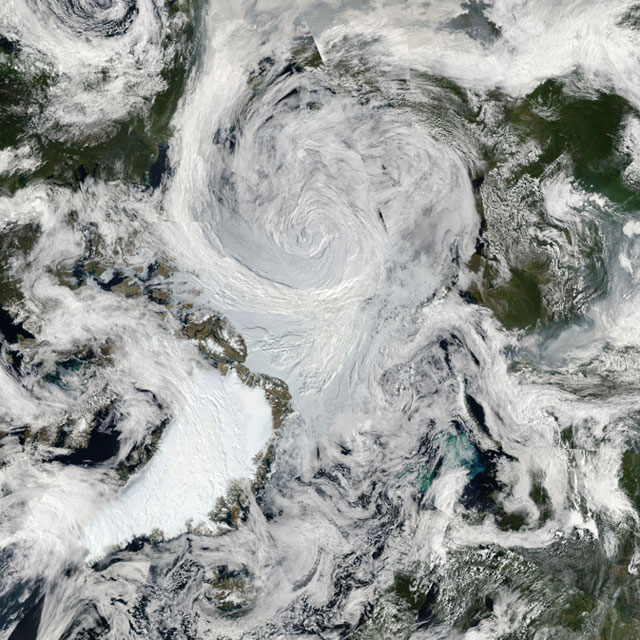
The storm had an unusually low central pressure area. Paul A. Newman, chief scientist for Atmospheric Sciences at NASA’s Goddard Space Flight Center in Greenbelt, Md., estimates that there have only been about eight storms of similar strength during the month of August in the last 34 years of satellite records. “It’s an uncommon event, especially because it’s occurring in the summer. Polar lows are more usual in the winter,” Newman said.
Arctic storms such as this one can have a large impact on the sea ice, causing it to melt rapidly through many mechanisms, such as tearing off large swaths of ice and pushing them to warmer sites, churning the ice and making it slushier, or lifting warmer waters from the depths of the Arctic Ocean.
I love The Day After Tomorrow. I know it’s a cheeseball disaster movie (which is pretty much why I love it) but it’s also looking more than a little prescient. Well, as prescient as a cheeseball disaster movie can be anyway. In the Washington Post the other day, prominent climatologist James Hansen wrote that human-driven climate change is responsible for an increase in extreme weather.
My projections about increasing global temperature have been proved true. But I failed to fully explore how quickly that average rise would drive an increase in extreme weather.
In a new analysis of the past six decades of global temperatures, which will be published Monday, my colleagues and I have revealed a stunning increase in the frequency of extremely hot summers, with deeply troubling ramifications for not only our future but also for our present.
This is not a climate model or a prediction but actual observations of weather events and temperatures that have happened. Our analysis shows that it is no longer enough to say that global warming will increase the likelihood of extreme weather and to repeat the caveat that no individual weather event can be directly linked to climate change. To the contrary, our analysis shows that, for the extreme hot weather of the recent past, there is virtually no explanation other than climate change.
In many ways, the phrase “global warming” is grossly misleading. “Oh,” we think, “it’s gonna be a couple degrees warmer in NYC in 20 years than it is now.” But the Earth’s climate is a chaotic non-linear system, which means that a sudden shift of a degree or two — and when you’re talking about something as big as the Earth, a degree over several decades is sudden — pushes things out of balance here and there in unpredictable ways. So it’s not just that it’s getting hotter, it’s that you’ve got droughts in places where you didn’t have them before, severe floods in other places, unusually hot summers, and even places that are cooler than normal, all of which disrupts the animal and plant life that won’t be able to acclimate to the new reality fast enough.
But pretty Arctic cyclone though, right?
Every decade since 1952, Sight & Sound has polled film professionals to determine the greatest films of all time. Citizen Kane is always the winner, except for the first year. This year, however, S&S expanded the number of contributors dramatically and included online critics as well resulting in Citizen Kane’s unseating. They’ve released the list of top 50 films now, and will release a top 100 in about a month.
About a year ago, the Sight & Sound team met to consider how we could best approach the poll this time. Given the dominance of electronic media, what became immediately apparent was that we would have to abandon the somewhat elitist exclusivity with which contributors to the poll had been chosen in the past and reach out to a much wider international group of commentators than before. We were also keen to include among them many critics who had established their careers online rather than purely in print.
To that end we approached more than 1,000 critics, programmers, academics, distributors, writers and other cinephiles, and received (in time for the deadline) precisely 846 top-ten lists that between them mention a total of 2,045 different films.
I (Aaron) have seen 4 of the movies in the top 50 because I am, apparently, a Luddite philistine. Topping the list this year is Vertigo.
After half a century of monopolising the top spot, Citizen Kane was beginning to look smugly inviolable. Call it Schadenfreude, but let’s rejoice that this now conventional and ritualised symbol of ‘the greatest’ has finally been taken down a peg. The accession of Vertigo is hardly in the nature of a coup d’etat. Tying for 11th place in 1972, Hitchcock’s masterpiece steadily inched up the poll over the next three decades, and by 2002 was clearly the heir apparent. Still, even ardent Wellesians should feel gratified at the modest revolution - if only for the proof that film canons (and the versions of history they legitimate) are not completely fossilised.
There’s also a directors’ list of top 10 films. (via @chrissandoval)
In 1979, singer Tom Waits appeared on The Don Lane Show in Australia. As you will soon be able to see (the action starts at 1:30), his appearance was likely the basis for Heath Ledger’s performance as The Joker in The Dark Knight.
Holy, uh, Batman, Batman!
Chris Marker, best known as a filmmaker and for his film La jetée, has died aged 91.
Marker’s creative use of sound, images and text in his poetic, political and philosophical documentaries made him one of the most inventive of film-makers. They looked forward to what is called “the new documentary”, but also looked back to the literary essay in the tradition of Michel de Montaigne. Marker’s interests lay in transitional societies - “life in the process of becoming history,” as he put it. How do various cultures perceive and sustain themselves and each other in the increasingly intermingled modern world?
La jetée is available in its 28-minute entirety on YouTube and is well worth watching.
The Wachowskis (The Matrix movies) and Tom Tykwer (Run Lola Run) are teaming up to bring David Mitchell’s award-winning novel, Cloud Atlas, to the big screen. It’s an ambitious effort given the plot of the book:
The novel consists of six nested stories that take the reader from the remote South Pacific in the nineteenth century to a distant, post-apocalyptic future. Each tale is revealed to be a story that is read (or observed) by the main character in the next. All stories but the last are interrupted at some moment, and after the sixth story concludes at the center of the book, the novel “goes back” in time, “closing” each story as the book progresses in terms of pages but regresses in terms of the historical period in which the action takes place. Eventually, readers end where they started, with Adam Ewing in the Pacific Ocean, circa 1850.
Here’s an extended trailer of the film:
The trailer is also on Apple’s site along with a short commentary by the directors. BTW, the Wachowskis are no longer brothers because Larry had sexual reassignment surgery and is now Lana…the directors’ commentary is the first I’ve seen of her since the switch.
A trailer for 2001: A Space Odyssey cut to make the movie seem like a big summer blockbuster.
Minnesota Nice is a 25-minute documentary about the Coen brothers’ Fargo.
(via ★interesting)
Scouting NY takes a look at some filming locations used by Woody Allen for Annie Hall to see how they’ve changed in the past 36 years.

The most unexpected thing about looking at old photos of NYC is how many fewer trees there were than there are now. (via ★spavis)
Ignoring the prequels (of course), how much power does Yoda put out when he’s using the Force? It’s perhaps less than you’d realize.
Yoda’s greatest display of raw power in the original trilogy came when he lifted Luke’s X-Wing from the swamp. As far as physically moving objects around goes, this was easily the biggest expenditure of energy through the Force we saw from anyone in the trilogy.
The energy it takes to lift an object to height h is equal to the object’s mass times the force of gravity times the height it’s lifted. The X-Wing scene lets us use this to put a lower limit on Yoda’s peak power output.
First we need to know how heavy the ship was. The X-Wing’s mass has never been canonically established, but its length has-16 meters. An F-22 is 19 meters long and weighs 19,700 lbs, so scaling down from this gives an estimate for the X-Wing of about 12,000 lbs (5 metric tons).
Design firm Dorothy has created a map where all the features are movie-themed: Jurassic Park, Shutter Island, Howards End, the Soylent Green…that sort of thing.
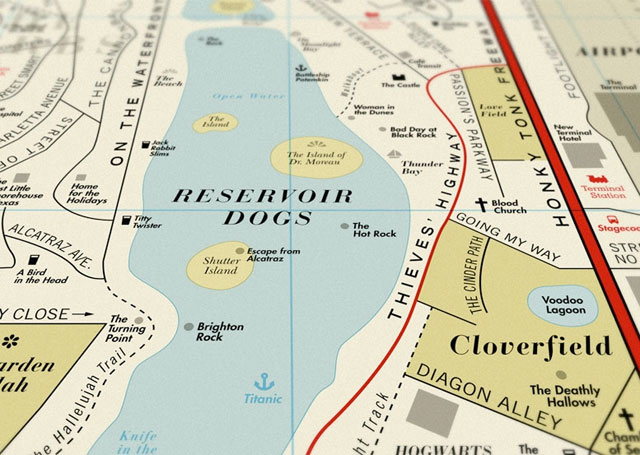
See also their song map.
Speaking of Wes Anderson, The Criterion Collection is releasing The Royal Tenenbaums on Blu-ray in August (pre-order at Amazon). In this age of watching streaming movies on small screens, there are still many that are better in HD with surround sound. (via @moth)
The Hollywood Reporter is reporting that Johnny Depp will be in Wes Anderson’s next movie.
No details regarding the film’s plot or Depp’s character have been revealed, but the project is said to be titled The Grand Budapest Hotel and will mark Texas-born Anderson’s first time shooting in Europe.
A bunch of Anderson regulars are also rumored to be involved: Bill Murray, Owen Wilson, Edward Norton, Jeff Goldblum, Adrien Brody, and Willem Dafoe. IMDB has it listed as Untitled Wes Anderson Project, described as “a European story”, and Owen Wilson is the only listed cast member.
Update: I am reminded, via Twitter, that Anderson has done several projects in Europe. The Life Aquatic was filmed in Italy, Hotel Chevalier was filmed in Paris, and Fantastic Mr. Fox was produced in the UK. Anderson lives in Paris full-time now, I believe, so I would expect that many of his projects moving forward will be filmed/set there.
For the next two weeks, Christian Marclay’s 24-hour supercut of clocks from movies will be on display at Lincoln Center. The Clock shows Tue-Thu from 8am to 10pm and continuously over the weekend.
The Clock is a spectacular and hypnotic 24-hour work of video art by renowned artist Christian Marclay. Marclay has brought together thousands of clips from the entire history of cinema, from silent films to the present, each featuring an exact time on a clock, on a watch, or in dialogue. The resulting collage tells the accurate time at any given moment, making it both a work of art and literally a working timepiece: a cinematic memento mori.
Admission is free, the space air-conditioned, and the couches only slightly uncomfortable. Seating capacity is 96, so the venue is posting updates on Twitter about how long the line is. I popped in earlier today expecting to wait 20 minutes or more and walked right in…quicker than the Shake Shack. I think the MoMA is supposed to be showing it in the next year or two and that is sure to be a complete mob scene so this is your chance to check it out with relative ease.
Earlier this year, Daniel Zalewski profiled Marclay for the New Yorker about how the artist created the film.
Marclay had a dangerous thought: “Wow, wouldn’t it be great to find clips with clocks for every minute of all twenty-four hours?” Marclay has an algorithmic mind, and, as with Sol LeWitt’s work, many of his best pieces have originated with a conceit as straightfoward as a recipe. The resulting collage, he realized, would be weirdly functional; the fragments, properly synched, would tell the time as well as a Rolex. And, because he’d be poaching from a vast number of films, the result would offer an unorthodox anthology of cinema.
There were darker resonances, too. People went to the movies to lose track of time; this video would pound viewers with an awareness of how long they’d been languishing in the dark. It would evoke the laziest of modern pleasures-channel surfing-except that the time wasted would be painfully underlined.
Andrew Stanton is working on a sequel to Finding Nemo. Holy cussing cuss!
I’ve been hearing for months that he would come aboard to direct the sequel to Disney-based Pixar’s Finding Nemo, with the idea that Disney would give him another shot behind the camera on a live-action film. I’m told he’s now officially come aboard the Finding Nemo sequel and has a concept the studio loves.
Well, this is something…an ex-jewel thief decides to unretire and rob people with help from his robot butler. I had to look this up on IMDB to make sure it wasn’t something from Funny or Die or College Humor.
Best robotic sidekick since Mr. Spock. Now reboot Lethal Weapon with Donald Glover and a robot playing the Mel Gibson role. (Yes, I meant Donald. Danny is clearly too old for that shit.)
I was reminded earlier today of True Films, Kevin Kelly’s collection of must-see documentaries, educational films, etc.
As dogged as I have been in tracking down great true films, I have seen only a fraction of the estimated 40,000 that have been made. So I am ready for more. However I will only list true films and documentaries that are available as VHS tape or DVDs at consumer prices. In other words, films that are easy for most people to see upon request. I won’t include films that are only shown in theaters, or available via high-priced rentals, or simply out of print.
The site hasn’t been updated in over a year but the content is evergreen. True Films is also available in book and ebook formats.
Back in 1999, as he prepared to make a movie called The Minority Report, Steven Spielberg gathered top science and technology types to an “idea summit” where they would share thoughts on what things might look like in 50 years. To mark the ten year anniversary of the movie’s release, Wired asked a dozen of the summit attendees to reflect on the experience. According to one participant: “There was no shortage of megalomania, although there was good reason for it.”
The prequel to Pixar’s Monsters, Inc. is coming out next summer…here’s a little teaser for it.
(via devour)
Swedish artist Anders Ramsell has recreated about twelve minutes of Blade Runner using 3285 different watercolor paintings. Wow.
See also Stamen’s watercolor maps. (via ★thefoxisblack)
Stanley Kubrick didn’t give long interviews…or didn’t like giving them anyway. But Jeremy Bernstein convinced him to sit down for one, perhaps because Kubrick was a huge chess nerd and Bernstein played chess seriously. So the two of them did this hour-long interview in 1965 that resulted in this New Yorker piece about his life, films, and the then in-production 2001.
During our conversation, I happened to mention that I had just been in Washington Square Park playing chess. He asked me who I had been playing with, and I described the Master. Kubrick recognized him immediately. I had been playing a good deal with the Master, and my game had improved to the point where I was almost breaking even with him, so I was a little stunned to learn that Kubrick had played the Master on occasion, and that in his view the Master was a potzer. Kubrick went on to say that he loved playing chess, and added, “How about a little game right now?” By pleading another appointment, I managed to stave off the challenge.
(via open culture)
It’s a Western film about bounty hunting starring Jamie Foxx, Leonardo DiCaprio, and Christoph Waltz.
The Nicholas Barclay/Frédéric Bourdin case, which David Grann covered in a 2008 article for the New Yorker, has now inspired a documentary film coming out in July.
As I wrote about Grann’s piece:
At some point, Bourdin’s story gets intertwined with that of Nicholas Barclay, a teen who went missing in Texas in 1994. After that, the story proceeds like the craziest episode of Law and Order you’ve ever seen.
(via @aaroncoleman0)
Saw this trailer in front of Moonrise Kingdom last night…Bill Murray plays Franklin Roosevelt in an upcoming movie called Hyde Park on Hudson.
I’m interested in seeing it, but Hyde Park on Hudson is a terrible name.
In the past day, I’ve run across two related theories of how all of Quentin Tarantino’s films are part of the same universe: this video and this post on Reddit. They differ slightly but the Reddit one is more interesting…specifically that Pulp Fiction, Reservoir Dogs, etc. take place in the aftermath of Inglourious Basterds and its unorthodox ending to World War II.
Because World War 2 ended in a movie theater, everybody lends greater significance to pop culture, hence why seemingly everybody has Abed-level knowledge of movies and TV. Likewise, because America won World War 2 in one concentrated act of hyperviolent slaughter, Americans as a whole are more desensitized to that sort of thing. Hence why Butch is unfazed by killing two people, Mr. White and Mr. Pink take a pragmatic approach to killing in their line of work, Esmerelda the cab driver is obsessed with death, etc.
You can extrapolate this further when you realize that Tarantino’s movies are technically two universes - he’s gone on record as saying that Kill Bill and From Dusk ‘Til Dawn take place in a ‘movie movie universe’; that is, they’re movies that characters from the Pulp Fiction, Reservoir Dogs, True Romance, and Death Proof universe would go to see in theaters. (Kill Bill, after all, is basically Fox Force Five, right on down to Mia Wallace playing the title role.)
(via ★pieratt & @natebirdman)
The teaser trailer for P.T. Anderson’s next film, The Master. Anderson himself cut the trailer — why don’t more director/editors do this?
Written and directed by Academy Award nominee Paul Thomas Anderson (the acclaimed director of, There Will Be Blood, Magnolia and Boogie Nights), this story stars Academy Award winner Philip Seymour Hoffman (Capote) and Academy Award-nominee Joaquin Phoenix (Walk the Line). Set in America in the years following World War II, a charismatic intellectual (Hoffman) launches a faith-based organization and taps a young drifter (Phoenix) as his right-hand man. But as the faith begins to gain a fervent following, the onetime vagabond finds himself questioning the belief system he has embraced, and his mentor. A truly one-of-a-kind drama, which promises magnetic virtuoso performances, the film marks the fifth collaboration between Anderson and Hoffman, following Hard Eight, Boogie Nights, Magnolia, and Punch Drunk Love.
As good as this looks, I’m a wee bit disappointed that this isn’t a PT Anderson-directed documentary style film about Doctor Who’s nemesis. Wouldn’t that be something? (via cigarettes & red vines)
In this interview with The Daily Beast, Ridley Scott reveals that he’s currently working on a sequel to Blade Runner.
Funny enough, I started my first meetings on the Blade Runner sequel last week. We have a very good take on it. And we’ll definitely be featuring a female protagonist.
Socials & More