kottke.org posts about journalism
In their first page one editorial since 1920, the NY Times argues for strict gun control.
But motives do not matter to the dead in California, nor did they in Colorado, Oregon, South Carolina, Virginia, Connecticut and far too many other places. The attention and anger of Americans should also be directed at the elected leaders whose job is to keep us safe but who place a higher premium on the money and political power of an industry dedicated to profiting from the unfettered spread of ever more powerful firearms.
It is a moral outrage and a national disgrace that civilians can legally purchase weapons designed specifically to kill people with brutal speed and efficiency. These are weapons of war, barely modified and deliberately marketed as tools of macho vigilantism and even insurrection. America’s elected leaders offer prayers for gun victims and then, callously and without fear of consequence, reject the most basic restrictions on weapons of mass killing, as they did on Thursday. They distract us with arguments about the word terrorism. Let’s be clear: These spree killings are all, in their own ways, acts of terrorism.
I don’t really want to get into it on a sunny Saturday morning, but 1) this doesn’t go far enough for me…I’m one of those people who does want guns taken away from everyone; and 2) the media also needs to make tough choices about how and how much they cover shootings like this. CNN anchor Brooke Baldwin can’t write an essay about how she’s sick and tired of reporting on gun violence and then her network gives their viewers a guided tour of the apartment where the suspects in the San Bernardino shooting lived (which Baldwin tweeted out to her followers advising them to TURN ON #CNN).
In the midst of this piece by Matt Taibbi on Republican presidential candidates blaming media bias for their outright falsehoods are two paragraphs which perfectly sum up the state of contemporary news media:
It’s our fault. We in the media have spent decades turning the news into a consumer business that’s basically indistinguishable from selling cheeseburgers or video games. You want bigger margins, you just cram the product full of more fat and sugar and violence and wait for your obese, over-stimulated customer to come waddling forth.
The old Edward R. Murrow, eat-your-broccoli version of the news was banished long ago. Once such whiny purists were driven from editorial posts and the ad people over the last four or five decades got invited in, things changed. Then it was nothing but murders, bombs, and panda births, delivered to thickening couch potatoes in ever briefer blasts of forty, thirty, twenty seconds.
If Americans are getting intellectually fat and lazy binging on junk news, perhaps the solution is something akin to “Eat food, not too much, mostly plants,” Michael Pollan’s advice for healthy eating: Follow the news, not too much, mostly facts.
Update: I was reminded that Clay Johnson wrote an entire book called The Information Diet (at Amazon).
The modern human animal spends upwards of 11 hours out of every 24 in a state of constant consumption. Not eating, but gorging on information ceaselessly spewed from the screens and speakers we hold dear. Just as we have grown morbidly obese on sugar, fat, and flour-so, too, have we become gluttons for texts, instant messages, emails, RSS feeds, downloads, videos, status updates, and tweets.
We’re all battling a storm of distractions, buffeted with notifications and tempted by tasty tidbits of information. And just as too much junk food can lead to obesity, too much junk information can lead to cluelessness. The Information Diet shows you how to thrive in this information glut-what to look for, what to avoid, and how to be selective. In the process, author Clay Johnson explains the role information has played throughout history, and why following his prescribed diet is essential for everyone who strives to be smart, productive, and sane.
Johnson spoke at Webstock the same year I did…here’s a video of his talk about Industrialized Ignorance. (via @philipashlock)

Ahhhh! Dan Barry of The NY Times went all olde tymey in his recap of game four of the NLCS between the Cubs and Mets, sorry, Metropolitans.
The Metropolitans — also known as the “Mets” — sent six safely across the plate before the third inning, mostly as a result of the derring-do of their Bunyanesque first-sacker, Lucas Duda. The mighty Californian smote a home run and a double to tally five of those six runs before the Cubs seemed to comprehend that a game concerning their possible erasure from the 2015 field was well underway.
The ignominious rout of the valiant but overmatched hometown squad turned the deafening cheers of the Chicago multitudes into plaintive keens, for now their agonizing wait for another championship — the last in 1908, during the presidency of the rough-riding Theodore Roosevelt — must continue.
I say! Capital stuff, old chap.
In McSweeney’s, Vijith Assar writes about the increasingly pernicious use of the passive voice in the media and how it may have developed, one small step at a time, from:
The quick brown fox jumps over the lazy dog.
to “the ultimate in passive voice”:
Speed was involved in a jumping-related accident while a fox was brown.
Josh Marshall argues provocatively and persuasively that news media, law enforcement, and everyone else should name the offenders in these mass shootings, in part because the refusal has become an empty sort of action that people can take to “help”.
It is a grand evasion because we need to make ourselves feel better by finding a way to think we are doing ‘something’ even though we’re unwilling to do anything that actually matters. Except for those immediately affected or those in the tightly defined communities affected we also shouldn’t give ourselves the solace of watching teary-eyed memorials or all the rest. Again, as a society we’ve made our decision. I would go so far as to say that it’s good for us to know Mercer’s name since we are in fact his accomplices. It’s good that we know each other.
Withholding knowledge is not the way forward.
Update: From the NY Times back in August, Zeynep Tufekci writes: The Virginia Shooter Wanted Fame. Let’s Not Give It to Him.
This doesn’t mean censoring the news or not reporting important events of obvious news value. It means not providing the killers with the infamy they seek. It means somber, instead of lurid and graphic, coverage, and a focus on victims. It means not putting the killer’s face on loop. It means minimizing or not using the killers’ names, as I have done here. It means not airing snuff films, or making them easily accessible on popular sites. It means holding back reporting of details such as the type of gun, ammunition, angle of attack and the protective gear the killer might have worn. Such detailed reporting can give the next killer a concrete road map.
(via @riondotnu)
Update: Read all the way to the bottom of this Mother Jones article for ways that they have changed how they report on mass shootings.
Report on the perpetrator forensically and with dispassionate language. Avoid terms like “lone wolf” and “school shooter,” which may carry cachet with young men aspiring to attack. Instead use “perpetrator,” “act of lone terrorism,” and “act of mass murder.”
HLN (which used to be CNN Headline News) needed someone to talk about Edward Snowden, US government whistleblower. They meant to invite a gentleman named John Hendren, a journalist for Al Jazeera, onto the show but instead invited funnyman Jon Hendren, who goes by the username of @fart on Twitter. Hendren, Jon used the opportunity to defend both Edward Snowden, briefly, and then sexy-but-misunderstood barber Edward Scissorhands.
Well, you know, to say he couldn’t harm someone, well, absolutely he could. But I think to cast him out, to make him invalid in society, simply because he has scissors for hands, I mean, that’s strange. People didn’t get scared until he started sculpting shrubs into dinosaur shapes and whatnot.
The best part is that anchor Yasmin Vossoughian just keeps on plowing right through her script like they’re not talking suddenly about a man with scissors for hands, deftly demonstrating what a farce these TV news “conversations” are. (via nymag)
The Associated Press and British Movietone are uploading 17,000 hours of archival news footage, some of dating back to the late 19th century. The videos can be found on the AP Archive and British Movietone channels. Some notable videos from the collection follow. Coverage of the Hindenberg disaster:
The celebration of VE Day in London:
Coco Chanel fashion show from 1932:
Martin Luther King Jr. and marchers being arrested in Selma:
See also British Pathe.
Every day, a program written by Julien Deswaef selects a war-related news item from the NY Times, formats it in the style of the infamous Star Wars opening crawl (complete with John Williams’ score), and posts the results to YouTube.
Published yesterday, the crawl for Episode XXVII was taken from a NY Times article about an Obama speech about the Iranian nuclear deal.
Here’s how the project was made and if you’d like to try it yourself, grab the source code. (via prosthetic knowledge)
Crafted is a 25-minute documentary from Morgan Spurlock about artisanship in the contemporary age, profiling knife makers, potters, and restaurateurs who still do things more or less manually. A trailer:
The documentary was created to explore the mindset of today’s artisan and determine how artisanship has evolved along with — or, at times, in spite of — new technologies that allow instantaneous sharing of knowledge and sourcing of ingredients. Brave creators are breaking from the norm and returning to their roots to master age-old art forms that are more relevant than ever in today’s world.
I have often joked about what I do here at kottke.org as being artisanal or handcrafted. (Free range links! Ha!) But watching the trailer the other day, I realized that maybe it’s not so much of a joke. Compared to the industrialized information factories of Buzzfeed, Facebook, and Twitter (or even the NY Times or Gawker), what I do is handcrafted. There’s no assembly line. I read a bunch of stuff and then write about just a few relevant things. It’s inefficient as hell, but most of the time, it results in a good product. (I hope!) In the site’s best moments, it really does feel, to me, like I’m treating people “like they’re in my house” rather than just pumping out content widgets.
The moment in the trailer that particularly resonated with me was the discussion of risk.
A single injury can have far-reaching consequences. If I injure my hands, I can’t feed my family.
I worried we’d be forced to quit from bankruptcy.
“If I injure my hands, I can’t feed my family”; I don’t handcraft knives, but that applies to me as well. If my wrists go, goodbye computer time. And I’ve been thinking a lot about how sustainable my business is in the age of industrialized content…my job seems a lot riskier to me than it did just a couple of years ago. But there’s still room in the world for handcrafted knives and food in a world of Henckels and McDonald’s, so maybe it’s possible for a small handcrafted information service like kottke.org to survive and even thrive in the age of Facebook and Buzzfeed. (via @mathowie)
The completion of the US transcontinental railroad in 1869 in Utah was also the birthplace of the newsflash. The news was delivered via telegraph through a clever scheme: the famous golden spike and a silver hammer were each wired to the telegraph so that when hammer struck nail, the circuit completed and the news raced out along telegraph wires to the rest of the nation.1
Where were you when you heard the news of the completion of the transcontinental railroad?
If you’ve bought a ticket to an event in the past, oh, 15-20 years, chances are you got it from Ticketmaster. Chances are also pretty good that you think Ticketmaster completely sucks, mostly because of the unavoidable and exorbitant convenience fee they charge. And that probably has you wondering: if everyone who uses the service hates Ticketmaster so much, how are they still in business? Because ticket buyers are not Ticketmaster’s customers. Artists and venues are Ticketmaster’s real customers and they provide plenty of value to them.
Ticketmaster sells more tickets than anybody else and they’re the biggest company in the ticket selling game. That gives them certain financial resources that smaller companies don’t have. TM has used this to their advantage by moving the industry toward very aggressive ticketing deals between ticketing companies and their venue clients. This comes in the form of giving more of the service charge per ticket back to the venue (rebates), and in cash to the venue in the form of a signing bonus or advance against future rebates. Venues are businesses too and, thus, they like “free” money in general (signing bonuses), as well as money now (advances) versus the same money later (rebates).
Read that whole Quora answer again…there’s nothing in there about TM being helpful for ticket buyers. It turns out asking “who’s the customer?” is a great way of thinking about when certain companies or industries do things that aren’t aligned with good customer service or user experience.1
Take Apple and Google for instance. Apple sells software and hardware directly to people; that’s where the majority of their revenue comes from. Apple’s customers are the people who use Apple products. Google gets most of their revenue from putting advertising into the products & services they provide. The people who use Google’s products and services are not Google’s customers, the advertisers are Google’s customers. Google does a better job than Ticketmaster at providing a good user experience, but the dissonance that results between who’s paying and who’s using gets the company in trouble sometimes. See also Facebook and Twitter, among many others.
Newspapers, magazines, and television networks have dealt with this same issue for decades now.2 They derive large portions of their revenue from advertisers and, in the case of the TV networks, from the cable companies who pay to carry their channels. That results in all sorts of user hostile behavior, from hiding a magazine’s table of contents in 20 pages of ads to shrieking online advertising to commercials that are louder than the shows to clunky product placement to trimming scenes from syndicated shows to cram in more commercials. From ABC to Vogue to the New York Times, you’re not the customer and it shows.
This might be off-topic (or else the best example of all), but “who’s the customer?” got me thinking about who the customers of large public corporations really are: shareholders and potential shareholders. The accepted wisdom of maximizing shareholder value has become an almost moral imperative for large corporations. The needs of their customers, employees, the environment, and the communities in which they’re located often take a backseat to keeping happy the big investment banks, mutual funds, and hedge funds who buy their stock. When providing good customer service and experience is viewed by companies as opposite to maximizing shareholder value, that’s a big problem for consumers.
Update: I somehow neglected to include the pithy business saying “if you’re not paying for the product, you are the product”, which originated in a slightly different phrasing on MetaFilter.
Update: One example of how maximizing shareholder value can work against good customer service comes from a paper by a trio of economists. In it, they argue that co-ownership of two or more airlines by the same investor results in higher prices.
In a new paper, Azar and co-authors Martin C. Schmalz and Isabel Tecu have uncovered a smoking gun. To test the hypothesis that institutional investors gain market power that results in higher prices, they examine airline routes. Although we think of airlines as independent companies, they are actually mostly owned by a small group of institutional investors. For example, United’s top five shareholders — all institutional investors — own 49.5 percent of the firm. Most of United’s largest shareholders also are the largest shareholders of Southwest, Delta, and other airlines. The authors show that airline prices are 3 percent to 11 percent higher than they would be if common ownership did not exist. That is money that goes from the pockets of consumers to the pockets of investors.
How exactly might this work? It may be that managers of institutional investors put pressure on the managers of the companies that they own, demanding that they don’t try to undercut the prices of their competitors. If a mutual fund owns shares of United and Delta, and United and Delta are the only competitors on certain routes, then the mutual fund benefits if United and Delta refrain from price competition. The managers of United and Delta have no reason to resist such demands, as they, too, as shareholders of their own companies, benefit from the higher profits from price-squeezed passengers. Indeed, it is possible that managers of corporations don’t need to be told explicitly to overcharge passengers because they already know that it’s in their bosses’ interest, and hence their own. Institutional investors can also get the outcomes they want by structuring the compensation of managers in subtle ways. For example, they can reward managers based on the stock price of their own firms — rather than benchmarking pay against how well they perform compared with industry rivals — which discourages managers from competing with the rivals.
(via @krylon)

Vox has a list of all the 2015 Pulitzer Prize winners. I am especially pleased to see Elizabeth Kolbert win the general nonfiction category for The Sixth Extinction: An Unnatural History…I’ve been reading her writing on climate change and environmental issues in the New Yorker for years now.
From Charlie Brooker’s Weekly Wipe, here’s how every single news report on the economy plays out:
Dennis and Pamela People are affected by numbers, and since they have a child, you’ll empathize with what they say while I nod in their direction.
“Well, it’s been hard because of the numbers.”
“Yeah, it has been hard, mainly because of the numbers.”
Brooker, you may remember, is the creator of Black Mirror.
Calling someone “the Michael Jordan of [whatever they’re good at]” is a familiar journalistic trope. A team at the WSJ decided to search through the newspapers of the world for mentions of the Jordans and LeBrons of their professions.
Calling someone “the Michael Jordan of…” or, more recently, “the LeBron James of…” is a trope that acknowledges excellence in a way that everyone can understand. So with the NBA getting set to host its annual All-Star Game, the Wall Street Journal went on a hunt for all of the Michael Jordans and LeBron Jameses in newspapers around the world. We found thousands, including the Michael Jordan of bagpipers and private detectives, and the LeBron James of yodeling and midwives.
Some examples:
Jimmy McIntosh, the Scotsman who started Carnegie Mellon’s bagpipe program, calls Gillies the Michael Jordan of piping.
We are the Michael Jordan of onion growers, Butch Peri said. “We started off as the smallest onion grower in the state of Nevada, and in 1999, we became the largest producer in the world of fresh market onions, the kind you buy in the grocery store.”
If you were to convert him from his importance in science to the sports world, Charles Darwin would be the Wayne Gretzky or the Michael Jordan of biology, says Dr. Greg Bole, a bioscientist from the University of B.C. “He shaped the field.”
With a medical cause ruled out, I was forced to accept reality… my son is just really good at screening things out. No, let me rephrase that. The boy is the LeBron James of selective hearing, the Michael Phelps of tuning me out. He’s a best-in-class parental ignorer, and actually it would be kind of admirable… if it wasn’t so infuriating.
This is surely the Tiger Woods of fun Friday links. (via @lauratitian)
Update: According to Google, describing people as “the Michael Jordan of ________” in books has been on the decline since 1999. (thx, david)
I love this cutaway view of Washington DC’s Evening Star Building, drawn in 1922. The building is on the National Register as a Historic Landmark and was formerly the office of The Washington Star newspaper.
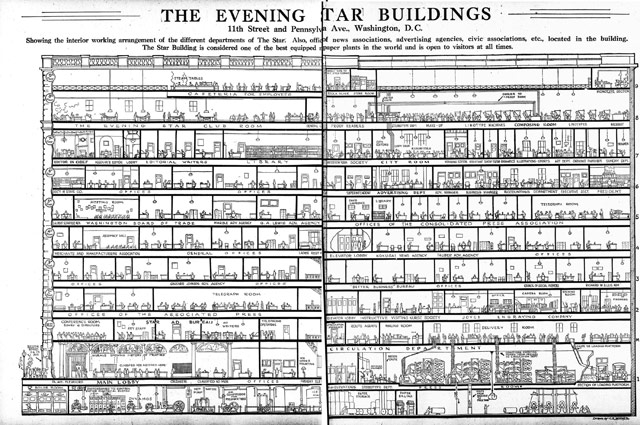
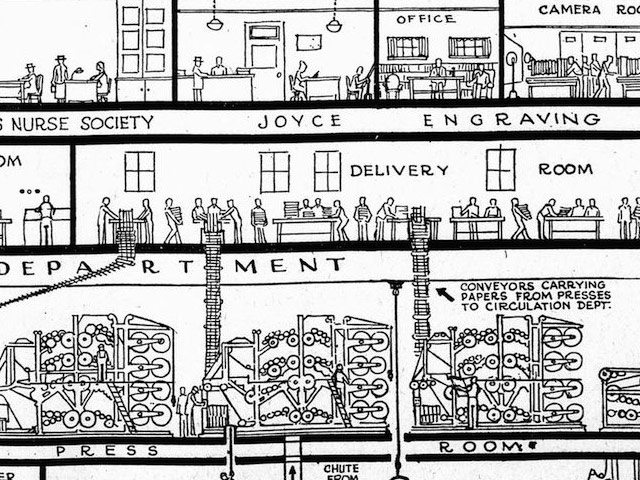
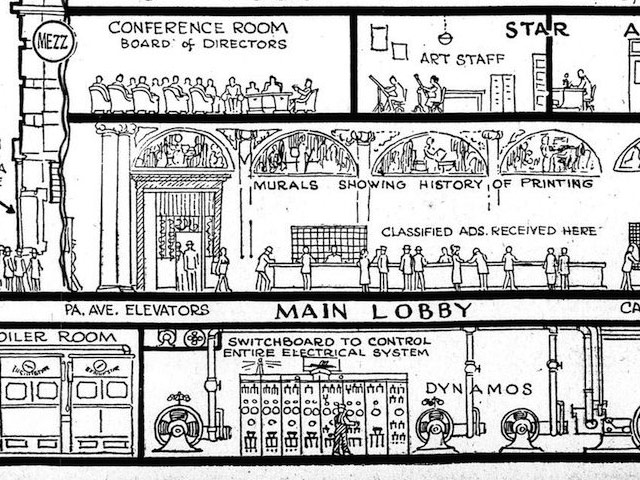
Best viewed huge. The whole thing is a fascinating view of how information flowed through a newspaper company in the 1920s. Raw materials in the form of electricity, water, telegraph messages, paper, and employees enter the building and finished newspapers leave out the back.
Found this via Craig Mod, who notes the Chris Ware-ness of the whole thing.
Newer posts
Older posts






Socials & More