kottke.org posts about Sesame Street
Sesame Street has uploaded a bunch of classic episodes to YouTube that are free to watch, including the very first episode from 1969, the one where Mister Rogers visits, and the episode where Mr. Snuffulupagus is finally revealed. The most recent one was uploaded just a couple of days ago, so it appears to be an ongoing effort. (via open culture)
P.S. From Four Things About Mr. Snuffleupagus:
Snuffy was finally introduced to the main human cast mainly due to a string of high profile and sometimes graphic stories of pedophilia and sexual abuse of children that had been aired on shows such as 60 Minutes and 20/20. The writers felt that by having the adults refuse to believe Big Bird despite the fact that he was telling the truth, they were scaring children into thinking that their parents would not believe them if they had been sexually abused and that they would just be better off remaining silent.
For years now, the people have wanted only one thing: for Daniel Craig’s chicken-fried detective Benoit Blanc to feature in a Muppet movie (with Craig as the only human). Earlier this year, Netflix picked up the streaming rights for Sesame Street. That partnership has borne some unexpected fruit: Forks Out: A Benoit Blanc Sesame Street Mystery.
In the video, detective Beignet Blanc arrives to investigate who ate Cookie Monster’s triple berry pie.
I have arrived to this Street of Sesame on a sunny day turned cloudy. We have a culinary culprit in our oven mitts. And to solve this confectionary conundrum, we must look right in front of our googly eyes at Cookie Monster.
The whole thing is delightful. See also Nerdist’s Rainbow Connection: A Benoit Blanc Mystery.
On May 22, 1981, for the finale of the show’s 12th season, Mister Rogers visited Sesame Street. With apologies to the Avengers, this has to be the greatest crossover event in history.
In the episode, Rogers agrees to judge a race between Big Bird and Mr. Snuffleupagus, a character that no one on the show but Big Bird has seen. When BB tells his friends he met Mister Rogers, they don’t believe him, including Mr. Snuffleupagus! Later, BB & MR have a conversation about what’s real and what’s make-believe. Here’s more on the episode from the Neighborhood Archive and the Muppet Wiki.
Mr. Rogers comes to visit Big Bird at his nest. Big Bird wonders if Mr. Rogers is really here, because no one believed him before. Mr. Rogers observes that sometimes it’s hard to distinguish between fantasy and reality, and suggests that they both pretend some more. Big Bird imagines a teddy bear riding a race car, and realizes that he can’t touch him — except in his imagination. Mr. Rogers, on the other hand, is real. They both share a hug.
A couple of weeks later, Big Bird visited the Neighborhood of Make-Believe on Mister Rogers’ Neighborhood. There’s no good clip of this on YT, but you can see some of the footage here and the full episode on Mister Rogers’ official site.
Big Bird didn’t visit Mr. Rogers directly (in the real world) because of the two shows’ differing views on make-believe:
Caroll Spinney agreed to appear in the episode as Big Bird after some dialogue with Fred Rogers; when Spinney originally received the script for the show he saw it required him to remove the costume and discuss the inner-workings of the Big Bird puppet. Spinney protested, as he didn’t believe in ruining the illusion of Big Bird for the children. Rogers agreed, but only under the stipulation that Big Bird’s appearance was restricted to the fantasy segments of the “Neighborhood of Make-Believe,” as he didn’t believe in perpetuating the deceitful blur of real and pretend to children that occurred when presenting the character as real in the “real world.”
While Sesame Street Unpaved mentions that Rogers understood Spinney’s concern over showing the children how Big Bird works, Spinney said at some of his book signings (promoting his autobiography, The Wisdom of Big Bird) that he and Fred Rogers argued over the phone for roughly twenty minutes over whether or not to have him tell the kids how he performs Big Bird.
And then there’s this, included here because I ran across it on YouTube: Arsenio Hall gifts Fred Rogers a very fly jacket.

An article about The Quintessential Urban Design of ‘Sesame Street’ with a bunch of photos? This is extremely up my alley. One of the show’s big influences when it began was Jane Jacobs’ landmark book, The Death and Life of Great American Cities, which informed the set design:
“Even if you hadn’t read Jane Jacobs, that book was so huge that it was in the air,” said Benjamin Looker, who is the author of “A Nation of Neighborhoods” and an associate professor of American studies at Saint Louis University.
The show’s creators, he said, were “assimilating some of the popular notions that she put into play about the value of the sidewalk and street life.”
On Sesame Street, the stoop, the outdoor-dining space in front of Hooper’s convenience store, and Elmo’s wide-open window blur the boundaries between public and private space, fostering neighborly interactions between characters.
Street noises in the background and neighbors hollering through windows signal to viewers that this block is not a wealthy one. The streetscape, Mr. Looker said, “is an extension of people’s homes.”
A friend shared that they recently visited the Sesame Street set and that is something I would very much like to do someday.

I know astronomical imagery is on the verge of being over-processed these days (those colors don’t exist out there!), but this image from the JWST is shocking. Clear evidence of Sesame Street’s Yip Yip Martians from billions of years ago. What did Jim Henson know and when did he know it?
In case you or someone you know needs a little levity or pick-me-up today, might I suggest what might be the cutest thing that’s ever aired on television: a little girl named Joey and Kermit the Frog saying the alphabet.
Two of my biggest childhood touchstones were Sesame Street and the Muppet Show. The creative spark behind both shows was Jim Henson, the subject of a forthcoming documentary directed by Ron Howard. From the press release:
Produced with the full participation and cooperation of the Henson family, “Jim Henson Idea Man” is an unprecedented, intimate look at Henson’s illustrious, revolutionary career and complex personal life. Using never-before-seen personal archival home movies, photographs, sketches, and Henson’s personal diaries, as well as interviews with those who knew him best, the film is the definitive portrait of one of the world’s most inspiring and iconoclastic creators.
Jim Henson Idea Man will be available to stream on Disney+ on Friday. (via the kid should see this)
Street Gang: How We Got to Sesame Street, a documentary about the beloved show’s first two decades, debuts today on HBO Max. The film is based on Michael Davis’s 2009 book Street Gang: The Complete History of Sesame Street.
The documentary focuses on the first two experimental and groundbreaking decades of Sesame Street, highlighting this visionary “gang” that audaciously interpreted radical changes in society and engaged children with innovative new ways to entertain and educate.
Featuring exclusive behind-the-scenes footage and interviews with over twenty original cast members and creators, the documentary explores how the team incorporated groundbreaking puppetry, clever animation, short films, music, humor, and cultural references into each episode to keep kids and parents coming back, while never shying away from difficult conversations with children.
In a review, NY Times TV critic James Poniewozik says the film reminds us that Sesame Street was political right from the beginning:
“Sesame Street,” which premiered in 1969, was the project of Joan Ganz Cooney, a TV executive who was originally more interested in the civil rights movement than in education but came to see the connection between the two. “The people who control the system read,” she once said, “and the people who make it in the system read.” And she believed that the best way to get the kids of the 1960s to read, paradoxically, was through TV.
Her Children’s Television Workshop brought together educators and entertainers, including a puppeteer named Jim Henson and the director Jon Stone, an idealist attracted to Cooney’s idea of closing the literacy gap for inner-city Black children. “I think what drew Dad in really had to do with her political vision,” his daughter Kate Stone Lucas says in the documentary.
Patrick Stewart, displaying the Shakespearian acting chops that landed him the role of Captain Picard on Star Trek: The Next Generation, appeared on Sesame Street in 1996, performing a parody of Hamlet’s soliloquy with the letter “B”. Stewart never doesn’t give it his all when acting.
In this charming video from 1969, right before Sesame Street premiered on PBS, Jim Henson spends about 15 minutes showing how to make simple puppets out of materials you might have handy at home: cardboard, plastic cups, fabric, wooden spoons, potatoes, etc. Joining him was the designer of the Muppets, Don Sahlin.
He is “the inventor” of the Muppet look, from a design point of view. As discussed in the book Jim Henson’s Designs and Doodles, many of the Muppets began as Henson’s rough sketches, which Sahlin then built and modified as needed… Sahlin was known to refer to himself as the “guardian of the essence” of the Muppets.
Henson’s Kermit-y voice is super soothing. What a great find by the indispensable Kid Should See This.
Sad news from Sesame Street: Carroll Spinney, the puppeteer who played Big Bird and Oscar the Grouch for almost 50 years, died today at age 85.
Caroll was an artistic genius whose kind and loving view of the world helped shape and define Sesame Street from its earliest days in 1969 through five decades, and his legacy here at Sesame Workshop and in the cultural firmament will be unending. His enormous talent and outsized heart were perfectly suited to playing the larger-than-life yellow bird who brought joy to generations of children and countless fans of all ages around the world, and his lovably cantankerous grouch gave us all permission to be cranky once in a while.
Spinney had retired from the show last year, citing health concerns. Here’s a look at how he operated the Big Bird puppet (more here):
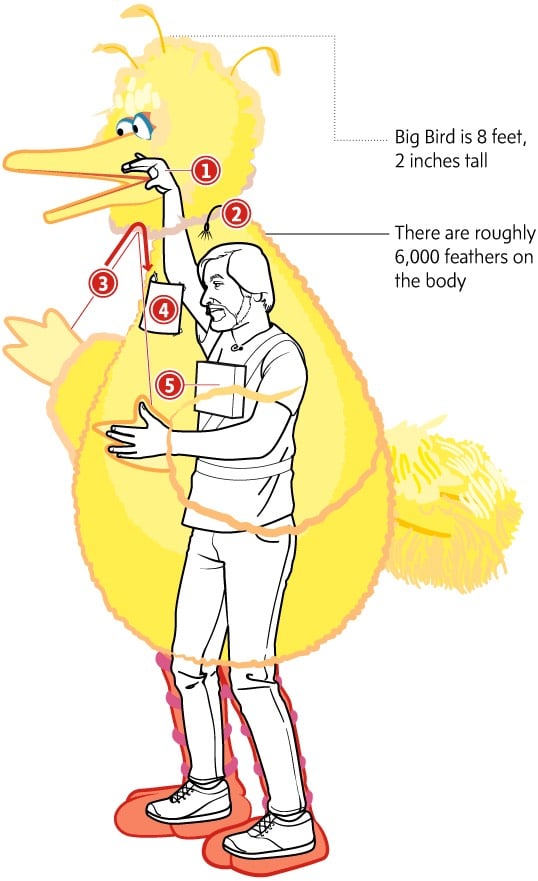
Spinney came out with a book in 2003 called The Wisdom of Big Bird (and the Dark Genius of Oscar the Grouch): Lessons from a Life in Feathers and was the subject of a 2015 documentary called I Am Big Bird. Here’s a trailer:
At Sesame Street creator Jim Henson’s memorial service at Cathedral of St. John the Divine after his unexpected death in 1990, Spinney walked out and, in full Big Bird costume, sang “It Ain’t Easy Being Green” in tribute to his friend:
Total silence after he finished…I can’t imagine there was a dry eye in the house after that. Rest in peace, gentle men.
To celebrate their 50th anniversary, the Sesame Street gang dropped by NPR for one of their Tiny Desk Concerts. They sang the theme song, People In Your Neighborhood, and four other tunes.
See also this new six-part Jim Henson documentary. Oh and Philip Glass on Sesame Street.
Defunctland has produced a six-part documentary series on Jim Henson. Each episode focuses on a different creative project that Henson did. Here’s the trailer:
The first four episodes are already out…here’s the second episode on Sesame Street:
You can watch the rest of them on YouTube.

We’ve established that I’m a huge fan of Cookie Monster, the most orally challenged but also the most literarily adept muppet. But even with those cards on the table, this Reddit AMA is something special.
Q: Is there anything you won’t eat? I mean, I’ve seen you eat a typewriter before…
A: Me stay away from anything in Oscar’s trashcan. Otherwise me not picky.
Q: My 7-year-old daughter is about to start selling cookies for Girl Scouts. Do you have any advice for her?
A: Don’t eat the product!
Q: There’s been a lot of famous people who have come to visit you and your friends on Sesame Street! Did any of those guests give you a cookie?
A: Me friends have surprised me with lots of cookies! Sir Ian Mckellan even gave me two cookies!
Q: Who would you most like to sing a “C is for Cookie” duet with?
A: Me would love to sing duet with Lady Gaga. Me and me friends are monsters after all. Me hope she see dis!
Q: What is the optimum number of chocolate chips per cookie?
A: Me always say the more the merrier. Me think me need at least 3.14 chocolate chippies per nom nom. MMM pi
Q: If you could only eat one type of cookie for the rest of your life, what would it be?
A: Wow! Me didn’t realize these question be so hard. If me had to choose just one cookie, me would have to pick me Mommy’s classic chocolate chippie!
Q: We know cookies are your favourite food. What is your second favourite food?
A: Can me say more cookies…?
A2: Me thought it over. Definitely “more cookies.”
Q: My son is your biggest fan in the world. His name is Nico and he’s almost 2. Any words of advice for him???
A: Me think it important to always share your cookies. Me know it hard to do sometimes, but it da kind thing to do.
A2: Oh, and HI NICO! Me love you!
Q: What was it like working with Jim Henson?
A: Me never sure what he did, but he always around to lend a hand and give me cookie!
Q: How’s the rent on Sesame Street?
A: Me think you confused…. Rent played on different street, me think Broadway?
It goes on and on like this. Maybe I’m too much of a softie (probably underbaked… god, it’s contagious), but I love this.

Sesame Street puppeteer Caroll Spinney is retiring after almost 50 years, and everybody is leading with the fact that he played and voiced everybody’s favorite, Big Bird. And then, if they get a chance, they might get around to mentioning that other iconic character he gave a voice and a soul, one of my favorites, Oscar the Grouch.
Karen Zraick writes about Oscar and his origins in the New York Times:
In his book “The Wisdom of Big Bird (and the Dark Genius of Oscar the Grouch),” Mr. Spinney wrote that he based Oscar’s voice on a surly cabdriver from the Bronx who took him to a meeting.
“He was the stereotypical cabby of the time — a guy in his 40s from the Bronx wearing a tweed cap with a little brim — and he kind of growled out of the corner of his mouth, ‘Where to, Mac?’” Mr. Spinney wrote.
He had found “the ideal model” for his new character, and he marveled as the driver “went on and on, colorfully expressing his opinion of Mayor Lindsay with a lot of four-letter words.”
Travis Andrews does the same in the Washington Post:
The purpose of Oscar, according to the Smithsonian National Museum of American History’s description of the character, is to teach “the importance of understanding, tolerance, and diversity.” According to Robert W. Morrow’s book “‘Sesame Street’ and the Reform of Children’s Television,” Oscar acted differently and lived in a different kind of home as a metaphor, “to dramatize tolerance for those who are different. … In segments about conflicts between Oscar and the others on the street, the show taught how children might cope with diversity in the context of school desegregation.”
Ok, sure. Ariane Beeston at Essential Kids more thoroughly spells out Oscar’s character, and its effect and appeal:
1. It’s okay to be different;
2. One man’s trash is another grouch’s treasure;
3. Embrace who you are and be yourself;
4. Just because you’re grouchy, doesn’t mean you can’t also be kind;
5. Emotions can be confusing.
Almost everyone gives credit to Spinney for giving Oscar his emotional complexity, with a simple mandate: Oscar is always grouchy and contrarian, but Oscar is never mean or cruel. In short, Oscar always has a heart. Let’s hope Spinney’s successor can continue to thread that needle. The kids of the present and the future deserve an Oscar who can be everything that he is.
Older posts





Socials & More