kottke.org posts about Google
According to Google’s search tracking, this is the worst flu season in more than 6 years.
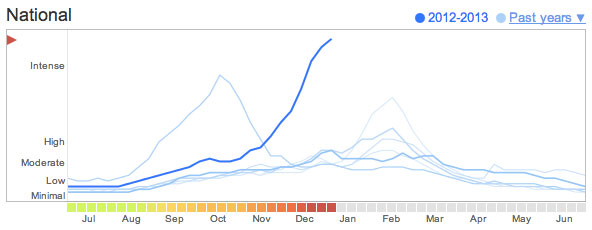
Google’s trends tend to follow the official CDC data closely and indeed the CDC concurs about the scope of the flu this year but their data is lagging behind Google’s by what looks like about 2 weeks. See also my post on how flu vaccines are made. (via @kellan)
The Atlantic’s Alexis Madrigal gets an inside look at how Google builds its maps (and what that means for the future of everything). “If Google’s mission is to organize all the world’s information, the most important challenge — far larger than indexing the web — is to take the world’s physical information and make it accessible and useful.”
The Google Earth Time Machine blog uses Google’s historical satellite maps to make now-and-then comparisons of interesting places around the world. Like the transformation of this Texas river bend into an oxbow lake over 60+ years:


(via stellar)
A few weeks ago, Twitter added an option to search the tweets of only the people you follow. This is useful for several different reasons (try searching for [recent pop culture key phrase] to see what I mean) but for those who use Twitter primarily to find cool links to read/watch, it’s an unexpected gift. To view your Twitter stream filtered to include only tweets containing links, just do a search for “http”. Simple but powerful.
ps. Who knows if they’re interested in this or not, but by a) making their entire archive available to search and b) allowing people to limit their search to their friends + 1-2 degrees of separation, Twitter could significantly better the search experience offered by Google et al in maybe 25-30% of all search cases. This is what Google is attempting to do with Google+ but Twitter could beat them to the punch.
Update: The search above, while quick, is also dirty in that it will include non-link tweets like “My favorite protocol is HTTP”. The official Twitter way to is to use “filter:links”, which will avoid that problem.
You can also filter out the links from your Twitter stream by negating the http search (this no longer works…), but you’ll have to wade through all the @replies.
But can she turn the company around? This is a super interesting move.
Marissa Mayer, one of the top executives at Google, will be the next C.E.O. of Yahoo, making her one of the most prominent women in Silicon Valley and corporate America.
The appointment of Ms. Mayer, who was employee No. 20 at Google and was one of the few public faces of the company, is considered a surprising coup for Yahoo, which has struggled in recent years to attract top flight talent in its battle with competitors like Google and Facebook.
To demonstrate a pair of their products, Google arranged for a group of skydivers to jump out of a blimp and parachute onto the roof of the Moscone Center in San Francisco, the building in which the Google I/O was being held. The divers were each wearing a pair of Google Glass networking glasses and video chatting on a Google+ Hangout.
Here’s what it looked like from the ground:
I think this is what Robin Sloan was referencing in his tweet earlier:
Watched #GoogleIO. This company is totally Doc Brown. In one corner, an automatic banana-peeler; in the other, A WORKING TIME MACHINE.
It’s funny. Or sad. Or predictable. It’s predictably sadly funny that many tech media outlets are saying that Apple’s iPad finally has a bonafide competitor in the Microsoft Surface. Set aside for now that Surface does look genuinely interesting, that the price hasn’t been set, and the thing isn’t even out yet. For a piece of portable networking technology like a smartphone or tablet to be successful on the scale at which Apple operates, you need to have an ecosystem, a network of interacting devices, software, products, and services that work together…hardware + software is not enough. Apple, Google (and partners), Amazon, and possibly Microsoft are the only companies with the expertise and pockets deep enough to build their own ecosystems. Ok, maybe Facebook in a couple years or if Nokia can dig themselves out of their current hole, but that’s really about it.
The current parts of the phone/tablet/media ecosystem are as follows:
1. A piece of hardware at a price that compares favorably to its quality and features. Apple sells premium hardware with great features at a premium-but-still-reasonable price. Google and their partners offer a range of devices at different prices corresponding to different levels of quality and features offered. Amazon offers low-price hardware with a relatively limited but appropriate set of features. Microsoft looks to have a nice piece of hardware with promising features but the price point is pending.
2. An OS that takes proper advantage of the hardware capabilities with features in line with the price of the device. Apple has iOS, with most of its devices running the same version. Google and their partners have many different versions of Android, most of which are not the most recent version. Amazon runs a customized Android OS for the Kindle Fire and a modified version of Linux for the non-Fire Kindles. Microsoft has Windows 8, which will eventually run, in different configurations, on lots of different kinds of hardware, from desktop computers to phones.
3. An app store stocked with the applications that smartphone and tablet owners want to use. Apple has the comprehensive App Store. Google, etc. have Google Play (née Android Market), Amazon’s Appstore for Android, and other stores, on which you can get most of the most popular apps. Amazon has their Appstore for Android for the Kindle Fire. Microsoft has the Windows Phone Marketplace for the Windows Phone with a more limited selection than the other stores…it’s unclear what their plans are for a Windows 8 app store.
4. A media store with books, movies, and TV shows. Apple has the iTunes store (as well as iBooks, Newstand, etc.). Android has Google Play. Amazon has the Kindle store and Amazon Instant Video. Will Microsoft offer a way to purchase media across their Windows 8 platform? Does Windows Media Player do this?
5. A digital media hub for managing media, apps, software updates, etc. This part is a bit more optional than the others since media management is moving to the device and the cloud, but still. Apple has iTunes. Android has a variety of possible desktop managers and management happens on the device or through the cloud? You manage the Kindle stuff through Amazon’s site and on the device. Microsoft will probably go cloud/device-based at this point?
6. An integrated cloud solution for syncing apps, media, and documents across devices. Again, this isn’t crucial but will likely become so over time. Apple has iCloud. Android has Google’s suite of apps (Gmail, calendar, Google docs, Google Drive, etc.). Amazon uses Whispernet and is leveraging AWS in various ways (e.g. Cloud Drive). Will Microsoft leverage SkyDrive for their tablets and phones?
7. Sister devices. Apple has the iPhone, iPad, iPod touches, Apple TV, and their full line of OS X-powered computers. Android runs on phones and tablets, but can also run on an increasing number of other devices (Google TV, etc.). And maybe ChromeOS devices? Amazon doesn’t really have an interacting network of devices. Microsoft will have phones, the Surface, billions of desktop computers running Windows 8, and, dare I even say it, the Xbox.
You don’t need to have every single part of the ecosystem for it to thrive but the more the better. Again, Surface does look genuinely interesting (as do the Windows phones from Nokia), Windows 8 and the Metro interface look promising, and Microsoft has deep pockets but all the pieces aren’t quite there yet for them. Microsoft’s real opportunity here is the Xbox. If they can properly leverage and integrate the Xbox’s growing status as a home media hub (Xbox Live), they can fill in a lot of the holes in their fledgling ecosystem, provide people with compelling devices & media experiences, and give Apple, Google, and Amazon a real run for their (and our) money.
Since Google released the video for their augmented reality glasses the other day, people have been busy making videos that show a more realistic (or cynical) portrayal of how the glasses might work. Here are a couple of the better ones. First a version of the glasses with Google ads:
And this one gives new meaning to the phrase “banner blindness”:
While not specifically about Google Glasses, this concept video by Keiichi Matsuda is also worth a look:
I will also direct your attention to the second episode of Black Mirror, a UK drama series by Charlie Brooker.
A satire on entertainment shows and our insatiable thirst for distraction set in a sarcastic version of a future reality. In this world, everyone must cycle on exercise bikes, arranged in cells, in order to power their surroundings and generate currency for themselves called Merits. Everyone is dressed in a grey tracksuit and has a “doppel”, a virtual avatar inspired by Miis and Xbox 360 Avatars that people can customise with clothes, for a fee of merits. Everyday activities are constantly interrupted by advertisements that cannot be skipped or ignored without financial penalty.
(via jake & stellar)
Google has shared a bit about their augmented reality glasses project (more at the NY Times).
A video released by Google on Wednesday, which can be seen below, showed potential uses for Project Glass. A man wanders around the streets of New York City, communicating with friends, seeing maps and information, and snapping pictures. It concludes with him video-chatting with a girlfriend as the sun sets over the city. All of this is seen through the augmented-reality glasses.
The glasses look a little strange, like Geordi La Forge’s visor…they might go over a little better if they looked more Warby Parkerish.
There seems to be something in the air. Within the last day or so, three ex-employees have written about why their feelings have changed about three formerly beloved companies. James Whittaker recently left Google:
The Google I was passionate about was a technology company that empowered its employees to innovate. The Google I left was an advertising company with a single corporate-mandated focus. […] Suddenly, 20% meant half-assed. Google Labs was shut down. App Engine fees were raised. APIs that had been free for years were deprecated or provided for a fee. As the trappings of entrepreneurship were dismantled, derisive talk of the “old Google” and its feeble attempts at competing with Facebook surfaced to justify a “new Google” that promised “more wood behind fewer arrows.”
The days of old Google hiring smart people and empowering them to invent the future was gone. The new Google knew beyond doubt what the future should look like. Employees had gotten it wrong and corporate intervention would set it right again.
The whole thing is worth a read, what with damning phrases like “social isn’t a product, social is people and the people are on Facebook” sprinkled liberally about.
In the NY Times this morning, Greg Smith writes that it’s his last day at Goldman Sachs after almost 12 years at the firm.
To put the problem in the simplest terms, the interests of the client continue to be sidelined in the way the firm operates and thinks about making money. Goldman Sachs is one of the world’s largest and most important investment banks and it is too integral to global finance to continue to act this way. The firm has veered so far from the place I joined right out of college that I can no longer in good conscience say that I identify with what it stands for.
It might sound surprising to a skeptical public, but culture was always a vital part of Goldman Sachs’s success. It revolved around teamwork, integrity, a spirit of humility, and always doing right by our clients. The culture was the secret sauce that made this place great and allowed us to earn our clients’ trust for 143 years. It wasn’t just about making money; this alone will not sustain a firm for so long. It had something to do with pride and belief in the organization. I am sad to say that I look around today and see virtually no trace of the culture that made me love working for this firm for many years. I no longer have the pride, or the belief.
There’s that saying: “If you’re not paying for something, you’re not the customer; you’re the product being sold.” Google’s product has always been the people using their products and it sounds like Goldman has made a sizable shift in that direction.
Andy Baio hasn’t worked for Yahoo for several years, but after the company announced they were filing a patent-infringement lawsuit against Facebook, Baio wrote of his displeasure about the move at Wired.
Yahoo’s lawsuit against Facebook is an insult to the talented engineers who filed patents with the understanding they wouldn’t be used for evil. Betraying that trust won’t be forgotten, but I doubt it matters anymore. Nobody I know wants to work for a company like that.
I’m embarrassed by the patents I filed, but I’ve learned from my mistake. I’ll never file a software patent again, and I urge you to do the same.
For years, Yahoo was mostly harmless. Management foibles and executive shuffles only hurt shareholders and employee morale. But in the last few years, the company’s incompetence has begun to hurt the rest of us. First, with the wholesale destruction of internet history, and now by attacking younger, smarter companies.
Yahoo tried and failed, over and over again, to build a social network that people would love and use. Unable to innovate, Yahoo is falling back to the last resort of a desperate, dying company: litigation as a business model.
Yahoo seems to be in a different stage in its lifecycle than Google or Goldman. In the mid-to-late 2000s, they tried what Google is trying now and failed and now, as Baio notes, they are trying everything they can to survive, like the T-1000 writhing in the molten steel at the end of Terminator 2. Perhaps a harbinger of things to come for Google and Goldman?
This is mesmerizing: using Google Image Search and starting with a transparent image, this video cycles through each subsequent related image, over 2900 in all.
(via ★mattb)
There’s no gameplay asside from firing the gun and moving around, but it’s still disturbing to walk around within Google Street View with an assault rifle. (thx, job)
The most fun on the internet right now: go to Google and search for “do a barrel roll” (no quotes). Whee!
A very raw and passionate post by former Amazon employee and current Google employee Steve Yegge in which he praises a key decision made by Amazon several years ago to build a platform…and argues that a major problem for Google going forward is a lack of a platform of their own. It starts off:
I was at Amazon for about six and a half years, and now I’ve been at Google for that long. One thing that struck me immediately about the two companies — an impression that has been reinforced almost daily — is that Amazon does everything wrong, and Google does everything right. Sure, it’s a sweeping generalization, but a surprisingly accurate one. It’s pretty crazy. There are probably a hundred or even two hundred different ways you can compare the two companies, and Google is superior in all but three of them, if I recall correctly. I actually did a spreadsheet at one point but Legal wouldn’t let me show it to anyone, even though recruiting loved it.
I mean, just to give you a very brief taste: Amazon’s recruiting process is fundamentally flawed by having teams hire for themselves, so their hiring bar is incredibly inconsistent across teams, despite various efforts they’ve made to level it out. And their operations are a mess; they don’t really have SREs and they make engineers pretty much do everything, which leaves almost no time for coding - though again this varies by group, so it’s luck of the draw. They don’t give a single shit about charity or helping the needy or community contributions or anything like that. Never comes up there, except maybe to laugh about it. Their facilities are dirt-smeared cube farms without a dime spent on decor or common meeting areas. Their pay and benefits suck, although much less so lately due to local competition from Google and Facebook. But they don’t have any of our perks or extras — they just try to match the offer-letter numbers, and that’s the end of it. Their code base is a disaster, with no engineering standards whatsoever except what individual teams choose to put in place.
I spent perhaps too much time this morning pondering one of the mysteries of the internet: Sergey Brin’s astronomically high scores on the Google+ version of Angry Birds. For instance, Brin’s high score on the easiest level of the game is 36240. It’s a legit score (here’s a higher one) and he has impressive scores on several other levels. But in 15 minutes of playing this morning, I couldn’t get within a thousand points of his score. (Hey, at least I beat Kevin Rose.)

So does Brin actually spend time obsessively playing Angry Birds to get those high scores (instead of, say, running Google or his other ventures) or has he written a program of some sort to produce near-optimal scores or does he have a fleet of interns playing as him for hours on end? We need to know this vital info…if you’re interviewing Sergey at an upcoming conference, please ask him about this!
Newer posts
Older posts





Socials & More