Entries for June 2017
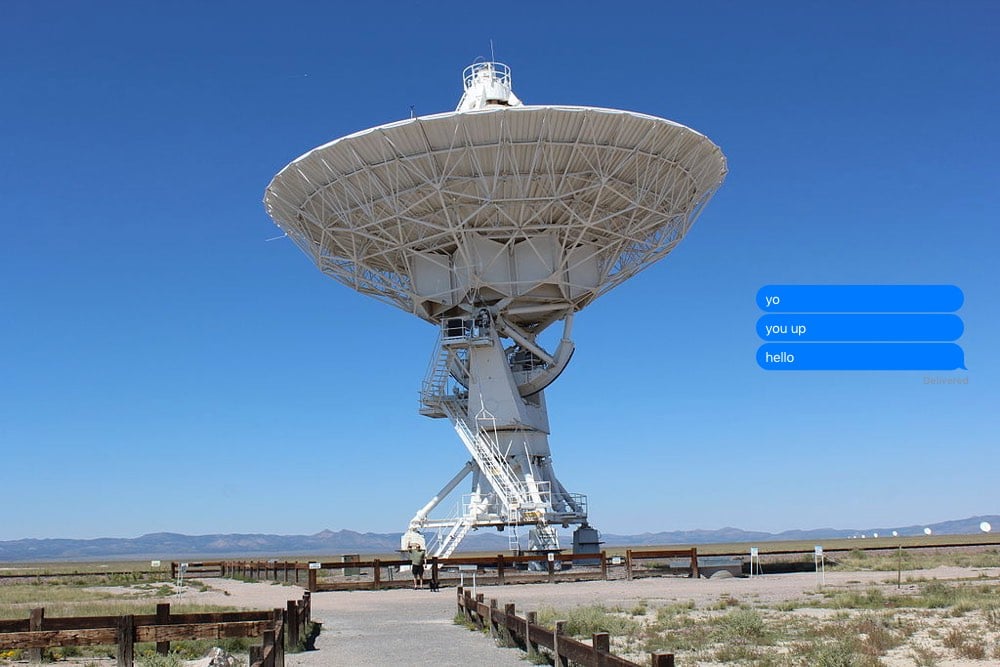
Humans currently have the capability to blast powerful messages into space that will travel hundreds and thousands of light years and fall on the ears, eyes, and radio telescopes of possible habitable worlds. A group called METI wants to do just that…to say a bracing “hello” to whoever is out there listening. But not everyone, starting with Elon Musk and Stephen Hawking, thinks this is such a good idea. In a piece for the NY Times Magazine called Greetings, E.T. (Please Don’t Murder Us.), Steven Johnson details the effort to communicate with possible alien worlds and the potential pitfalls.
The anti-METI movement is predicated on a grim statistical likelihood: If we do ever manage to make contact with another intelligent life-form, then almost by definition, our new pen pals will be far more advanced than we are. The best way to understand this is to consider, on a percentage basis, just how young our own high-tech civilization actually is. We have been sending structured radio signals from Earth for only the last 100 years. If the universe were exactly 14 billion years old, then it would have taken 13,999,999,900 years for radio communication to be harnessed on our planet. The odds that our message would reach a society that had been tinkering with radio for a shorter, or even similar, period of time would be staggeringly long. Imagine another planet that deviates from our timetable by just a tenth of 1 percent: If they are more advanced than us, then they will have been using radio (and successor technologies) for 14 million years. Of course, depending on where they live in the universe, their signals might take millions of years to reach us. But even if you factor in that transmission lag, if we pick up a signal from another galaxy, we will almost certainly find ourselves in conversation with a more advanced civilization.
It is this asymmetry that has convinced so many future-minded thinkers that METI is a bad idea. The history of colonialism here on Earth weighs particularly heavy on the imaginations of the METI critics. Stephen Hawking, for instance, made this observation in a 2010 documentary series: “If aliens visit us, the outcome would be much as when Columbus landed in America, which didn’t turn out well for the Native Americans.” David Brin echoes the Hawking critique: “Every single case we know of a more technologically advanced culture contacting a less technologically advanced culture resulted at least in pain.”
As Johnson notes, concerns like these will likely grow in number and magnitude in the coming decades. The march of technology is placing more and more potential power into the hands of fewer people.
Wrestling with the METI question suggests, to me at least, that the one invention human society needs is more conceptual than technological: We need to define a special class of decisions that potentially create extinction-level risk. New technologies (like superintelligent computers) or interventions (like METI) that pose even the slightest risk of causing human extinction would require some novel form of global oversight. And part of that process would entail establishing, as Denning suggests, some measure of risk tolerance on a planetary level. If we don’t, then by default the gamblers will always set the agenda, and the rest of us will have to live with the consequences of their wagers.
Between 1945 and now, the global community has thus far successfully navigated the nuclear danger to human civilization but has struggled to identify and address the threat of climate change initiated with the Industrial Revolution. Things like superintelligence and cheap genetic modification (as with CRISPR) aren’t even on the global agenda and something METI sounds like science fiction to even the tech-savviest politicians. Technology can move very fast sometimes and the pace is quickening. Politics? Not so much.
P.S. If you want to read some good recent sci-fi about the consequences of extraterrestrial communication, try Liu Cixin’s The Three Body Problem.
Update: Johnson’s long piece was even longer pre-publication and he shared some of the outtakes on his site, including a reference to the The Three Body Problem.
Even with 8,000 words to play with, we had to cut a number of passages that might still be of interest. About fifty people asked me on Twitter (or in the Times comments section) why the piece didn’t reference The Dark Forest trilogy, and particularly its opening novel The Three Body Problem, which features a METI-style outreach that goes spectacularly wrong. We did originally have a nod to the books, but just didn’t have the space to keep it; but they are indeed terrific (and haunting) and well worth reading if you’re interested in this question.



In his series Guide to the Flora and Fauna of the World, Zhao Renhui photographed a number of animals and plants that have been bred or otherwise modified by humans. Pictured above are a square apple:
Sold in a department store in South Korea, these square apples were created as gifts for students taking the College Scholastic Ability Test, with some inscribed with the words ‘pass’ or ‘success’. A similar square watermelon was developed in Japan in the 1980s. The cubic fruits are created by stunting their growth in glass cubes.
a remote-controlled beetle:
In 2012, Japanese scientists implanted electrodes, a radio and a camera on a Goliath beetle which could be wirelessly controlled. The scientists inserted the parts in the beetle during different phases of the pupa stage. The components were powered by generators connected to the flight muscles of the beetle. Most of the components were not visible to the human eye, except for the tiny camera lens peering out of the beetle’s head. The first photograph by a Goliath beetle camera was taken in December 2012, remotely controlled by researchers in a facility 200km away.
and Chinese pork that’s been made to look and taste like beef:
It has recently been found in China that pork has been made to aesthetically look like beef. ‘Beef colouring’ and ‘beef extracts’ were added to pork to make it look and taste like beef.
(via the atlas for the end of the world)
Jay-Z has a new album out today called 4:44 and it’s available exclusively on the streaming music service he owns, Tidal. But that’s not the only catch. To hear the album, you need have been a Tidal customer before today or you need to switch your mobile service to Sprint (or be a current Sprint customer).
This is all part of Tidal’s $200 million deal with Sprint and it makes very little sense to me. It’s a nice extra for current Sprint subscribers, but I can’t imagine that many people are going to sign up for Sprint just to hear an album. And Tidal’s gonna get a bunch of pissed-off first-time subscribers who will sign up thinking they’ll have access to the album but, oops!, they actually don’t. Dumb.
Rumor has it the exclusive is only for a week and then it’ll be elsewhere…which seems like a lot of fuss for very little reward.
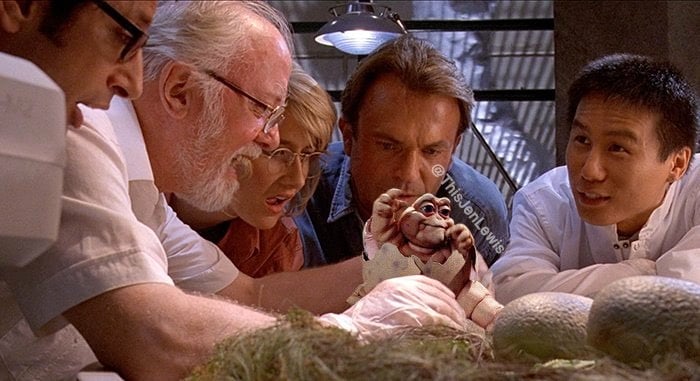
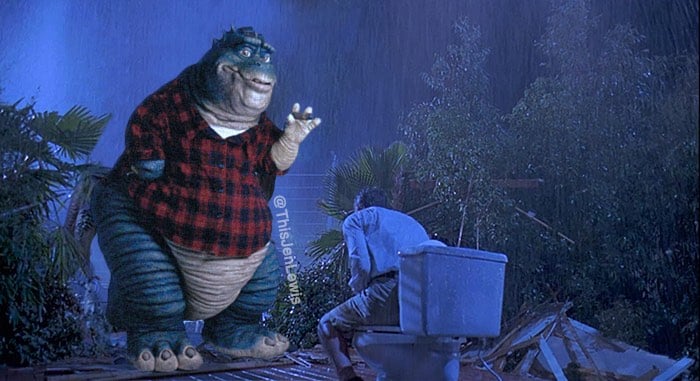
If you thought that photoshopping the characters from the 90s TV Dinosaurs into scenes from Jurassic Park would be impossible, well, Jen Lewis found a way.
(FYI, I loved Dinosaurs. I just looked at when it started airing and it came out much later than I thought…I was a senior in high school and continued watching it after heading off to college. I have clearly repressed the memory of how deeply uncool I was then. (“Then? Then?!!” cackles the narrator.))
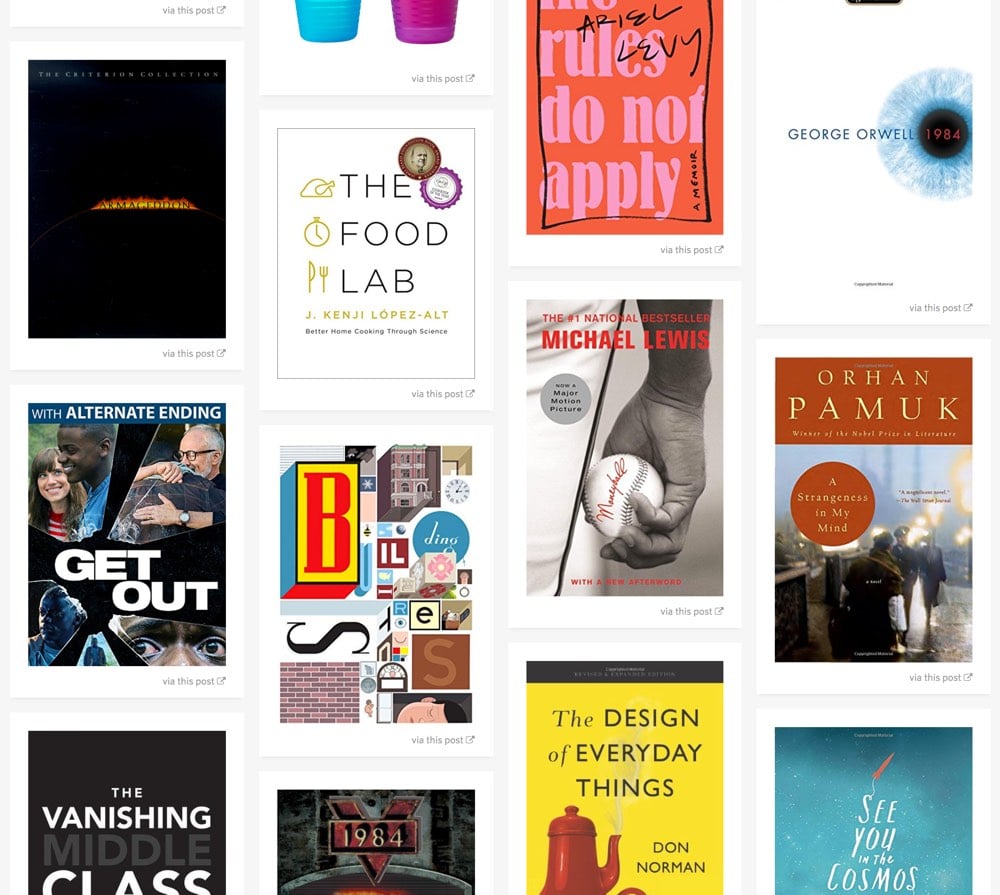
If kottke.org ran a store, what would that look like? (Like this, but hold that thought for a second.)
Lots of things on kottke.org happen by accident. When I started writing here in 1998, it wasn’t supposed to be a blog. An offhand comment by a friend led me to turn a hobby into a job that I’m still doing 12 years later. A lunch conversation last summer with someone I’d never met before saved the site from financial ruin. kottke.org was never supposed to host fan sites for Wes Anderson and Jane Jacobs or vertical blogs about sports, politics, and climate change.
kottke.org was also never supposed to be a store. But as the years piled on, so did the links to all sorts of interesting books, movies, music, and other products that people could buy. I’ve collected many of those products into The Accidental Shop. The shop contains over 2000 items from 19+ years of posts. You can dip into it by filtering by the most recent items mentioned on the site, my top picks, and with a random selection of items. The default view is a weighted combination of recent, top picks, and random which tries to achieve a blend of recency, serendipity, and relevance. Clicking on the item image will take you to the Amazon page for that product. Most of the items are accompanied by a link to the most recent kottke.org post mentioning that item, so the shop also functions as an alternate way of browsing through the kottke.org’s extensive archive.
This is very much a first version of the shop. Right now, all of the items are from Amazon (if you buy something via the shop, I get a small affiliate fee), but I will be adding non-Amazon items to the shop in the near future — stuff like Tattly, 20x200 prints, pastrami from Katz’s, and kottke.org memberships. I will also be adding a localization feature so readers in Canada and the UK will see links to their respective Amazon stores.
So that’s The Accidental Shop. As always, let me know what you think via email or on Twitter.
P.S. Thanks to kottke.org members for their help with The Accidental Shop. I shared an in-progress version with them on my members-only mailing list a couple of months ago and received lots of great feedback and encouragement. If you’d like to help out on future projects or just lurk on the newsletter, become a member today.
Update: How about a little behind-the-scenes info? I’ve been doing web design since 1995, and I’ve always wanted to design and build an online store but never had the chance. So this was pretty fun. To build the shop’s catalog, I went through and scraped all ~25,000 posts I’ve done over the past 19 years, looking for product links to Amazon. The script found almost 2300 distinct items and put them into a database, noting the dates of the initial & most recent mentions and the # of mentions for each item. Then I used Amazon’s Product Advertising API to retrieve all sorts of information about each item, including title, type (book, eBook, kitchen, DVD, etc.), price, image, and the creator (a book’s author, a movie’s director).
Once that was done, I built the shop interface with an admin function for rating each item on a scale of 1 to 4 (or 0, which excludes the item from the public shop altogether). I used the admin interface to rate every single item in the database — it only took a few hours while watching reruns of ST:TNG on Netflix. Then I wrote a script to assign a “score” to each item based on: my rating, how recently it was mentioned, the frequency of mentions, and a couple other factors. The highest scoring items are an eerily accurate reflection of what I am interested in and what I talk about on the site. FYI, the current highest scoring items: Infinite Jest, The Death and Life of Great American Cities, the Kindle Paperwhite, The Victorian Internet, the Harry Potter books, 1491, and The Making of the Atomic Bomb, all of which I’ve mentioned on the site 10+ times.
The layout is pure CSS…I’m using the column feature to create a quick & dirty Pinterest-style layout. Each of the store filters (recent, top picks, random) is randomized to give you a slightly different product assortment with each page refresh. The scoring and rating system, combined with the semi-randomized output, makes for a lively and ever-changing store interface without me having to constantly pick which items go where in the layout. A high-maintenance, just-so layout that’s updated daily would undoubtedly work better — but probably not way better and as a one-person operation, I don’t have that kind of time anyway. This is pretty much the approach I use for all my projects: do the most I can with the least possible effort. Make it appear complex but work simply. As Milton Glaser said: “Just enough is more.”
Sergio Rojo has cut together scenes from more than 70 movies that are set in NYC, including Manhattan, Ghost, Tootsie, Taxi Driver, Breakfast at Tiffany’s, Birdman, and The Devil Wears Prada. Familiar locations like Times Square, Central Park, the Brooklyn & Manhattan Bridges, the subway, the Empire State Building, the NYPL, and the Statue of Liberty are all amply represented. (via gothamist)
From Clickhole, a fascinating video essay on one of the most important scientific projects yet undertaken by the human race: solving world hunger by engineering a single massive ear of corn.
Vox’s Joss Fong assembles a scale model of Stonehenge and explains some of the ancient monument’s geometry, the geology of the stone it’s built from, and the its possible astronomical significance.
Stonehenge is a popular destination for summer solstice celebrations because the 5,000-year-old monument points toward the summer solstice sunrise on the horizon. However, it also points to the winter solstice sunset in the opposite direction and there’s good reason to believe that this may have been the more important alignment for the Neolithic people who built Stonehenge. We investigate by constructing a tiny model of the Stonehenge monument.
For once, it’s nice to watch an onscreen robbery where everything goes according to plan.
Why are bird eggs shaped the way they are? Also, whaaaaaat: “…most eggs are not egg-shaped”
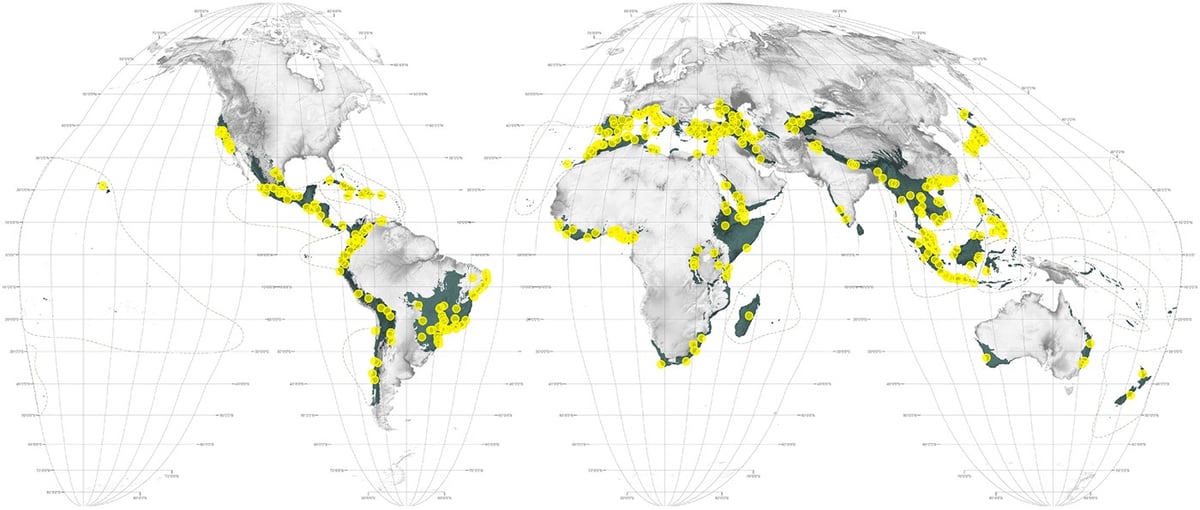
The Atlas for the End of the World is a project started by Penn architect Richard Weller to highlight the effects of human civilization and urbanization on our planet’s biodiversity.
Coming almost 450 years after the world’s first Atlas, this Atlas for the End of the World audits the status of land use and urbanization in the most critically endangered bioregions on Earth. It does so, firstly, by measuring the quantity of protected area across the world’s 36 biodiversity hotspots in comparison to United Nation’s 2020 targets; and secondly, by identifying where future urban growth in these territories is on a collision course with endangered species.
There’s lots to see at the site: world and regional maps, data visualizations, key statistical data, photos of plants and animals that have been modified by humans, as well as several essays on a variety of topics.
And here’s a fun map: countries with national biodiversity strategies and action plans in place. Take a wild guess which country is one of the very few without such a plan in place!
A 63-year-old Jackie Chan kicking ass in a dramatic role as a father trying to avenge his daughter’s murder? Yes. Yes, please. The movie is based on the 1992 novel The Chinaman, is directed by Martin Campbell (Casino Royale), and co-stars Pierce Brosnan.
Oliver Babish makes videos showing how to prepare dishes from movies and TV shows…like the carbonara from Master of None, the strudel from Inglourious Basterds, and Pulp Fiction’s Big Kahuna Burger. For this installment, Babish makes a number of notable cocktails from movies, including the White Russian from The Big Lebowski, the French 75 from Casablanca, and James Bond’s Vesper Martini.
Maybe I was a little tired this morning when I watched this, but the joke at 1:30 caught me off guard and I laughed like an idiot.
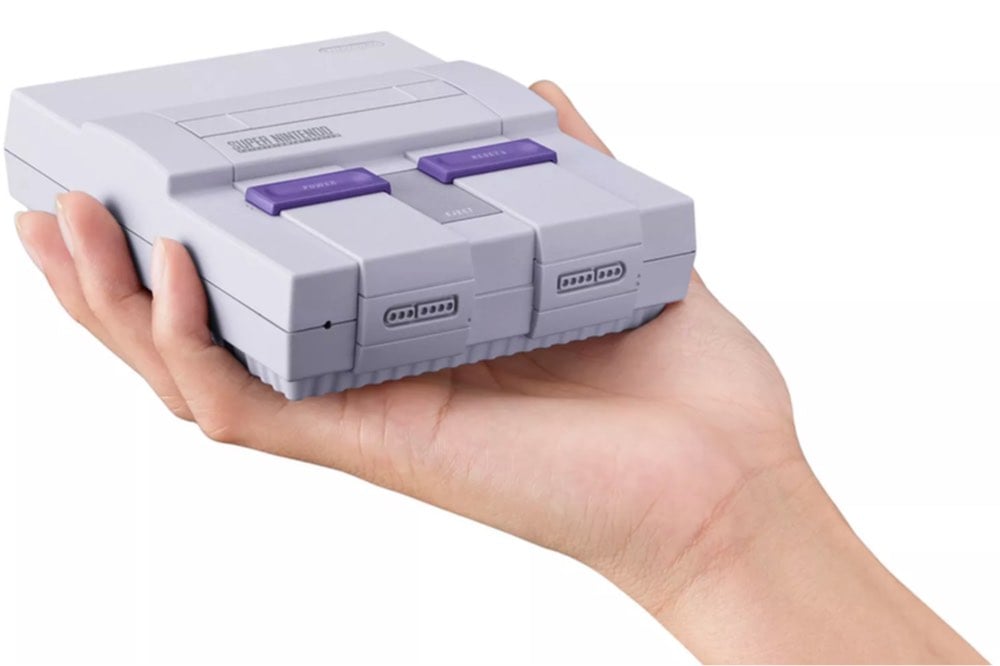
Last year, Nintendo came out with a mini version of their original NES console with 30 pre-installed games. This year, they hoping to repeat that device’s wild popularity with the Super NES Classic. List price is $79.99. The SNES Classic comes with two controllers and 21 games built-in, including Super Mario Kart, F-ZERO, Super Mario World, and The Legend of Zelda: A Link to the Past. US pre-order information isn’t available yet (relevant Amazon page), but I’ll update this post when it is.
The fourth (and sadly final) season of Halt and Catch Fire starts this August. The show has followed a core cast through the personal computer revolution, through the rise of online service companies, and into Silicon Valley. As teased last season, the action in this final season focuses on the World Wide Web.
We’re building it together and it’s awesome.
Pretty excited about this for a variety of reasons! You can catch up on Netflix before the new season starts.
Update: New promo trailer is out. Someone’s building a search engine?
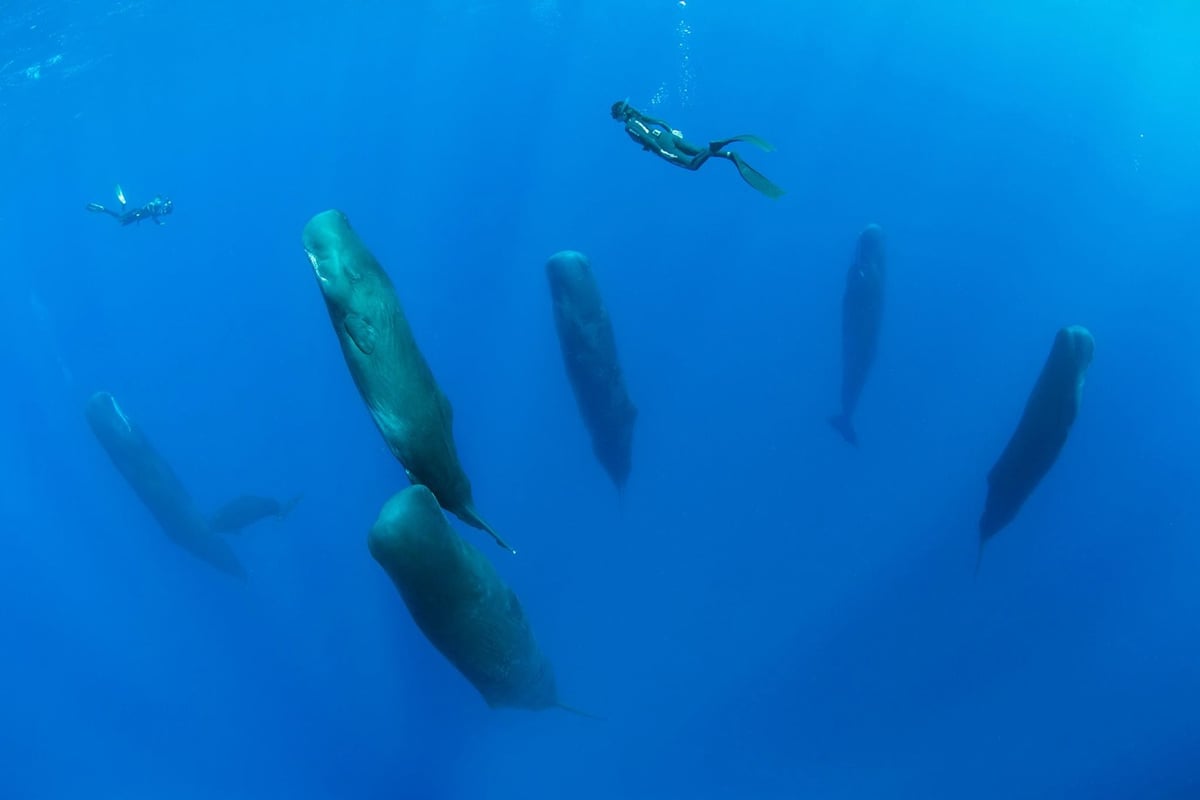
Sperm whales sleep together in a pod facing up in the water. From bioGraphic:
Photographer Franco Banfi and his fellow divers were following this pod of sperm whales (Physeter macrocephalus) when the giants suddenly seemed to fall into a vertical slumber. This phenomenon was first studied in 2008, when a team of biologists from the UK and Japan inadvertently drifted into a group of non-responsive sperm whales floating just below the surface. Baffled by the behavior, the scientists analyzed data from tagged whales and discovered that these massive marine mammals spend about 7 percent of their time taking short (6- to 24-minute) rests in this shallow vertical position. Scientists think these brief naps may, in fact, be the only time the whales sleep.
Photo by Franco Banfi, a finalist in the 2017 Big Picture Competition.
According to a recently conducted survey by the Pew Research Center, the election of Donald Trump has sharply eroded the confidence of other world nations in the United States and its ability to “do the right thing when it comes to international affairs”.
Confidence in President Trump is influenced by reactions to both his policies and his character. With regard to the former, some of his signature policy initiatives are widely opposed around the globe.
His plan to build a wall along the U.S.-Mexico border, for example, is opposed by a median of 76% across the 37 countries surveyed. Opposition is especially intense in Mexico, where more than nine-in-ten (94%) oppose the U.S. government erecting a wall.
Similar levels of global opposition greet Trump’s policy stances on withdrawing from international trade agreements and climate change accords. And most across the nations surveyed also disapprove of the new administration’s efforts to restrict entry into the U.S. by people from certain Muslim-majority nations.
Trump’s intention to back away from the nuclear weapons agreement with Iran meets less opposition than his other policy initiatives, but even here publics around the world disapprove of such an action by a wide margin.
Trump’s character is also a factor in how he is viewed abroad. In the eyes of most people surveyed around the world, the White House’s new occupant is arrogant, intolerant and even dangerous. Among the positive characteristics tested, his highest rating is for being a strong leader. Fewer believe he is charismatic, well-qualified or cares about ordinary people.
This chart is pretty remarkable:
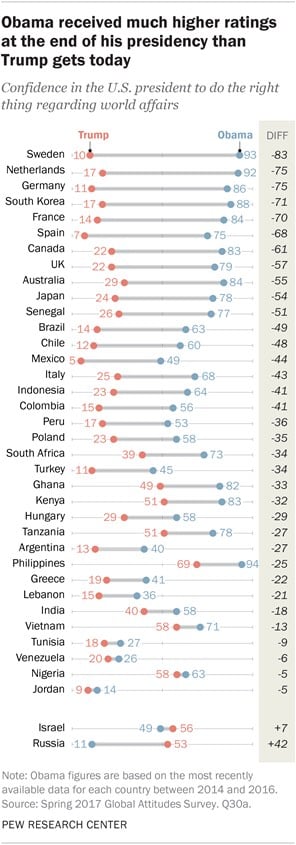
It took George W. Bush more than half of his presidency to reach confidence rates as low as Trump has right out of the gate. Usually in these situations you say something like “there’s nowhere to go but up” but unfortunately there’s plenty of room at the bottom here.
For his book Everybody Lies: Big Data, New Data, and What the Internet Can Tell Us About Who We Really Are, Seth Stephens-Davidowitz combed through data on Google Trends for five years, looking for data on searches that Google users “don’t tell to possibly anybody else, things they might not tell to family members, friends, anonymous surveys, or doctors”.
According to a recent interview with Stephens-Davidowitz, right now the data is showing an increase in search queries on how to perform abortions at home and, no surprise, the activity is highest in parts of the country where access to abortion is most difficult.
I’m pretty convinced that the United States has a self-induced abortion crisis right now based on the volume of search inquiries. I was blown away by how frequently people are searching for ways to do abortions themselves now. These searches are concentrated in parts of the country where it’s hard to get an abortion and they rose substantially when it became harder to get an abortion. They’re also, I calculate, missing pregnancies in these states that aren’t showing up in either abortion or birth rates.
That’s pretty disturbing and I think isn’t really being talked about. But I think, based on the data, it’s clearly going on.
The Awl’s Everything Changes newsletter gave their readers a mission this week: “to notice people doing tiny kindnesses for each other”. Here’s what they observed.
My toddler and I were waiting in a long line at Russ and Daughters this morning, and a guy gave me a much earlier number. He’d somehow ended up with an extra number right after his, and waited until he saw someone he thought needed it. I gave my number to the last couple in line, and if they did the same, it might still be going.
My husband and I were having lunch together at a deli. A woman two tables over from us was eating by herself and received a phone call on her bluetooth. She began crying from what appears to have been bad news. She was fairly quiet about it and kept it to herself, but she was obviously crying. Another patron in the restaurant stopped, patted her shoulder and mouthed “Are you OK?”. She nodded through her tears and continued with her phone call. He and a few other patrons continued to monitor her out of the corner of their eyes, but gave her her privacy. It seemed a small gesture — but I felt all of us in the restaurant sending her strength through the man’s small pat on the shoulder.
I was about to cross a side street in Brooklyn when a concerned-looking man crossing in the opposite direction stood in the middle of the street and began frantically waving a tshirt in front of the cars that were about to get a green light. I quickly realized that he was stopping traffic so that a blocked ambulance with its sirens on could make it through further down. It worked — the traffic cleared and the ambulance moved. When I got a few blocks down in the direction he’d been coming from, EMTs were on the scene, attending to an unconscious, apparently homeless person on the sidewalk. I think most people would call 911, but this guy went the extra mile. He did what a family member would do.
I think if we all “did what a family member would do” more often, the world would be a better place.
Update: From the early Christian author and philosopher Lactantius:
The whole point of justice consists precisely in our providing for others through humanity what we provide for our own family through affection.
(thx, chris)
The scuttlebutt around the tech/media internet water cooler over the past few months is that Facebook CEO Mark Zuckerberg is going to run for President in 2020. This feeling has been fueled by Zuck’s goal for this year of visiting the remaining 30 or so US states that he has yet to visit and the way in which he’s been documenting his trips. Nathan Hubbard argues that Zuck actually has other things on his mind as he tours America:
Zuck isn’t running for President. He’s trying to understand the role the product he created played in getting this one elected.
Facebook has undergone two major evolutionary events in its history, both of which were driven by what Zuck saw as existential threats.
The incredible revenue growth in mobile (probably the greatest biz execution of our generation) helped Facebook survive a platform shift.
And the fearless acquisitive streak of Instagram, WhatsApp and others helped Facebook survive a shift in how we communicate and organize.
Zuck woke up on Nov 9th acutely aware that FB had facilitated a new shift he didn’t foresee or understand; that’s terrifying to a founder.
He’s the head of product. So he’s ventured out into the world beyond his bubble to do field research and inform how FB will evolve again.
I am also sympathetic to the argument that Zuckerberg doesn’t need to run for President because he’s already the leader of the largest group of people ever assembled in the history of humanity (aside from possibly the British Empire). Facebook doesn’t possess many necessary qualities of a sovereign country, but it also has many advantages that countries don’t. Zuckerberg is already among the world’s most important people and with Facebook still growing, he could one day soon be the most powerful person in the world.
Yesterday, Grover Norquist shared a short parable about taxes on Twitter:
How Republicans are born…
Daughter, 8, has been savings up to buy her first Guitar.
Found it for $35. She had 35 exact.
Then…sales tax
Norquist has famously been on a quest to stop tax increases in the US…in 2015 he wrote a book called End the IRS Before It Ends Us.1 Many people took Norquist to task over his remarks:
Did you mention that you drove her to the guitar store on roads that were partly funded by sales taxes?
In a car which only has seat belts preventing you from being badly injured in the event of a crash due to taxpayer funded regulations?
or those same taxes that pay for emergency services that will respond if you do get in an accident?
These responses remind me of a pair of posts written several years ago about the contributions to society of both taxpayer-funded and corporate goods & services. From the liberal version:
After spending another day not being maimed or killed at work thanks to the workplace regulations imposed by the department of labor and the occupational safety and health administration, enjoying another two meals which again do not kill me because of the USDA, I drive my NHTSA car back home on the DOT roads, to my house which has not burned down in my absence because of the state and local building codes and fire marshal’s inspection, and which has not been plundered of all its valuables thanks to the local police department.
And from the conservative viewpoint:
When my Motorola-manufactured Cable Set Top Box showed the appropriate time, I got into my Toyota-manufactured Prius vehicle and set out to my graphic design workplace and stopped to purchase some gasoline refined by the Royal Dutch Shell company, using my debit card issued to me by Bank of the West. On the way to my workplace, I dropped off a package at the local UPS store for delivery, and dropped my children off at a local private school.
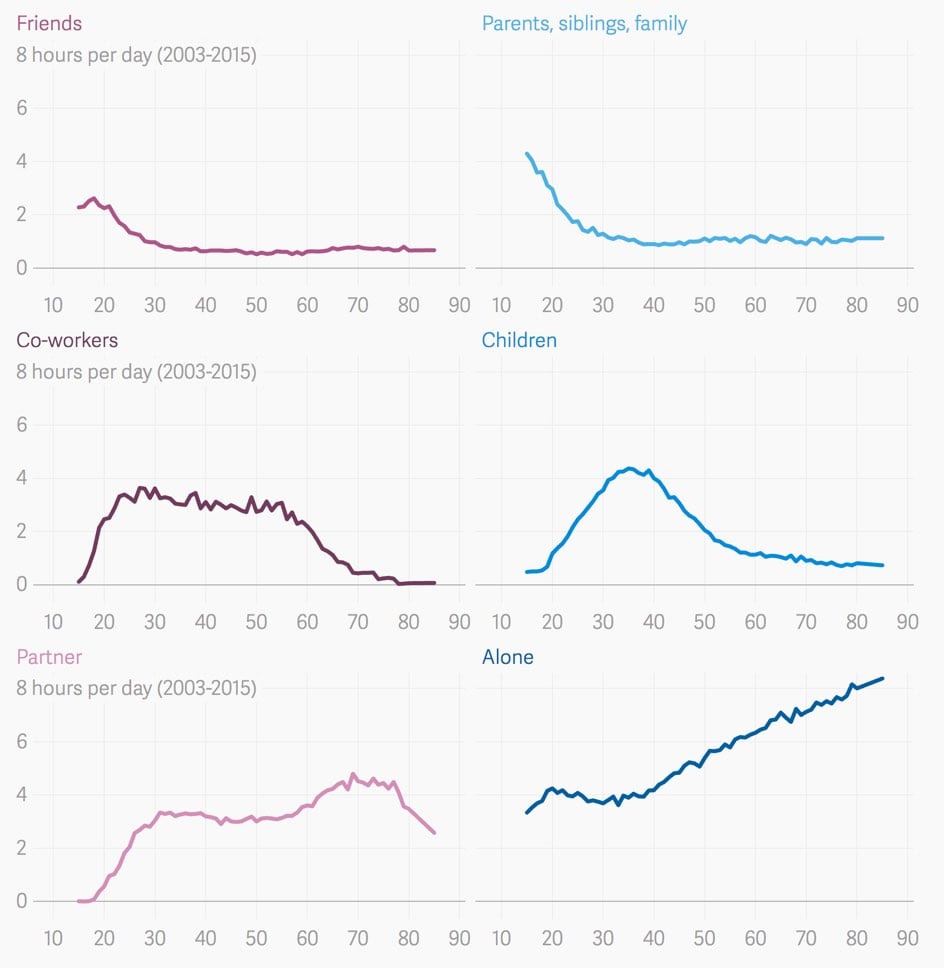
From Quartz, six charts that show who Americans spend their time with.
Some of the relationships Lindberg found are intuitive. Time with friends drops off abruptly in the mid-30s, just as time spent with children peaks. Around the age of 60 — nearing and then entering retirement, for many — people stop hanging out with co-workers as much, and start spending more time with partners.
Others are more surprising. Hours spent in the company of children, friends, and extended family members all plateau by our mid-50s. And from the age of 40 until death, we spend an ever-increasing amount of time alone.
This would make a great book…one chapter about why each chart looks as it does.
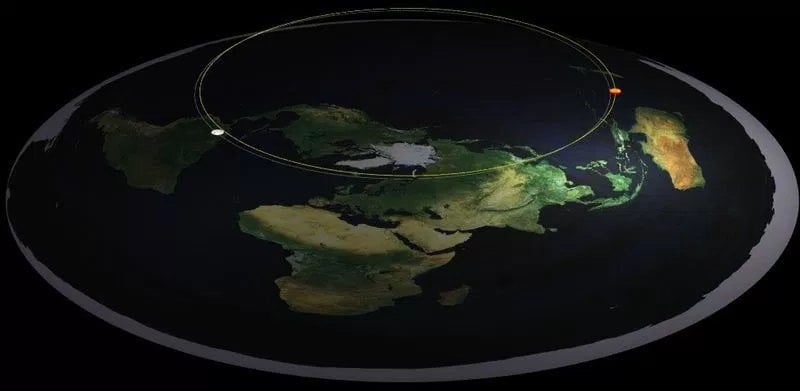
We all know the Earth is (nearly) spherical. Wellllll, not everyone does. So what if our planet did suddenly turn flat? Gizmodo recently asked a bunch of scientists this question and the answer came back: certain death for all life on Earth. More specifically, seismologist Susan Hough says:
If the earth were to suddenly flatten, presumably all sorts of hell would break loose. I guess it would depend on how flat is flat. If we’re talking pancake flat, gravity would be an immediate problem: gravitational attraction goes as G(m1*m2)/r^2, where G is the gravitational constant, m1 & m2 are two masses, and r is distance. A sphere is the 3D shape that maximizes surface area relative to volume, which kind of gives gravity the biggest bang for its buck. If you flatten the sphere, the far side gets closer to the new center point, but the ends spread way out, so surface gravity goes down at the center, and way down at the edges. Lose gravity and bye-bye atmosphere.
Other first-order problems: heat, radioactivity, etc. In our spherical earth, both of these are concentrated in the core. If the earth were flattened, they would have to go somewhere-presumably a lot closer to the surface.
An outfit called Rollin’ Wild makes these fun videos imagining if animals were super round, like balloons. (via swissmiss)
Filmmaker Neill Blomkamp (District 9, Chappie) is planning on making a series of experimental short films as proofs-of-concept for possible feature film development. His first short has just been released through Oats Studios; it’s called Rakka, stars Sigourney Weaver, and is kind of a cross between District 9 and Edge of Tomorrow. Also, they’re selling some of the film’s assets on Steam: concept art, 3D print files, and video files with more promised (dailies, visual effects behind-the-scenes, etc.).
Back in 2010, legendary Japanese animator Hayao Miyazaki picked his 50 favorite books for children and young adults. Here are the top five:
1. The Borrowers by Mary Norton
2. The Little Prince by Antoine de Saint-Exupéry
3. Children of Noisy Village by Astrid Lindgren
4. When Marnie Was There by Joan G. Robinson
5. Swallows and Amazons by Arthur Ransome
It’s easy to see the influence of the books from the list on the movies he made. Indeed, two of the top five books were actually made into Studio Ghibli films (The Borrowers and When Marnie Was There).
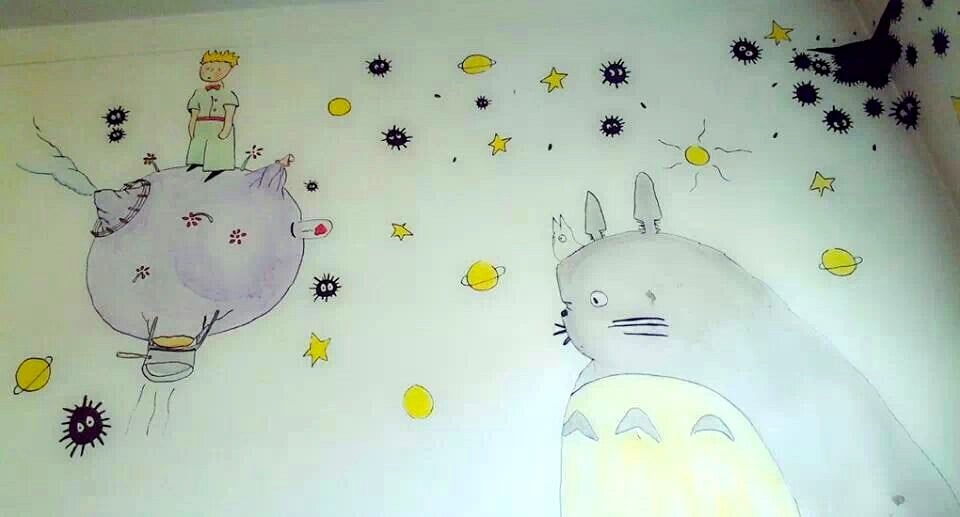
P.S. The Totoro / Little Prince illustration is from Pinterest, but I couldn’t find the original source. Anyone?

Lego has introduced an Apollo Saturn V rocket set, complete with lunar lander and 3 astronaut minifigs.
Packed with authentic details, it features 3 removable rocket stages, including the S-IVB third stage with the lunar lander and lunar orbiter. The set also includes 3 stands to display the model horizontally, 3 new-for-June-2017 astronaut microfigures for role-play recreations of the Moon landings, plus a booklet about the manned Apollo missions and the fan designers of this educational and inspirational LEGO Ideas set.
Three rocket stages! And look at this lander:

Amazing detail: the set contains 1969 pieces, which is the year that the Apollo 11 astronauts landed on the Moon. I typically leave the Lego building to my kids, but I might have to make an exception for this. (via mike)
As if I weren’t looking forward to this enough: this four-minute making-of featurette on Blade Runner 2049 features Harrison Ford, Roger Deakins, Ridley Scott, Denis Villeneuve, Ridley Scott, and others talking about the forthcoming film. Come *on* October, get here already.
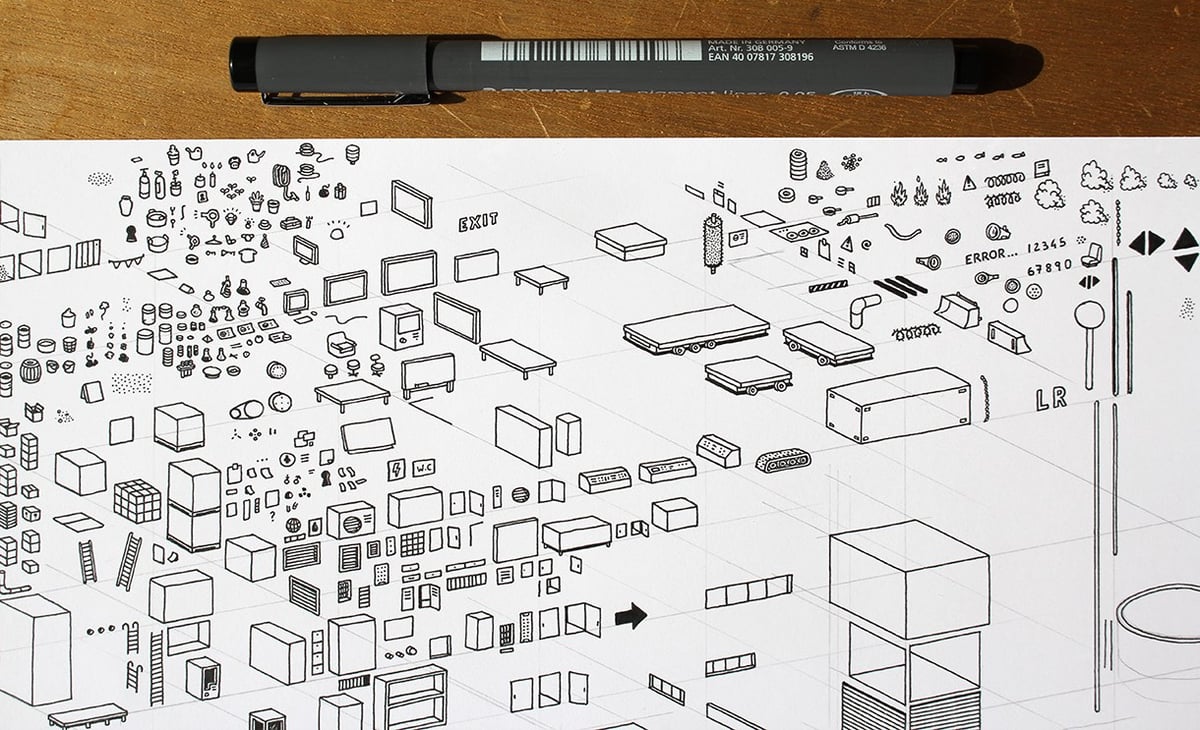
I love the aesthetic for Hidden Folks, an iOS game that’s like an interactive version of Where’s Waldo? in black & white. The creators just released a big update to the game and explained how they designed and built the new level.
Like everything in Hidden Folks, the Factory started on paper. Sylvain Tegroeg, the Illustrator with whom I made the game, uses a fineliner to draw every single element individually. Sylvain and I brainstorm on the theme and possible sub-themes that could work well with interactions, after which Sylvain enters The Zone™ and just draws whatever comes to mind. After drawing a bunch of things, Sylvain scans them and (manually) places them in a sprite sheet.
Sometimes, the technology you use ends up unexpectedly affecting your creative output:
When Sylvain and I started working on Hidden Folks about three years ago, he decided to buy a somewhat medium-quality / cost-efficient scanner for the project. When that scanner broke down recently, he used a better scanner for a while only to discover that his digital drawings suddenly looked very different, and so we bought that same low-budget scanner just to make sure all Hidden Folks drawings look consistent.
(via @njvack)
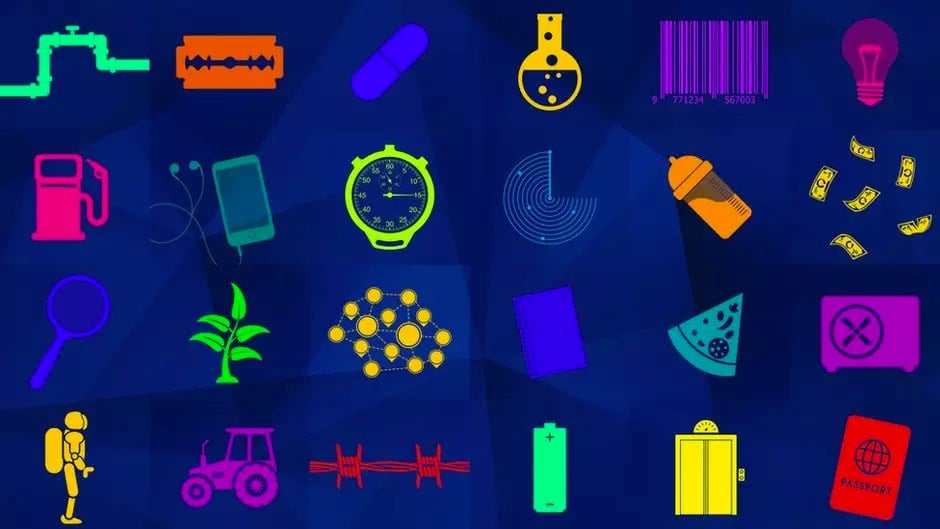
Tim Harford, aka The Undercover Economist, is coming out with a new book called Fifty Inventions That Shaped the Modern Economy.
New ideas and inventions have woven, tangled or sliced right through the invisible economic web that surrounds us every day. From the bar code to double-entry bookkeeping, covering ideas as solid as concrete or as intangible as the limited liability company, this book not only shows us how new ideas come about, it also shows us their unintended consequences — for example, the gramophone introducing radically unequal pay in the music industry, or how the fridge shaped the politics of developing countries across the globe.
It’s based on his BBC podcast 50 Things That Made the Modern Economy.
Fun fact that I just discovered: Harford and I share the same birthday, both date and year.
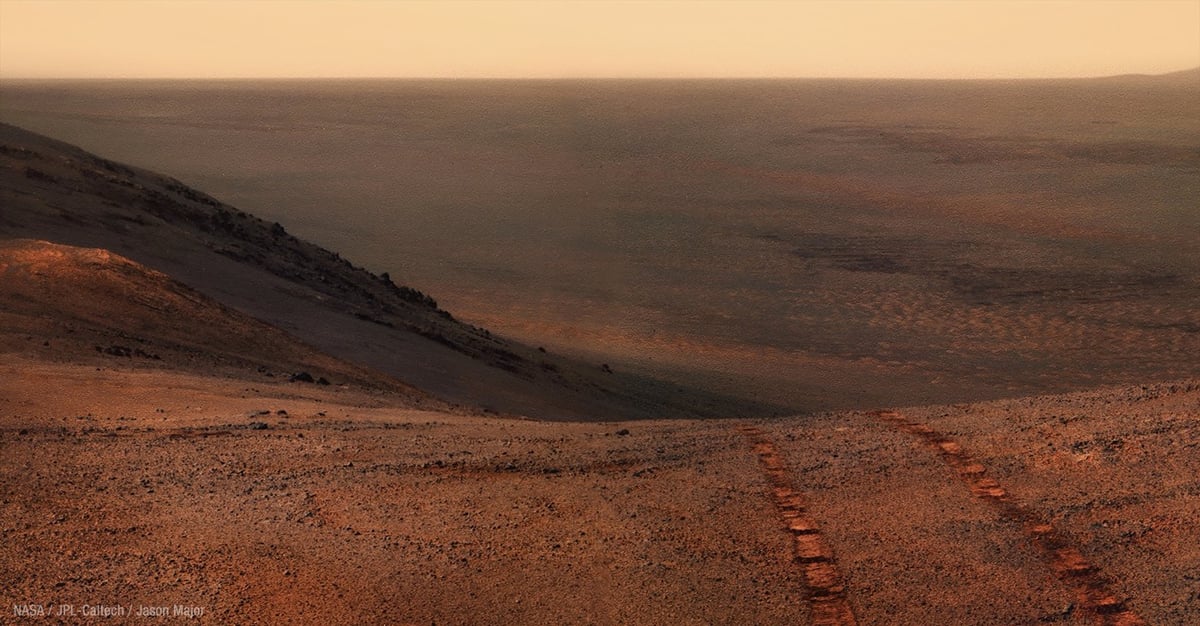
NASA’s Opportunity rover started exploring the surface of Mars in January 2004. Its mission was supposed to last about 90 days, but over 13 years later, Opportunity is still rolling around the red planet, doing science and taking photos. Jason Major processed a few of Opportunity’s most recent snaps of the Endeavour Crater and they’re just wonderful. I’m especially taken with the one included above…it belongs in a museum!
Older posts




Socials & More