



George Lucas still asserting that Greedo shot first

Advertise here with Carbon Ads
This site is made possible by member support. 💞
Big thanks to Arcustech for hosting the site and offering amazing tech support.
When you buy through links on kottke.org, I may earn an affiliate commission. Thanks for supporting the site!
kottke.org. home of fine hypertext products since 1998.
Beloved by 86.47% of the web.
Entries for November 2015
Can you ID these unlabeled subway maps?

Using Neil Freeman’s maps at Fake is the New Real, the Guardian created a quiz: Can you identify the world cities from their ‘naked’ metro maps? As interested as I am in both maps and subways, I did shockingly bad on this quiz. (via @daveg)
Update: Here’s a similar quiz using unlabeled street maps. See also Smarty Pins and GeoGuessr for more geography quiz fun.
The vocal ranges of pop singers. Mariah Carey, Prince, and Steven Tyler are near the top. But #1 is surprising…
America’s junk news binge epidemic
In the midst of this piece by Matt Taibbi on Republican presidential candidates blaming media bias for their outright falsehoods are two paragraphs which perfectly sum up the state of contemporary news media:
It’s our fault. We in the media have spent decades turning the news into a consumer business that’s basically indistinguishable from selling cheeseburgers or video games. You want bigger margins, you just cram the product full of more fat and sugar and violence and wait for your obese, over-stimulated customer to come waddling forth.
The old Edward R. Murrow, eat-your-broccoli version of the news was banished long ago. Once such whiny purists were driven from editorial posts and the ad people over the last four or five decades got invited in, things changed. Then it was nothing but murders, bombs, and panda births, delivered to thickening couch potatoes in ever briefer blasts of forty, thirty, twenty seconds.
If Americans are getting intellectually fat and lazy binging on junk news, perhaps the solution is something akin to “Eat food, not too much, mostly plants,” Michael Pollan’s advice for healthy eating: Follow the news, not too much, mostly facts.
Update: I was reminded that Clay Johnson wrote an entire book called The Information Diet (at Amazon).
The modern human animal spends upwards of 11 hours out of every 24 in a state of constant consumption. Not eating, but gorging on information ceaselessly spewed from the screens and speakers we hold dear. Just as we have grown morbidly obese on sugar, fat, and flour-so, too, have we become gluttons for texts, instant messages, emails, RSS feeds, downloads, videos, status updates, and tweets.
We’re all battling a storm of distractions, buffeted with notifications and tempted by tasty tidbits of information. And just as too much junk food can lead to obesity, too much junk information can lead to cluelessness. The Information Diet shows you how to thrive in this information glut-what to look for, what to avoid, and how to be selective. In the process, author Clay Johnson explains the role information has played throughout history, and why following his prescribed diet is essential for everyone who strives to be smart, productive, and sane.
Johnson spoke at Webstock the same year I did…here’s a video of his talk about Industrialized Ignorance. (via @philipashlock)
This Book is a Camera

Kelli Anderson is at it again. Her pop-up book, This Book is a Planetarium, is due out this spring, but in the meantime, she’s made a book that turns into an actual camera. And you can buy it or make your own. Here’s how the camera works:
My copy arrived in the mail the other day and I can’t wait to try it out.
Whoa, Amazon releases more details and videos about their drone delivery program. The drones are huge!
A moving cover for the New Yorker
Chris Ware, in collaboration with John Kuramoto, Ira Glass, and Nico Muhly, made a moving cover for the latest issue of the New Yorker, both in the sense that it is actually in motion and that the story it tells is touching and makes an impression.
The New Yorker is arguably the primary venue for complex contemporary fiction around, so I often wonder why the cover shouldn’t, at least every once in a while, also give it the old college try? In the past, the editors have generously let me test the patience of the magazine’s readership with experiments in narrative elongation: multiple simultaneous covers, foldouts, and connected comic strips within the issue. This week’s cover, “Mirror,” a collaboration between The New Yorker and the radio program “This American Life,” tries something similar. Earlier in the year, I asked Ira Glass (for whose 2007-2009 Showtime television show my friend John Kuramoto, d.b.a. “Phoobis,” and I did two short cartoons) if he had any audio that might somehow be adapted, not only as a cover but also as an animation that could extend the space and especially the emotion of the usual New Yorker image.
An older, smaller developed world
From the WSJ, a big package on how life will be in 35 years: 2050: Demographic Destiny. In the developed world, the future will be smaller.
Next year, the world’s advanced economies will reach a critical milestone. For the first time since 1950, their combined working-age population will decline, according to United Nations projections, and by 2050 it will shrink 5%.
As Dave Pell writes in Nextdraft:
In other words, it turns out that the big problem in the world isn’t that there are too many people, but rather that there are too few (Thanksgiving dinners excepted).
A final test of relativity
A European Space Agency probe will be launched into space early next month to help test the last major prediction of Einstein’s theory of general relativity: the existence of gravitational waves.
Gravitational waves are thought to be hurled across space when stars start throwing their weight around, for example, when they collapse into black holes or when pairs of super-dense neutron stars start to spin closer and closer to each other. These processes put massive strains on the fabric of space-time, pushing and stretching it so that ripples of gravitational energy radiate across the universe. These are gravitational waves.
The Lisa Pathfinder probe won’t measure gravitational waves directly, but will test equipment that will be used for the final detector.
LISA Pathfinder will pave the way for future missions by testing in flight the very concept of gravitational wave detection: it will put two test masses in a near-perfect gravitational free-fall and control and measure their motion with unprecedented accuracy. LISA Pathfinder will use the latest technology to minimise the extra forces on the test masses, and to take measurements. The inertial sensors, the laser metrology system, the drag-free control system and an ultra-precise micro-propulsion system make this a highly unusual mission.
(via @daveg)
Happy Thanksgiving everyone! “Fuck turkey. Turkey is not a good-tasting bird.”
Why isn’t it faster flying west?
Why isn’t it super-fast to fly west in an airplane, given that the Earth is spinning at 700-1000 miles per hour relative to its center? This seems like a sorta-variation on the old airplane on a treadmill question, doesn’t it?
Tank with stabilized gun excels at balancing beer
The Leopard 2 battle tank was developed for the West German army in the 70s and has a fully stabilized main gun. What does that mean? It means that even if you’re flying along at 30 mph on bumpy ground, your gun remains steadily pointed on-target (like an owl or chicken head). It also means you can balance a full mug of beer on the gun without spilling a drop, making the Leopard the world’s best and most expensive waiter. (via @MachinePix)
Update: Here’s a longer video featuring the same tank. The commentary is in German, but the visuals aren’t that difficult to follow.
In addition to covering how the stabilizing gun works, they show how the tank stays level over uneven terrain and how the gun can stay locked on a target even when the tank is moving from side to side…the video of which is unnerving. (via @le_barte)
Teen solves Cube in under 5 seconds
Fourteen-year-old Lucas Etter solved a randomly scrambled Rubik’s Cube in just 4.9 seconds the other day, the first time anyone has ever solved one under five seconds. As Oliver Roeder writes over at 538, Cube solve times have fallen quickly in the past decade.
In these competitions, the colorful cubes are randomly scrambled according to a computer program, and a solver has 15 seconds to inspect a cube before racing to spin it back to its organized state. The first official record - 22.95 seconds - was set at the first world championship, held in 1982 in Hungary, home country of the cube’s inventor, Erno Rubik. But speed cubing went into hibernation for two decades, until the next world championship was held in 2003. From there, the record has fallen precipitously, thanks to innovations like the Fridrich method, the Petrus system and even “cube lube.”
(via @djacobs)
Lucas on the Star Wars divorce
George Lucas says he had nothing to do with The Force Awakens and furthermore that the movie was not done the way he would have done it.
“The issue was ultimately, they looked at the stories and they said, ‘We want to make something for the fans,’” Lucas said. “People don’t actually realize it’s actually a soap opera and it’s all about family problems — it’s not about spaceships. So they decided they didn’t want to use those stories, they decided they were going to do their own thing so I decided, ‘fine…. I’ll go my way and I let them go their way.’”
Soooooooooooooooo, if Star Wars is a family story, why did you make it about spaceships and special effects?
Let’s get rid of the penny
This week on Last Week Tonight, John Oliver rails against the penny. This seems like such an obvious thing, that we should stop using pennies, but I bet if the government ever moved to ban pennies, it would set off a firestorm of protest.
The best books of 2015
The person I listen to the most regarding books I should be reading is Tyler Cowen…he has never once steered me wrong. So when he wrote about the best fiction of 2015, I perked up. I’ve been hearing many good things about Elena Ferrante’s series (Cowen himself flagged her The Lost Daughter as a favorite back in 2008) but his assertion that her recent series of novels ranks as “one of the prime literary achievements of the last twenty years” puts it solidly on my holiday beach reads list. The New World by Chris Adrian & Eli Horowitz and Vendela Vida’s The Diver’s Clothes Lie Empty also sound particularly interesting.
Update: Cowen recently shared his list of best non-fiction books of the year as well. Biographies rule the list: on Elon Musk, Henry Kissinger, Margaret Thatcher, and Genghis Khan. What a list…but I have to say that reading biographies of Thatcher or Kissinger doesn’t appeal at all.
Update: The NY Times weighs in with their list of 100 Notable Books of 2015. Between the World and Me by Ta-Nehisi Coates makes an appearance, as do the latest installments by Ferrante and Karl Ove Knausgaard.
Update: From Buzzfeed, The 24 Best Fiction Books of 2015 and from Slate, The Overlooked Books of 2015.
Update: The NY Times Sunday Book Review names their 10 Best Books of 2015. Coates and Ferrante feature. By my count, 7 of the 10 books are written by women.
Update: From Slate, a list of the best audiobooks of 2015. The Economist’s best books of the year, including SPQR: A History of Ancient Rome and Steve Silberman’s NeuroTribes. For part one of their best books list, The Guardian asked writers for their favorite books of the year; Max Porter’s Grief is the Thing with Feathers got multiple mentions (but is not yet out in the US).
Update: Amazon’s editors picked their 100 best books of the year and Lauren Groff’s Fates and Furies topped the list. The top non-fiction book is Becoming Nicole: The Transformation of an American Family.
Update: A design-oriented list from Michael Bierut, including The Making of Stanley Kubrick’s ‘2001: A Space Odyssey’.
Update: Bill Gates shared his favorite books of 2015, including Randall Munroe’s Thing Explainer: Complicated Stuff in Simple Words.
For The Millions Year in Reading 2015, they asked a bunch of writers for their reading recommendations. Joyce Carol Oates recommends the Didion biography The Last Love Song while Celeste Ng read The Suicide Index.
The Atlantic asked their editors and writers to share The Best Book I Read This Year. This is one of several lists to include The Invention of Nature: Alexander von Humboldt’s New World by Andrea Wulf.
Update: The NY Times book critics weigh in with their favorite books of the year. Moar Ferrante! Moar Coates!
Forecasting awesome sunsets

A team of three Pennsylvania meteorologists is now providing a coast-to-coast sunset quality forecast.
The team behind SunsetWx has already published a thorough methodology of its algorithm and a case study of successfully predicted “vivid” sunsets its first day of forecasting last week. Basically, the model blends high-resolution forecasts of humidity, pressure changes, and clouds at various levels of the atmosphere, weighting wispy upper-level clouds the strongest and penalizing for thick, low-level clouds or average clear sky evenings.
They totally called Sunday’s bonkers NYC sunset, so maybe they’re worth a follow. Sunset photo by @AirlineFlyer.
Want to learn how to enjoy a cold dark winter? Take a page from the Norwegians.
Bezos’ rocket achieves controlled landing back on Earth
A rocket built by Blue Origin, an aerospace company backed by Jeff Bezos, recently reached space and executed a controlled landing back on Earth, which allows it to be used again. Bezos himself joined Twitter1 this morning to announce the news. Elon Musk, whose SpaceX company has been trying (and failing) to do something similar lately, congratulated Bezos and his team on Twitter2 but also threw a little shade on BO’s efforts to reach “space” vs. SpaceX’s efforts to reach “orbit”.
It is, however, important to clear up the difference between “space” and “orbit”, as described well by https://what-if.xkcd.com/58/. Getting to space needs ~Mach 3, but GTO orbit requires ~Mach 30. The energy needed is the square, i.e. 9 units for space and 900 for orbit.
Welcome to Twitter, Jeff.
I like his bio: “Amazon, Blue Origin, Washington Post”.↩
Musk’s bio reads: “Tesla, SpaceX, SolarCity & PayPal”. Oh, these boys and their toys.↩
Fire tornado in super slow motion
The Slow Mo Guys lit a bucket of kerosene on fire, surrounded it with 12 box fans, whipped the fire into a tornado, and filmed it with slow motion cameras at up to 2500 fps. I don’t know about you, but I want quit my job, say goodbye to my family, give this mesmerizing rotating fire all of my money, and follow it around the world, doing its bidding. (via colossal)
The movie that no one will see for 100 years
Perhaps inspired by the long time scale filmmaking of Richard Linklater’s Boyhood, John Malkovich and Robert Rodriguez have teamed up to make a movie that won’t be released until 2115. Why? As a promotion for luxury brand Louis XIII Cognac, which is also aged 100 years. According to io9, Louis XIII is sending out 1000 tickets to people whose descendants will be able to see a screening of the film 100 years from now.
I wonder how serious they are about this? To what extent have they futureproofed their media? The io9 piece says the movie is “preserved on film stock”…is that and an old movie projector sufficient? Have they consulted with MoMA or Danny Hillis?
Buster Keaton and the Art of the Gag
For the latest installment of Every Frame a Painting, Tony Zhou and Taylor Ramos examine the artistry and thought silent film master Buster Keaton put into the physical comedy in his movies. I used to watch all sorts of old movies with my dad (Chaplin, Keaton, Laurel & Hardy) and had forgotten how good Keaton was. If you’re anything like me in wanting to head down a Keaton rabbit hole, they recommend starting with the first short film he directed and released, One Week.
See also Studs Terkel’s 1960 interview with Keaton, a video showing Keaton’s use of symmetry and center framing (Wes Anderson, Kubrick), Every Frame a Painting episode on Jackie Chan, and The Ultimate Buster Keaton Collection, a 14-disc Blu-ray box set.
Trailer for season 2 of Transparent
Transparent was my favorite first season of television since Game of Thrones, or maybe even Mad Men. So I’m delighted to see the trailer for the show’s second season, which starts on Dec 11. If you haven’t seen the first season yet, I would highly recommend doing so…this show does so many things right.
Adele’s isolated vocals from SNL
At the risk of turning this into an Adele fan site, here are the isolated vocals for her performance of “Hello” for Saturday Night Live. They are raw and flawless and real and everything pop music isn’t these days.
Update: That YouTube video got yanked, but I found the vocals on Soundcloud. We’ll see how long that’ll last.
Update: Welp, that lasted about 10 minutes. Digg has embedded their own video. How fast will that one disappear?
Taking a neural net out for a walk
Kyle McDonald hooked a neural network program up to a webcam and had it try to analyze what it was seeing in realtime as he walked around Amsterdam. See also a neural network tries to identify objects in Star Trek:TNG intro. (via @mbostock)
Adele Shows Up to Adele Impersonator Contest in Disguise
This is all sorts of charming. BBC held an Adele impersonator contest and arranged for Adele to compete in disguise as a woman named Jenny. I love the looks on the women’s faces when they realize what’s going on.
See also Jewel’s undercover karaoke and Macklemore and Ryan Lewis surprising a bus full of passengers with a performance.
Don’t sneak
Charles Haggerty is a promising candidate for the best and most chill dad of all time. In the late 1950s, in a much less progressive era, he had a talk with his son, who would come to realize later in life that he (the son) was gay, about the responsibility you have to your true self.
Don’t sneak. Because if you sneak like you did today, it means you think you doing the wrong thing. And if you run around spending your whole life thinking that you’re doing the wrong thing, then you’ll ruin your immortal soul.
Reader, I don’t often say things like “that stopped me dead in my tracks” because life doesn’t work like that most of the time, but that last bit, about ruining your soul, did just that. A fantastic reminder of to thine own self be true. (via cup of jo)
Noma: My Perfect Storm
Noma: My Perfect Storm is a feature-length documentary about chef René Redzepi and his Copenhagen restaurant Noma, which is currently ranked #3 in the world.
How did Redzepi manage to revolutionize the entire world of gastronomy, inventing the alphabet and vocabulary that would infuse newfound pedigree to Nordic cuisine and establish a new edible world while radically changing the image of the modern chef? His story has the feel of a classic fairy tale: the ugly duckling transformed into a majestic swan, who now reigns over the realm of modern gourmet cuisine.
The film is out Dec 18 in theaters, on Amazon, iTunes, etc.
A pair of twins were separated at 6 mo old; one was raised Jewish, the other joined the Hitler Youth
11 years of Saturn photos from the Cassini probe
The Cassini probe, launched from Earth in 1997 (six months before I started publishing kottke.org), has been taking photos of Saturn and its moons for 11 years now. The Wall Street Journal has a great feature that shows exactly what the probe has been looking at all that time. (Note: the video above features flashing images, so beware if that sort of thing is harmful to you.)
The 10,000 Year Clock
In 1995, Danny Hillis came up with the idea of building a clock that would last 10,000 years.
I cannot imagine the future, but I care about it. I know I am a part of a story that starts long before I can remember and continues long beyond when anyone will remember me. I sense that I am alive at a time of important change, and I feel a responsibility to make sure that the change comes out well. I plant my acorns knowing that I will never live to harvest the oaks.
I want to build a clock that ticks once a year. The century hand advances once every 100 years, and the cuckoo comes out on the millennium. I want the cuckoo to come out every millennium for the next 10,000 years.
The Clock of the Long Now is a short video portrait of Hillis and his collaborators as they build this clock in a mountain in western Texas. I like what Hillis had to say about our future:
I’m very optimistic about the future. I’m not optimistic because I think our problems are small. I’m optimistic because I think our capacity to deal with problems is great.
Einstein’s first proof
Steven Strogatz walks us through the first mathematical proof Albert Einstein did when he was a boy: a proof of the Pythagorean theorem.
Einstein, unfortunately, left no such record of his childhood proof. In his Saturday Review essay, he described it in general terms, mentioning only that it relied on “the similarity of triangles.” The consensus among Einstein’s biographers is that he probably discovered, on his own, a standard textbook proof in which similar triangles (meaning triangles that are like photographic reductions or enlargements of one another) do indeed play a starring role. Walter Isaacson, Jeremy Bernstein, and Banesh Hoffman all come to this deflating conclusion, and each of them describes the steps that Einstein would have followed as he unwittingly reinvented a well-known proof.
Twenty-four years ago, however, an alternative contender for the lost proof emerged. In his book “Fractals, Chaos, Power Laws,” the physicist Manfred Schroeder presented a breathtakingly simple proof of the Pythagorean theorem whose provenance he traced to Einstein.
Of course, that breathtaking simplicity later became a hallmark of Einstein’s work in physics. See also this brilliant visualization of the Pythagorean theorem
P.S. I love that two of the top three most popular articles on the New Yorker’s web site right now are about Albert Einstein.
Marijuana Thanksgiving
If you’ve ever wanted to see a video about how to cook a pot-infused Thanksgiving turkey shot in the style of a Requiem for a Dream heroin-shooting sequence, you have come to the right place. (via devour)
Gorgeously shot video of a 1600-foot slackline walk
OMG OMG OMG! Théo Sanson recently slacklined across a gap spanning nearly a third of a mile in Utah, which might just be a world record. This is gorgeously filmed; you really get a sense of the scale of the gap Sanson crossed and how high in the air he was. My palms are absolutely drenched after watching that. (via colossal)
The space doctor’s big idea
Randall Munroe has a new book coming out called Thing Explainer: Complicated Stuff in Simple Words in which he uses the 1000 most common English words to explain interesting mostly scientific stuff. In a preview of the book, Munroe has a piece in the New Yorker explaining Einstein’s theory of relativity using the same constraint.
The problem was light. A few dozen years before the space doctor’s time, someone explained with numbers how waves of light and radio move through space. Everyone checked those numbers every way they could, and they seemed to be right. But there was trouble. The numbers said that the wave moved through space a certain distance every second. (The distance is about seven times around Earth.) They didn’t say what was sitting still. They just said a certain distance every second.
It took people a while to realize what a huge problem this was. The numbers said that everyone will see light going that same distance every second, but what happens if you go really fast in the same direction as the light? If someone drove next to a light wave in a really fast car, wouldn’t they see the light going past them slowly? The numbers said no-they would see the light going past them just as fast as if they were standing still.
It’s a fun read, but as Bill Gates observed in his review of Thing Explainer, sometimes the limited vocabulary gets in the way of true understanding:1
If I have a criticism of Thing Explainer, it’s that the clever concept sometimes gets in the way of clarity. Occasionally I found myself wishing that Munroe had allowed himself a few more terms — “Mars” instead of “red world,” or “helium” instead of “funny voice air.”
See also Albert Einstein’s Theory of Relativity In Words of Four Letters or Less. You might prefer this explanation instead, in the form of a video by high school senior Ryan Chester:
This video recently won Chester a $250,000 Breakthrough Prize college scholarship.2 Nice work!
Other quibble: I would have called Einstein the time doctor. [cue Tardis noise]↩
Which reminds me of when I was a high school senior and I showed a clip of Bill & Ted’s Excellent Adventure to my physics class for a report on time travel and wormholes. It’s been all downhill for me since then.↩
The Breathing Earth
From NASA, an animation of the yearly cycle of the Earth’s plant life. The data is taken from satellite measurements (plant density for land and chlorophyll concentration for the ocean) and averaged over several years.
From December to February, during the northern hemisphere winter, plant life in the higher latitudes is minimal and receives little sunlight. However, even in the mid latitudes plants are dormant, shown here with browns and yellows on the land and dark blues in the ocean. By contrast the southern ocean and land masses are at the height of the summer season and plant life is revealed with dark green colors on the land and in the ocean. As the year progresses, the situations reverses, with plant life following the increased sunlight northward, while the southern hemisphere experiences decreased plant activity during its winter.
If you’re anything like me, about 2-3 times into the video’s cycle, you’ll be breathing in tune to the Earth. Oxygen in, carbon dioxide out. Carbon dioxide in, oxygen out. Oxygen in, carbon dioxide out… (via @EricHolthaus)
Man records entire Vegas vacation with his GoPro pointed the wrong way
Evan Griffin let his dad use his GoPro camera on his vacation to Las Vegas, but Papa Griffin didn’t know which end was which, so he shot the entire trip with the camera pointed at himself. A video selfie tour of Vegas. Hilarious.
Massive data analysis of NYC taxi and Uber data
Todd Schneider used a couple publicly available data sets (NYC taxis, Uber) to explore various aspects of how New Yorkers move about the city. Some of the findings include the rise of Uber:
Let’s add Uber into the mix. I live in Brooklyn, and although I sometimes take taxis, an anecdotal review of my credit card statements suggests that I take about four times as many Ubers as I do taxis. It turns out I’m not alone: between June 2014 and June 2015, the number of Uber pickups in Brooklyn grew by 525%! As of June 2015, the most recent data available when I wrote this, Uber accounts for more than twice as many pickups in Brooklyn compared to yellow taxis, and is rapidly approaching the popularity of green taxis.
…the plausibility of Die Hard III’s taxi ride to stop a subway bombing:
In Die Hard: With a Vengeance, John McClane (Willis) and Zeus Carver (Jackson) have to make it from 72nd and Broadway to the Wall Street 2/3 subway station during morning rush hour in less than 30 minutes, or else a bomb will go off. They commandeer a taxi, drive it frantically through Central Park, tailgate an ambulance, and just barely make it in time (of course the bomb goes off anyway…). Thanks to the TLC’s publicly available data, we can finally address audience concerns about the realism of this sequence.
…where “bridge and tunnel” folks go for fun in Manhattan:
The most popular destinations for B&T trips are in Murray Hill, the Meatpacking District, Chelsea, and Midtown.
…the growth of north Williamsburg nightlife:
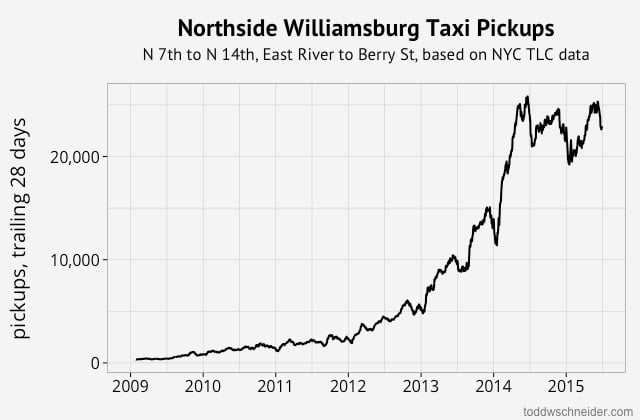
…the privacy implications of releasing taxi data publicly:
For example, I don’t know who owns one of theses beautiful oceanfront homes on East Hampton’s exclusive Further Lane (exact address redacted to protect the innocent). But I do know the exact Brooklyn Heights location and time from which someone (not necessarily the owner) hailed a cab, rode 106.6 miles, and paid a $400 fare with a credit card, including a $110.50 tip.
as well as average travel times to the city’s airports, where investment bankers live, and how many people pay with cash vs. credit cards. Read the whole thing and if you want to play around with the data yourself, Schneider posted all of his scripts and knowhow on Github.
Update: Using summaries published by the New York City Taxi & Limousine Commission, Schneider takes a look at how taxi usage in NYC is shrinking and how usage of Uber is growing.
This graph will continue to update as the TLC releases additional data, but at the time I wrote this in April 2016, the most recent data shows yellow taxis provided 60,000 fewer trips per day in January 2016 compared to one year earlier, while Uber provided 70,000 more trips per day over the same time horizon.
Although the Uber data only begins in 2015, if we zoom out to 2010, it’s even more apparent that yellow taxis are losing market share.
Lyft began reporting data in April 2015, and expanded aggressively throughout that summer, reaching a peak of 19,000 trips per day in December 2015. Over the following 6 weeks, though, Lyft usage tumbled back down to 11,000 trips per day as of January 2016 — a decline of over 40%.
Zoolander 2 trailer
Stiller. Wilson. Cruz. Ferrell. Cumberbatch. Wiig. Bieber? If this is even half the goofy fun of the first one, I will be happy.
Socials & More