



Matchbook Diaries of New York City
Matchbook Diaries is an Instagram account collecting photos of NYC restaurant matchbooks. Some notables:



This site is made possible by member support. 💞
Big thanks to Arcustech for hosting the site and offering amazing tech support.
When you buy through links on kottke.org, I may earn an affiliate commission. Thanks for supporting the site!
kottke.org. home of fine hypertext products since 1998.
Beloved by 86.47% of the web.
Matchbook Diaries is an Instagram account collecting photos of NYC restaurant matchbooks. Some notables:
The food is fresh. Natural. Locally sourced. Sometimes even organic. That might sound like your local farmer’s market, but it’s actually part of a new and growing movement in the fast-food industry. Think Shake Shack, Chipotle, Panera. While we’re not exactly seeing tractors in the drive-thrus, the rise of these chains (and the pressure on their predecessors that placed a lot more emphasis on the fast than the food) tell us a lot about economic inequality, the modern workday, and fries. From The New Yorker’s James Surowiecki: The Shake Shack Economy.
Someone called TolkienEditor has cut the three Peter Jackson The Hobbit movies down into a single 4-hour film and put the result up on BitTorrent. Their goal was to make the film hew more closely to the book, put the focus back on Bilbo as the main character, and to quicken the pace of the narrative.
The investigation of Dol Guldor has been completely excised, including the appearances of Radagast, Saruman and Galadriel. This was the most obvious cut, and the easiest to carry out (a testament to its irrelevance to the main narrative). Like the novel, Gandalf abruptly disappears on the borders of Mirkwood, and then reappears at the siege of the Lonely Mountain with tidings of an orc army.
The Tauriel-Legolas-Kili love triangle has also been removed. Indeed, Tauriel is no longer a character in the film, and Legolas only gets a brief cameo during the Mirkwood arrest. This was the next clear candidate for elimination, given how little plot value and personality these two woodland sprites added to the story. Dwarves are way more fun to hang out with anyway.
I enjoyed PJ’s The Hobbit, particularly the second one, but my main criticism was the lack of focus on Bilbo. I couldn’t rustle up any interest in the dwarves or their quest…they were a bunch of ex-rich dudes trying to get their money back. Bah! Martin Freeman was an amazing Bilbo and we just didn’t get enough of him. (via @tcarmody)
Update: There is also a three-hour cut of the film that keeps even closer to the spirit of the book. (via @cdwarren)


What if the Busy Busy Town Richard Scarry wrote about was Silicon Valley circa 2015? Meet the fine citizens of Business Town. Great stuff, but did someone forget to credit Ruben Bolling’s comic strip Richard Scarry’s 21st Century Busy Town Jobs for the inspiration?
As you know, I love videos of how stuff is made. (See below.) Well, I just discovered this treasure trove of more than 300 14-minute videos from a Japanese show called The Making: playlist #1, playlist #2. Each video shows how a different thing is made, from wires to sugar to trophies to cheese and all of them are dialogue-free. Here’s the one on how 55-gallon drums are made:
I can’t wait to show some of these to the kids. Their favorite online video, which they request weekly, is this one on how croissants are made.
When I was a kid, maybe 12 or 13 years old, I watched this program on PBS that showed how a snack food manufacturer came up with a new snack food, from design to manufacturing. The thing that stuck with me the most was that they showed a number of the missteps in-between…like they tried a certain shape with a certain filling and it didn’t work out in taste tests, that sort of thing. I LOVED seeing that trial and error in action. I only saw the show once, but it’s one of my most vivid childhood TV memories. Maybe it’s why I ended up becoming a designer?
Wait, wait! Holy shit, holy shit! I found the show! It was a NOVA program called How to Create a Junk Food that aired in 1988, when I was 14. I couldn’t find the video or even a clip, but here’s a review in the LA Times.
The ultimate weapon is the flavorist, a 20th-Century alchemist who analyzes natural things like Danish blue cheese or barbecued beef, reconstructs them chemically in the lab and produces their essences to punch up the taste of bland fillings.
Marketing and technology co-produce a croissant-dough cone with a moist meat or cheese filling that appears perfect. But when they test it on the mouths of real consumers (English housewives), it’s a bloomin’ flop.
Undaunted, the technologists go back to their gizmos and test tubes. After doing such goofy things as gluing electrodes to a chewer’s cheeks to get “chew profiles” of different fillings, they come up with a second prototype, Crack a Snack. The wheat-cracker wrapped “savory tube” is called a “triumph of food engineering,” which, we’re warned, if it is given the proper image, “there’s little doubt we’ll buy it.”
New Scientist wrote about Crack a Snack around the same time.
So yeah, now you know I’m the sort of kid who gleefully watched food engineering documentaries on PBS at 14. But you probably already suspected as much. (via @go)

The American Museum of Natural History’s research library has an online exhibit of bird illustrations taken from the book Extraordinary Birds. (via @kellianderson)
Alastair Humphreys writes about making his living as an adventurer. But really, this advice works for anyone who wants to turn their hobby into a job. For instance, this list of reasons he’s an adventurer is pretty much why I did the same thing with kottke.org almost 10 years ago.
- I love almost every aspect of what I do.
- I love being self-employed: the freedom and the responsibility and the pressure.
- I think I’m probably now un-employable.
- I love being creative.
- I appreciate that building a profile helps generate exciting opportunities. (And I have come to accept — though not enjoy — the weird world of relentless self-promotion that being a career adventurer requires. I remain uncomfortable with people praising me more than I deserve, and I continue to get very angry and upset with the inevitable haters that your self-promotion will attract.)
Notice I don’t mention “going on adventures”, because there are loads of ways to do that in life. Don’t become a career adventurer solely because you want to go off on fun trips. There’s easier ways to do that.
That third point is a real double-edged sword. I can’t imagine what other job I would be even remotely qualified for other than this one. Feels like walking a tightrope without a safety net sometimes. (via @polarben)
For those w/o HBO GO, the remastered HD version of The Wire is now available on Amazon Instant Video
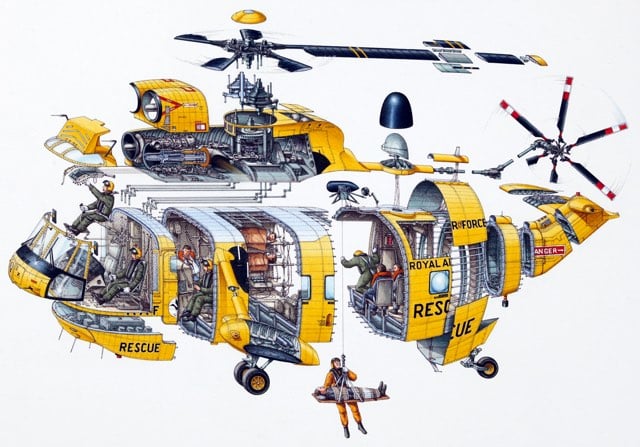
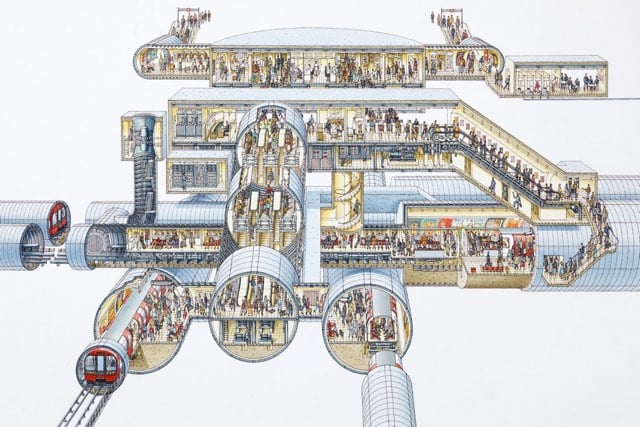
Stephen Biesty is a illustrator for books who draws “illustrations that are unrivaled for their ambitious scope and attention to detail”. I love this but somehow I hadn’t seen any of his apparently quite popular books. Many of them appear to be out of print, but there are some available on Amazon: Stephen Biesty’s Incredible Cross-Sections, Stephen Biesty’s Incredible Everything, and Into the Unknown.
Looking through these illustrations and also thinking about Richard Scarry’s books, I’m reminded of the intricate cross-sections from Wes Anderson’s movies. For instance, the boat from The Life Aquatic:
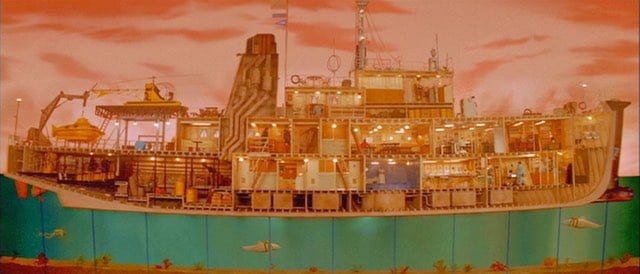
Biesty’s first book with this illustration style came out in 1992, the same year a 23-year-old Anderson shot his first short film, Bottle Rocket. But the director’s first real use of the cross-section didn’t happen until The Royal Tenenbaums in 2001, and even then it wasn’t explicit…but the tour of the Tenenbaum house definitely felt detailed in the same way as Biesty’s intricate cross-sectional drawings. I’m not the first person to draw parallels between Anderson’s work and Scarry, but I wonder if Biesty is somewhere in there too. (via @aaroncoleman0)
Paul Ford writes about how Greg Knauss scaled Paper’s web site after they broke the internet with nude photos of Kim Kardashian.
Via email, Jacobs told Knauss that PAPER believed “they’ve got something that they think will generate at least 100 million page views, and will their current infrastructure support that?”
“This sort of cold thrill goes down my spine,” Knauss said, “and the only thought that makes it out of my brain is, ‘Eep.’”
He continued: “I reflexively begin designing the architecture in my head. It’s a nerd impulse. Dogs chase after thrown balls, system administrators design to arbitrary traffic.”
I love this article for a whole bunch of reasons (including that it’s written by a friend about two other friends, one of whom is responsible for keeping kottke.org’s servers going), but I was just talking about the burstable web scaling issue with a friend the other day. She was trying to make a reservation for a ferry. The reservations open for the entire season on a particular day at a particular hour and in a matter of hours, most (if not all) of the reservations are taken. And of course, their tiny web site and backend systems melts into a huge puddle that day, people can’t get in, and everyone wastes 4 hours of their day trying to make a simple reservation. Basically, the ferry company needs to be Ticketmaster, but only for 3 or 4 hours every year. That’s a weird problem and it’s been an issue on the web since forever, and no one has solved it in an entirely off-the-shelf way. Someone get on this, riches await.
Last week, Tommy Caldwell and Kevin Jorgeson completed the first free ascent of The Dawn Wall on Yosemite’s El Capitan. It’s been called the most difficult climb ever completed. The NY Times has some good coverage of the climb, including an interactive feature/map of the wall and a 3.4 gigapixel zoomable photograph of the climb in progress. Here’s a 3-minute video of Caldwell navigating Pitch 15, one of the most difficult sections of the climb:
“The crux holds of pitch 15 are some of the smallest and sharpest holds I have ever attempted to hold onto,” Tommy wrote on his Facebook page. Four unique camera angles reveal those minuscule holds and the 1,300 feet of exposure under Tommy’s precarious foot placements. While multiple pitches of extremely difficult climbing remained above, the completion of pitch 15 was considered the last major hurdle to the eventual success of this seven-year project.
It gets intense around 1:30. Jesus, my palms are sweating right now. I feel like I’m gonna pass out! (via @sippey)
Update: I totally didn’t notice but several people pointed this out on Twitter: Caldwell only has 4 fingers on his left hand. He cut off his index finger with a table saw, got it reattached, and then removed again so it wouldn’t hinder his climbing.1
And as if completing the most difficult climb in the world with only 9 fingers and discarding a finger to pursue a passion isn’t quite enough for one life, Caldwell and some friends were captured by rebels while climbing in Kyrgyzstan. Caldwell helped save the group by pushing one of their captors over a cliff.
All the scheming comes to nothing, until at one point three of the rebels go away leaving a lone man in charge of the captives as they climb a steep ridge. Then, near the top …
Tommy Caldwell: Our captor sees that the hillside is easing off and he starts to run ahead. He has been really scared this whole time on this cliff because he’s not a climber. So I asked Beth if she thinks I should do this.
Beth Rodden: And at that point I just thought that this was our best opportunity.
Tommy Caldwell: So I ran up behind him and grabbed him by his gun strap and pulled him over the edge. We were probably about 2,000 feet (610 meters) above the river, but it’s a cliff that is pretty sheer. We saw him fall 20 feet (6 meters), bounce off this ledge, and then fall basically into the black abyss below. I totally panicked. I broke down. I couldn’t believe I’d just done that, because it’s something that I never morally thought I could do and I never wanted to do. And Beth came up and, you know, gave me a lot of comfort as well as Jason and John.
Beth Rodden: I told him he’d just saved our lives and now we had this opportunity to run and hopefully find the Kyrgyz Army.
Reading that story makes my palms sweat almost as much as watching the video. Jesus.
Little known fact: there’s a photo of Caldwell’s severed finger next to the definition of “dedication” in the dictionary.↩
From the Daily Overview, a photo of the whirlpool exchange that connects three major roads together in Dubai (map).
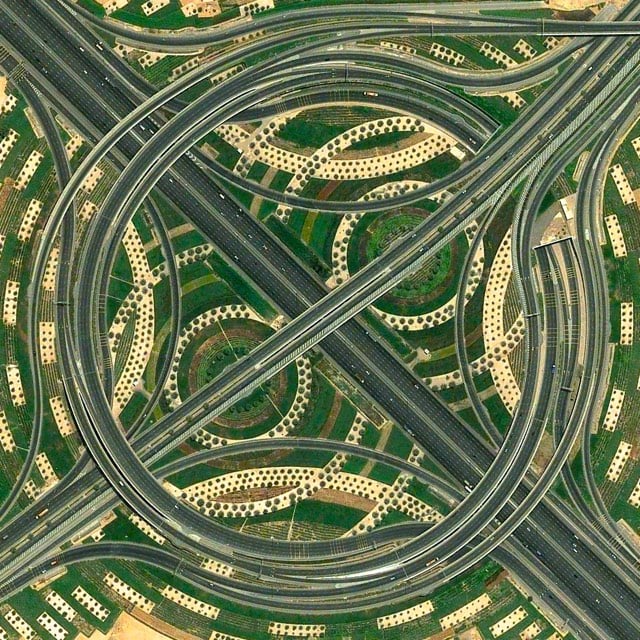
Worth viewing larger…that’s a 12-lane highway running through the center of this monster. (thx, bill)
In 1958, Fortune magazine published the first major essay by Jane Jacobs that laid out her case against modernist urban developers. Downtown is for People was the catalyst for the publication of Jacobs’ seminal The Death and Life of Great American Cities three years later.
You’ve got to get out and walk. Walk, and you will see that many of the assumptions on which the projects depend are visibly wrong. You will see, for example; that a worthy and well-kept institutional center does not necessarily upgrade its surroundings. (Look at the blight-engulfed urban universities, or the petered-out environs of such ambitious landmarks as the civic auditorium in St. Louis and the downtown mall in Cleveland.) You will see that suburban amenity is not what people seek downtown. (Look at Pittsburghers by the thousands climbing forty-two steps to enter the very urban Mellon Square, but balking at crossing the street into the ersatz suburb of Gateway Center.)
You will see that it is not the nature of downtown to decentralize. Notice how astonishingly small a place it is; how abruptly it gives way, outside the small, high-powered core, to underused area. Its tendency is not to fly apart but to become denser, more compact. Nor is this tendency some leftover from the past; the number of people working within the cores has been on the increase, and given the long-term growth in white-collar work it will continue so. The tendency to become denser is a fundamental quality of downtown and it persists for good and sensible reasons.
If you get out and walk, you see all sorts of other clues. Why is the hub of downtown such a mixture of things? Why do office workers on New York’s handsome Park Avenue turn off to Lexington or Madison Avenue at the first corner they reach? Why is a good steak house usually in an old building? Why are short blocks apt to be busier than long ones?
It is the premise of this article that the best way to plan for downtown is to see how people use it today; to look for its strengths and to exploit and reinforce them. There is no logic that can be superimposed on the city; people make it, and it is to them, not buildings, that we must fit our plans. This does not mean accepting the present; downtown does need an overhaul, it is dirty, it is congested. But there are things that are right about it too, and by simple old-fashioned observation we can see what they are. We can see what people like.
People ask me why I ski.1 A: Because sometimes it’s as insanely fun as this guy makes it look.
He. Skis. THROUGH THE MOUNTAIN. Also, if you can, pause it right after he jumps off the lift platform…the kid on the lift with his dad is like ( ゚o゚).
No one has ever asked me this. No one ever asks people questions like this. “People ask me…” is a phrase writers use to create a sense of an ongoing story. It’s better than “This is a cool video”…you can only use that one so many times. ↩
I’ve started posting more links to the @kottke Twitter account and including them on the front page of the site (pinned to the second post on the page). Read on for an explanation of why and where this is (maybe) going.
More than 12 years ago, before kottke.org became my full-time job, I made 2-3 posts per day. Maaaybe up to 5 on a good day. For whatever reason, in December of 2002 I started posting a bunch of links to the site every day. Like 10-12 per day…sometimes up to 20.1 The next month, I stuck that link blog in the sidebar of the site and called them “remaindered links”. I kept at it, posting a few things to the main blog each week and dozens of remaindered links every week. Eventually, I pulled the remaindered links out of the sidebar and into the main column. The link descriptions became longer, I started pulling short quotes from the articles I was linking to, and eventually, these links became full-fledged posts. These remaindered links, these leftovers, they are kottke.org now.
The links gave the site a velocity it didn’t previously have. I hadn’t really thought about it until I sat down to write this post, but that increase in velocity made it possible, more than two years later, for me to quit my job and do kottke.org full-time. But the web has changed. Sites like Reddit, Digg, and Hacker News and services like Facebook and Twitter are so much faster than this one man band…trying to keep pace is like racing an F1 car on roller skates. So, I’ve traded that velocity for quality (or, if you’d prefer, fussiness). I no longer post 10-12 things per day. Instead I post 4-6 of the most interesting things I can share with you on that given day.2 That means there’s a ton of very interesting but not-quite-right-for-whatever-reason stuff that I see but don’t have time to share. And that’s been frustrating me lately.
So, I’ve begun posting those extra links, those remainders, to the @kottke Twitter account. Then I pull those links in from Twitter and publish them to the front page of kottke.org. There’s no permanent archive, I might stop at any time, they’re not gonna show up in RSS, on Facebook, or on Tumblr, and there are no plans beyond what I’ve already done. I wanted to start with the simplest possible thing and see if it sticks or goes anywhere.
I do have a few ideas on where it could go, however. As my remaindered links experience shows, going fast without a plan can be beneficial in unexpected ways. With different tools and media delivery channels available to me now, I wonder: how fast can a one-person site go while still maintaining that choosiness? Using those new tools, 13 people built Instagram into a $1 billion company with millions of users. I’m not after billions, but I’d settle for making kottke.org sustainable in the future and not having to get a regular job again.
Anyway, your thoughts, questions, and feedback are always welcome.
“The Internet is ours.” After 15 years, an update to the seminal Cluetrain Manifesto.
This article attempts to explain, in great detail, what happens when you type ‘google.com’ into your browser and press enter.
To pick a zero point, let’s choose the enter key on the keyboard hitting the bottom of its range. At this point, an electrical circuit specific to the enter key is closed (either directly or capacitively). This allows a small amount of current to flow into the logic circuitry of the keyboard, which scans the state of each key switch, debounces the electrical noise of the rapid intermittent closure of the switch, and converts it to a keycode integer, in this case 13. The keyboard controller then encodes the keycode for transport to the computer. This is now almost universally over a Universal Serial Bus (USB) or Bluetooth connection, but historically has been over PS/2 or ADB connections.
An I, Pencil for the internet age.
Netdiver picks the best design objects, publications, and entities for 2014. Lots of great stuff here.
Vogue has 73 questions for Victoria Beckham. “Favorite spice?” “Posh.” Why can’t I stop watching this?
Lucky Peach, the publishing arm of the Momofuku restaurant group, recently launched their new web site with a bunch of online content. Among their offerings is a series of videos featuring David Chang making various foods, including this omelette flavored with an instant ramen seasoning packet:
See also Chang making tonkotsu broth and gnocchi from instant ramen noodles.
On the off chance you get this before it spontaneously combusts, you should probably know that Earth just experienced its hottest year on record (again). You can blame humans, you blame nature, you can blame Mister Heat Miser. But for most scientists, there is a towering body of evidence to explain this inferno, and the debate over what’s causing the warm-up has already been decided (which is good, because the venue where the debate was being held just melted).
WaPo got reactions to the latest numbers from 21 scientists: “The temperature record is yet another brick in the massive wall of evidence that the climate is warming due to human activity.” Hey, (Science) Teacher, leave them kids alone…
If we’re going down in flames, let’s at least take 5 charts that explain 2014’s record-smashing heat. Or perhaps you’d prefer an animation?
Apparently, human activity has pushed Earth beyond four of nine planetary boundaries. (In layman’s terms: Uh oh.)
In other news, ocean life faces mass extinction.
Molly Beauchemin is a dental health enthusiast. She talked to several dentists about what the current best practices are for keeping your teeth and gums as healthy as possible: The Truth About Your Smile.
Most people have heard a common criticism of hand sanitizer: using it too often makes you more vulnerable to sickness because it kills off even the beneficial germs that fight viruses like the cold and flu. The same is true for the bacteria in your mouth: mouthwash is so antiseptic that most dentists recommend you only use it if you are impaired or have an injury that prevents you from brushing. Otherwise, you risk killing off even the beneficial flora (yes, our mouths are disgusting wastelands of bacteria, but a lot of them are good guys) that help fight plaque and odor-causing bacteria.
I’ve been searching around for something like this for a few months. Dental hygiene, for me, is a set of mesofacts — I’m mired in the knowledge of my youth about how to brush, when to floss, etc. — but increasingly the kids would come home from the dentist with some new tidbit I’d never heard of before, like the thing about not rinsing the toothpaste out of your mouth after brushing. I have to say though, the oil pulling bit at the end sounds like a bunch of hokum.
This an excerpt of the excellent commencement speech David Foster Wallace gave at Kenyon College in 2005, set to video.
I’ve either heard or read this speech at least 8 or 9 times, and I still got sucked in to watching the entire video.
You can read the whole speech online and in book form or watch it on YouTube. (via kung fu grippe)
Along with imagining Mary Poppins as one of Doctor Who’s Time Lords, one of my favorite literary alternate realities is imagining Hermione Granger as the main character of the Harry Potter books. In 2011, Sady Doyle wrote a review of the books as if Rowling had focused on Hermione.
In Hermione, Joanne Rowling undermines all of the cliches that we have come to expect in our mythic heroes. It’s easy to imagine Hermione’s origin story as some warmed-over Star Wars claptrap, with tragically missing parents and unsatisfying parental substitutes and a realization that she belongs to a hidden order, with wondrous (and unsettlingly genetic) gifts. But, no: Hermione’s normal parents are her normal parents. She just so happens to be gifted. Being special, Rowling tells us, isn’t about where you come from; it’s about what you can do, if you put your mind to it. And what Hermione can do, when she puts her mind to it, is magic.
Ditto for the whole “Chosen One” thing. Look: I’ve enjoyed stories that relied on a “Chosen One” mythology to convince us that the hero is worth our time. I liked Buffy the Vampire Slayer as much as anyone. But it’s hard to deny that “Chosen Ones” are lazy writing. Why is this person the hero? Because everyone says he’s the hero. Why does everyone say he’s the hero? Because everyone says so, shut up, there’s magic.
And more recently, Daniel Dalton had a more overtly feminist and humorous take.
It was clear that she was the one who was protecting Harry and Ron, and this was never more evident than when she revealed she could control time.
She’d been using her Time-Turner to attend twice the number of classes, but she agreed to use it to help Harry save his godfather, even though it meant she’d never be able to use it again.
She’d given up her greatest power for her best friend, because helping people made her feel good.
And though she hoped he understood the sacrifice she was making by letting her education slide, she knew he didn’t. Because men.
Over the past year or so, I’ve been rereading the books and rewatching the movies with my kids through the Hermione-as-hero lens. And I’ve noticed that even without altering the story as Doyle and Dalton do, Hermione is by far the smartest, most loyal, and bravest young witch or wizard at Hogwarts. Harry has his moments but the kid had a rough and abusive childhood and so his principal talent is getting angry and doing stupid impulsive shit. Mainly, he’s manipulated by Voldemort and Dumbledore into doing exactly what they want him to do, and he plays the part splendidly. On the other hand, Hermione is an amazing witch and has a real choice as to how she wants to apply her considerable talents. And she chooses goodness, friendship, and doing the right thing over comfort, power, and even her own family, every time. (via @djacobs)
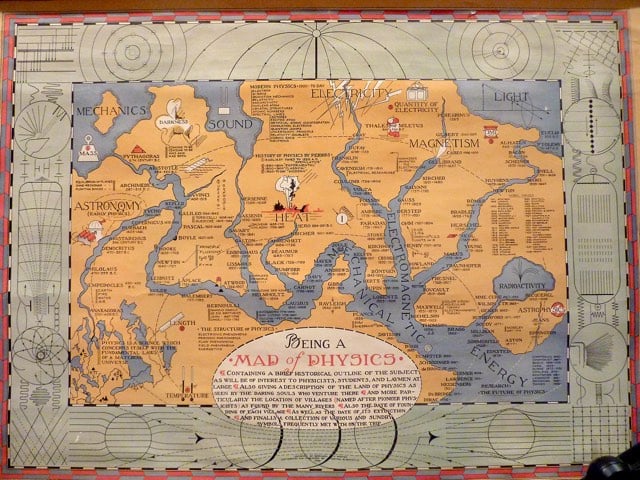
A map published by Bernard Porter in 1939 depicting physics as a landmass through which several rivers corresponding to the main branches (light, sound, heat, etc.) run and converge into one.
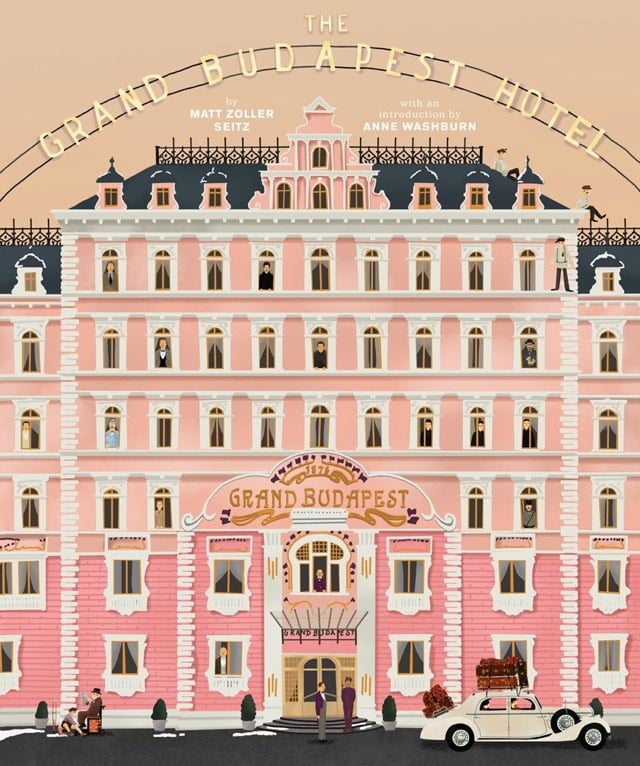
As an addendum to his 2013 book, The Wes Anderson Collection, Matt Zoller Seitz has written a book on Anderson’s latest film, The Grand Budapest Hotel.
This supplementary, one-volume companion to The Wes Anderson Collection (Abrams 2013) is the only book to take readers behind the scenes of The Grand Budapest Hotel, with in-depth interviews between Anderson and cultural critic and New York Times bestselling author Matt Zoller Seitz. Anderson shares the story behind the film’s conception, the wide variety of sources that inspired it — from author Stefan Zweig to filmmaker Ernst Lubitsch to photochrom landscapes from turn-of-the-century Middle Europe — personal anecdotes about the making of the film, and other reflections on his filmmaking process.
Here’s an interview with Seitz on the book and Inhabiting Wes Anderson’s Universe. This new book will look good next to The Wes Anderson Collection and The Making of Fantastic Mr Fox on my bookshelf.
Update: Martin Venezky is the designer of the book and has shared some spreads from the book. Looks gorgeous.

This simulator evolves increasingly effective walking creatures through genetic algorithms. After each round, the winners are sent through to the next round and copied by the rest of the competitors, with mutations introduced. At first, the pace of improvement is swift — two orders of magnitude within 100 generations — but slows pretty dramatically after that. (via @nickrichter)
The Art of the Title covers the opening title sequence to Kubrick’s Dr. Strangelove.
Notably, none of the aerial footage in the opening came from — or was even made for — Kubrick’s film. The footage is all stock. Because it came from more than one stock reel, the sequence features multiple aircraft, including an angle from a KC-135 Stratotanker’s refueling deck, which dates back to October 20, 1956 and came directly from the Boeing company. The sequence shows the KC-135 transferring its precious fluids to a B-52 Stratofortress, the colossal bomber featured later in the film. The phallic piece of machinery in the first shot, however, is not the refueling probe of a B-52 or of a KC-135, as one would assume, but possibly that of a Gloster Meteor jet fighter. Regardless, it is the first in a long line of sight gags and sex jokes sprinkled throughout the film.
Also included is a short interview with the title designer, Pablo Ferro.

Socials & More